
Research Methods in Education Session 6 Observation and
Research Methods in Education Session 6 Observation and the use of video
Let’s look at a lesson
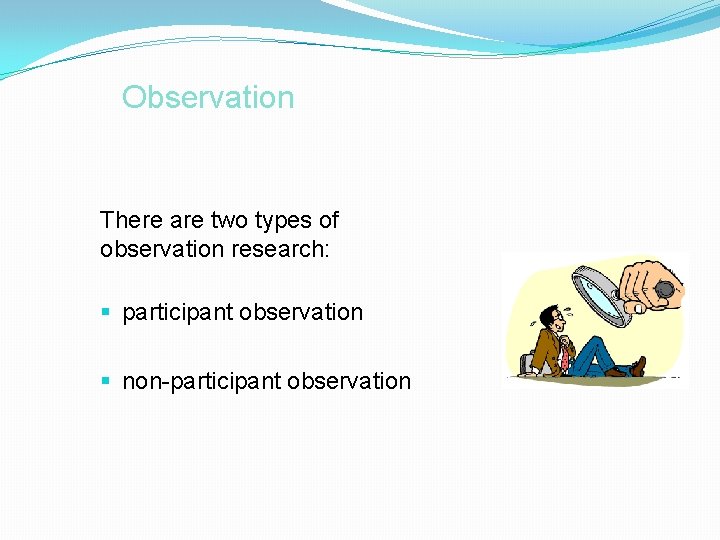
Observation There are two types of observation research: § participant observation § non-participant observation
They share the same characteristics … �rely on direct observation by the researcher �take place in natural settings �are complicated by issues of perception
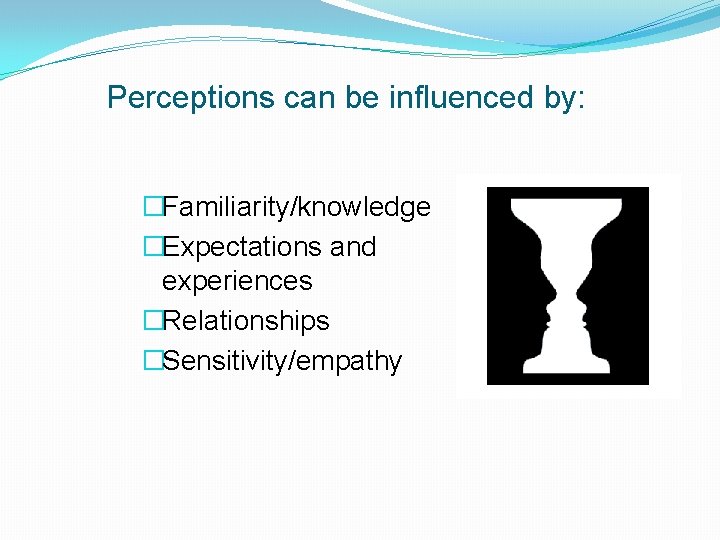
Perceptions can be influenced by: �Familiarity/knowledge �Expectations and experiences �Relationships �Sensitivity/empathy
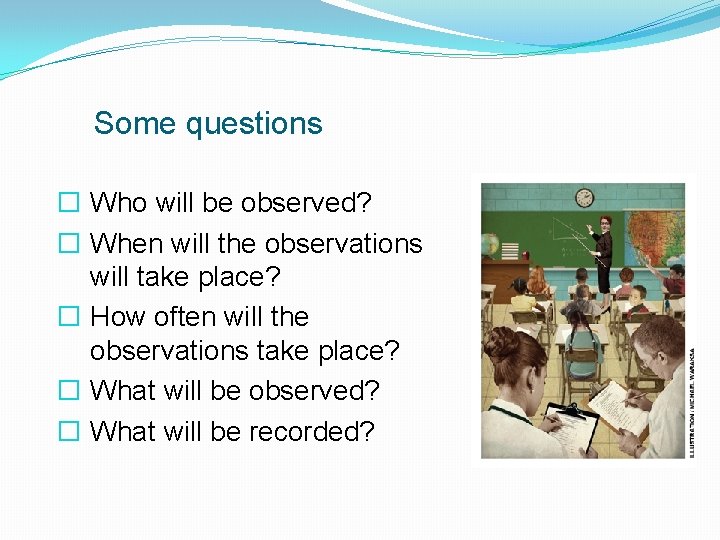
Some questions � Who will be observed? � When will the observations will take place? � How often will the observations take place? � What will be observed? � What will be recorded?
Some issues for the observer Non-Participant Observer: �Placing in room �Eye contact �Dress/personal style �Method of recording observations Participant Observer: �How do you record?
The need to be selective Impossible to observe let alone record everything. Therefore need to establish a basis for selection of elements of observation: �Content/process �Interaction between individuals �Nature of language �Specific types of questions/responses
What might you look at? - Pupils � Physical setting � Number of pupils � Grouping of pupils � Use of classroom territory � Nature of transactions between pupils (if any) � Nature of transactions between pupils and teacher � Classroom conventions in behaviour (e. g. hand raising) � Division of labour amongst pupils
What might you look at? – Teachers � Use of classroom territory � Posture/tone/other personal characteristics � Complexity of vocabulary � Nature of questions � Explicit/implicit structure for lesson � Flexibility of teacher � Resources provided/available
Informal (unsystematic) observation �Perhaps better called non- formal observation i. e. no systematic framework for sampling/recording observations. �Observer decides what to record from observations. �Recording could be by written note or photographs. �Videorecording can be considered a informal research method. �Continuous (complete? ) capture possible through use of video.
Systematic (formal) observation �Does not attempt to capture everything. �Pre-planned decisions about focus of observation. �Often employ a system of categories related to observable activities. �Usually observations made against a time interval baseline. �Produces data that can be presented in quantitative forms, and that can be summarised and related to other data using statistical techniques.
Systematic (formal) observation �Usually some form of coding sheet/observation inventory/schedule generated. �Once the procedures for recording, and the observation categories, have been decided, the role of the observer is one of following the protocol such that all observers of the same event should record it in an identical fashion (inter-observer reliability). �Video could be used with coding carried out at a later time. �Software available to record video and allow coding.
An example – FIAC Flanders Interaction Analysis Categories Teacher Talk: Response: 1. 2. 3. 4. Accepts feelings Praises/Encourages Accepts/uses pupil ideas Asks questions Initiation: 5. 6. 7. Lecturing Giving directions Criticising/justifying authority 8. 9. Pupil talk = response Pupil talk = initiation 10. Silence or confusion Pupil Talk: Response: Initiation: Silence: Coding about every three seconds (i. e. 20/25 codes per minute)
Some issues �Maintaining consistency of observations particular with short interval recording �Concentration �Partial picture of complex realities �Possibilities for use of technology to support observation (BOSS) to enhance validity and reliability.
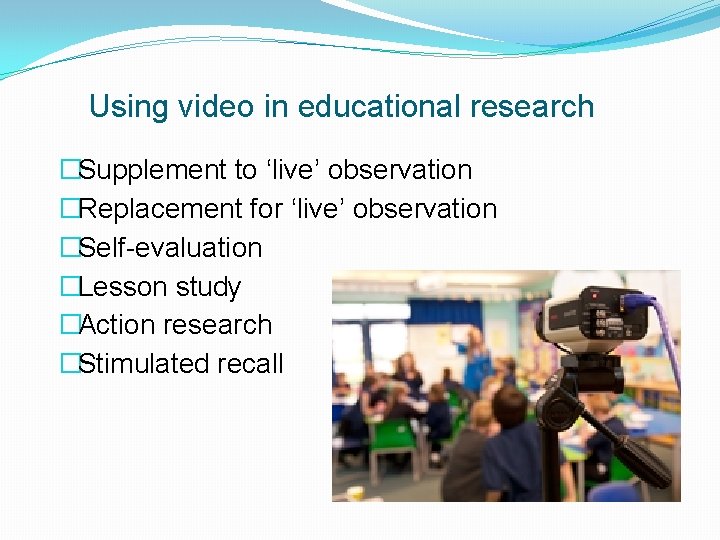
Using video in educational research �Supplement to ‘live’ observation �Replacement for ‘live’ observation �Self-evaluation �Lesson study �Action research �Stimulated recall
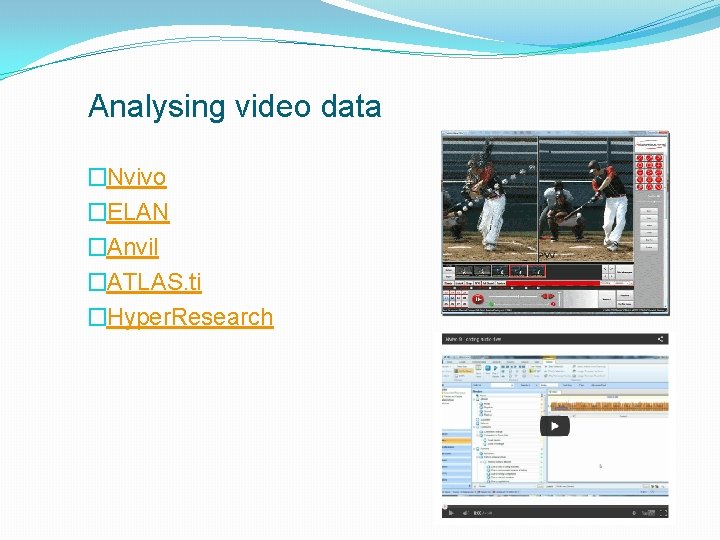
Analysing video data �Nvivo �ELAN �Anvil �ATLAS. ti �Hyper. Research
- Slides: 18