
Research Methods for the Behavioral Sciences 5 e
Research Methods for the Behavioral Sciences, 5 e GRAVETTER | FORZANO 10 The Nonexperimental and Quasi-Experimental Strategies © 2016 Cengage Learning. All Rights Reserved.
10. 1 Nonexperimental and Quasi. Experimental Research Strategies • The structure of nonexperimental and quasi-experimental designs – The distinction between the two types of designs is the degree to which the research strategy limits confounding variables and controls threats to internal validity • A nonexperimental design makes little or no attempt to minimize threats • A quasi-experimental design makes some attempt to minimize threats to internal validity—is almost, but not quite, a true experiment © 2016 Cengage Learning. All Rights Reserved.
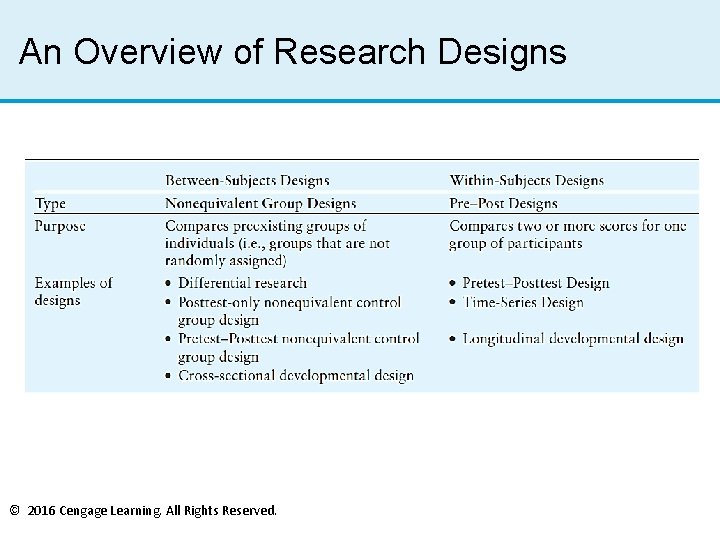
An Overview of Research Designs © 2016 Cengage Learning. All Rights Reserved.

10. 2 Between-Subjects Nonexperimental and Quasi-Experimental Designs • Nonequivalent group design – Different groups of participants are formed under circumstances that do not permit the researcher to control the assignment of individuals to groups • The researcher cannot use random assignment to create groups of participants © 2016 Cengage Learning. All Rights Reserved.

The General Structure of a Nonequivalent Group Study © 2016 Cengage Learning. All Rights Reserved.

Threats to Internal Validity for Nonequivalent Group Designs • Note: the groups are differentiated by one specific factor that identifies the groups • Assignment bias precludes a clear causeand-effect explanation – Groups have different participant characteristics • There is no random assignment to groups ► no assurance of equivalent groups © 2016 Cengage Learning. All Rights Reserved.
Nonexperimental Designs with Nonequivalent Groups • The differential research design: a research study that compares preexisting groups – Goal: to establish differences between the preexisting groups – Also called an ex post facto design—looks at differences “after the fact” © 2016 Cengage Learning. All Rights Reserved.
Nonexperimental Designs with Nonequivalent Groups • The posttest-only nonequivalent control group design uses preexisting groups – One group serves in the treatment condition – A second group of similar but nonequivalent participants is used for the control condition – There is no random assignment to groups © 2016 Cengage Learning. All Rights Reserved.
A Quasi-Experimental Design with Nonequivalent Groups • A pretest–posttest nonequivalent control group design compares two nonequivalent groups – One group is measured twice ►once before a treatment is administered and once after – A second group is measured at the same two times but does not receive any treatment – This design attempts to limit threats to internal validity—thus classified as quasi-experimental © 2016 Cengage Learning. All Rights Reserved.
10. 3 Within-Subjects Nonexperimental and Quasi-Experimental Designs • Pre-post designs – Threats to internal validity • History • Instrumentation • Testing effects • Maturation • Statistical regression © 2016 Cengage Learning. All Rights Reserved.

A Nonexperimental Pre-Post Design • The pretest-posttest design: a research study in which a series of observations is made over time for one group of participants – There is no attempt to control the many threats that exist © 2016 Cengage Learning. All Rights Reserved.
A Quasi-Experimental Pre-Post Design • A time-series design has a series of observations for each participant before a treatment or event and a series of observations after the treatment or event – Treatment: a manipulation administered by the researcher – Event: an outside occurrence that is not controlled or manipulated by the researcher – The researcher can minimize most threats to internal validity © 2016 Cengage Learning. All Rights Reserved.

Single-Case Applications of Time-Series Designs • Possible to see the trend in the data that existed before the treatment was administered and that continues after the treatment © 2016 Cengage Learning. All Rights Reserved.
10. 4 Developmental Research Designs • Nonexperimental developmental research designs – The cross-sectional developmental research design uses different groups of individuals • Each group represents a different age – The different groups are measured at one point in time and then compared – This design is an example of a betweensubjects nonexperimental design (a nonequivalent group design) © 2016 Cengage Learning. All Rights Reserved.
Strengths and Weaknesses of the Cross. Sectional Developmental Design • Strengths: – Data can be collected in a short period of time • Researcher can observe how behavior changes as people age without waiting for subjects to grow older • Weaknesses: – Factors other than age may differentiate groups • Cohort effects • Generation effects © 2016 Cengage Learning. All Rights Reserved.
The Longitudinal Developmental Research Design • Involves measuring a variable in the same group of individuals over a period of time – An example of a within-subjects nonexperimental design (a one-group pretestposttest design) • A set of observations is followed by a period of development or aging, then another set of observations – Differences between observations define the effects of development © 2016 Cengage Learning. All Rights Reserved.
Cross-Sectional Longitudinal Designs • Compares the results obtained from separate samples (like a cross-sectional design) that were obtained at different times (like a longitudinal design) • Examines the development of phenomena other than individual aging © 2016 Cengage Learning. All Rights Reserved.
Strengths and Weaknesses of Longitudinal Research Designs • Longitudinal – Strengths • No cohort or generation effects • Assesses individual behavioral changes – Weaknesses • Time-consuming • Participant dropout may create bias • Potential for practice effects © 2016 Cengage Learning. All Rights Reserved.
Strengths and Weaknesses of Cross. Sectional Research Designs • Cross-sectional – Strengths • Time-efficient • No long-term cooperation required – Weaknesses • Individual changes are not assessed • Cohort or generation effects may be responsible for observed differences © 2016 Cengage Learning. All Rights Reserved.
10. 5 Applications, Statistical Analysis, and Terminology • Nonexperimental and quasi-experimental research – Between-subjects designs: refer to chapter 8 – Within-subjects designs: refer to chapter 9 • Two-group designs – Compare numerical scores with a t test for two means or a single-factor analysis of variance for multiple means – Use chi-square test for non-numerical data © 2016 Cengage Learning. All Rights Reserved.
The Pretest–Posttest Nonequivalent Control Group Design • Statistical analysis of numerical scores – A two-factor, mixed design analysis of variance – Refer to a statistical software program, e. g. , SPSS © 2016 Cengage Learning. All Rights Reserved.
Review of Research Design Terminology • Within the context of nonexperimental and quasi-experimental research – Quasi-independent variable (IV): the variable that is used to differentiate the groups of participants or the groups of scores being compared – Dependent variable (DV): the variable that is measured to obtain the scores within each group © 2016 Cengage Learning. All Rights Reserved.
- Slides: 22