
RESEARCH METHODS FOR ECONOMICS UNIT1 INTRODUCTION q VISUALISING


- Slides: 41
RESEARCH METHODS FOR ECONOMICS UNIT-1
INTRODUCTION q. VISUALISING A LAB q. TESTING CHEMICALS q. COMPLEX SUBJECTS q. WRITING DESSERTATIONS q. COLLECTING DATAS q. STUDYING NIGHT AND DAY q. ANALYSING THINGS q. IDENTIFYING A PROBLEM q. OFFERING SOLUTIONS
RESEARCH MEANS ALL THE ABOVE BUT NOT IN UNISON BUT AS A COLLECTION OF ALL.
RESEARCH IT IS A SYSTEMATIC AND ORGANISED EFFORT TO INVESTIGATE A SPECIFIC PROBLEM ENCOUNTERED IN THE WORK SETTING, THAT NEEDS A SOLUTION. IT COMPRISES SERIES OF STEPS DESIGNED AND EXECUTED WITH THE GOAL OF FINDING ANSWERS TO THE ISSUES THAT ARE OF CONCERN TO THE MANAGER IN THE WORK ENVIRONMENT.
MEANING OF RESEARCH THE ENTIRE PROCESS BY WHICH WE ATTEMPT TO SOLVE ANY OR A GIVEN PROBLEM IS CALLED RESEARCH INVOLVES A SERIES OF WELL THOUGHT EFFORTS AND CAREFULLY EXECUTED ACTIVITIES THAT WILL ENABLE A MANGER TO KNOW HOW ORGANISATIONAL PROBLEMS CAN BE SOLVED OR MINIMISED.
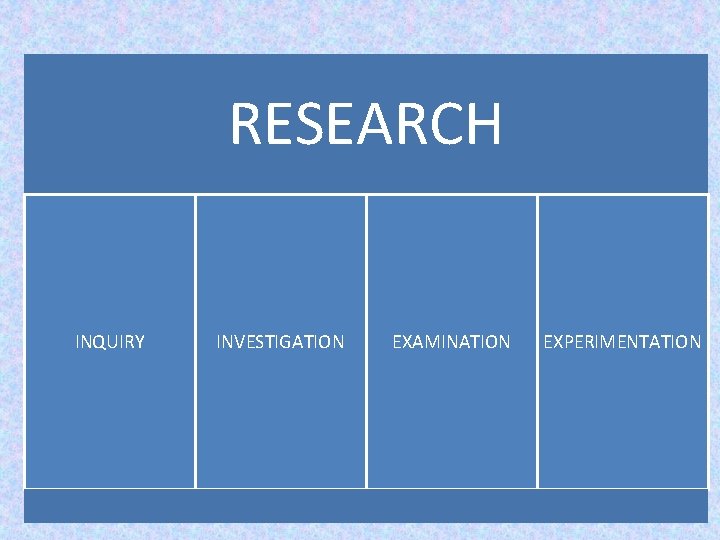
RESEARCH INQUIRY INVESTIGATION EXAMINATION EXPERIMENTATION
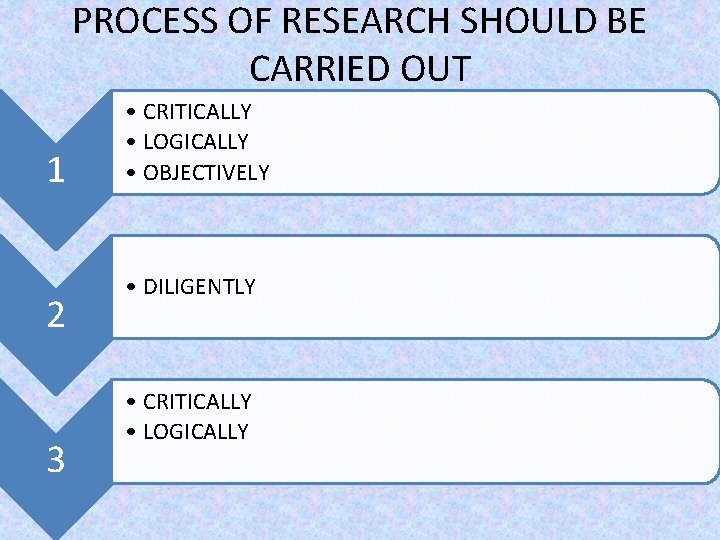
PROCESS OF RESEARCH SHOULD BE CARRIED OUT 1 2 3 • CRITICALLY • LOGICALLY • OBJECTIVELY • DILIGENTLY • CRITICALLY • LOGICALLY
DEFINITION OF RESEARCH IT IS AN ORGANISED, SYSTEMATIC, DATA BASED, CRITICAL, OBJECTIVE SCIENTIFIC INQUIRY INTO A SPECIFIC PROBLEM, UNDERTAKEN WITH THE PURPOSE OF FINDING SOLUTIONS TO IT. RESEARCH PROVIDES THE NEEDED INFORMATION THAT GUIDES MANAGERS TO MAKE INFORMED DECISIONS TO SUCCESSFULLY DEAL WITH THE PROBLEM.
RESEARCH AND MANAGER IN BUSINESS RESEARCH IS USUALLY CONDUCTED TO RESOLVE PROBLAMATIC ISSUES INTERRELATED AMONG THE AREAS OF Ø FINANCE, Ø ACCOUNTING, Ø MANAGEMENT, Ø MARKETING, ETC. , .
Research applications in marketing • • • Market & consumer analysis Product research Pricing research Promotional research Place research
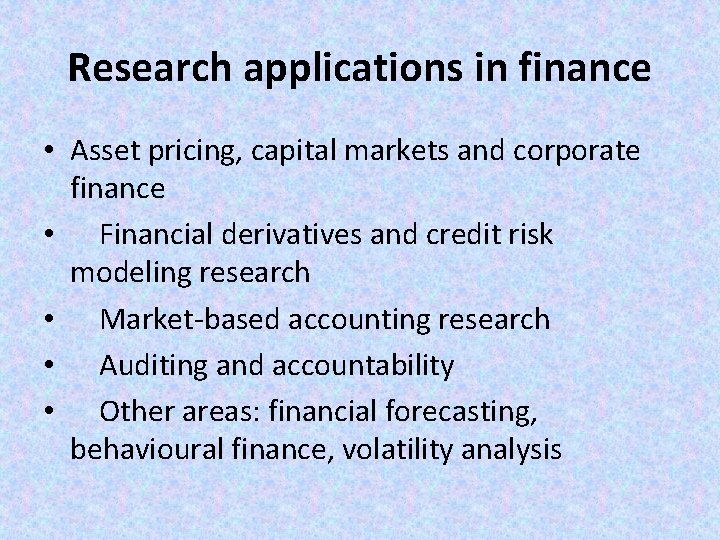
Research applications in finance • Asset pricing, capital markets and corporate finance • Financial derivatives and credit risk modeling research • Market-based accounting research • Auditing and accountability • Other areas: financial forecasting, behavioural finance, volatility analysis
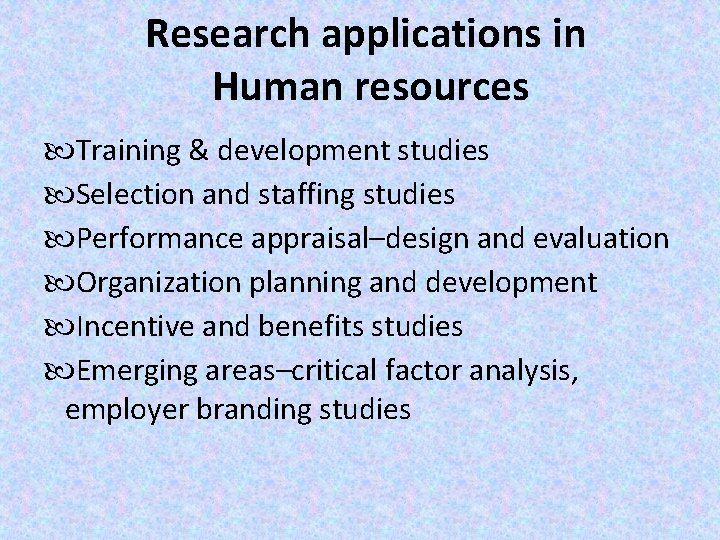
Research applications in Human resources Training & development studies Selection and staffing studies Performance appraisal–design and evaluation Organization planning and development Incentive and benefits studies Emerging areas–critical factor analysis, employer branding studies
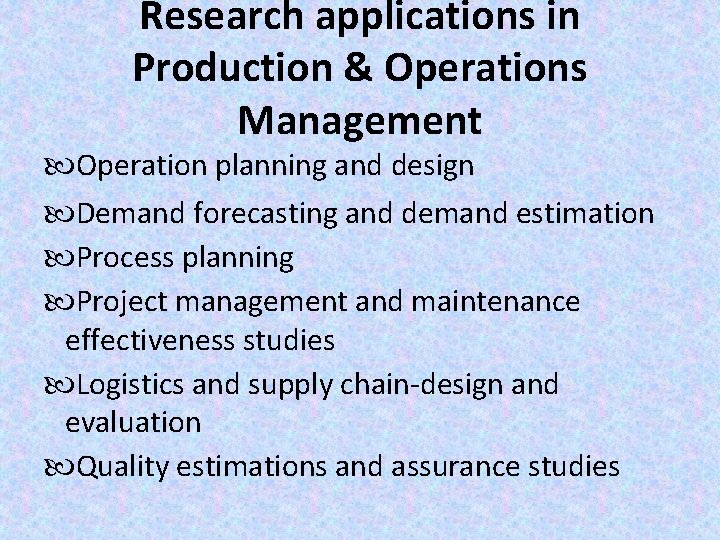
Research applications in Production & Operations Management Operation planning and design Demand forecasting and demand estimation Process planning Project management and maintenance effectiveness studies Logistics and supply chain-design and evaluation Quality estimations and assurance studies
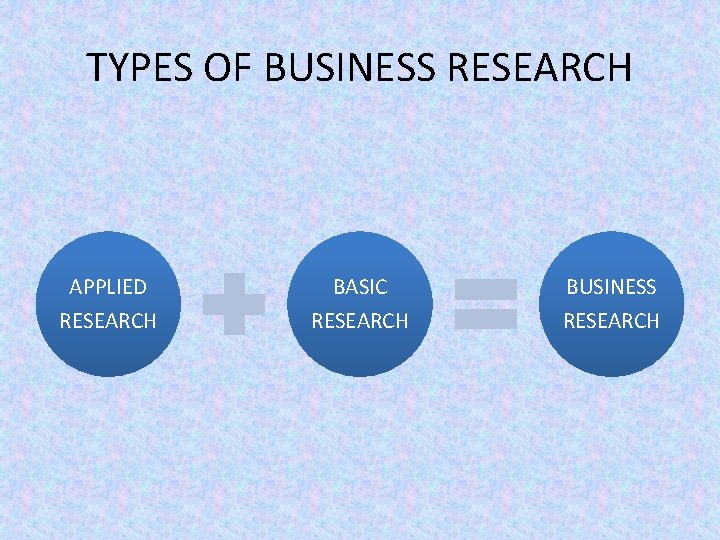
TYPES OF BUSINESS RESEARCH APPLIED BASIC BUSINESS RESEARCH
APPLIED RESEARCH DONE WITH THE INTENSION OF APPLYING THE RESULTS OF THE FINDINGS TO SOLVE SPECIFIC PROBLEMS CURRENTLY BEING EXPERIENCED IN THE ORGANISATION.
BASIC/PURE/FUNDAMENTAL RESEARCH DONE TO ENHANCE THE UNDERSTANGING OF CERTAIN PROBLEMS THAT COMMONLY OCCUR IN ORGANISATIONAL SETTINGS AND SEEK METHODS OF SOLVING THEM. MOST R&D DEPARTMENT OF VARIOUS UNIVERSITIES AND COLLEGES DO BASIC RESEARCH SO THAT MORE KNOWLEDGE IS GENERATED IN PARTICULAR AREAS OF INTEREST TO INDUSTRIES, ORGN AND
THOUGH THE OBJECTIVE OF ENGAGING IN BASIC RESEARCH IS PRIMARILY TO EQUIP WITH ADDITIONAL KNOWLEDGE OF CERTAIN PHENOMENA AND PROBLEMS THAT OCCUR IN SEVERAL ORGN S & INDUSTRIES WITH A VIEW T O FIND SOLUTIONS, THE KNOWLEDGE GENERATED FROM SUCH RESEARCH IS OFTEN APPLIED LATER FOR SOLVING MANY ORGANISATIONAL PROBLEMS.
Universities engage in basic research in an effort to understand generate more knowledge about various aspects of businesses, such as How to improve the effectiveness of information systems Integration of technology into the overall strategic objectives of an organisation Increasing the productivity of employees in service industries Monitoring sexual harassment at the workplace Increasing the effectiveness of small businesses These findings later become useful for application in business situations.
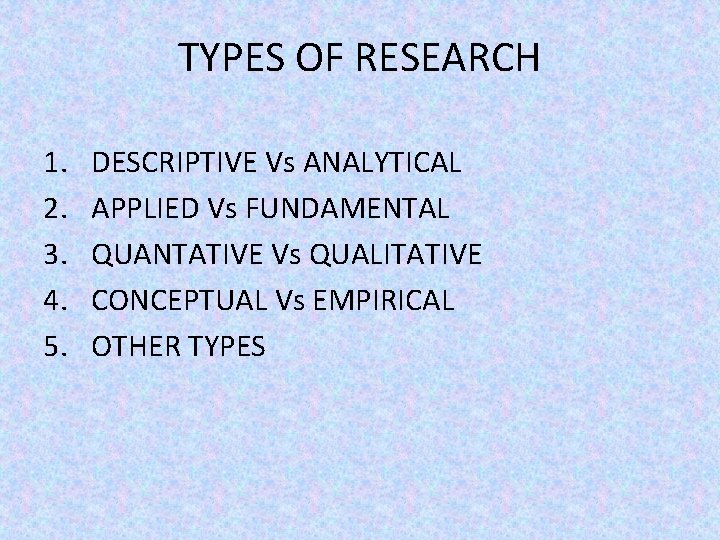
TYPES OF RESEARCH 1. 2. 3. 4. 5. DESCRIPTIVE Vs ANALYTICAL APPLIED Vs FUNDAMENTAL QUANTATIVE Vs QUALITATIVE CONCEPTUAL Vs EMPIRICAL OTHER TYPES
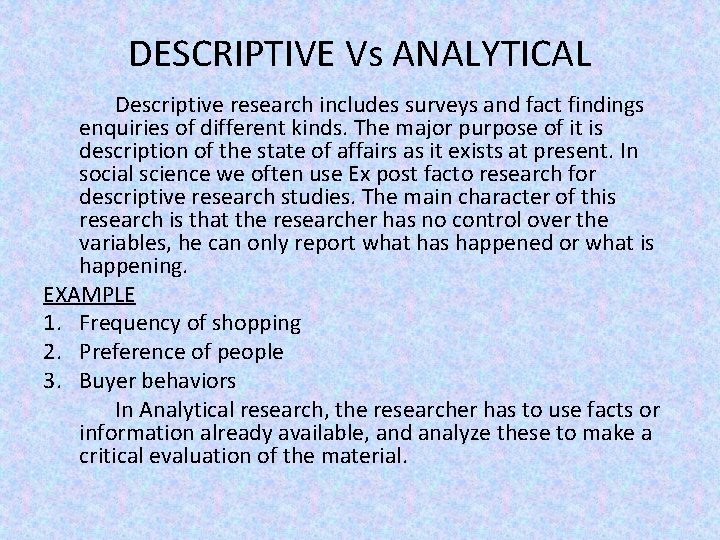
DESCRIPTIVE Vs ANALYTICAL Descriptive research includes surveys and fact findings enquiries of different kinds. The major purpose of it is description of the state of affairs as it exists at present. In social science we often use Ex post facto research for descriptive research studies. The main character of this research is that the researcher has no control over the variables, he can only report what has happened or what is happening. EXAMPLE 1. Frequency of shopping 2. Preference of people 3. Buyer behaviors In Analytical research, the researcher has to use facts or information already available, and analyze these to make a critical evaluation of the material.
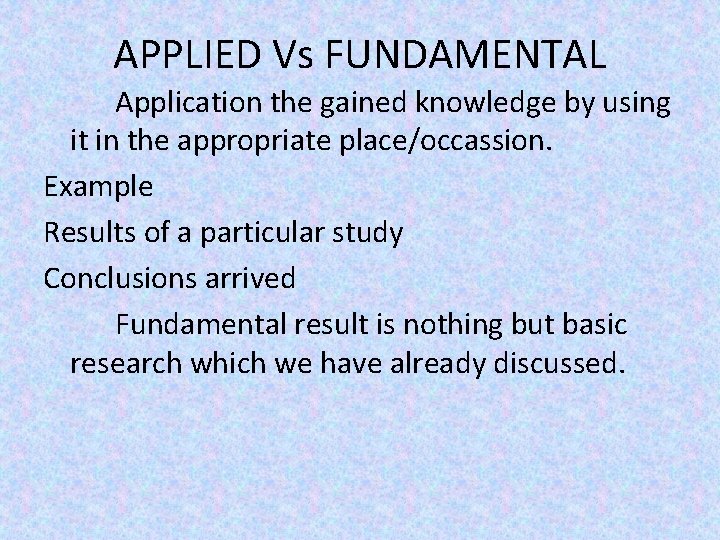
APPLIED Vs FUNDAMENTAL Application the gained knowledge by using it in the appropriate place/occassion. Example Results of a particular study Conclusions arrived Fundamental result is nothing but basic research which we have already discussed.
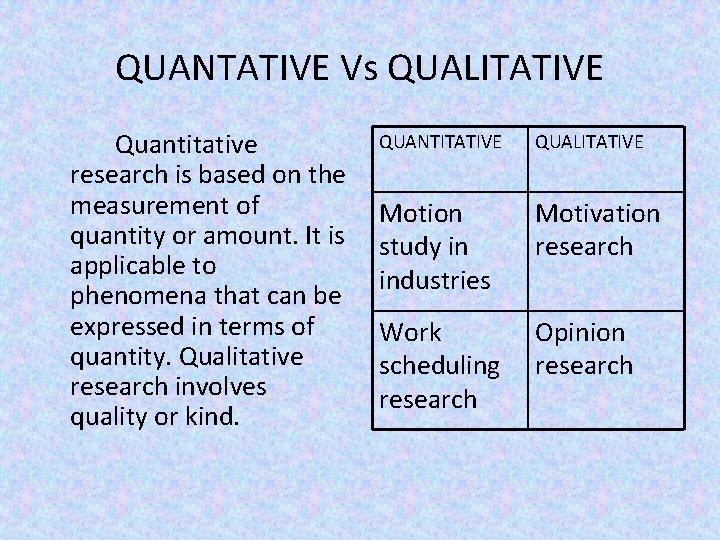
QUANTATIVE Vs QUALITATIVE Quantitative research is based on the measurement of quantity or amount. It is applicable to phenomena that can be expressed in terms of quantity. Qualitative research involves quality or kind. QUANTITATIVE QUALITATIVE Motion study in industries Motivation research Work scheduling research Opinion research
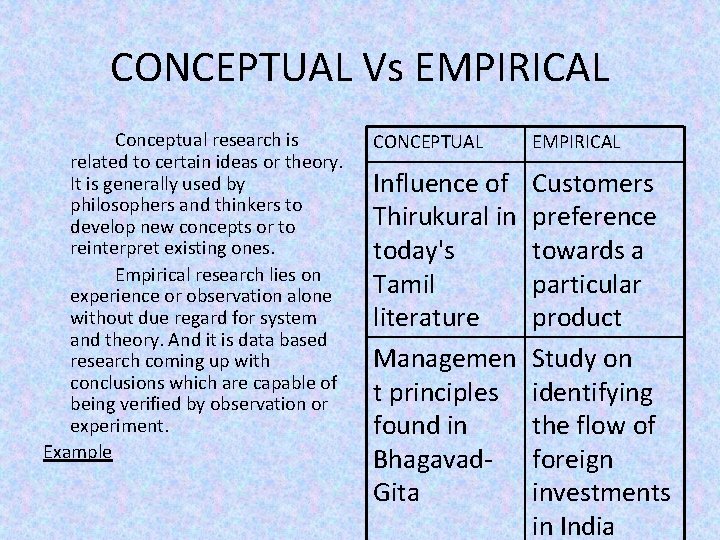
CONCEPTUAL Vs EMPIRICAL Conceptual research is related to certain ideas or theory. It is generally used by philosophers and thinkers to develop new concepts or to reinterpret existing ones. Empirical research lies on experience or observation alone without due regard for system and theory. And it is data based research coming up with conclusions which are capable of being verified by observation or experiment. Example CONCEPTUAL EMPIRICAL Influence of Thirukural in today's Tamil literature Managemen t principles found in Bhagavad. Gita Customers preference towards a particular product Study on identifying the flow of foreign investments in India
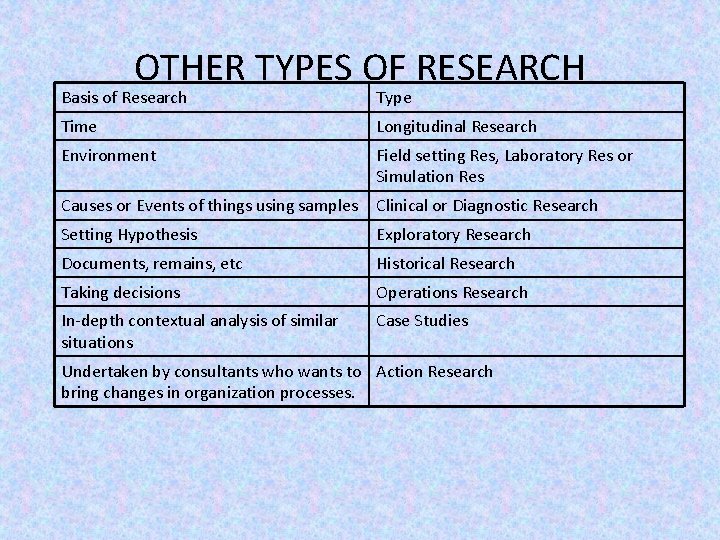
OTHER TYPES OF RESEARCH Basis of Research Type Time Longitudinal Research Environment Field setting Res, Laboratory Res or Simulation Res Causes or Events of things using samples Clinical or Diagnostic Research Setting Hypothesis Exploratory Research Documents, remains, etc Historical Research Taking decisions Operations Research In-depth contextual analysis of similar situations Case Studies Undertaken by consultants who wants to Action Research bring changes in organization processes.
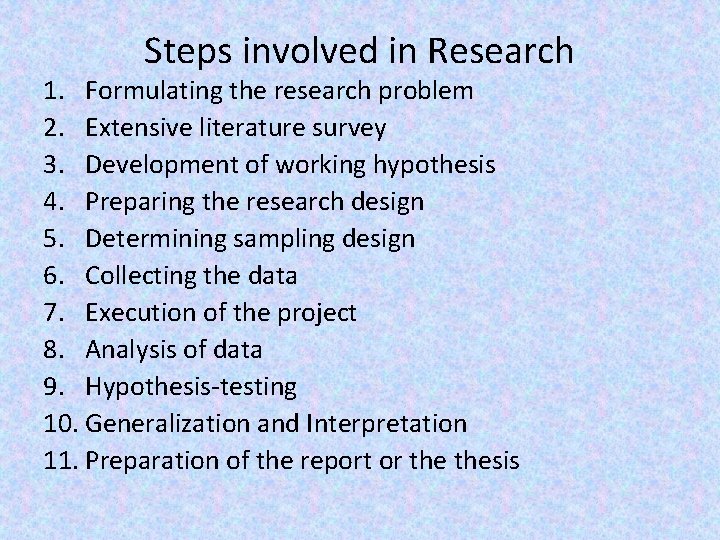
Steps involved in Research 1. Formulating the research problem 2. Extensive literature survey 3. Development of working hypothesis 4. Preparing the research design 5. Determining sampling design 6. Collecting the data 7. Execution of the project 8. Analysis of data 9. Hypothesis-testing 10. Generalization and Interpretation 11. Preparation of the report or thesis
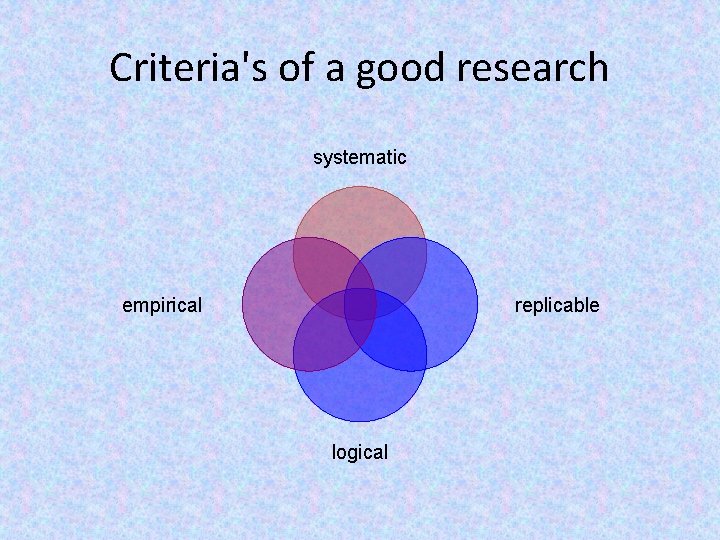
Criteria's of a good research systematic empirical replicable logical
SCIENTIFIC RESEARCH Managers frequently face issues that call for critical decision making. Which should be based on the results of scientific research. Scientific Research focuses on solving problems and pursues a step by step logical, organized and rigorous method to identify the problems, gather data, analyze them and draw valid conclusions there from. Because of the rigorous ways it is done this research enables all those who are interested in researching and knowing about the same or similar issues to come up with comparable findings when then data are analyzed. It is more objective than subjective, and helps specific attention so as to avoid, minimize or solve problems, . Scientific investigation and managerial decisions making are integral aspects of effective problem solving. It applies to both basic and applied research.
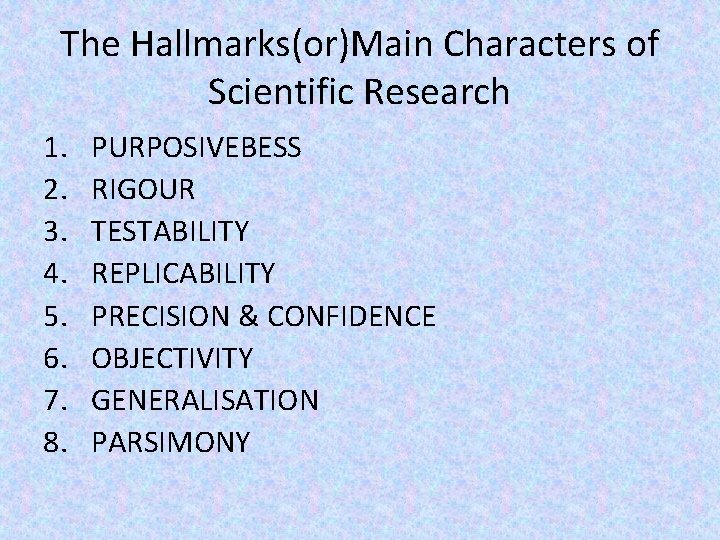
The Hallmarks(or)Main Characters of Scientific Research 1. 2. 3. 4. 5. 6. 7. 8. PURPOSIVEBESS RIGOUR TESTABILITY REPLICABILITY PRECISION & CONFIDENCE OBJECTIVITY GENERALISATION PARSIMONY
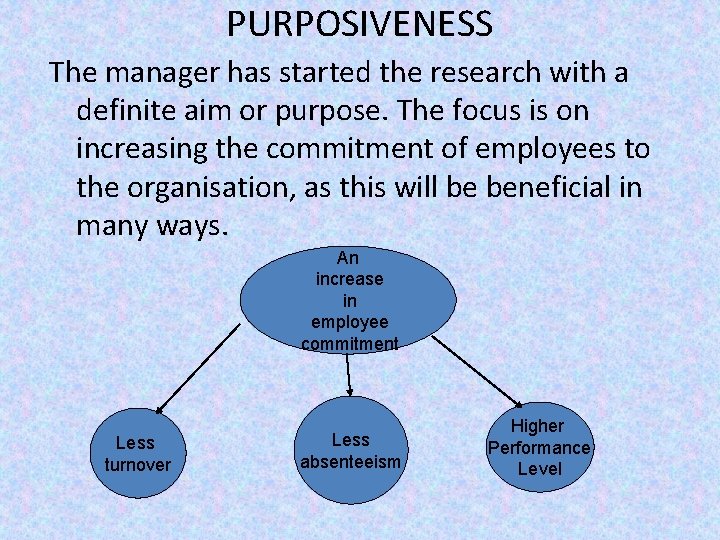
PURPOSIVENESS The manager has started the research with a definite aim or purpose. The focus is on increasing the commitment of employees to the organisation, as this will be beneficial in many ways. An increase in employee commitment Less turnover Less absenteeism Higher Performance Level
RIGOR A good theoretical base and a sound methodological design would add rigor to a purposive study. Rigor means carefulness, scrupulousness, and the degree of exactitude in research investigations. Rigorous research involves a good theoretical base and a carefully throughout methodology. These factors enable the researcher to collect the right kind of information from an appropriate sample with the minimum degree of bias, and facilitate suitable analysis of the data gathered.
Example The manager of an organisation asks 10 to 12% of its employees to indicate what would increase their level of commitment to it. If solely on the basis of their responses, the manager reaches several conclusion on how employee commitment can be increased, the whole investigation can be unscientific, • If it is taken from less no of employees • There may be other important influences on organizational commitment • The manner of framing and addressing the questions could have been biased
Testability If, after talking to a random selection of employees of the organization and study of the previous research done in the area of organizational commitment, the manager or researcher develops certain hypotheses on how employee commitment can be enhanced, then these can be tested by applying certain statistical tests to the data collected for the purpose. For example, the researcher might hypothesize that those employees who perceive greater opportunities for participation in decision making would have a higher level of commitment. This is a hypothesis that can be tested when the data are collected. A correlation analysis would indicate whether the hypothesis is substantiated or not.
REPLICABILITY The results of the tests of hypotheses should be supported again and yet again when the same type of research is repeated in other similar circumstances. The hypotheses would not have been supported merely by chance, but are reflective of the true state of affairs in the population.
PRECISION & CONFIDENCE Precision refers to the closeness of the findings to reality based on a sample. Precision reflects the degree of accuracy or exactitude of the results on the basis of the sample, to what really exists in the universe. Confidence refers to the probability that our estimations are correct. It is also important that we can confidently claim that 95% of the time our results would be true and there is only a 5% chance of our being wrong. This is also known as confidence level.
OBJECTIVITY The conclusions drawn through the interpretation of the results of data anlysis should be objective, that is, they should be based on the facts of the findings derived from actual data and not on our own subjective or emotional values.
GENERALIZABILITY It refers to the scope of applicability of the research findings in one organsiational setting to other settings. The wider the range of applicability of the solutions generated by research, the more useful the research is to the users.
PARSIMONY Simplicity in explaining the problems that occur, and in generalizing solutions for the problems, is always preferred to complex research frameworks that consider an unmanageable number of factors. Example If 3 variables are identified and changed in an organisation that can increase work participation to 45%, that would be more useful to the organsiation, than if changing 10 variables and getting 48%rise in work participation.
RESEARCH DESIGN A research design is the arrangement of conditions for collection and analysis of data in a manner that aims to combine relevence to research purpose with economy in procedure. It is a conceptual structure within which research is conducted. It is the blueprint for the collection and analysis of data. It happens to be in the following areas like
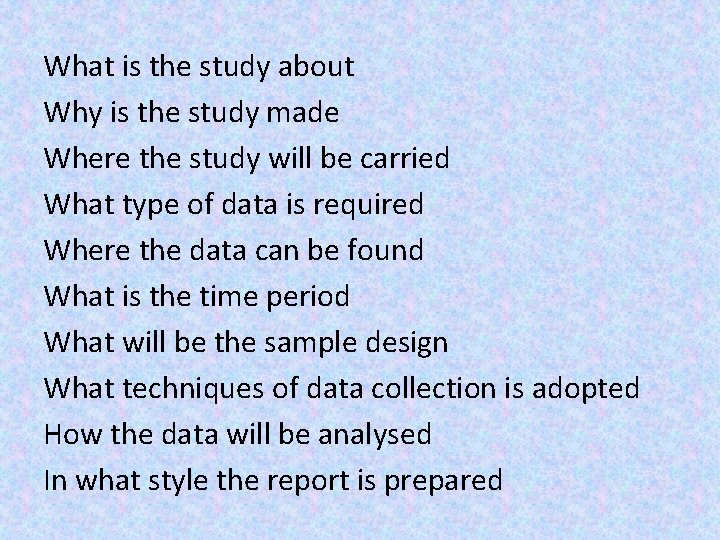
What is the study about Why is the study made Where the study will be carried What type of data is required Where the data can be found What is the time period What will be the sample design What techniques of data collection is adopted How the data will be analysed In what style the report is prepared
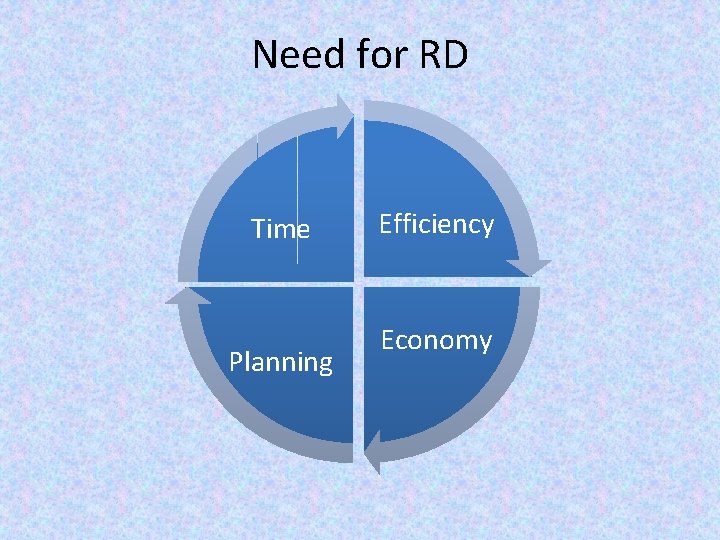
Need for RD Time Planning Efficiency Economy
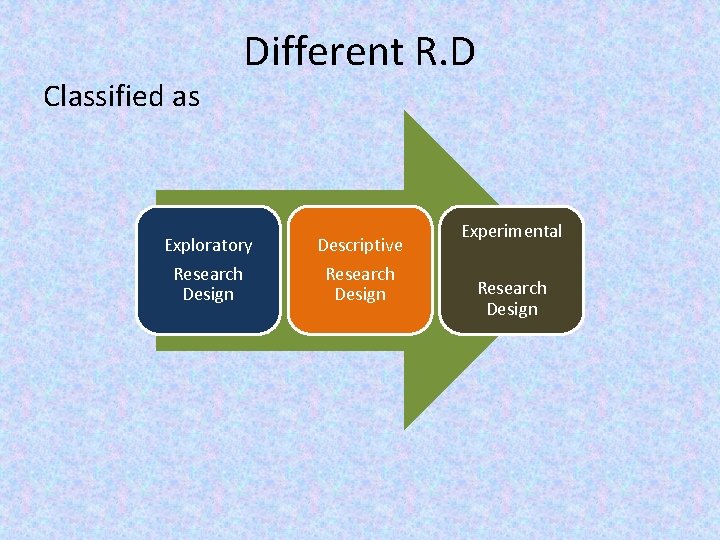
Classified as Different R. D Exploratory Research Design Descriptive Research Design Experimental Research Design