
RESEARCH METHODS Chapter Objectives Lesson One Describe the
RESEARCH METHODS
Chapter Objectives: Lesson One: Describe the nature and advantages of experimentation. Lesson Two: Discuss the main methods of psychological experimentation. Lesson Three: Identify how to make a psychological study valid and reliable. Lesson Four: Describe the ethical guidelines that must be followed when conducting psychological research. Lesson Five: Identify the appropriate statistics to use when analyzing psychological data.
Lesson One: Objectives By the end of this lesson, I will be able to: 1. Describe how research design drives the reasonable conclusions that can be drawn (e. g. , experiments are useful for determining cause and effect; the use of experimental controls reduces alternative explanations). 2. Identify independent, confounding, and control variables in experimental designs. 3. Distinguish between random assignment of participants to conditions in experiments and random selection of participants, primarily in correlational studies and surveys.
Lesson One: The Controlled Experiment The goal of psychological research is to describe, , predict, and explain, and control psychological phenomenon. Psychologists conduct research to answer behavioral questions. They acquire data through careful observation and measurement. Experiments, naturalistic observations, interviews, questionnaires, and case studies are all used to gather data.
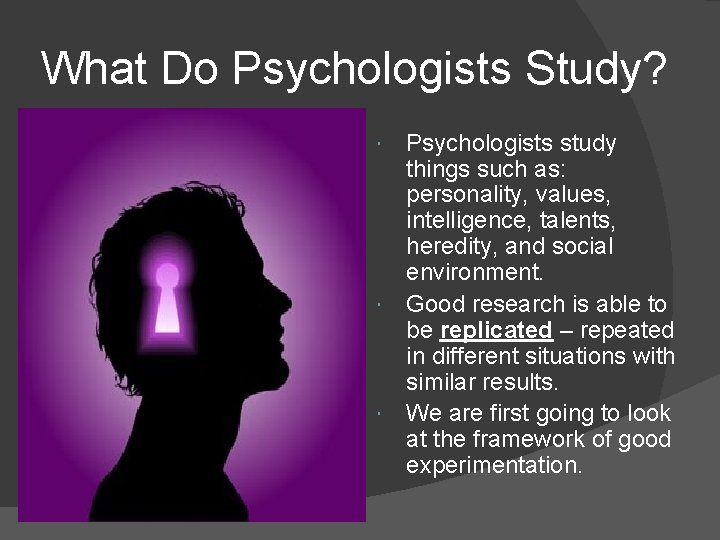
What Do Psychologists Study? Psychologists study things such as: personality, values, intelligence, talents, heredity, and social environment. Good research is able to be replicated – repeated in different situations with similar results. We are first going to look at the framework of good experimentation.
How Do Psychologists Use Research? Psychologists spend much of their time trying to find out why something is happening. (correlations, causations, etc. ) With that being said, psychologists use a four tiered approach when trying to explain and ultimately control behavior. 1. Describe – This is easy – John gets into fights regularly at school 2. Predict – Every time John gets made fun of at school he starts fighting. 3. Explain – John is physically abused at home by his Dad. 4. Control – Remove John from his abusive environment and provide him with an outlet for his built up anger. (MMA)
The Controlled Experiment: Researching scientist use hypotheses to drive their experimentation. Hypothesis – Predictions of how two or more factors are likely to be related. (testable) Experiment – A researcher systematically manipulates a variable under controlled conditions and observes the response.
The Controlled Experiment: Independent Variable – The factor that the researcher manipulates (gives aspirin to participant) Dependent Variable – The factor that may change as a result of the manipulation of the independent variable (how the participant feels after taking the aspirin) Think about it like this: IV – Cause DV – Effect Important: A controlled research experiment is the only research methods that can establish a cause and effect relationship.
Hypotheses are: 1. 2. 3. 4. 5. Integrated sets of principles that help to organize observations Testable predictions, often derived from theories Hunches about mental processes Measures of relationships between two factors Both 3 and 4
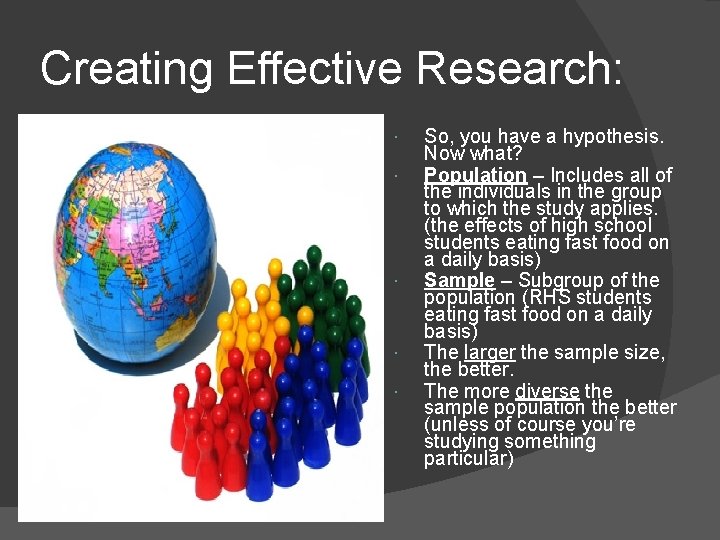
Creating Effective Research: So, you have a hypothesis. Now what? Population – Includes all of the individuals in the group to which the study applies. (the effects of high school students eating fast food on a daily basis) Sample – Subgroup of the population (RHS students eating fast food on a daily basis) The larger the sample size, the better. The more diverse the sample population the better (unless of course you’re studying something particular)
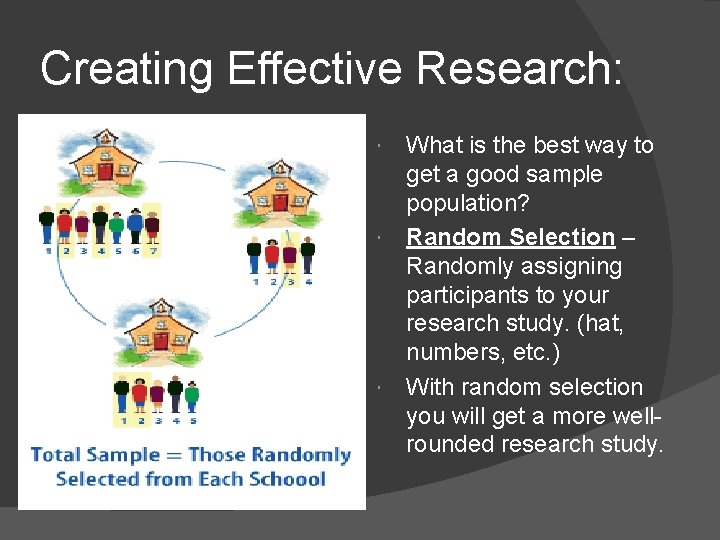
Creating Effective Research: What is the best way to get a good sample population? Random Selection – Randomly assigning participants to your research study. (hat, numbers, etc. ) With random selection you will get a more wellrounded research study.
Psychologists use experimental research in order to reveal or to understand: 1. 2. 3. 4. 5. Correlational Relationships Operational definitions Hypotheses Theories Cause and effect relationships
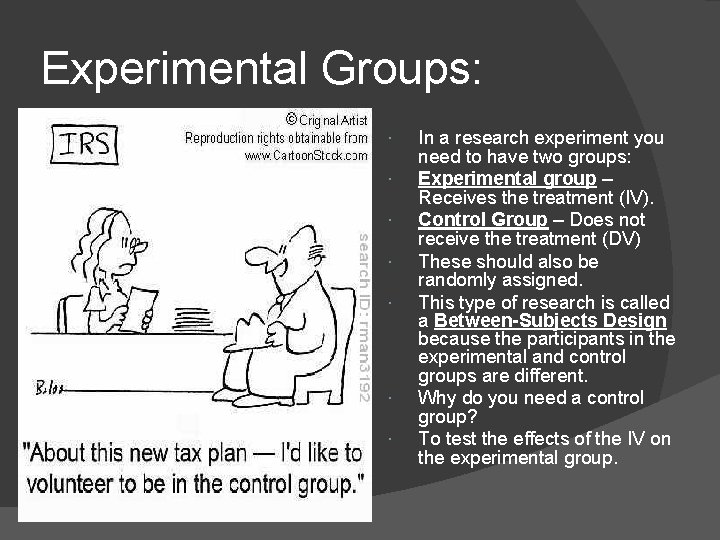
Experimental Groups: In a research experiment you need to have two groups: Experimental group – Receives the treatment (IV). Control Group – Does not receive the treatment (DV) These should also be randomly assigned. This type of research is called a Between-Subjects Design because the participants in the experimental and control groups are different. Why do you need a control group? To test the effects of the IV on the experimental group.
The procedure designed to ensure that the experimental and control groups do not differ in any way that might affect the experiment’s results is called: 1. 2. 3. 4. 5. Variable controlling Random assignment Representative sampling Stratification Between-subjects design
In order to determine the effects of a new drug on memory, one group of subjects is given a pill that contains the drug. A second group is given a sugar pill that does not contain the drug. This second group constitutes the: 1. 2. 3. 4. 5. Random sample Experimental group Control Group Test Group Dependent group
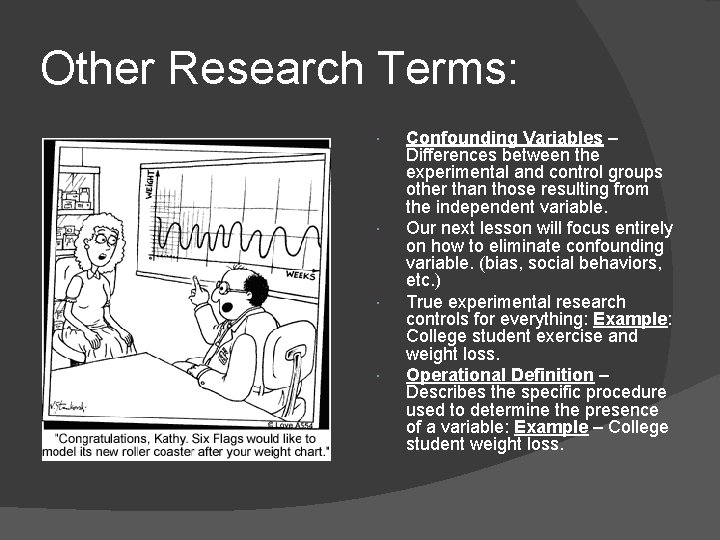
Other Research Terms: Confounding Variables – Differences between the experimental and control groups other than those resulting from the independent variable. Our next lesson will focus entirely on how to eliminate confounding variable. (bias, social behaviors, etc. ) True experimental research controls for everything: Example: College student exercise and weight loss. Operational Definition – Describes the specific procedure used to determine the presence of a variable: Example – College student weight loss.
In an experiment to determine the effects of exercise on motivation, exercise is the: 1. 2. 3. 4. 5. Confounding variable Intervening variable Independent variable Dependent variable Hypothetical variable
Lesson Two: Objectives: By the end of this lesson, I will be able to: 1. Differentiate types of research (e. g. , experiments, correlational studies, survey research, naturalistic observations, and case studies) with regard to purpose, strengths, and weaknesses.
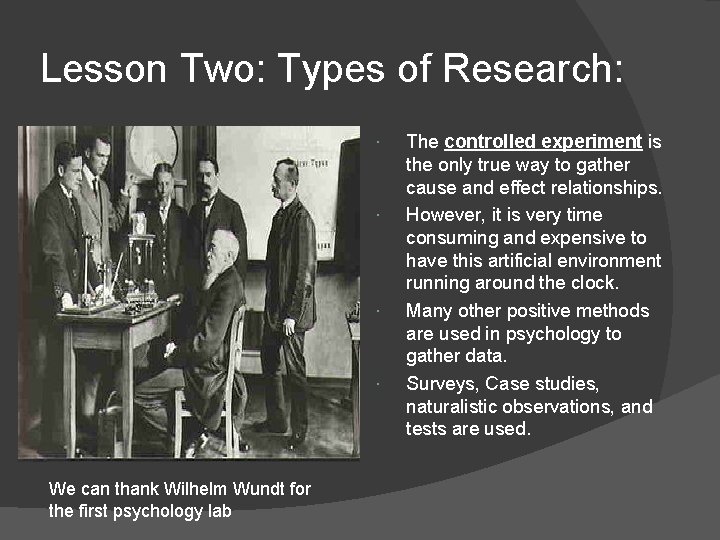
Lesson Two: Types of Research: We can thank Wilhelm Wundt for the first psychology lab The controlled experiment is the only true way to gather cause and effect relationships. However, it is very time consuming and expensive to have this artificial environment running around the clock. Many other positive methods are used in psychology to gather data. Surveys, Case studies, naturalistic observations, and tests are used.
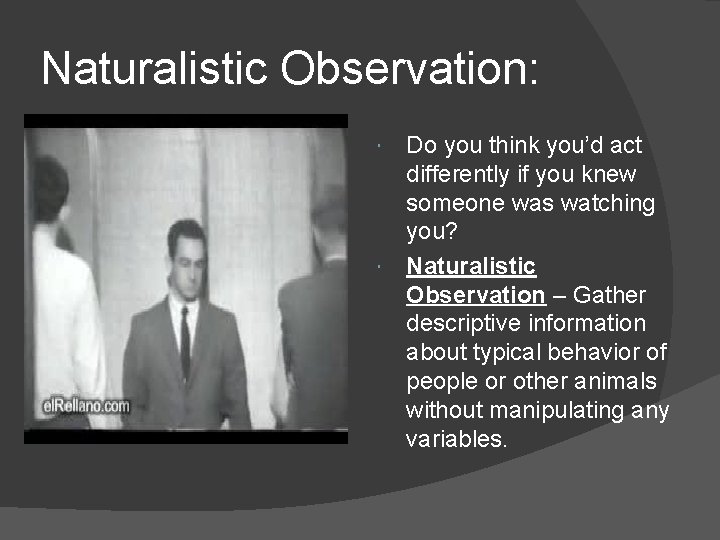
Naturalistic Observation: Do you think you’d act differently if you knew someone was watching you? Naturalistic Observation – Gather descriptive information about typical behavior of people or other animals without manipulating any variables.
Naturalistic Observation (cont. ) Positives: Inexpensive Ambiguous Easy to collect data Very realistic behavior and data Negatives: People may realize you’re studying them (act different) Desired behavior(s) may never happen No control over the environment (Mc. Donald’s French Fries)
Which of the following research strategies would be best for determining whether alcohol impairs memory? 1. 2. 3. 4. 5. Experiment Naturalistic Observation Survey Case Study Correlational study
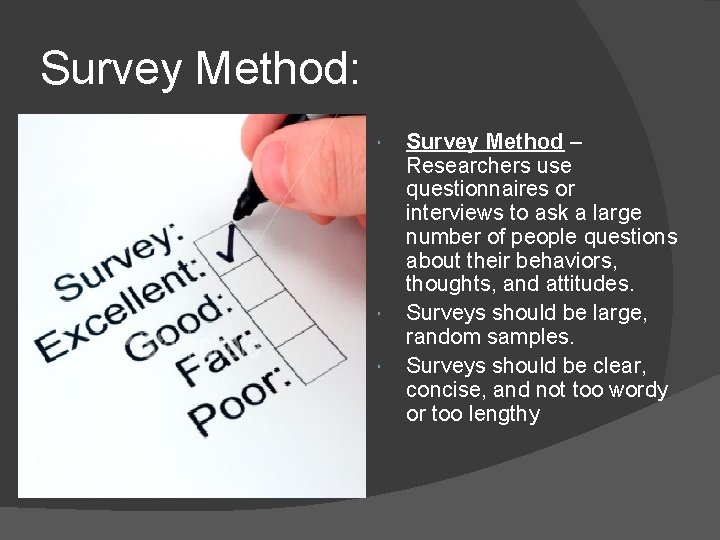
Survey Method: Survey Method – Researchers use questionnaires or interviews to ask a large number of people questions about their behaviors, thoughts, and attitudes. Surveys should be large, random samples. Surveys should be clear, concise, and not too wordy or too lengthy
Surveys (cont. ) Conducting a survey requires a representative sample, or a sample that reflects all major characteristics of the population you want to represent. If you are attempting to survey "America's attitude towards exercising", then your sample cannot include only Caucasian, upper-class college students between the ages of 18 and 22 years. This does not represent America.
A psychologist studies the play behavior of third grade children by watching groups during recess at school. Which research strategy is being used? 1. 2. 3. 4. 5. Correlational Case Study Experimental Survey Naturalistic Observation
Surveys: Positives and Negatives: Positives: Quick and efficient Can poll large number of people Relatively inexpensive Reliable measure (everyone gets the same survey) Negatives: Questions may be confusing or biased People may not take it seriously Sometimes difficult to gain in depth knowledge
Another way: use interviews: Example: In the early 1970’s, researchers found an increase in babies being born with deformed limbs in England the USA. Researchers decided to use Ex Post Facto Studies – studies that look at an effect and seek the cause – to try to find out what was going on. They found a strong correlation between the defects and the mothers that took a drug called Thalidomide during pregnancy. After the study, researchers went back tested the drug on rats and found similar results.
Well done surveys measure attitudes in a representative subset, or _____, of an entire group, or _____. 1. 2. 3. 4. Population; Random Sample Control Group; Experimental Group; Control Group Random Sample; Population
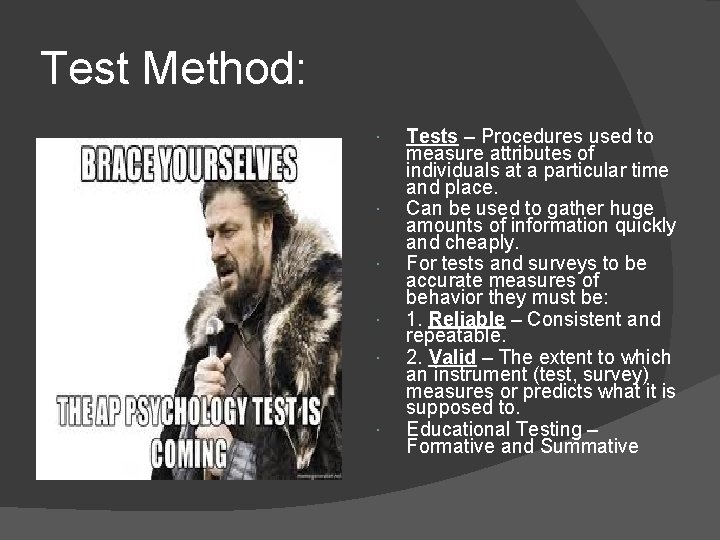
Test Method: Tests – Procedures used to measure attributes of individuals at a particular time and place. Can be used to gather huge amounts of information quickly and cheaply. For tests and surveys to be accurate measures of behavior they must be: 1. Reliable – Consistent and repeatable. 2. Valid – The extent to which an instrument (test, survey) measures or predicts what it is supposed to. Educational Testing – Formative and Summative
Tests: Positives and Negatives Positives: Easy to administer and grade Everyone gets the same test Quick results Negatives: Expensive Need to continue to update test Cannot control outside human factors (sleep, wellbeing, etc. )
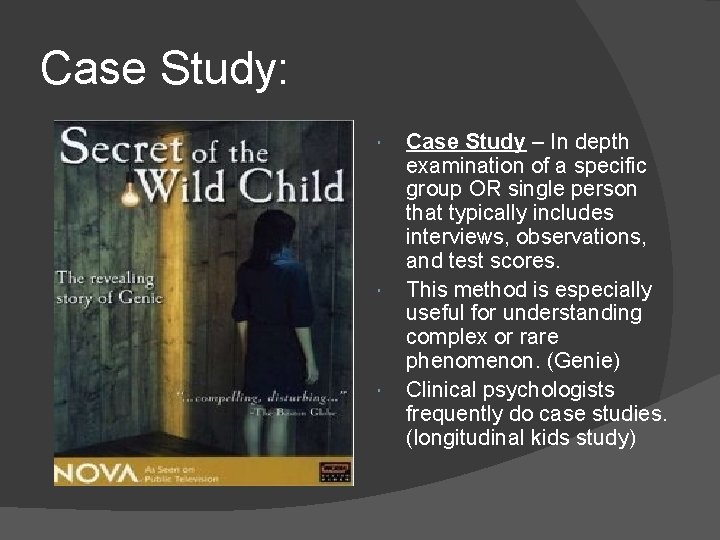
Case Study: Case Study – In depth examination of a specific group OR single person that typically includes interviews, observations, and test scores. This method is especially useful for understanding complex or rare phenomenon. (Genie) Clinical psychologists frequently do case studies. (longitudinal kids study)
Case Study: Positives and Negatives: Positives: Very detailed information Not very expensive Negatives: Not applicable to larger populations Takes a lot time, effort, and attention to detail
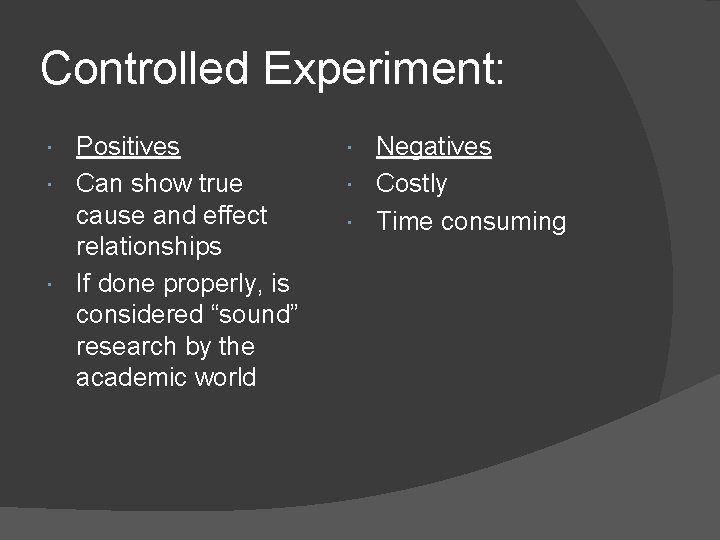
Controlled Experiment: Positives Can show true cause and effect relationships If done properly, is considered “sound” research by the academic world Negatives Costly Time consuming
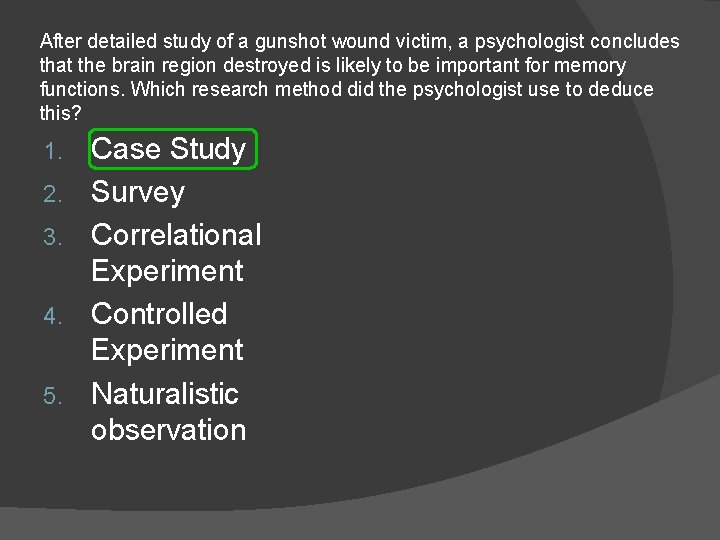
After detailed study of a gunshot wound victim, a psychologist concludes that the brain region destroyed is likely to be important for memory functions. Which research method did the psychologist use to deduce this? 1. 2. 3. 4. 5. Case Study Survey Correlational Experiment Controlled Experiment Naturalistic observation
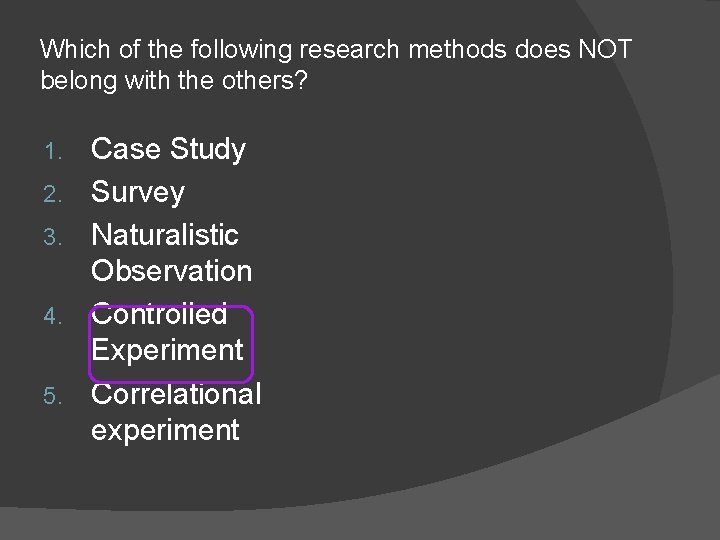
Which of the following research methods does NOT belong with the others? 1. 2. 3. 4. 5. Case Study Survey Naturalistic Observation Controlled Experiment Correlational experiment
Lesson Three: Objectives: By the end of this lesson, I will be able to: 1. Predict the validity of behavioral explanations based on the quality of research design (e. g. , confounding variables limit confidence in research conclusions). 2. Identify how ethical issues inform and constrain research practices. 3. Describe how ethical and legal guidelines (e. g. , those provided by the American Psychological Association, federal regulations, local institutional review boards) protect research participants and promote sound ethical practice.
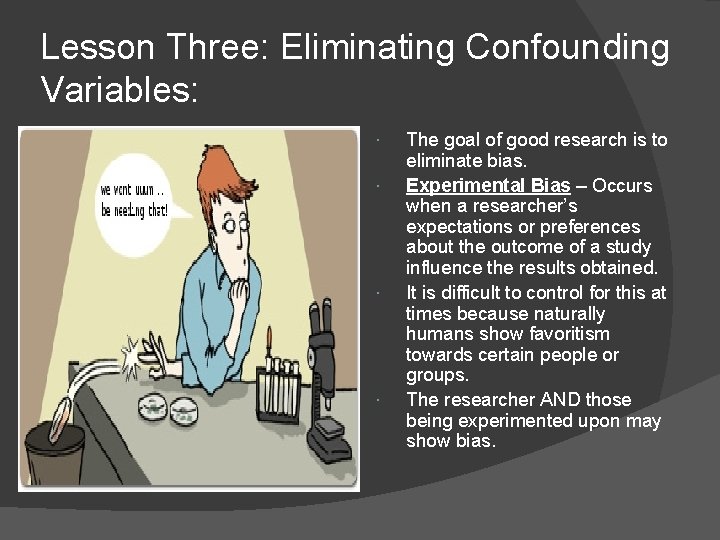
Lesson Three: Eliminating Confounding Variables: The goal of good research is to eliminate bias. Experimental Bias – Occurs when a researcher’s expectations or preferences about the outcome of a study influence the results obtained. It is difficult to control for this at times because naturally humans show favoritism towards certain people or groups. The researcher AND those being experimented upon may show bias.
Eliminating Confounding Variables: Imagine being a part of a study where the researcher kept you in the dark about what exactly was being studied. You would probably be interested in finding out what was being studied (so would others in your group). Demand characteristics Those being researched upon will gather clues or rumors suggesting how they should respond.
Single / Double Blind Procedures: Single Blind Procedure – Aims to eliminate the effects of demand characteristics because the participants don’t know if they are in the experimental or control group. Double Blind Procedure – Neither the experimenter or the participants know who is in the experimental and control groups. A second researcher or assistant that doesn’t know the hypothesis or group assignment administers the experiment. The principal investigator stays away from the participants.
Within Subjects Design: Many research designs use: Within Subjects Design – A subject acts as his or her own control group How does this work? The subject receives a treatment and then behavior is recorded The same is recording without the treatment Researchers get to see what difference the treatment made in the subject behavior
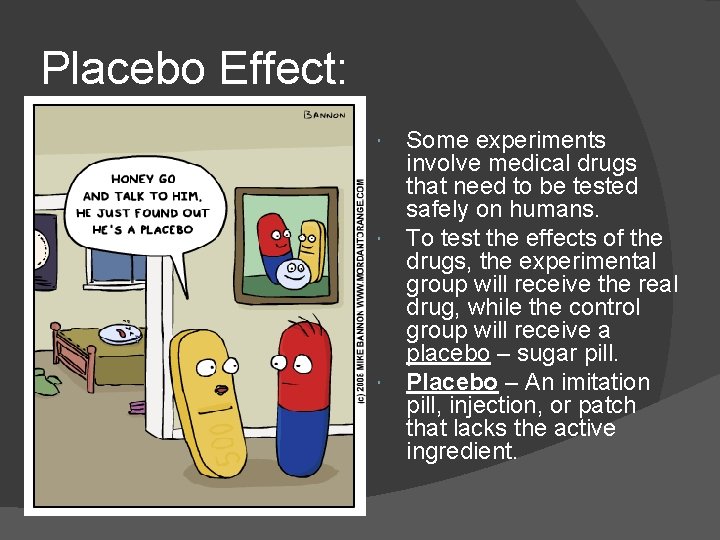
Placebo Effect: Some experiments involve medical drugs that need to be tested safely on humans. To test the effects of the drugs, the experimental group will receive the real drug, while the control group will receive a placebo – sugar pill. Placebo – An imitation pill, injection, or patch that lacks the active ingredient.
Placebo Effect: Placebo Effect – Experimental participants change their behavior in absence of any kind of experimental manipulation. If two treatments are being tested, the researcher may use counterbalancing to assign people to two separate groups instead of all people getting both drugs. (there may be some residual effects from the first drug. )
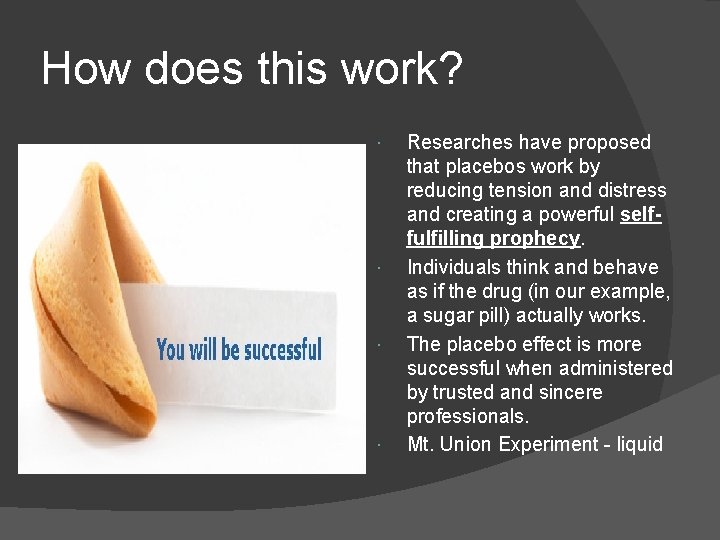
How does this work? Researches have proposed that placebos work by reducing tension and distress and creating a powerful selffulfilling prophecy. Individuals think and behave as if the drug (in our example, a sugar pill) actually works. The placebo effect is more successful when administered by trusted and sincere professionals. Mt. Union Experiment - liquid
Quasi-Experimental Research: Quasi-experimental research – Participants are not randomly assigned. Maybe you want to study the differences between men and women (though the participants are random selected within that particular sub group) Other examples: young and old, students in one class vs. students in another class. This type of research does not establish cause and effect because of the sheer amount of possible confounding variables.
Lesson Four: Ethical Guidelines By the end of this lesson, I will be able to: 1. Identify how ethical issues inform and constrain research practices. 2. Describe how ethical and legal guidelines (e. g. , those provided by the American Psychological Association, federal regulations, local institutional review boards) protect research participants and promote sound ethical practice.
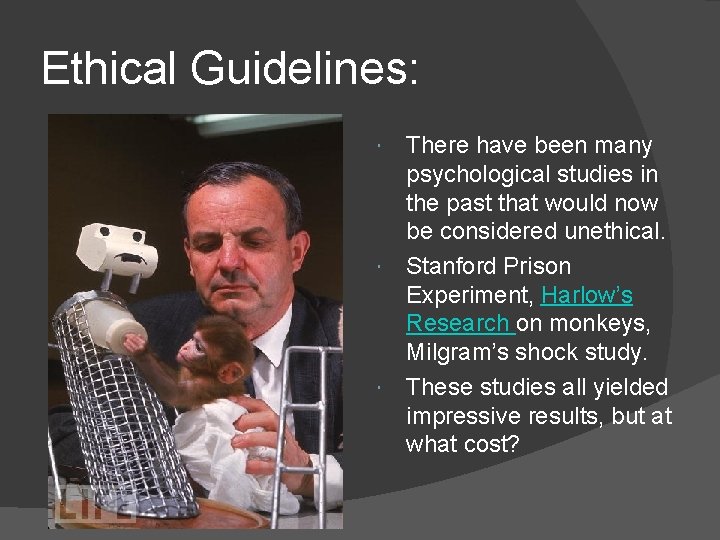
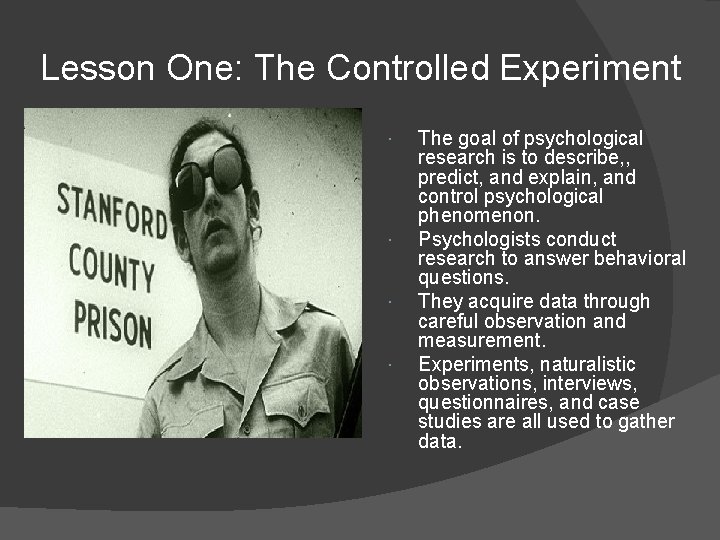
Ethical Guidelines: There have been many psychological studies in the past that would now be considered unethical. Stanford Prison Experiment, Harlow’s Research on monkeys, Milgram’s shock study. These studies all yielded impressive results, but at what cost?
Animal Research: The guidelines for animal research is less strict. Here is what the APA says: 1. The animals must be treated humanely 2. The animals must be acquired, cared for, used, and disposed of properly. 3. Researchers must make efforts to minimize their discomfort, infection, illness, and pain.
Institutional Review Boards: Before the 1970’s, psychologists conducted research without any restrictions. Ethics were not a huge consideration. Data was most important. After Harlow’s Research in the 1970’s, colleges and universities started to realize that a watchdog organization was needed in order to protect both humans and animals from unethical treatment during research. Most psychological research is done at colleges and universities. Each of these colleges or universities has a Institutional Review Board (IRB) that must approve a research study before it can be started. All sections of the experiment must be explained and all forms, equipment, etc. must be approved before commencing with the study.
APA Guidelines For Human Research: The APA states that in order to experiment on humans, the following guidelines must be followed: 1. Obtain the informed consent of potential participants (can use some deception here) 2. Protect them from harm and discomfort (can leave the study) 3. Treat information about individual participants confidentially (storage afterwards) 4. Fully explain the research after the experiment (debriefing)
Lesson Five: Objectives: By the end of this lesson, I will be able to: 1. Distinguish the purposes of descriptive statistics and inferential statistics. • 2. Apply basic descriptive statistical concepts, including interpreting and constructing graphs and calculating simple descriptive statistics (e. g. , measures of central tendency, standard deviation).
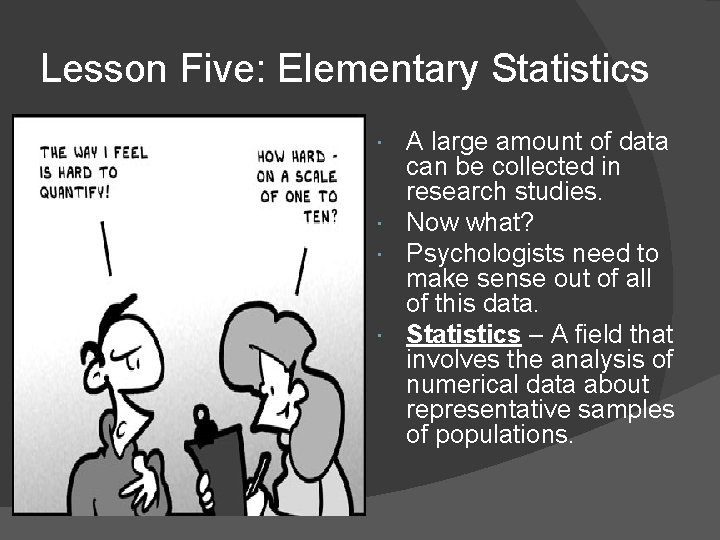
Lesson Five: Elementary Statistics A large amount of data can be collected in research studies. Now what? Psychologists need to make sense out of all of this data. Statistics – A field that involves the analysis of numerical data about representative samples of populations.
Types of Data Collection: Two types of data collection: Quantitative – Data that is already scored using a numerical quality (survey responses) Qualitative – Data that needs to be turned into numerical data (interview responses, case study data – look for themes)
Types of Scales: How do we make sense of the data? Many different scales are used to help clarify the numbers before they are computed. Nominal Scale – When numbers are used to name something (1 = male, 2 = female) Ordinal Scale – When numbers are used to rank order something (1 = first, 2 = second) Interval Scale – When numbers are used to show a meaningful difference between other numbers (temperature – 32 degrees is 10 degrees different than 42 degrees, so is 45 and 55. ) Ratio Scale – When a meaningful ratio can be made with two numbers. (ratio scale has a real or absolute zero)
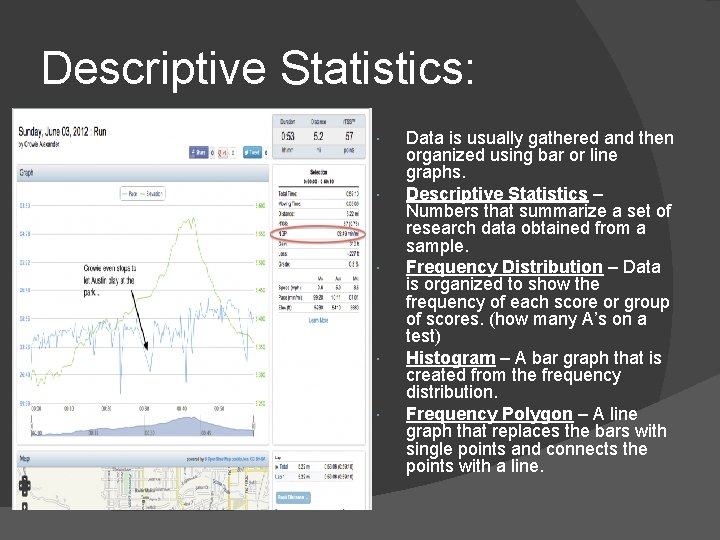
Descriptive Statistics: Data is usually gathered and then organized using bar or line graphs. Descriptive Statistics – Numbers that summarize a set of research data obtained from a sample. Frequency Distribution – Data is organized to show the frequency of each score or group of scores. (how many A’s on a test) Histogram – A bar graph that is created from the frequency distribution. Frequency Polygon – A line graph that replaces the bars with single points and connects the points with a line.
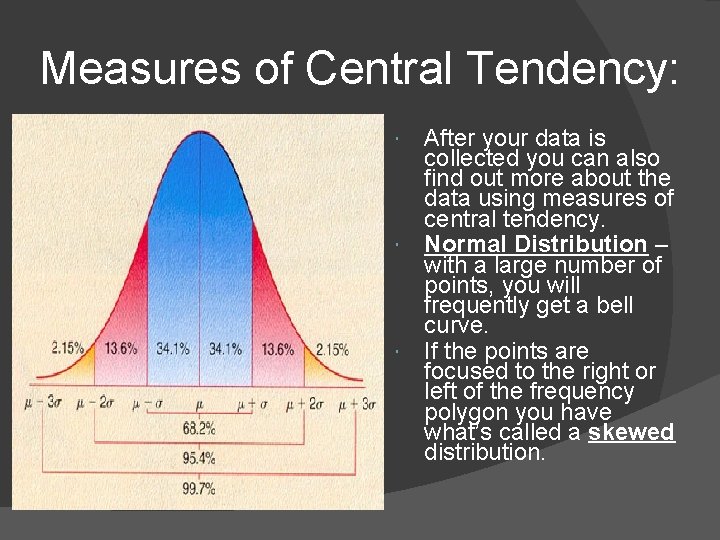
Measures of Central Tendency: After your data is collected you can also find out more about the data using measures of central tendency. Normal Distribution – with a large number of points, you will frequently get a bell curve. If the points are focused to the right or left of the frequency polygon you have what’s called a skewed distribution.
Measures of Central Tendency: Mode - The most frequently occurring score in a distribution Example: 2, 3, 4, 5, 6, 7, 7, 8, 9, 7, 6, 4, 5, 7, 7 Obviously, seven is the most frequently occurring score. You might use this with survey research. Bimodal – If two scores appear most frequently. Multi-Modal – If three or more scores appear most frequently.
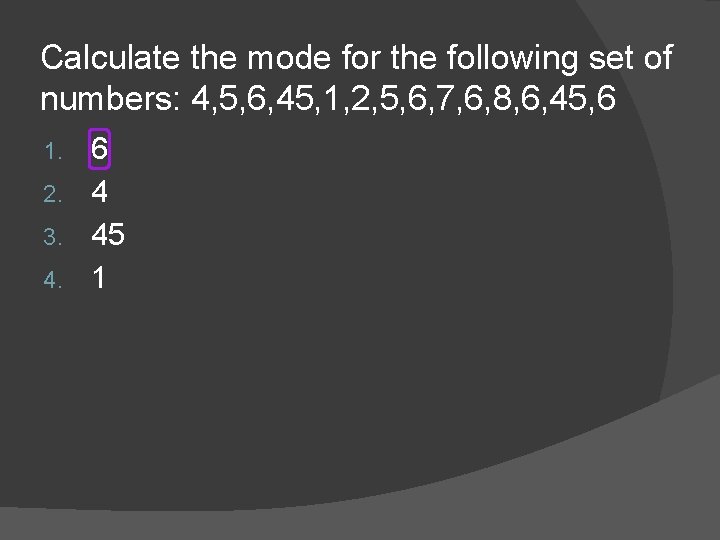
Calculate the mode for the following set of numbers: 4, 5, 6, 45, 1, 2, 5, 6, 7, 6, 8, 6, 45, 6 6 2. 4 3. 45 4. 1 1.
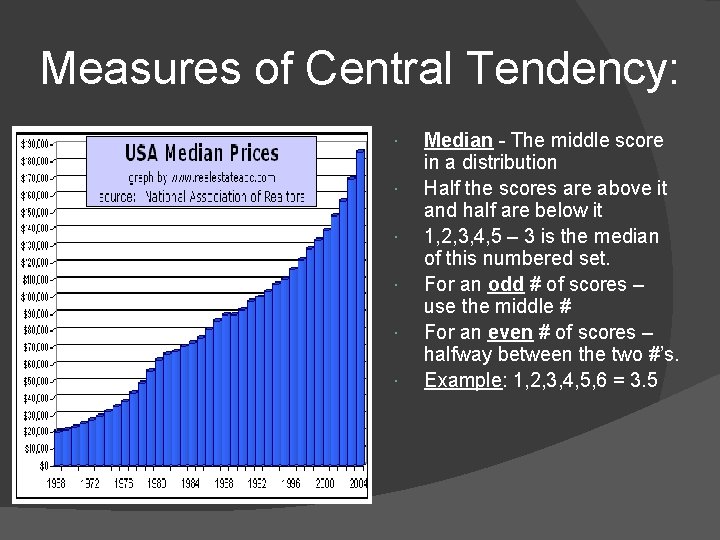
Measures of Central Tendency: Median - The middle score in a distribution Half the scores are above it and half are below it 1, 2, 3, 4, 5 – 3 is the median of this numbered set. For an odd # of scores – use the middle # For an even # of scores – halfway between the two #’s. Example: 1, 2, 3, 4, 5, 6 = 3. 5
Calculate the Median of the following set of numbers: 3, 4, 5, 6, 7, 8, 9, 10 6 2. 6. 5 3. 7 4. 5 1.
Measures of Central Tendency: Mean - The arithmetic average of a distribution Obtained by adding the scores and then dividing by the number of scores 1+2+3+4+5 = 15 / 5 = 3
Calculate the Mean of the following numbers: 2, 4, 6, 8, 10 3 2. 4 3. 6 4. 3. 14 1.
Measure of Variability: Variability – describes the spread or dispersion of scores for a set of research data or distribution. Range – The largest score minus the smallest score. Example (quiz scores out of 10 pts. ): 5, 6, 7, 7, 7, 8, 8, 9, 10 – the range is 5.
What is the range for the following set of numbers? 5, 6, 6, 7, 7, 8, 8, 9, 9, 10, 11, 15 8 2. 15 3. 5 4. 10 1.
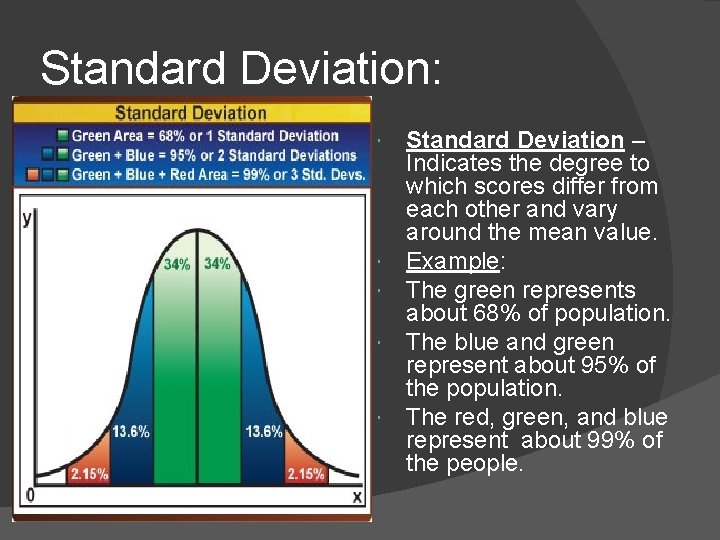
Standard Deviation: Standard Deviation – Indicates the degree to which scores differ from each other and vary around the mean value. Example: The green represents about 68% of population. The blue and green represent about 95% of the population. The red, green, and blue represent about 99% of the people.
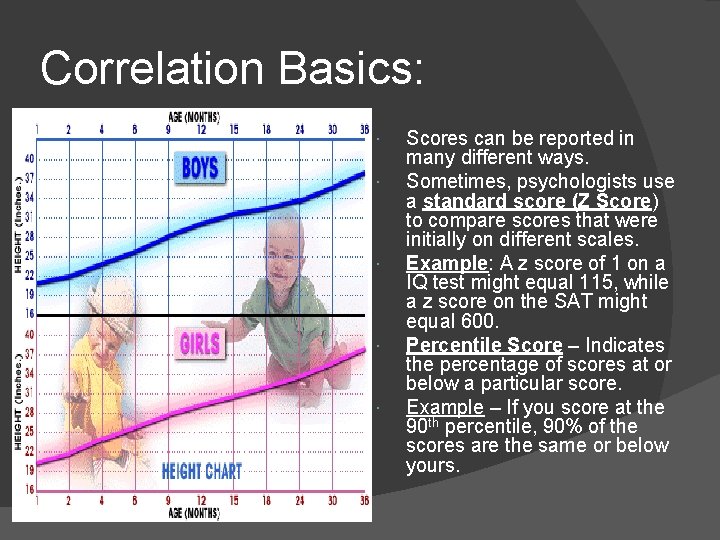
Correlation Basics: Scores can be reported in many different ways. Sometimes, psychologists use a standard score (Z Score) to compare scores that were initially on different scales. Example: A z score of 1 on a IQ test might equal 115, while a z score on the SAT might equal 600. Percentile Score – Indicates the percentage of scores at or below a particular score. Example – If you score at the 90 th percentile, 90% of the scores are the same or below yours.
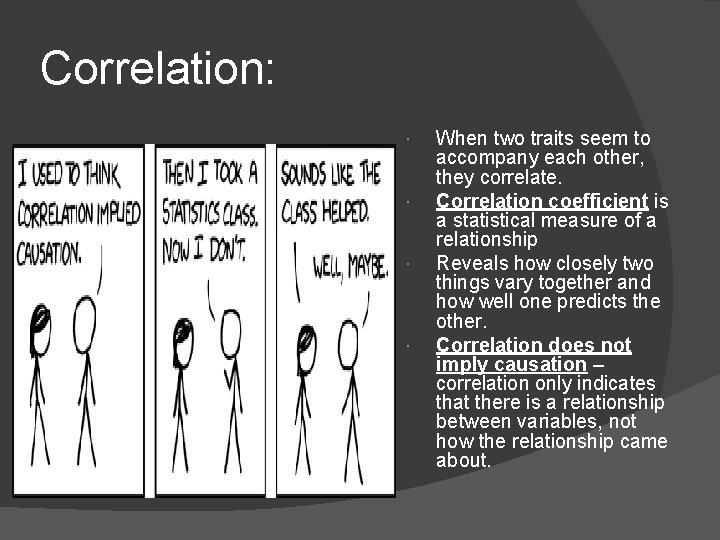
Correlation: When two traits seem to accompany each other, they correlate. Correlation coefficient is a statistical measure of a relationship Reveals how closely two things vary together and how well one predicts the other. Correlation does not imply causation – correlation only indicates that there is a relationship between variables, not how the relationship came about.
Correlation Vs. Causation You have to be careful assuming that correlations show cause and effect. Example: Over the last 26 years, there has been a +. 88 correlation between which professional football team (American or National League) wins the Super Bowl and whether the stock market rises or falls. +. 88 is a very high positive correlation. It indicates only a relationship; winning a Super Bowl could not possibly cause a winning or losing Stock Market.
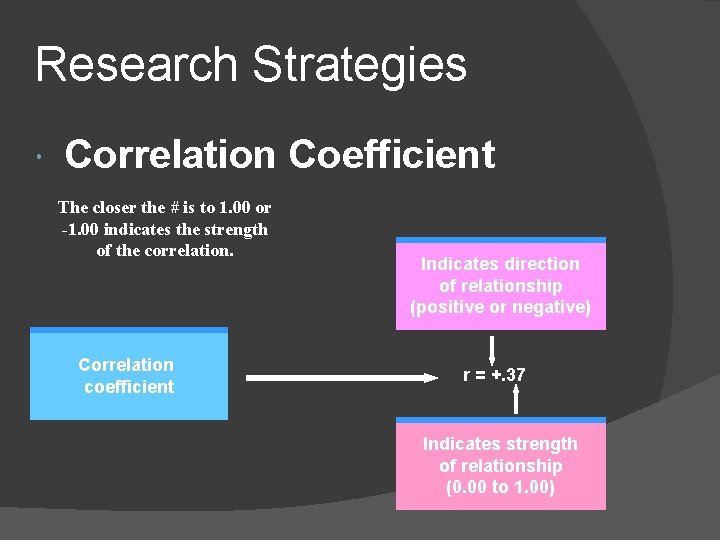
Research Strategies Correlation Coefficient The closer the # is to 1. 00 or -1. 00 indicates the strength of the correlation. Correlation coefficient Indicates direction of relationship (positive or negative) r = +. 37 Indicates strength of relationship (0. 00 to 1. 00)
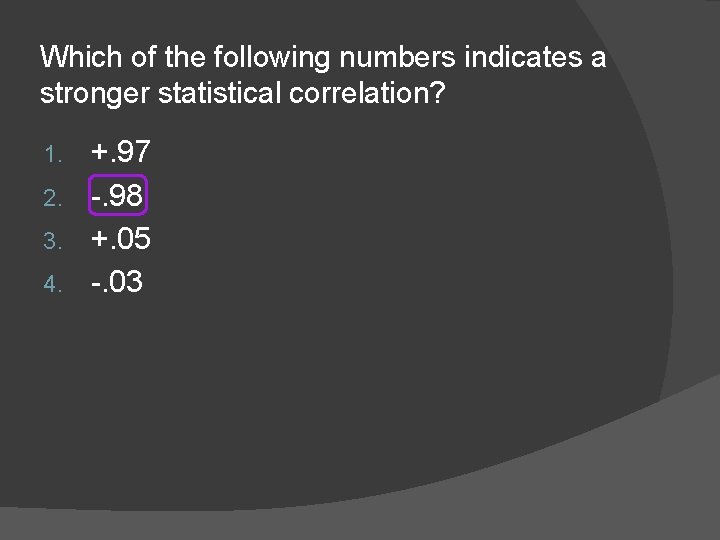
Which of the following numbers indicates a stronger statistical correlation? +. 97 2. -. 98 3. +. 05 4. -. 03 1.
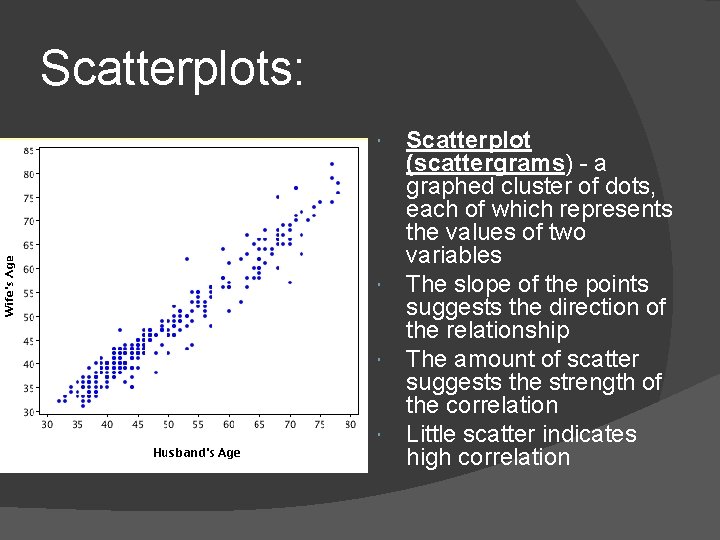
Scatterplots: Scatterplot (scattergrams) - a graphed cluster of dots, each of which represents the values of two variables The slope of the points suggests the direction of the relationship The amount of scatter suggests the strength of the correlation Little scatter indicates high correlation
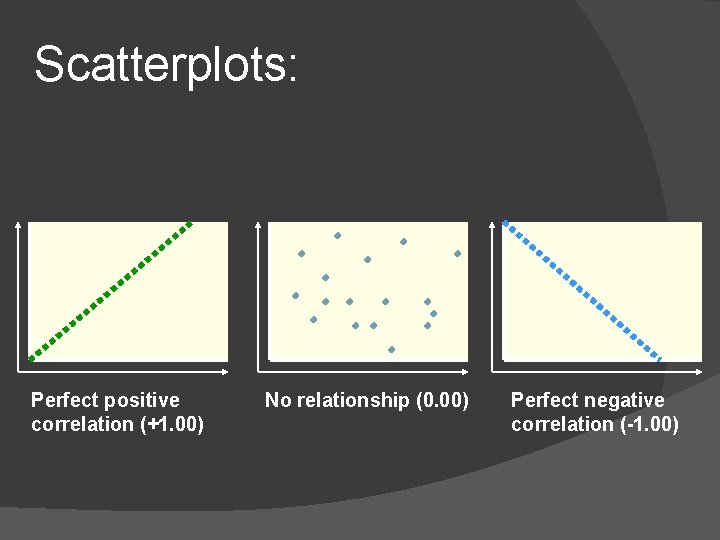
Scatterplots: Perfect positive correlation (+1. 00) No relationship (0. 00) Perfect negative correlation (-1. 00)
Inferential Statistics: Inferential Statistics – Are used to interpret data and draw conclusions (make inferences) They tell psychologists whether or not they can generalize their results to a larger population. Statistical Significance – a measure of the likelihood that your results show a real difference rather than just chance. P <. 05 = there is a 1/20 probability of being caused by chance. P <. 01 = there is a 1/100 probability of being caused by chance. These results are tabulated by using a computer program equipped with Meta-Analysis software (SPSS)
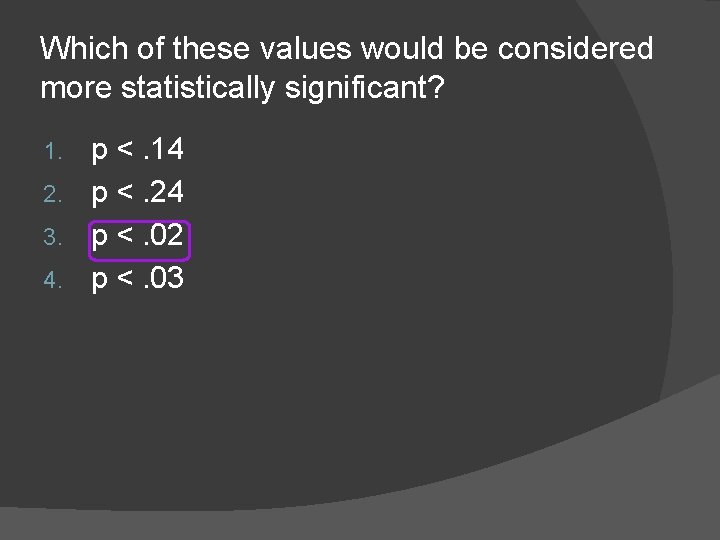
Which of these values would be considered more statistically significant? p <. 14 2. p <. 24 3. p <. 02 4. p <. 03 1.
- Slides: 73