
Research Methods Assignment 2 Sport and Exercise Science
- Slides: 10
Research Methods Assignment 2 Sport and Exercise Science Year 2
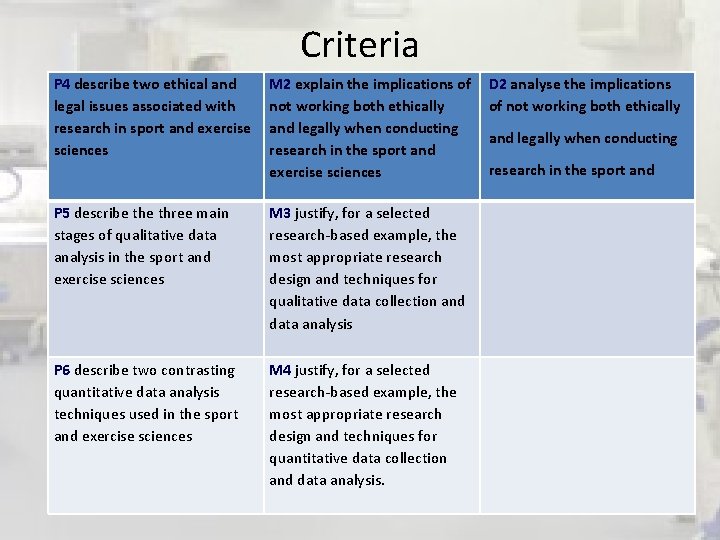
Criteria P 4 describe two ethical and legal issues associated with research in sport and exercise sciences M 2 explain the implications of not working both ethically and legally when conducting research in the sport and exercise sciences P 5 describe three main stages of qualitative data analysis in the sport and exercise sciences M 3 justify, for a selected research-based example, the most appropriate research design and techniques for qualitative data collection and data analysis P 6 describe two contrasting quantitative data analysis techniques used in the sport and exercise sciences M 4 justify, for a selected research-based example, the most appropriate research design and techniques for quantitative data collection and data analysis. D 2 analyse the implications of not working both ethically and legally when conducting research in the sport and
Ethical and legal issues in sport and Ex Sci • What does it mean to act ethical? • Task. In pairs discuss what it means to act ethical in SES • Definition: in accordance with principles of conduct that are considered correct, especially those of a given profession or group (www. thefreedictionary) • When we conduct Research what might we consider for example we will have to get consent from the participant. Think of 3 others
Ethical and legal consideration • • • Ethical clearance Informed consent Confidentiality/data protection Safety of the participant Acting with regard for equality and impartiality
Ethical clearance • In order to begin any Research study including a dissertation which you will do at University you must gain ethical clearance from an appropriate body- this might be a university committee for your area of study. • They will decide if whether your research is ethical and meets the professional standards set by BASES and if it is Safe • They may want you to provide additional information, risk assessments, • Finally they will confirm if you can start your project
Informed consent • You must gain consent from the participants before you start your study. It can be verbal but it is always safer to have written consent • The form should consist of • Description of the investigation • Details of the procedure/testing • Details of the risk (must be explicit) • Potential benefits (must not exaggerate) • Offer to answer questions • They are free to withdraw at any time without being penalised • Inform them that the information that is collected will be confidential
Confidentiality/ Data Protection • Where confidentiality is concerned, you may disclose only information that is important to the study you are conducting. Any data you collect is protected under the terms of the Data Protection Act (1998). No data that makes the participants personally identifiable should be included in your research project • All data collected should be stored safely or password protected
Equality and impartiality • To protect the reputation of SES you must remain professional at all times you must be unbiased in your action and your practices. • You can not let age, race, gender, sexuality affect the way that you work with clients. • You must not exploit personal relationships for personal gain • Any decisions/recommendation must be be objective (based on the facts)
Why is it important to abide by ethics and legalities • discuss why? • Ensure the safety /welfare of the participant and the researcher • Ensure that the workers work within their expertise and know the limitation of their experience and qualifications • Preserving and developing the reputation of SES by following the relevant procedures
What might happen if you do not follow ethics and legalities? • • What are the implications? Discuss in pairs. Tribunals Legal or civil action Being stopped by BASES, having restrictions, and exclusions