
Research Methodology Research problem Problem A question raised
Research Methodology Research problem
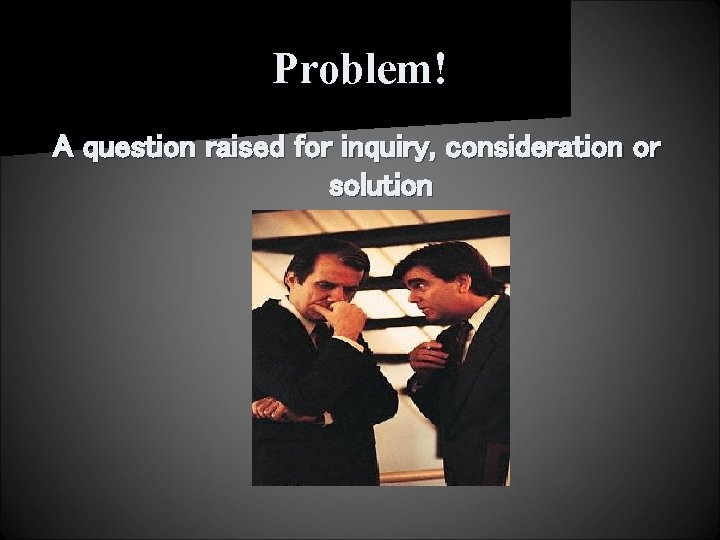
Problem! A question raised for inquiry, consideration or solution
What do we do with Problems? n Ignore them n Talk about them n Try to solve them
What is a Research Problem? A research problem is an issue or concern that an investigator presents and justifies in a research study.
What is a research problem? A problem that someone would like to research Anything that a person find unsatisfactory or unsettling, a difficulty of some sort, a state of affairs that need to be changed. A problems involve areas of concerns to researchers, for condition they want to improve, difficulties they want to eliminate, questions for which they want to seek answers.
n It is the demarcation of a problem area within a certain context involving the v. WHO v. WHAT v. WHERE v. WHEN and the WHY of the problem situation. n Identification of research problem is a first step in the research process. n A research problem should be selected very carefully. The subject matter of research should be of researcher’s interest. Copyright © Allyn & Bacon 2008
How to Identify a Research Problem n Search for a problem. n Read more about your problem. n Take notes or keep a research journal. n Seek professional advice. n Keep the topic interesting.
Formulating a Research problem n The first step in beginning a research project is to decide “ What is the Research Question”? n A “Research Question” is a question about the problem to be addressed , it is therefore focused on the content of the topic of interest. n This is the most critical step in the Research
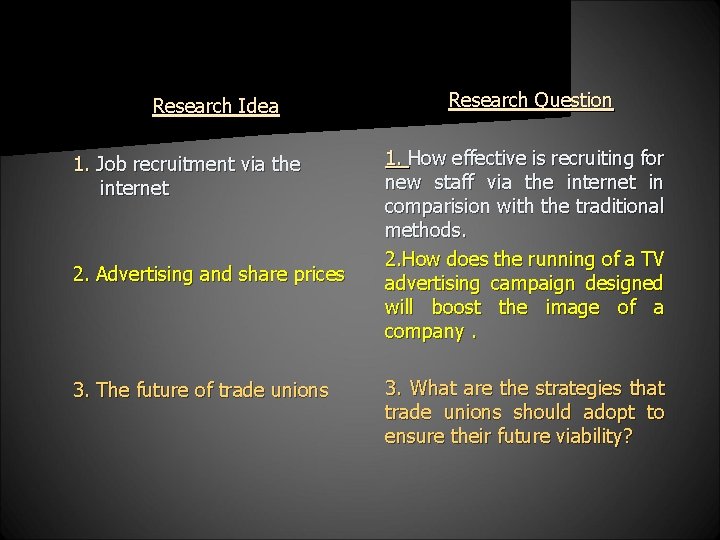
Research Idea 1. Job recruitment via the internet 2. Advertising and share prices 3. The future of trade unions Research Question 1. How effective is recruiting for new staff via the internet in comparision with the traditional methods. 2. How does the running of a TV advertising campaign designed will boost the image of a company. 3. What are the strategies that trade unions should adopt to ensure their future viability?
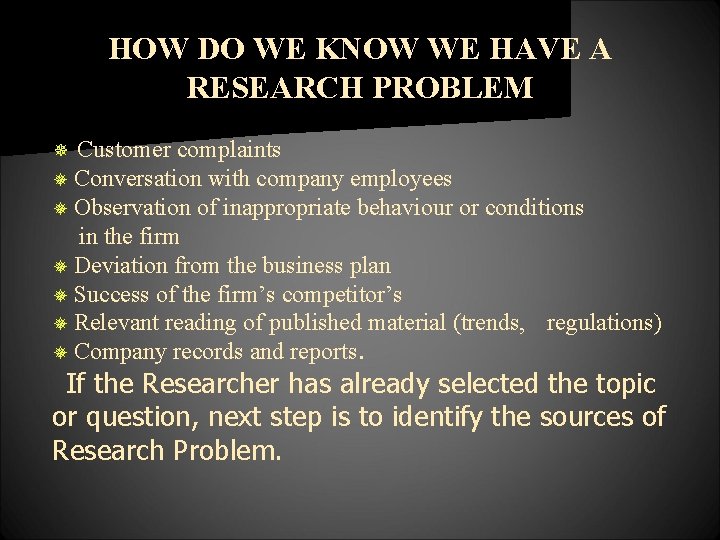
HOW DO WE KNOW WE HAVE A RESEARCH PROBLEM ¯ Customer complaints Conversation with company employees ¯ Observation of inappropriate behaviour or conditions in the firm ¯ Deviation from the business plan ¯ Success of the firm’s competitor’s ¯ Relevant reading of published material (trends, regulations) ¯ Company records and reports. ¯ If the Researcher has already selected the topic or question, next step is to identify the sources of Research Problem.
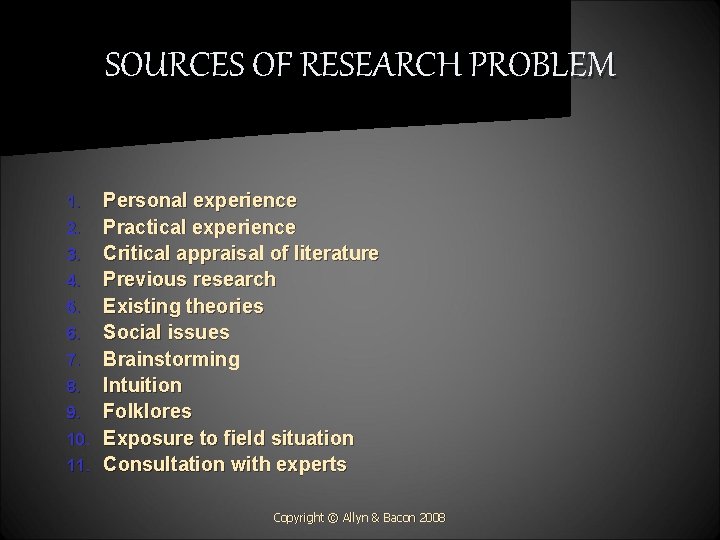
SOURCES OF RESEARCH PROBLEM Personal experience 2. Practical experience 3. Critical appraisal of literature 4. Previous research 5. Existing theories 6. Social issues 7. Brainstorming 8. Intuition 9. Folklores 10. Exposure to field situation 11. Consultation with experts 1. Copyright © Allyn & Bacon 2008
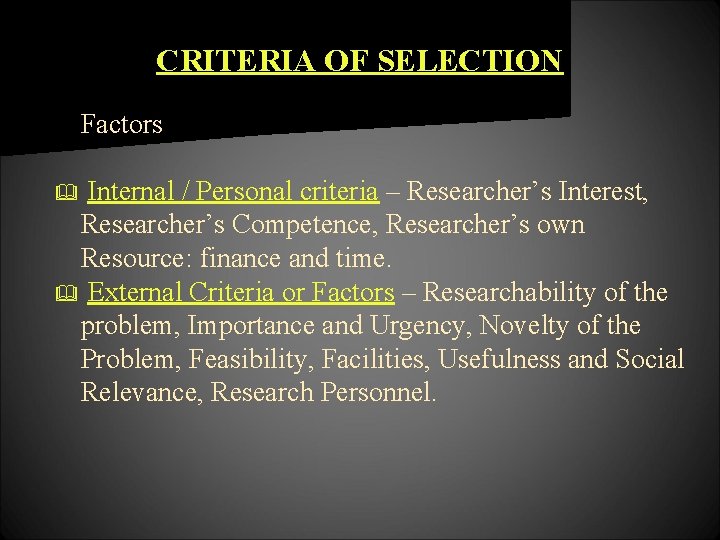
CRITERIA OF SELECTION Factors Internal / Personal criteria – Researcher’s Interest, Researcher’s Competence, Researcher’s own Resource: finance and time. & External Criteria or Factors – Researchability of the problem, Importance and Urgency, Novelty of the Problem, Feasibility, Facilities, Usefulness and Social Relevance, Research Personnel. &
¶Formulation of the Problem @There are two ways of stating a problem: @Posting question / questions @Making declarative statement / statements
Eg: Why is productivity in Japan so much higher than in India? Brain storming What sort of productivity is being referred? What period? Which sector? Rephrasing: What factors were responsible for the higher labour productivity of Japan’s manufacturing industries during the period 1971 -1980 relative to India’s manufacturing industries? Further rethinking and rephrasing might place the problem on a still better operational basis as shown below: “To what extent did labour productivity in 1971 to 1980 in Japan exceed that of India in respect of 15 selected manufacturing industries? What factors were responsible for the productivity differentials between the two countries by industries? ”
Steps in defining a Problem 1. Statement of the problem in a general 2. 3. 4. 5. way Understanding the nature of the problem Surveying the available literature Developing ideas through discussions Rephrasing the research problem
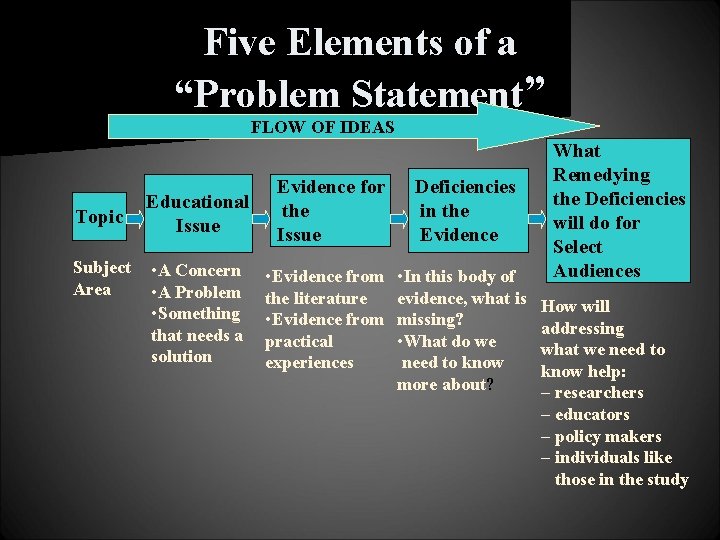
Five Elements of a “Problem Statement” FLOW OF IDEAS Topic Subject Area Educational Issue • A Concern • A Problem • Something that needs a solution Evidence for the Issue • Evidence from the literature • Evidence from practical experiences Deficiencies in the Evidence • In this body of evidence, what is missing? • What do we need to know more about? What Remedying the Deficiencies will do for Select Audiences How will addressing what we need to know help: – researchers – educators – policy makers – individuals like those in the study
COMPONENTS OF PROBLEM STATEMENTS n Relevance of the study n Title of the study n Operational definition of the variables n Objectives of the study n Delimitations of the study n Scope and limitations of the study Copyright © Allyn & Bacon 2008
Writing Problem Statements n Tells what will be (or was) done n Identifies variables & relationships to be studied
Deductive reasoning happens when a researcher works from the more general information to the more specifc n An example of deductive reasoning can be seen in this set of statements: Every day, I leave for work in my car at eight o’clock. Every day, the drive to work takes 45 minutes I arrive to work on time. Therefore, if I leave for work at eight o’clock today, I will be on time. ic. Sometimes this is called the “top-down” approach n
Inductive Reasoning Inductive reasoning works the opposite way, moving from specific observations to broader generalizations and theories. This is sometimes called a “bottom up” approach n An example of inductive reasoning can be seen in this set of statements: Today, I left for work at eight o’clock and I arrived on time. Therefore, every day that I leave the house at eight o’clock, I will arrive to work on time n
CONCEPTS n n n Concept is an abstract symbol representing an object, a property of an object or a certain phenomena A concepts is a word or set of words that express a general idea concerning the nature of thing or the relations between things. Often providing a category for the classification of phenomena. Concepts provide a means of ordering the vast diversity of empirical phenomena. However concept s are not inherent in nature itself but are man made for example personality, family, society, event, status, change, growth etc. are all concepts. for example investor, carries many meaning, corporate investor, retail investor, individual investor etc. so, it has to be explained through clear definitions to avoid the misunderstanding of the concept of the research under study
CONSTRUCTS A construct is a concept devised to aid in scientific analysis and generalization, thus a construct is a concept with the added meaning of having been deliberately and consciously invented or adopted for a special scientific purpose n for example “ intelligence” is a concept and “ intelligence quotient” (IQ) is a scientific construct, which enables behavioral scientist to measure the intelligence of a person. n
THEORETICAL FRAMEWORK A theoretical framework is a collection of interrelated concepts, like a theory but not necessarily so well worked-out. n A theoretical framework guides your research, determining what things you will measure, and what statistical relationships you will look for. n Theoretical frameworks are obviously critical in deductive, theory-testing sorts of studies(see Kinds of Research for more information). In those kinds of studies, theoretical framework must be very specific and well-thought out. n

n. A theoretical framework is analogous to the frame of the house. Just as the foundation supports a house, a theoretical framework provides a rationale for predictions about the relationships among variables of a research study
n n n n It provides a context for examining a problem i. e. theoretical rationale for: Developing hypotheses frame of reference/base for Observations Definitions of concepts Research designs Interpretations Generalizations Serves as a guide to systematically identify logical, precisely defined relationships among variables
- Slides: 25