
RESEARCH METHODOLOGY Moshe Banai Ph D Editor International

RESEARCH METHODOLOGY Moshe Banai, Ph. D Editor International Studies of Management and Organization 1
What is Research? There are many accepted definitions for the term “research”, for example: Research is an active, diligent and systematic process of inquiry in order to discover, interpret or revise facts, events, behaviours, or theories, or to make practical applications with the help of such facts, laws or theories. The term ‘research’ is also used to describe the collection of information about a particular subject (Encyclopedia Wikipedia) 2
What is Research? Other insightful definitions of “research” are: Ø Systematic, intensive, patient study and investigation in some field of knowledge, usually employing the techniques of hypothesis and experiment, whose purpose is to reveal new facts, theories, or principles Ø A systematic investigation, including research development, testing and evaluation, designed to develop or contribute to generalizable knowledge Ø Systematic study directed toward more complete scientific knowledge or understanding of the subject studied 3
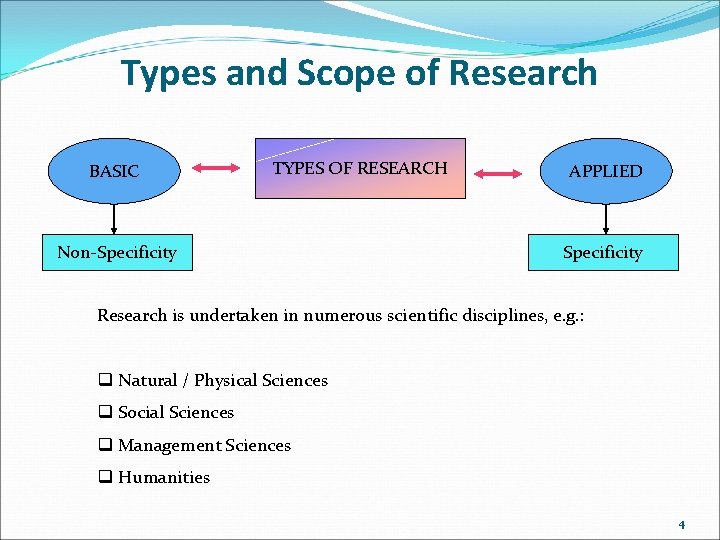
Types and Scope of Research BASIC TYPES OF RESEARCH Non-Specificity APPLIED Specificity Research is undertaken in numerous scientific disciplines, e. g. : q Natural / Physical Sciences q Social Sciences q Management Sciences q Humanities 4

The Dimensions of Research Theories Concepts Deductive Reasoning RESEARCH Propositions Scientific Method Inductive Reasoning Hypotheses Empiricism 5
What is a Theory? Zikmund (p. 41) has defined a theory as “a coherent set of general propositions, used as principles of explanation of the amount of the apparent relationships of certain observed phenomena” Concepts (or constructs) are the basic building blocks of theory development. A concept (or construct) is a generalized idea about a class of objects, attributes, occurrences, or processes that have been given a name. A concept (or construct) may vary in terms of the level of abstraction Examples: Productivity, Leadership, Morale, Assets, Inflation 6
What is a Theory? A proposition is a statement concerned with the relationship between concepts. It asserts a universal connection and logical linkage between concepts. Propositions are at a higher level of abstraction than concepts Example: Smoking is injurious to health Hypotheses are propositions which are empirically testable. They are usually concerned with the relationships between variables Example: Increasing salary by 10% will double the production 7
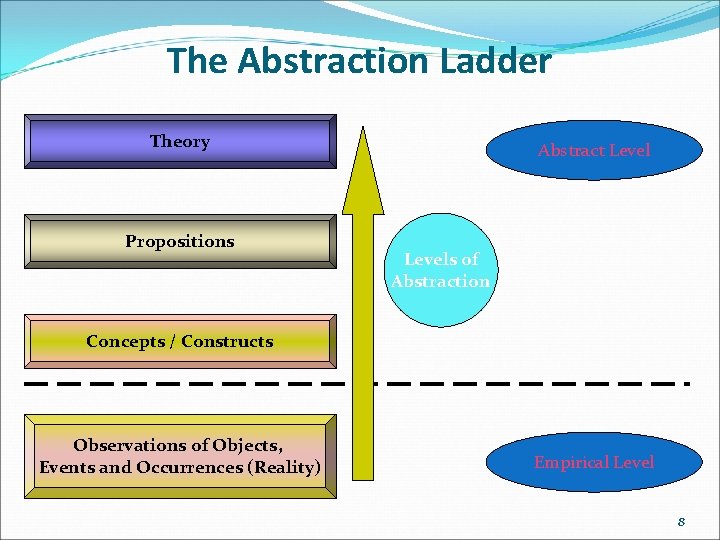
The Abstraction Ladder Theory Propositions Abstract Levels of Abstraction Concepts / Constructs Observations of Objects, Events and Occurrences (Reality) Empirical Level 8
Qualities of a Good Theory “A theory is a good theory if it satisfies two requirements. It must accurately describe a large class of observations on the basis of a model that contains only a few arbitrary elements. And it must make definite predictions about the result of future observations” Stephen Hawking, A Brief History of Time, 1988 9
Qualities of a Good Theory Often, competing theories are put forth to explain certain phenomena. One cannot really be 100% certain that a given theory is correct because, no matter on how many occasions the results of experiments agree with theory, there may come an occasion when some do not Theories must be: q. Objective q. Verifiable (i. e. within the accepted margins of error) q. Falsifiable / disprovable Good theories must describe, explain and predict 10
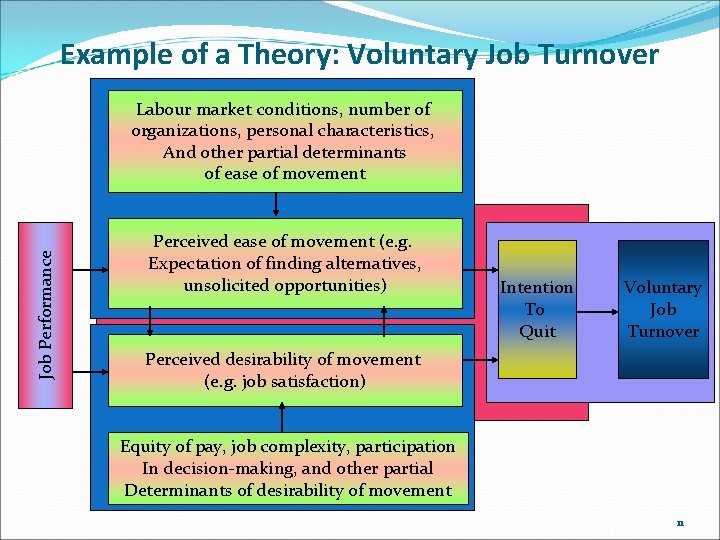
Example of a Theory: Voluntary Job Turnover Job Performance Labour market conditions, number of organizations, personal characteristics, And other partial determinants of ease of movement Perceived ease of movement (e. g. Expectation of finding alternatives, unsolicited opportunities) Intention To Quit Voluntary Job Turnover Perceived desirability of movement (e. g. job satisfaction) Equity of pay, job complexity, participation In decision-making, and other partial Determinants of desirability of movement 11
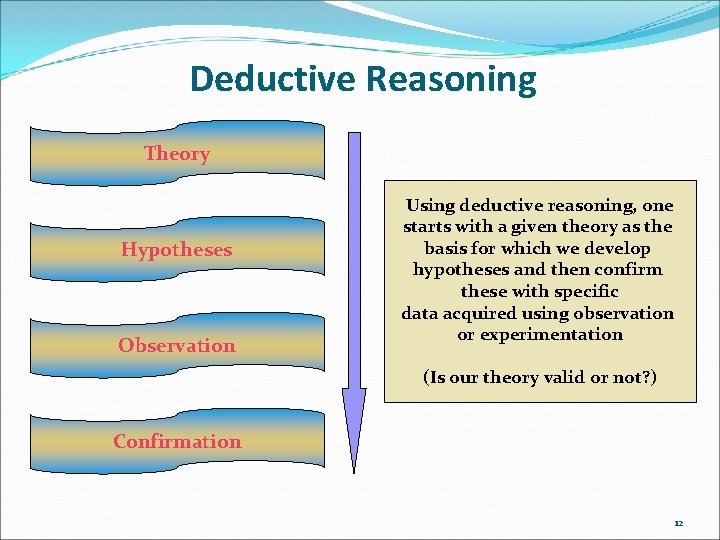
Deductive Reasoning Theory Hypotheses Observation Using deductive reasoning, one starts with a given theory as the basis for which we develop hypotheses and then confirm these with specific data acquired using observation or experimentation (Is our theory valid or not? ) Confirmation 12
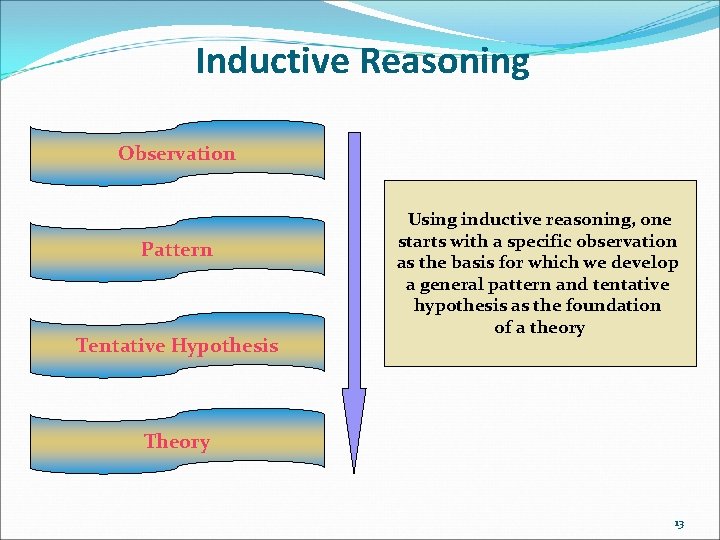
Inductive Reasoning Observation Pattern Tentative Hypothesis Using inductive reasoning, one starts with a specific observation as the basis for which we develop a general pattern and tentative hypothesis as the foundation of a theory Theory 13
The Scientific Method The “scientific method” is basically an overarching perspective on how scientific investigations should be undertaken. It can, in effect, be considered as a complete set of principles and methods that help researchers in all scientific disciplines obtain valid results for their research studies, and which includes the provision of clear and universally accepted guidelines for acquiring, evaluating and communicating information in the context of a research study The goals of scientific research are, broadly speaking, to understand, explain and predict 14
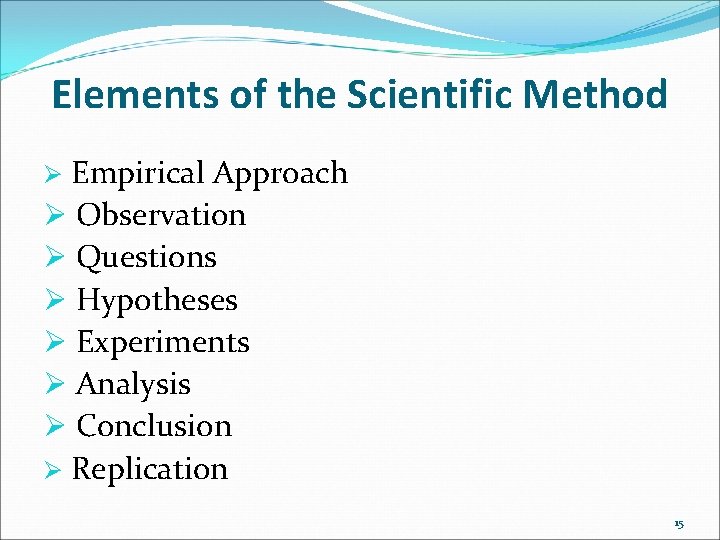
Elements of the Scientific Method Empirical Approach Ø Observation Ø Questions Ø Hypotheses Ø Experiments Ø Analysis Ø Conclusion Ø Replication Ø 15
Elements of the Scientific Method (Empirical Approach) Evidence-based approach. The guiding principle behind all research conducted in accordance with the scientific method Data derived from direct, systematic and careful observation and experimentation (as opposed to speculation, intuition, opinions, hunches, gut feeling) 16
Elements of the Scientific Method (Observation) Awareness of the real / physical / social world in which we exist. This, in turn, gives rise to questions as the basis for research studies or investigations Operational Definitions – Ensures consistency when researchers talk about or are interested in undertaking or replicating research on the same phenomenon. Example: What is “exercise”? 17
Elements of the Scientific Method (Questions) Making an answerable question out of a research idea. The question must be answered using available and established scientific research techniques and procedures. Scientific Analysis should not be attempted on questions which cannot be answered Example of an answerable question: Can regular exercising reduce an individual’s cholesterol level? Example of a (currently) unanswerable question: Is time travel possible? 18
Elements of the Scientific Method (Hypotheses) Hypotheses attempt to explain phenomena of interest. A hypothesis is a proposition that is empirically testable. It usually seeks to explain relationships between variables, and predict, and must be falsifiable 19
Elements of the Scientific Method (Hypotheses) Typical hypotheses structures: ü Conditional - If Condition X is fulfilled, then Outcome Y will result ü Correlational - The value of Variable B is observed to be related with changes in the value of Variable A ü Causal – The value of Variable Alpha determines the value of Variable Beta
Elements of the Scientific Method (Experiments) Experiments are basically about measuring phenomena and collecting accurate and reliable data which are used for analysis and evaluation Accuracy – Correctness of the Measurement Reliability – Consistency of the Measurement 21
Elements of the Scientific Method (Analysis) üAnalysis is about the use of qualitative or quantitative tools and techniques to process data üQuantitative tools and techniques are considered more desirable (objective) than qualitative tools and techniques üStatistical analysis is typically used to quantitatively analyze data acquired in research studies 22
Elements of the Scientific Method (Conclusions) ü Based on the results of the analysis conducted, and used to support or refute a hypothesis ü When undertaking research, conclusions should only be based on the available data and not broadened to include statements which are not supported by the data ü Example: If the research analysis shows that two variables are correlated (related), do not assert also that a causal relationship exists between them 23
Elements of the Scientific Method (Replication) üThe purpose of replication is to ensure that if the same research study is conducted with different participants (i. e. researchers, research subjects), then the same results are achieved üReplication establishes the reliability of a research study’s conclusions üConclusions are often based on the results of one research study (aberration effect), which may not be accurate 24
- Slides: 24