
Research Methodology Interview Method Gangotri Chakraborty A research
Research Methodology Interview Method Gangotri Chakraborty
§ A research interview involves an Research Methodology Interview Method interviewer, who coordinates the process of the conversation and asks questions, and an interviewee, who responds to those questions. . Interviews are an appropriate method when there is a need to collect in-depth information on people's opinions, thoughts, experiences, and feelings.
§ A person designated the Interviewer asking § questions in a face-to-face contact to the other § person or persons, designated as Interviewee/s, Definition § who gives answers to the questions. § Any person to person interaction between two § or more individuals with a specific purpose in § mind is called Interview
§ In depth information can be obtained from the § respondent. § • Clarifications and explanations can be made. § • Complete responses can be obtained. Advantages of Interview § • Full control over respondents environment. § • Takes less time and effort of the respondent. § • Flexible for illiterates. § • Less ambiguity. § • Adaptability of language. § • Observation of supplementary information.

§ Disadvantages of Interview § • Expensive method when the target population is § big in number and widely spread. Disadvantages of Interview § • Biased analysis. § • Same set of questions may receive diverse answers. § • No Anonymity. § • Requires skilled and trained interviewers. § • Difficulty in getting appointment with top level § management groups. § • Technical barrier.
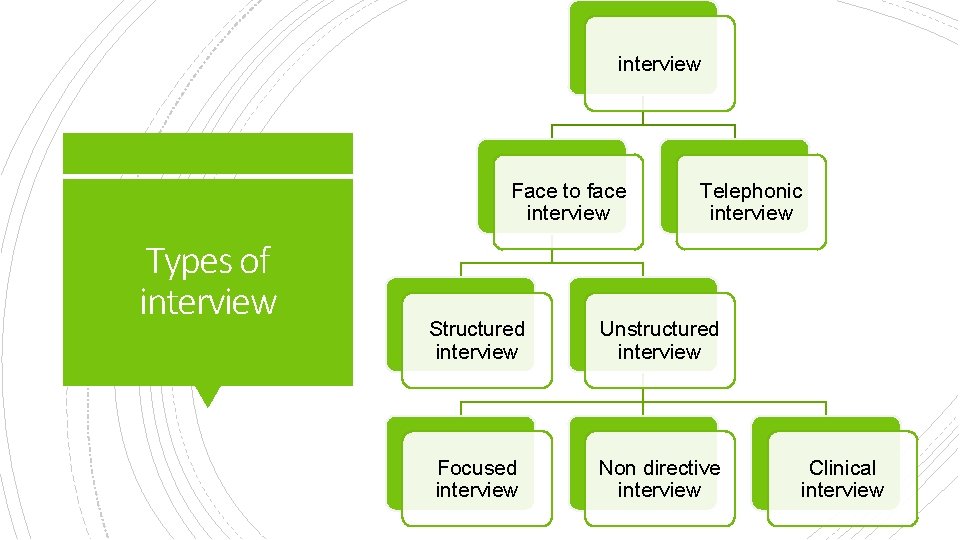
interview Face to face interview Types of interview Telephonic interview Structured interview Unstructured interview Focused interview Non directive interview Clinical interview
§ In structured interview the interviewer asks the pre§ drafted set of questions. Here he/she cannot change § the questions, or the sequence. No freedom of addition Structured Interview § or deletion of the questions is possible. § Example. § 1)Do you make use of computers in your research? § a) Yes………. . b) No………. § 2) Are you aware of the concept of deep web? § a) Yes………. b) No……….
§ Advantages § • Generates uniform data. § • Requires less skill. Structured interviews § • Requires less time. § Disadvantages § • More Ambiguity. § • No clearance of doubts. § • No possibility of addition or deletion
§ In this type of interview the interviewer exercises § autonomy what ever comes to his/her mind on a § particular research problem. Here interviewer is Unstructured Interview § free to ask additional questions and also repeat, § delete or modify questions. § Example. § Q) How do you keep up-to-date in the field of research? § ………………………………………………………….
§ Advantages § • Free to ask additional questions. § • Gives in depth information. Unstructured Interview § • More flexible. § Disadvantages § • Time consuming. § • Demands specialized training. § • Difficult to analyse the results

§ Focussed interview is conducted basically to get § focussed, in depth information on may given issue § from the respondent. The main task of the Focused Interview § interviewer is to involve the respondent in § discussion on specific topic so that the researcher § gets desired information. § Q) As a preserver of the library how you are saving § books from insects
§ Interviewer in this type of interview acts like a § catalyst. He/she prompts the respondent to give § information on the topic under investigation. Here § respondent is given free environment so that he can Non-directive Interview § express his views freely and to the point. The § researcher simply supports the views expressed by the § respondent instead of approving or disapproving them. § Example: § Q) Tell me about the incident in which your all documents § were burned.
§ This type of interview basically covers the broad § underlying feelings, life experiences, motivations of § the respondents. Here the interviewer has the § freedom to interact freely with the respondent to Clinical Interview § elicit the information on the given topic. § This type of interview are conducted during social § case work, in psychiatric clinics and in prison § administration. Example: § Q) Which circumstances made you to theft the precious book of our library?
§ This type of interview is conducted on phone. the Telephonic Interview § researcher needs a telephone connection and an § instrument, a phone directory and a set of questions § to be asked. § It plays an important role in industrial research.
§ Advantages. § • Faster and cheaper. § • Replies can be recorded. § • No field staff required. § Disadvantages Telephonic Interview § • Costly International calls. § • Possibility of having no telephone connections to § respondents. § • Poor signal or other network problem. § • Language barrier. § • No control over respondents environment.

§ CATI system is used to conduct telephone interview Computer Assisted Telephone Interviewing (CATI) System § to gather data from number of respondents scattered § all over the world. In simple words computer is used § to conduct surveys. This system requires PC , which is § linked through network to server where data can be § stored centrally.
§ Plan Interview Process § • Preparation of Interview schedule § • Pilot test of the study § • Conducting the Interview
§ In this stage the researcher plans the whole interview Plan process, § which includes the training, time and venue. § it also takes into account the cost factor and travel time
Preparation of Interview schedule §. § It is a list of printed questions prepared in advance, set in § some order or sequence. The researcher records the answers § on the printed schedule during the interview session.
§ Before the actual interview process starts it is advisable to § pre test the interview questions. A group of respondents Pilot test of the study § should be selected for pilot study. But this group should not § be included in the proper study. After getting responses the § researcher can modify it accordingly
§ Here the researcher manages multiple tasks like putting § questions to the respondents, giving clarifications, Conducting the Interview § explanations, demonstrations and listening answers. § The researcher has to take care of time. The questions should § be covered in the session.
§ Interviewer should always plan in advance the § venue and time. § • Should behave friendly with the respondent. § • Should have the ability to mobilize the respondent Guidelines for conducting Interviews § to answer freely and frankly. § • Questions should be well framed. § • Complex questions should be avoided. § • Should have an unbiased approach. § • Should not indulge in any argument. § Should show gratitude for the respondent
§ In closed ended questions it is easy to record the responses on Recording the interview § the interview schedule and it becomes easy for researcher to § write the responses in the same way as the respondent § responses. This method is called Note Taking Method.
§ For open-ended questions, it is difficult for a researcher to § remind all the responses of the respondent and to write them. recording § Thus In order to get the successful substance from the § researcher it is easy to record the interview by using a tape § recorder and to record all necessary information for data § analysis and interpretation
Preparation of Verbatim Transcripts: § After the interview the recording are transformed into § verbatim transcripts. This form the primary material for § research

§ Analysing the qualitative data is a very difficult task. Same § sets of questions receive diverse answers. So the main Analyses of Data and Report Writing: work of § the researcher is to analyse the data by using many techniques. § Report form the basis of a research so it should be very clear § and précis.

Thank You
- Slides: 27