
RESEARCH METHODOLOGY FOR CSC Lecture 01 A walkthrough

- Slides: 23
RESEARCH METHODOLOGY FOR CSC Lecture 01: A walkthrough to the course Module Leader: Mr. Bilal Ahmad
INTRODUCTION TO THE COURSE Course Name: Research Methodology for CSC Course Code: CSC 381 Module Leader: Mr. Bilal Ahmad Lecture Timing: 10: 30 AM to 12: 50 PM & 1: 05 PM to 3: 00 PM Email of the Module Leader: bilal@leads. edu. pk Visiting Hours: Monday till Thursday 9: 30 to 10: 00 AM & 2: 15 to 2: 45 PM + Sunday 11 AM to 1 PM. NO STUDENT WILL BE ALLOWED IN THE CLASS AFTER 10: 40 AM.
AIM OF THE COURSE Providing the Students of Computer Science, Information Technology and Software Engineering With the Conceptual Research and Working Skills. Facilitating a smooth transition to undergraduate studies and research. The course spans multiple elements including TIME Management, Writing and Presentation Skills and general consideration for the Experiment Design and Planning. Key Words to Remember; For Computer Science “CS” For Information Technology “IT” For Software Engineering “SE”
COURSE DESCRIPTION Introduction to Research Methodology and Research Methods in Computer Science, Information Technology and Software Engineering: Experimental, Quantitative, Qualitative and Development Research. The course will cover the Topics such as Development of relevant Research Questions, exploration of scientific inquiry in Computer Science, and the challenges and opportunities of the multidisciplinary Research. Introduction to Research Ethics and writing Scientific Reports.
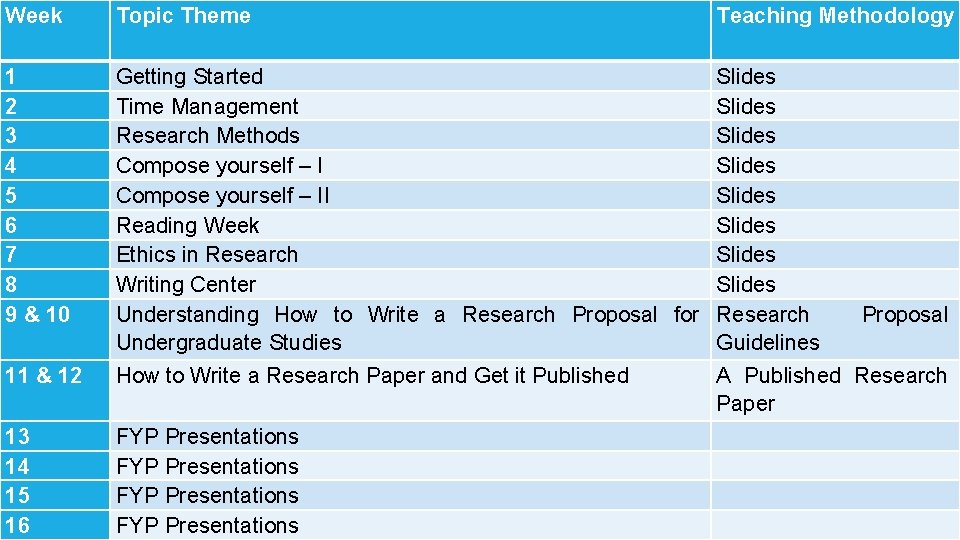
Week Topic Theme 1 2 3 4 5 6 7 8 9 & 10 Getting Started Slides Time Management Slides Research Methods Slides Compose yourself – II Slides Reading Week Slides Ethics in Research Slides Writing Center Slides Understanding How to Write a Research Proposal for Research Proposal Undergraduate Studies Guidelines How to Write a Research Paper and Get it Published A Published Research Paper FYP Presentations 11 & 12 13 14 15 16 Teaching Methodology
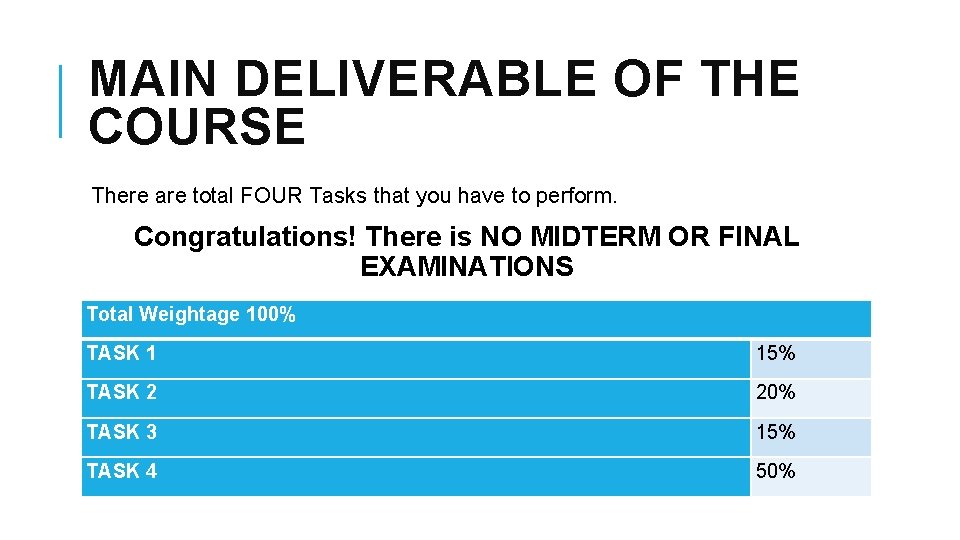
MAIN DELIVERABLE OF THE COURSE There are total FOUR Tasks that you have to perform. Congratulations! There is NO MIDTERM OR FINAL EXAMINATIONS Total Weightage 100% TASK 1 15% TASK 2 20% TASK 3 15% TASK 4 50%
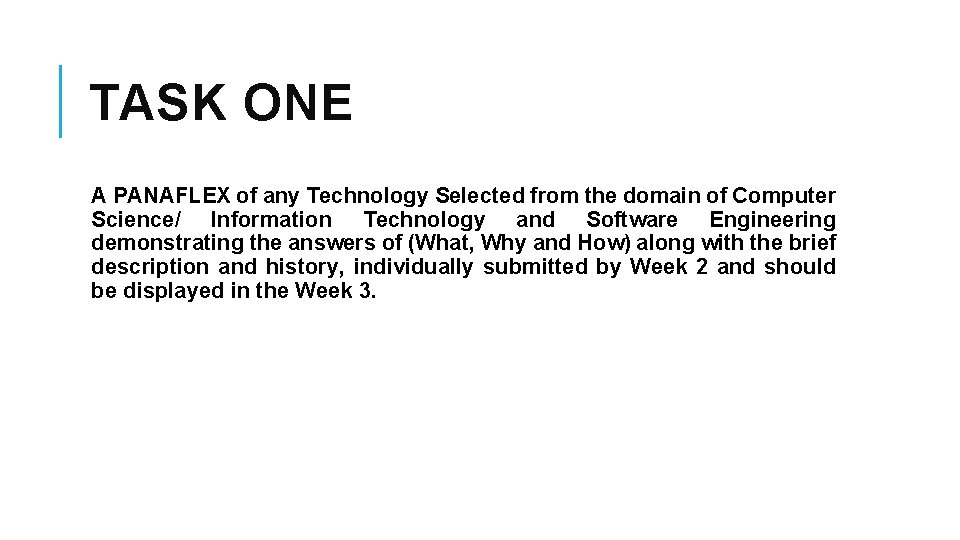
TASK ONE A PANAFLEX of any Technology Selected from the domain of Computer Science/ Information Technology and Software Engineering demonstrating the answers of (What, Why and How) along with the brief description and history, individually submitted by Week 2 and should be displayed in the Week 3.
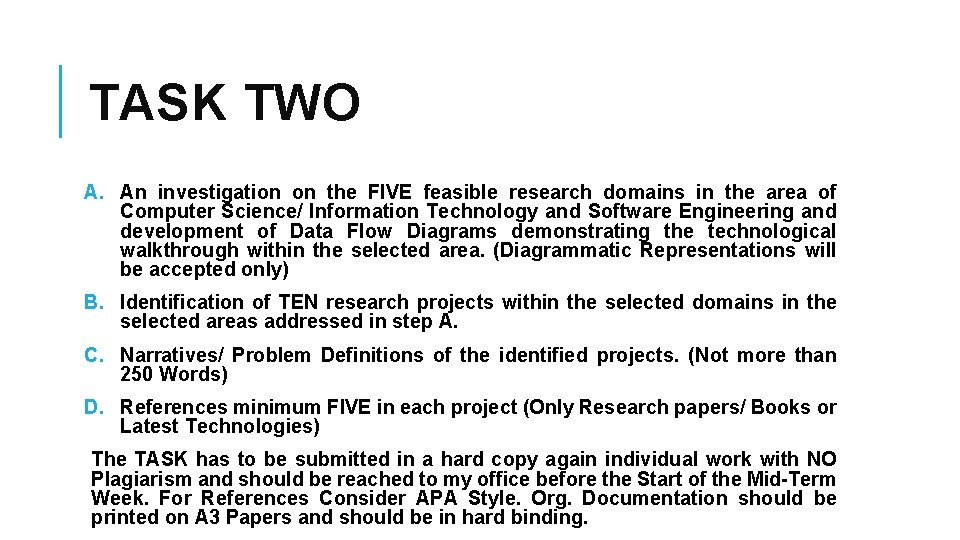
TASK TWO A. An investigation on the FIVE feasible research domains in the area of Computer Science/ Information Technology and Software Engineering and development of Data Flow Diagrams demonstrating the technological walkthrough within the selected area. (Diagrammatic Representations will be accepted only) B. Identification of TEN research projects within the selected domains in the selected areas addressed in step A. C. Narratives/ Problem Definitions of the identified projects. (Not more than 250 Words) D. References minimum FIVE in each project (Only Research papers/ Books or Latest Technologies) The TASK has to be submitted in a hard copy again individual work with NO Plagiarism and should be reached to my office before the Start of the Mid-Term Week. For References Consider APA Style. Org. Documentation should be printed on A 3 Papers and should be in hard binding.
TASK THREE Submission of filled Documentation provided by the department that have information of the agreed Final Year Project Topic and allocated supervisor by Week 9. Visit the Photocopier he has the material for Research Proposal Guidelines and Student Performa. This is a Group activity and a Group should not have more or less than THREE Students.
TASK FOUR Submission of Final Project Proposal signed by the project supervisor and appearing in the Final Year Presentation starting from week 13. The Presentation has to be on a Power Point Slides. You will be having only 10 Minutes to demonstrate your work and then the assessment committee will judge your work. Bring THREE Copies of your proposal, all must be signed by the Supervisor and Plagiarism checked by the Chief Librarian officer.
RECOMMENDED BOOK Booth, Colomb, and Williams, “The Craft of Research”, University of Chicago Press, 3 rd Edition, 2008
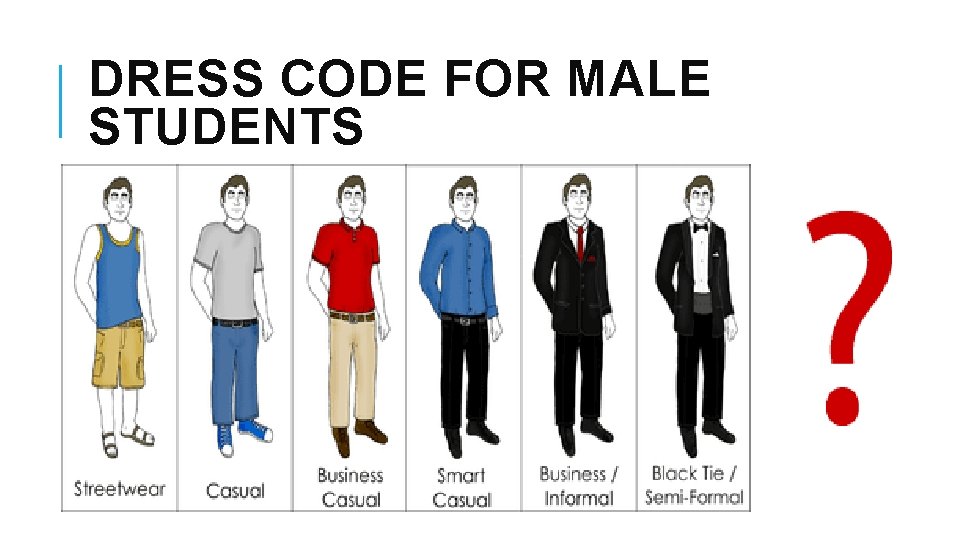
SUGGESTIONS IF YOU WANT TO ACHIEVE GOOD GRADES 1. Attend all the Lectures as Lahore Leads University Attendance Policy will be Strictly followed 2. Participate in all the Class activities 3. Don’t miss any assessment as there will no late submissions accepted 4. All Submissions should be in Hard Copies NO Soft Copies are acceptable 5. Don’t Plagiarize 6. Always come in FORMAL Dress while Presenting or displaying any activity. NO CASUAL dresses are acceptable 7. NO REPEAT/ NO CLASHES
DRESS CODE FOR MALE STUDENTS
DRESS CODE FOR FEMALE STUDENTS
GETTING STARTED! What is the difference between SEARCH & RE-SEARCH? LETS PERFORM A CLASS ACTIVITY I WANT YOU TO WRITE DOWN ON A NEAT PLACE OF PAPER ABOUT YOUR QUALITIES AND WHAT MAKES YOU DIFFERENT FROM OTHER STUDENTS?
SEARCH AND RESEARCH Search and research are TWO different words in the English Language. Students get confused by the similar composition of both words. In the coming slides you will come to know that there are so many differences between the two and what are they? Search: An act of find something, which has lost before or missing. For example I am searching for my mobile phone. To explore through travel an unfamiliar area To find food: The birds search for insects To Look for something for further study (I am searching on GOOGLE for my research topic)
SEARCH AND RESEARCH CONTINUED RESEARCH: It is a systematic act of examining or questioning into a subject for improved (Revise) fact, theory or application etc. For example you are trying to find that a particular tool/ software can model your system or not. For this you will follow a systematic process of research to analyze information to establish the facts and to arrive the conclusion.
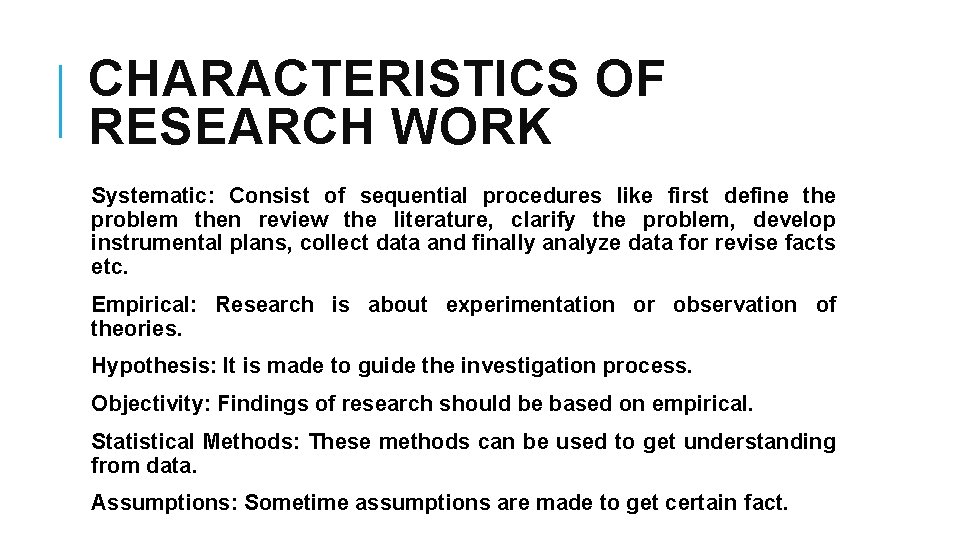
CHARACTERISTICS OF RESEARCH WORK Systematic: Consist of sequential procedures like first define the problem then review the literature, clarify the problem, develop instrumental plans, collect data and finally analyze data for revise facts etc. Empirical: Research is about experimentation or observation of theories. Hypothesis: It is made to guide the investigation process. Objectivity: Findings of research should be based on empirical. Statistical Methods: These methods can be used to get understanding from data. Assumptions: Sometime assumptions are made to get certain fact.
CONCLUSION Search is to look for something and Research is to look into it. Research is normally done by experts however, the search is made by everybody.
WHAT IS RESEARCH IN CS/ IT AND SE? Computer science is the engine of the digital revolution, contributing to the emergence of entirely new industries and dramatic changes in quality of life. Continuing advances in revolution depend heavily on computer science. this digital research in
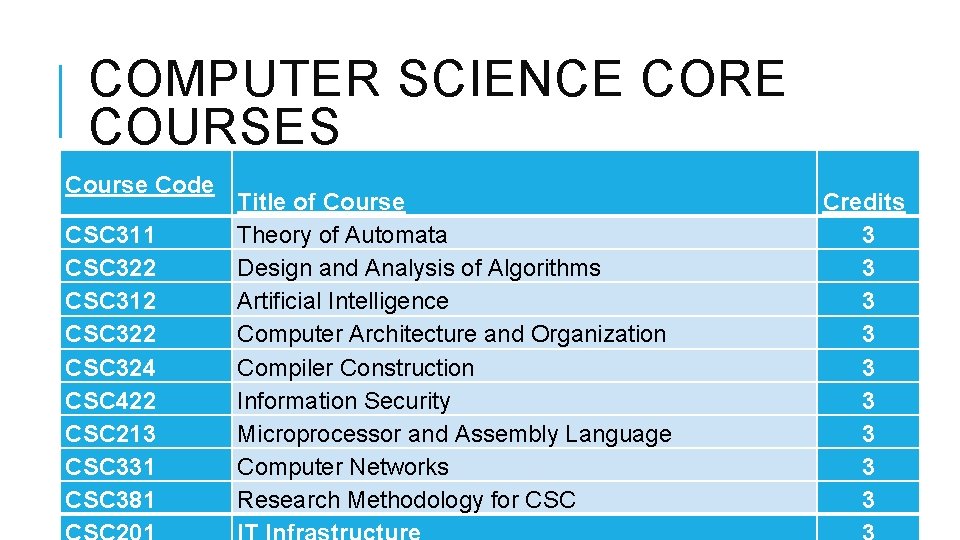
COMPUTER SCIENCE CORE COURSES Course Code CSC 311 CSC 322 CSC 312 CSC 324 CSC 422 CSC 213 CSC 331 CSC 381 Title of Course Theory of Automata Design and Analysis of Algorithms Artificial Intelligence Computer Architecture and Organization Compiler Construction Information Security Microprocessor and Assembly Language Computer Networks Research Methodology for CSC Credits 3 3 3 3 3
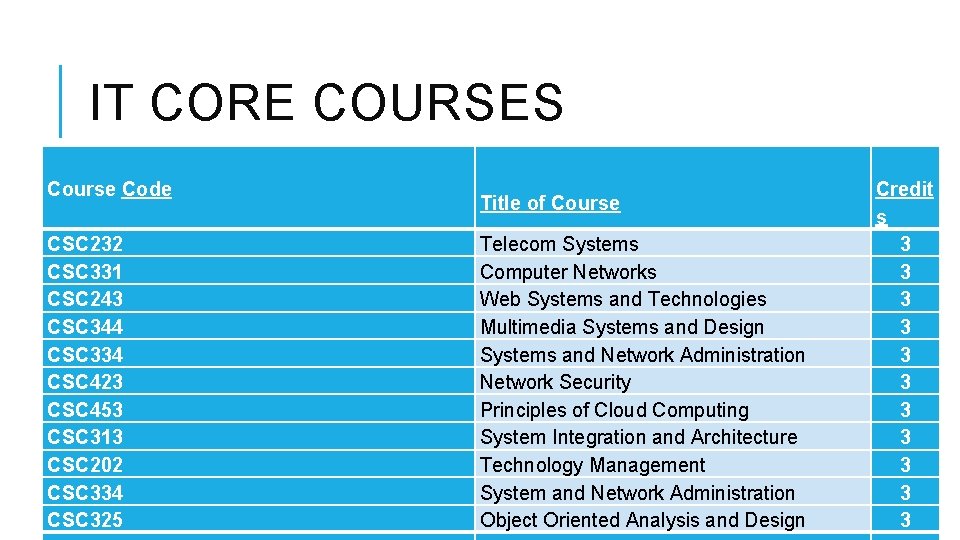
IT CORE COURSES Course Code CSC 232 CSC 331 CSC 243 CSC 344 CSC 334 CSC 423 CSC 453 CSC 313 CSC 202 CSC 334 CSC 325 Title of Course Telecom Systems Computer Networks Web Systems and Technologies Multimedia Systems and Design Systems and Network Administration Network Security Principles of Cloud Computing System Integration and Architecture Technology Management System and Network Administration Object Oriented Analysis and Design Credit s 3 3 3
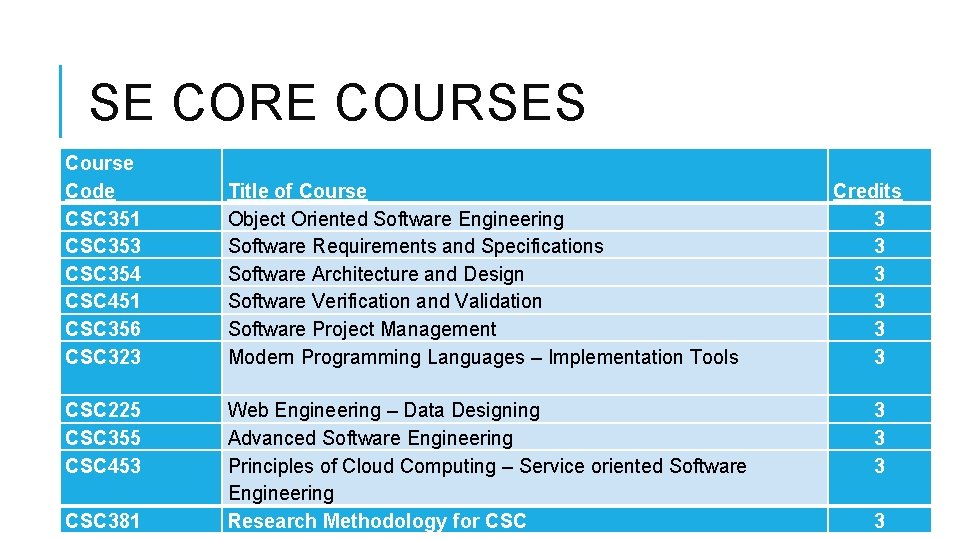
SE CORE COURSES Course Code CSC 351 CSC 353 CSC 354 CSC 451 CSC 356 CSC 323 CSC 225 CSC 355 CSC 453 CSC 381 Title of Course Object Oriented Software Engineering Software Requirements and Specifications Software Architecture and Design Software Verification and Validation Software Project Management Modern Programming Languages – Implementation Tools Web Engineering – Data Designing Advanced Software Engineering Principles of Cloud Computing – Service oriented Software Engineering Research Methodology for CSC Credits 3 3 3 3 3