
Research Methodology Definition Business Research o Systematic and
Research Methodology

Definition: Business Research o Systematic and Scientific inquiry aimed at providing information to solve managerial problems
Basic (Fundamental) Research o o Generalization of natural phenomenon or human behavior Conducted to solve perplexing questions of a theoretical nature E. g. Cars running on compressed air
Applied Research o o Solution to some practical problems Conducted to reveal answers to specific questions related to action or policy needs E. g. Study of declining sales of particular car model
Why business research? n n n Manager wants improve decision making skill by widening his knowledge to reduce uncertainty to justify his decision
Business Research o Corporate research: n n n Forecasting Economic trends Business & Industry trends Technology trends Global environment
o Financial Research: n n n o Portfolio analysis Business opportunities & threats analysis Cost analysis Production: n Total quality management
o Sales & Marketing: n n n n Market potential Market share Market segmentation Sales analysis Sales forecasting New product testing Effectiveness of marketing strategies
o Human resources: n n Morale & job satisfaction Employee productivity Organizational effectiveness Training needs
o Information system: o o o Data mining Technical support satisfaction Enterprise Resource Planning (ERP)/Customer Relationship Management (CRM) systems
Types Of Research o Exploratory o Descriptive o Predictive
Exploratory Research o o Gather Information around the topic at elementary level Leads to insights into the problem E. g. a pharmaceutical company wants to expand
Descriptive Research o o o Fact finding inquiries Who, what, when, how, where etc No powerful inference is drawn E. g. mining company databases for describing the nature customer complaints.
Predictive Research o o Cause –effect relationship Conducted for well understood problems E. g. sale of small cars depends on price, fuel efficiency, engine
Research Process o o o Formulating Research problem Select Research design Data collection and presentation Data analysis and interpretation Research reporting
Formulating a Research Problem
Problem: Dilemma faced by manager E. g. Software consulting firm is witnessing high attrition of employees
Management Question o o What are the reasons for high attrition rate? What steps to be taken to control it?
Research Question o o What is the employee satisfaction level in the organisation? What are the corrective measures available?
Investigating Question o o Timings, travelling, facilities available, work culture Annual increment, additional incentives, permission to pursue higher education
Measurement Question o Questions to be asked to employees regarding timings, travelling, facilities available, work culture, additional incentives, permission to pursue higher education etc.
Formulated Research Problem o o o What characteristics are to be studied? What data is to be collected? What relations need to be explored?
Research Design o Research design is a plan and structure of investigation to obtain answers to research questions
Exploratory Studies Aim is to find the practicality to do formal research in this area The techniques used are o Secondary data analysis o Experience Survey o Focus groups o Depth interviews
Secondary Data Analysis Review of prior research studies o Survey of concerned literature: Catalogs, subject guides and electronic indexes in libraries help to identify periodicals and books o Online service using computer This method supplies excellent background, identifies suitable methodology and decision making patterns. o
Experience Survey o Seeking information from persons experienced in the area of study by interviewing This technique gives practicality of doing study, facilities available, factors need to be controlled
Focus Groups o o Panel of people led by a trained moderator Facilitator introduces the topic and encourages the group to discuss it among themselves Quickly and inexpensively grasp the core issues
Depth Interviews o o Carried out to obtain information on sensitive issues to discover motives and desires Respondent is taken in confidence Answers are obtained by probing Indirect questions provide information on attitude towards the subject
Descriptive Studies The research design in such studies should be rigid , no bias , reliable and should aim at o Description of the characteristics associated with the population o Estimates of the proportion of the population possessing the characteristics o Studying association among these characteristics
Causal Studies o o If Changes in one variable are responsible for changes in another variable then the former variable is independent and later is dependent Drawing inferences about causal relationship require procedures that will reduce bias and increase reliability
Design of Experiments o o o Replication: repetition of observation Random assignment: each person must have equal chance of exposure Control: All other factors must be held constant
Informal Experimental Designs
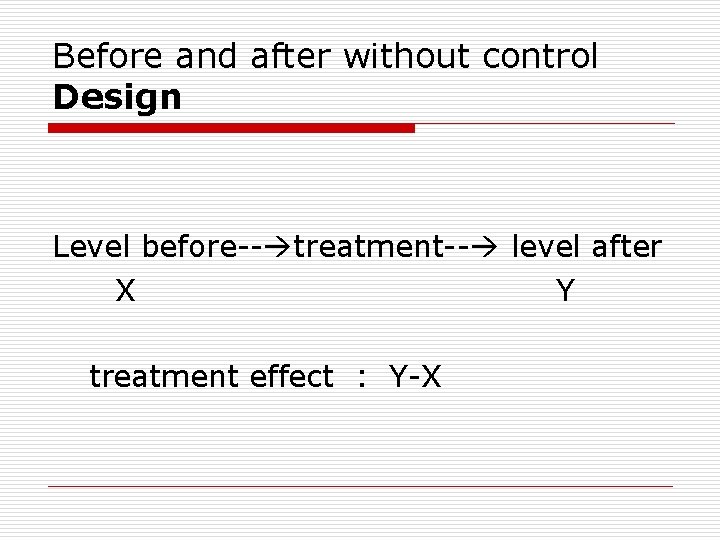
Before and after without control Design Level before-- treatment-- level after X Y treatment effect : Y-X
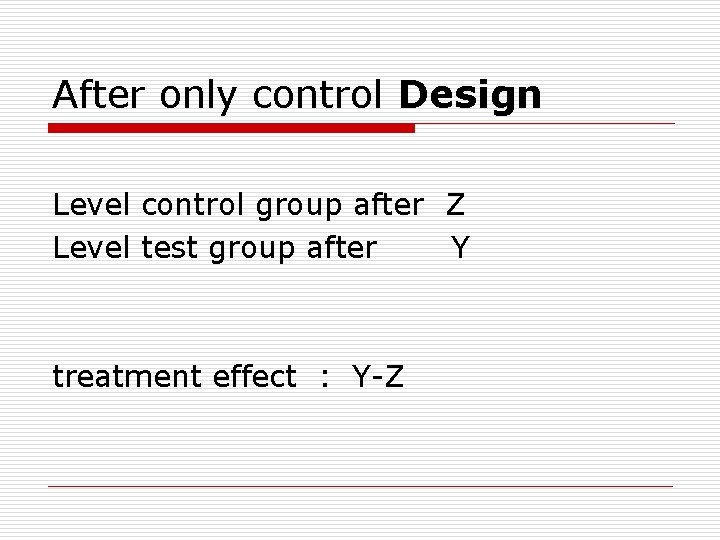
After only control Design Level control group after Z Level test group after Y treatment effect : Y-Z
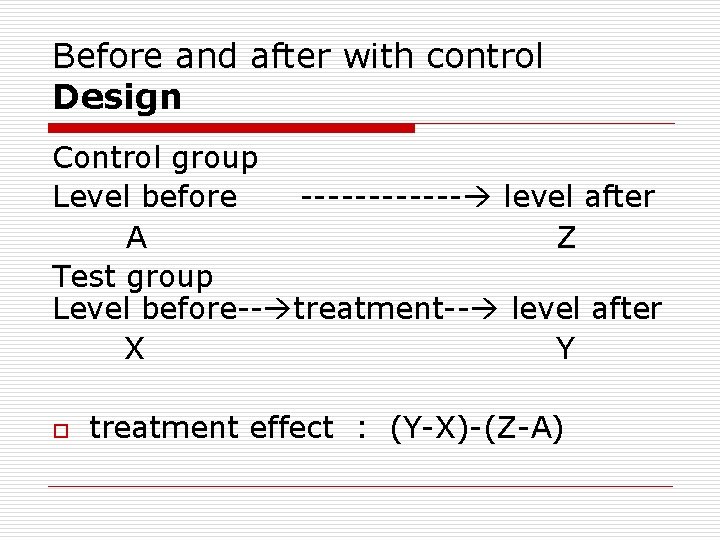
Before and after with control Design Control group Level before ------ level after A Z Test group Level before-- treatment-- level after X Y o treatment effect : (Y-X)-(Z-A)
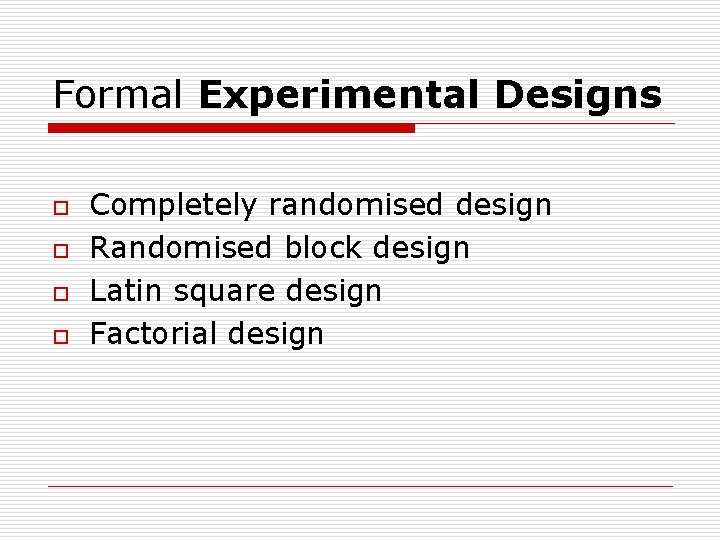
Formal Experimental Designs o o Completely randomised design Randomised block design Latin square design Factorial design
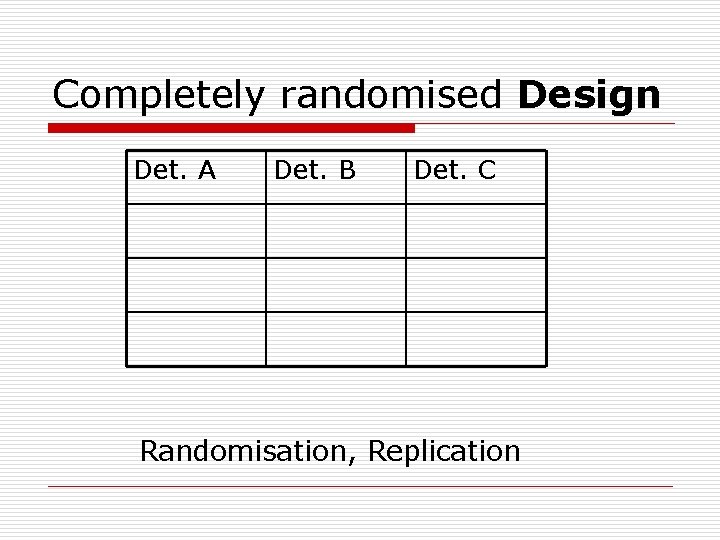
Completely randomised Design Det. A Det. B Det. C Randomisation, Replication
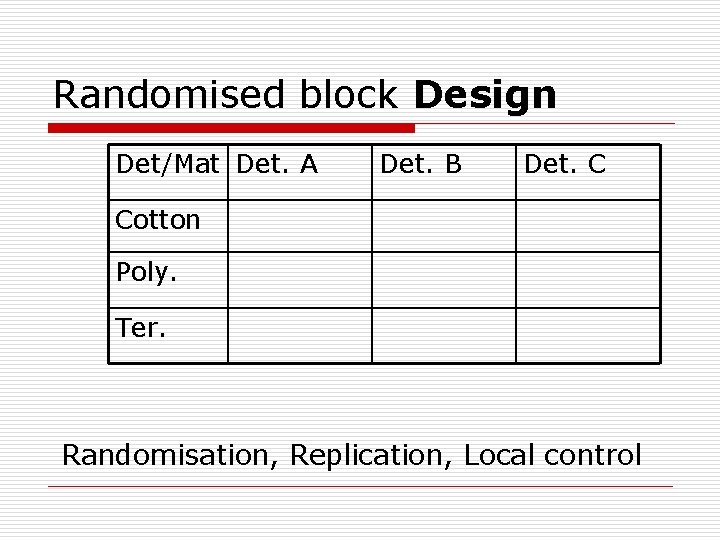
Randomised block Design Det/Mat Det. A Det. B Det. C Cotton Poly. Ter. Randomisation, Replication, Local control
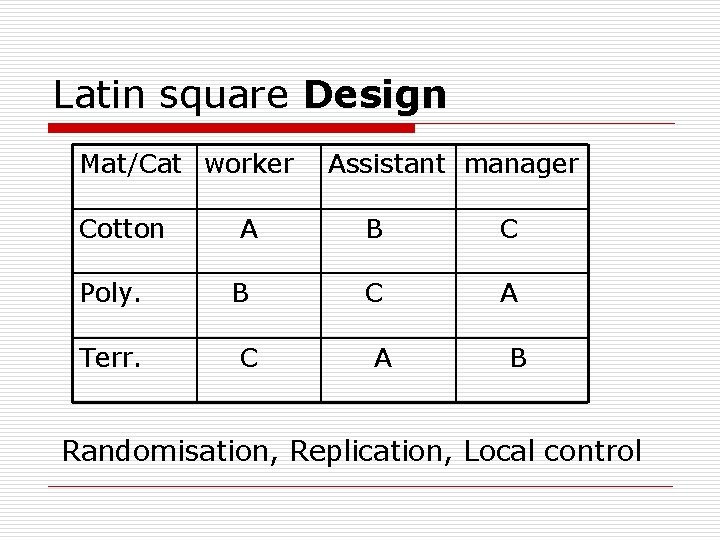
Latin square Design Mat/Cat worker Cotton Poly. Terr. A B C Assistant manager B C C A A B Randomisation, Replication, Local control
Factorial Design o o Treatments are combination of factors at different levels. Effects of the factors rather than treatments are studied.
Ex Post Facto Design o o o Widely used in business research Not possible to assign treatments Study of subjects exposed to treatments to seek causal explanation
Sampling Design o Census versus sample Census: small population Sample: greater speed, less cost, greater accuracy, inevitable Sample must represent all characteristics of the population. (no bias, precise)
Types of Sampling o Probability sampling o Non probability sampling
Probability Sampling o o o Simple random sampling Systematic sampling Stratified sampling Cluster sampling Multi-stage sampling
Non probability Sampling o Judgment sampling o Quota sampling
Sample Size Sample size should be proportional to population size Larger sample is required if o Greater dispersion within population o High confidence level in the estimates o Narrow interval range budget constraint may influence sample size
Measurement and Scaling o o Measurement: assigning numbers to objects with a set of rules Data types: Classification - nominal Order - ordinal Distance - interval Origin - ratio
Tests of Measurement o o o Validity: the extent to which the measuring tool measures what we are interested in measuring Reliability: Accuracy and precision of measurement procedure Practicality: economy, convenience and interpretability
Scaling Procedure for assignment of numbers to objects Types of measurement scale o Rating o Ranking o Categorization
Rating Scales E. g. Survey on mobiles
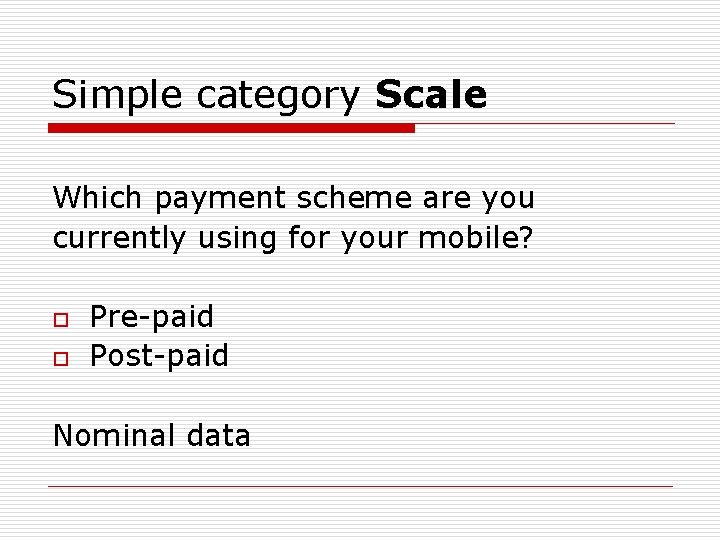
Simple category Scale Which payment scheme are you currently using for your mobile? o o Pre-paid Post-paid Nominal data
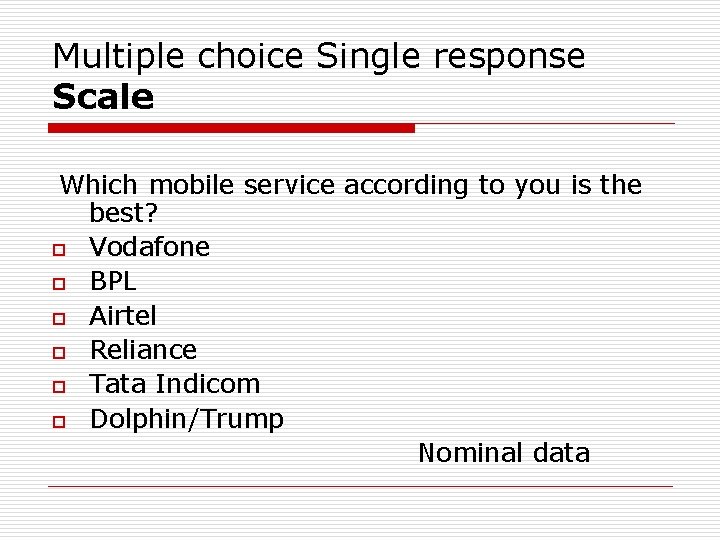
Multiple choice Single response Scale Which mobile service according to you is the best? o Vodafone o BPL o Airtel o Reliance o Tata Indicom o Dolphin/Trump Nominal data
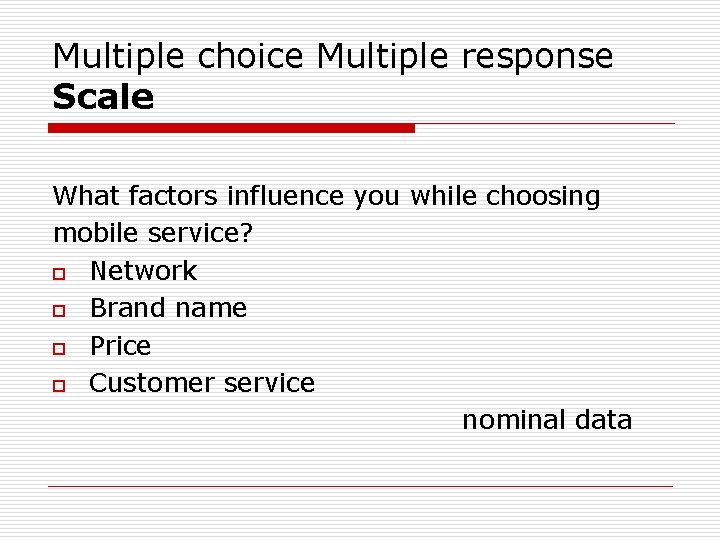
Multiple choice Multiple response Scale What factors influence you while choosing mobile service? o Network o Brand name o Price o Customer service nominal data
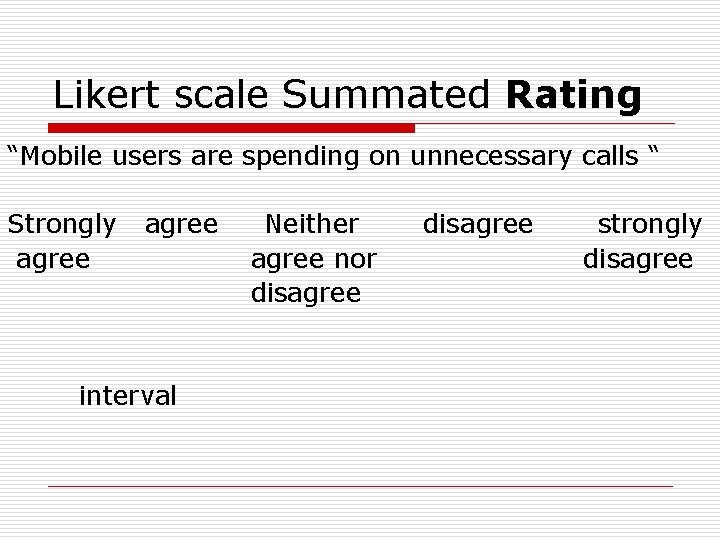
Likert scale Summated Rating “Mobile users are spending on unnecessary calls “ Strongly agree interval Neither agree nor disagree strongly disagree
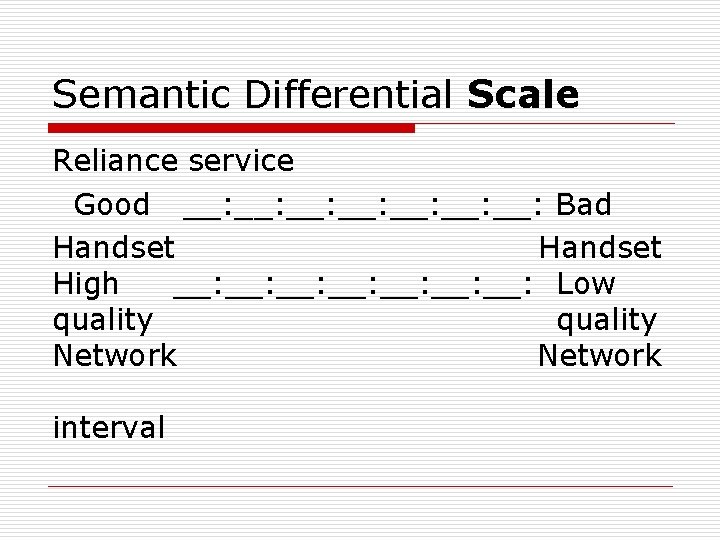
Semantic Differential Scale Reliance service Good __: __: Bad Handset High __: __: Low quality Network interval
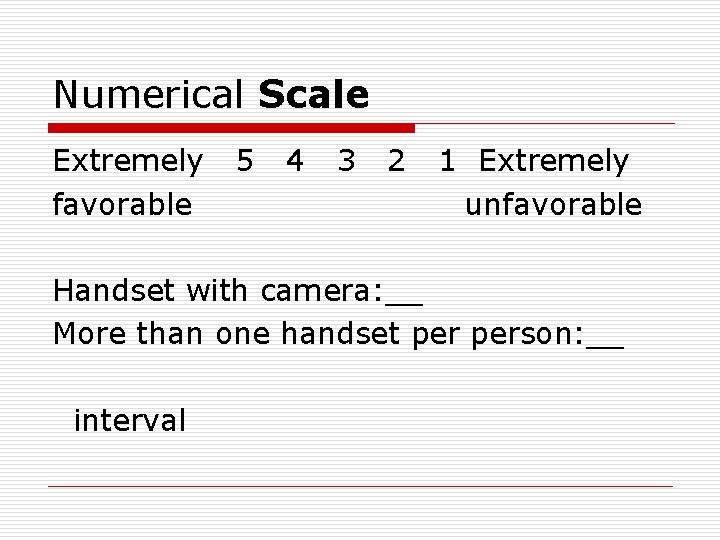
Numerical Scale Extremely favorable 5 4 3 2 1 Extremely unfavorable Handset with camera: __ More than one handset person: __ interval
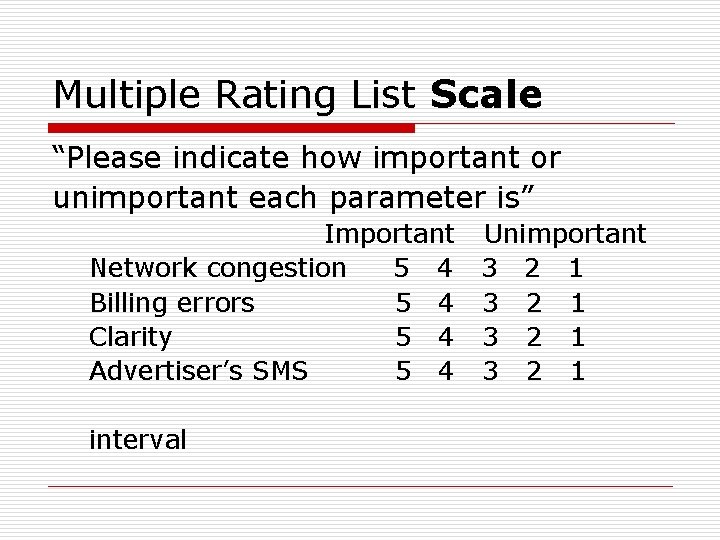
Multiple Rating List Scale “Please indicate how important or unimportant each parameter is” Important Unimportant Network congestion 5 4 3 2 1 Billing errors 5 4 3 2 1 Clarity 5 4 3 2 1 Advertiser’s SMS 5 4 3 2 1 interval
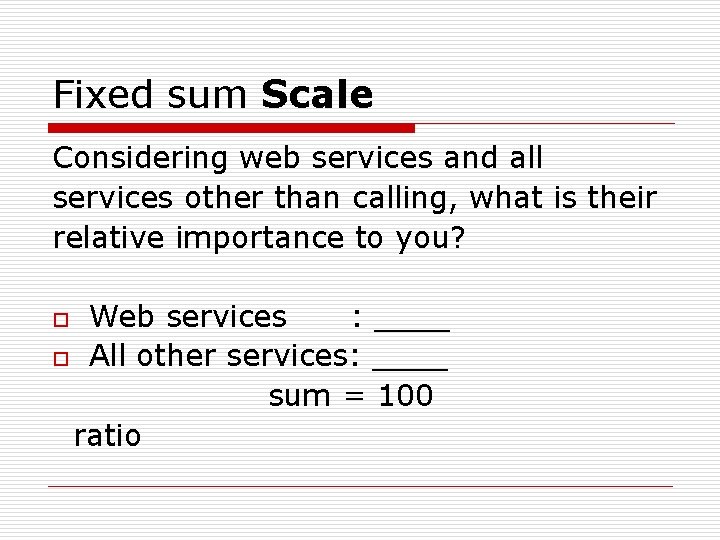
Fixed sum Scale Considering web services and all services other than calling, what is their relative importance to you? Web services : ____ o All other services: ____ sum = 100 ratio o
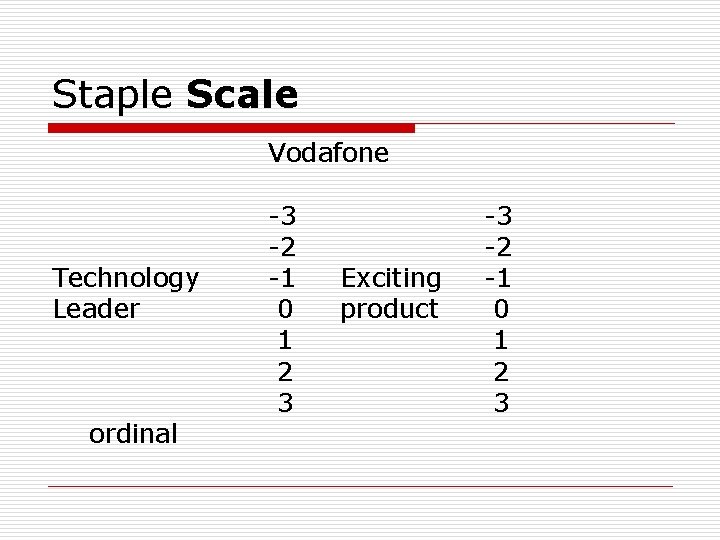
Staple Scale Vodafone Technology Leader ordinal -3 -2 -1 0 1 2 3 Exciting product -3 -2 -1 0 1 2 3
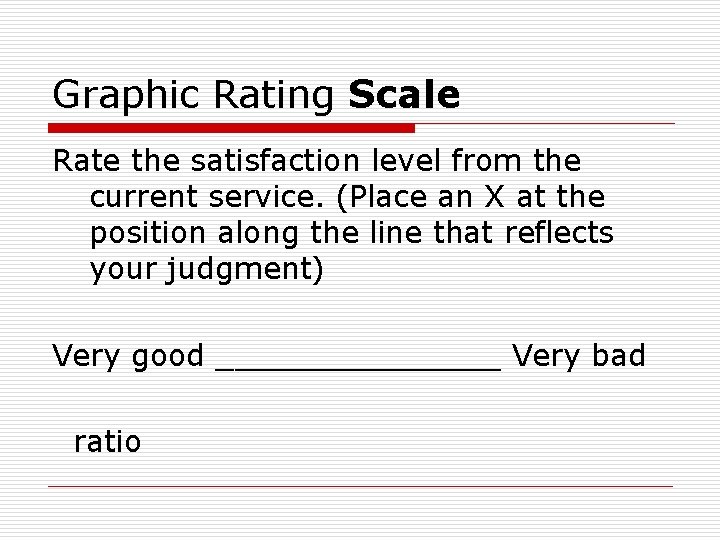
Graphic Rating Scale Rate the satisfaction level from the current service. (Place an X at the position along the line that reflects your judgment) Very good ________ Very bad ratio
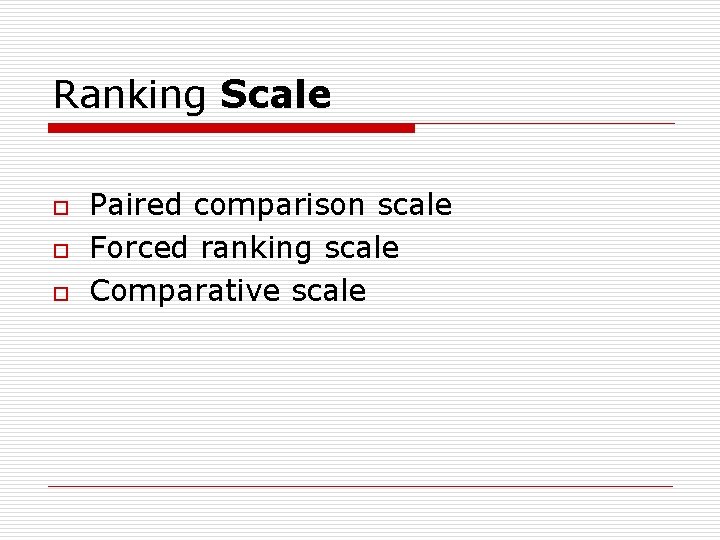
Ranking Scale o o o Paired comparison scale Forced ranking scale Comparative scale
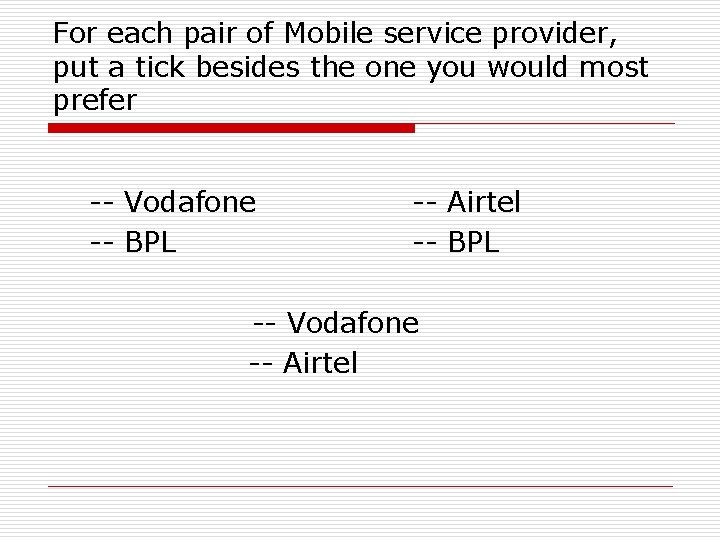
For each pair of Mobile service provider, put a tick besides the one you would most prefer -- Vodafone -- BPL -- Airtel -- BPL -- Vodafone -- Airtel
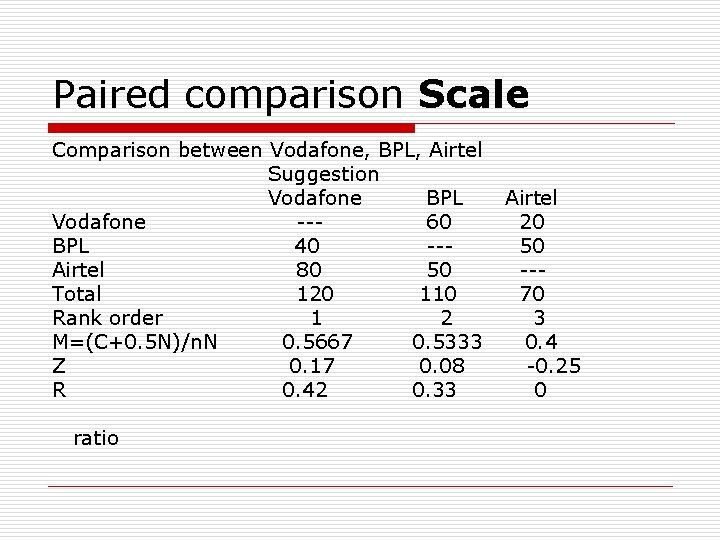
Paired comparison Scale Comparison between Vodafone, BPL, Airtel Suggestion Vodafone BPL Vodafone --60 BPL 40 --Airtel 80 50 Total 120 110 Rank order 1 2 M=(C+0. 5 N)/n. N 0. 5667 0. 5333 Z 0. 17 0. 08 R 0. 42 0. 33 ratio Airtel 20 50 --70 3 0. 4 -0. 25 0
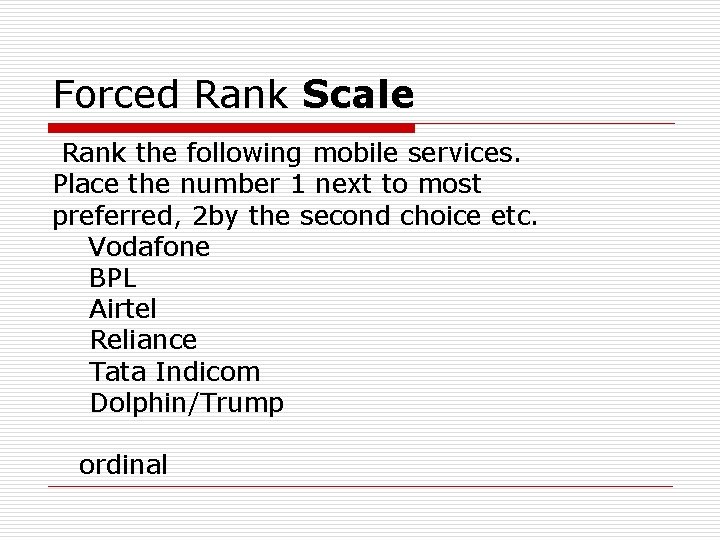
Forced Rank Scale Rank the following mobile services. Place the number 1 next to most preferred, 2 by the second choice etc. Vodafone BPL Airtel Reliance Tata Indicom Dolphin/Trump ordinal
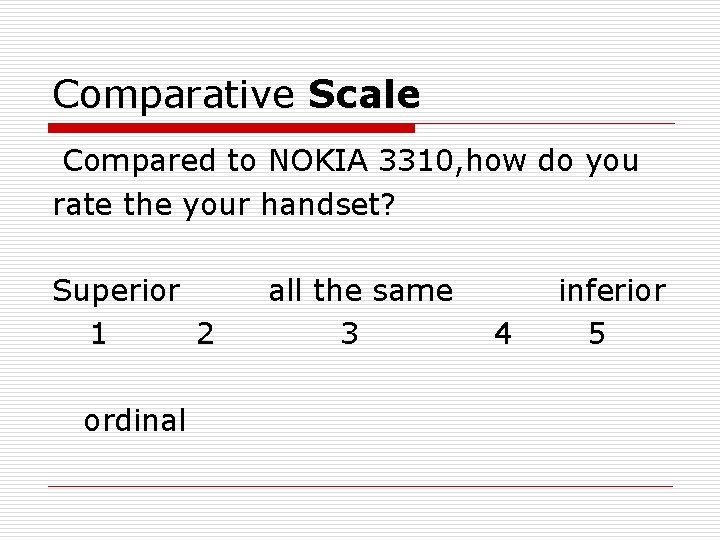
Comparative Scale Compared to NOKIA 3310, how do you rate the your handset? Superior 1 2 ordinal all the same 3 4 inferior 5
Measurement Scale Construction o o Arbitrary scaling Consensus scaling Item analysis scaling Cumulative scaling
Arbitrary Scaling o o o Designed by collecting several items appropriate to the given topic Each item is scored from 1 to 5 depending degree of favorableness Total represents respondent’s view
Consensus Scaling o o Panel of judges evaluate items on the basis of relevance to topic, potential for ambiguity and level of attitude Time consuming, costly , rarely used in management research
Item analysis Scaling o o Designed by collecting several items appropriate to the given topic Each item is scored from 1 to 5 depending degree of favorableness On the basis of total score two groups are formed (top 25% and bottom 25%) Comparative analysis of each statement of members of these two groups is carried out
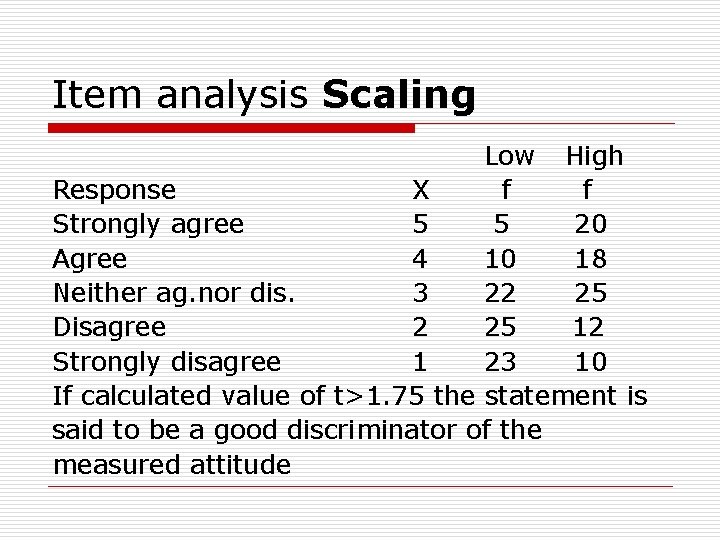
Item analysis Scaling Low High Response X f f Strongly agree 5 5 20 Agree 4 10 18 Neither ag. nor dis. 3 22 25 Disagree 2 25 12 Strongly disagree 1 23 10 If calculated value of t>1. 75 the statement is said to be a good discriminator of the measured attitude
Cumulative Scaling From total score it is possible to estimate which items were answered positively and negatively
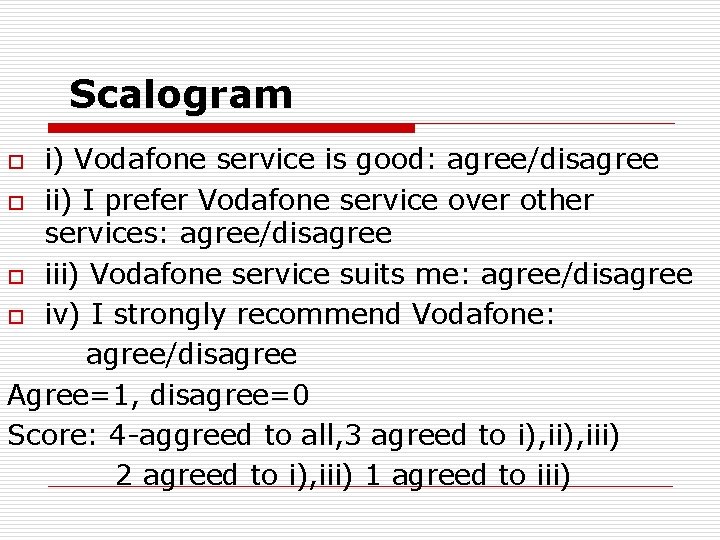
Scalogram i) Vodafone service is good: agree/disagree o ii) I prefer Vodafone service over other services: agree/disagree o iii) Vodafone service suits me: agree/disagree o iv) I strongly recommend Vodafone: agree/disagree Agree=1, disagree=0 Score: 4 -aggreed to all, 3 agreed to i), iii) 2 agreed to i), iii) 1 agreed to iii) o
Data collection and Presentation o o Primary sources (original work of research): Government data (census, economic, labour) laws, regulations Secondary sources (interpretation of primary data): magazines, newspapers, newscasts, annual reports
Government Sources o o National sample survey Economic survey Census survey http: //www. censusindia. net Central Statistical organisation: Statistical Outlines of India, annual survey of industries http: //mospi. nic. in
Other databases to Business Researchers CRISIL INFAC www. crisil. com o NSE publications o National readership survey (cinema, TV, radio, newspaper) o A C Nielsen company ( consumer products) www 2. acnielsen. com o ORG (pharmaceutical products) Mining Internal sources o
o o o TAM (Television Audience measurement) Adex ( advertising exposures ) IRS (Indian Readership survey) NRS (National Readership survey) indiacar. com autocarindia. com
Survey Methods o o o Observation method Interview method Questionnaire/schedules Projective techniques Case study method
Observation Method o o o Information obtained by direct observation without asking the respondents Scientific tool when systematically planned and recorded No non-response
Interview Method o o o Personal interview: Information directly obtained from person concerned Use of set of predetermined questions: structured interview Telephone interview
Questionnaire/schedules Method o o Questionnaire is mailed to the respondents and replies collected Schedules are similar to questionnaire but are being filled in by the enumerators
Projective Techniques o o Word association Sentence completion Thematic appreciation test Role play
Case Study Method o o o Qualitative analysis Observation on a social unit or a person or an institution or a community An exhaustive study of each and every aspect of the concerned unit and its relationship to other units
Questionnaire o o Question: short, simple, easy to understand, arranged in logical sequence, self explanatory, objective with possible answers, no numerical calculation, provide cross check Classification questions, target questions Covering letter Test on small group, remove deficiency, final draft
- Slides: 83