
Research method Introduction Fundamental type of research descriptive


- Slides: 75
Research method Introduction
Fundamental type of research descriptive research What is going on? explanatory research Why is it going on?
Descriptive research n n n Question: what no dismiss descriptive research – it is the first, fundamental step of research good description is fundamental to the research it has added immeasurably to our knowledge of the shape and nature of problem Concrete and/or abstract Good description provokes the why
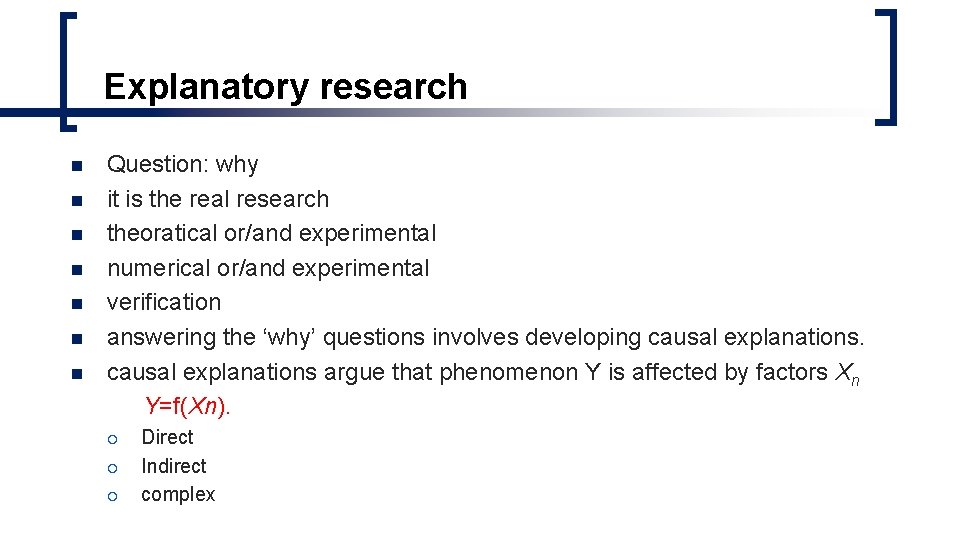
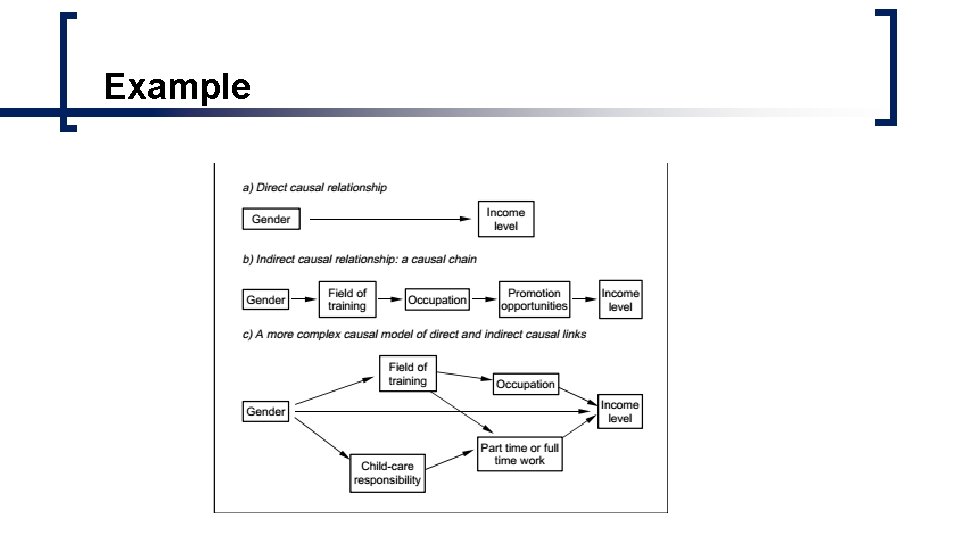
Explanatory research n n n n Question: why it is the real research theoratical or/and experimental numerical or/and experimental verification answering the ‘why’ questions involves developing causal explanations argue that phenomenon Y is affected by factors Xn Y=f(Xn). ¡ ¡ ¡ Direct Indirect complex
Example
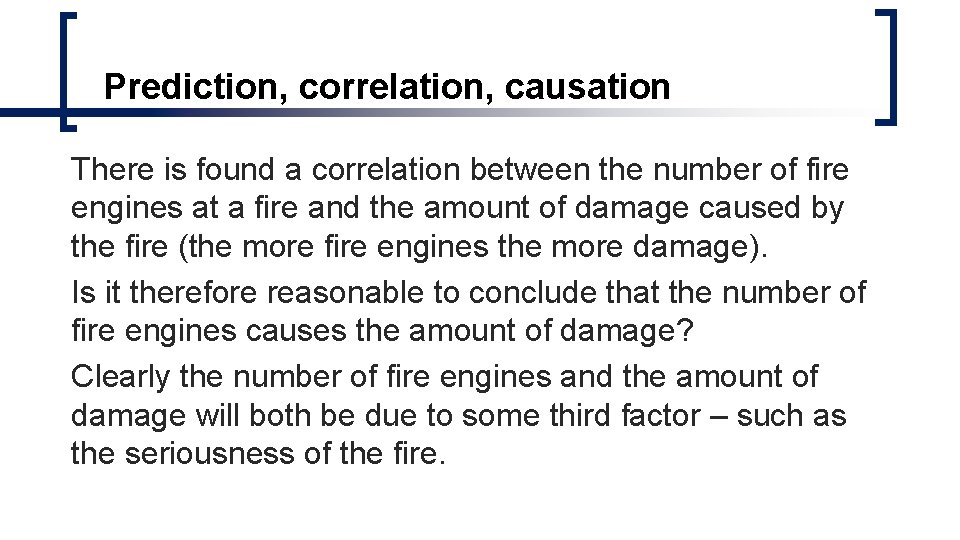
Prediction, correlation, causation There is found a correlation between the number of fire engines at a fire and the amount of damage caused by the fire (the more fire engines the more damage). Is it therefore reasonable to conclude that the number of fire engines causes the amount of damage? Clearly the number of fire engines and the amount of damage will both be due to some third factor – such as the seriousness of the fire.
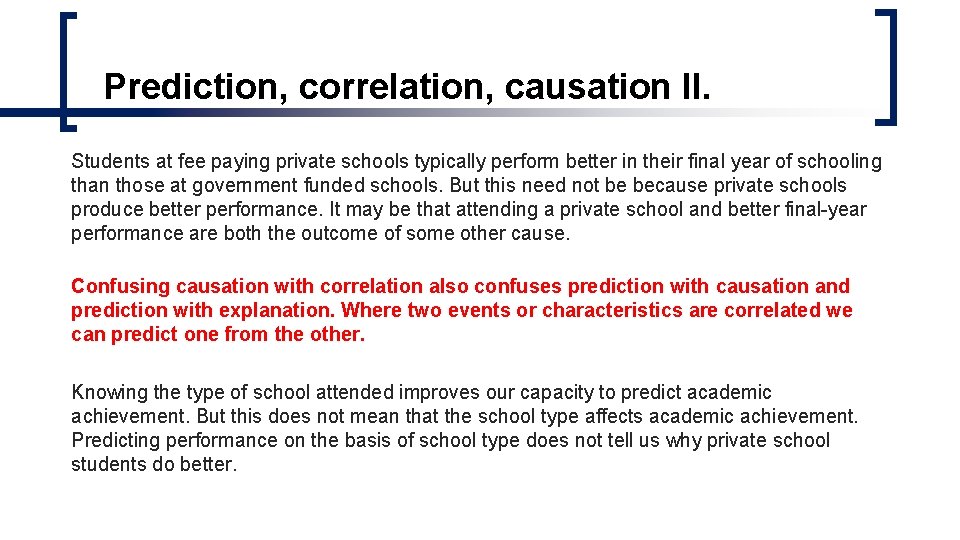
Prediction, correlation, causation II. Students at fee paying private schools typically perform better in their final year of schooling than those at government funded schools. But this need not be because private schools produce better performance. It may be that attending a private school and better final-year performance are both the outcome of some other cause. Confusing causation with correlation also confuses prediction with causation and prediction with explanation. Where two events or characteristics are correlated we can predict one from the other. Knowing the type of school attended improves our capacity to predict academic achievement. But this does not mean that the school type affects academic achievement. Predicting performance on the basis of school type does not tell us why private school students do better.
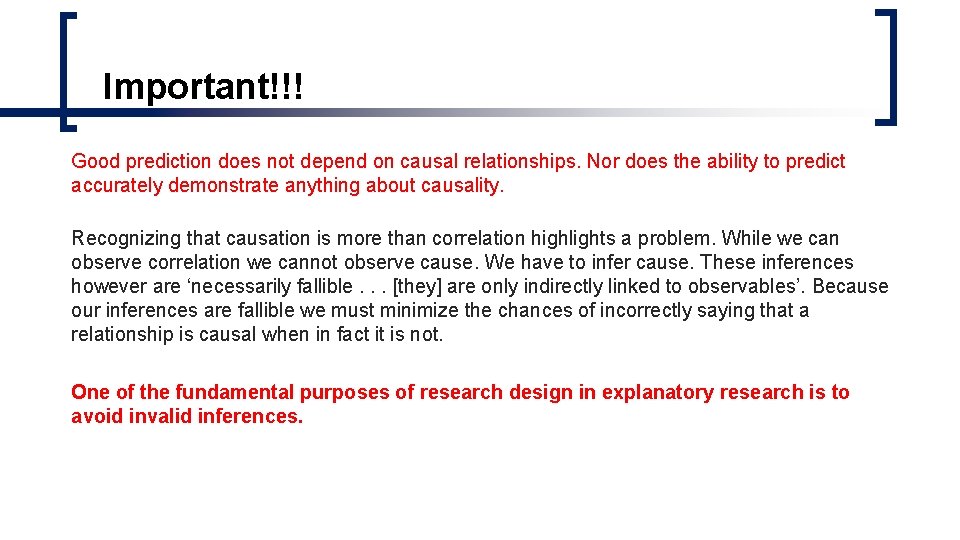
Important!!! Good prediction does not depend on causal relationships. Nor does the ability to predict accurately demonstrate anything about causality. Recognizing that causation is more than correlation highlights a problem. While we can observe correlation we cannot observe cause. We have to infer cause. These inferences however are ‘necessarily fallible. . . [they] are only indirectly linked to observables’. Because our inferences are fallible we must minimize the chances of incorrectly saying that a relationship is causal when in fact it is not. One of the fundamental purposes of research design in explanatory research is to avoid invalid inferences.
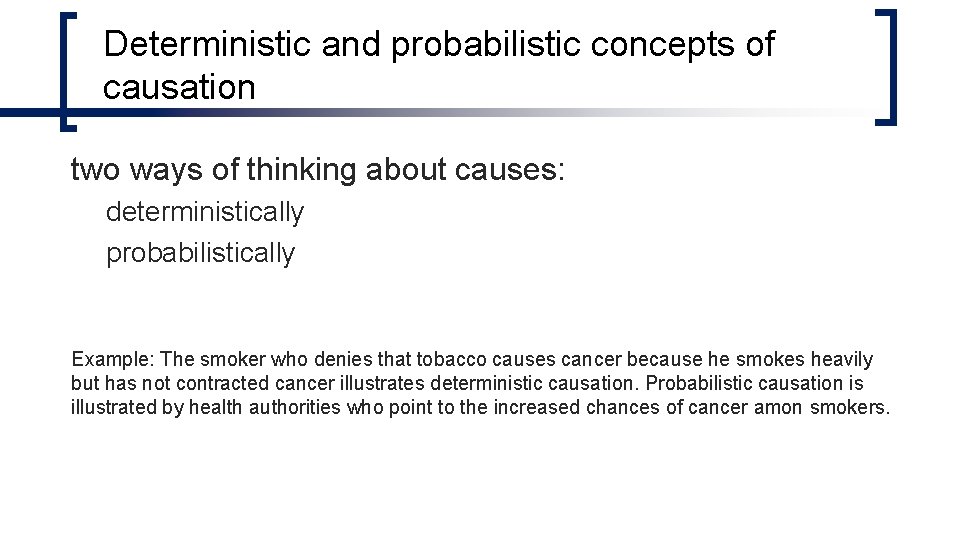
Deterministic and probabilistic concepts of causation two ways of thinking about causes: deterministically probabilistically Example: The smoker who denies that tobacco causes cancer because he smokes heavily but has not contracted cancer illustrates deterministic causation. Probabilistic causation is illustrated by health authorities who point to the increased chances of cancer amon smokers.
Deterministic concept Deterministic causation is where variable X is said to cause Y if, and only if, X invariably produces Y. That is, when X is present then Y will ‘necessarily, inevitably and infallibly’ occur. This approach seeks to establish causal laws such as: whenever water is heated to 100 °C it always boils
Deterministic concept – real life They will always specify particular conditions under which that law operates. Indeed a great deal of scientific investigation involves specifying the conditions under which particular laws operate. At sea level heating pure water to 100 °C will always cause water to boil .
Probabilistic explanation Most causal thinking is probabilistic rather than deterministic. That is, we work at the level that a given factor increases (or decreases) the probability of a particular outcome factor. It can improve probabilistic explanations by specifying conditions under which X is less likely and more likely to affect Y. But we will never achieve complete or deterministic explanations.
Probabilistic explanation Most causal thinking is probabilistic rather than deterministic. That is, we work at the level that a given factor increases (or decreases) the probability of a particular outcome factor. It can improve probabilistic explanations by specifying conditions under which X is less likely and more likely to affect Y. But we will never achieve complete or deterministic explanations. At sea level heating pure water to 100 °C could be cause water to boil. The probalistic factor of pure water’ boiling at 100 °C is 95% at sea level
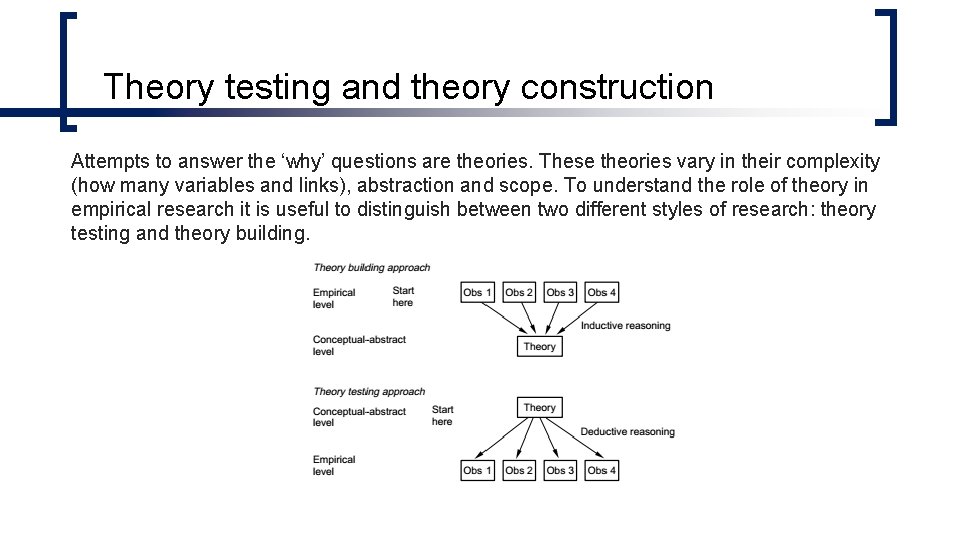
Theory testing and theory construction Attempts to answer the ‘why’ questions are theories. These theories vary in their complexity (how many variables and links), abstraction and scope. To understand the role of theory in empirical research it is useful to distinguish between two different styles of research: theory testing and theory building.
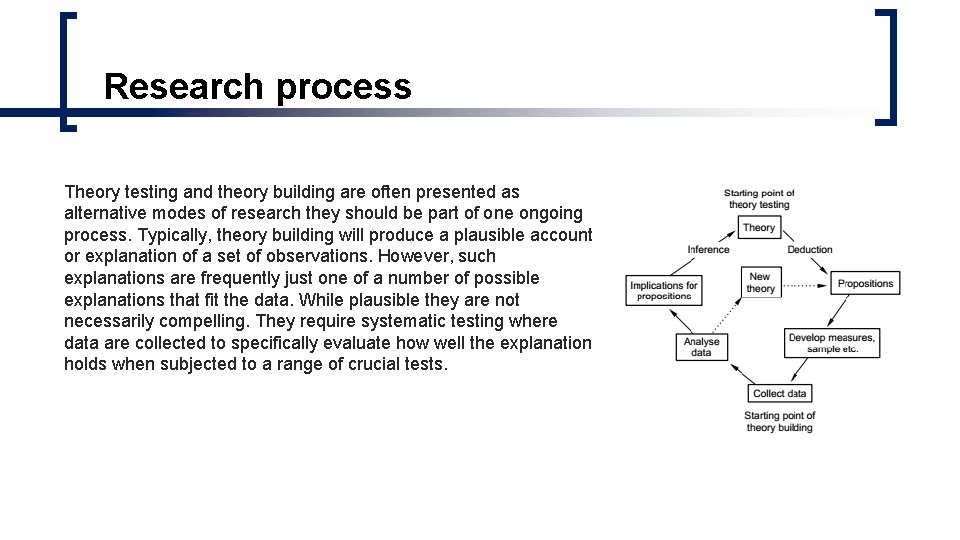
Research process Theory testing and theory building are often presented as alternative modes of research they should be part of one ongoing process. Typically, theory building will produce a plausible account or explanation of a set of observations. However, such explanations are frequently just one of a number of possible explanations that fit the data. While plausible they are not necessarily compelling. They require systematic testing where data are collected to specifically evaluate how well the explanation holds when subjected to a range of crucial tests.
Research design ‘deals with a logical problem and not a logistical problem’. A research design is not just a work plan. A work plan details what has to be done to complete the project but the work plan will flow from the project’s research design. The function of a research design is to ensure that the evidence obtained enables us to answer the initial question as unambiguously as possible.
Generating and Refining Research Ideas
In good science, questions come first. Science is just a tool for answering those questions. —John Bargh The scientist is not the one who gives the right answers, but the one who asks the right questions. —Claude Lévi-Strauss
Generating research ideas n n From common sense From previous research
Generating ideas from common sense n Question everything, including old sayings: ¡ ¡ ¡ n True? When is it not true? Why is it true? Attack practical problems n Questions to ask about a phenomenon: ¡ ¡ Who/When/Why/How What are its effects (short-term, long-term, good, bad)?
How to get research ideas from previous research A more preferred way to generate research ideas is to base an idea on previous research. Most advances in science come from scientists building on each other’s work. For a beginning researcher, basing an idea on previous research has at least three major advantages. 1. 2. 3. A hypothesis based on previous research is more than a guess—it is an educated guess. Because your prediction is consistent with a previous study’s results and the logic used to predict or explain those results, your hypothesis is likely to be supported. Regardless of whether your hypothesis is supported, your study will be relevant to what other scientists have done. Consequently, your research will not produce an isolated, trivial fact. Doing research based on other people’s work is easier than starting from scratch, especially when you are a beginning researcher. A beginning researcher might feel comfortable building on someone else’s study. 21
Research ideas from previous research If you can develop an idea from previous research, you may be able to justify your hypothesis by saying that it is consistent with findings from previous research, you may be able to test your hypothesis using the methods from previous research, and you should be able to show that your results are relevant to previous research.
Generating research ideas from previous research: conclusions n n Easy way to get started in research Likely to produce research that is relevant rather than trivial Consider improving study by improving its internal, external, or construct validity Consider extending study by looking at practical implications, moderator variables, and mediating variables
Converting an idea into a research hypothesis: a testable prediction about the relationship between two or more variables A research hypothesis is not a research topic, not a vague question you have, but a short, specific statement of how two or more variables will be related. Although converting an idea into a workable research hypothesis can be difficult, it is essential because the goal of all research is to test hypotheses. All researchers should have hypotheses before they conduct their research. If they started their research without having a hypothesis to help them know what to look for, it is unlikely that they would find anything.
Research hypothesis n n Make it testable Make it supportable (Avoid the null hypothesis) Be sure to have a rationale: How theory can help Demonstrate its relevance: Theory versus trivia
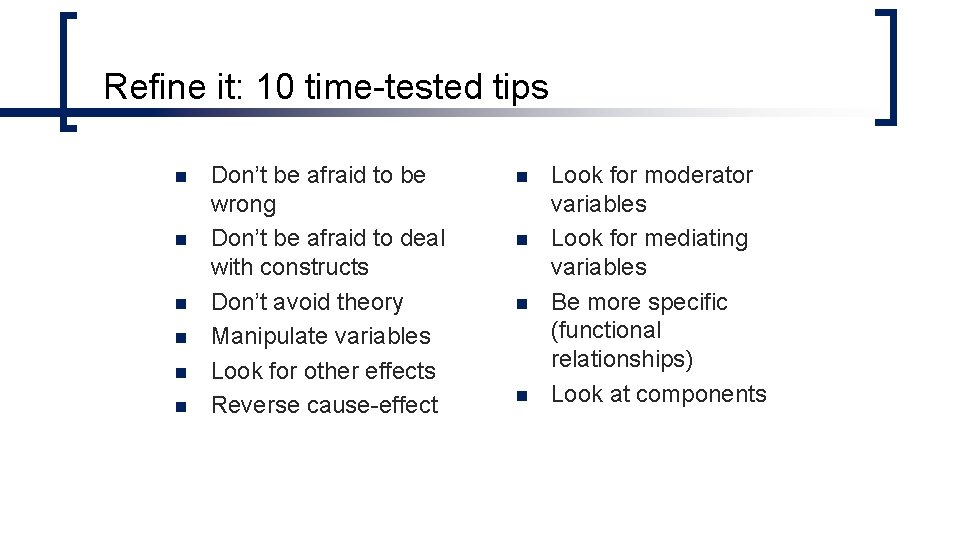
Refine it: 10 time-tested tips n n n Don’t be afraid to be wrong Don’t be afraid to deal with constructs Don’t avoid theory Manipulate variables Look for other effects Reverse cause-effect n n Look for moderator variables Look for mediating variables Be more specific (functional relationships) Look at components
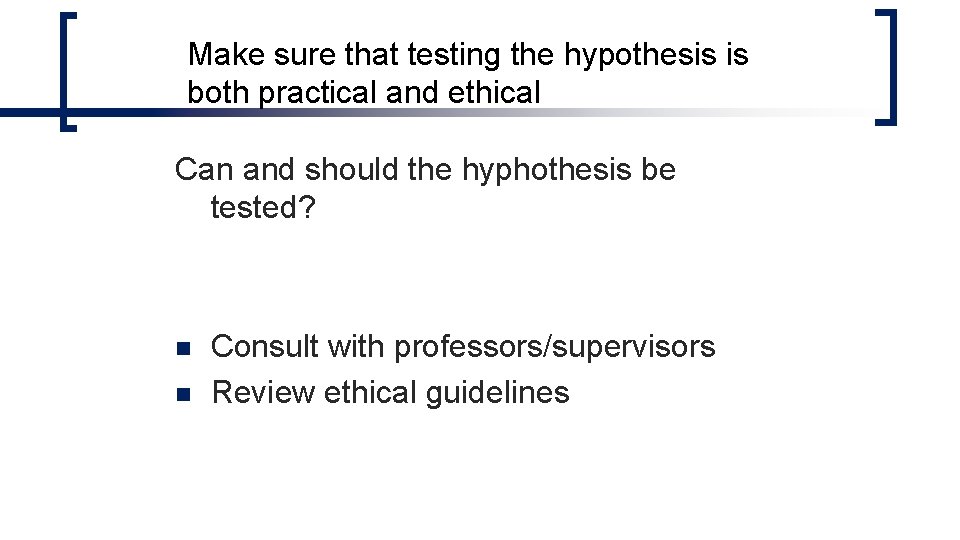
Make sure that testing the hypothesis is both practical and ethical Can and should the hyphothesis be tested? n n Consult with professors/supervisors Review ethical guidelines
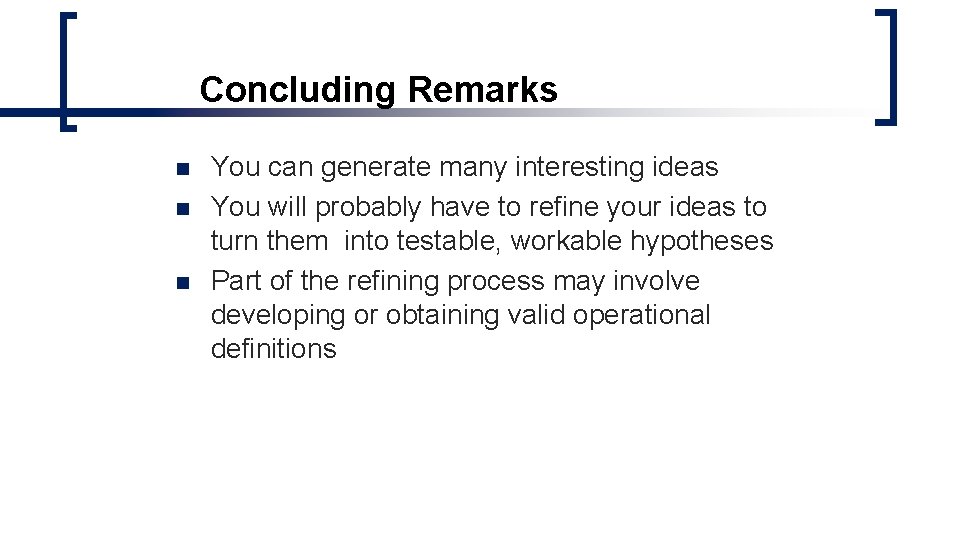
Concluding Remarks n n n You can generate many interesting ideas You will probably have to refine your ideas to turn them into testable, workable hypotheses Part of the refining process may involve developing or obtaining valid operational definitions
Reading and Evaluating Research
Overview When you need the best information, you need to read the research and question that research. l l Understanding an article Developing ideas from an article
Reading for Understanding n n n Choosing an article Reading the abstract Reading the introduction Reading the method section Reading the results section Reading the discussion
Choosing an article n n Selecting the right article may be the most important step Approaches to finding an interesting article ¡ ¡ ¡ Track down study that you heard about or read about Look through table of contents of current journals looking for articles with interesting titles Search the literature using computerized tools like (subject, author, reference) – interesting title n Web of Science n Science. Direct n Springer
Reading the Abstract n The abstract is a summary of the article ¡ ¡ n Goal, hyphothesis Method Results Discussion If you don’t like the article’s abstract, consider finding another article ¡ If the abstract seems promising, scan the article and read the first paragraph of the Discussion section. If you can’t understand that paragraph, consider looking for another article.
Reading the Introduction The best place to start reading an article is at the beginning. Although unlabeled, the beginning of the article is called the introduction. The introduction is the most difficult, most timeconsuming, and most important part of the article to understand. You must understand the introduction because it is where the authors tell you 1. how they came up with the hypothesis, including reasons why they think the hypothesis will be supported 2. reasons why the hypothesis might not be correct 3. why the hypothesis is important 4. why the authors’ way of testing the hypothesis is the best way to test the hypothesis
Reading the Introduction n n May be difficult and time-consuming, but it tells you what hypotheses they are testing and why: Sets the stage for the rest of the article. Don’t leave the introduction without knowing ¡ ¡ What the hypothesis is Why they are testing the hypothesis
Re-reading the Introduction Then, after doing your background reading, reread the introduction. Do not move on to the method section until you can answer these six questions: 1. What variables are the authors interested in? 2. What is the prediction (hypothesis) involving those variables? (What is being studied? ) 3. Why does the prediction (hypothesis) make sense? 4. How do the authors plan to test their prediction? Why does their plan seem to be a reasonable one? 5. Does the study correct a weakness in previous research? If so, what was that weakness? That is, where did others go wrong? 6. Does the study fill a gap in previous research? If so, what was that gap? That is, what did others overlook?
Reading the Method Section n Who the participants/materials were (often in Participants/Materials subsection)? How could flow the measurement (Apparatus, What happened (often in Procedure subsection)?
Design subsection The design subsection might tell you whether the design was a survey ¡ ¡ a between subjects design (in which one group of participants is compared against another group), a within-subjects—also called “repeated measures”— design (in which each participant is compared against himself or herself). Instead of a separate design section, authors may put information about the design in the participants section, in some other section, or even leave design information out of the method section entirely.
Method subsection n n even though the introduction probably foreshadowed how the authors planned to test the hypothesis the authors are still going to take you, step-by-step, through the process so that you could repeat their experiment.
Method section n This “How we did it” section ¡ ¡ ¡ (a) the authors give you too many details (details that might be useful for redoing the study but aren’t essential for understanding the basics of what the researchers did), (b) the authors avoid giving you too many details by using a shorthand for a procedure (e. g. , “we used the same procedure Hannibal & Lector [2005] used”), (c) the authors use some task or piece of equipment that you are familiar/unfamiliar with.
Method section After reading the method section, ask the followings ¡ ¡ ¡ Would you have been engaged in the study? Would you have acted natural? Would you have figured out the hypothesis? Would you have interpreted the situation the way the researchers expected you to? Would you have been able to avoid biasing the results?
Method section 1. 2. 3. 4. 5. 6. What were the participants/subjects like (species, gender, age), and how did they come to be in the study? What was the procedure? What were the key variables in this study, and how did the researcher operationally define those variables? For example, how was the dependent variable measured? What was the design (type of study, e. g. , survey, simple experiment)? Is it possible to repeat the measurement (apparatus, step of measuring) Statistical analysis!!!!
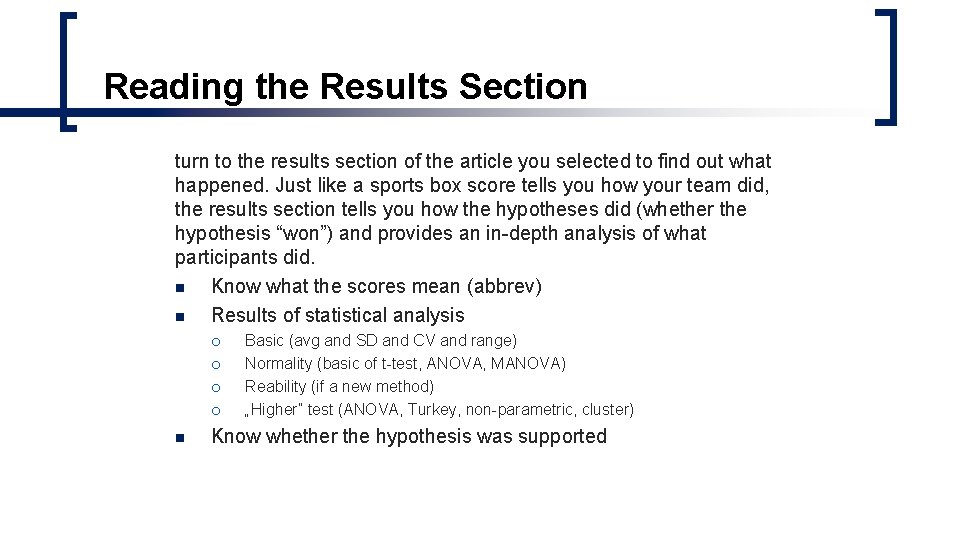
Reading the Results Section turn to the results section of the article you selected to find out what happened. Just like a sports box score tells you how your team did, the results section tells you how the hypotheses did (whether the hypothesis “won”) and provides an in-depth analysis of what participants did. n Know what the scores mean (abbrev) n Results of statistical analysis ¡ ¡ n Basic (avg and SD and CV and range) Normality (basic of t-test, ANOVA, MANOVA) Reability (if a new method) „Higher” test (ANOVA, Turkey, non-parametric, cluster) Know whether the hypothesis was supported
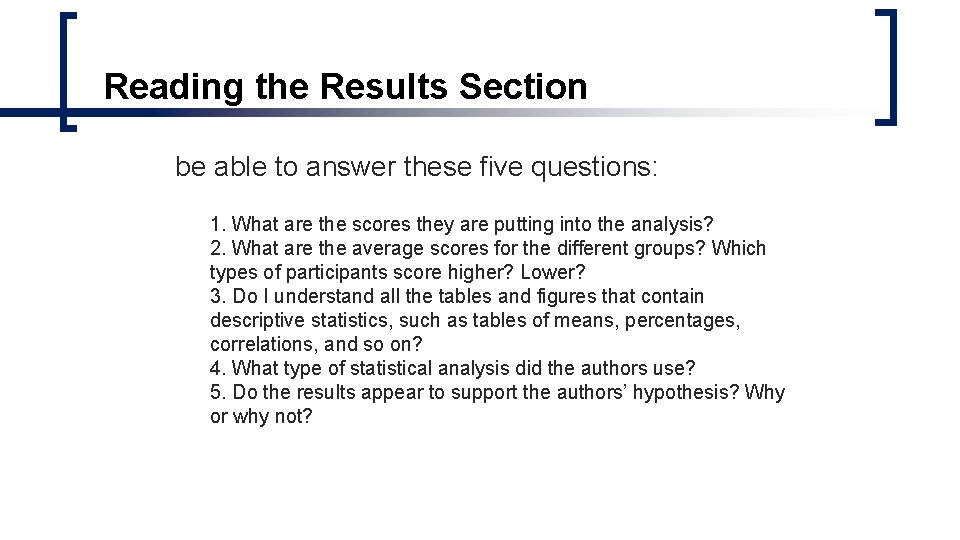
Reading the Results Section be able to answer these five questions: 1. What are the scores they are putting into the analysis? 2. What are the average scores for the different groups? Which types of participants score higher? Lower? 3. Do I understand all the tables and figures that contain descriptive statistics, such as tables of means, percentages, correlations, and so on? 4. What type of statistical analysis did the authors use? 5. Do the results appear to support the authors’ hypothesis? Why or why not?
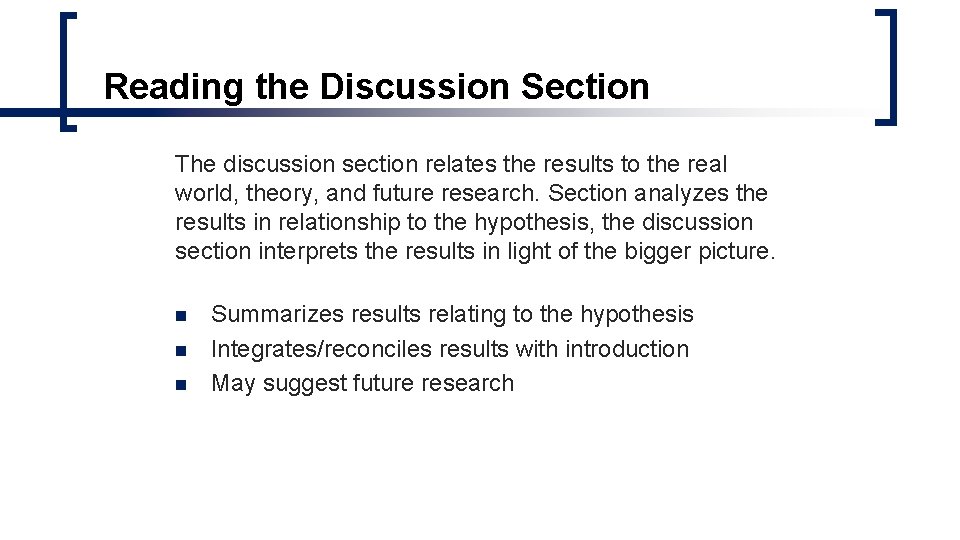
Reading the Discussion Section The discussion section relates the results to the real world, theory, and future research. Section analyzes the results in relationship to the hypothesis, the discussion section interprets the results in light of the bigger picture. n n n Summarizes results relating to the hypothesis Integrates/reconciles results with introduction May suggest future research
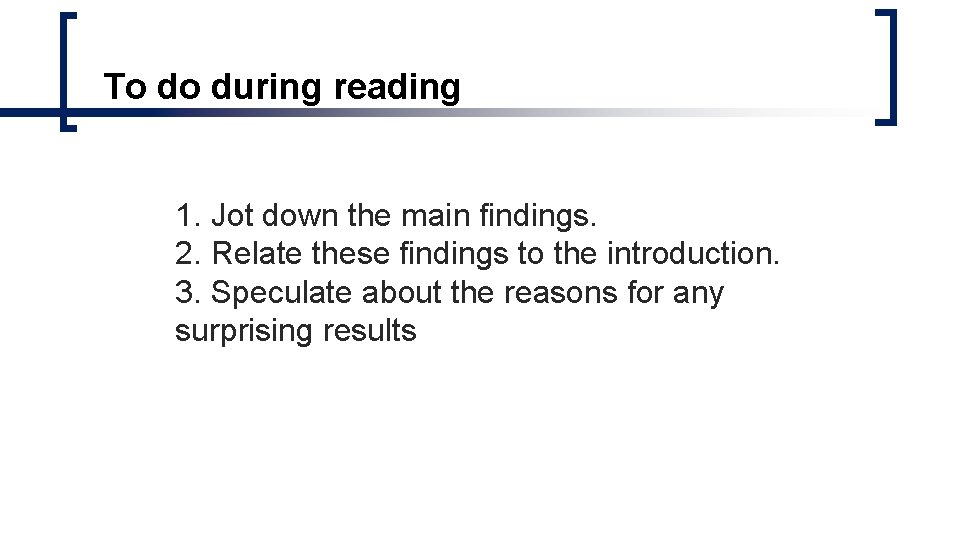
To do during reading 1. Jot down the main findings. 2. Relate these findings to the introduction. 3. Speculate about the reasons for any surprising results
Questions after Discussion you should be able to answer these six questions: 1. How well do the authors think the results matched their predictions? 2. How do the authors explain any discrepancies between their results and their predictions? 3. Do the authors admit that their study was flawed or limited in any way? If so, how? 4. What additional studies, if any, do the authors recommend? 5. What are the authors’ main conclusions? 6. What is the limitation of study
Developing Research Ideas from Existing Research n n Direct replications Systematic replications Conceptual replications Extending research
Concluding Remarks You now know how to ¡ ¡ ¡ Read research Criticize/Evaluate research Get research ideas from published research
Writing your literature review for your Ph. D dissertation
Aims of the session n Explore what a literature review is and the purpose of it Critical reading (to ensure critical writing) Writing the review: ¡ ¡ Structure Introductions conclusions Critical approaches to writing
Activity 1: Discuss on your tables 1. What is a literature review? 2. What is the purpose of the literature review in your dissertation/final year project?
What is the literature review? n n A literature review summarises, critically analyses and evaluates previous research available on the subject, presenting this in an organised way. It should address a clearly articulated question or series of questions It is NOT: ¡ ¡ ¡ A descriptive list or summaries of books/articles etc An exhaustive bibliography on everything ever written on the topic- you need to make a decision about what to include Your arguments and ideas (like an essay)
Why do we write a literature review? n n n n Demonstrate an in-depth understanding of your topic area including key concepts, terminology, theories and definitions Identify who the major thinkers are Identify what research has been done in that area Find gaps in the research or current areas of interest to help you formulate your own research question Identify the main research methodologies in your subject area Identify main areas of agreement or controversy convince the reader that your research questions are significant, important and interesting convince the reader that your thesis will make an original contribution to the area being investigated.
Steps to complete the literature review 1. Find relevant literature on your topic and follow trails of references 2. Identify themes/ideas/theories/approaches to the topic that have emerged from reading 3. Introduce ideas by themes/theory/approach/chronologically or any other appropriate structure but do not just list different authors’ viewpoints 4. Introduce and explain each theme (or theory/approach), present evidence from readings (agreements/ disagreements), critically commentate and relate to your own research
Critical reading
Activity 2: The importance of critical reading n In your groups come up with at least 5 questions that you would ask yourself when critically analysing a text for your review
Critical questioning when reading 1. 2. 3. 4. 5. 6. 7. 8. 9. 10. Who is the author? What is the authors central point or main argument? What findings and conclusions are made? What evidence is used to support the conclusions? Is the evidence relevant? What methodology has the author used? What are the strengths and limitations? Does the author make any assumptions? What is not being said? Is there any explicit or hidden bias? How is the text relevant to YOUR project or assignment? How does this link with other texts that you have read?
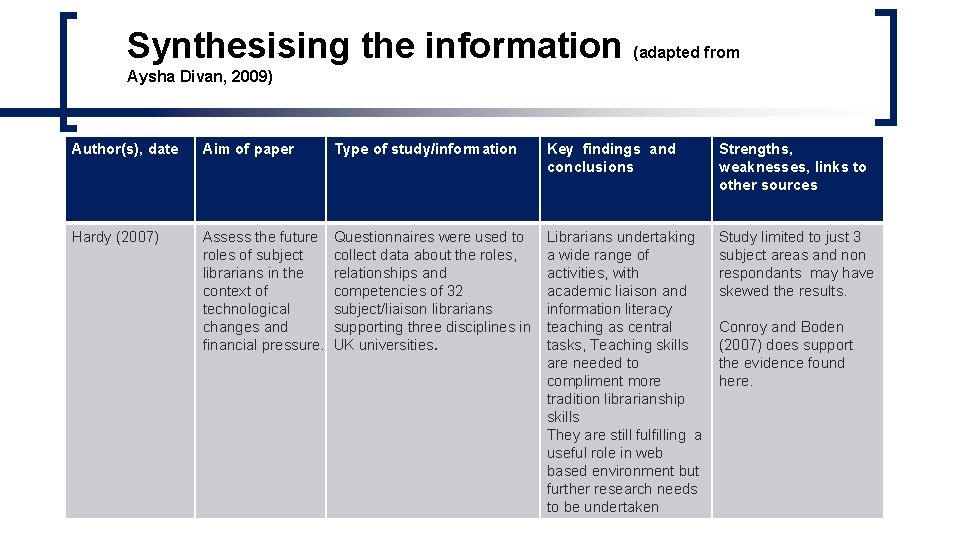
Synthesising the information (adapted from Aysha Divan, 2009) Author(s), date Aim of paper Type of study/information Key findings and conclusions Strengths, weaknesses, links to other sources Hardy (2007) Assess the future roles of subject librarians in the context of technological changes and financial pressure. Questionnaires were used to collect data about the roles, relationships and competencies of 32 subject/liaison librarians supporting three disciplines in UK universities. Librarians undertaking a wide range of activities, with academic liaison and information literacy teaching as central tasks, Teaching skills are needed to compliment more tradition librarianship skills They are still fulfilling a useful role in web based environment but further research needs to be undertaken Study limited to just 3 subject areas and non respondants may have skewed the results. Conroy and Boden (2007) does support the evidence found here.
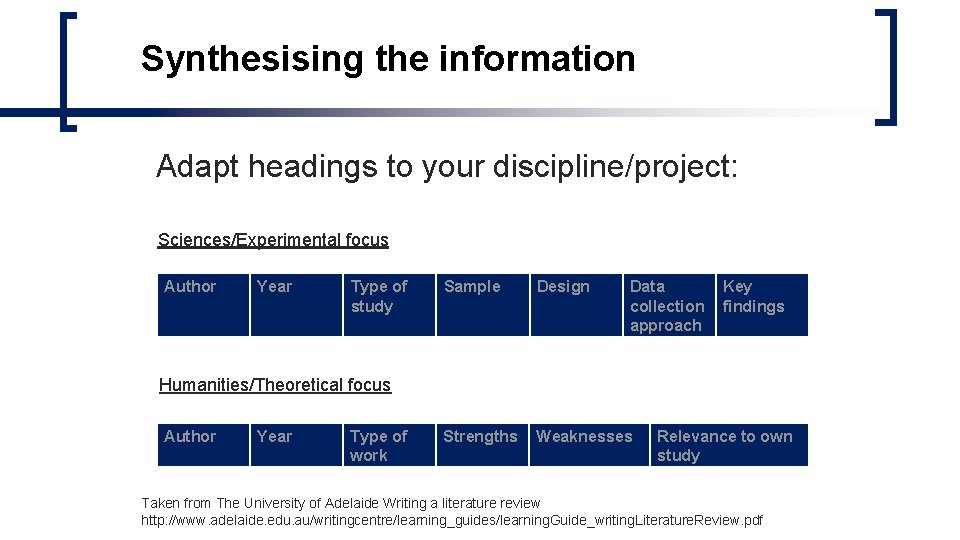
Synthesising the information Adapt headings to your discipline/project: Sciences/Experimental focus Author Year Type of study Sample Design Data collection approach Strengths Weaknesses Key findings Humanities/Theoretical focus Author Year Type of work Relevance to own study Taken from The University of Adelaide Writing a literature review http: //www. adelaide. edu. au/writingcentre/learning_guides/learning. Guide_writing. Literature. Review. pdf
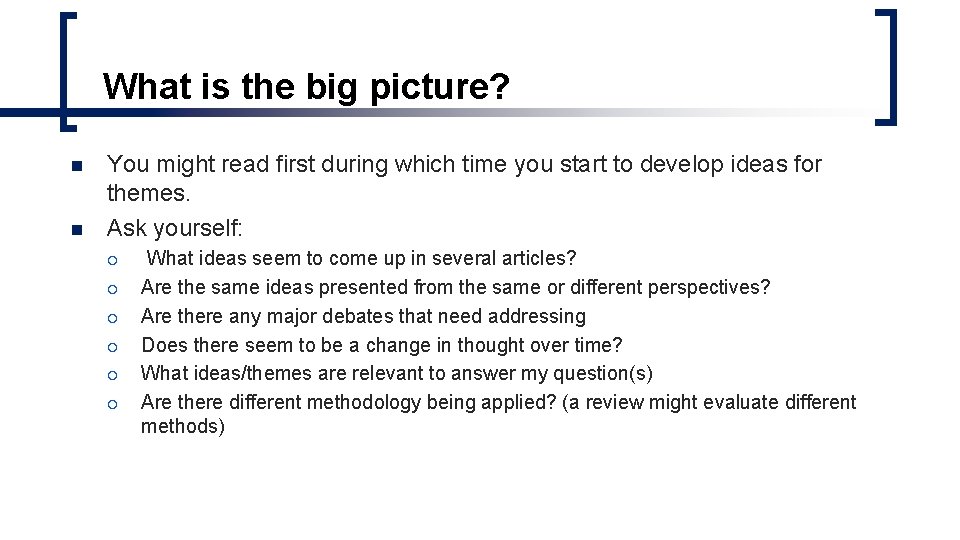
What is the big picture? n n You might read first during which time you start to develop ideas for themes. Ask yourself: ¡ ¡ ¡ What ideas seem to come up in several articles? Are the same ideas presented from the same or different perspectives? Are there any major debates that need addressing Does there seem to be a change in thought over time? What ideas/themes are relevant to answer my question(s) Are there different methodology being applied? (a review might evaluate different methods)
Writing the review: The structure
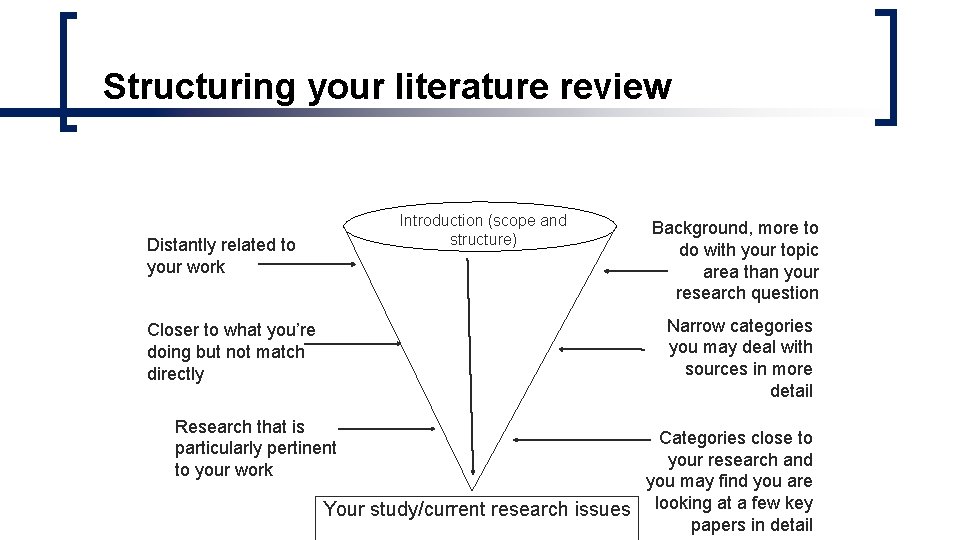
Structuring your literature review Introduction (scope and structure) Distantly related to your work Background, more to do with your topic area than your research question Narrow categories you may deal with sources in more detail Closer to what you’re doing but not match directly Research that is particularly pertinent to your work Categories close to your research and you may find you are Your study/current research issues looking at a few key papers in detail
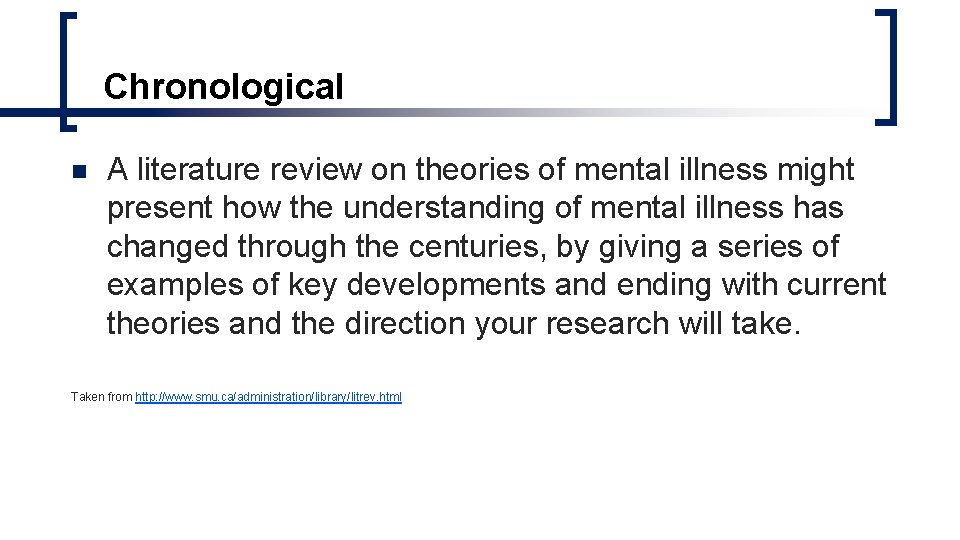
Chronological n A literature review on theories of mental illness might present how the understanding of mental illness has changed through the centuries, by giving a series of examples of key developments and ending with current theories and the direction your research will take. Taken from http: //www. smu. ca/administration/library/litrev. html
Writing the literature review
Compare the two introductions on your handout and answer the questions underneath the extracts
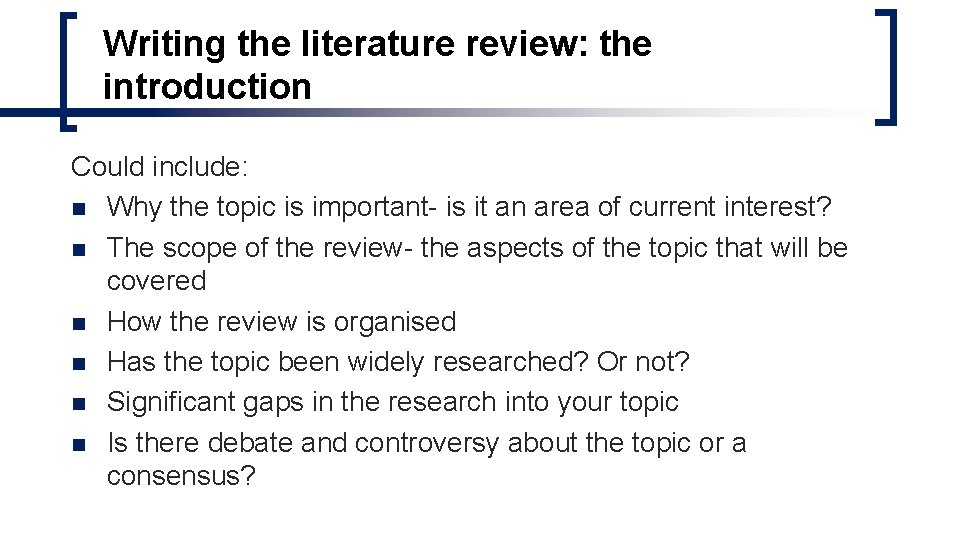
Writing the literature review: the introduction Could include: n Why the topic is important- is it an area of current interest? n The scope of the review- the aspects of the topic that will be covered n How the review is organised n Has the topic been widely researched? Or not? n Significant gaps in the research into your topic n Is there debate and controversy about the topic or a consensus?
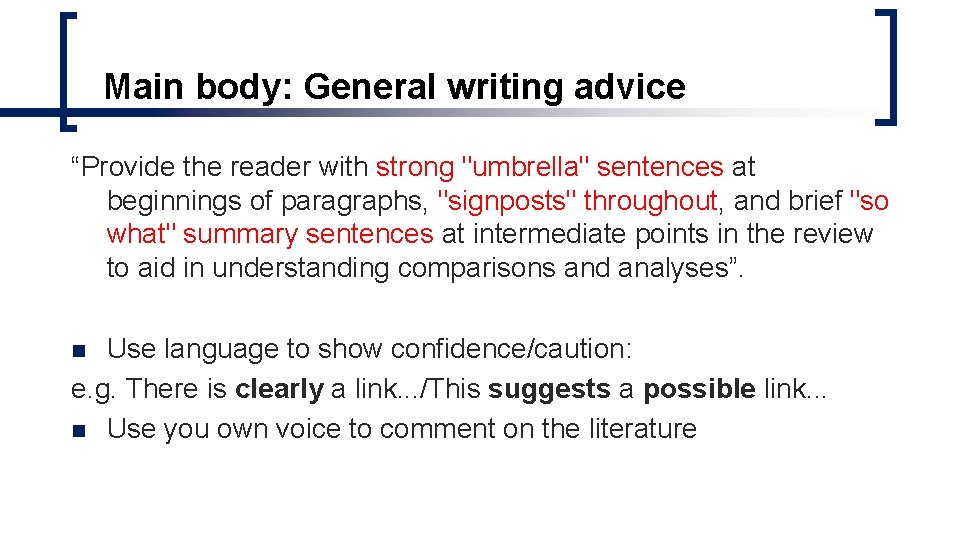
Main body: General writing advice “Provide the reader with strong "umbrella" sentences at beginnings of paragraphs, "signposts" throughout, and brief "so what" summary sentences at intermediate points in the review to aid in understanding comparisons and analyses”. Use language to show confidence/caution: e. g. There is clearly a link. . . /This suggests a possible link. . . n Use you own voice to comment on the literature n
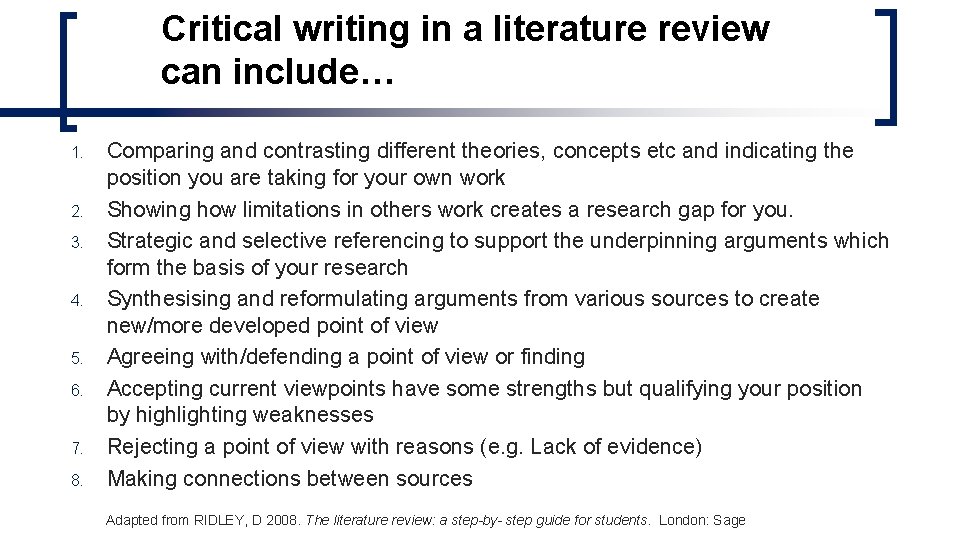
Critical writing in a literature review can include… 1. 2. 3. 4. 5. 6. 7. 8. Comparing and contrasting different theories, concepts etc and indicating the position you are taking for your own work Showing how limitations in others work creates a research gap for you. Strategic and selective referencing to support the underpinning arguments which form the basis of your research Synthesising and reformulating arguments from various sources to create new/more developed point of view Agreeing with/defending a point of view or finding Accepting current viewpoints have some strengths but qualifying your position by highlighting weaknesses Rejecting a point of view with reasons (e. g. Lack of evidence) Making connections between sources Adapted from RIDLEY, D 2008. The literature review: a step-by- step guide for students. London: Sage
Can you identify these features in the literature review extracts? n Underline: Where the student has commented on the literature they are reviewing n Circle- Where the writer has used language to avoid a ‘black and white’, right/wrong type of judgement (showing caution/confidence) n Using the list on the Critical writing in a literature review slide decide how the writer has shown criticality by assigning a number 1 -8 (can assign more than one number)
Conclusions Conclude your literature review with a statement which summarises your review and links this to your own research/current issues: In conclusion, extensive research has shown space to be an important concept that vastly affects society. Definitions of public and private spaces are changing noticeably over time, in particular in Western cities such as the UK. An increasing withdrawal from public life can be observed as technology and other factors largely impact the way we live and experience otherness. These changes in public, private and electronic spaces do and will continue to greatly impact fundraising activities and giving behaviour. This research therefore fills an evident gap in charity and geographical research, bringing these two concepts together in an important investigation of space and charity.
Don’t forget about the referencing! n n Keep a record of all the sources that you use! Use the referencing style recommended by your School ¡ Skills@Library referencing pages http: //library. leeds. ac. uk/referencing
Reviewing your review Checklist 1. 2. 3. 4. 5. 6. ~~~~~~~~ 3 ~~~~~~~~~
Grammar, spelling and punctuation University of Bradford: n http: //www. brad. ac. uk/learnerdevelopment/resources/study/GSP/
Further help Online: n The Final Chapter: http: //library. leeds. ac. uk/tutorials/thefinalchapter/ n Skills@Library writing pages: http: //library. leeds. ac. uk/skills-writing n Academic Phrasebank: http: //www. phrasebank. manchester. ac. uk/ Books: n RIDLEY, D. 2008. The literature review: a step-by-step guide for students. London: SAGE. n DIVAN, A. 2009. Communication skills for the biosciences: a graduate guide. Oxford: Oxford University Press. n Aveyard, H. 2010. Doing a literature review in health and social care : a practical guide. Maidenhead: Mc. Graw-Hill