
Research led teaching Student involvement in an eye
- Slides: 20
Research led teaching: Student involvement in an eye tracking study Dr Christina Schelletter School of Humanities
Overview Aims/Research Skills The Research Project and Eye Tracking Methodology The module ‘Language Processing’ The tasks Student Involvement: participants, data analysis, written and oral presentation
Aims/ Research Skills • Formulate testable hypotheses based on relevant literature • justify appropriate selection of analysis tools for particular research tasks; • Manage information on data sources, research procedures, analytic frameworks; • organise knowledge and articulate arguments effectively both in assessed written assignments and in oral presentations;
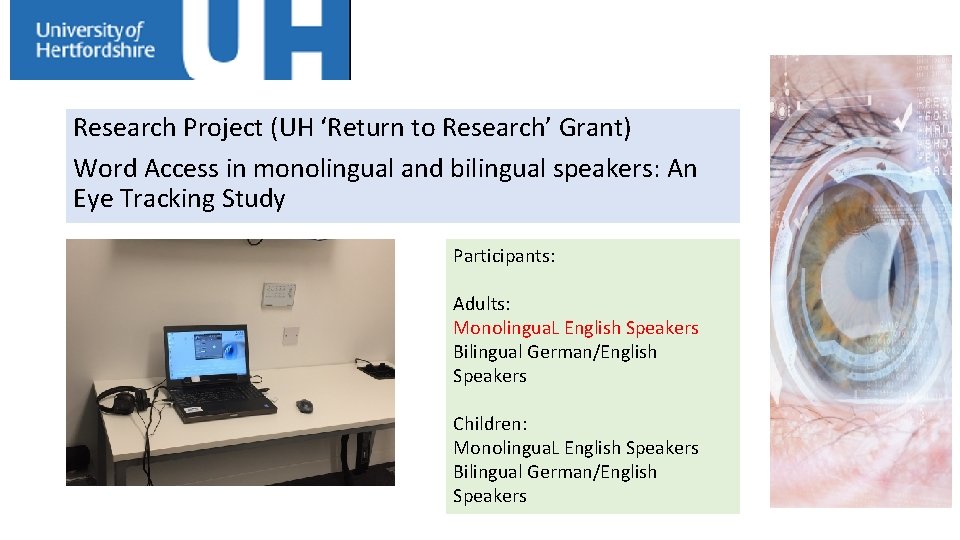
Research Project (UH ‘Return to Research’ Grant) Word Access in monolingual and bilingual speakers: An Eye Tracking Study Participants: Adults: Monolingua. L English Speakers Bilingual German/English Speakers Children: Monolingua. L English Speakers Bilingual German/English Speakers
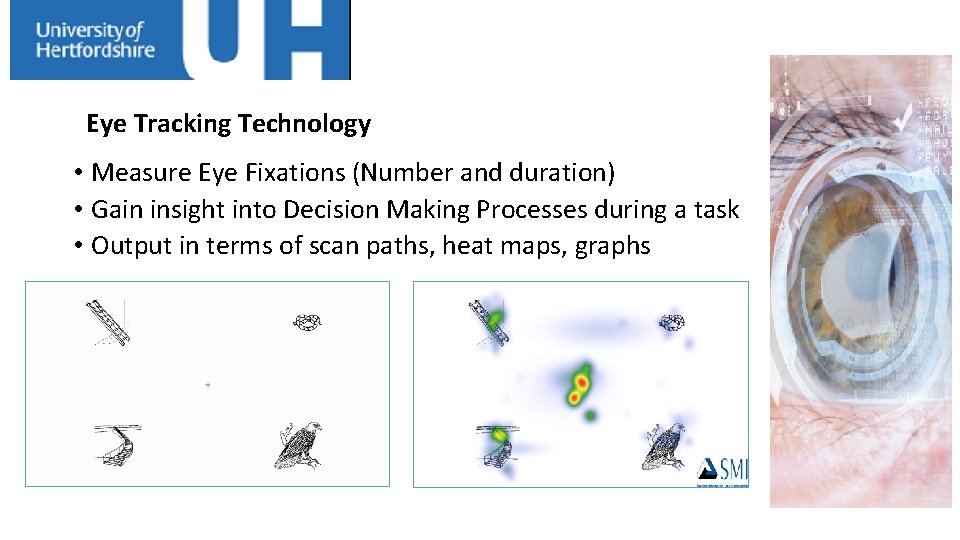
Eye Tracking Technology • Measure Eye Fixations (Number and duration) • Gain insight into Decision Making Processes during a task • Output in terms of scan paths, heat maps, graphs
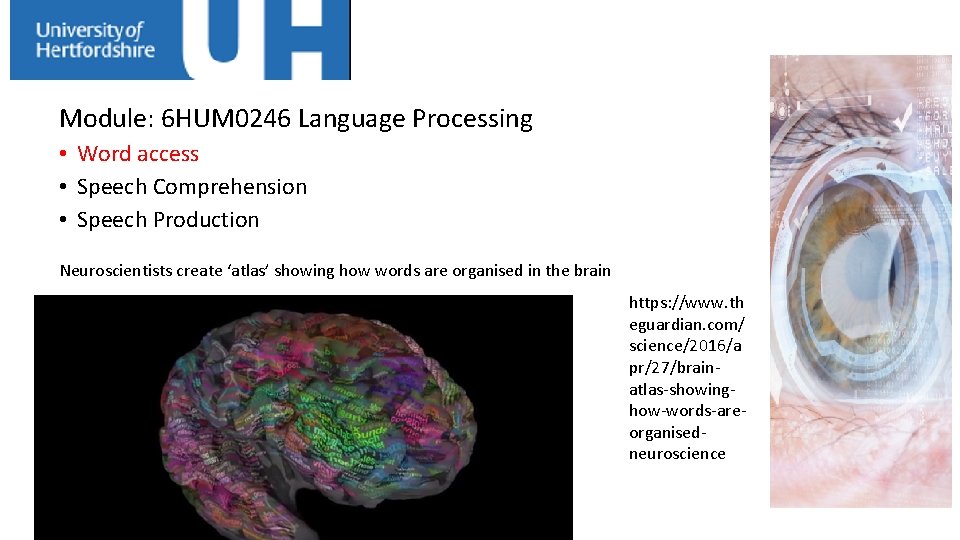
Module: 6 HUM 0246 Language Processing • Word access • Speech Comprehension • Speech Production Neuroscientists create ‘atlas’ showing how words are organised in the brain https: //www. th eguardian. com/ science/2016/a pr/27/brainatlas-showinghow-words-areorganisedneuroscience
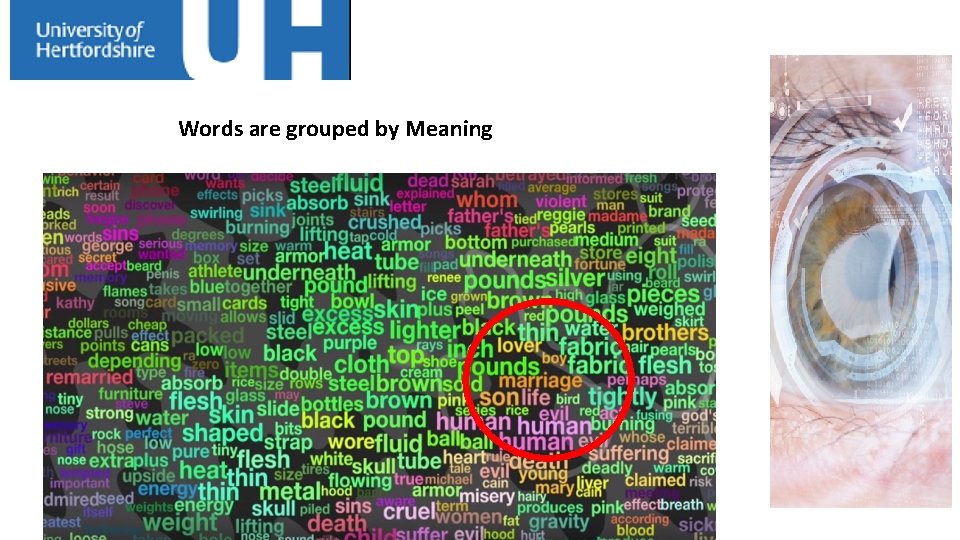
Words are grouped by Meaning
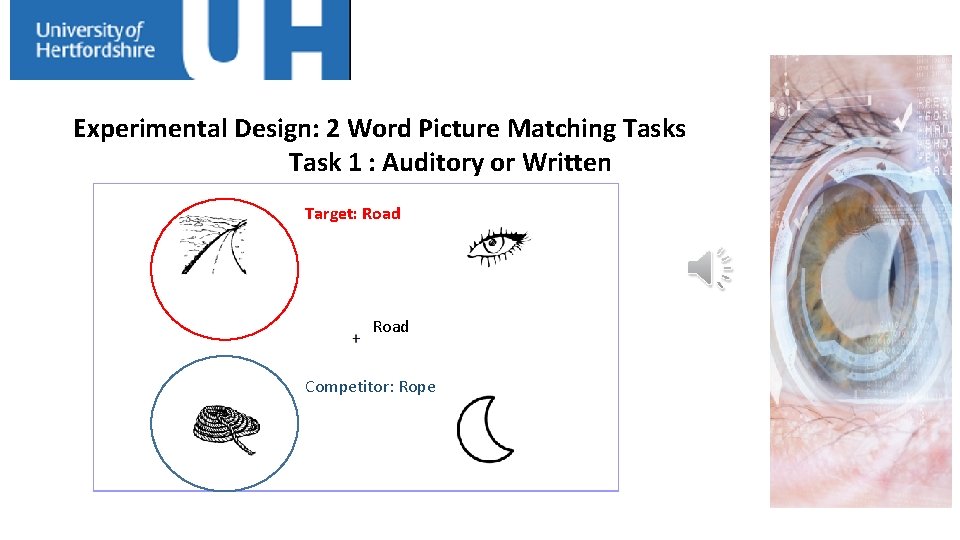
Factors affecting word access • Frequency of a word (familiarity, Age of Acquisition) • The number of similar sounding words (phonological or orthographic neighbours) man - mat – map – mad – van – ban - can road – rope – rode – roll – toad • Co-occurring Words (priming) lamb – lamp (similarity in sound) stairs – ladder (similarity in meaning)
• Frequent words are accessed faster (lower Reaction times) • Larger Neighbourhood size facilitates access of low frequency words
Experimental Design: 2 Word Picture Matching Tasks Task 1 : Auditory or Written Target: Road Competitor: Rope
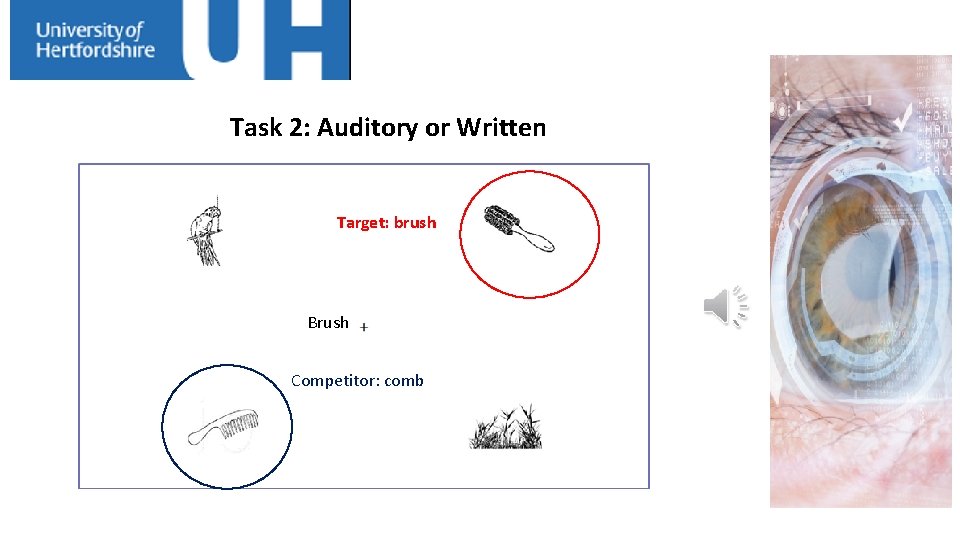
Task 2: Auditory or Written Target: brush Brush Competitor: comb
Student Involvement 1. Students were participants in the experiment • 22 final year students, half were assigned to the written mode of the experiment, half to the audio mode 2. Students analysed a particular task (Written assignment) • Students were assigned to one of 8 groups: • 4 groups analysed one of the tasks/mode of presentation • 2 groups compared mode of presentation for one task • 2 groups compared Task 1 and Task 2 3. Students presented the background/analysis in groups • 8 presentation groups: Mini conference
HUM/SF/UH/02704 1. Students as participants • Students filled in a consent form and short questionnaire about their language background (Ethics Approval HUM/SF/UH/02704) • their data was anonymised on the computer system • Students carried out both tasks either in the written presentation mode (word appeared on screen) or the audio presentation mode (words were heard via headphones) • The students’ eye fixations were measured with the eye tracker • The student’s reaction times for each picture display were recorded
2. Students analysed a particular task • Students were debriefed after the experiment • Background of the task (Literature, previous findings) • Psycholinguistic Models • Hypotheses • Folders with Materials for each group • Reaction Time data (Excel file) • Eye fixation graphs • Experiment items (list and displays)
Written Presentation: Group 3 Comparison between Audio and Visual Presentation for Task 1 a. Formulate testable hypothesis, based on literature Hypothesis: “In alignment with Shelton & Kumar’s (2010) study, auditory presentation will elicit a faster reaction time (RT) and more accurate response than visual presentation” b. Justify appropriate selection of analysis tools for particular research tasks “In order to determine any differences between phonological priming in visual and spoken word-recognition, a comparison between the mean RT and accuracy of LD target words in orthographic and phonological presentation was necessary”.
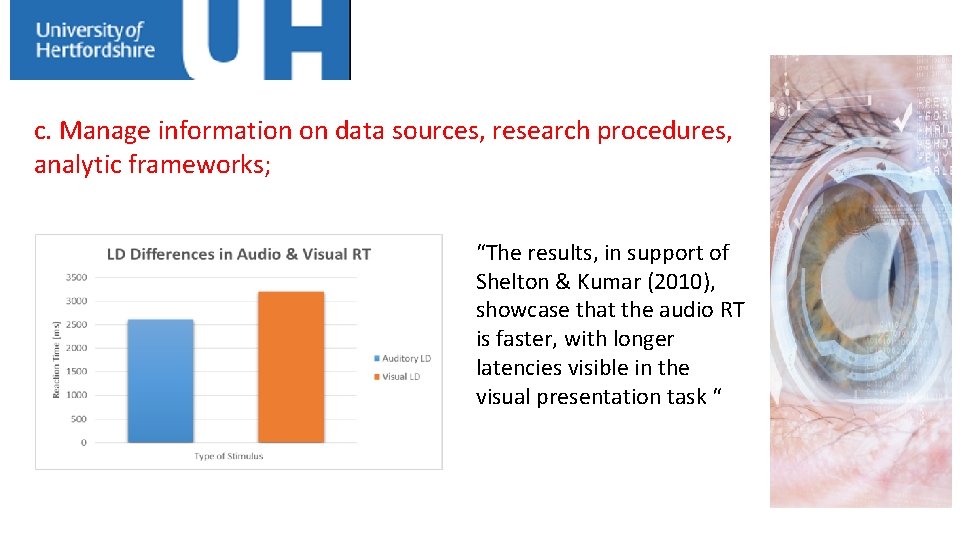
c. Manage information on data sources, research procedures, analytic frameworks; “The results, in support of Shelton & Kumar (2010), showcase that the audio RT is faster, with longer latencies visible in the visual presentation task “
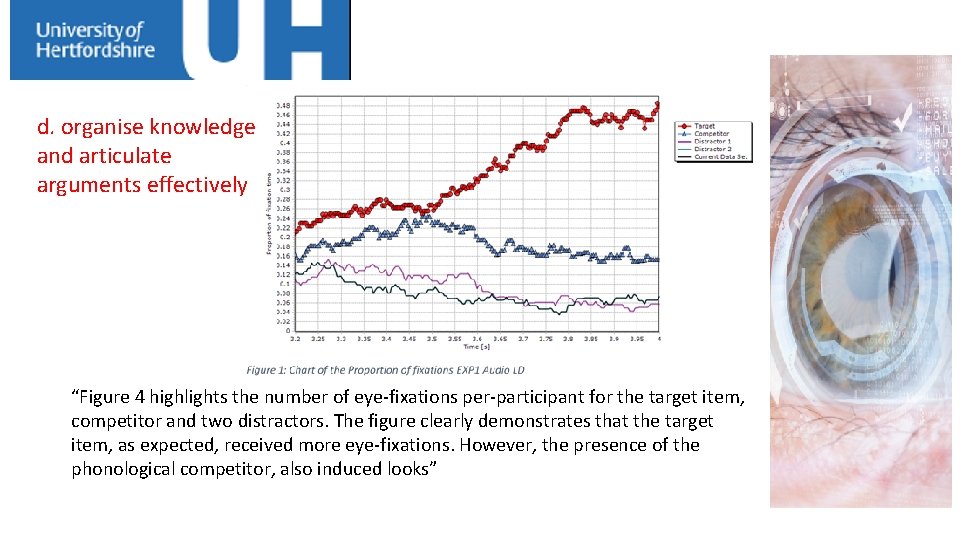
d. organise knowledge and articulate arguments effectively “Figure 4 highlights the number of eye-fixations per-participant for the target item, competitor and two distractors. The figure clearly demonstrates that the target item, as expected, received more eye-fixations. However, the presence of the phonological competitor, also induced looks”
“As a closing comment, the Reaction Times for the auditory presentation is faster and more accurate than thevisual presentation. For the auditory task there was a greater significance in competitor eye fixation, explained in regards to the effects of the Distributed Cohort Model and priming”.
3. Student presentations in groups • The different groups presented their results as a group • As all students worked on a different aspect of the task, results from different aspects of the task were put together • Students get to know about the different aspects of the experiment • The presentations together form a ‘mini conference’ on word access using eye tracking methodology
Thank You!!