
RESEARCH INTO SECOND LANGUAGE SPEECH PERFORMANCE WITH A





- Slides: 47
RESEARCH INTO SECOND LANGUAGE SPEECH PERFORMANCE WITH A HONG KONG TWIST PETER SKEHAN UNIVERSITY COLLEGE LONDON
AN OUTLINE OF THE PRESENTATION • Earlier research into tasks, task conditions, and performance, often from HK • Later (and still Hong Kong-oriented) research • A brief account of the Levelt model of first language speaking • Research findings presented through the lens of the Levelt model • Reconsidering the Levelt model (but not very much) and offering some takeaways
TASKS, ACQUISITION, PEDAGOGY, PERFORMANCE • An acquisitional approach, e. g. Mike Long, Alison Mackey, with a focus as tasks triggering feedback which triggers acquisition • A pedagogic approach, with tasks being a unit of teaching, as with Jane Willis • A performance approach, and a means of exploring second language speaking, HERE!! • Also, the approach will reflect my Limited Attention Capacity proposals: speaking places demands upon working memory and attention, so some of the time speakers have to make choices about priorities, e. g Complexity rather than Accuracy
THREE PRELIMINARIES FOR SECOND LANGUAGE SPEAKING RESEARCH • A brief mention of performance measures • Complexity (e. g. subordination), accuracy (e. g. proportion of error free clauses), lexis, fluency, e. g. speed, pausing, repair (CALF) • These variables are used all the time in task research, and therefore we are more able to compare results across studies, and develop models, and I forced my students to use them • Tasks (and their characteristics) and Task Conditions • In general (not all the time) the second, Task Conditions, will be emphasized here • I argue that tasks are less impressive or consistent in their influence on performance • The Levelt Model of First Language Speaking (and there’s more later) • Conceptualisation > Formulation > Articulation
PART ONE: • (Slightly) older research with CALF, with broader surveys of various areas: • Planning • Repetition • Post-tasks • Task characteristics
PLANNING: PART ONE : GENERALISATIONS (NOTE, A FREE AND EASY PEDAGOGIC TECHNIQUE) • Pre-task planning (but note other pre-task possibilities, e. g. modelling) • • • Usually (tho not always) 10 mins Consistently raises language complexity and fluency, serious effect sizes Raises accuracy inconsistently and with smaller effect sizes (Pang&Skehan 14) • On-line planning, i. e. little time pressure when the task is being done • Raises accuracy, reduces fluency, sometimes raises complexity (Wang, 2014) • Working memory shows no relationship with pre-task planning (Wen) but does correlate with performance in on-line planning (Ahmadian) Note: References at end
PLANNING: PART TWO • Pang & Skehan 14: Qualitative (introspection) and quantitative (performance) study with narrative retellings after planning. Usual planning x CALF results • Qualitative research showed that higher performance was associated with participants who said they focused in ideas and were realistic. Lower performance from participants who focused on detail, language, and who were over-ambitious. Forgot planning they’d done! • Wang 14: Complex study, with many conditions. One of the conditions was a combination of pre-task and on-line planning. In this: • CAF all improved: Note – this is unusual – the three areas often compete with one another • It looks like having something to say (pre-task planning, Conceptualisation) and then helpful conditions for saying it (on-line planning, Formulation) is a good
TASK REPETITION (ALSO FREE AND EASY) • Earlier research, e. g. Bygate, suggested improved performance, even after an interval of several weeks. Note, though, this wasn’t a CALF study. • Wang (Jan), with immediate but unanticipated, repetition, and using CALF measures, showed huge effect sizes for CAF, but not L • Kormos, Lambert, Minn used 6 repetitions, suggesting fluency gets better and better (1 -6), ideas (and complexity) increase Reps 1 to 3, accuracy, Reps 4 -6 • Suggestions also that modelling the task, between original and repeated performance, has a good effect • Great area for more research: e. g. length of time interval, no of reps, what happens in between, proficiency level
POST-TASK (SELECTIVE ATTENTION) EFFECTS • Give people a post-task, with the intention to change their approach to doing an actual, earlier task and prioritise meaning and fluency less. (S+F 97; F+S 13) • Foreknowledge, anticipation of the post task, it is hypothesized, would sensitise speakers to language (accuracy especially) encouraging more attention to it. • Two possibilities have been explored: a public performance; transcription • S&F: Transcription was better, larger accuracy effect, both monologic and dialogic tasks. Also complexity with the dialogic task • Christina Li: Repeated this general idea, but also contrasted post-task vs no post task, and post task alone with post task followed by analysis • • Confirmed the earlier research even more strongly for post task vs no post task Post task plus analysis raised complexity, Po. Ta without analysis raised accuracy • Also a very useful free pedagogic technique this!
TASKS AND TASK QUALITIES 1 • Structured (macrostructure) tasks, e. g. problem-solution, raise CAF (sometimes) • Tasks requiring information integration (e. g. background and foreground in a picture narrative) raise complexity • Tasks requiring transformation of material raise complexity • Task information which is familiar or concrete tends to raise fluency and acc. • Well designed dialogic tasks raise complexity
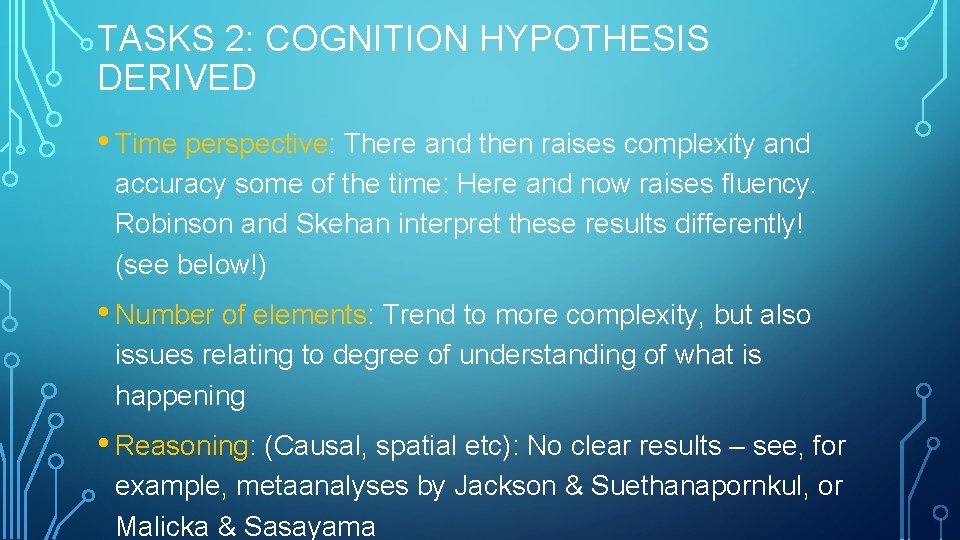
TASKS 2: COGNITION HYPOTHESIS DERIVED • Time perspective: There and then raises complexity and accuracy some of the time: Here and now raises fluency. Robinson and Skehan interpret these results differently! (see below!) • Number of elements: Trend to more complexity, but also issues relating to degree of understanding of what is happening • Reasoning: (Causal, spatial etc): No clear results – see, for example, metaanalyses by Jackson & Suethanapornkul, or Malicka & Sasayama
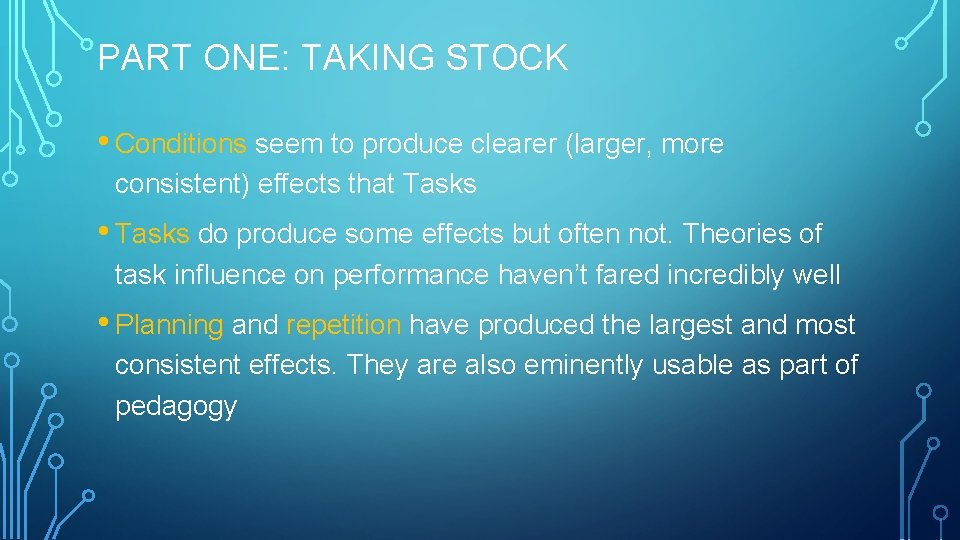
PART ONE: TAKING STOCK • Conditions seem to produce clearer (larger, more consistent) effects that Tasks • Tasks do produce some effects but often not. Theories of task influence on performance haven’t fared incredibly well • Planning and repetition have produced the largest and most consistent effects. They are also eminently usable as part of pedagogy
PART TWO: MEASUREMENT, CONSISTENCY, STYLE Christina+Jan Francine, Macao Francine, but where? Clue: A helipad. Nearest HK univ? Educ Univ Gavin
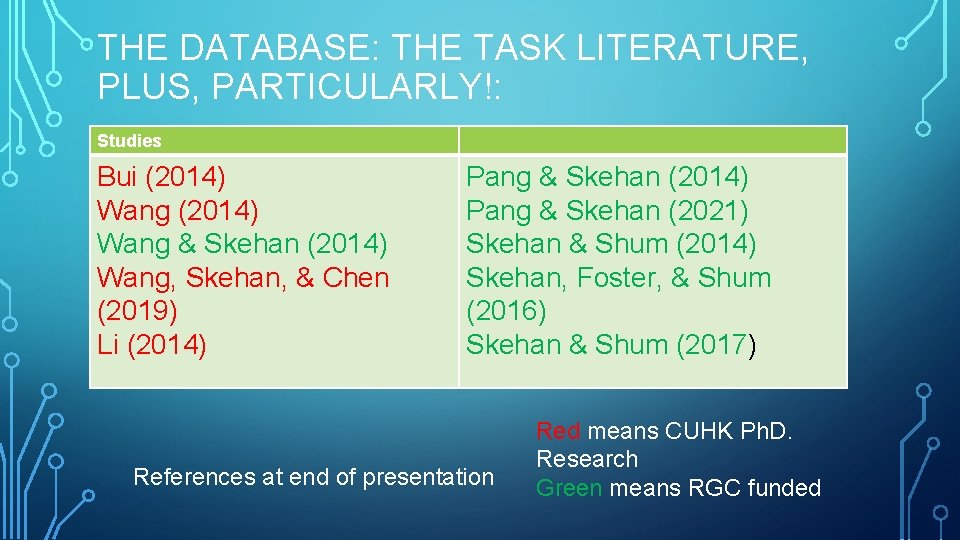
THE DATABASE: THE TASK LITERATURE, PLUS, PARTICULARLY!: Studies Bui (2014) Wang & Skehan (2014) Wang, Skehan, & Chen (2019) Li (2014) Pang & Skehan (2021) Skehan & Shum (2014) Skehan, Foster, & Shum (2016) Skehan & Shum (2017) References at end of presentation Red means CUHK Ph. D. Research Green means RGC funded
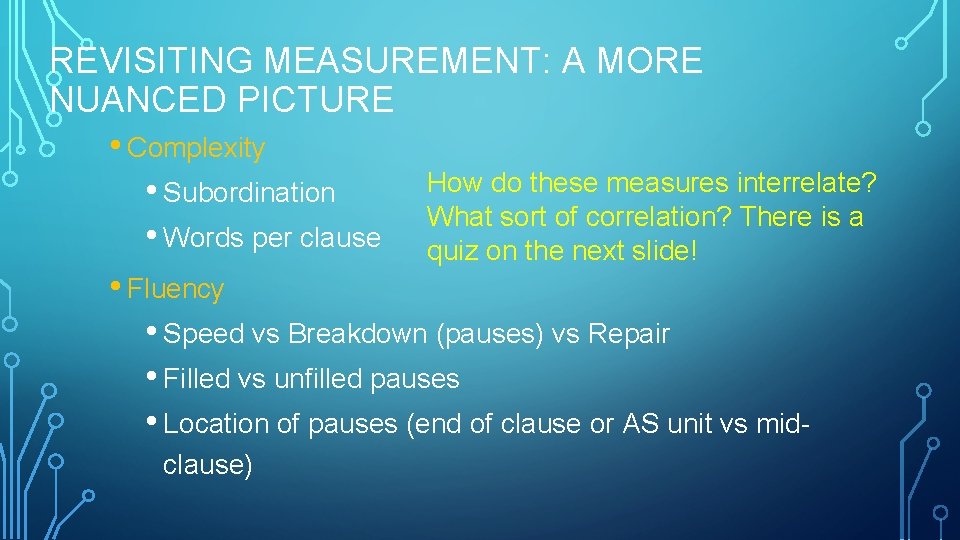
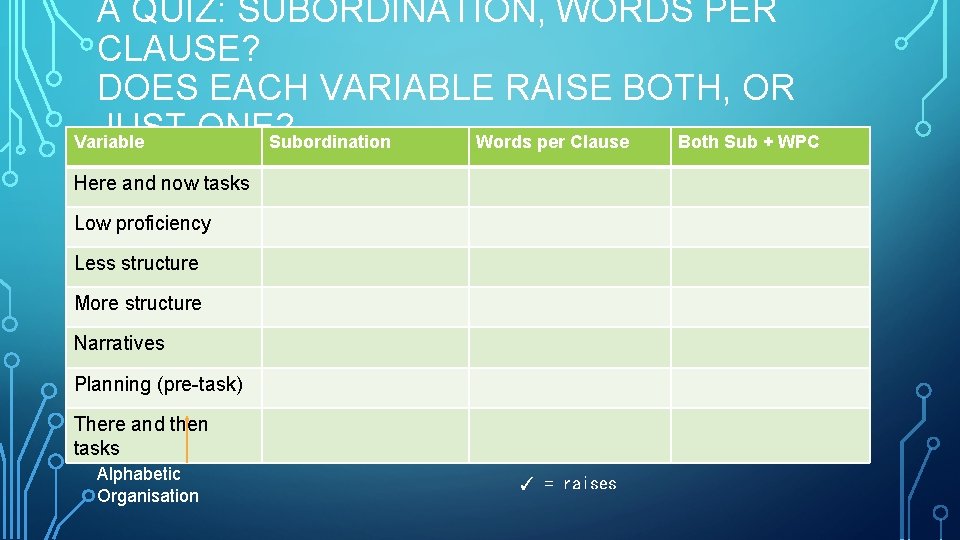
REVISITING MEASUREMENT: A MORE NUANCED PICTURE • Complexity How do these measures interrelate? • Subordination What sort of correlation? There is a • Words per clause quiz on the next slide! • Fluency • Speed vs Breakdown (pauses) vs Repair • Filled vs unfilled pauses • Location of pauses (end of clause or AS unit vs midclause)
A QUIZ: SUBORDINATION, WORDS PER CLAUSE? DOES EACH VARIABLE RAISE BOTH, OR JUST ONE? Variable Subordination Words per Clause Both Sub + WPC Here and now tasks Low proficiency Less structure More structure Narratives Planning (pre-task) There and then tasks Alphabetic Organisation ✓ = raises
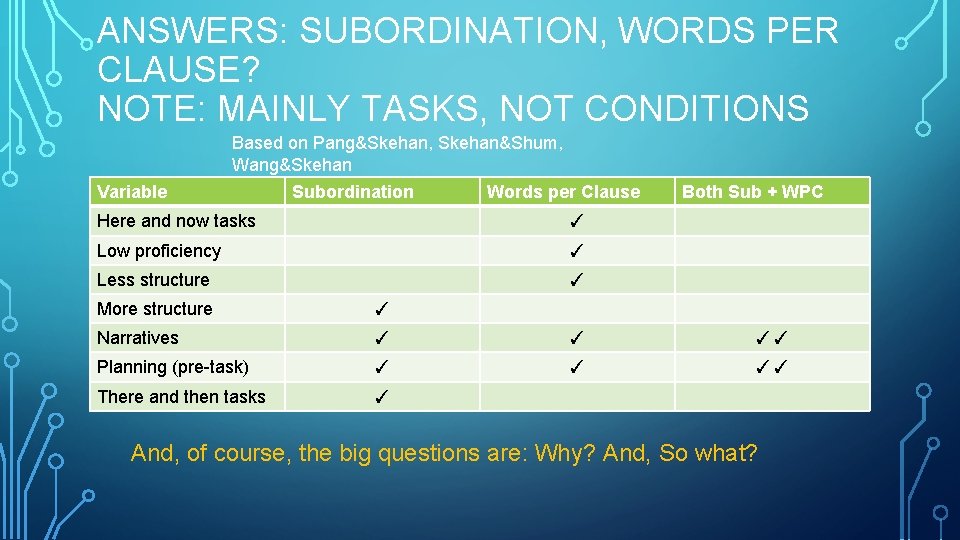
ANSWERS: SUBORDINATION, WORDS PER CLAUSE? NOTE: MAINLY TASKS, NOT CONDITIONS Based on Pang&Skehan, Skehan&Shum, Wang&Skehan Variable Subordination Words per Clause Here and now tasks ✓ Low proficiency ✓ Less structure ✓ Both Sub + WPC More structure ✓ Narratives ✓ ✓ ✓✓ Planning (pre-task) ✓ ✓ ✓✓ There and then tasks ✓ And, of course, the big questions are: Why? And, So what?
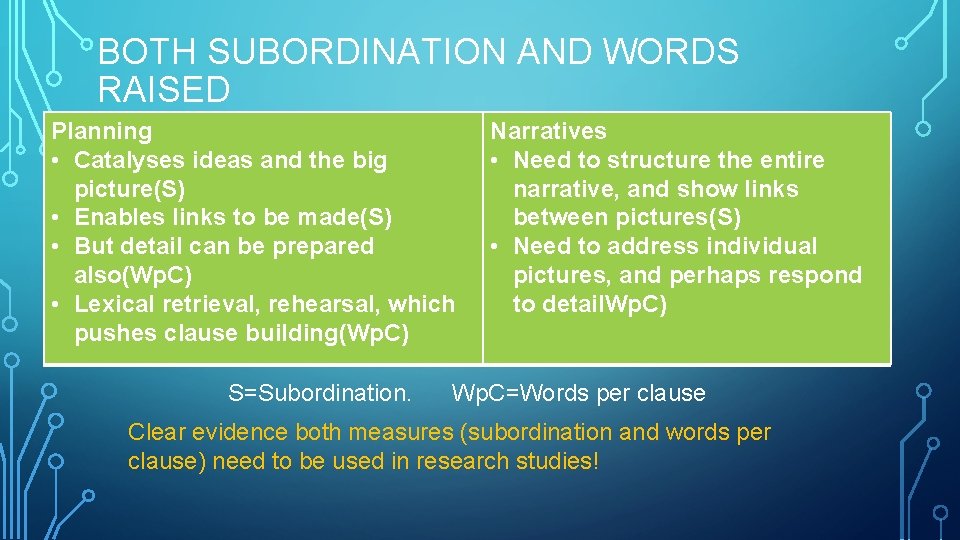
BOTH SUBORDINATION AND WORDS RAISED Planning • Catalyses ideas and the big picture(S) • Enables links to be made(S) • But detail can be prepared also(Wp. C) • Lexical retrieval, rehearsal, which pushes clause building(Wp. C) S=Subordination. Narratives • Need to structure the entire narrative, and show links between pictures(S) • Need to address individual pictures, and perhaps respond to detail. Wp. C) Wp. C=Words per clause Clear evidence both measures (subordination and words per clause) need to be used in research studies!
SUBORDINATION (ONLY) RAISERS • Task structure • Relationship between elements is clearer, i. e. the big picture, the overall narrative • Emphasis away from detail • There and then tasks • Memory for detail more prone to forgetting (see Pang & Skehan 2014) • Freedom to repackage, to select, to bring out structure, to justify through more complex AS units
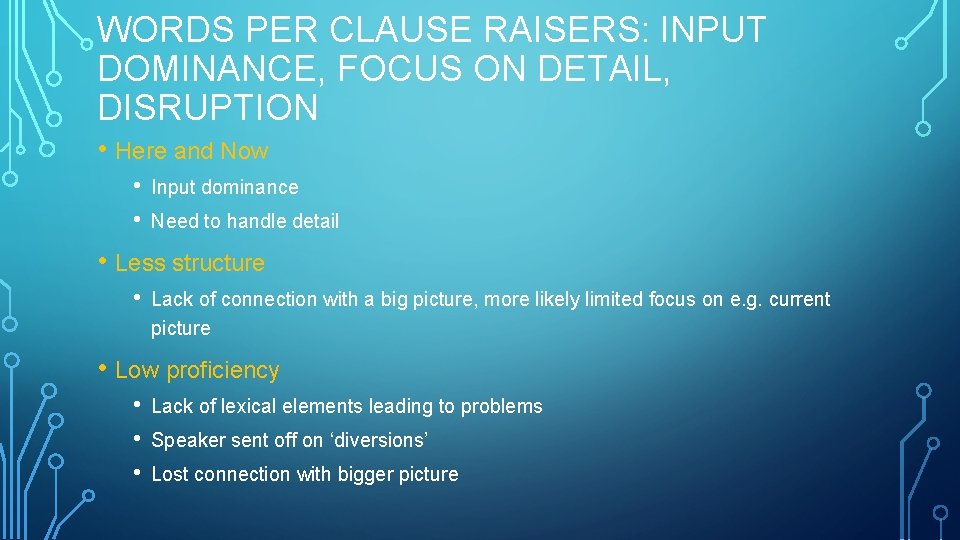
WORDS PER CLAUSE RAISERS: INPUT DOMINANCE, FOCUS ON DETAIL, DISRUPTION • Here and Now • • Input dominance Need to handle detail • Less structure • Lack of connection with a big picture, more likely limited focus on e. g. current picture • Low proficiency • • • Lack of lexical elements leading to problems Speaker sent off on ‘diversions’ Lost connection with bigger picture
FOCUSSING ON THE INDIVIDUAL • Consistency in performance across tasks • General style
(A) NS/NNS COMPARISON: (B) FOR EACH, IS THERE CONSISTENCY? • Skehan, Foster, & Shum: Skehan & Shum • 4 narrative (Mr Bean) video retellings done by all participants • 28 NS, 28 NNS • Little difference between NS and NNS for: • Subordination, Words per clause, lexical sophistication • NSs did better with: • Fluency: Fewer pauses, less repair, were faster Note: No accuracy comparison made: NS assumed to only lapse!
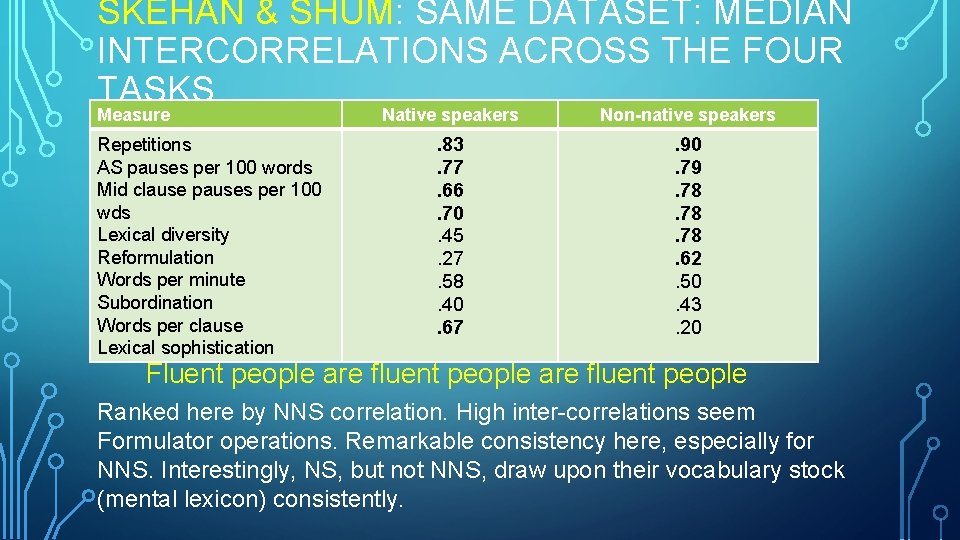
SKEHAN & SHUM: SAME DATASET: MEDIAN INTERCORRELATIONS ACROSS THE FOUR TASKS Measure Repetitions AS pauses per 100 words Mid clause pauses per 100 wds Lexical diversity Reformulation Words per minute Subordination Words per clause Lexical sophistication Native speakers Non-native speakers . 83. 77. 66. 70. 45. 27. 58. 40. 67 . 90. 79. 78. 78. 62. 50. 43. 20 Fluent people are fluent people Ranked here by NNS correlation. High inter-correlations seem Formulator operations. Remarkable consistency here, especially for NNS. Interestingly, NS, but not NNS, draw upon their vocabulary stock (mental lexicon) consistently.
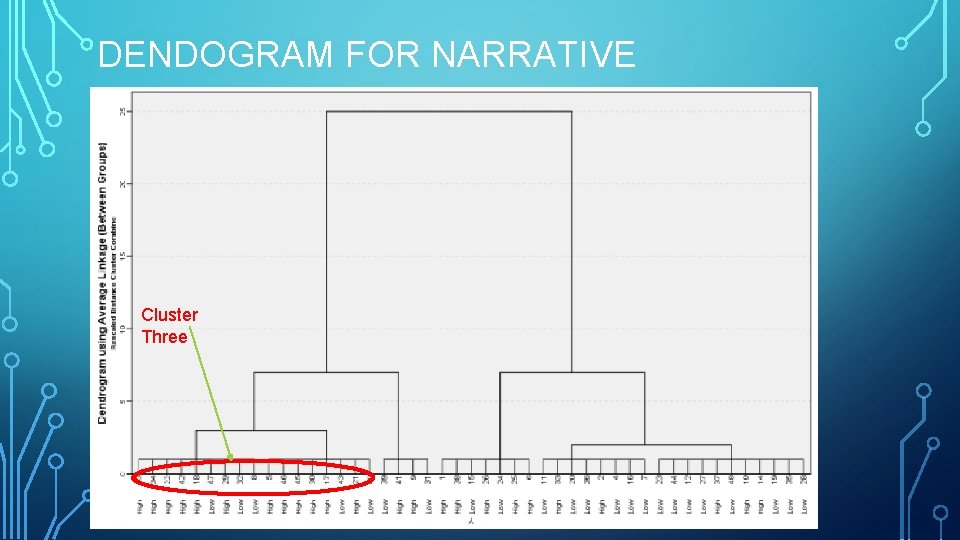
PANG & SKEHAN (2021): GENERAL STYLE • N=48: (1) Picture based narrative (Shaun the Sheep) and (2) Decision making task (Agony Aunt) with usual set of measures (CALF) • Data was cluster analysed • Most statistical analyses look at connections between variables, e. g. correlations • Cluster analysis looks for connections, profiles between people (cases) • It starts by identifying the pair of people who are most similar across their scores, and links them into a cluster. Then it starts again (with one fewer case) and identifies the next cluster. And on, and on, until there is only one cluster left. • The ‘trick’? To identify the number of clusters that makes sense, that is not too large, and which can be interpreted
DENDOGRAM FOR NARRATIVE Cluster Three
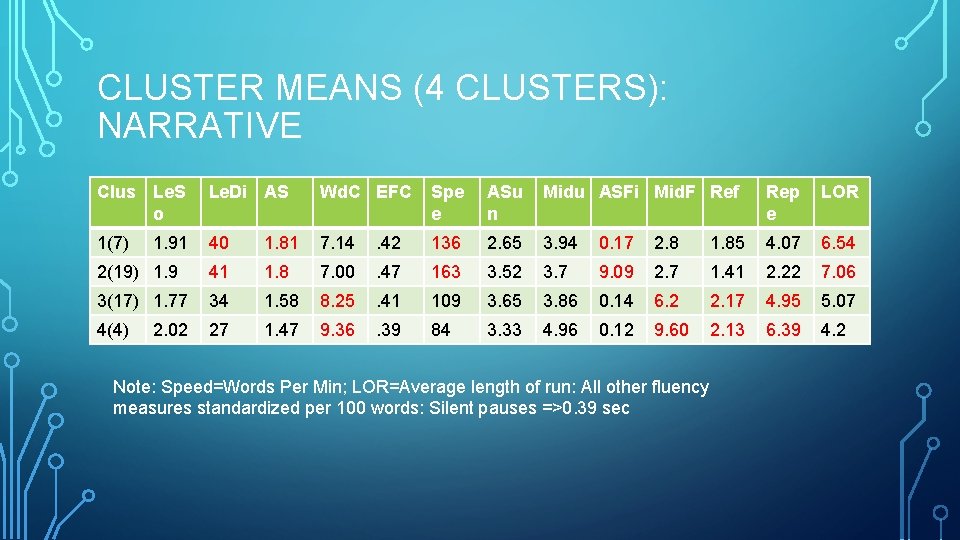
CLUSTER MEANS (4 CLUSTERS): NARRATIVE Clus Le. S o Le. Di AS Wd. C EFC Spe e ASu n Midu ASFi Mid. F Ref Rep e LOR 1(7) 40 1. 81 7. 14 . 42 136 2. 65 3. 94 0. 17 2. 8 1. 85 4. 07 6. 54 2(19) 1. 9 41 1. 8 7. 00 . 47 163 3. 52 3. 7 9. 09 2. 7 1. 41 2. 22 7. 06 3(17) 1. 77 34 1. 58 8. 25 . 41 109 3. 65 3. 86 0. 14 6. 2 2. 17 4. 95 5. 07 4(4) 27 1. 47 9. 36 . 39 84 3. 33 4. 96 0. 12 9. 60 2. 13 6. 39 4. 2 1. 91 2. 02 Note: Speed=Words Per Min; LOR=Average length of run: All other fluency measures standardized per 100 words: Silent pauses =>0. 39 sec
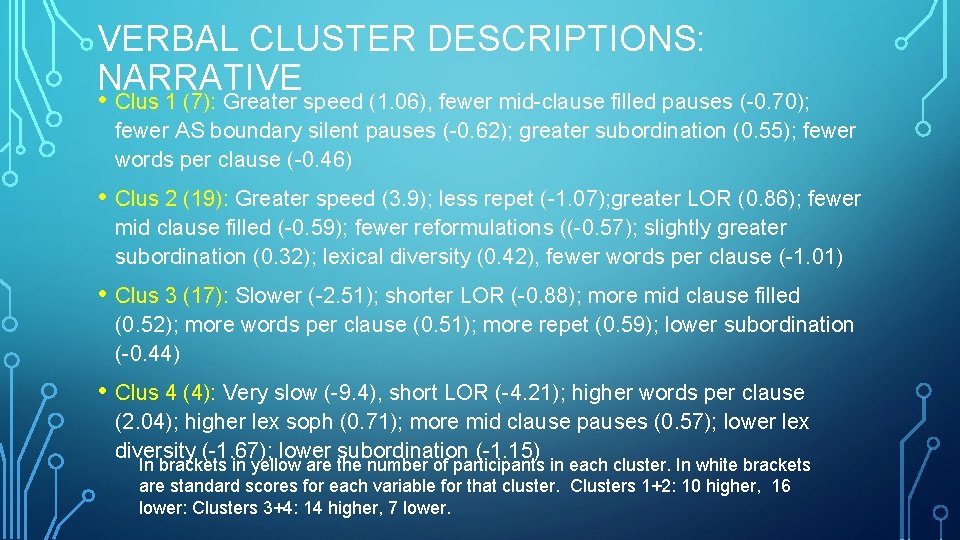
VERBAL CLUSTER DESCRIPTIONS: NARRATIVE • Clus 1 (7): Greater speed (1. 06), fewer mid-clause filled pauses (-0. 70); fewer AS boundary silent pauses (-0. 62); greater subordination (0. 55); fewer words per clause (-0. 46) • Clus 2 (19): Greater speed (3. 9); less repet (-1. 07); greater LOR (0. 86); fewer mid clause filled (-0. 59); fewer reformulations ((-0. 57); slightly greater subordination (0. 32); lexical diversity (0. 42), fewer words per clause (-1. 01) • Clus 3 (17): Slower (-2. 51); shorter LOR (-0. 88); more mid clause filled (0. 52); more words per clause (0. 51); more repet (0. 59); lower subordination (-0. 44) • Clus 4 (4): Very slow (-9. 4), short LOR (-4. 21); higher words per clause (2. 04); higher lex soph (0. 71); more mid clause pauses (0. 57); lower lex diversity (-1. 67); lower subordination (-1. 15) In brackets in yellow are the number of participants in each cluster. In white brackets are standard scores for each variable for that cluster. Clusters 1+2: 10 higher, 16 lower: Clusters 3+4: 14 higher, 7 lower.
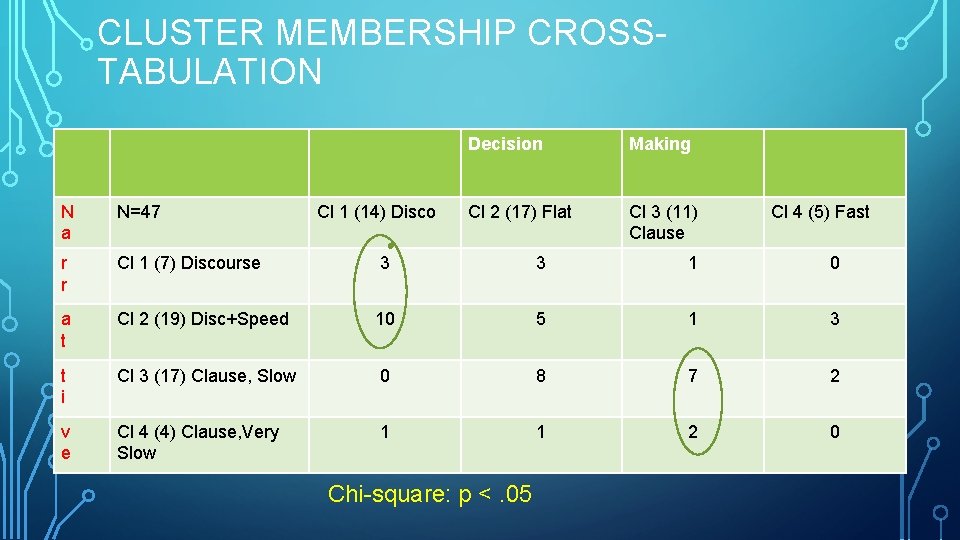
CLUSTER MEMBERSHIP CROSSTABULATION Cl 1 (14) Disco Decision Making Cl 2 (17) Flat Cl 3 (11) Clause N a N=47 r r Cl 1 (7) Discourse 3 3 1 0 a t Cl 2 (19) Disc+Speed 10 5 1 3 t i Cl 3 (17) Clause, Slow 0 8 7 2 v e Cl 4 (4) Clause, Very Slow 1 1 2 0 Chi-square: p <. 05 Cl 4 (5) Fast
GENERAL INTERPRETATION • In the narrative (monologic) task, there is a reasonably clear contrast between a discourse, faster, clause-end pausing subordinating style versus a slower, more repaired midclause-oriented style • In the decision-making (interactive) task, this contrast is still there but not so clearly, with a flat cluster also • Despite this, the discourse versus clause contrast still carries over from one task to another, but only to a certain extent and with certain people only
INTERPRETATIONS • What might a ‘discourse’ style involve? • Macroplanning, and ‘spans’ over several utterances, driven by discourse and discourse organization? Note though: this is a planning study. • Do some people gravitate to this more than others? i. e. nature’s Complexifiers? • What might a ‘clause’ style involve? • Pawley and Syder’s ‘one clause at a time’ hypothesis • Are these ‘improvisers’? Is the style to focus on detail, at the expense of the bigger picture? • Could this be a reflection of how they didn’t draw upon their
THREE BRIEF STUDIES: (1) WANG, SKEHAN, CHEN (2019) • Same dataset as before (Wang, 2014), but this time linking performance under different conditions to level of proficiency • The question: which CALF measures correlate with proficiency under which conditions? Do higher proficiency have higher complexity, accuracy etc? • Basically proficiency doesn’t correlate much with performance under most conditions • EXCEPT with accuracy, and only with on-line planning conditions. • Having more time, more relaxed performance conditions enables the benefits of greater proficiency to be realized. Not having relaxed time conditions means proficiency doesn’t make much of a contribution to accuracy
(2) BUI (2014) • Cleverly designed study of matched and mismatched groups with their academic specialisations • Computer studies and medicine students, each required to give an account of a computer virus and a human body virus, i. e. matched and unmatched. Plus or minus planning also. • Planning produced its usual effects • Specialisation match, e. g. computer studies AND computer virus, did not lead to differences in complexity or accuracy. • It did lead to higher scores for lexical sophistication and
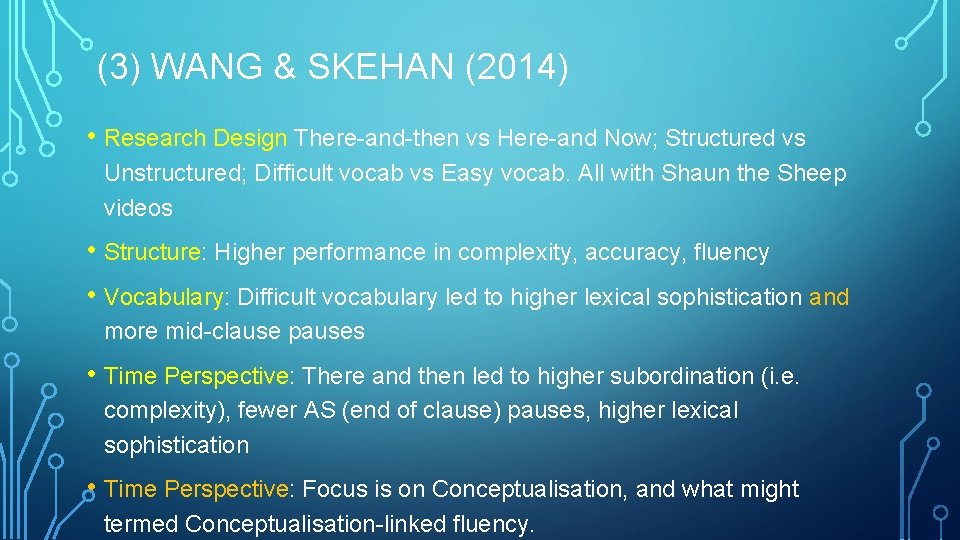
(3) WANG & SKEHAN (2014) • Research Design There-and-then vs Here-and Now; Structured vs Unstructured; Difficult vocab vs Easy vocab. All with Shaun the Sheep videos • Structure: Higher performance in complexity, accuracy, fluency • Vocabulary: Difficult vocabulary led to higher lexical sophistication and more mid-clause pauses • Time Perspective: There and then led to higher subordination (i. e. complexity), fewer AS (end of clause) pauses, higher lexical sophistication • Time Perspective: Focus is on Conceptualisation, and what might termed Conceptualisation-linked fluency.
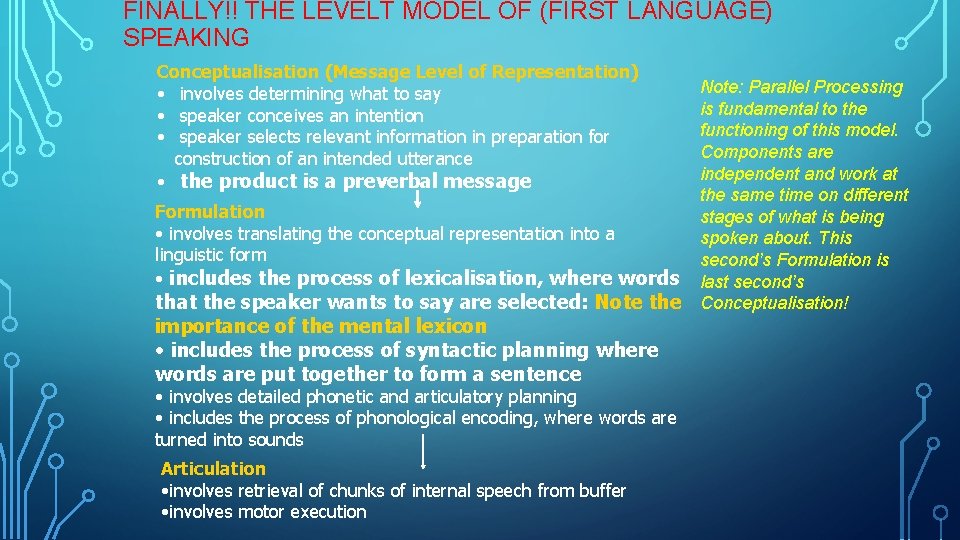
FINALLY!! THE LEVELT MODEL OF (FIRST LANGUAGE) SPEAKING Conceptualisation (Message Level of Representation) • involves determining what to say • speaker conceives an intention • speaker selects relevant information in preparation for construction of an intended utterance • the product is a preverbal message Formulation • involves translating the conceptual representation into a linguistic form • includes the process of lexicalisation, where words that the speaker wants to say are selected: Note the importance of the mental lexicon • includes the process of syntactic planning where words are put together to form a sentence • involves detailed phonetic and articulatory planning • includes the process of phonological encoding, where words are turned into sounds Articulation • involves retrieval of chunks of internal speech from buffer • involves motor execution Note: Parallel Processing is fundamental to the functioning of this model. Components are independent and work at the same time on different stages of what is being spoken about. This second’s Formulation is last second’s Conceptualisation!
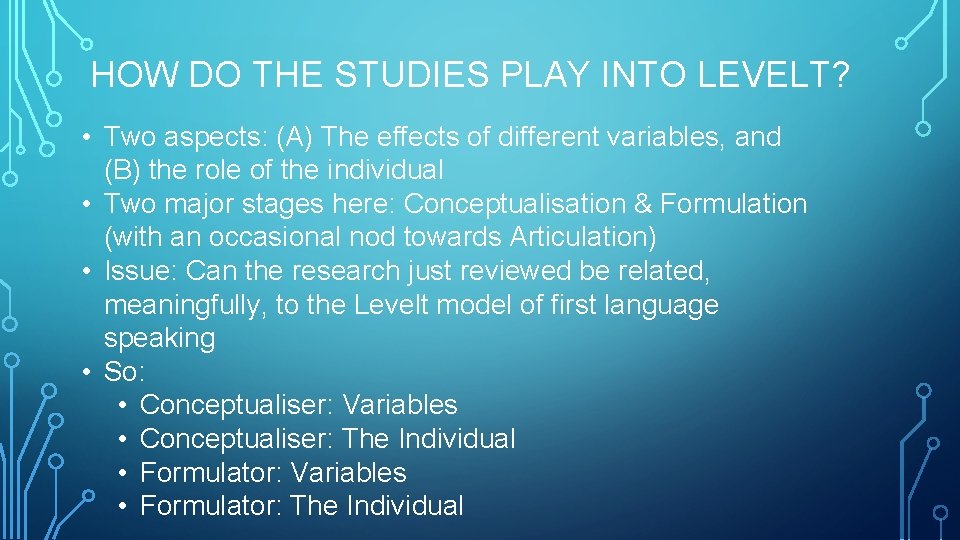
HOW DO THE STUDIES PLAY INTO LEVELT? • Two aspects: (A) The effects of different variables, and (B) the role of the individual • Two major stages here: Conceptualisation & Formulation (with an occasional nod towards Articulation) • Issue: Can the research just reviewed be related, meaningfully, to the Levelt model of first language speaking • So: • Conceptualiser: Variables • Conceptualiser: The Individual • Formulator: Variables • Formulator: The Individual
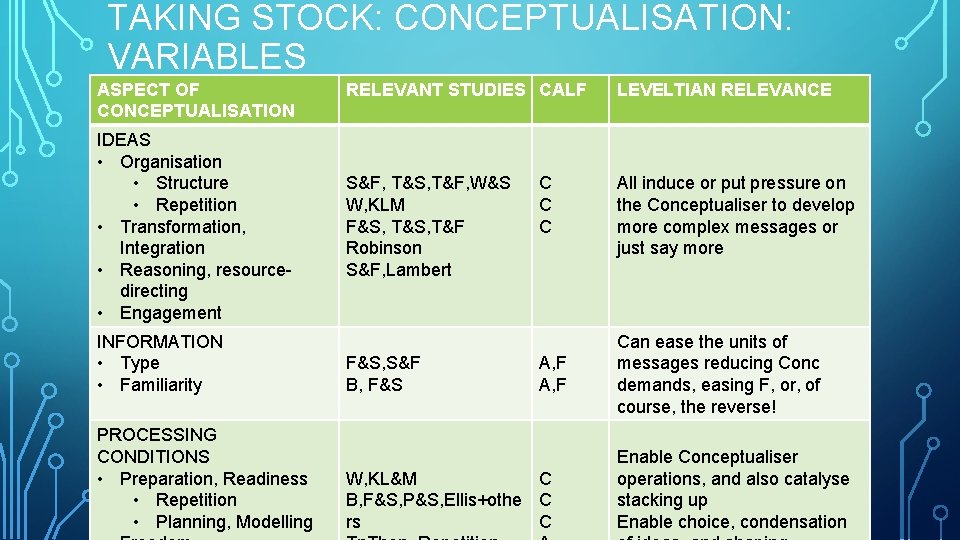
TAKING STOCK: CONCEPTUALISATION: VARIABLES ASPECT OF CONCEPTUALISATION IDEAS • Organisation • Structure • Repetition • Transformation, Integration • Reasoning, resourcedirecting • Engagement INFORMATION • Type • Familiarity PROCESSING CONDITIONS • Preparation, Readiness • Repetition • Planning, Modelling RELEVANT STUDIES CALF LEVELTIAN RELEVANCE S&F, T&S, T&F, W&S W, KLM F&S, T&F Robinson S&F, Lambert All induce or put pressure on the Conceptualiser to develop more complex messages or just say more F&S, S&F B, F&S C C C A, F W, KL&M C B, F&S, P&S, Ellis+othe C rs C Can ease the units of messages reducing Conc demands, easing F, or, of course, the reverse! Enable Conceptualiser operations, and also catalyse stacking up Enable choice, condensation
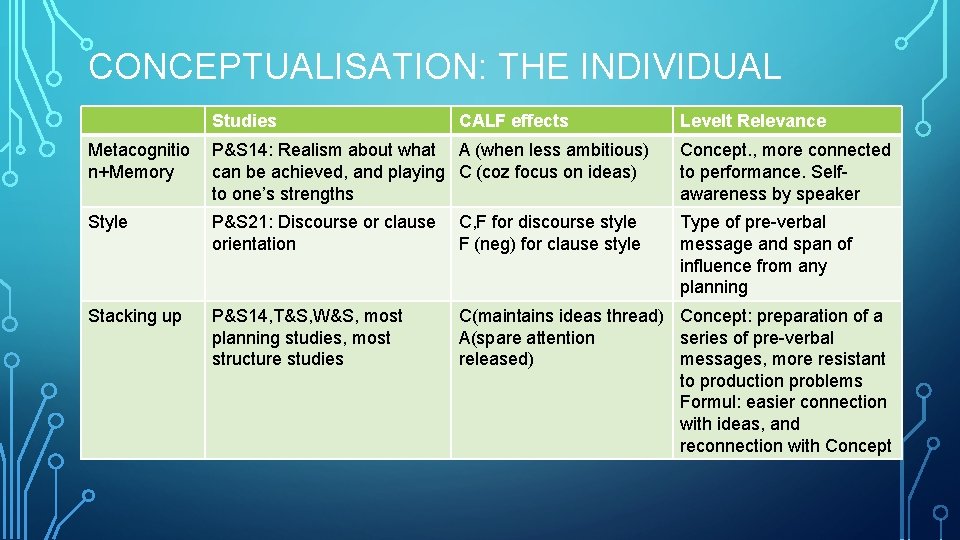
CONCEPTUALISATION: THE INDIVIDUAL Studies CALF effects Levelt Relevance Metacognitio n+Memory P&S 14: Realism about what A (when less ambitious) can be achieved, and playing C (coz focus on ideas) to one’s strengths Concept. , more connected to performance. Selfawareness by speaker Style P&S 21: Discourse or clause orientation C, F for discourse style F (neg) for clause style Type of pre-verbal message and span of influence from any planning Stacking up P&S 14, T&S, W&S, most planning studies, most structure studies C(maintains ideas thread) Concept: preparation of a A(spare attention series of pre-verbal released) messages, more resistant to production problems Formul: easier connection with ideas, and reconnection with Concept
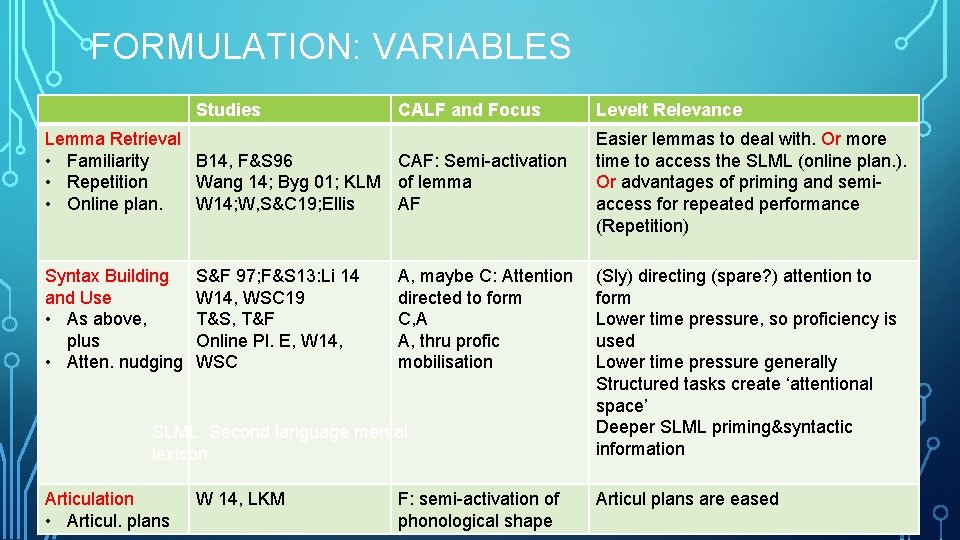
FORMULATION: VARIABLES Studies CALF and Focus Levelt Relevance Lemma Retrieval • Familiarity B 14, F&S 96 CAF: Semi-activation • Repetition Wang 14; Byg 01; KLM of lemma • Online plan. W 14; W, S&C 19; Ellis AF Easier lemmas to deal with. Or more time to access the SLML (online plan. ). Or advantages of priming and semiaccess for repeated performance (Repetition) Syntax Building and Use • As above, plus • Atten. nudging (Sly) directing (spare? ) attention to form Lower time pressure, so proficiency is used Lower time pressure generally Structured tasks create ‘attentional space’ Deeper SLML priming&syntactic information S&F 97; F&S 13: Li 14 W 14, WSC 19 T&S, T&F Online Pl. E, W 14, WSC A, maybe C: Attention directed to form C, A A, thru profic mobilisation SLML: Second language mental lexicon Articulation • Articul. plans W 14, LKM F: semi-activation of phonological shape Articul plans are eased
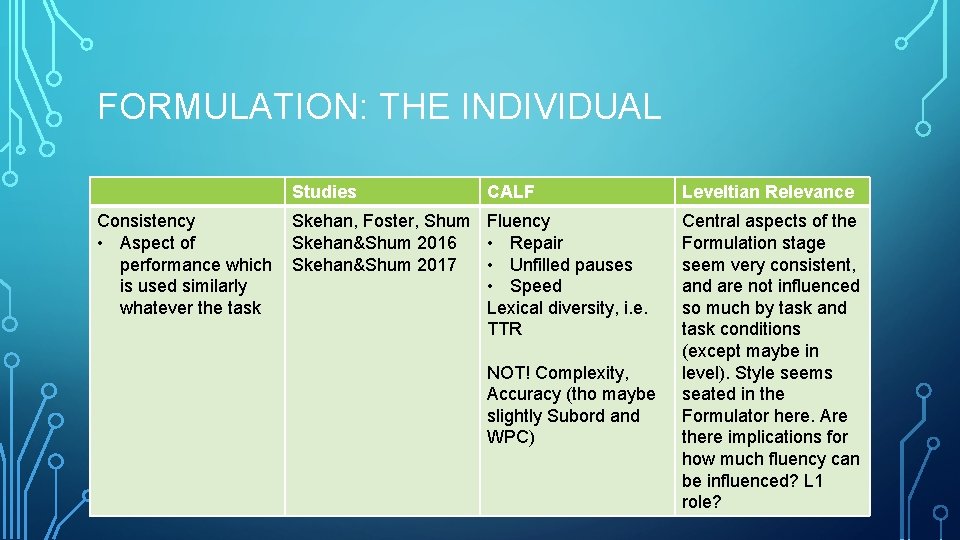
FORMULATION: THE INDIVIDUAL Studies Consistency • Aspect of performance which is used similarly whatever the task CALF Skehan, Foster, Shum Fluency Skehan&Shum 2016 • Repair Skehan&Shum 2017 • Unfilled pauses • Speed Lexical diversity, i. e. TTR NOT! Complexity, Accuracy (tho maybe slightly Subord and WPC) Leveltian Relevance Central aspects of the Formulation stage seem very consistent, and are not influenced so much by task and task conditions (except maybe in level). Style seems seated in the Formulator here. Are there implications for how much fluency can be influenced? L 1 role?
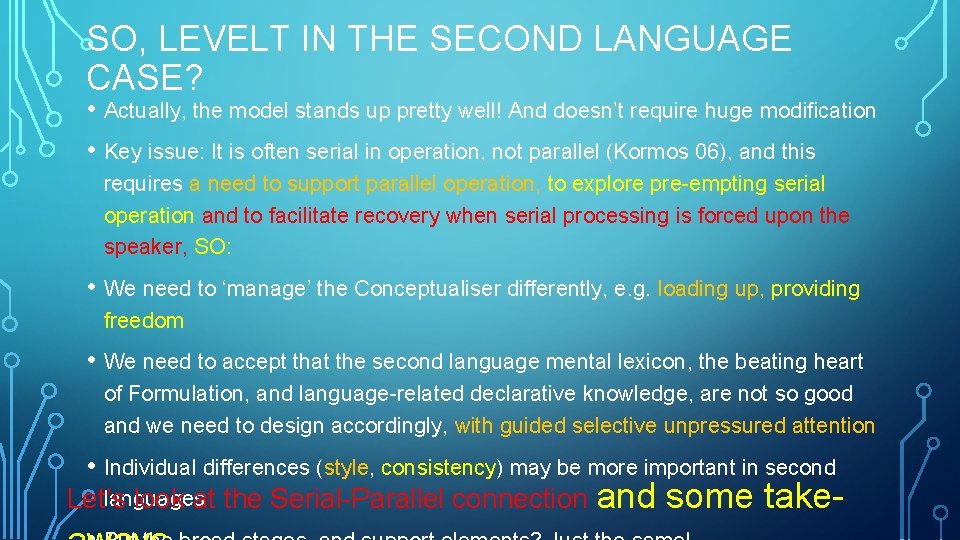
SO, LEVELT IN THE SECOND LANGUAGE CASE? • Actually, the model stands up pretty well! And doesn’t require huge modification • Key issue: It is often serial in operation, not parallel (Kormos 06), and this requires a need to support parallel operation, to explore pre-empting serial operation and to facilitate recovery when serial processing is forced upon the speaker, SO: • We need to ‘manage’ the Conceptualiser differently, e. g. loading up, providing freedom • We need to accept that the second language mental lexicon, the beating heart of Formulation, and language-related declarative knowledge, are not so good and we need to design accordingly, with guided selective unpressured attention • Individual differences (style, consistency) may be more important in second languages Let’s look at the Serial-Parallel connection and some take-
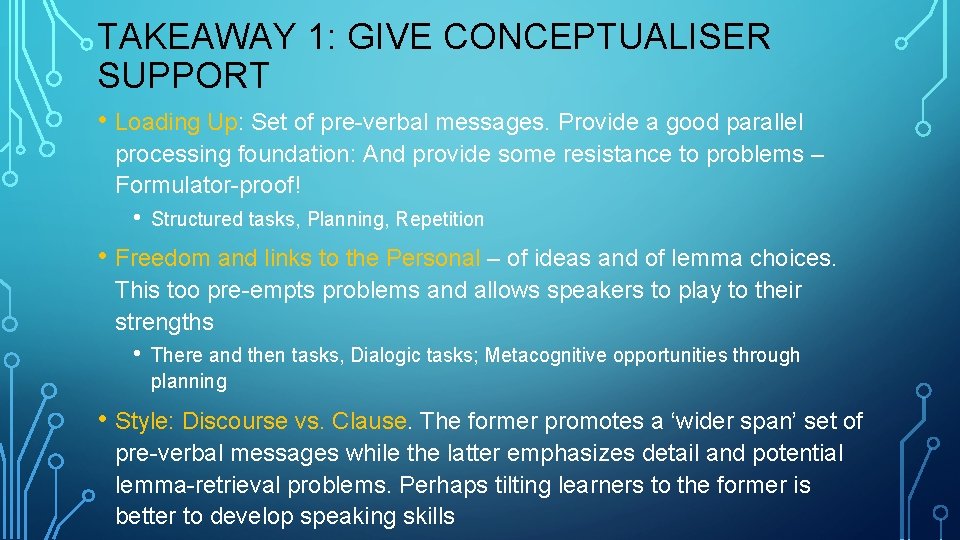
TAKEAWAY 1: GIVE CONCEPTUALISER SUPPORT • Loading Up: Set of pre-verbal messages. Provide a good parallel processing foundation: And provide some resistance to problems – Formulator-proof! • Structured tasks, Planning, Repetition • Freedom and links to the Personal – of ideas and of lemma choices. This too pre-empts problems and allows speakers to play to their strengths • There and then tasks, Dialogic tasks; Metacognitive opportunities through planning • Style: Discourse vs. Clause. The former promotes a ‘wider span’ set of pre-verbal messages while the latter emphasizes detail and potential lemma-retrieval problems. Perhaps tilting learners to the former is better to develop speaking skills
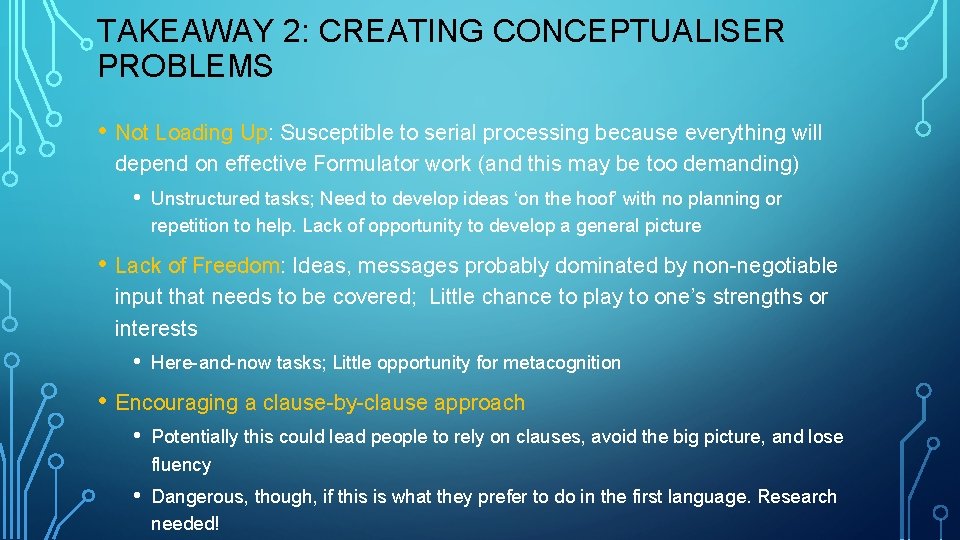
TAKEAWAY 2: CREATING CONCEPTUALISER PROBLEMS • Not Loading Up: Susceptible to serial processing because everything will depend on effective Formulator work (and this may be too demanding) • Unstructured tasks; Need to develop ideas ‘on the hoof’ with no planning or repetition to help. Lack of opportunity to develop a general picture • Lack of Freedom: Ideas, messages probably dominated by non-negotiable input that needs to be covered; Little chance to play to one’s strengths or interests • Here-and-now tasks; Little opportunity for metacognition • Encouraging a clause-by-clause approach • Potentially this could lead people to rely on clauses, avoid the big picture, and lose fluency • Dangerous, though, if this is what they prefer to do in the first language. Research needed!
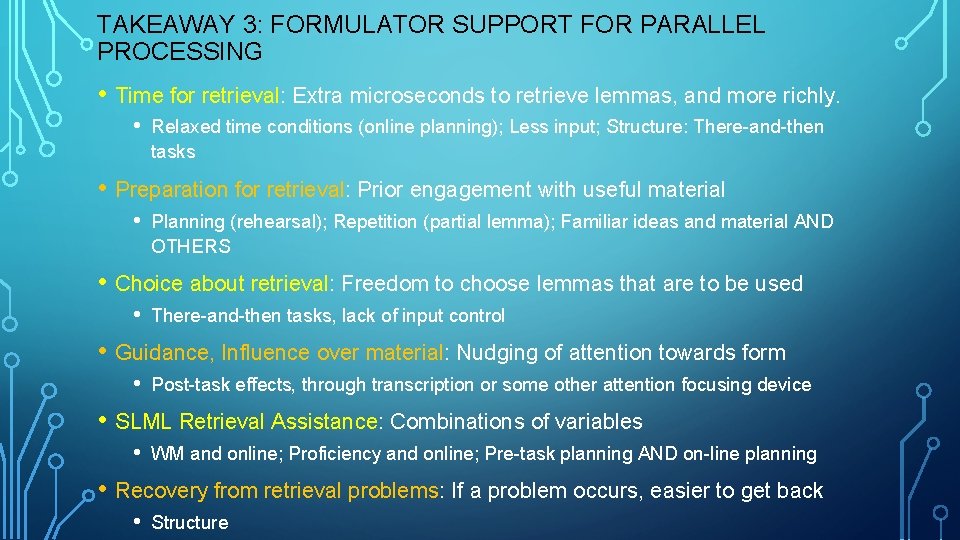
TAKEAWAY 3: FORMULATOR SUPPORT FOR PARALLEL PROCESSING • Time for retrieval: Extra microseconds to retrieve lemmas, and more richly. • Relaxed time conditions (online planning); Less input; Structure: There-and-then tasks • Preparation for retrieval: Prior engagement with useful material • Planning (rehearsal); Repetition (partial lemma); Familiar ideas and material AND OTHERS • Choice about retrieval: Freedom to choose lemmas that are to be used • There-and-then tasks, lack of input control • Guidance, Influence over material: Nudging of attention towards form • Post-task effects, through transcription or some other attention focusing device • SLML Retrieval Assistance: Combinations of variables • WM and online; Proficiency and online; Pre-task planning AND on-line planning • Recovery from retrieval problems: If a problem occurs, easier to get back • Structure
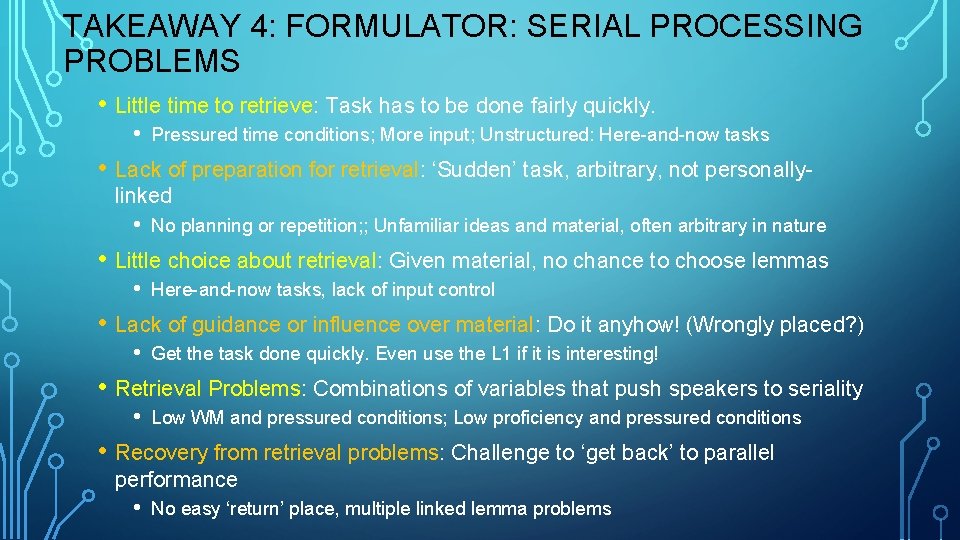
TAKEAWAY 4: FORMULATOR: SERIAL PROCESSING PROBLEMS • Little time to retrieve: Task has to be done fairly quickly. • Pressured time conditions; More input; Unstructured: Here-and-now tasks • Lack of preparation for retrieval: ‘Sudden’ task, arbitrary, not personallylinked • No planning or repetition; ; Unfamiliar ideas and material, often arbitrary in nature • Little choice about retrieval: Given material, no chance to choose lemmas • Here-and-now tasks, lack of input control • Lack of guidance or influence over material: Do it anyhow! (Wrongly placed? ) • Get the task done quickly. Even use the L 1 if it is interesting! • Retrieval Problems: Combinations of variables that push speakers to seriality • Low WM and pressured conditions; Low proficiency and pressured conditions • Recovery from retrieval problems: Challenge to ‘get back’ to parallel performance • No easy ‘return’ place, multiple linked lemma problems
THANK YOU And it was near Lai Chi Wo (Catch a minibus from Tai Po Market to, or drive and park at Wu Kau Tang, and you can walk (and get good views of Shenzhen). Three hours in total. Come back for a meal at Tai Me Tuk (and a bike ride for the still energetic)).
REFERENCES • • • Ahmadian, M. J. (2012). The Relationship Between Working Memory Capacity and L 2 Oral Performance Under Task. Based Careful Online Planning Condition. TESOL Quarterly, 46, 1, 165 -175. Bui, G. (2014). Task readiness: Theoretical framework and empirical evidence from topic familiarity, strategic planning, and proficiency levels. In Skehan (2014). Bygate, M. (2001). Effects of task repetition on the structure and control of oral language. In Bygate, M. , Skehan, P. , & Swain, M. (Eds. ). Researching Pedagogic Tasks. (pp. 23 -48). Harlow, UK: Longman. Ellis, R. (2005 a). Planning and task based performance: Theory and research. In Ellis, R. (Ed. ). (pp. 3 -36). Ellis, R. (2005 b). Planning and Task Performance in a Second Language. Amsterdam: John Benjamins. • Foster, P. & Skehan, P. (1996 a). The influence of planning on performance in task-based learning. Studies in Second Language Acquisition, 18, 3, 299 -324. • Foster, P. & Skehan, P. (2013) The effects of post-task activities on the accuracy of language during task performance. Canadian Modern Language Review, 69, 249 -273. • Inoue, C. (2016). A comparative study of the variables used to measure syntactic complexity and accuracy in taskbased research. The Language Learning Journal, 1, 1 -18. • Kormos, J. (2006). Speech Production and Second Language Acquisition. Mahwah, N. J. : Erlbaum. • Lambert, C. , Kormos, J. & Minn, D. (2016). Task repetition and second language speech processing. Studies in Second Language Acquisition, 38, 1 -30. • Levelt, W. J. M. (1989). Speaking: From intention to articulation. Cambridge, Ma. : MIT Press.
REFERENCES (CONT. ) Li, Q. (2014). Get it right in the end: The effects of post-task transcribing on learners' oral performance. In P. Skehan (Ed. ), (pp. 129 -154). Pang, F. & Skehan, P. (2014). Self-reported planning behavior and second language performance in narrative retelling. In Skehan (2014) Pang, F. & Skehan, P. (2021). Performance profiles on second language speaking tasks. Modern Language Journal, Spring. Robinson, P. (2015). The Cognition Hypothesis, second language task demands, and the SSARC model of pedagogic task sequencing. In Bygate, M. (Ed. ). Domains and Directions in the Development of TBLT. pp. 87 -122. Amsterdam: John Benjamins. Sasayama, S. (2016). Is a ‘complex’ task really complex? Validating the assumption of cognitive Skehan, P. (2014). Processing Perspectives on Task Performance. Amsterdam: John Benjamins. Skehan, P. & Foster, P. (1997). The influence of planning and post-task activities on accuracy and complexity in task based learning. Language Teaching Research, 1, 185 -211. Skehan, P. , Foster, P. & Shum, S. (2016). Ladders and snakes in second language fluency. International Review of Applied Linguistics, 54, 2, 97 - 111. Skehan, P. & Shum, S. (2014). Structure and processing conditions in video-based narrative retelling. In Skehan (2014). Skehan, P. & Shum, S. (2017). What influences performance? Personal style or the task being done? In Wong, L. L. C. & Hyland, K. (Eds. ). Faces of English Education, pp. 28 -43. London: Routledge. Tavakoli, P. & Foster, P. (2008). Task design and second language performance: The effect of narrative type on learner output. Language Learning, 58, 2, 439 -473. Tavakoli, P. & Skehan, P. (2005). Planning, task structure, and performance testing. In Ellis (2005). Wang, Z. (2014). On-line time pressure manipulations. In Skehan (2014), (pp. 27 -62). Wang, Z. & Skehan, P. (2014). Structure, lexis, and time perspective: Influences on task performance. In Skehan (2014). Wang, Z. , Skehan, P. , & Chen, G. (2019)