
Research into Obedience Milgrams study explanations Why do
Research into Obedience Milgram’s study & explanations
Why do we obey?
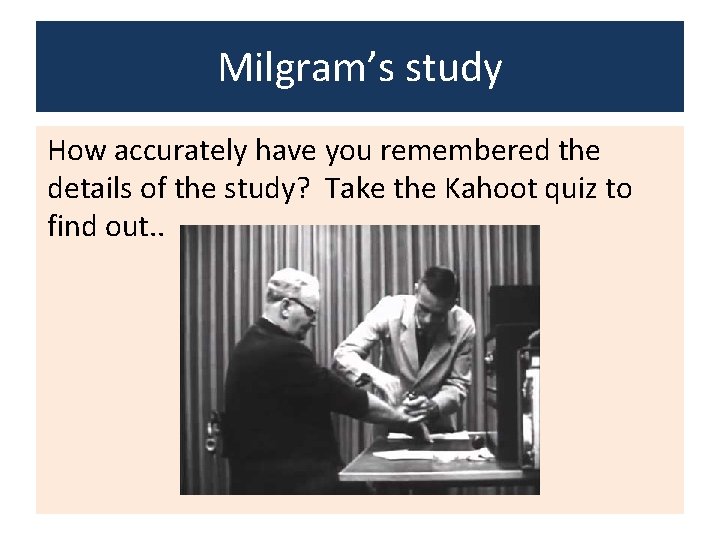
Milgram’s study How accurately have you remembered the details of the study? Take the Kahoot quiz to find out. .
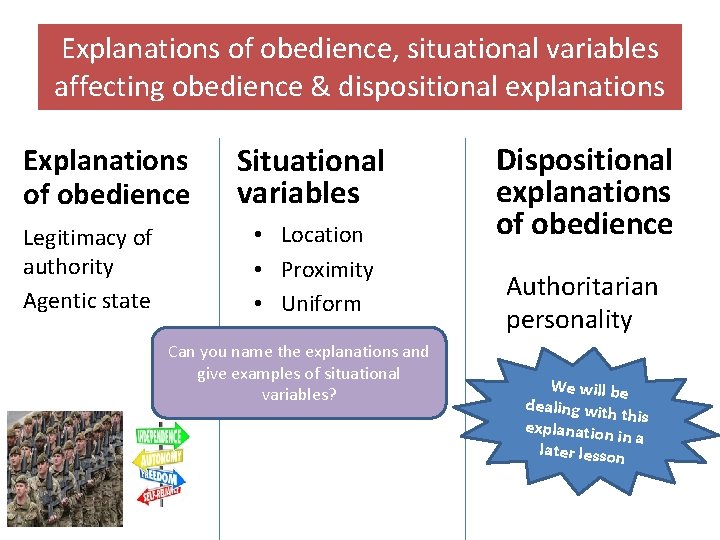
Explanations of obedience, situational variables affecting obedience & dispositional explanations Explanations of obedience Legitimacy of authority Agentic state Situational variables • Location • Proximity • Uniform Can you name the explanations and give examples of situational variables? Dispositional explanations of obedience Authoritarian personality We will be dealing with this explanation in a later lesson
Explanation: Legitimacy of authority On mini-whiteboards, summarise the explanation in three bullet points • People have been socialised into acting on the requests of a legitimate authority. We tend to obey those with authority because we assume they know what they are doing • If someone has legitimate authority they have a role that is defined by society that gives them a right to exert their control over others. • We may obey these people because we trust them, or because we believe that they have the power to punish us • Legitimate authority may come from a person’s status in society, which may be conveyed by a uniform, or their position in the family structure
Explanation: Agentic State • What does it mean if we say that someone is operating in autonomous mode? • What does it mean if we say that someone is operating in agentic state?
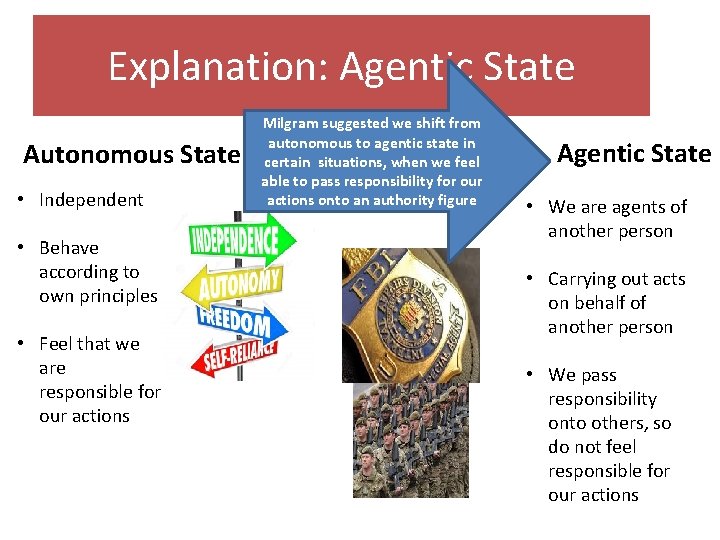
Explanation: Agentic State Autonomous State • Independent • Behave according to own principles • Feel that we are responsible for our actions Milgram suggested we shift from autonomous to agentic state in certain situations, when we feel able to pass responsibility for our actions onto an authority figure Agentic State • We are agents of another person • Carrying out acts on behalf of another person • We pass responsibility onto others, so do not feel responsible for our actions
Can you Location remember how • Location can have an effect on obedience rates because some theylegitimacy make aof the authority locations increase the perceived figure. difference? Proximity • This can refer to how close the person is to the consequences of their actions when obeying an authority figure - the more able they are to avoid witnessing the consequences of their obedient behaviour, the more likely they are to obey. • Also, how close the person is to the authority figure when orders are given. Uniform • A uniform can give the perception of greater authority, and therefore we would expect that obedience rates would be higher if the person giving the order was wearing a uniform
Explanations of Obedience On a mini whiteboard, write down a reason why the person is obeying in the following situations. Your answers must be linked to the explanations and situational factors you looked at as part of your homework You can discuss your answers in your group

Example 1 • Harold agrees to use a different lift when he is confronted by a security guard at the shopping centre who tells him that the lift he wants to use is reserved for special visitors Legitimate authority/uniform
Example 2 • Matthew sees his school caretaker when he is out in town. The caretaker asks him to wait with his dog while he goes into the supermarket. Matthew refuses and says he has too much to do. When Matthew is back at school, he sees the caretaker in the playground, who asks him to pick up some rubbish that is laying near the bin. Matthew agrees. Location/legitimate authority
Example 3 • Catherine is at university. There are signs in the stairwells and in the corridors asking people to keep left, but Catherine walks on the right to avoid the crowd. A lecturer passes her and asks her to walk on the left, which she does. Legitimate authority/location
Example 4 • Vijay is at school. An older child gives him a lunch box which he tells him he has stolen from another child. The older child tells Vijay to hide it for him and he will collect it later. Vijay agrees. Agentic mode
Example 5 • Susan and her friend Mary are looking at Susan’s facebook feed. One of Susan’s ‘friends’ has shared a pro-foxhunting post. Although Susan doesn’t feel that strongly about the issue, Mary tells her that she must post a message telling her she is a bloodthirsty murderer. Susan agrees Proximity
Example 6 • Cassie works at a supermarket. A disabled man approaches her and tells her that he is desperate to use the toilet and there is not one within half a mile. He asks if he can use the toilet in the store. Cassie tells him that it is against the rules. The man asks if she could make an exception for him, but she says she can’t as those are the rules and she is simply following them. Agentic mode
Example 7 • George works in a sweet shop. When he started he was told that he must not give away free sweets to his friends. Sometimes if the sweet shop owner is in the stockroom when his friends come in, George gives them some free sweets from the jar. When the sweet shop owner is in the shop, George never gives away sweets. Proximity
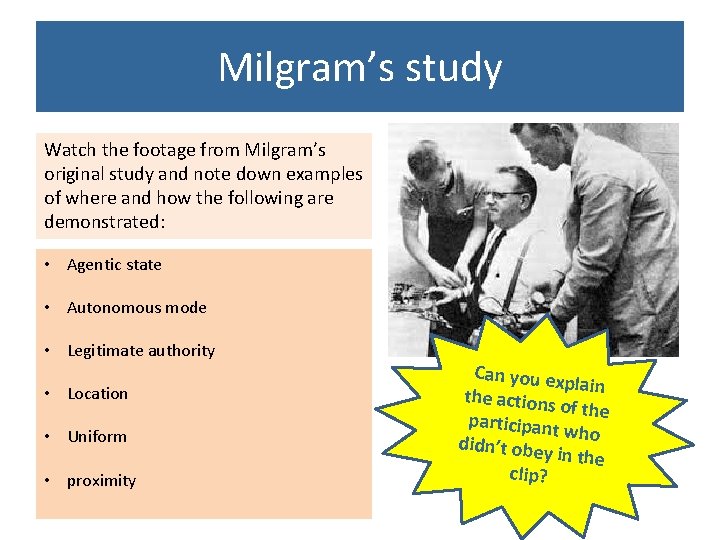
Milgram’s study Watch the footage from Milgram’s original study and note down examples of where and how the following are demonstrated: • Agentic state • Autonomous mode • Legitimate authority • Location • Uniform • proximity Can you ex plain the actions of the participant who didn’t obey in the clip?

Exam practice Complete the following question individually and without notes. You have 5 minutes: Describe two ethical issues that can be illustrated by Milgram’s research into obedience to authority. (4 marks) Now give yourself a mark out of 4 according to the mark scheme on the next slide
Mark scheme • AO 3 = 4 • For each issue, 1 mark for identification of issue and a further mark for elaboration. • For example: One issue is deception. (1 mark) Milgram deceived participants into believing that they had an equal chance of being the teacher or learner, when in fact it was rigged so that the real participant was always the teacher (further mark for elaboration) Note: Right to withdraw is only an ethical issue in terms of it being made difficult to withdraw. Milgram did in fact give his participants the right to withdraw at the very start of the experiment; however he then made it very difficult for them to do so by pressuring them to continue. Simply stating ‘there was no right to withdraw’ will not gain credit.
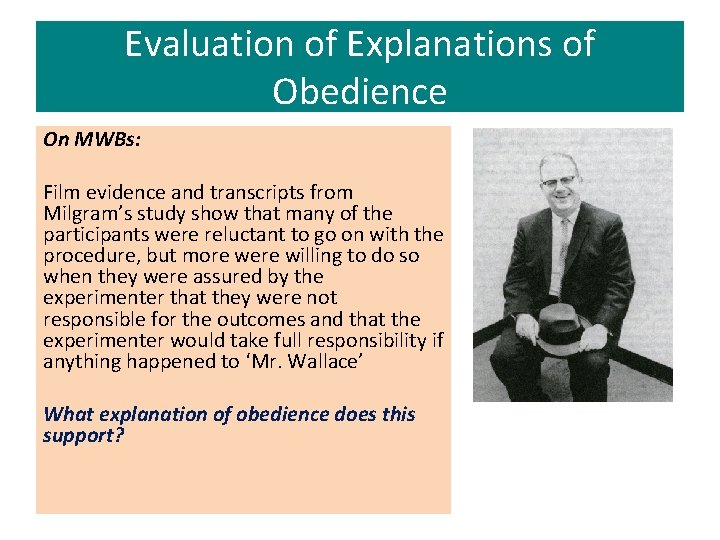
Evaluation of Explanations of Obedience On MWBs: Film evidence and transcripts from Milgram’s study show that many of the participants were reluctant to go on with the procedure, but more were willing to do so when they were assured by the experimenter that they were not responsible for the outcomes and that the experimenter would take full responsibility if anything happened to ‘Mr. Wallace’ What explanation of obedience does this support?

Evaluation of Explanations of Obedience On MWBs: Can you come up with any real-life examples of where someone has justified their behaviour through being in agentic state? Adolph Eichmann, who orchestrated the ‘final solution’ (the Nazi plan of mass extermination of European Jews) and William Calley, who sent his troops into My Lai during the Vietnam war to massacre the inhabitants of the village both tried to use the defence that they were ‘just following orders’ (agentic state)
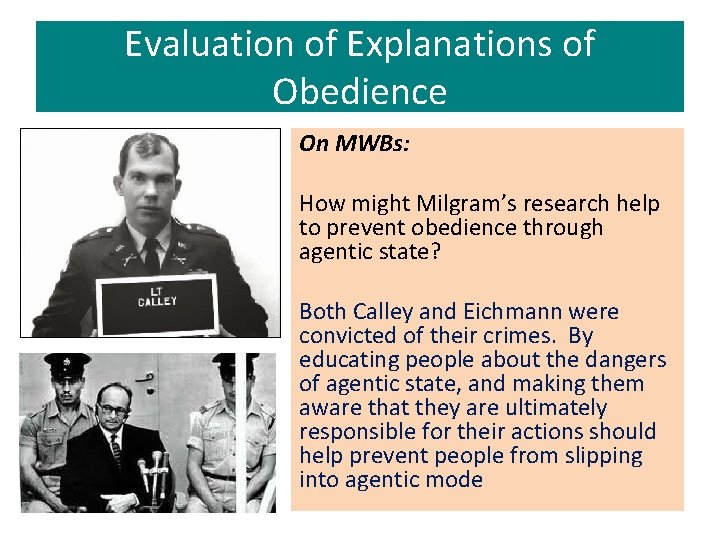
Evaluation of Explanations of Obedience On MWBs: How might Milgram’s research help to prevent obedience through agentic state? Both Calley and Eichmann were convicted of their crimes. By educating people about the dangers of agentic state, and making them aware that they are ultimately responsible for their actions should help prevent people from slipping into agentic mode
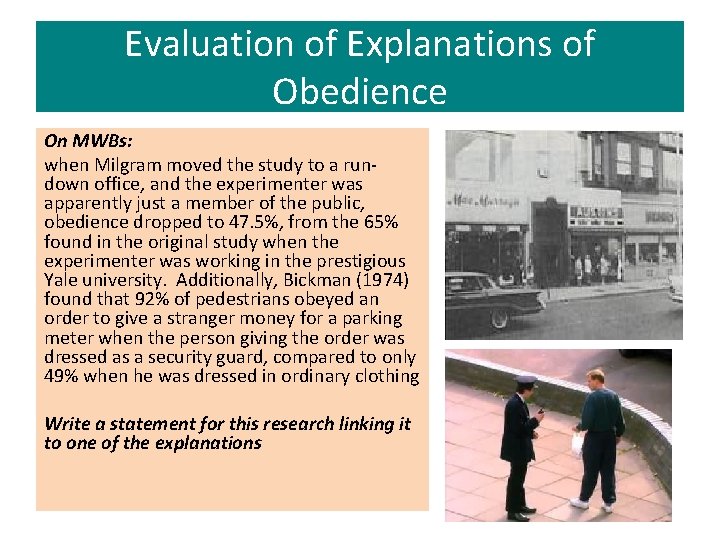
Evaluation of Explanations of Obedience On MWBs: when Milgram moved the study to a rundown office, and the experimenter was apparently just a member of the public, obedience dropped to 47. 5%, from the 65% found in the original study when the experimenter was working in the prestigious Yale university. Additionally, Bickman (1974) found that 92% of pedestrians obeyed an order to give a stranger money for a parking meter when the person giving the order was dressed as a security guard, compared to only 49% when he was dressed in ordinary clothing Write a statement for this research linking it to one of the explanations
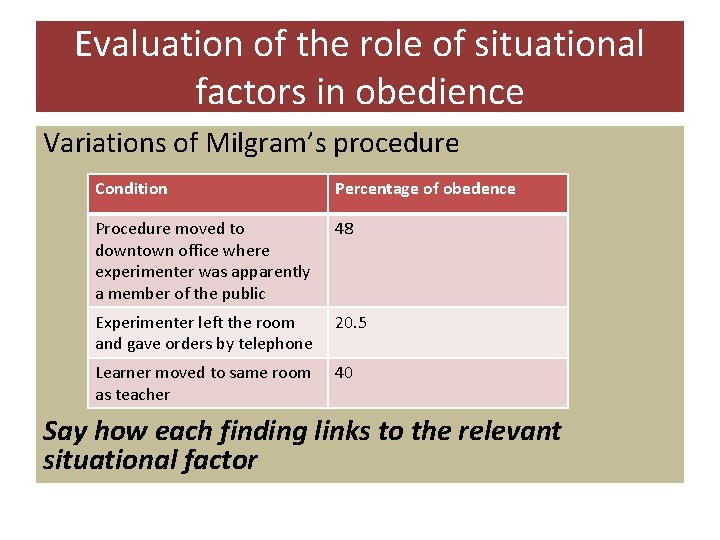
Evaluation of the role of situational factors in obedience Variations of Milgram’s procedure Condition Percentage of obedence Procedure moved to downtown office where experimenter was apparently a member of the public 48 Experimenter left the room and gave orders by telephone 20. 5 Learner moved to same room as teacher 40 Say how each finding links to the relevant situational factor
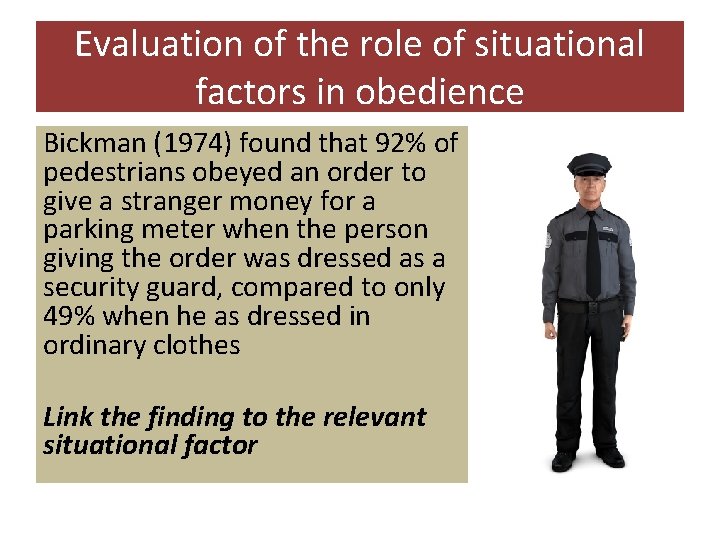
Evaluation of the role of situational factors in obedience Bickman (1974) found that 92% of pedestrians obeyed an order to give a stranger money for a parking meter when the person giving the order was dressed as a security guard, compared to only 49% when he as dressed in ordinary clothes Link the finding to the relevant situational factor
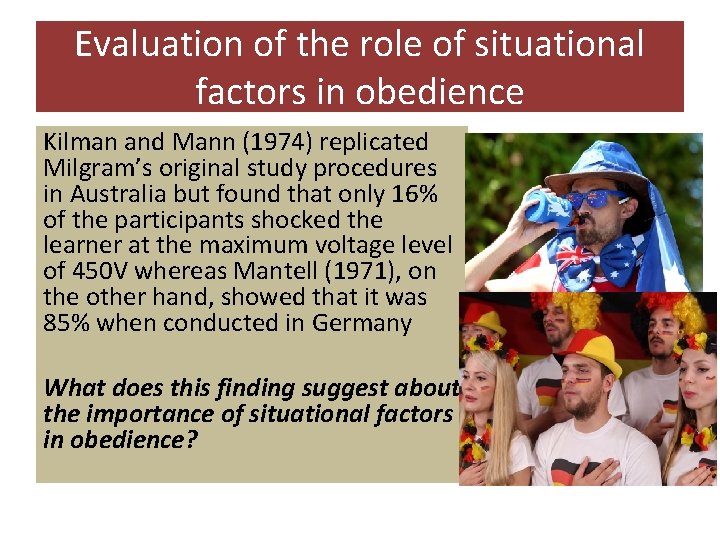
Evaluation of the role of situational factors in obedience Kilman and Mann (1974) replicated Milgram’s original study procedures in Australia but found that only 16% of the participants shocked the learner at the maximum voltage level of 450 V whereas Mantell (1971), on the other hand, showed that it was 85% when conducted in Germany What does this finding suggest about the importance of situational factors in obedience?

Snap Plan Write a snap plan for the following essay title: Discuss situational factors in obedience (16 marks)
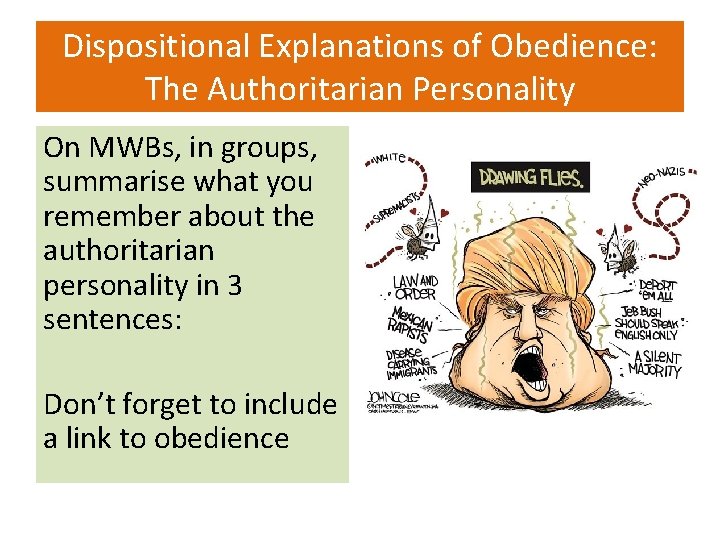
Dispositional Explanations of Obedience: The Authoritarian Personality On MWBs, in groups, summarise what you remember about the authoritarian personality in 3 sentences: Don’t forget to include a link to obedience

Bernard’s story Bernard was brought up by strict parents who believed strongly in discipline and respect for authority. When Bernard was little, his mother would hit him over the back of the hand with a wooden spoon when he was naughty and as he got older, his father would punish him by hitting him with a belt. Bernard is very respectful to his parents and loves them deeply. Even though he is now an adult, he always obeys their wishes. Bernard believes that rules need to be followed. He is very respectful of his boss at work, even though he sometimes makes unreasonable demands on Bernard always carries out his wishes. Bernard manages a team of three people. He will not tolerate any challenge to his authority and insists that his staff follow his rules totally. He recently had one of his staff sacked for not following the dress code that Bernard implemented Using what you know about the Authoritarian Personality, explain Bernard’s behaviour. Make reference to details in the scenario in your answer (6 marks) Now use the model answer on the next slide to give yourself a mark out of 6
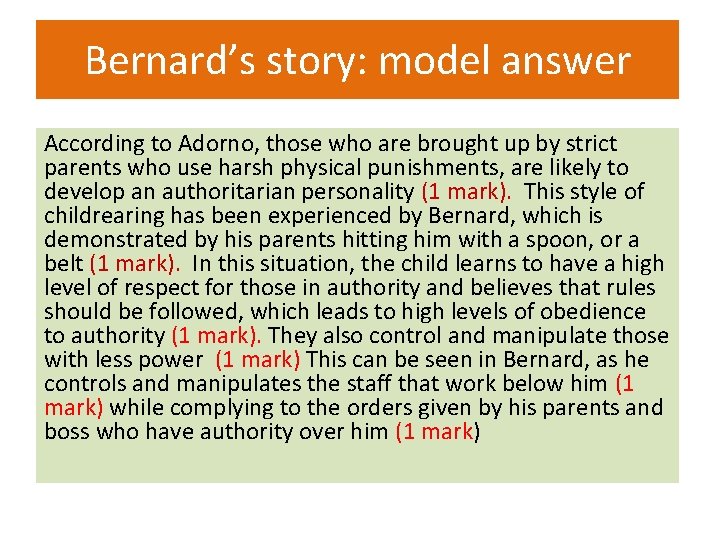
Bernard’s story: model answer According to Adorno, those who are brought up by strict parents who use harsh physical punishments, are likely to develop an authoritarian personality (1 mark). This style of childrearing has been experienced by Bernard, which is demonstrated by his parents hitting him with a spoon, or a belt (1 mark). In this situation, the child learns to have a high level of respect for those in authority and believes that rules should be followed, which leads to high levels of obedience to authority (1 mark). They also control and manipulate those with less power (1 mark) This can be seen in Bernard, as he controls and manipulates the staff that work below him (1 mark) while complying to the orders given by his parents and boss who have authority over him (1 mark)
Evaluation of the Authoritarian Personality You have 5 minutes silent reading time on the evaluation of the authoritarian personality (p. 15 of the information pack) Now complete the exercise on Ali’s answer without looking at the pack

8 Mark Essay Structure On MWBs answer the following questions: • How many AO 1 marks do you think will be available in an 8 mark essay? This means that you have to condense the information in an 8 mark essay or you will run out of time! • Therefore how many marks will be available for AO 3? • How many PEEL points should you include in an 8 mark essay?
Authoritarian Personality: Exam practice Have a go at this question individually without notes Outline and evaluate the authoritarian personality as an explanation of obedience to authority (8 marks) Now swap with the person sitting next to you and give them a mark out of 8 using the mark scheme on the following slide
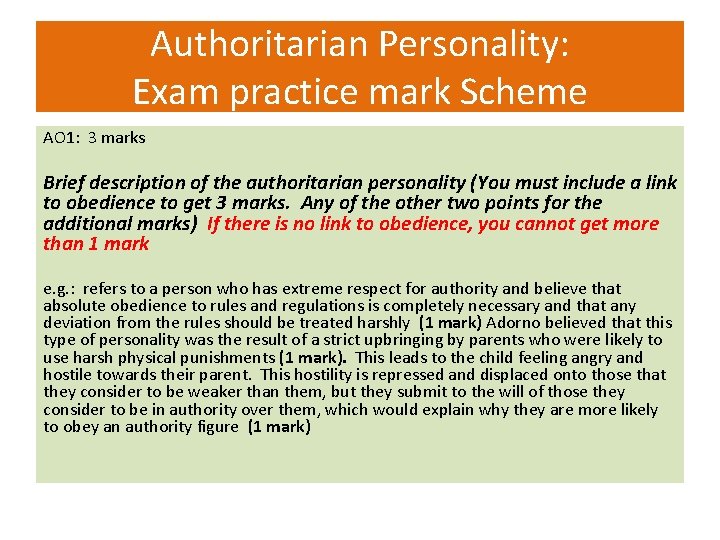
Authoritarian Personality: Exam practice mark Scheme AO 1: 3 marks Brief description of the authoritarian personality (You must include a link to obedience to get 3 marks. Any of the other two points for the additional marks) If there is no link to obedience, you cannot get more than 1 mark e. g. : refers to a person who has extreme respect for authority and believe that absolute obedience to rules and regulations is completely necessary and that any deviation from the rules should be treated harshly (1 mark) Adorno believed that this type of personality was the result of a strict upbringing by parents who were likely to use harsh physical punishments (1 mark). This leads to the child feeling angry and hostile towards their parent. This hostility is repressed and displaced onto those that they consider to be weaker than them, but they submit to the will of those they consider to be in authority over them, which would explain why they are more likely to obey an authority figure (1 mark)
Authoritarian Personality: Exam practice mark Scheme AO 3: 5 marks Two evaluation points Examples: P There is research evidence to support the view that the authoritarian personality is linked to higher rates of obedience. Zillmer et al (1995) reported that 16 Nazi war criminals scored highly on three of the F Scale dimensions. E Elms & Milgram (1966) found that the highly obedient participants in Milgram’s study scored significantly higher on the F scale than the less obedient participants. E Both of these studies offer some support for the view that authoritarianism may lead to higher levels of obedience. L However, as Zillmer found that only three of the dimensions on the F-scale were relevant, we may question whether it is the authoritarian personality as a whole that is linked to obedience, or whether it is a few specific traits that happen to be part of that personality type.
Authoritarian Personality: Exam practice mark Scheme AO 3: 5 marks Two evaluation points Examples: P There is a difficulty establishing a cause and effect link between the authoritarian personality and obedience. This is because the supporting research is correlational and therefore lacks internal validity. E For example, in Elms and Milgram’s study, we cannot say that having an authoritarian personality caused higher obedience because there may have been another unaccounted for variable, or variables, that were responsible for both personality and obedience behaviour. E In addition, it is not possible in any retrospective study, where we are trying to explain a behaviour through something that has happened in the past, to establish the direction of the effect. It could be that the authoritarian views of the participants resulted from their experience of being part of the Nazi regime, rather than the other way round. L These problems highlight the difficulty of establishing a dispositional basis of any behaviour such as obedience.
Authoritarian Personality: Exam practice mark Scheme AO 3: 5 marks Two evaluation points Examples: P It is thought that theory itself may be subject to research bias. E This is because it presumes that the authoritarian personality is exclusively limited to right wing individuals. E However, in a preliminary study, Conway devised a scale to measure dogmatic and authoritarian views in left wing individuals and found a parallel with Adorno’s results indicating that left-wing individuals are just as likely to display authoritarian traits as right wing individuals and therefore may be just as susceptible to obeying authority as right-wing individuals. L This shows how the expectations of the researcher may skew our view of personality types that are likely to be associated with increased obedience, therefore giving us a limited understanding.
- Slides: 37