
Research Integrity for Supervisors A global university Perth
Research Integrity for Supervisors A global university Perth | Kalgoorlie | Dubai | Malaysia | Singapore
Agenda • At this end of this short presentation you will understand: • Your responsibilities as a researcher • Your responsibilities as a supervisor • What the relevant guides and policies that govern supervision and responsible research practices are • Where to find information on how to be compliant with legislation
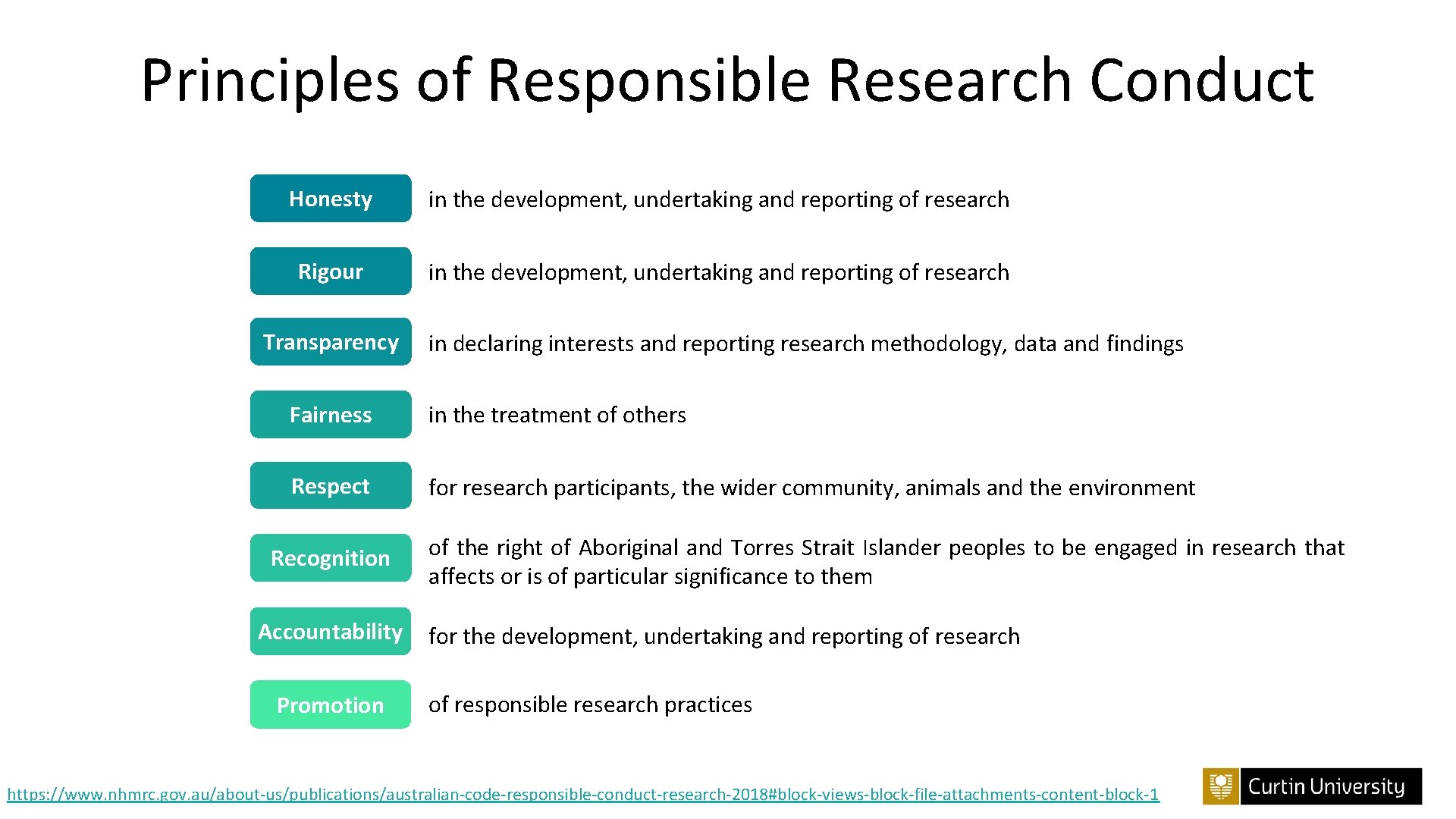
Principles of Responsible Research Conduct Honesty in the development, undertaking and reporting of research Rigour in the development, undertaking and reporting of research Transparency in declaring interests and reporting research methodology, data and findings Fairness in the treatment of others Respect for research participants, the wider community, animals and the environment Recognition Accountability Promotion of the right of Aboriginal and Torres Strait Islander peoples to be engaged in research that affects or is of particular significance to them for the development, undertaking and reporting of research of responsible research practices https: //www. nhmrc. gov. au/about-us/publications/australian-code-responsible-conduct-research-2018#block-views-block-file-attachments-content-block-1
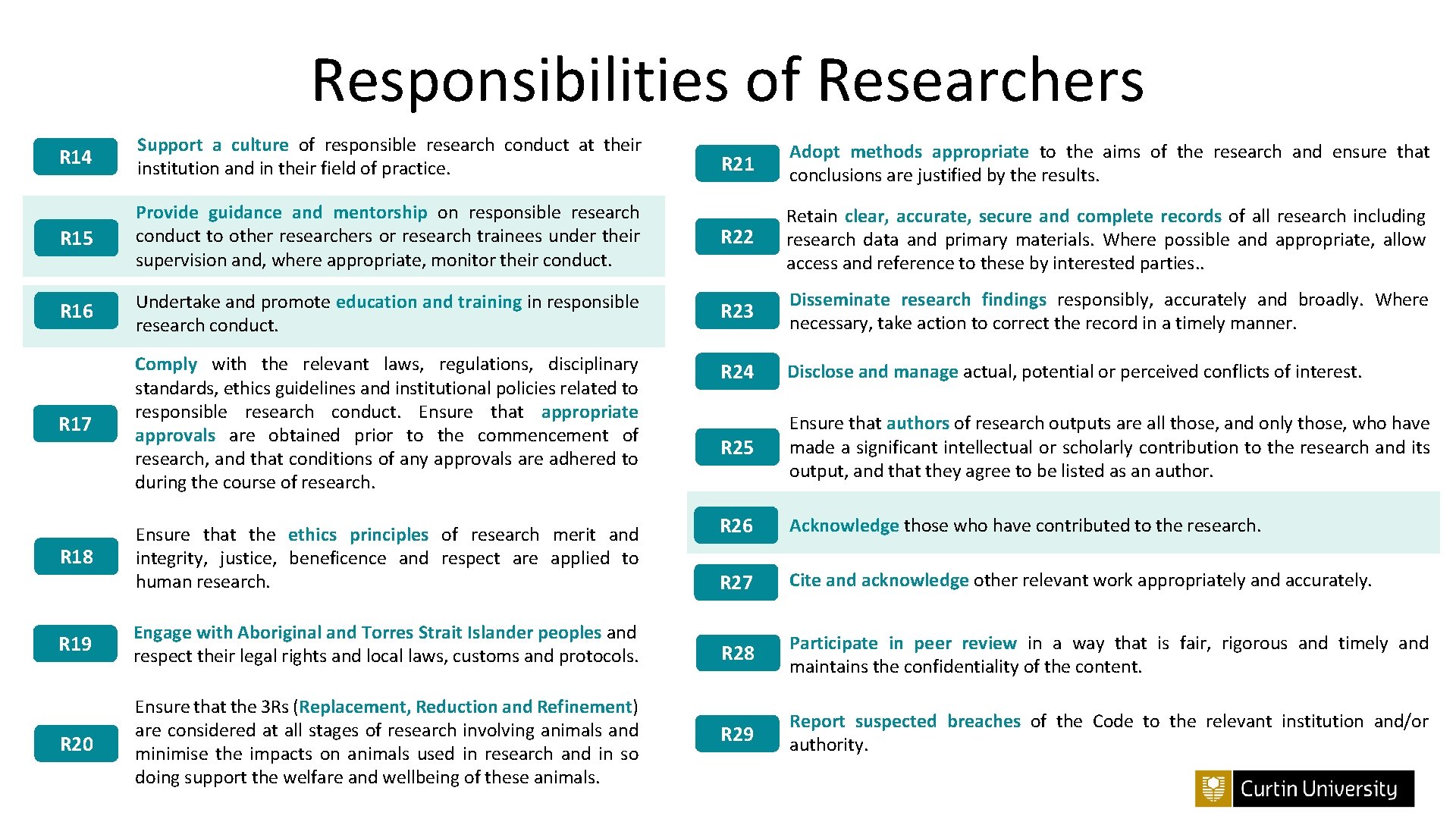
Responsibilities of Researchers R 14 Support a culture of responsible research conduct at their institution and in their field of practice. R 15 Provide guidance and mentorship on responsible research conduct to other researchers or research trainees under their supervision and, where appropriate, monitor their conduct. R 21 Adopt methods appropriate to the aims of the research and ensure that conclusions are justified by the results. R 22 Retain clear, accurate, secure and complete records of all research including research data and primary materials. Where possible and appropriate, allow access and reference to these by interested parties. . R 16 Undertake and promote education and training in responsible research conduct. R 23 Disseminate research findings responsibly, accurately and broadly. Where necessary, take action to correct the record in a timely manner. R 24 Disclose and manage actual, potential or perceived conflicts of interest. R 17 Comply with the relevant laws, regulations, disciplinary standards, ethics guidelines and institutional policies related to responsible research conduct. Ensure that appropriate approvals are obtained prior to the commencement of research, and that conditions of any approvals are adhered to during the course of research. R 25 Ensure that authors of research outputs are all those, and only those, who have made a significant intellectual or scholarly contribution to the research and its output, and that they agree to be listed as an author. R 26 Acknowledge those who have contributed to the research. R 18 Ensure that the ethics principles of research merit and integrity, justice, beneficence and respect are applied to human research. R 27 Cite and acknowledge other relevant work appropriately and accurately. R 28 Participate in peer review in a way that is fair, rigorous and timely and maintains the confidentiality of the content. R 29 Report suspected breaches of the Code to the relevant institution and/or authority. R 19 Engage with Aboriginal and Torres Strait Islander peoples and respect their legal rights and local laws, customs and protocols. R 20 Ensure that the 3 Rs (Replacement, Reduction and Refinement) are considered at all stages of research involving animals and minimise the impacts on animals used in research and in so doing support the welfare and wellbeing of these animals.
Supervision Guide • Supervision plays a critical role in the responsible conduct of research • Principle 4, ‘Fairness in the treatment of others’, which requires researchers to treat fellow researchers and others involved in the research fairly and with respect. • Principle 7, ‘Accountability for the development, undertaking and reporting of research’. • Principle 8, ‘Promotion of responsible research practices’, which requires researchers to promote and foster a research culture and environment that supports the responsible conduct of research. • The responsibilities of supervisors are • diverse • include maintaining currency in discipline-specific knowledge and practices • setting the highest standards in research design and methodology to assure high quality, reliable, and reproducible research • developing and maintaining a working knowledge of the legal and policy frameworks that underpin responsible conduct of research at the disciplinary, institutional, and national levels • developing a respectful, culturally aware and professional relationship • providing mentoring or career advice and assisting those under their supervision to access relevant services https: //www. nhmrc. gov. au/about-us/publications/australian-code-responsible-conduct-research-2018#block-views-block-file-attachments-content-block-1
Policies and Procedures • Research Management Policy • Responsible Conduct of Research Procedures • Authorship, Peer Review and Publication of Research Findings Policy • Authorship, Peer Review and Publication of Research Findings Procedures • Research Data and Primary Materials Policy https: //policies. curtin. edu. au/findapolicy/index. cfm
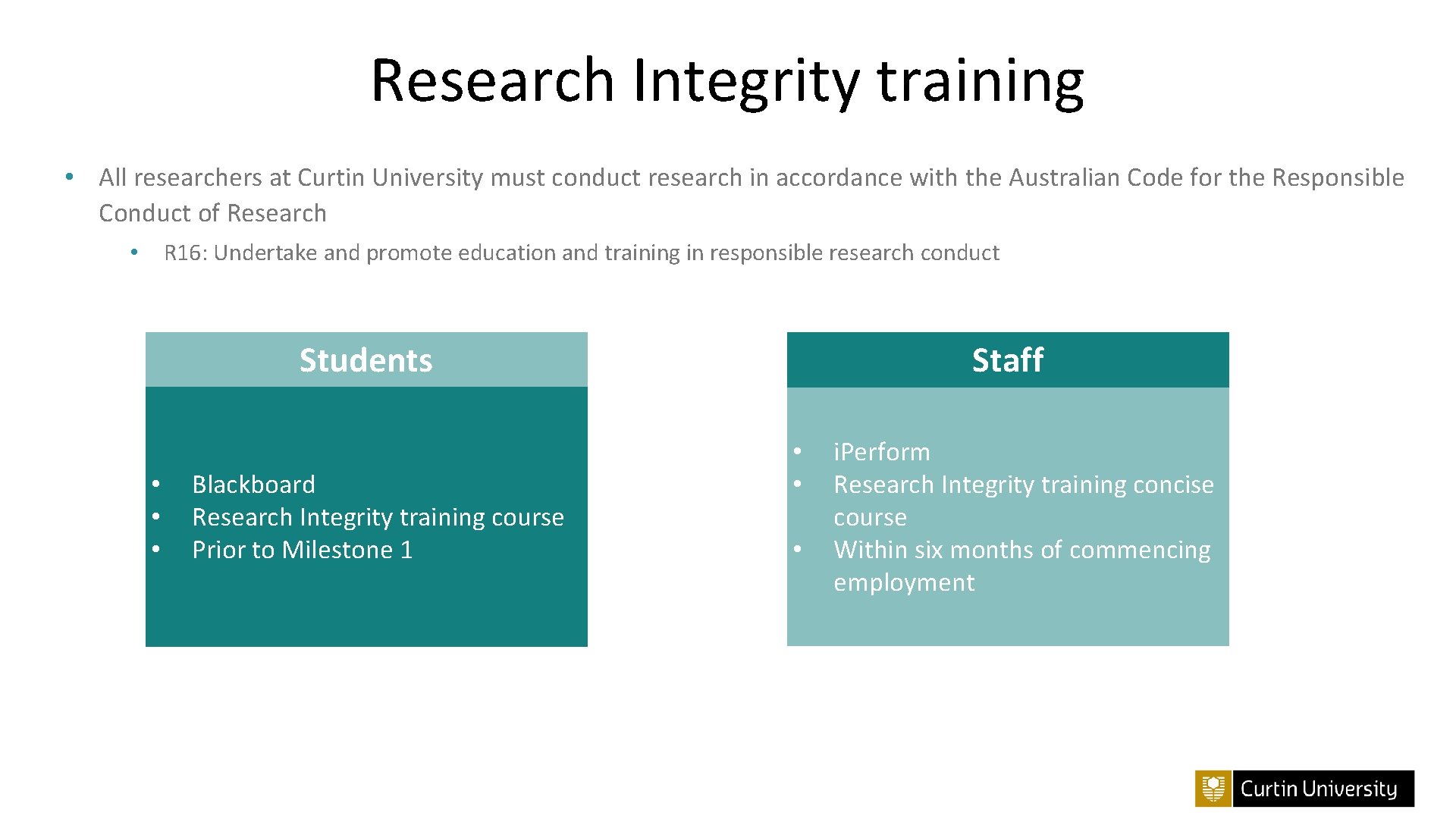
Research Integrity training • All researchers at Curtin University must conduct research in accordance with the Australian Code for the Responsible Conduct of Research R 16: Undertake and promote education and training in responsible research conduct • Students • • • Blackboard Research Integrity training course Prior to Milestone 1 Staff • • • i. Perform Research Integrity training concise course Within six months of commencing employment
Research Initiation Guide • A tool to assist staff and students in understanding their governance obligations before commencing research • Asks a series of questions covering legislation, regulations and Curtin policy and procedures • based on your answers, you are provided with general advice on which legislation, regulations and/or Curtin policy and procedures may be applicable to their research, and how you may comply with them • The RIG empowers researchers with information they need to ensure they are compliant • This helps influence and drive compliant research culture and reduces risk to Curtin https: //rig. curtin. edu. au/
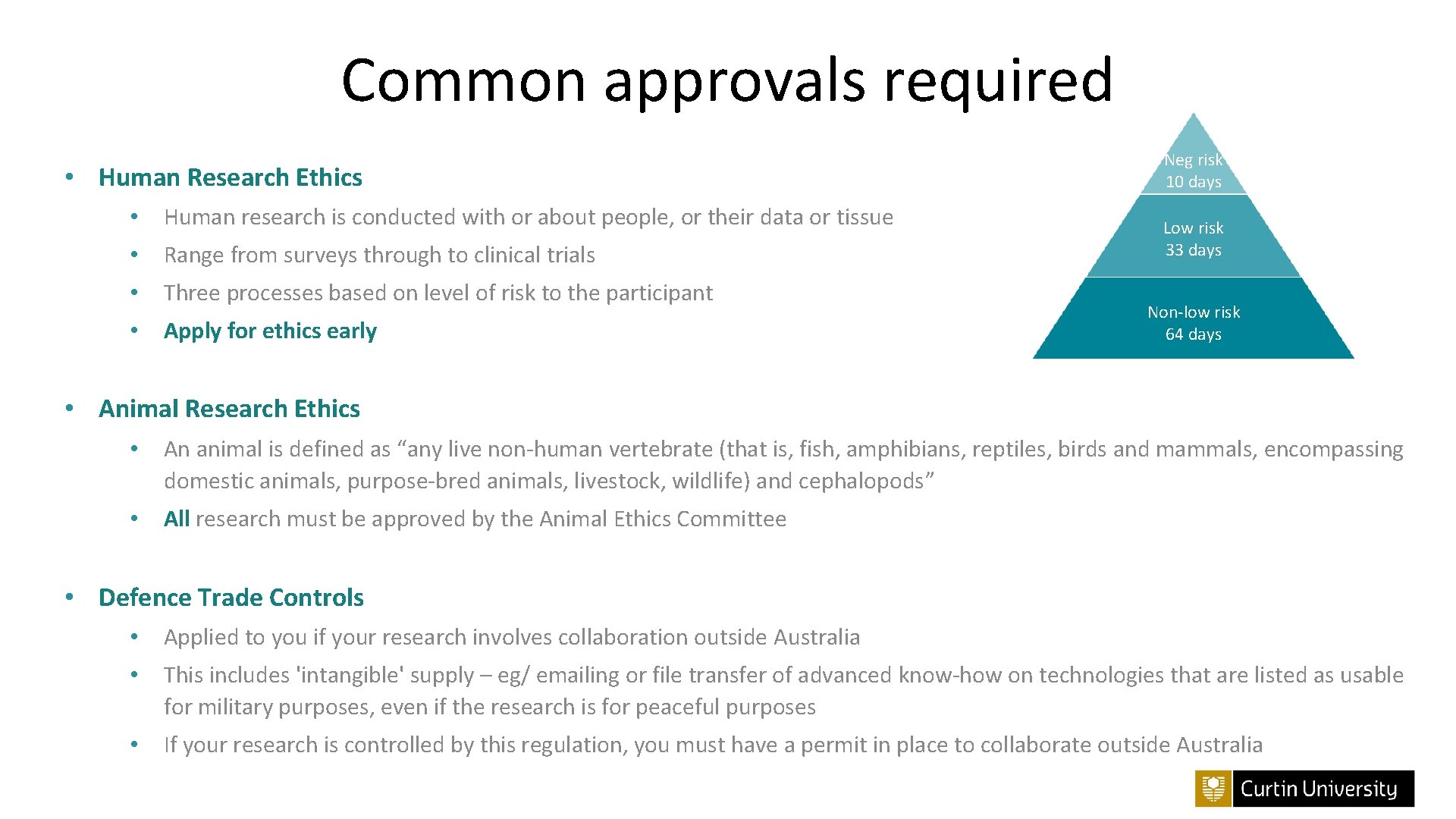
Common approvals required • Human Research Ethics • Human research is conducted with or about people, or their data or tissue • Range from surveys through to clinical trials • Three processes based on level of risk to the participant • Apply for ethics early Neg risk 10 days Low risk 33 days Non-low risk 64 days • Animal Research Ethics • An animal is defined as “any live non-human vertebrate (that is, fish, amphibians, reptiles, birds and mammals, encompassing domestic animals, purpose-bred animals, livestock, wildlife) and cephalopods” • All research must be approved by the Animal Ethics Committee • Defence Trade Controls • Applied to you if your research involves collaboration outside Australia • This includes 'intangible' supply – eg/ emailing or file transfer of advanced know-how on technologies that are listed as usable for military purposes, even if the research is for peaceful purposes • If your research is controlled by this regulation, you must have a permit in place to collaborate outside Australia
Contact us • Ethics • ROC-ethics@curtin. edu. au • Amy Bowater, Team Leader Ethics • a. bowater@curtin. edu. au, x 1724 • Animal Facility • Beng Chua • b. chua@curtin. edu. au, x 1827 • Research Integrity • Catherine Gangell, Manager Research Integrity • • catherine. gangell@curtin. edu. au, x 7093 Lois Ho, Manager Research Integrity • lois. ho@curtin. edu. au, x 7093

Questions A global university Perth | Kalgoorlie | Dubai | Malaysia | Singapore
- Slides: 11