
Research Inquiry Overview Scientific investigation and the functions
- Slides: 39
Research Inquiry
Overview Scientific investigation and the functions of research Basic tools of communication science Time and research designs Stages in the research process
Scientific Investigation Basic steps in scientific investigations: Specifying explanations (theories) Making observations Interpreting the results Refining explanations
Functions of Research 1. Exploration 2. Description 3. Explanation Most research involves all three Studies move toward exploration as knowledge accumulates
1. Exploration • “Learn about” or “familiarize” • Asking basic questions • E. g. : • • How does the public feel about term limits? Do the people support the death penalty? • Focus groups useful for exploration • Purposes: • • • 1. General understanding 2. Test feasibility of further research 3. Pretest methods of further research
2. Description Describing situations and events More deliberate than exploratory research Precise, measured description Idiographic orientation E. g. : U. S. Census Opinion polls How strong is public support for the war?
3. Explanation Getting at the question of “why” More than describing events Explain why they occur in a certain way Nomothetic orientation Laws that govern nature of relationships E. g. , Going beyond opinion polls: Why are people voting for a certain candidate?
Basic Tools of Communication Science Experiments Field (or “natural”) experiments Surveys Social network analysis Content analysis Focused interviews Qualitative Field Research
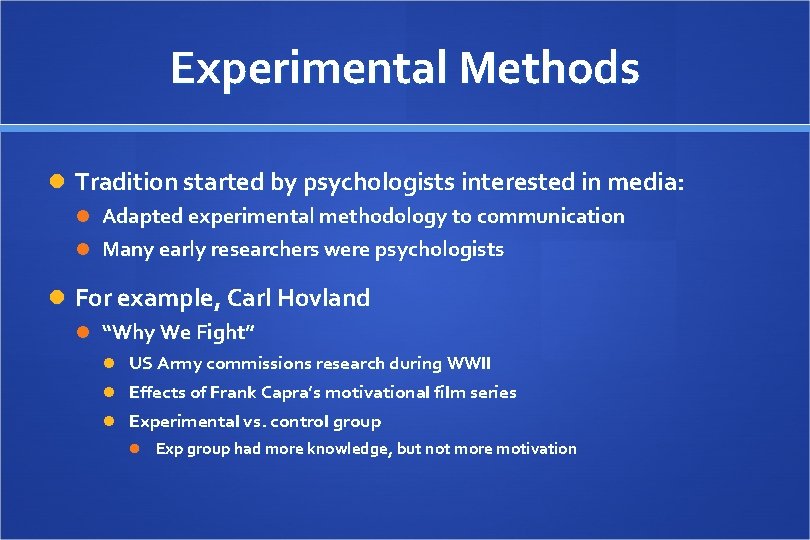
Experimental Methods Tradition started by psychologists interested in media: Adapted experimental methodology to communication Many early researchers were psychologists For example, Carl Hovland “Why We Fight” US Army commissions research during WWII Effects of Frank Capra’s motivational film series Experimental vs. control group Exp group had more knowledge, but not more motivation
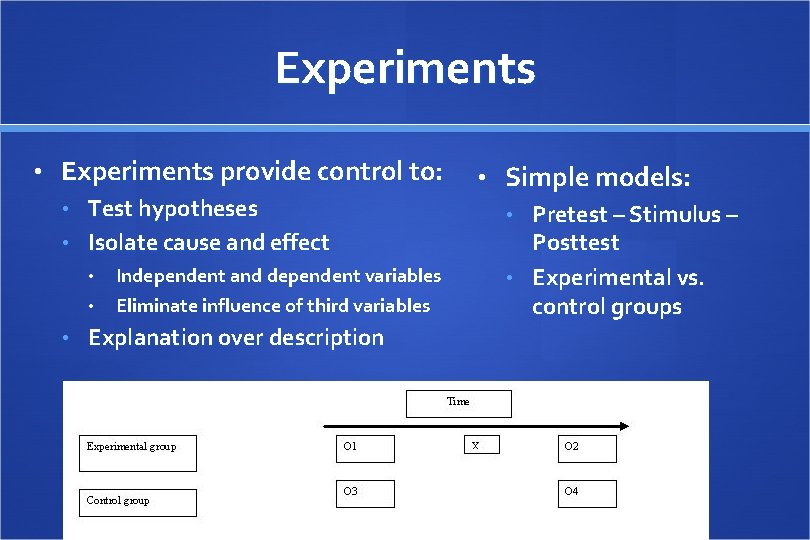
Experiments • Experiments provide control to: • Test hypotheses • Isolate cause and effect • • Independent and dependent variables Eliminate influence of third variables • Explanation over description • Simple models: • Pretest – Stimulus – Posttest • Experimental vs. control groups
Value of Experiments Isolating cause and effect Exp vs. Control group All other factors are controlled Facilitates causal inferences
Limitations of Experiments • Narrow focus • Limited number of variables at once • Artificial situation • Subjects are aware they are being observed • Limited external generalizability • Best at isolating short-term effects • • Many media effects are long-term How long do experimental effects last?
Field (Natural) Experiments that take place in the real world By design: Public health campaign: intervention vs. control community By coincidence: Naturally occurring phenomenon E. g. , Comparing Northern Jersey to Southern Jersey in terms of voter turnout due to differing media conditions
Advantages of Field Experiments Approximating control of experiment Less artificial setting Some control is sacrificed for greater generalizability
Types of Surveys Polls (descriptive surveys) Census (full population) Sample surveys (specific group_ Probability sample survey Each member of population has an equal chance of being selected in sample – representativeness Permits generalizations about larger population
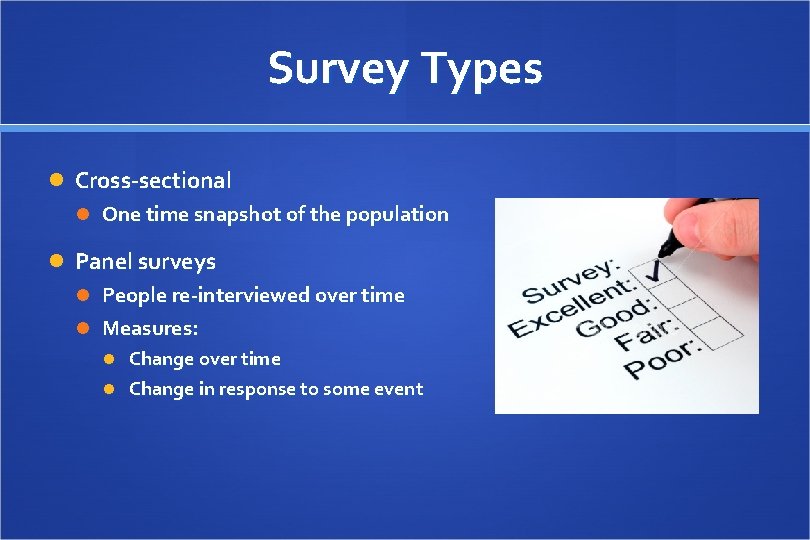
Survey Types Cross-sectional One time snapshot of the population Panel surveys People re-interviewed over time Measures: Change over time Change in response to some event
Contact Methods in Survey Research Face-to-face Paper and pencil Telephone Direct mail Mall intercept Web-based
Advantages of Survey Research Describing characteristics of a large population Flexibility: Permits measurement of many variables Open and closed-ended questions Capturing a large amount of information on: Cognitions (thoughts), attitudes and behaviors Possibility for anonymous response
Limitations of Survey Research • Structuring responses: • “round pegs into square holes” • “pseudo-opinions” • Often asks about opinions without context • General attitudes rather than more concretely applied to real situations • Artificiality of responding to survey • Demand characteristics, social desirability, conscious of observation
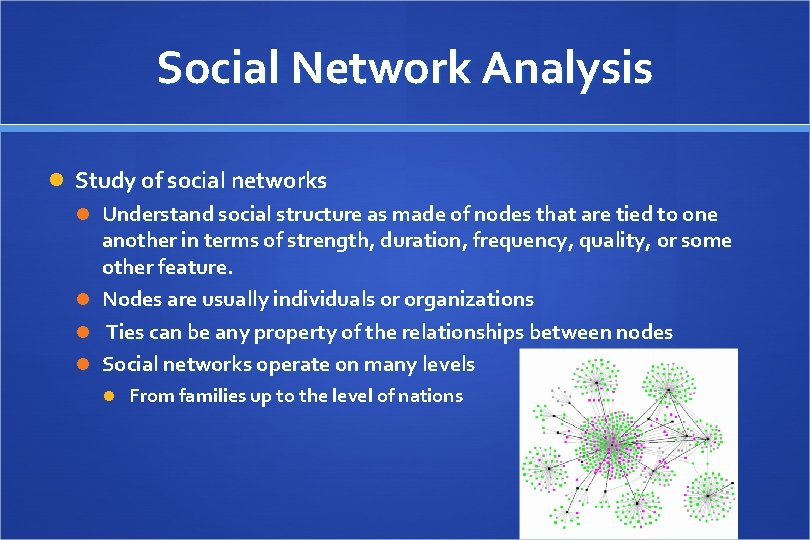
Social Network Analysis Study of social networks Understand social structure as made of nodes that are tied to one another in terms of strength, duration, frequency, quality, or some other feature. Nodes are usually individuals or organizations Ties can be any property of the relationships between nodes Social networks operate on many levels From families up to the level of nations
Social Network Metrics Centrality: This measure gives a rough indication of the social power of a node based on how well they "connect" the network. Are they a hub or a spoke? Closeness: This measures gives a sense of whether a node is near all other nodes in a network (directly or indirectly). How far along the "grapevine”? Cohesion: This measures the degree to which nodes are connected directly - ‘cliques’ if every nodes is directly tied to every other one, ‘social circles’ if nodes are directly and indirectly tied to each other. In-Degree and Out-Degree: The count of the number of ties to other nodes in the network – ties coming in vs. ties going out
Content Analysis Systematic analysis of media texts, programs, etc. Design coding instrument with content variables to be measured More than one coder analyzes content Codings compared to ensure reliability
Advantages of Content Analysis Systematic analysis of content Non-obtrusive Reliability easy to assess Do two observers reach the same conclusion?
Limitations of Content Analysis Hard to get at deep meaning of content Mundane questions emphasized for reliable measurement More interesting concepts are hard to measure reliably E. g. , “media bias”
Focused Interviews • Trying to get a more in-depth look at opinion holding • More open-ended questions • Focus groups: • • Planned discussions in an open-environment Loosely-structured script with moderator 6 to 12 participants Samples usually not randomly selected 1 to 2 hours Qualitative and quantitative analysis of transcript Often combined with surveys of participants
Functions of Focus Groups • Prior to survey research: • • • Identifying closed-ended survey items Suggesting hypotheses E. g. , Media uses and gratifications-sought • Supplementing survey research • • Going in-depth, “behind” the survey responses E. g. , Attitudes toward affirmative action • Getting at complex opinion/belief structures • More detailed responses • Subjects use their own language, terms, concepts
Limitations of Focus Groups Influence of the facilitator Influence of vocal participants Small, non-representative groups Biases in transcript interpretation Artificial nature of focus group situations Ditto for surveys and experiments
Qualitative Field Research Naturalism – detailed and accurate description Grounded Theory – patterns and themes from observational work Case Study and Extended Case Method – focus on case and cases Ethnography – participant and observer of the situation Participatory Action Research – Serve as resource for studied group
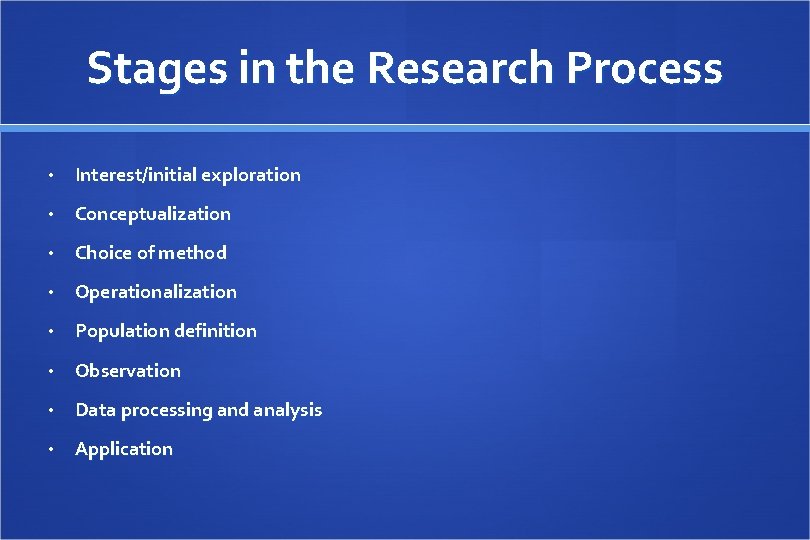
Stages in the Research Process • Interest/initial exploration • Conceptualization • Choice of method • Operationalization • Population definition • Observation • Data processing and analysis • Application
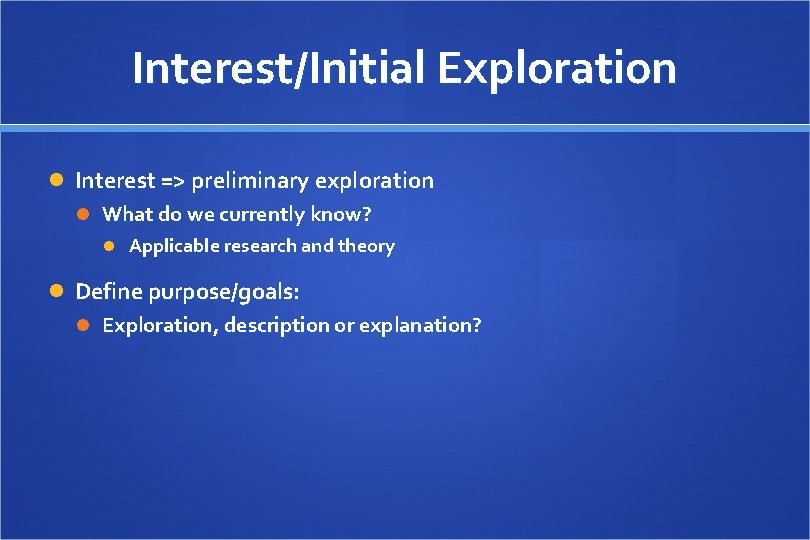
Interest/Initial Exploration Interest => preliminary exploration What do we currently know? Applicable research and theory Define purpose/goals: Exploration, description or explanation?
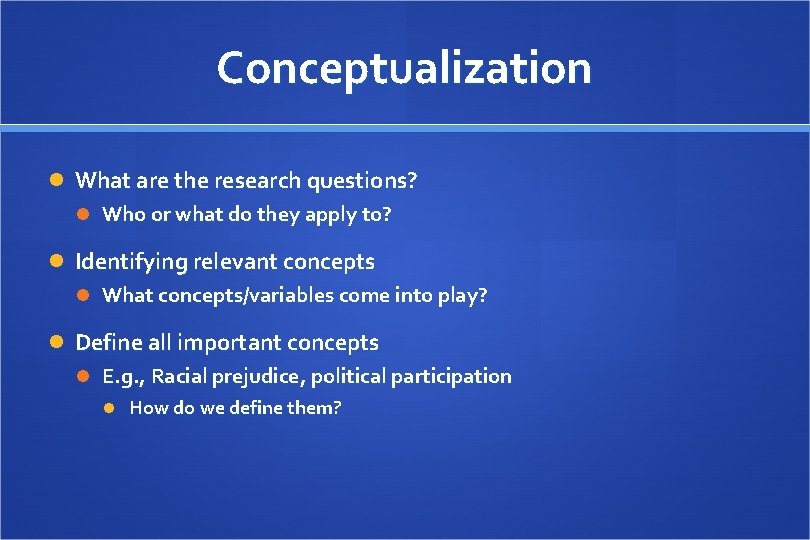
Conceptualization What are the research questions? Who or what do they apply to? Identifying relevant concepts What concepts/variables come into play? Define all important concepts E. g. , Racial prejudice, political participation How do we define them?
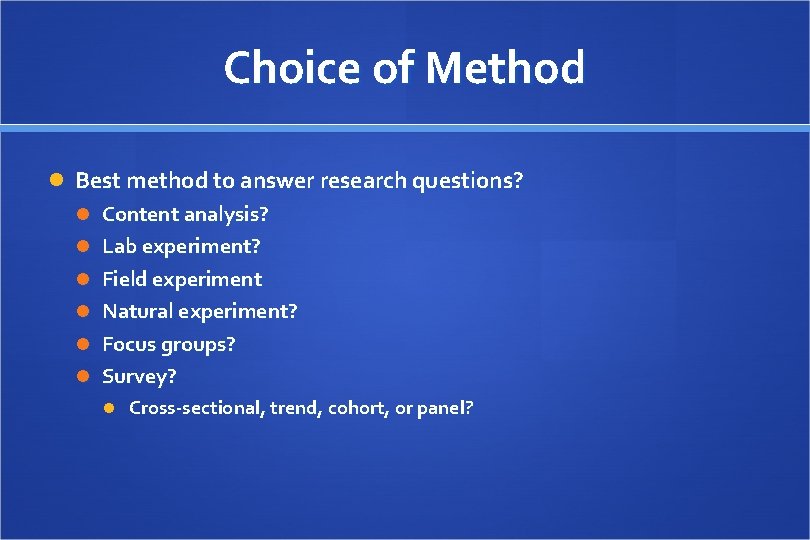
Choice of Method Best method to answer research questions? Content analysis? Lab experiment? Field experiment Natural experiment? Focus groups? Survey? Cross-sectional, trend, cohort, or panel?
Operationalization How do we measure concepts? E. g. , Measuring attention to media How has past research measured concepts? What is best for our purposes?
Population Definition To whom do we want to generalize results? Define the population of units Define sampling frame (population list) Who are we going to study? Define sampling strategy for selection Should represent larger population
Observation Making observations/collecting data For example: Survey interviewing Content analysis coding Taping focus group interactions Experimental observations
Data Processing and Analysis Data processing Translating the observations into data E. g. , survey answers translated into numbers and entered into the computer E. g. , content coded into numbers Data analysis Synthesizing larges amounts of information Data analysis examining relationships b/w concepts Application of statistics and summary tables
Application Packaging the results in usable form Writing a research report: Who is the audience? Researchers, policymakers or public
Workshop on Class Project 2006 DDB Life Style Data Massive dataset – 5188 respondents to over 800 questions Question categories include: Attitudes, Interests, Opinions Sense of Ideal Self Areas of Interests + Media and Communication on these topics Activities Internet Activities Consumer Behaviors Product Ownership and Intent to Purchase Media Consumption - TV, Radio, Magazines Demographics and Dispositions
Range of Possible Topics Contentment, Participation, and News ? Financial Concern, Environmental Attitudes, and Talk? Religious Media and Social Political Attitudes? Tech Attitudes and Online Behaviors? Interests, Media Use, and Self Concept? Social Media, Entertaining, and Engagement? Television Use and Fast Food Consumption? Commercial Media Use and Overconsumption?