
Research in Sputtered Amorphous Silicon Thin Film Solar
![The Current State of Solar Power • “Total installed [photovoltaic] capacity in the world](https://slidetodoc.com/presentation_image_h/e137fcabe726e7f5431be23c6940b4b9/image-2.jpg "The Current State of Solar Power • “Total installed [photovoltaic] capacity in the world")

- Slides: 40
Research in Sputtered Amorphous Silicon Thin Film Solar Cells Presented By: Martin Friedl Jeremy Miller Michael Sawires
The Current State of Solar Power • “Total installed [photovoltaic] capacity in the world now amounts to around 40 GW, producing some 50 terawatthours (TWh) of electrical power every year. ” – EPIA, May 2011 • Only about 0. 2% of the total global generated electricity in 2010 comes from PV sources • Solar will become increasingly important in the future as we begin to rely less on fossil fuels and turn to renewable energy sources for our power needs
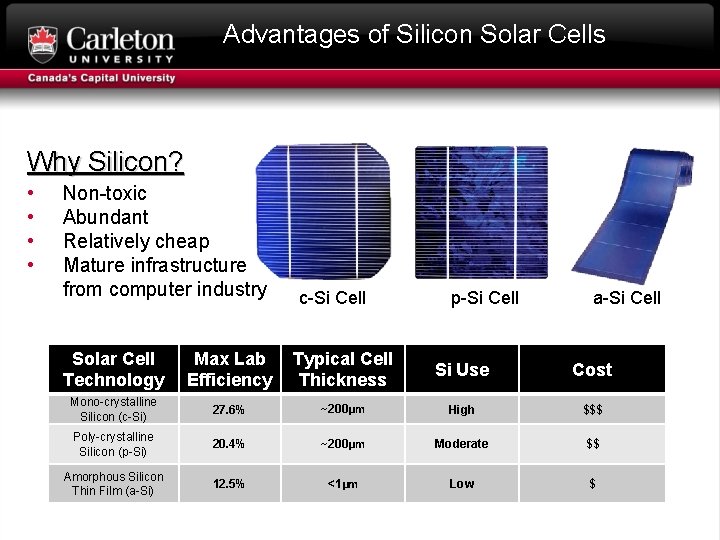
Advantages of Silicon Solar Cells Why Silicon? • • Non-toxic Abundant Relatively cheap Mature infrastructure from computer industry c-Si Cell p-Si Cell a-Si Cell Solar Cell Technology Max Lab Efficiency Typical Cell Thickness Si Use Cost Mono-crystalline Silicon (c-Si) 27. 6% ~200µm High $$$ Poly-crystalline Silicon (p-Si) 20. 4% ~200µm Moderate $$ Amorphous Silicon Thin Film (a-Si) 12. 5% <1µm Low $
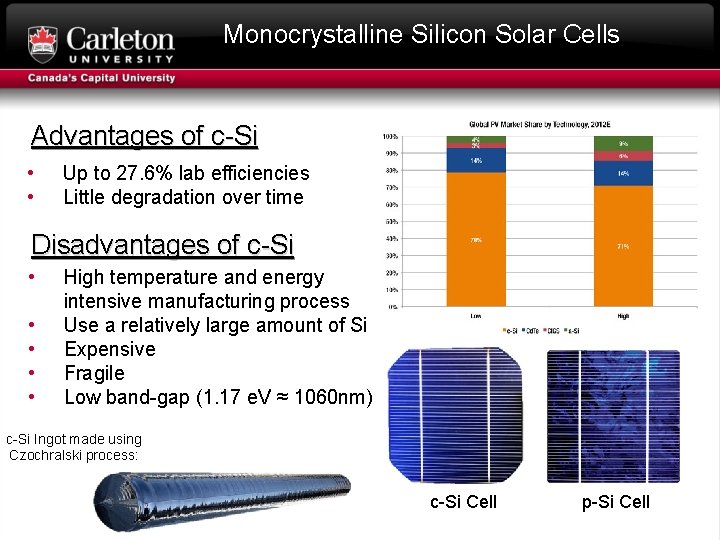
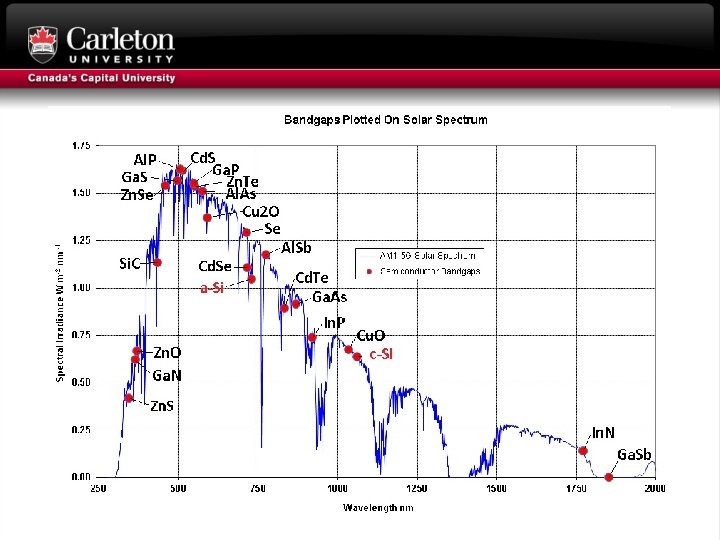
Monocrystalline Silicon Solar Cells Advantages of c-Si • • Up to 27. 6% lab efficiencies Little degradation over time Disadvantages of c-Si • • • High temperature and energy intensive manufacturing process Use a relatively large amount of Si Expensive Fragile Low band-gap (1. 17 e. V ≈ 1060 nm) c-Si Ingot made using Czochralski process: c-Si Cell p-Si Cell
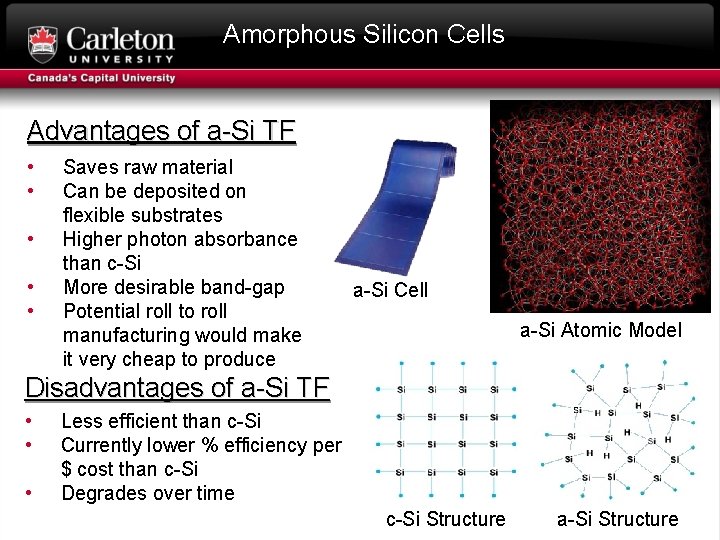
Amorphous Silicon Cells Advantages of a-Si TF • • • Saves raw material Can be deposited on flexible substrates Higher photon absorbance than c-Si More desirable band-gap Potential roll to roll manufacturing would make it very cheap to produce a-Si Cell a-Si Atomic Model Disadvantages of a-Si TF • • • Less efficient than c-Si Currently lower % efficiency per $ cost than c-Si Degrades over time c-Si Structure a-Si Structure
Principles of Operation • PN Junctions • PIN Junctions • Schottky Junctions
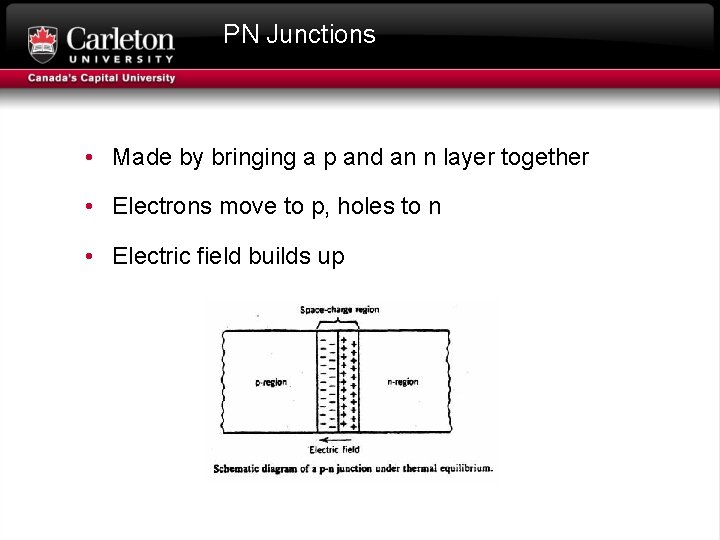
PN Junctions • Made by bringing a p and an n layer together • Electrons move to p, holes to n • Electric field builds up
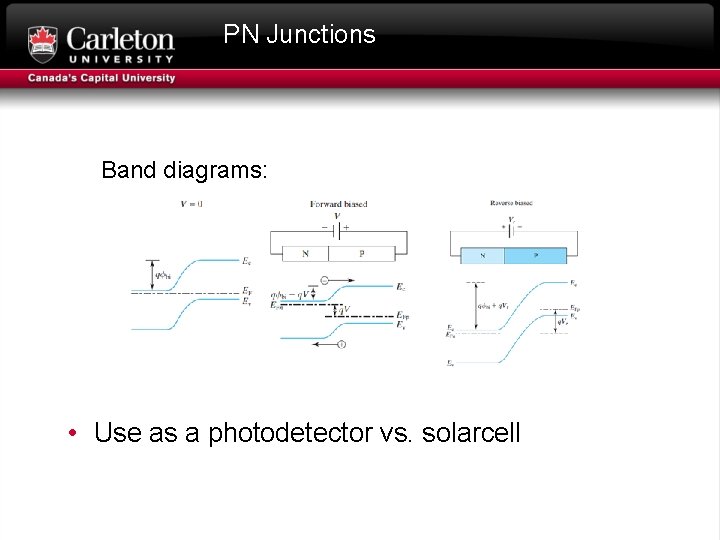
PN Junctions Band diagrams: • Use as a photodetector vs. solarcell
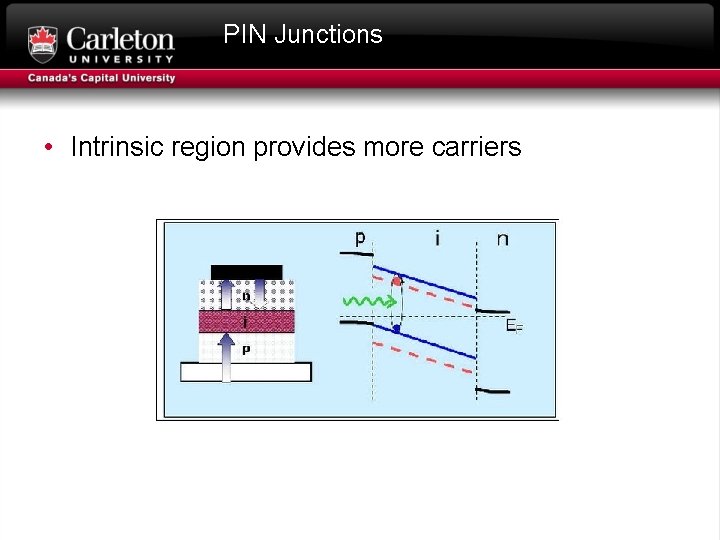
PIN Junctions • Intrinsic region provides more carriers
PIN Junctions Advantages: § Thicker depletion region, absorb more penetrating wavelengths § As a diode, less capacitance, can be used in HF applications Disadvantage: § Not practical in LF applications § Power consuming due to reverse recovering time
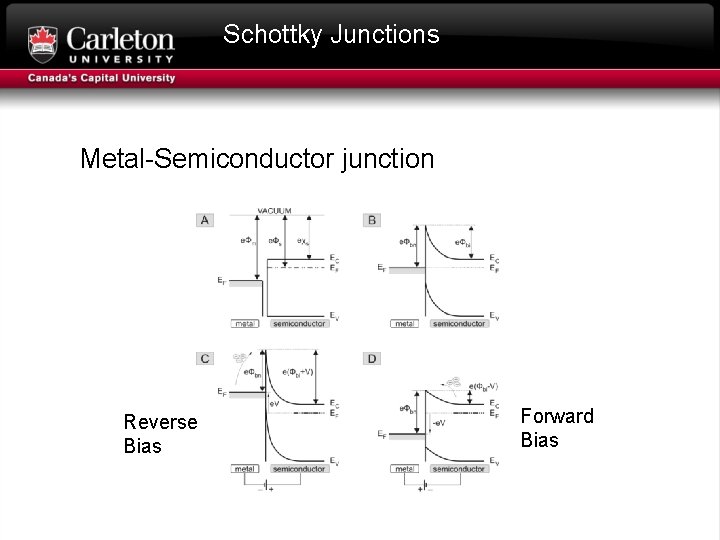
Schottky Junctions Metal-Semiconductor junction Reverse Bias Forward Bias
Schottky Junction Advantages: § Low forward voltage, responds to less intensity of light § Smaller dielectric (ε) due to metal, lower capacitance, HF applications Disadvantages: § Thin barrier makes it easy for charges to leak § Low reverse breakdown voltage, high reverse current.
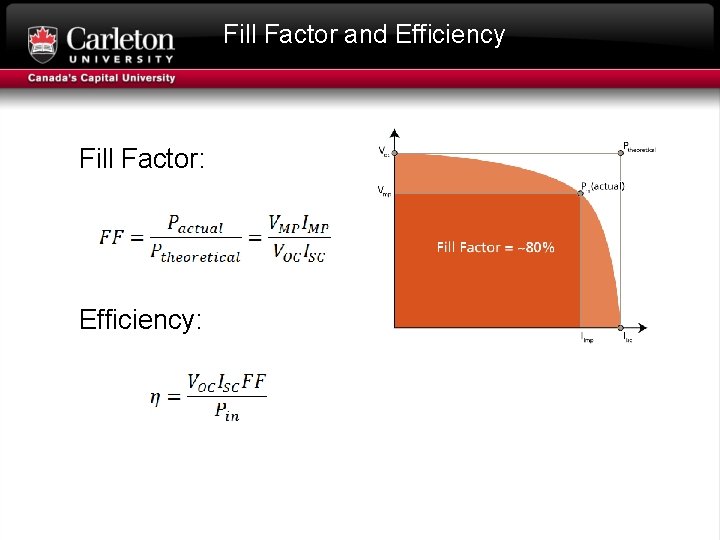
Fill Factor and Efficiency Fill Factor: Efficiency:
Cell Design • Schottky Solar Cell • P-I-N Solar Cell
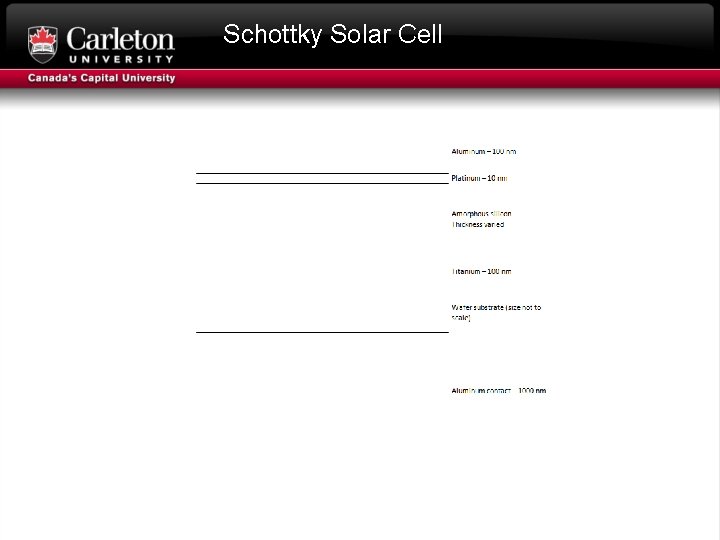
Schottky Solar Cell
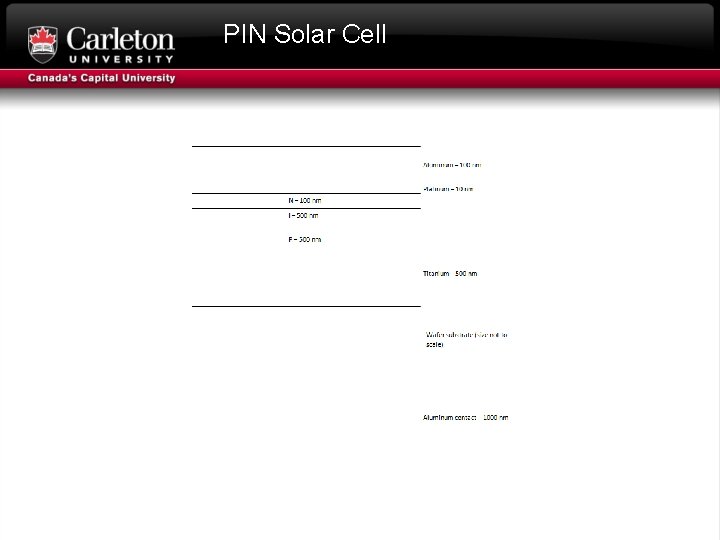
PIN Solar Cell
Manufacturing Our Cells • Lab Machines and Processes Used • Steps in manufacturing
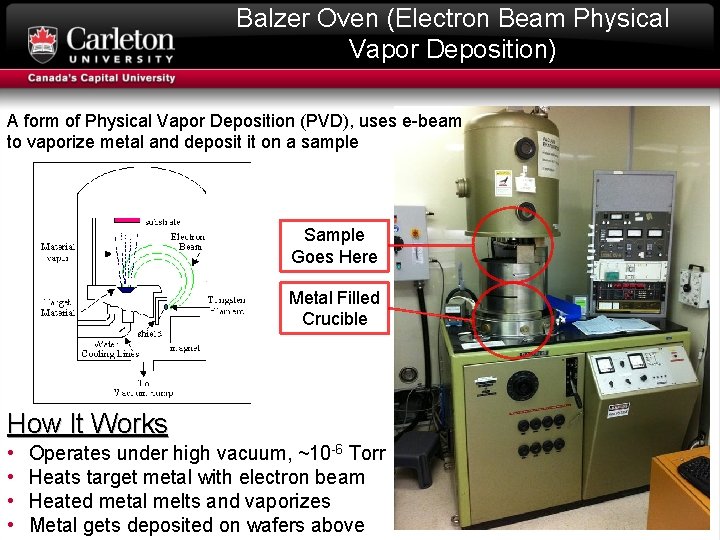
Balzer Oven (Electron Beam Physical Vapor Deposition) A form of Physical Vapor Deposition (PVD), uses e-beam to vaporize metal and deposit it on a sample Sample Goes Here Metal Filled Crucible How It Works • • Operates under high vacuum, ~10 -6 Torr Heats target metal with electron beam Heated metal melts and vaporizes Metal gets deposited on wafers above
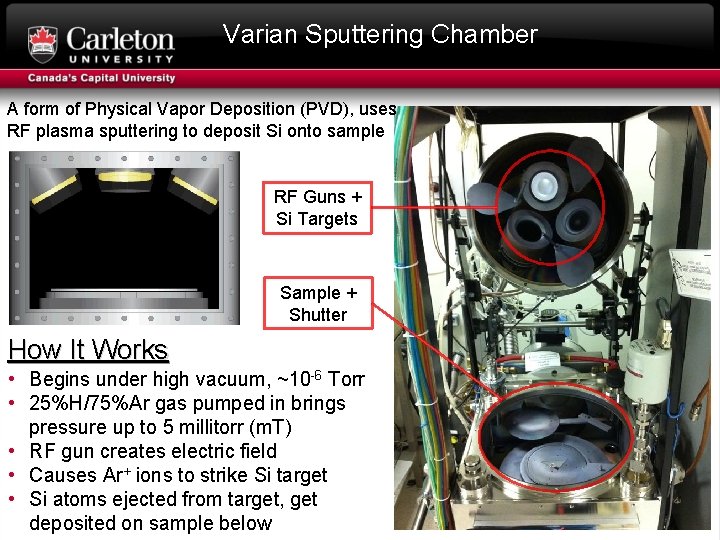
Varian Sputtering Chamber A form of Physical Vapor Deposition (PVD), uses RF plasma sputtering to deposit Si onto sample RF Guns + Si Targets Sample + Shutter How It Works • Begins under high vacuum, ~10 -6 Torr • 25%H/75%Ar gas pumped in brings pressure up to 5 millitorr (m. T) • RF gun creates electric field • Causes Ar+ ions to strike Si target • Si atoms ejected from target, get deposited on sample below
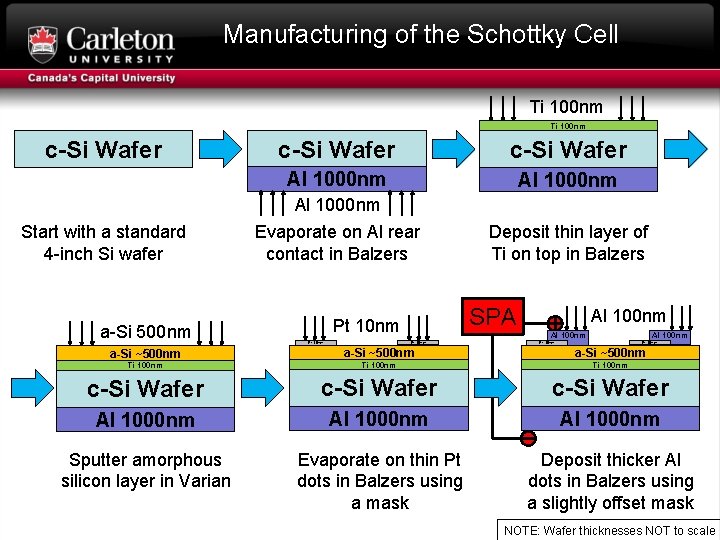
Manufacturing of the Schottky Cell Ti 100 nm c-Si Wafer Start with a standard 4 -inch Si wafer a-Si 500 nm c-Si Wafer Al 1000 nm Evaporate on Al rear contact in Balzers Deposit thin layer of Ti on top in Balzers SPA Pt 10 nm Al 100 nm Pt 10 nm a-Si ~500 nm Ti 100 nm c-Si Wafer Al 1000 nm Sputter amorphous silicon layer in Varian Evaporate on thin Pt dots in Balzers using a mask Deposit thicker Al dots in Balzers using a slightly offset mask NOTE: Wafer thicknesses NOT to scale
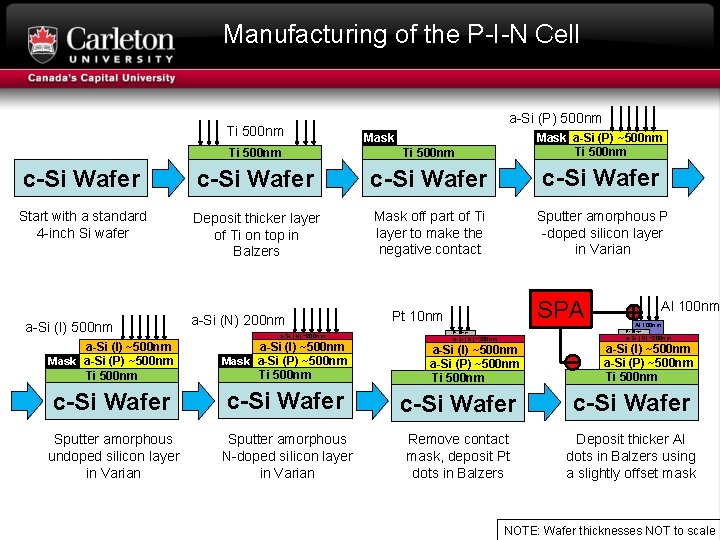
Manufacturing of the P-I-N Cell Ti 500 nm a-Si (P) 500 nm Ti 500 nm Mask a-Si (P) ~500 nm Ti 500 nm c-Si Wafer Start with a standard 4 -inch Si wafer Deposit thicker layer of Ti on top in Balzers Mask off part of Ti layer to make the negative contact Sputter amorphous P -doped silicon layer in Varian a-Si (I) 500 nm a-Si (N) 200 nm a-Si (N) ~200 nm Mask SPA Pt 10 nm Al 100 nm Pt 10 nm a-Si (I) ~500 nm Mask a-Si (P) ~500 nm Ti 500 nm a-Si (N) ~200 nm a-Si (I) ~500 nm a-Si (P) ~500 nm Ti 500 nm c-Si Wafer Sputter amorphous undoped silicon layer in Varian Sputter amorphous N-doped silicon layer in Varian Remove contact mask, deposit Pt dots in Balzers Deposit thicker Al dots in Balzers using a slightly offset mask NOTE: Wafer thicknesses NOT to scale
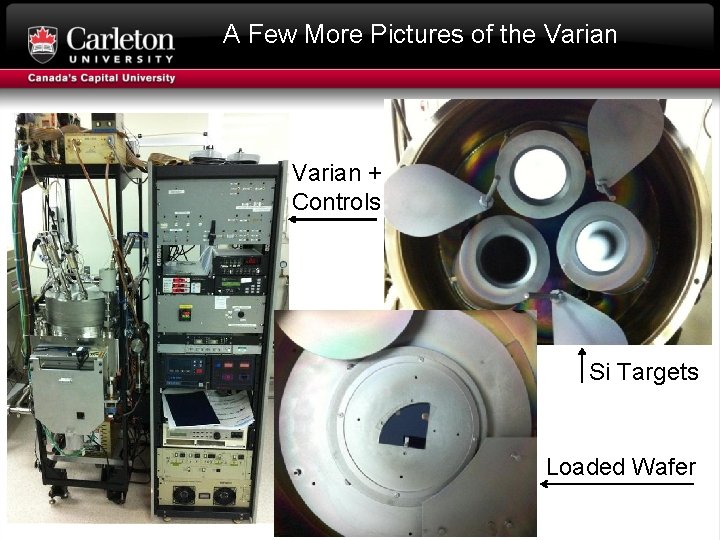
A Few More Pictures of the Varian + Controls Si Targets Loaded Wafer
Testing and Results • Testing Methods • Cell Fill Factor • Cell Efficiencies
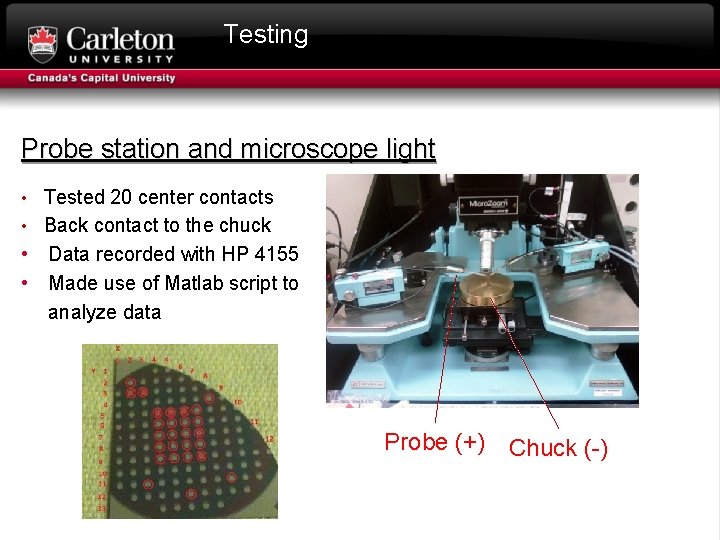
Testing Probe station and microscope light • Tested 20 center contacts • Back contact to the chuck • Data recorded with HP 4155 • Made use of Matlab script to analyze data Probe (+) Chuck (-)
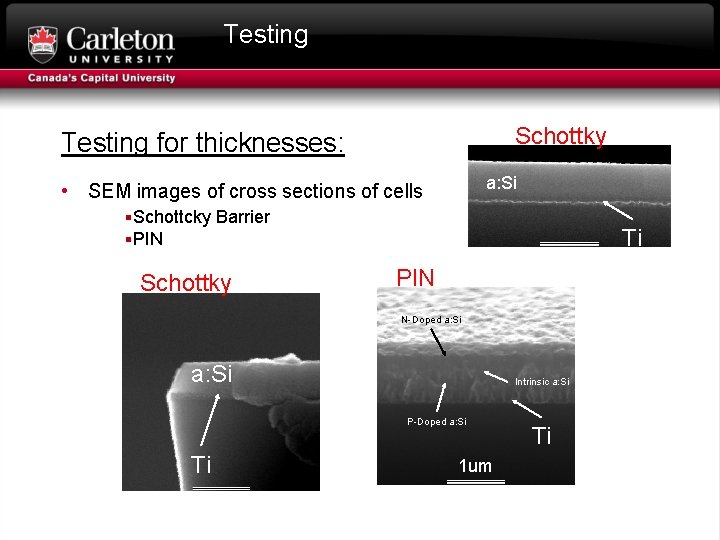
Testing Schottky Testing for thicknesses: a: Si • SEM images of cross sections of cells §Schottcky Barrier §PIN Schottky Ti PIN N-Doped a: Si Intrinsic a: Si P-Doped a: Si Ti 1 um Ti
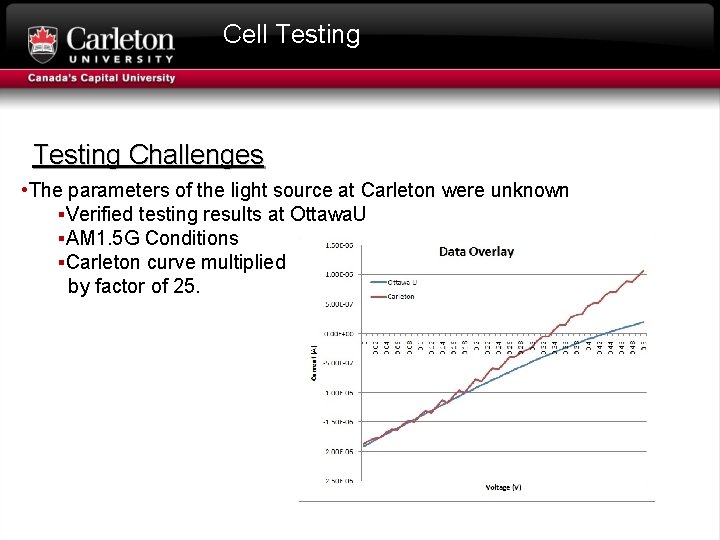
Cell Testing Challenges • The parameters of the light source at Carleton were unknown §Verified testing results at Ottawa. U §AM 1. 5 G Conditions §Carleton curve multiplied by factor of 25.
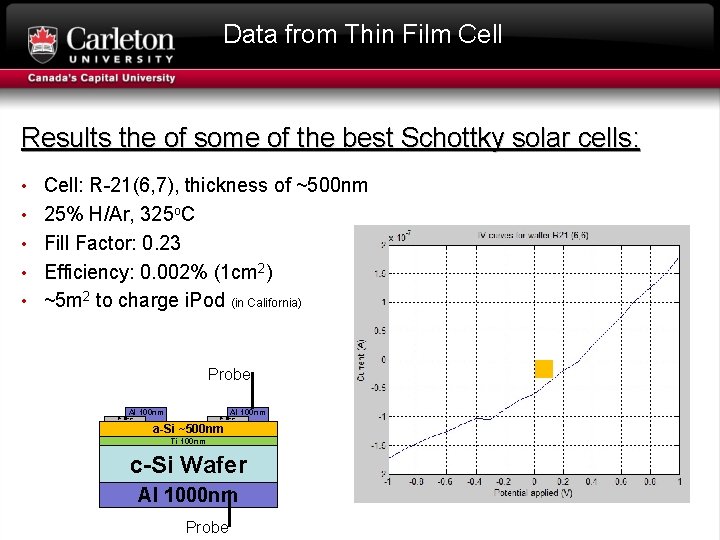
Data from Thin Film Cell Results the of some of the best Schottky solar cells: • Cell: R-21(6, 7), thickness of ~500 nm • 25% H/Ar, 325 o. C • Fill Factor: 0. 23 • Efficiency: 0. 002% (1 cm 2) • ~5 m 2 to charge i. Pod (in California) Probe Al 100 nm Pt 10 nm a-Si ~500 nm Ti 100 nm c-Si Wafer Al 1000 nm Probe
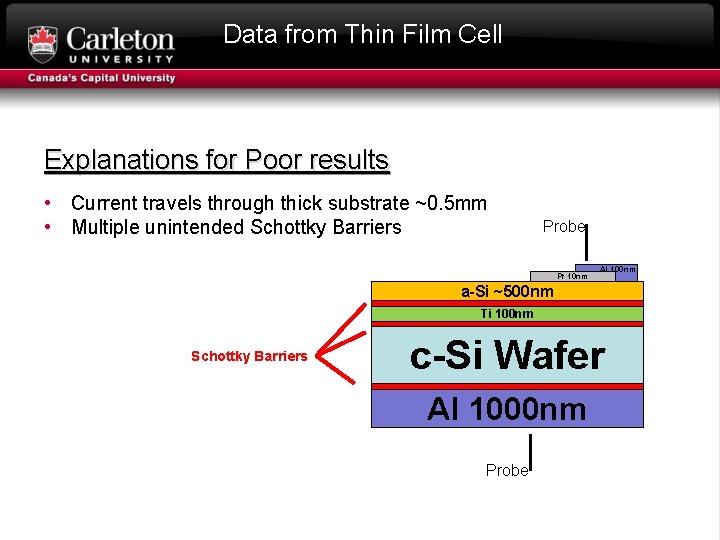
Data from Thin Film Cell Explanations for Poor results • Current travels through thick substrate ~0. 5 mm • Multiple unintended Schottky Barriers Probe Pt 10 nm Al 100 nm a-Si ~500 nm Ti 100 nm Schottky Barriers c-Si Wafer Al 1000 nm Probe
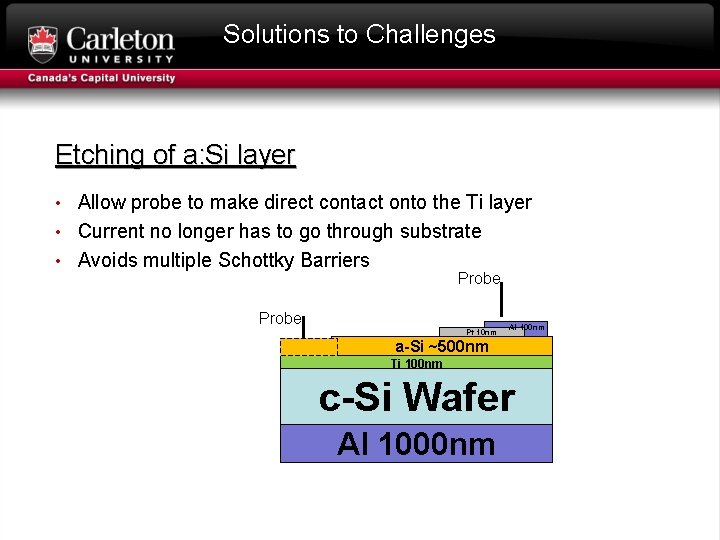
Solutions to Challenges Etching of a: Si layer • Allow probe to make direct contact onto the Ti layer • Current no longer has to go through substrate • Avoids multiple Schottky Barriers Probe Pt 10 nm Al 100 nm a-Si ~500 nm Ti 100 nm c-Si Wafer Al 1000 nm
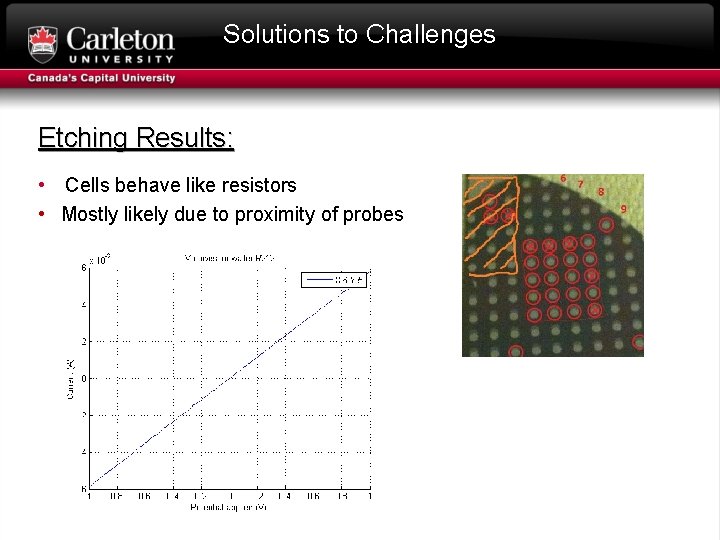
Solutions to Challenges Etching Results: • Cells behave like resistors • Mostly likely due to proximity of probes
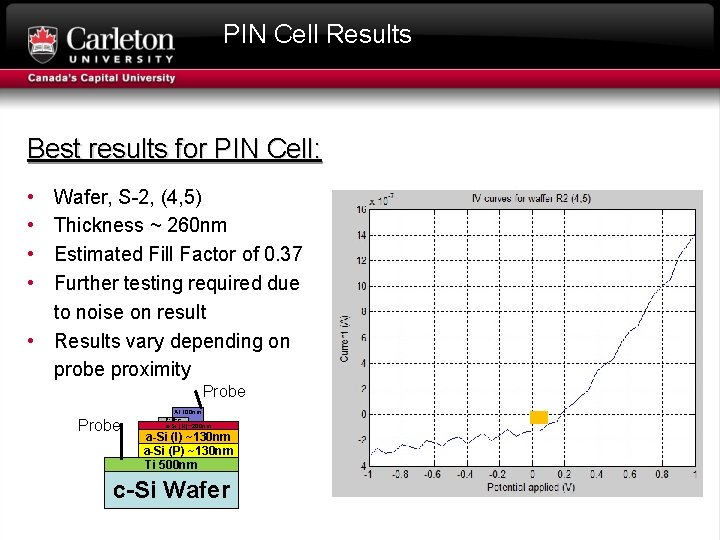
PIN Cell Results Best results for PIN Cell: • • Wafer, S-2, (4, 5) Thickness ~ 260 nm Estimated Fill Factor of 0. 37 Further testing required due to noise on result • Results vary depending on probe proximity Probe Al 100 nm Probe Pt 10 nm a-Si (N) ~200 nm a-Si (I) ~130 nm a-Si (P) ~130 nm Ti 500 nm c-Si Wafer
Conclusion Summary: • a: Si thin film remains a cheap & non-toxic way to produce solar cells • More desirable than c: Si • Potentially cheaper to manufacture then most other cell types What we’d like to achieve: • Further Testing in a: Si PIN cells §Efficiency values §Consistent contact design
Other Research This Summer • ELEC 4703 – New Solar Cell Course (Winter 2012) • Building New Photonics Testing Stage
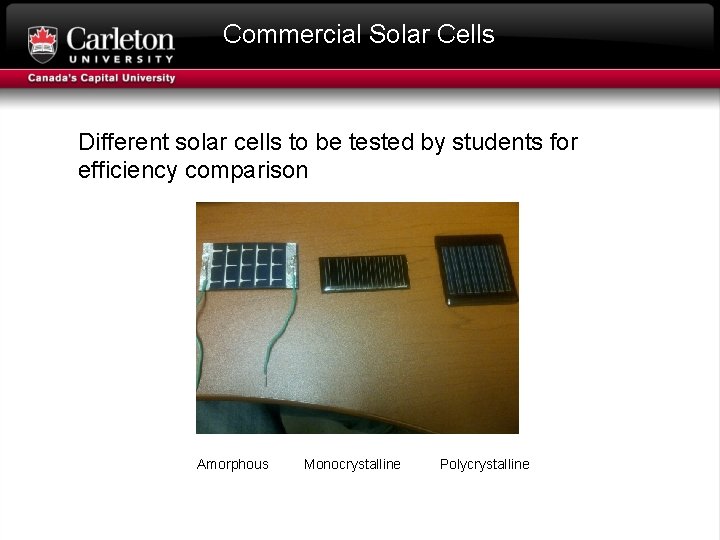
Commercial Solar Cells Different solar cells to be tested by students for efficiency comparison Amorphous Monocrystalline Polycrystalline
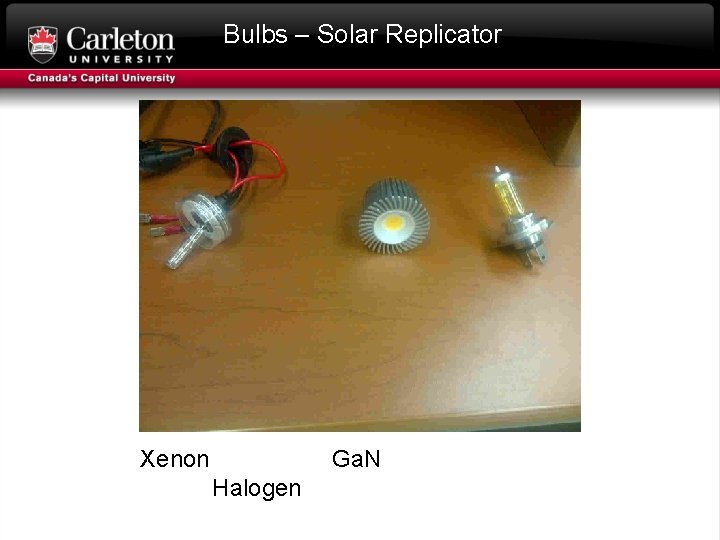
Bulbs – Solar Replicator Xenon Ga. N Halogen
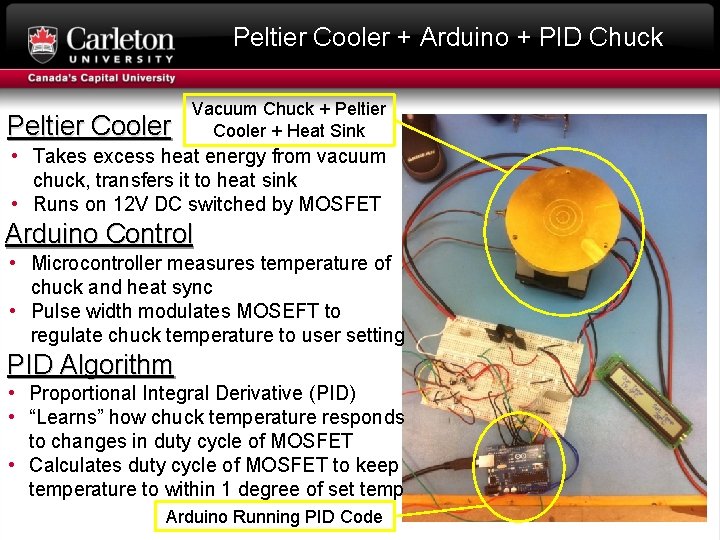
Peltier Cooler + Arduino + PID Chuck Peltier Cooler Vacuum Chuck + Peltier Cooler + Heat Sink • Takes excess heat energy from vacuum chuck, transfers it to heat sink • Runs on 12 V DC switched by MOSFET Arduino Control • Microcontroller measures temperature of chuck and heat sync • Pulse width modulates MOSEFT to regulate chuck temperature to user setting PID Algorithm • Proportional Integral Derivative (PID) • “Learns” how chuck temperature responds to changes in duty cycle of MOSFET • Calculates duty cycle of MOSFET to keep temperature to within 1 degree of set temp Arduino Running PID Code
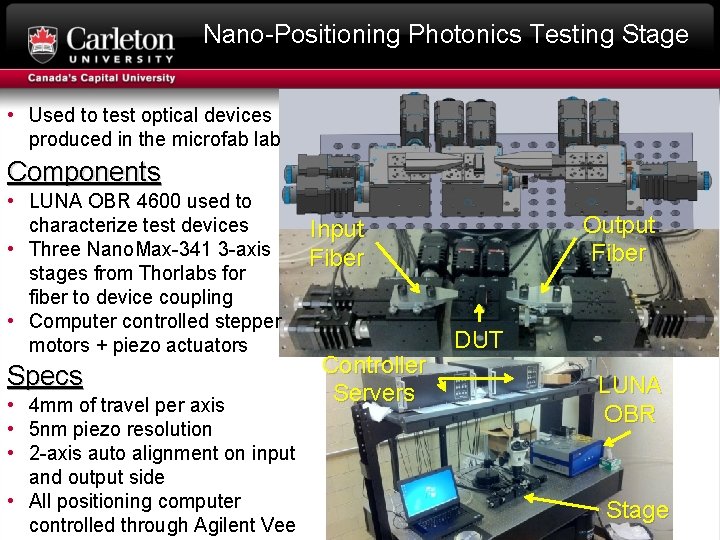
Nano-Positioning Photonics Testing Stage • Used to test optical devices produced in the microfab lab Components • LUNA OBR 4600 used to characterize test devices • Three Nano. Max-341 3 -axis stages from Thorlabs for fiber to device coupling • Computer controlled stepper motors + piezo actuators Specs • 4 mm of travel per axis • 5 nm piezo resolution • 2 -axis auto alignment on input and output side • All positioning computer controlled through Agilent Vee Output Fiber Input Fiber Controller Servers DUT LUNA OBR Stage
Acknowledgements We would like to give special thanks to: • • • • NSERC Dr. Winnie Ye Dr. Garry Tarr Dr. Karin Hinzer Nagui Mikhail Rob Vandeusen Rick Adams Angela Burns Dr. Tom Smy Blazenka Power Andrew Tam Ryan Griffin Svetlana Demtchenko Scott Ferguson Scott Bruce
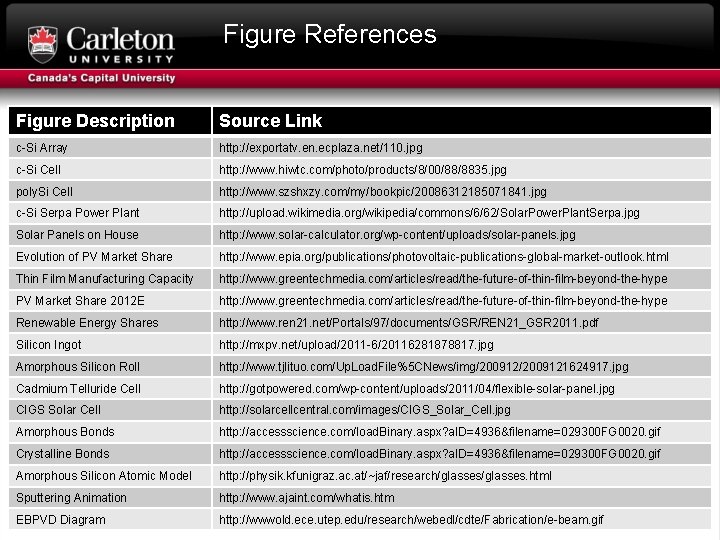
Figure References Figure Description Source Link c-Si Array http: //exportatv. en. ecplaza. net/110. jpg c-Si Cell http: //www. hiwtc. com/photo/products/8/00/88/8835. jpg poly. Si Cell http: //www. szshxzy. com/my/bookpic/20086312185071841. jpg c-Si Serpa Power Plant http: //upload. wikimedia. org/wikipedia/commons/6/62/Solar. Power. Plant. Serpa. jpg Solar Panels on House http: //www. solar-calculator. org/wp-content/uploads/solar-panels. jpg Evolution of PV Market Share http: //www. epia. org/publications/photovoltaic-publications-global-market-outlook. html Thin Film Manufacturing Capacity http: //www. greentechmedia. com/articles/read/the-future-of-thin-film-beyond-the-hype PV Market Share 2012 E http: //www. greentechmedia. com/articles/read/the-future-of-thin-film-beyond-the-hype Renewable Energy Shares http: //www. ren 21. net/Portals/97/documents/GSR/REN 21_GSR 2011. pdf Silicon Ingot http: //mxpv. net/upload/2011 -6/20116281878817. jpg Amorphous Silicon Roll http: //www. tjlituo. com/Up. Load. File%5 CNews/img/2009121624917. jpg Cadmium Telluride Cell http: //gotpowered. com/wp-content/uploads/2011/04/flexible-solar-panel. jpg CIGS Solar Cell http: //solarcellcentral. com/images/CIGS_Solar_Cell. jpg Amorphous Bonds http: //accessscience. com/load. Binary. aspx? a. ID=4936&filename=029300 FG 0020. gif Crystalline Bonds http: //accessscience. com/load. Binary. aspx? a. ID=4936&filename=029300 FG 0020. gif Amorphous Silicon Atomic Model http: //physik. kfunigraz. ac. at/~jaf/research/glasses. html Sputtering Animation http: //www. ajaint. com/whatis. htm EBPVD Diagram http: //wwwold. ece. utep. edu/research/webedl/cdte/Fabrication/e-beam. gif