
Research In Psychology An Overview Defining Psychology w


- Slides: 24
Research In Psychology An Overview
Defining Psychology w From the Greek psi roughly meaning immortal soul
Common Modern Definition: “Psychology is the science of behavior and cognitive processes. ” Science: system of rules for conducting repeatable observations Behavior may be overt (‘obvious’) or covert (hidden; capable of exposure or ‘observation by inference’) As we noted before, the object of study may be difficult to rigorously quantify
About the course… w Organized around six “great” questions or issues, such as sex differences, cognitive life, etc. w Long of interest to human kind w Psychology can now offer answers (albeit not the only answers), from scientific and critical thinking perspectives
Organizing Theme: Critical Thinking Two elements: 1. A set of skills to process and generate information and beliefs 2. A habit, based on intellectual commitment, of using skills to guide behavior
Critical Thinking Defined w “disciplined process of analyzing and evaluating information gathered by observation, experience, reflection, reason, and/or communication so that belief and action are guided. (Scriven and Paul, 2000)”
The “critical thinker”, then; w Seeks information and perspectives w Evaluates information and perspective by a rational criteria w Reconciles fact and action
An “uncritical thinker” w Avoids information and perspective w Fails to evaluate information and perspective they do experience w Acquires information with no commitment to act on it (Trivial Pursuits) w Or, acts uncritically (against information)
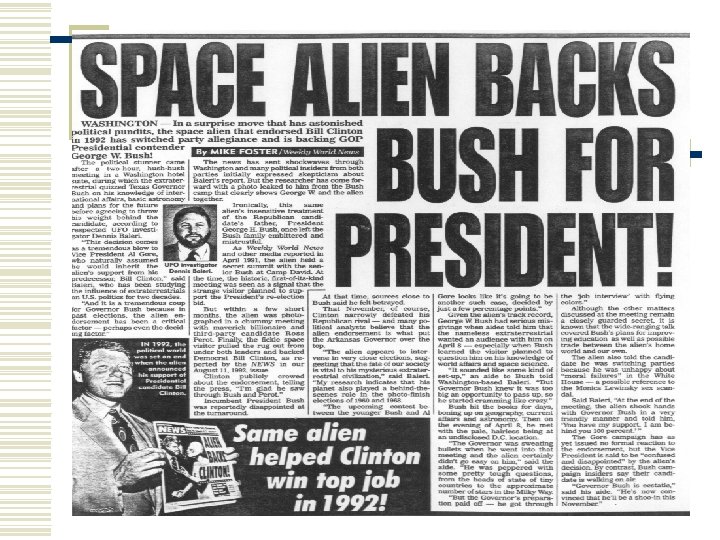
Evaluating Claims w Sometimes, a negative example helps…
Some Potential Evaluative Standards w w w w Nature of Assumptions Consistency with accepted facts Motivation for claims of truth (“Point of View”) Logic Quality of Evidentiary Data Potential to be Falsified Critical Thinking is a requirement of the scientific process– indeed, the two are inseparable.
Doing Psychological Research Logic and Process
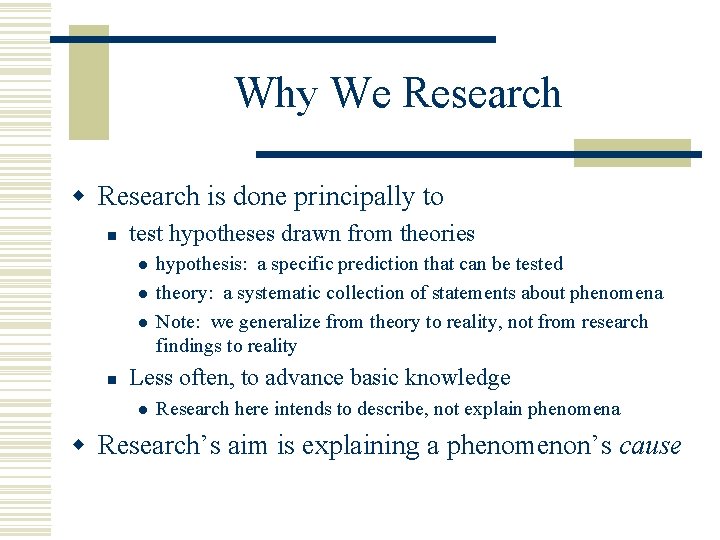
Why We Research w Research is done principally to n test hypotheses drawn from theories l l l n hypothesis: a specific prediction that can be tested theory: a systematic collection of statements about phenomena Note: we generalize from theory to reality, not from research findings to reality Less often, to advance basic knowledge l Research here intends to describe, not explain phenomena w Research’s aim is explaining a phenomenon’s cause
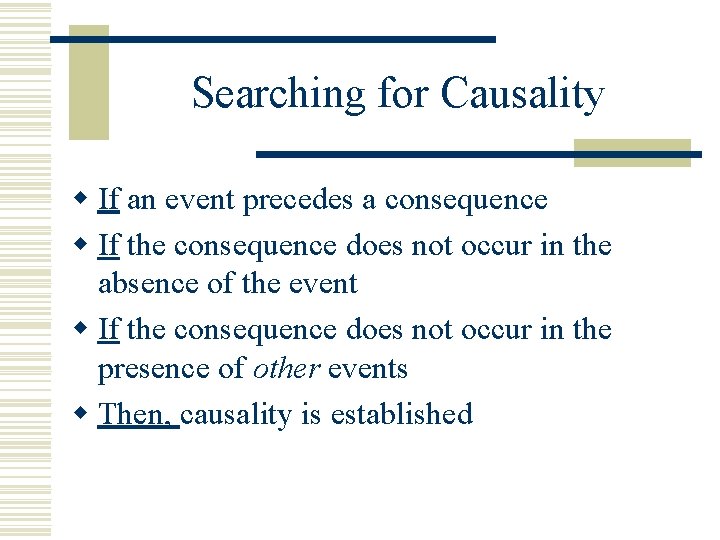
Searching for Causality w If an event precedes a consequence w If the consequence does not occur in the absence of the event w If the consequence does not occur in the presence of other events w Then, causality is established
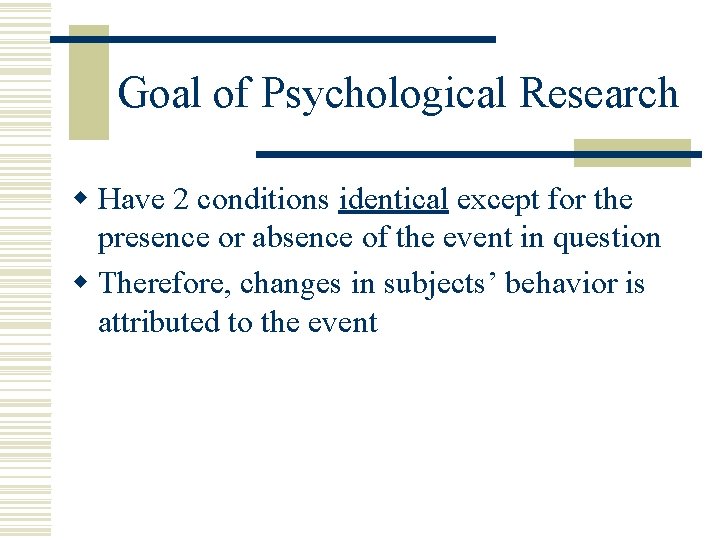
Goal of Psychological Research w Have 2 conditions identical except for the presence or absence of the event in question w Therefore, changes in subjects’ behavior is attributed to the event
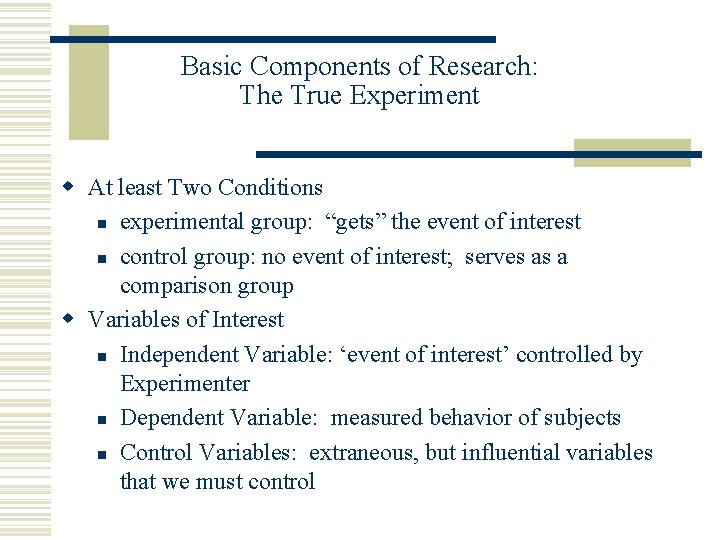
Basic Components of Research: The True Experiment w At least Two Conditions n experimental group: “gets” the event of interest n control group: no event of interest; serves as a comparison group w Variables of Interest n Independent Variable: ‘event of interest’ controlled by Experimenter n Dependent Variable: measured behavior of subjects n Control Variables: extraneous, but influential variables that we must control
w Random Assignment of Subjects to Conditions n Note: not “Random Sampling” in which everyone has equal chance of participating in study
A Goofy Example w Drug “X” n Afternoon garage project enhances sex appeal, doubles intelligence, eliminates all bad odors, guarantees financial and social success, and promotes hair growth l preliminary tests on mice indicates 2% mortality rate (ethical problem? ) l It’s time for human trials, so… l n Any Volunteers?
w “X” volunteers are n n n more adventuresome less aware of probabilities more materialistic than the “control” group w By Accepting Volunteers, any differences may be to their adventuresome natures, not to the effects of “Drug X” n But how can we tell? w Threat to Internal Validity n lessens confidence in findings of study
Other Common Internal Validity Threats w Experimenter Expectancies n controlled by the double blind procedures l neither Experimenter nor Subjects know what condition or hypothesis w Subject Expectancies n n subjects seek hypothesis subjects shape behavior to support or challenge hypothesis (demand characteristics)
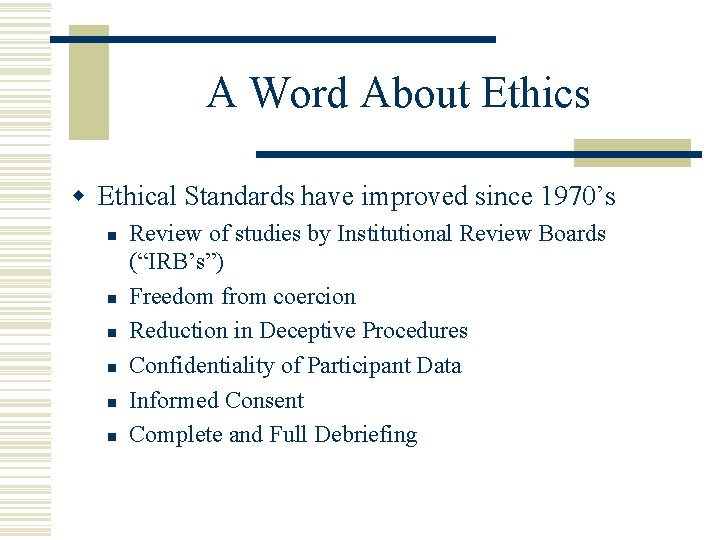
A Word About Ethics w Ethical Standards have improved since 1970’s n n n Review of studies by Institutional Review Boards (“IRB’s”) Freedom from coercion Reduction in Deceptive Procedures Confidentiality of Participant Data Informed Consent Complete and Full Debriefing
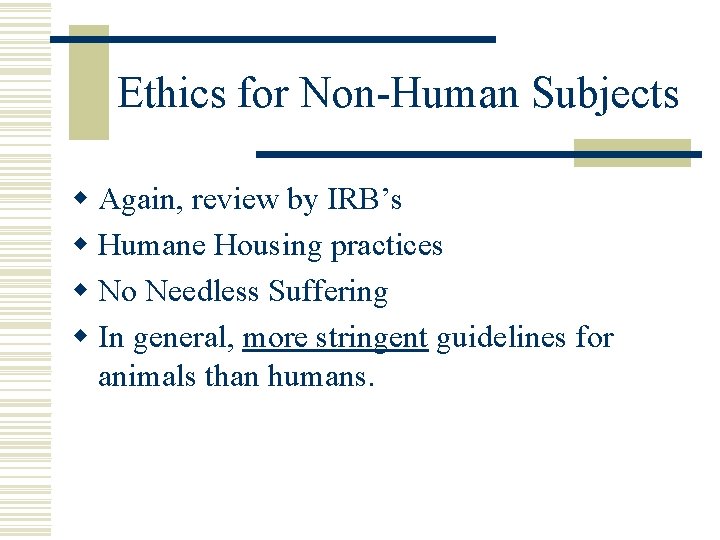
Ethics for Non-Human Subjects w Again, review by IRB’s w Humane Housing practices w No Needless Suffering w In general, more stringent guidelines for animals than humans.