
Research in physical therapy WHAT IS RESEARCH n

![Which of these can be classified as research? n [1] someone prepared a paper](https://slidetodoc.com/presentation_image_h2/361bfc2861d69c17871aa211886f5403/image-6.jpg "Which of these can be classified as research? n [1] someone prepared a paper")












- Slides: 44
Research in physical therapy
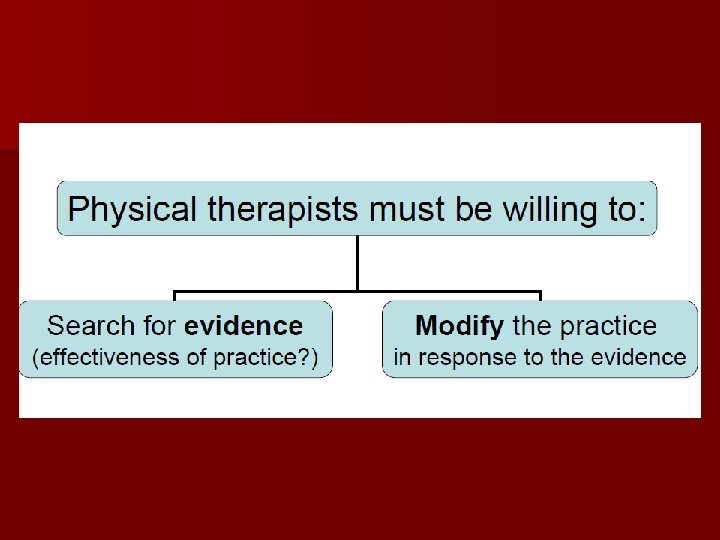
WHAT IS RESEARCH? n Research is finding solutions to problem in a logical and systematic fashion • n The process by which we determine whether what we do as physical therapists makes a difference in the lives of the people we serve”(Domholdt, 2000)
After finding the solution you have to disseminate this knowledge n Thesis or dissertation n Scientific article All have the same basic structure and format. The rationale is that readers of research will know exactly where to find the information they are looking for,
n systematic, because it follows certain steps that are logical in order. These steps are: n 1. Selecting and identifying the problem. n 2. Reviewing literature to understand how others have approached or dealt with the problem.
n 3. Collecting data in an organized and controlled manner so as to arrive at valid decisions. n 4. Analyzing data appropriate to the problem. n 5. Drawing conclusions and making generalizations.
Which of these can be classified as research? n [1] someone prepared a paper on “electro rehabilitation in physical therapy ” after reviewing literature on the subject available in his university library n [2] someone says that he has researched and completed a document which gives information about the age of his patients, their diagnosis, and their financial status
None of the above examples can be classified under the name research. n • Research isn’t information gathering: – Gathering information from resources such books or magazines isn’t research. – No contribution to new knowledge. n Research isn’t the transportation of facts: – Merely transporting facts from one resource to another doesn’t constitute research. – No contribution to new knowledge although this might make existing knowledge more accessible
Why do we need research?
n 1. To establish a body of knowledge for physical therapy n –For the survival of a profession
n 2. To determine the efficacy of physical therapy treatments n 3. Improve patient care n 4 - To get Ph. Ds, Masters and Bachelors degree
STEPS IN CONDUCTING RESEARCH
• Identification / Selection of the Problem • Formulation of the Problem
Step 1: Selection of the research topic: write down general areas of interest At this stage, it doesn’t matter if the terms used are broad or specific, abstract or concrete. , The important point is to put ideas on papers.
SOURCES OF PROBLEMS n n n n Reading Exposure to Field Situations Brainstorming Personal experience. Existing resources. Previous research.
Step 2: Narrowing the topic n Once a research topic has been specified and contemplate, the researcher must then narrow it down in order to develop a research problem. n This is done through generating questions from the research topic.
n Step 3 Initial review of literature n Discover relevant material in the problem area Theoretical framework. Methodology. Data collection methods. Data collection tools Significance of the study
Review of literature will also help to identify what is known and what is not known about the research problem. Therefore, the research problem could be specified and stated at this point.
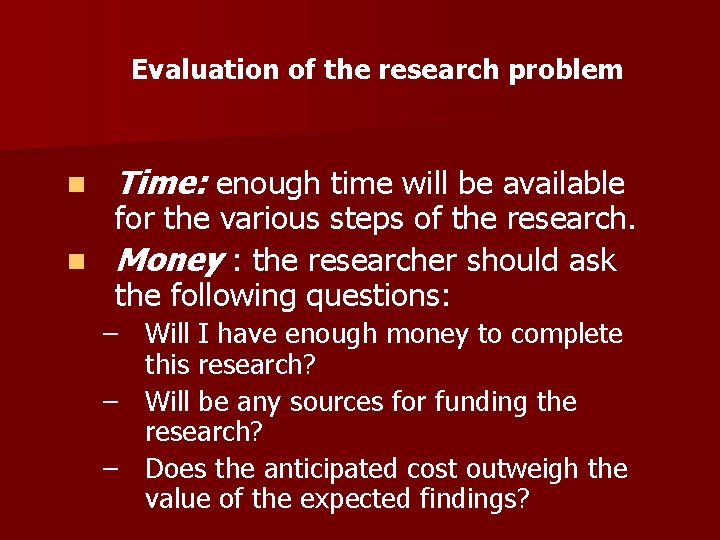
Evaluation of the research problem n Time: enough time will be available for the various steps of the research. n Money : the researcher should ask the following questions: – Will I have enough money to complete this research? – Will be any sources for funding the research? – Does the anticipated cost outweigh the value of the expected findings?
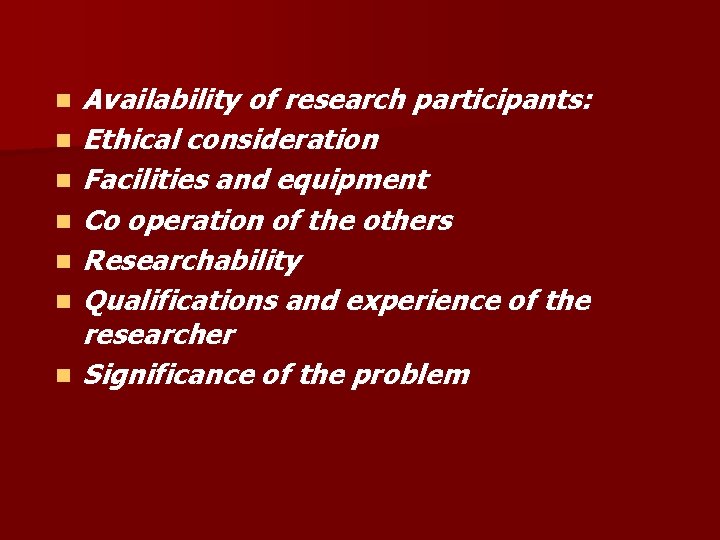
n n n n Availability of research participants: Ethical consideration Facilities and equipment Co operation of the others Researchability Qualifications and experience of the researcher Significance of the problem
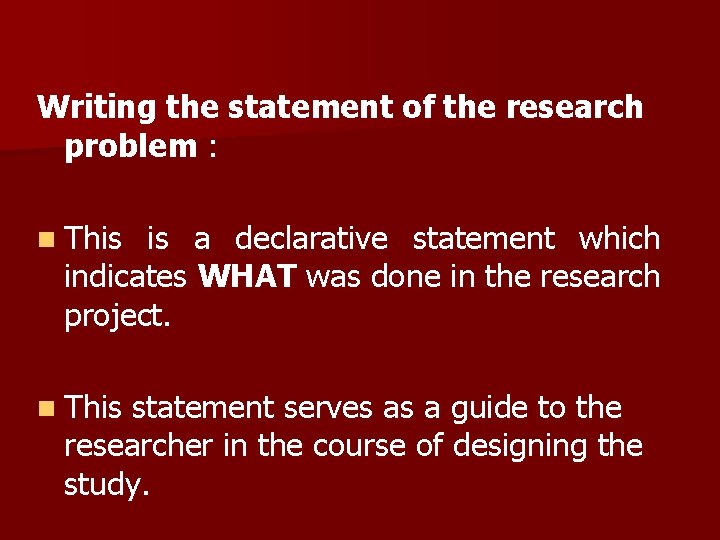
Writing the statement of the research problem : n This is a declarative statement which indicates WHAT was done in the research project. n This statement serves as a guide to the researcher in the course of designing the study.
n Typically, the statement of the problem begins with some variation : n 1. "The study investigated. . . " n 2. "The study was concerned with. . . " n 3. “the study examined. . . "
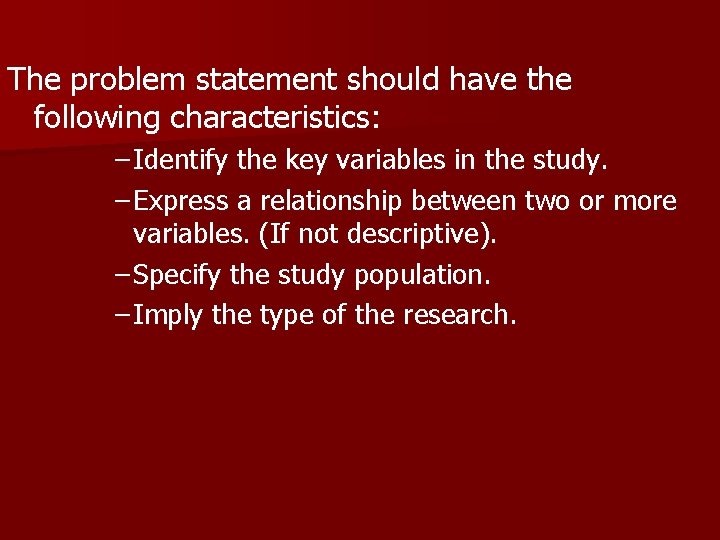
The problem statement should have the following characteristics: – Identify the key variables in the study. – Express a relationship between two or more variables. (If not descriptive). – Specify the study population. – Imply the type of the research.
n Defining Problem , Results in Clear Cut Research purposes
n The purpose of the study must indicate WHY the study was done. n researcher indicates the reasons, or objectives, he or she has for doing the study. n What uses or contributions will the results of the study make?
Justification of the study n Elaborate on the purpose n From one to three pages n Supported by literature
Guiding questions n Are there a knowledge gap in literature? n Do we need more information concerning the problem area? n Do we need to validate present information, theoretical or practical in the problem area? n Is there a need for better knowledge in order to choose between alternate practices?
Limitations n Limitation related to the participants. n Limitation to the instrument. n Limitation related to the research process.
Delimitations n Narrowing the scope of the study In this section researcher present his restrictions on such items n No and kind of subjects n No and kind of variables n The instrument utilized in the study n Time and duration of the study n Analytical procedure n Significance level
example n A) Subjects n Forty subjects of both sexes with age ranged from 40 to 50 years old were participated in the study. n The subjects were recruited from faculty's out clinic. n The subjects were assigned randomly into two equal groups: study group and control group.
B) Instrumentation n EMG instrument was used for measuring Amplitude of MUAPs. Device that was used is toennies neuroscreen plus version 1. 59. n Formetric II device was used to measure spinal sagittal balance n electrogniometer was used to measure ROM n VAS was used to measure the pian intensity
n C) Methods n For both groups, spinal sagittal balance, VAS, ROM and Amplitude of (MUAPs) were measured at two instances before the treatment and at the end of 10 weeks. n Treatment program was provided to the study group three days/week for 10 weeks. n -The level of significance was< 0. 05.
hypotheses n. Generating tentative guesses (hypotheses) about the relation of the variables
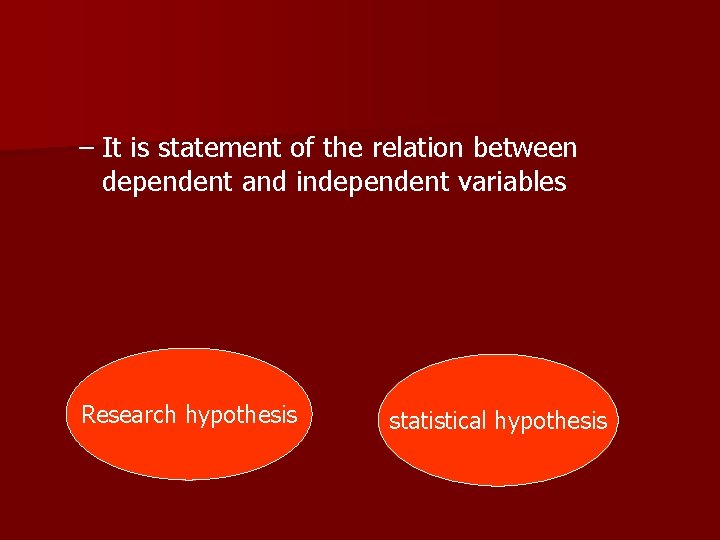
– It is statement of the relation between dependent and independent variables Research hypothesis statistical hypothesis
Importance of R. H. : n It provides direction for the type of research (i. e. design, sampling, data collection. . etc. ). n Suggests the type of statistical analysis to be used in the study. n Identifies the variables to be manipulated and/or measured
How to state a R. H. : n Research hypothesis should be stated clearly, concisely, and measurably,
Types of hypothesis A research hypothesis is also classified as directional or nondirectional.
n Directional: One that specifies the direction of the expected findings; this is done when the researcher has definite reasons; for expecting certain relationships or certain differences to occur between groups.
n Non-directional: Doesn't, specify, the direction that expected differences or relationships may take.
Null n It predicts no relationship between I. V. and D. V. n It is used when statistical testing procedures are applied to the data. Example: n There is no relationship between maternal smoking and newborn’s birth weight.
n complex research will have a multiplicity of hypotheses n Simple rule of thumb: State one hypothesis for every subproblem and/or for every data-collection device that is used.
n There is no upper limit on the number of hypotheses we can have n The hypothesis are not supported, this does not negate the value of the research. n Some of our most important theoretical thinking has resulted from research that did not support its hypothesis.
n The two major elements which structure hypotheses are the: n 1. Researcher's previous experience. n 2. Literature.
n Characteristics of research hypothesis: n 1. It should be improve or adding to our body knowledge. n 2. It should be testable. n 3. It should be stated clearly in other word you must define what your variables mean. n 4. It should be realistic in its aims (not over ambitious).