
Research in Health Psychology Chapter 2 HEALTH PSYCHOLOGY

- Slides: 28
Research in Health Psychology Chapter 2 HEALTH PSYCHOLOGY Richard O. Straub | Sixth Edition
Critical Thinking and Evidence-Based Medicine • Critical Thinking • Involves questioning approach to all information and arguments • Evidence-Based Medicine • Uses current best evidence in making decisions about the care of individual patients or about the delivery of health services
The Dangers of “Unscientific” Thinking • Available information is used to formulate cause-andeffect relationships about behavior of self and others • Confirmation Bias • Form of faulty reasoning in which expectations prevent people from seeing alternative explanations for their observations
Protecting Research Participants from Harm • Code of Ethics • Moral code that provides researchers with guidelines about what is “right” and what is “wrong” • Institutional Review Board (IRB) • Protects research participants from harm by permitting only studies that follow a strict code of ethics
Health Psychology Research Methods • Health psychologists use various research methods in the search to learn how psychological factors affect health • They also utilize methods from the field of epidemiology • Scientific study of the frequency, distribution, and causes of a particular disease or other health outcome in a population
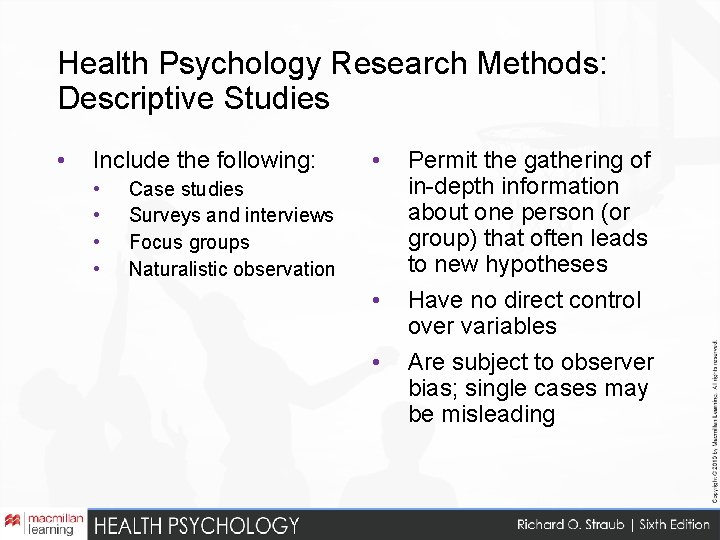
Health Psychology Research Methods: Descriptive Studies • Include the following: • • • Case studies Surveys and interviews Focus groups Naturalistic observation • • Permit the gathering of in-depth information about one person (or group) that often leads to new hypotheses Have no direct control over variables Are subject to observer bias; single cases may be misleading
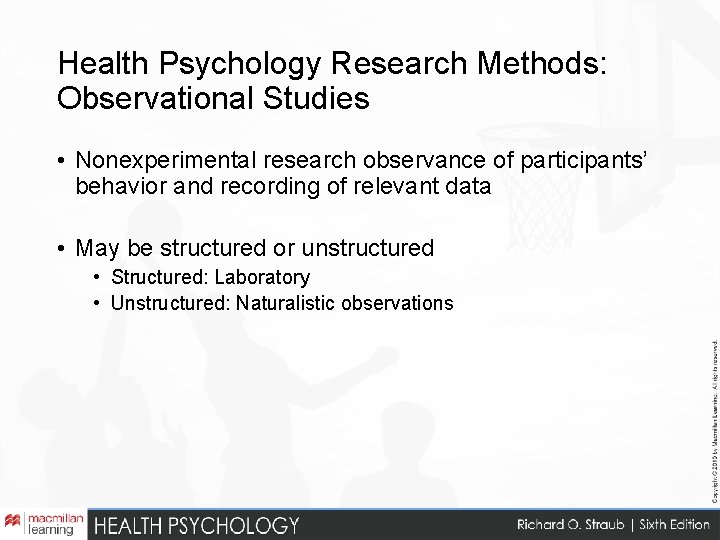
Health Psychology Research Methods: Observational Studies • Nonexperimental research observance of participants’ behavior and recording of relevant data • May be structured or unstructured • Structured: Laboratory • Unstructured: Naturalistic observations
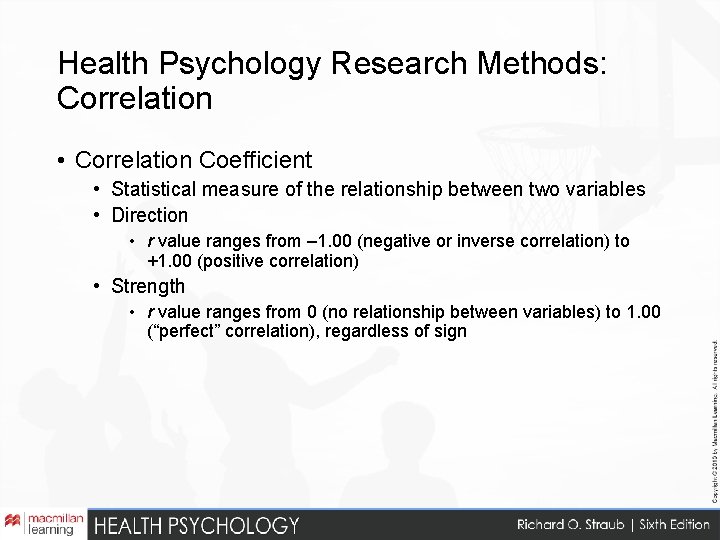
Health Psychology Research Methods: Correlation • Correlation Coefficient • Statistical measure of the relationship between two variables • Direction • r value ranges from – 1. 00 (negative or inverse correlation) to +1. 00 (positive correlation) • Strength • r value ranges from 0 (no relationship between variables) to 1. 00 (“perfect” correlation), regardless of sign
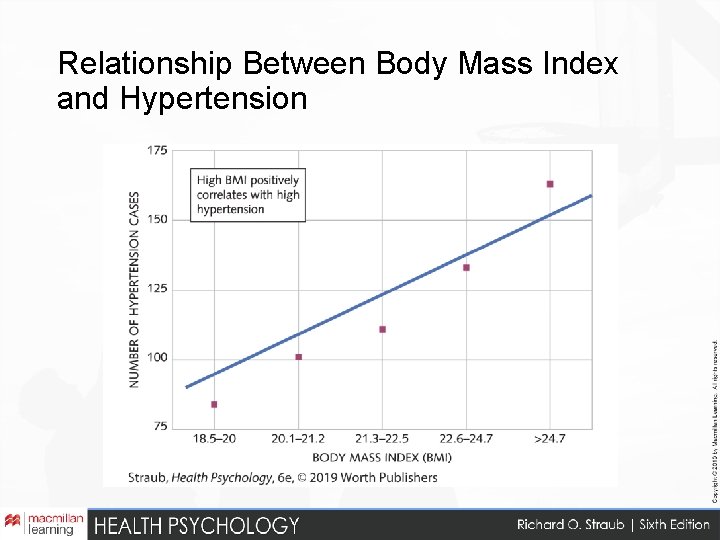
Relationship Between Body Mass Index and Hypertension
Interpreting Data… Association Versus Causation • Mistaking statements of association for statements of causation is a common error in the interpretation of research results • Correlations do NOT • Dismiss possible contributions of other variables • Pinpoint directionality • Guarantee causality
Health Psychology Research Methods: Experimental Studies (part 1) • Involve statistical comparison • Experimental and control groups • Have high degree of control over IV and DV; random assignment eliminates preexisting group differences • Are usually conducted in laboratory • Limit generalizability • May involve some variables that cannot be investigated
Health Psychology Research Methods: Experimental Studies (part 2) • Independent Variable • Experimental factor manipulated by variable; the variable whose effect is being studied • Dependent Variable • Mental process variable in an experiment that may change in response to manipulations of the independent variable • Random Assignment • Assignment of research participants to groups by chance in order to minimize preexisting differences
Health Psychology Research Methods: Quasi-Experiments • Use two or more comparison groups that differ naturally on the variables of interest at the outset of the study (not a true experiment) • Draw no cause-and-effect conclusions • Commonly use age, gender, ethnicity, and SES variables
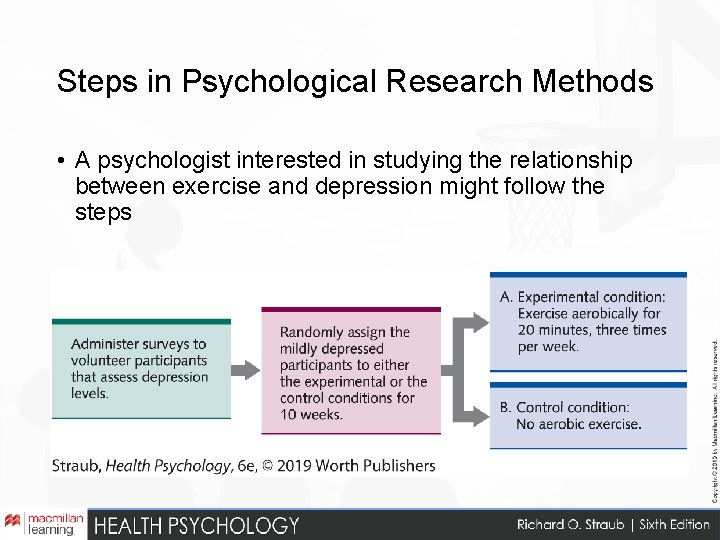
Steps in Psychological Research Methods • A psychologist interested in studying the relationship between exercise and depression might follow the steps
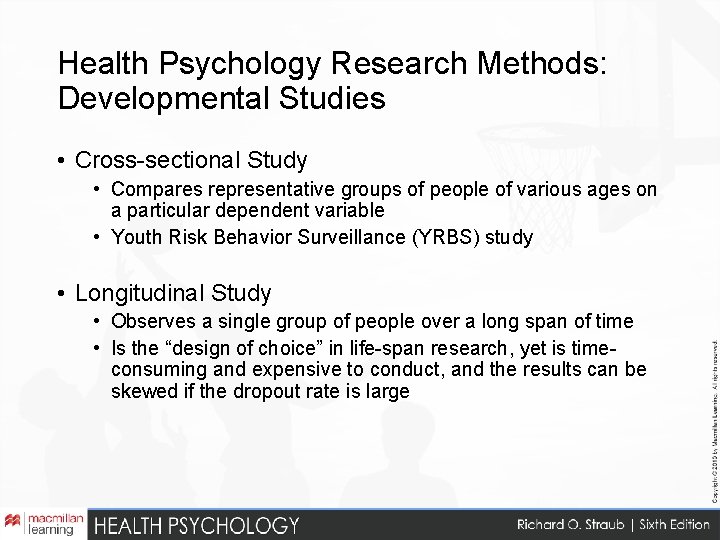
Health Psychology Research Methods: Developmental Studies • Cross-sectional Study • Compares representative groups of people of various ages on a particular dependent variable • Youth Risk Behavior Surveillance (YRBS) study • Longitudinal Study • Observes a single group of people over a long span of time • Is the “design of choice” in life-span research, yet is timeconsuming and expensive to conduct, and the results can be skewed if the dropout rate is large
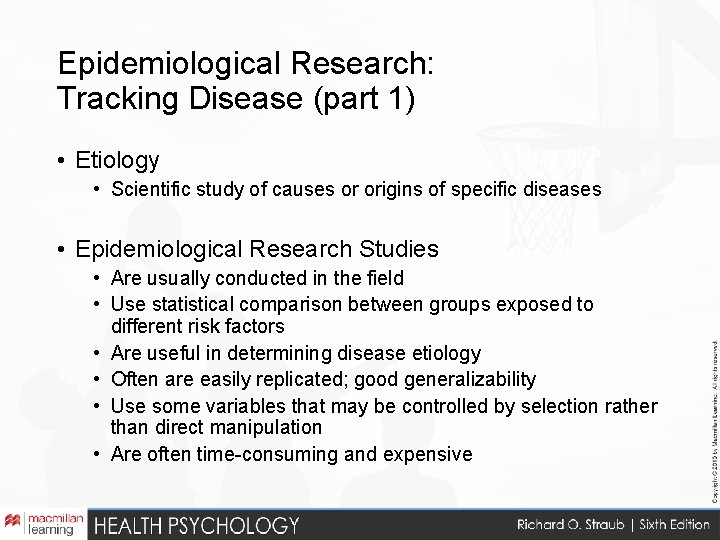
Epidemiological Research: Tracking Disease (part 1) • Etiology • Scientific study of causes or origins of specific diseases • Epidemiological Research Studies • Are usually conducted in the field • Use statistical comparison between groups exposed to different risk factors • Are useful in determining disease etiology • Often are easily replicated; good generalizability • Use some variables that may be controlled by selection rather than direct manipulation • Are often time-consuming and expensive
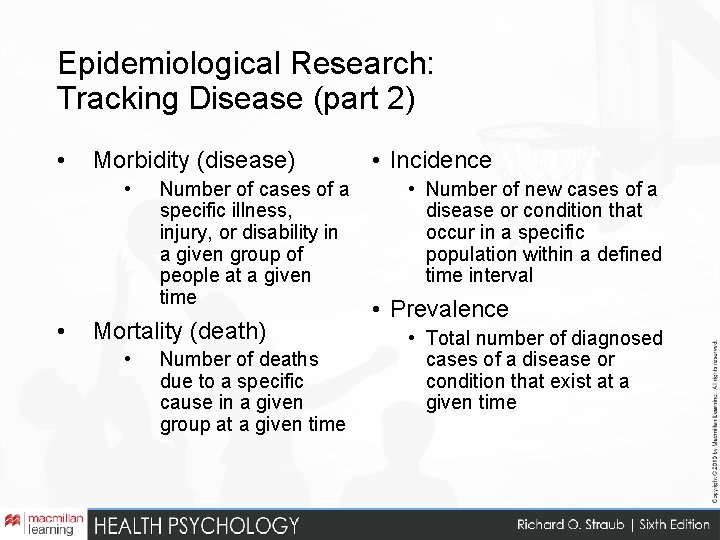
Epidemiological Research: Tracking Disease (part 2) • Morbidity (disease) • • Number of cases of a specific illness, injury, or disability in a given group of people at a given time Mortality (death) • Number of deaths due to a specific cause in a given group at a given time • Incidence • Number of new cases of a disease or condition that occur in a specific population within a defined time interval • Prevalence • Total number of diagnosed cases of a disease or condition that exist at a given time
Objectives in Epidemiological Research • Epidemiologists have three fundamental objectives: • Pinpoint the etiology of a particular disease in order to generate hypotheses • Evaluate the hypotheses • Assess the effectiveness of intervention programs created to test the researchers’ hypotheses
Research Methods in Epidemiology (part 1) • Retrospective Study • Longitudinal study that looks back at the history of a group of people, often one suffering from a particular disease or condition • Case–control studies • Comparison of people who have a disease or condition (cases) with people who are not affected by the disease or condition (controls) • Identification of risk factors that led to AIDS • INTERHEART study of risk factors for myocardial infarction
Research Methods in Epidemiology (part 2) • Prospective Study • Forward-looking longitudinal study that begins with a healthy group of subjects and follows the development of a particular disease in that sample • BMI and later occurrence of hypertension • Breast cancer and drinking
Research Methods in Epidemiology (part 3) • Randomized Clinical Trial (RCT) • True experiment that tests the effects of one independent variable on individuals or on groups of individuals • Most common types • Baseline measures are taken • Participants are randomly assigned to experimental group or control group • Differences are attributed to treatment differences
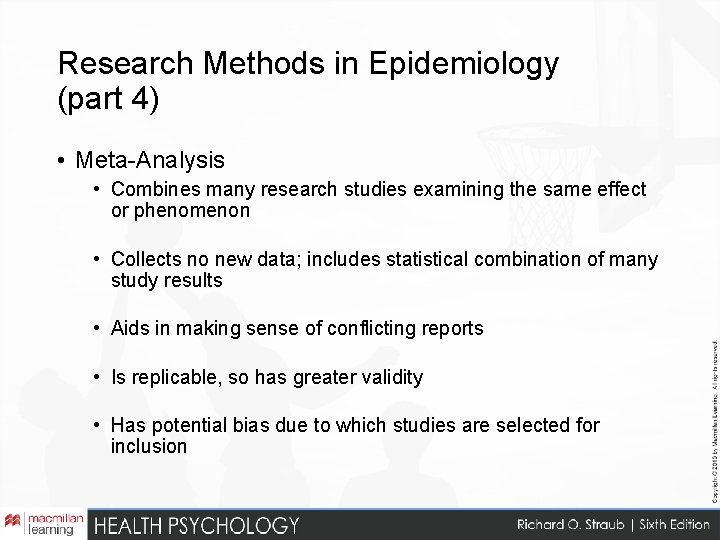
Research Methods in Epidemiology (part 4) • Meta-Analysis • Combines many research studies examining the same effect or phenomenon • Collects no new data; includes statistical combination of many study results • Aids in making sense of conflicting reports • Is replicable, so has greater validity • Has potential bias due to which studies are selected for inclusion
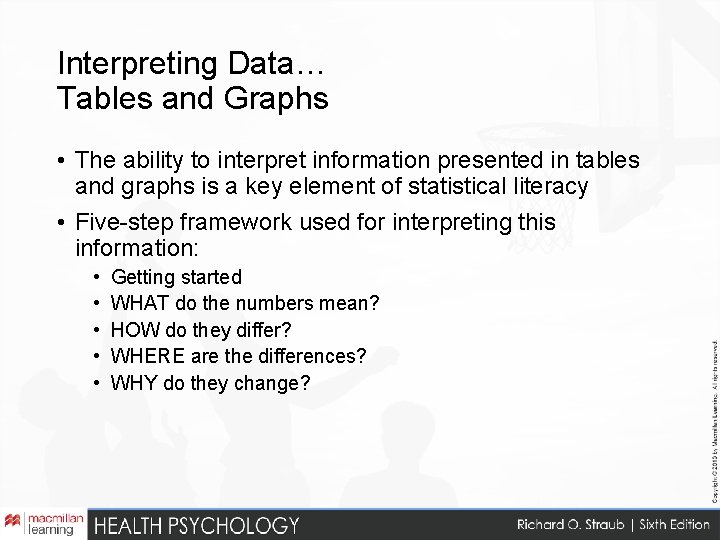
Interpreting Data… Tables and Graphs • The ability to interpret information presented in tables and graphs is a key element of statistical literacy • Five-step framework used for interpreting this information: • • • Getting started WHAT do the numbers mean? HOW do they differ? WHERE are the differences? WHY do they change?
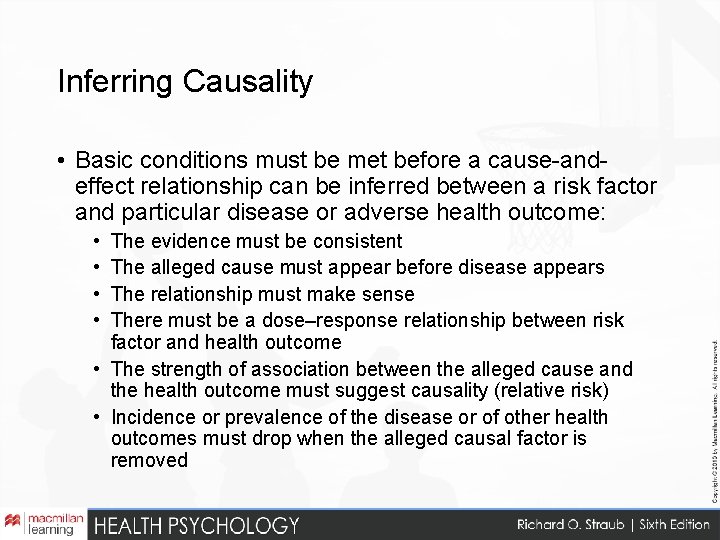
Inferring Causality • Basic conditions must be met before a cause-andeffect relationship can be inferred between a risk factor and particular disease or adverse health outcome: • • The evidence must be consistent The alleged cause must appear before disease appears The relationship must make sense There must be a dose–response relationship between risk factor and health outcome • The strength of association between the alleged cause and the health outcome must suggest causality (relative risk) • Incidence or prevalence of the disease or of other health outcomes must drop when the alleged causal factor is removed
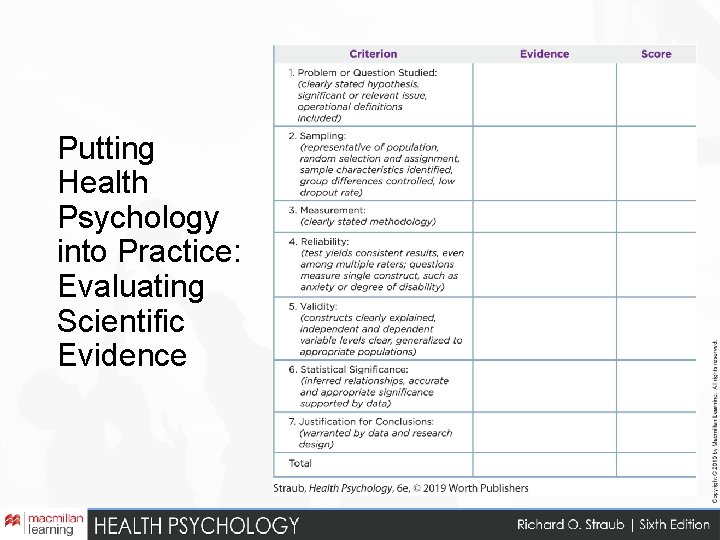
Putting Health Psychology into Practice: Evaluating Scientific Evidence
Research Methods in Epidemiology (part 5) • Qualitative Research • Focuses on qualities instead of quantities • Often uses participants’ expressed ideas as part of qualitative studies • May be combined with experimental methods to make investigations more comprehensive
Research Ethics and Scientific Misconduct • Responsible researchers ensure that participation is voluntary, harmless, and confidential • APA and National Science Foundation (NSF) have research guidelines to protect research participants • APA ethics code mandates informed consent, protection from harm, guarantee of confidentiality, and debriefing
Scientific Misconduct • Scientific misconduct is the violation of accepted codes of scholarship and ethical behavior in research • Fabrication • Falsification • Plagiarism • Reproducibility of results is the defining feature of the scientific method