
Research Hypotheses and Multiple Regression 2 Comparing model
- Slides: 13
Research Hypotheses and Multiple Regression: 2 • Comparing model performance across populations • Comparing model performance across criteria
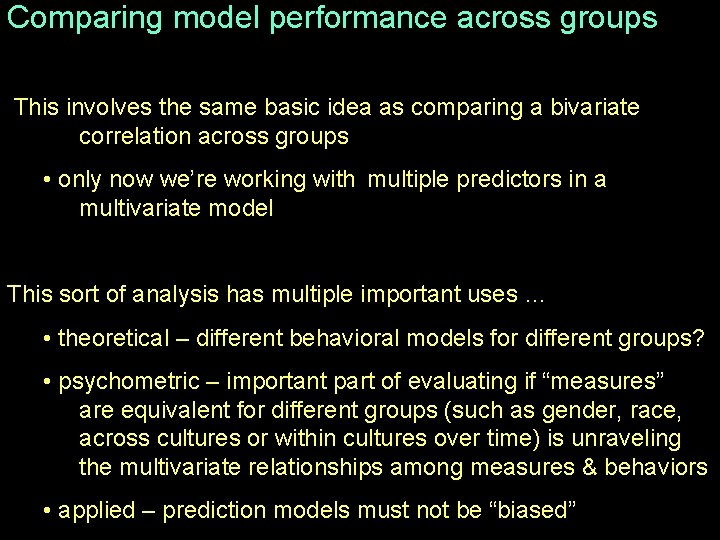
Comparing model performance across groups This involves the same basic idea as comparing a bivariate correlation across groups • only now we’re working with multiple predictors in a multivariate model This sort of analysis has multiple important uses … • theoretical – different behavioral models for different groups? • psychometric – important part of evaluating if “measures” are equivalent for different groups (such as gender, race, across cultures or within cultures over time) is unraveling the multivariate relationships among measures & behaviors • applied – prediction models must not be “biased”
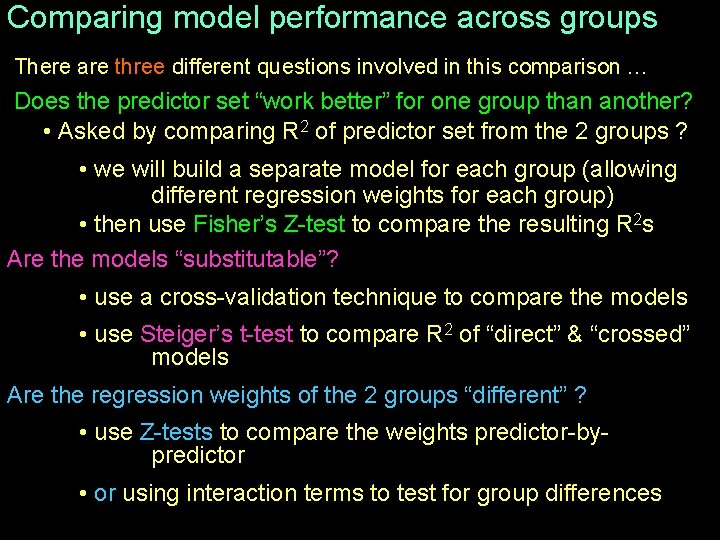
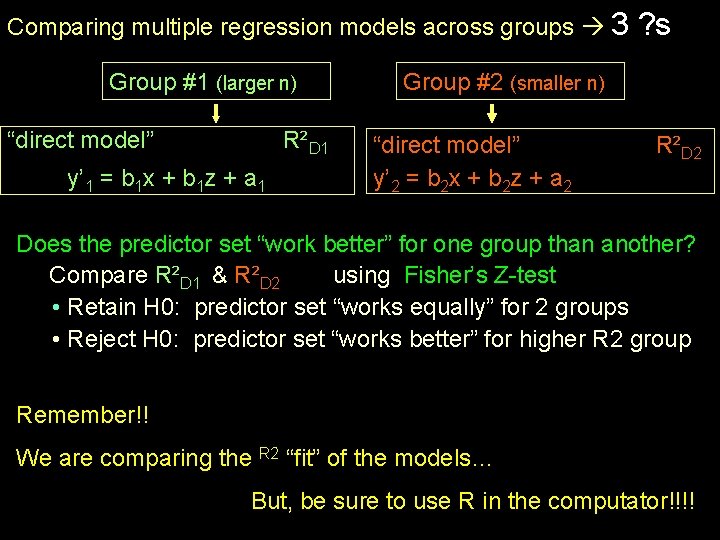
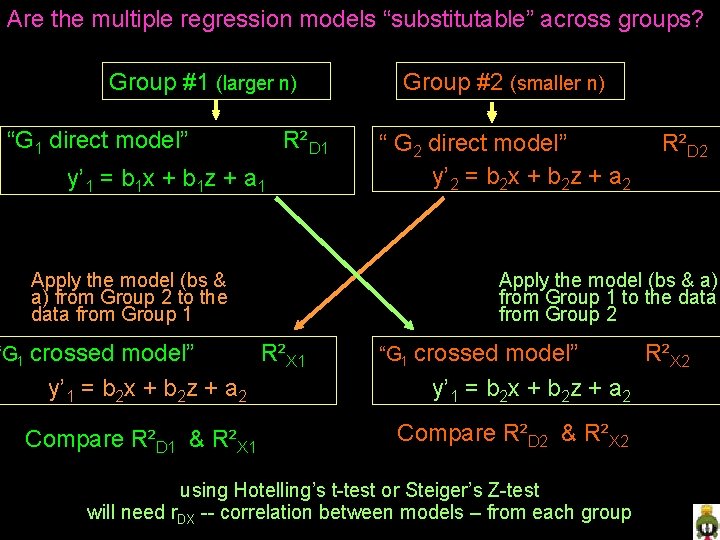
Comparing model performance across groups There are three different questions involved in this comparison … Does the predictor set “work better” for one group than another? • Asked by comparing R 2 of predictor set from the 2 groups ? • we will build a separate model for each group (allowing different regression weights for each group) • then use Fisher’s Z-test to compare the resulting R 2 s Are the models “substitutable”? • use a cross-validation technique to compare the models • use Steiger’s t-test to compare R 2 of “direct” & “crossed” models Are the regression weights of the 2 groups “different” ? • use Z-tests to compare the weights predictor-bypredictor • or using interaction terms to test for group differences
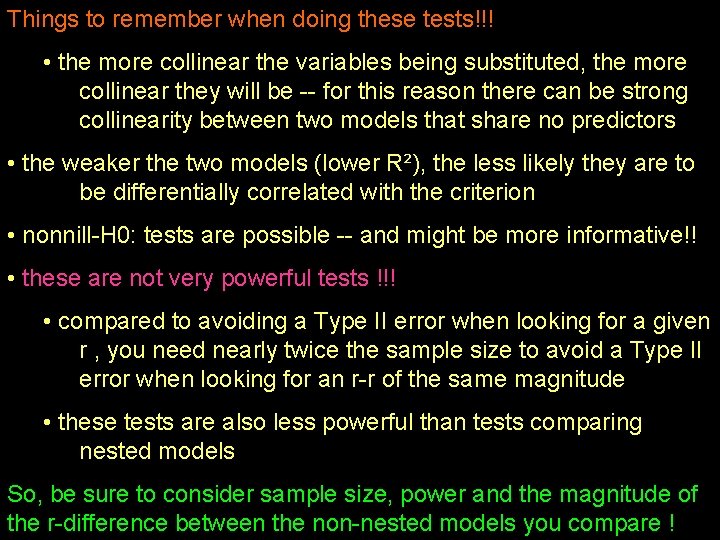
Things to remember when doing these tests!!! • the more collinear the variables being substituted, the more collinear they will be -- for this reason there can be strong collinearity between two models that share no predictors • the weaker the two models (lower R²), the less likely they are to be differentially correlated with the criterion • nonnill-H 0: tests are possible -- and might be more informative!! • these are not very powerful tests !!! • compared to avoiding a Type II error when looking for a given r , you need nearly twice the sample size to avoid a Type II error when looking for an r-r of the same magnitude • these tests are also less powerful than tests comparing nested models So, be sure to consider sample size, power and the magnitude of the r-difference between the non-nested models you compare !
Comparing multiple regression models across groups 3 Group #1 (larger n) “direct model” R²D 1 y’ 1 = b 1 x + b 1 z + a 1 ? s Group #2 (smaller n) “direct model” y’ 2 = b 2 x + b 2 z + a 2 R²D 2 Does the predictor set “work better” for one group than another? Compare R²D 1 & R²D 2 using Fisher’s Z-test • Retain H 0: predictor set “works equally” for 2 groups • Reject H 0: predictor set “works better” for higher R 2 group Remember!! We are comparing the R 2 “fit” of the models… But, be sure to use R in the computator!!!!
Are the multiple regression models “substitutable” across groups? Group #1 (larger n) “G 1 direct model” R²D 1 y’ 1 = b 1 x + b 1 z + a 1 Group #2 (smaller n) “ G 2 direct model” y’ 2 = b 2 x + b 2 z + a 2 Apply the model (bs & a) from Group 2 to the data from Group 1 “G 1 crossed model” R²X 1 y’ 1 = b 2 x + b 2 z + a 2 Compare R²D 1 & R²X 1 R²D 2 Apply the model (bs & a) from Group 1 to the data from Group 2 “G 1 crossed model” R²X 2 y’ 1 = b 2 x + b 2 z + a 2 Compare R²D 2 & R²X 2 using Hotelling’s t-test or Steiger’s Z-test will need r. DX -- correlation between models – from each group
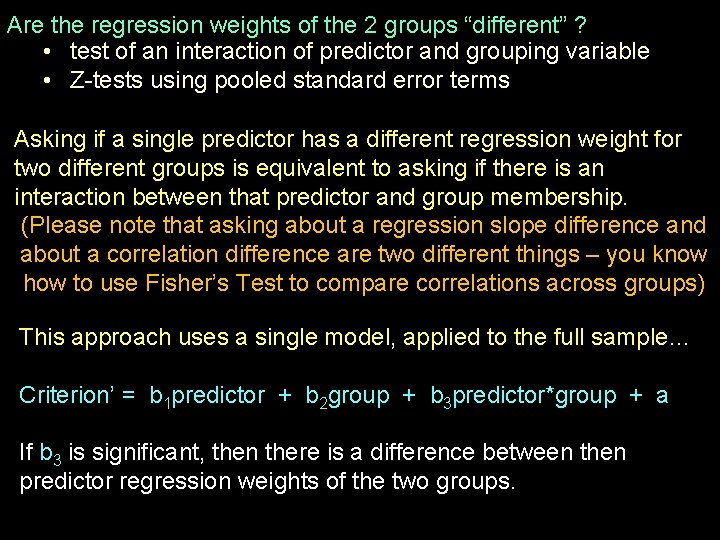
Are the regression weights of the 2 groups “different” ? • test of an interaction of predictor and grouping variable • Z-tests using pooled standard error terms Asking if a single predictor has a different regression weight for two different groups is equivalent to asking if there is an interaction between that predictor and group membership. (Please note that asking about a regression slope difference and about a correlation difference are two different things – you know how to use Fisher’s Test to compare correlations across groups) This approach uses a single model, applied to the full sample… Criterion’ = b 1 predictor + b 2 group + b 3 predictor*group + a If b 3 is significant, then there is a difference between then predictor regression weights of the two groups.
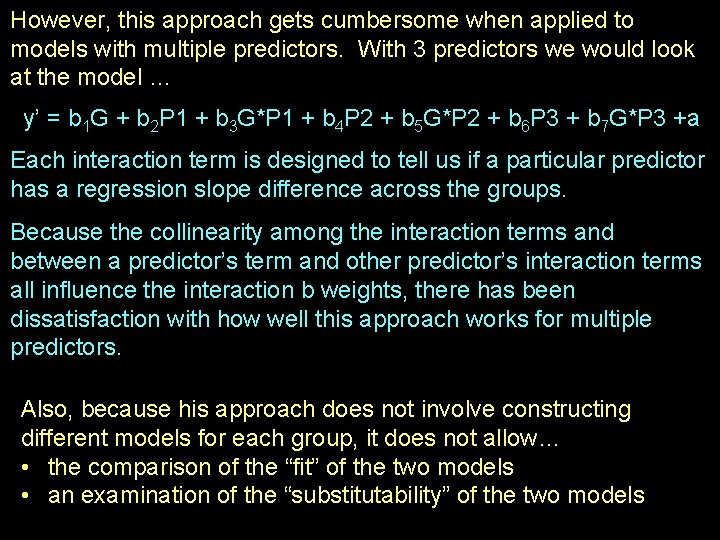
However, this approach gets cumbersome when applied to models with multiple predictors. With 3 predictors we would look at the model … y’ = b 1 G + b 2 P 1 + b 3 G*P 1 + b 4 P 2 + b 5 G*P 2 + b 6 P 3 + b 7 G*P 3 +a Each interaction term is designed to tell us if a particular predictor has a regression slope difference across the groups. Because the collinearity among the interaction terms and between a predictor’s term and other predictor’s interaction terms all influence the interaction b weights, there has been dissatisfaction with how well this approach works for multiple predictors. Also, because his approach does not involve constructing different models for each group, it does not allow… • the comparison of the “fit” of the two models • an examination of the “substitutability” of the two models
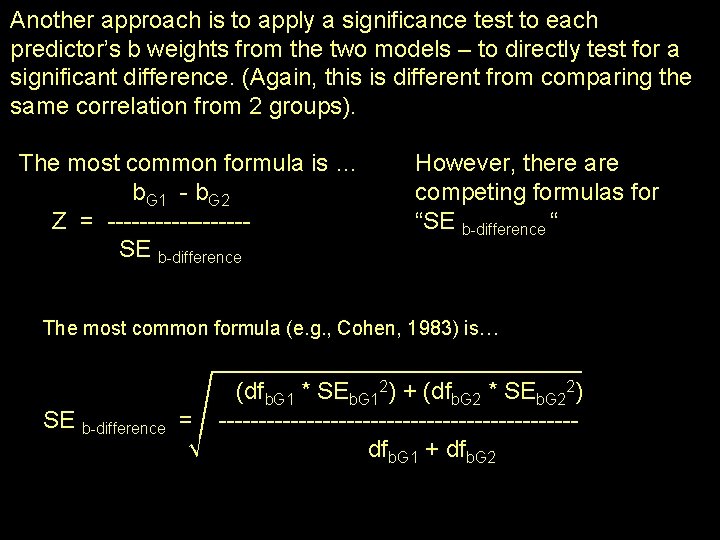
Another approach is to apply a significance test to each predictor’s b weights from the two models – to directly test for a significant difference. (Again, this is different from comparing the same correlation from 2 groups). The most common formula is … b. G 1 - b. G 2 Z = ---------SE b-difference However, there are competing formulas for “SE b-difference “ The most common formula (e. g. , Cohen, 1983) is… SE b-difference (dfb. G 1 * SEb. G 12) + (dfb. G 2 * SEb. G 22) = ----------------------√ df b. G 1 + dfb. G 2
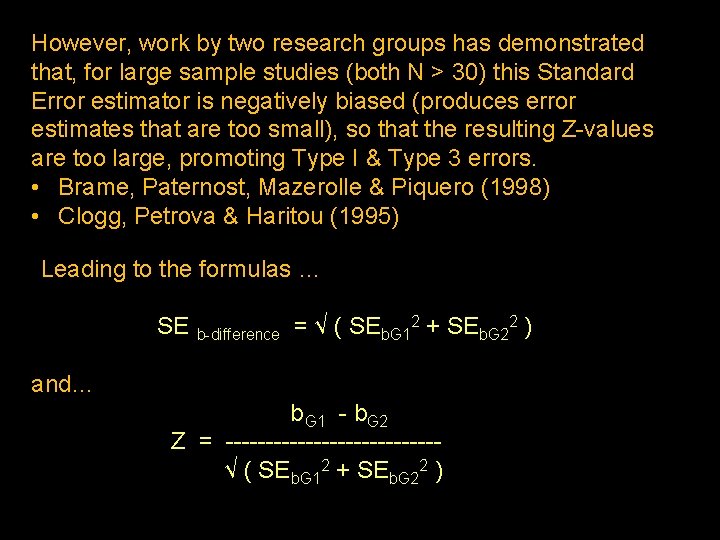
However, work by two research groups has demonstrated that, for large sample studies (both N > 30) this Standard Error estimator is negatively biased (produces error estimates that are too small), so that the resulting Z-values are too large, promoting Type I & Type 3 errors. • Brame, Paternost, Mazerolle & Piquero (1998) • Clogg, Petrova & Haritou (1995) Leading to the formulas … SE b-difference = √ ( SEb. G 12 + SEb. G 22 ) and… b G 1 - b. G 2 Z = -------------√ ( SEb. G 12 + SEb. G 22 )
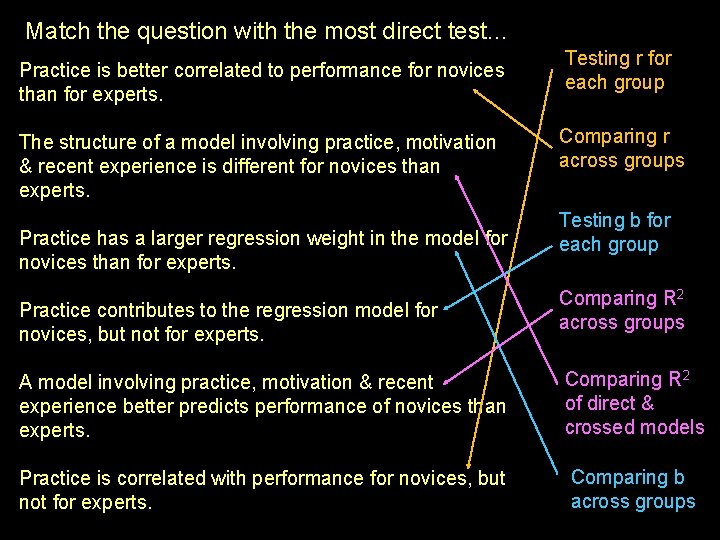
Match the question with the most direct test… Practice is better correlated to performance for novices than for experts. The structure of a model involving practice, motivation & recent experience is different for novices than experts. Practice has a larger regression weight in the model for novices than for experts. Practice contributes to the regression model for novices, but not for experts. Testing r for each group Comparing r across groups Testing b for each group Comparing R 2 across groups A model involving practice, motivation & recent experience better predicts performance of novices than experts. Comparing R 2 of direct & crossed models Practice is correlated with performance for novices, but not for experts. Comparing b across groups
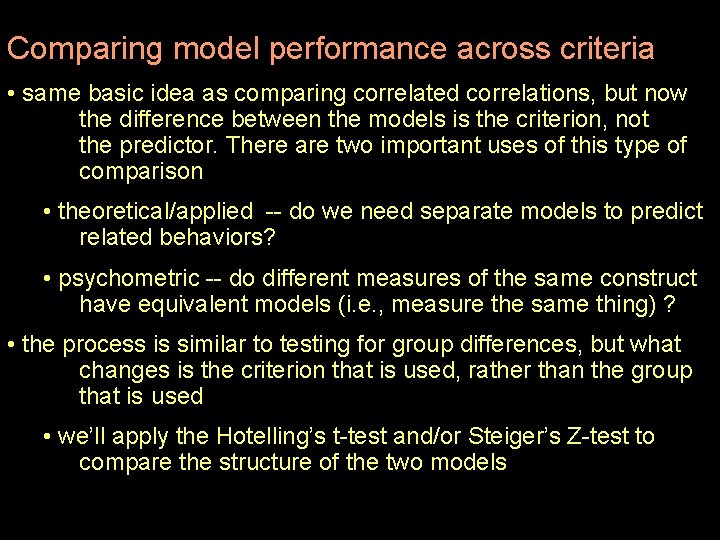
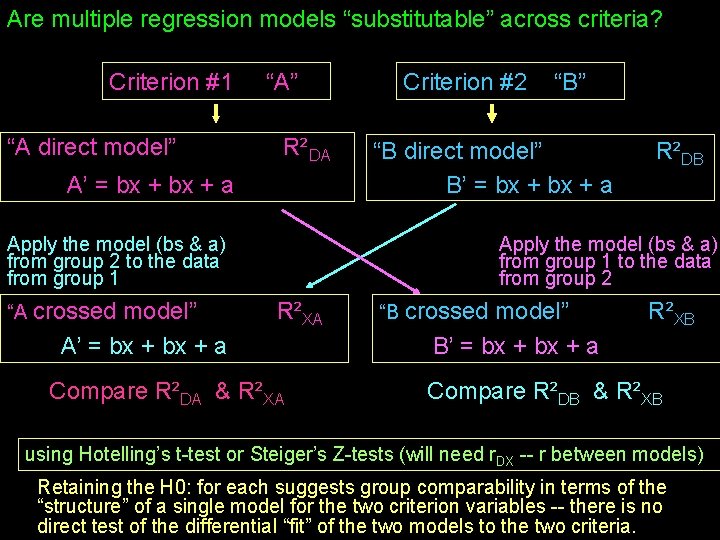
Comparing model performance across criteria • same basic idea as comparing correlated correlations, but now the difference between the models is the criterion, not the predictor. There are two important uses of this type of comparison • theoretical/applied -- do we need separate models to predict related behaviors? • psychometric -- do different measures of the same construct have equivalent models (i. e. , measure the same thing) ? • the process is similar to testing for group differences, but what changes is the criterion that is used, rather than the group that is used • we’ll apply the Hotelling’s t-test and/or Steiger’s Z-test to compare the structure of the two models
Are multiple regression models “substitutable” across criteria? Criterion #1 “A direct model” “A” R²DA A’ = bx + a Criterion #2 “B direct model” B’ = bx + a Apply the model (bs & a) from group 2 to the data from group 1 “A crossed model” A’ = bx + a “B” R²DB Apply the model (bs & a) from group 1 to the data from group 2 R²XA Compare R²DA & R²XA “B crossed model” B’ = bx + a R²XB Compare R²DB & R²XB using Hotelling’s t-test or Steiger’s Z-tests (will need r. DX -- r between models) Retaining the H 0: for each suggests group comparability in terms of the “structure” of a single model for the two criterion variables -- there is no direct test of the differential “fit” of the two models to the two criteria.