
Research framework Research Design Constitute the blueprint for
Research framework
Research Design • Constitute the blueprint for the collection, measurement, and analysis of data • Aid the scientist in the allocation of his limited resources • Conclude an outline of what the investigator will do from writing hypotheses and their operational implications to the final analysis of data
Research Design • The design is a plan for selecting the sources and types of information used to answer the research question • It is a framework for specifying the relationships among the study’s variables • It is a blueprint that outlines each procedure from the hypotheses to the analysis of data --Cooper & Schindler
Classification of Research Design • Degree of Problem crystallization – Exploratory studies – Formal studies • Method of data collection – Observational studies – Survey • Research control of variables – Experiment – Ex post facto design • The purpose of the study – Descriptive study – Causal study
Classification of Research Design • The Time Dimension – Cross-sectional – Longitudinal • The topical scope – Statistical studies – Case studies • The research environment – Field – Laboratory – Simulations • Subject perceptions
Exploratory Studies • • Qualitative techniques Secondary data analysis Experience survey Focus group
Focus Group • • • Traditional focus group Telephone focus group Online focus group Videoconferencing focus group Recording analysis and reporting
Research Designs • Exploratory studies – Secondary data analysis – Experience Survey – Focus group – Two-stage design • Descriptive studies • Causal Studies
The Concept of Cause • The essential element of causation is that A “produces” B or A “forces” B to occur • Empirically, we can never demonstrate an A -B causality with certainty • Mill’s Canons – Method of agreement – Method of difference – Negative Canon of agreement
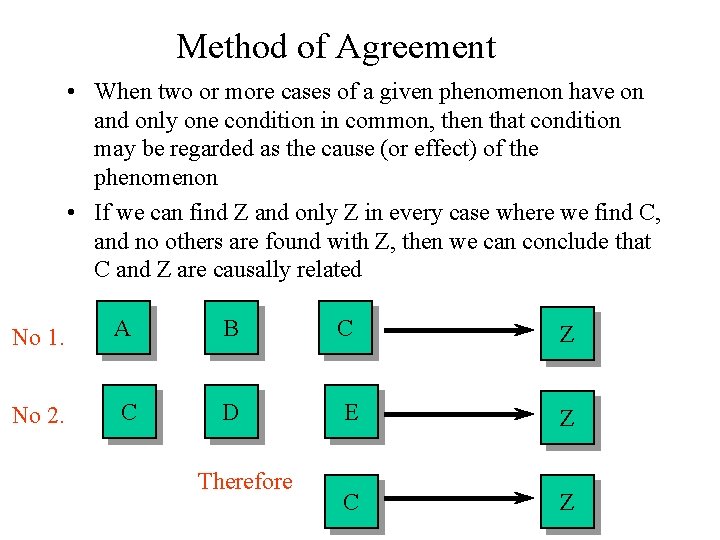
Method of Agreement • When two or more cases of a given phenomenon have on and only one condition in common, then that condition may be regarded as the cause (or effect) of the phenomenon • If we can find Z and only Z in every case where we find C, and no others are found with Z, then we can conclude that C and Z are causally related No 1. A B C Z No 2. C D E Z C Z Therefore
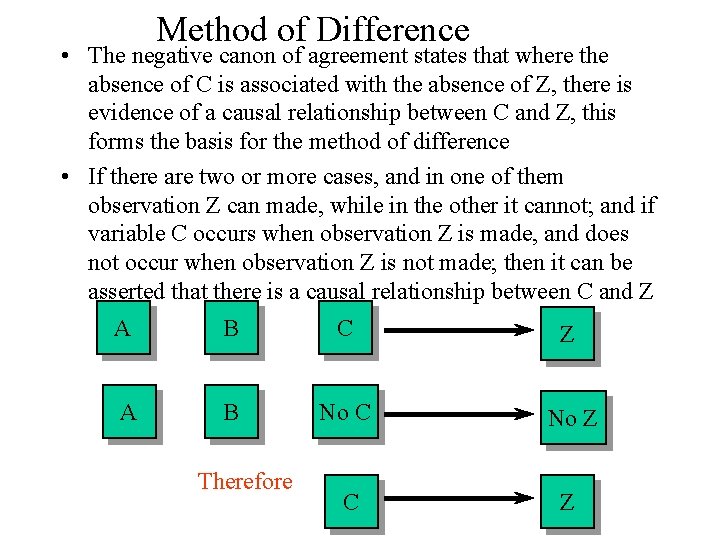
Method of Difference • The negative canon of agreement states that where the absence of C is associated with the absence of Z, there is evidence of a causal relationship between C and Z, this forms the basis for the method of difference • If there are two or more cases, and in one of them observation Z can made, while in the other it cannot; and if variable C occurs when observation Z is made, and does not occur when observation Z is not made; then it can be asserted that there is a causal relationship between C and Z A B C Z A B No C No Z C Z Therefore
Types of Business Research • Exploratory Study • Descriptive Research • Causal Research
Exploratory Research • Be Conducted to clarify ambiguous problems • Be conducted with the expectation that subsequent research will be require to provide conclusive evidence • Example – Child-care program
Descriptive Research • To describe characteristics of a population or phenomenon • To determine the answers to who, what, where, and how questions • Give no explanation for the cause of the findings • Examples – A university placement center may want to determine if its facilities and services are adequate – To describe the market potential of personal photocopying machines
Causal Research • To identify cause-and-effect relationships among variables • To establish that one event is the means for producing another event • A causal relationship is impossible to prove – Nevertheless, researchers seek certain types of evidence to help them understand predict relationships
Conditions for Inferring Causality • Establish the appropriate causal order or sequence of events • Measure the concomitant variation between the presumed cause and the presumed effect • Recognize the presence or absence of alternative plausible explanations or causal factors
Examples for Exploratory Research • Absenteeism is increasing and we don’t know why • Would people be interested in our newproduct idea? • What task conditions influence the leadership process in our organization?
Examples for Descriptive Research • What kind of people favor trade protectionism? • Did last year’s product recall have an impact on our company’s stock price? • Has the average merger rate for savings and loans increased in the past decade?
Examples for Causal Research • Which of two training program is more effective? • Can I predict the value of energy stocks if I know the current dividends and growth rate of dividends? • Will buyers purchase more of our product in a new package?
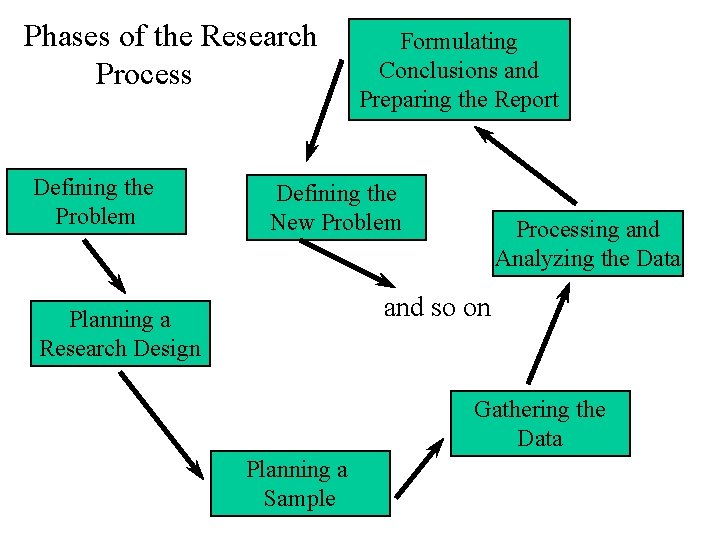
Phases of the Research Process Defining the Problem Formulating Conclusions and Preparing the Report Defining the New Problem Processing and Analyzing the Data and so on Planning a Research Design Gathering the Data Planning a Sample
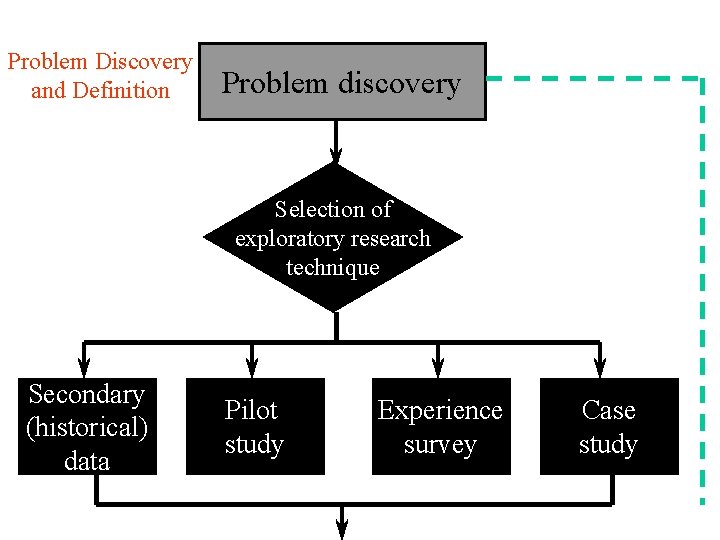
Problem Discovery and Definition Problem discovery Selection of exploratory research technique Secondary (historical) data Pilot study Experience survey Case study
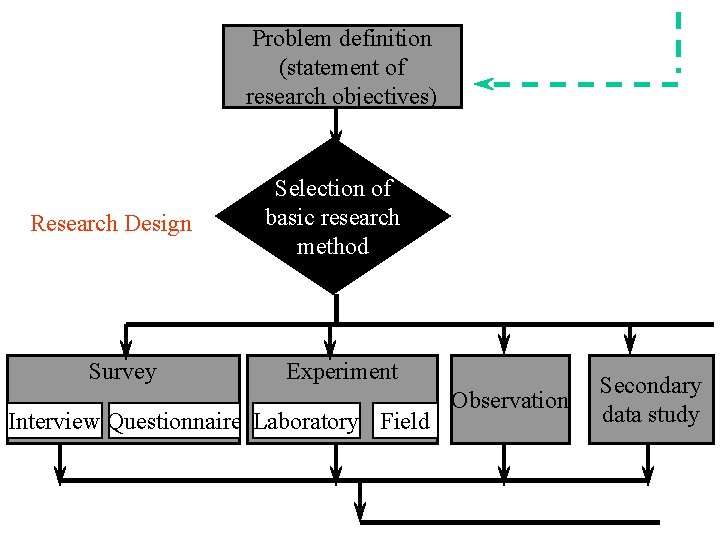
Problem definition (statement of research objectives) Research Design Survey Selection of basic research method Experiment Interview Questionnaire Laboratory Field Observation Secondary data study
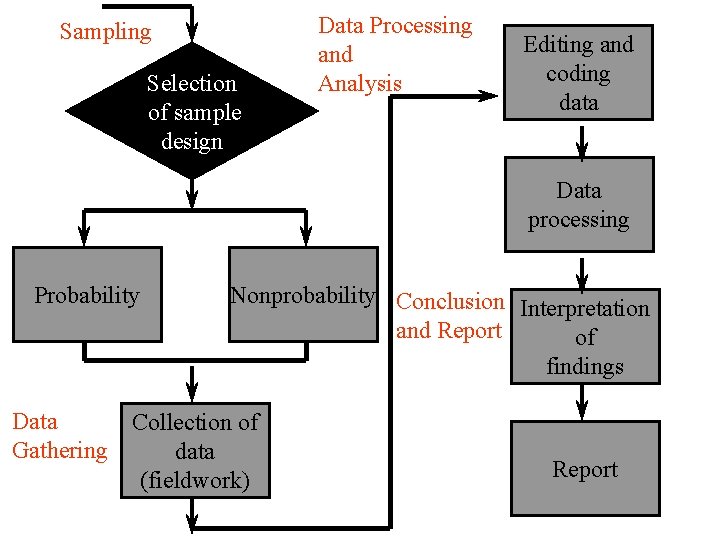
Sampling Selection of sample design Data Processing and Analysis Editing and coding data Data processing Probability Data Gathering Nonprobability Conclusion Interpretation and Report of findings Collection of data (fieldwork) Report
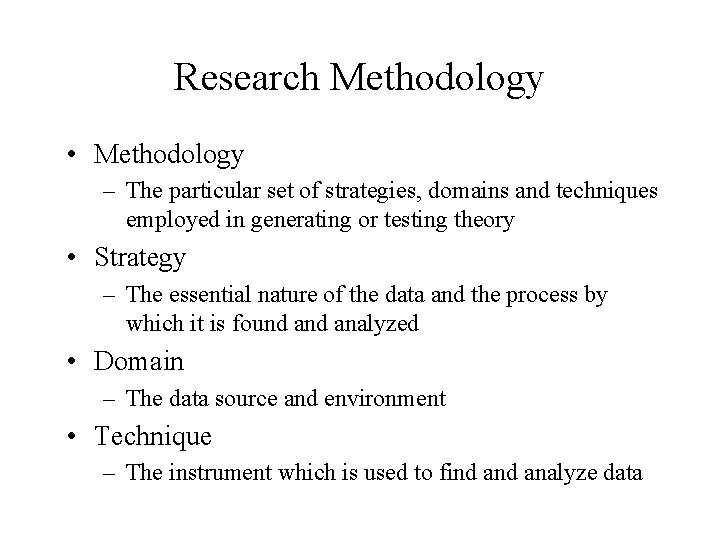
Research Methodology • Methodology – The particular set of strategies, domains and techniques employed in generating or testing theory • Strategy – The essential nature of the data and the process by which it is found analyzed • Domain – The data source and environment • Technique – The instrument which is used to find analyze data
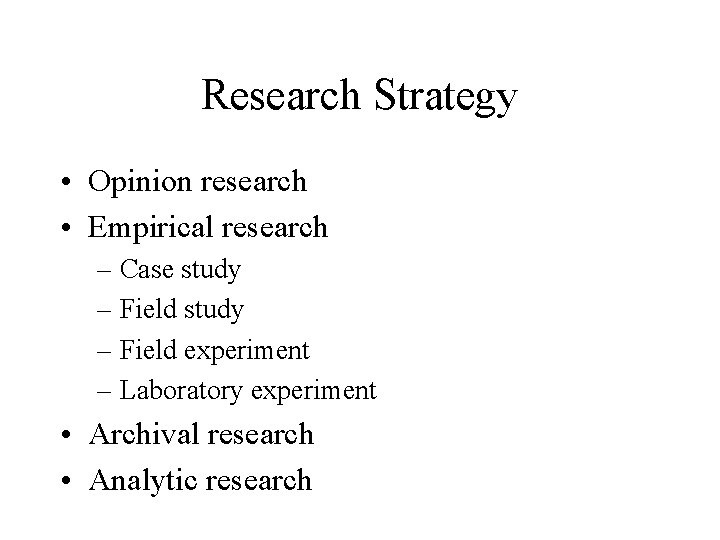
Research Strategy • Opinion research • Empirical research – Case study – Field experiment – Laboratory experiment • Archival research • Analytic research
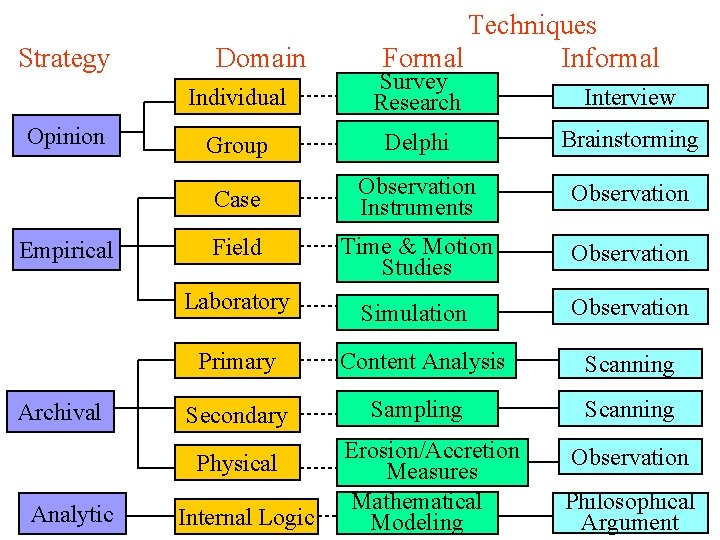
Strategy Opinion Empirical Archival Domain Individual Survey Research Interview Group Delphi Brainstorming Case Observation Instruments Observation Field Time & Motion Studies Observation Laboratory Simulation Observation Primary Content Analysis Scanning Secondary Sampling Scanning Physical Analytic Techniques Formal Informal Internal Logic Erosion/Accretion Measures Mathematical Modeling Observation Philosophical Argument
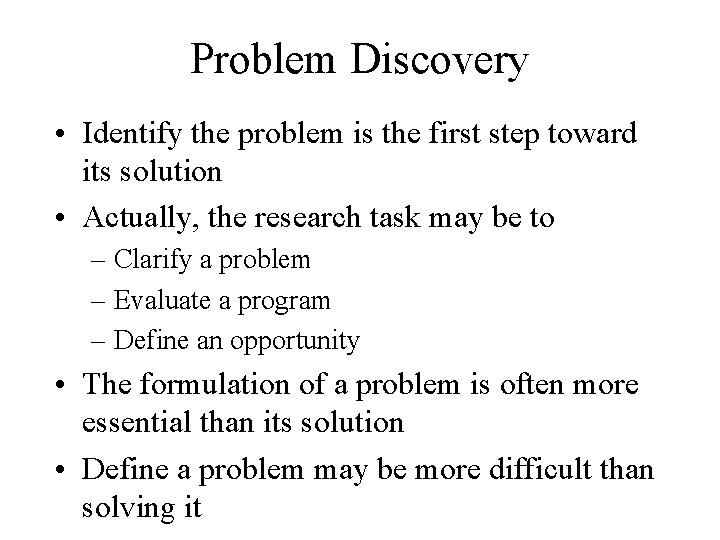
Problem Discovery • Identify the problem is the first step toward its solution • Actually, the research task may be to – Clarify a problem – Evaluate a program – Define an opportunity • The formulation of a problem is often more essential than its solution • Define a problem may be more difficult than solving it
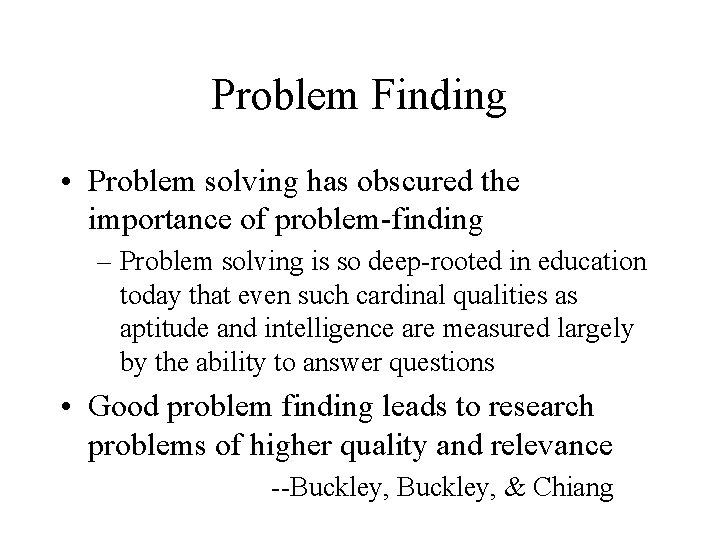
Problem Finding • Problem solving has obscured the importance of problem-finding – Problem solving is so deep-rooted in education today that even such cardinal qualities as aptitude and intelligence are measured largely by the ability to answer questions • Good problem finding leads to research problems of higher quality and relevance --Buckley, & Chiang
Mario Bunge, in seeking to reawaken our interest in Problem-finding, makes these cogent observations: The best criterion for finding out whether a discipline is still alive is to ascertain whether it still poses new problems the solutions to which would presumably add to our knowledge. . . . Similarly, the peculiar mark that distinguishes original investigators from everyone else is the capacity for finding, inventing, and handling new problems. No new problem can be raised within the framework of a dead doctrine: this requires commentators but no research workers, i. e. , investigators who can advance the subject. There can be nothing to advance if the problems concerned are pronounced solved. Untouchable solutions and unapproachable problems set a limit to scientific inquiry. . . Human progress depends more and more on problem-seekers and a free society in which the posing of problems of every kind and research into them find no limits other than those of the state of knowledge. --Buckley, Buckley & Chiang
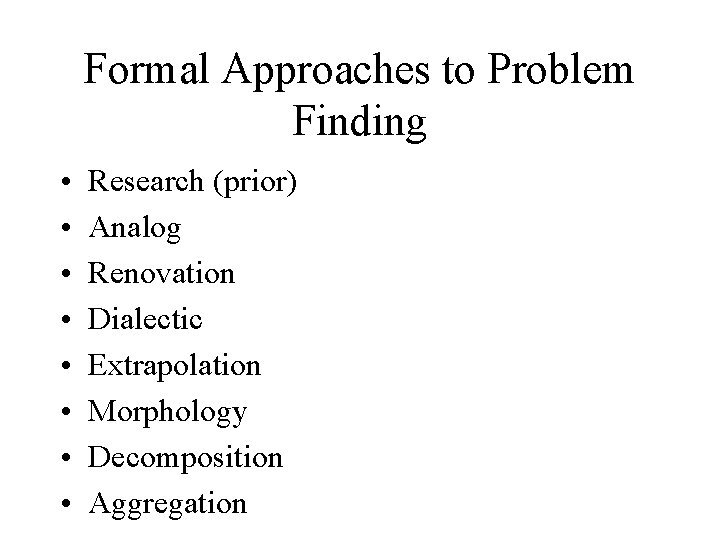
Formal Approaches to Problem Finding • • Research (prior) Analog Renovation Dialectic Extrapolation Morphology Decomposition Aggregation
Informal Approaches to Problem Finding • • Conjecture Phenomenology Consensus Experiential
Prior Research • Inductive – Consist of fact-finding which leads to the generation of theory – Result in hypotheses which lend themselves to testing through deduction • Deductive – Refer to the testing of theory – Point to the need for detailed inquiry into certain aspects of a problem • Example – Top management relies on informal and summarized information
Analog • Use knowledge gain in one problem-area to formulate a research question with regard to a related area – Require the two systems under consideration be comparable in all essential respects • Examples – Human resource accounting –R&D – Advertising
Renovation • Renovation is used to replace defective components with a view to restoring or improving the effectiveness of a theory • Require training in structural analysis • Example – Auditing – EDP auditing
Dialectic • Consist of developing counter-plans for the purpose of challenging, refining, or deposing of existing or proposed theories • “Is there a better method? ” is the question which typically underlies the dialectic approach • The technique is used extensively in medicine where the positive and contraindications of a medication are analyzed and reported
Extrapolation • Consist of extending current trends into the future and posing questions relative to the predicted outcome • The method may use econometric models or rely on more subjective analysis
Morphology • A formal method for analyzing the combinatorial possibilities inherent in complex systems • The method is of value in identifying the totality of alternatives inherent in a given problem area • Judgment must be exercised in recognizing those alternatives which are most promising so as to gear research effort in those directions
Decomposition • Consist of breaking a problem down into its component parts • “Dichotomy” is a common mathematical technique which is used in the decomposition of complex problems – It consist of breaking down a problem into a series of questions which can be answered by yes or no
Aggregation • It can be used take research findings or theories from discrete areas and apply them toward the definition or resolution of more complex systems • Example – Can input-output analysis, utility theory, and motivational theory be applied simultaneously to the problem of measuring managerial performance?
Problem Definition • A problem well defined is a problem half solved • Allow the researcher to set the proper research objectives, . • Example – Ha-Psu-Shu-Tse • American Indian food product
Characteristics of A Research Problem • The problem is defined properly, is labeled and described accurately • The problem is posed in solvable terms • The problem is connected logically to the environment from which it is drawn-- and the solution can be applied within that environment • The problem has been screened against the existing body of knowledge to assure its uniqueness, I. e. , it has not been solved previously • The solution to the problem must be view as making a potential contribution to the body of knowledge, i. e. , the problem must be significant
Exploratory Research • Experience survey – A technique in which individuals who are knowledgeable about a particular research problem are surveyed • Secondary data analysis – Preliminary review of data collected for another purpose to clarify issues in the early stages of a research effort
Exploratory Research • Case study method – A techniques that intensively investigates one or a few situations similar to the researcher’s problem situation • Pilot studies – A collective term used to describe any smallscale exploratory research technique that uses sampling, but does not apply rigorous standards
Exploratory Research Design • • Survey Experiment Secondary Data Study Observation
Opinion Research (I) • If the researcher seeks the views, judgments or appraisals of other persons with respect to a research problem, he or she is engaged in opinion research • The researcher may resort to the opinions of persons as individuals or groups • There a variety of techniques appropriate to opinion research – Survey – Interview
Empirical Research (I) • The dictionary defines empirical as something which originates in or is based on observation or experience – The term used here conforms to this definition • The empirical strategy requires that the researcher observe and/or experience things for himself rather than through the mediation of others
Empirical Research (II) • In its broadest sense it has com to mean the use of “real-world” data in the application of research, and as such would apply to opinion or recorded data which purports to be of real-world origin – This usage fails to distinguish between opinion and experience, between first and second-hand evidence, or between impression and reality • We favor a stricter construction of the term
Empirical Research (III) • Observation and experience – These terms require the researcher to enter the arena of action, to either experience the phenomena for himself or to be an eye-witness to the events which take place – Occur in one of the following domain • Case • Field • Laboratory – These domains are differentiated in terms of the criteria of experimental design and control • The former refers to the presence of formal a priori hypotheses and research procedures • The latter refers to the ability to isolate and manipulate variables in a specified way, in order to study the causal relationships among selected variables
Empirical Research (IV) • Case study – Has neither experimental design or control – No significant advance planning and not attempt to manipulate or structure the research setting • Field study – Has experimental design but not control – A researcher enters the field knowing what he is seeking and the manner in which he intends to collect and analyze his data. But no attempt is made to control the variables in the research environment • Laboratory study – Is accompanied by experimental design and control – Detailed planning precedes the experiment and there is a conscious effort to isolate and manipulate variable so as to study certain possible causal relationships
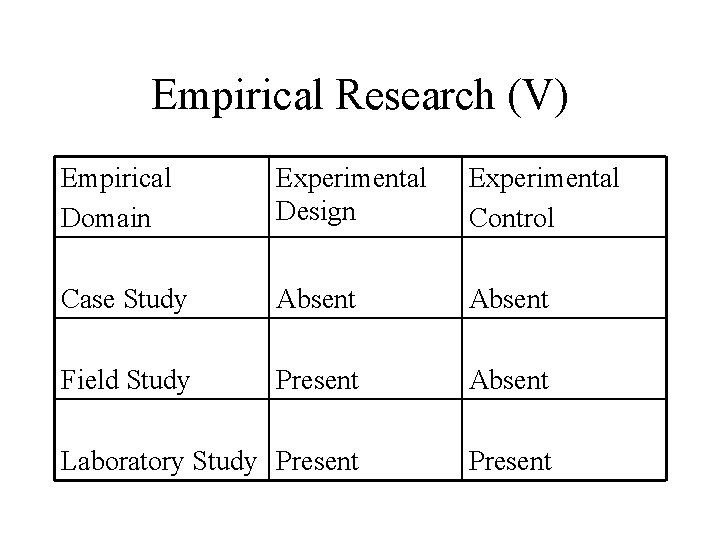
Empirical Research (V) Empirical Domain Experimental Design Experimental Control Case Study Absent Field Study Present Absent Laboratory Study Present
Empirical Research (VI) • The purpose of observation is to witness factual situations and perceive reality without intermediation – A highly-skilled individual who sees order in what appears to be a confused environment – He has the ability to separate the relevant from the irrelevant, to see causal relationships and to derive theories which are capable of further testing • Observation occurs in one of these four modes – – Participant Non-participant Obtrusive non-obtrusive
Archival Research • Is a place in which recorded facts are preserved • Concerned with the examination of recorded facts • Three domains – Primary – Secondary – Physical • Informal techniques – Scanning – Observation • Formal techniques – Content analysis
Analytic Research • Some problems are solved analytically by breaking the problem down into its component parts so as to discover its true nature and the causal relationships among its variable • Analytical research relies on the use of internal logic • Formal techniques – Mathematical logic , mathematical modeling, formal organization techniques (flowcharting, network analysis) • Informal techniques – The scenario, the dialectic
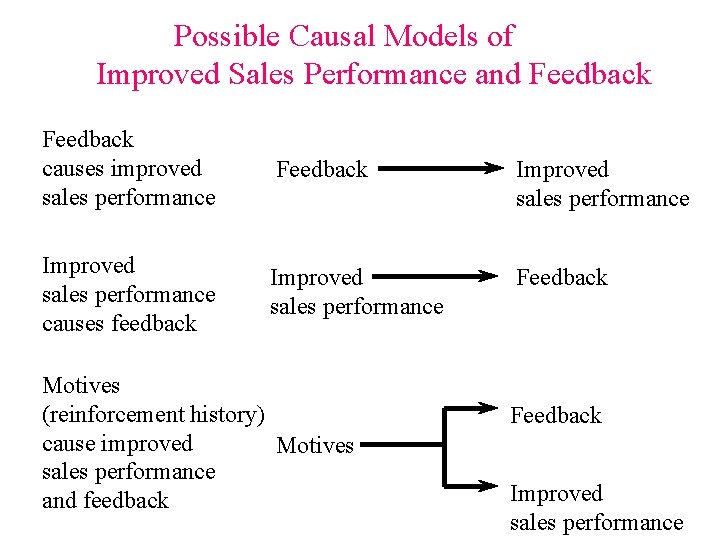
Possible Causal Models of Improved Sales Performance and Feedback causes improved sales performance Feedback Improved sales performance causes feedback Improved sales performance Feedback Motives (reinforcement history) cause improved Motives sales performance and feedback Feedback Improved sales performance
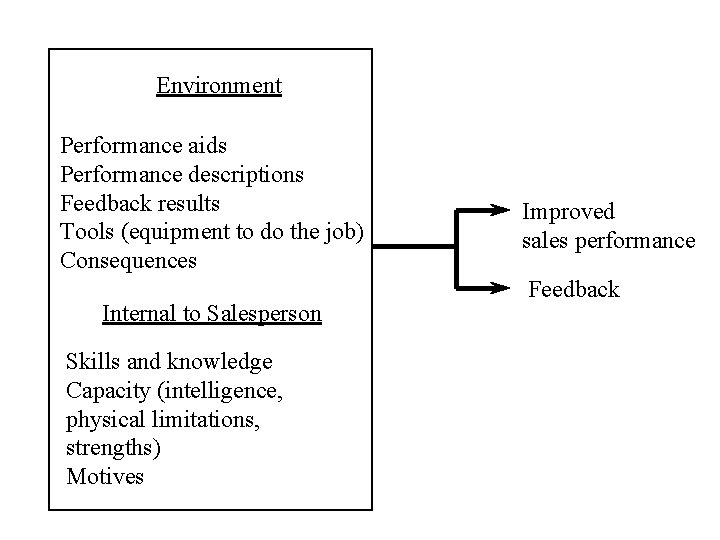
Environment Performance aids Performance descriptions Feedback results Tools (equipment to do the job) Consequences Internal to Salesperson Skills and knowledge Capacity (intelligence, physical limitations, strengths) Motives Improved sales performance Feedback
Causal Relationships • One variable affects, or is “responsible for, ” changes in another variable • Some external factor “produces” a change in the dependent variable • Relationships between variables – Symmetrical • Two variable fluctuate together • Assume the changes in neither variable are due to changes in the other – Reciprocal • Mutual influence or reinforce each other – Asymmetrical
Asymmetrical Relationships • The major relationships of interest to the research analysts • The identification of the IV and DV is often obvious, but sometimes the choice is not clear • In these cases we evaluate then on the basis of – The degree to which they may be altered – The time order between them
Types of Asymmetrical Relationships • Stimulus-responses relationships – Price rise-fewer unit sales – Work rules-higher level of worker output • Property-disposition relationships – Age-attitude about saving • Disposition-behavior relationships – Opinion about a brand its purchase • Property-behavior relationships – Age-sports participation
Testing Causal Hypotheses • Is there a predicted covariation between A and B? – When such conditions of covariation exist, it is an indication of a possible causal connection • Is the time order of events moving in the hypothesized direction? • Is it possible to eliminate other possible causes of B? – Can one determine that C, D, E, and so forth do not covary with B in a way that suggests possible causal connections?
Causation and Experimental Design • Successful inference making from experimental designs must meet two other requirements – Control – Random assignment – Example • To see whether the emotional or the rational appeal will draw the greater response • Matching – An approach to control – Age, major. . . • Matching and controlling are useful, but they do not account for all unknowns
Causation and Ex Post Facto Design • Study subjects who have been exposed to the independent factor and those who have not • Examples – Absenteeism on Mondays • Club member • Nonclub member • Some evidence of time order of events • Many other factors could be causing the high absenteeism among the club members – Age may a factor
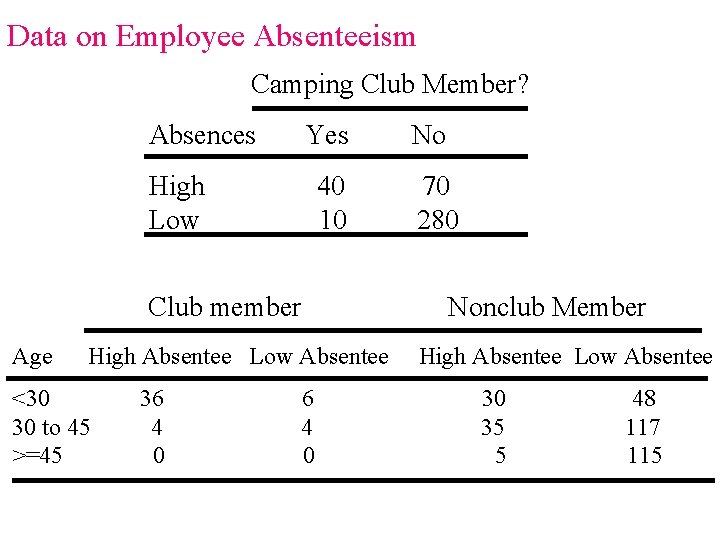
Data on Employee Absenteeism Camping Club Member? Absences Yes High Low 40 10 Club member Age High Absentee Low Absentee <30 30 to 45 >=45 36 4 0 No 70 280 Nonclub Member High Absentee Low Absentee 30 35 5 48 117 115
- Slides: 62