
Research Focus STM Systems Dependability of STM Performance
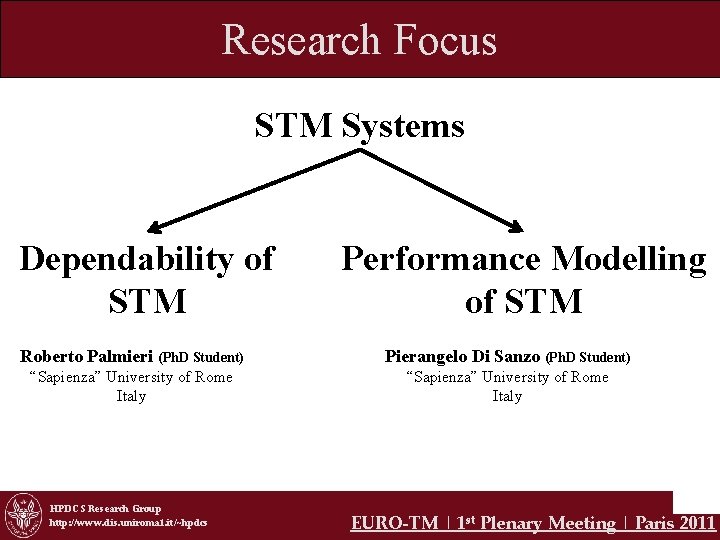
Research Focus STM Systems Dependability of STM Performance Modelling of STM Roberto Palmieri (Ph. D Student) Pierangelo Di Sanzo (Ph. D Student) “Sapienza” University of Rome Italy HPDCS Research Group http: //www. dis. uniroma 1. it/~hpdcs EURO-TM | 1 st Plenary Meeting | Paris 2011
Dependability Issues of STMs § In STM systems, manipulated data and related statements are not natively logged on stable storage § Data-audit loss in case of crashes § Periodic logging (check-pointing) could be employed, however with time-granularity not adequate to the properation grain REPLICATION HPDCS Research Group http: //www. dis. uniroma 1. it/~hpdcs EURO-TM | 1 st Plenary Meeting | Paris 2011
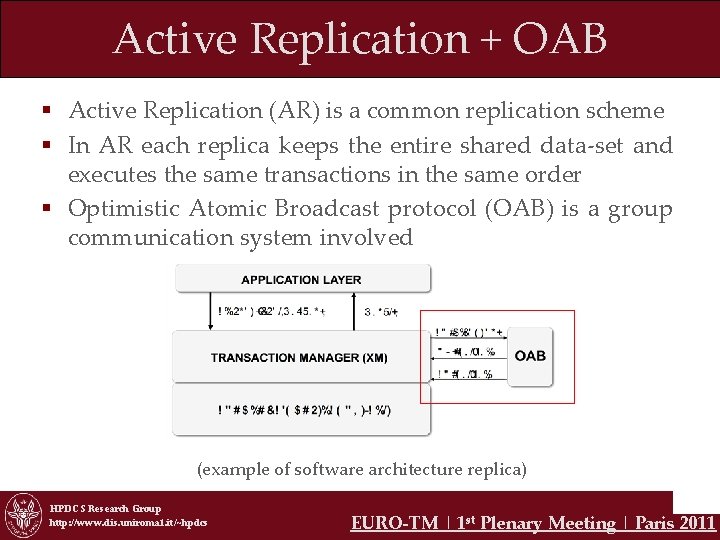
Active Replication + OAB § Active Replication (AR) is a common replication scheme § In AR each replica keeps the entire shared data-set and executes the same transactions in the same order § Optimistic Atomic Broadcast protocol (OAB) is a group communication system involved (example of software architecture replica) HPDCS Research Group http: //www. dis. uniroma 1. it/~hpdcs EURO-TM | 1 st Plenary Meeting | Paris 2011
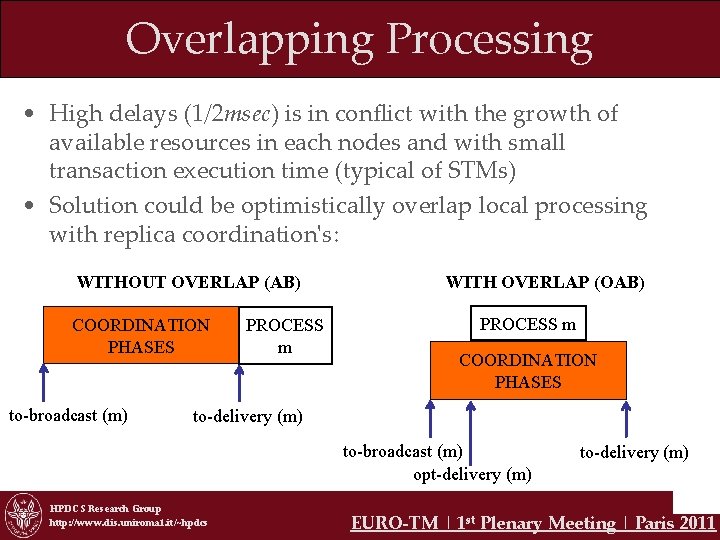
Overlapping Processing • High delays (1/2 msec) is in conflict with the growth of available resources in each nodes and with small transaction execution time (typical of STMs) • Solution could be optimistically overlap local processing with replica coordination's: WITHOUT OVERLAP (AB) COORDINATION PHASES to-broadcast (m) PROCESS m WITH OVERLAP (OAB) PROCESS m COORDINATION PHASES to-delivery (m) to-broadcast (m) opt-delivery (m) HPDCS Research Group http: //www. dis. uniroma 1. it/~hpdcs to-delivery (m) EURO-TM | 1 st Plenary Meeting | Paris 2011
STR FRAMEWORK § Speculative Transactional Replication Framework § Until the arrive of TO-Delivery, set of optimistically delivered (unordered) transactions could be processed in speculative way § Key Idea -> STR Framework on-line identifies all and only transaction serialization orders that would cause optimistically executed transactions to exhibit distinct outcomes. § Properties: Consistency, Non-redundancy, Completeness § Graph based Concurrency Control: § Speculative Polygraph HPDCS Research Group http: //www. dis. uniroma 1. it/~hpdcs EURO-TM | 1 st Plenary Meeting | Paris 2011
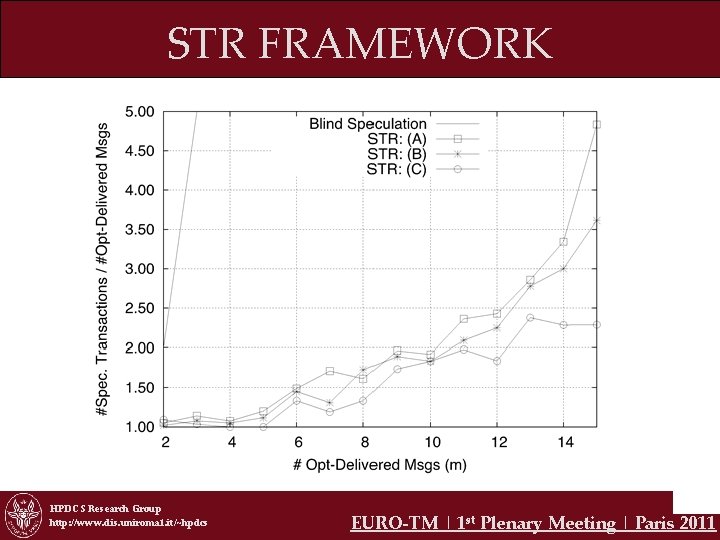
STR FRAMEWORK HPDCS Research Group http: //www. dis. uniroma 1. it/~hpdcs EURO-TM | 1 st Plenary Meeting | Paris 2011
AGGRO § AGGRessively Optimistic replication protocol § Tailored for network with spontaneous order (Opt-Delivery order matches TO-Delivery order) § Optimistic processing aimed to follow the optimistic delivery order § The key idea -> Uncommitted data item versions are aggressively made visible to other transactions independently of whether the creating transactions will be eventually committed § Transactions abort/retry materializing a history compliant with optimistic delivery order HPDCS Research Group http: //www. dis. uniroma 1. it/~hpdcs EURO-TM | 1 st Plenary Meeting | Paris 2011
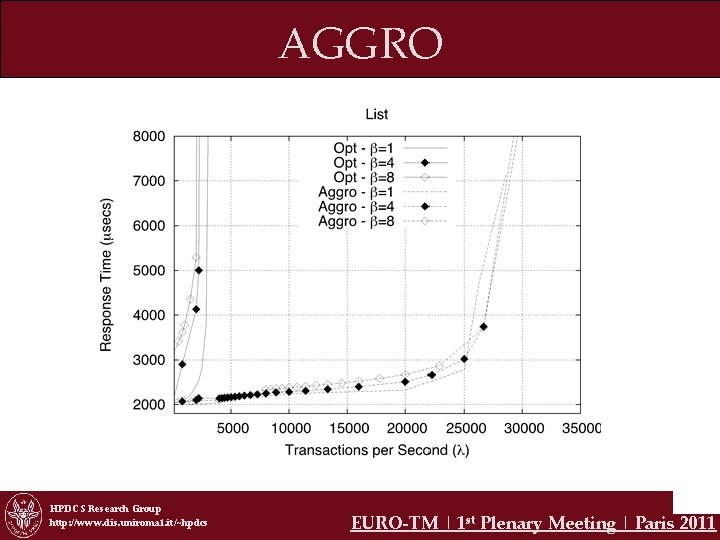
AGGRO HPDCS Research Group http: //www. dis. uniroma 1. it/~hpdcs EURO-TM | 1 st Plenary Meeting | Paris 2011
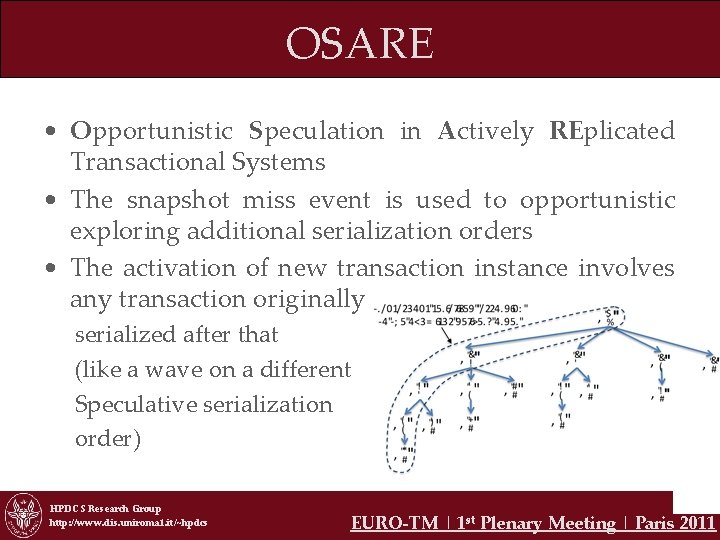
OSARE • Opportunistic Speculation in Actively REplicated Transactional Systems • The snapshot miss event is used to opportunistic exploring additional serialization orders • The activation of new transaction instance involves any transaction originally serialized after that (like a wave on a different Speculative serialization order) HPDCS Research Group http: //www. dis. uniroma 1. it/~hpdcs EURO-TM | 1 st Plenary Meeting | Paris 2011
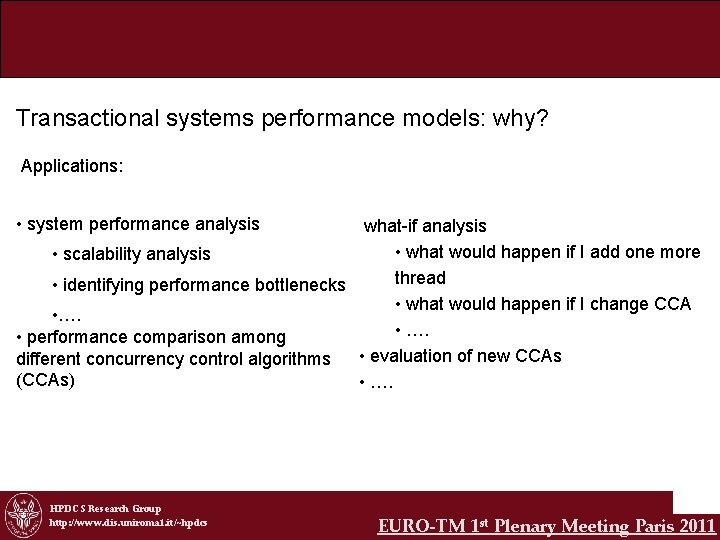
Transactional systems performance models: why? Applications: • system performance analysis what-if analysis • what would happen if I add one more • scalability analysis thread • identifying performance bottlenecks • what would happen if I change CCA • …. • performance comparison among • evaluation of new CCAs different concurrency control algorithms (CCAs) • …. HPDCS Research Group http: //www. dis. uniroma 1. it/~hpdcs EURO-TM 1 st Plenary Meeting Paris 2011
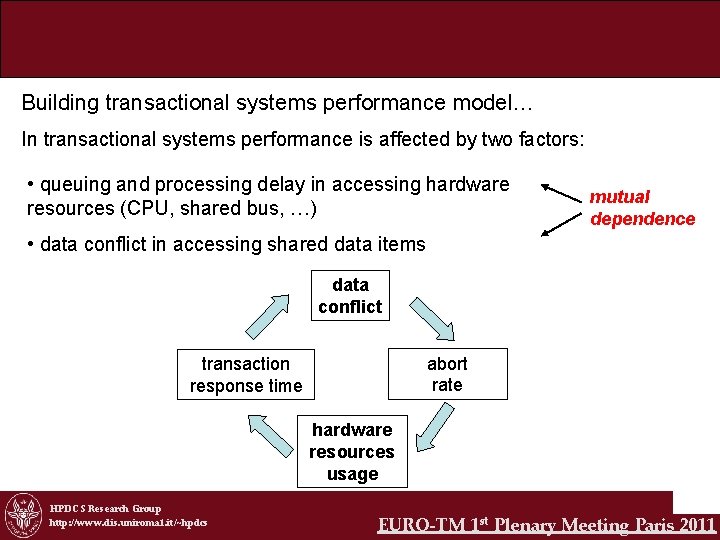
Building transactional systems performance model… In transactional systems performance is affected by two factors: • queuing and processing delay in accessing hardware resources (CPU, shared bus, …) mutual dependence • data conflict in accessing shared data items data conflict abort rate transaction response time hardware resources usage HPDCS Research Group http: //www. dis. uniroma 1. it/~hpdcs EURO-TM 1 st Plenary Meeting Paris 2011
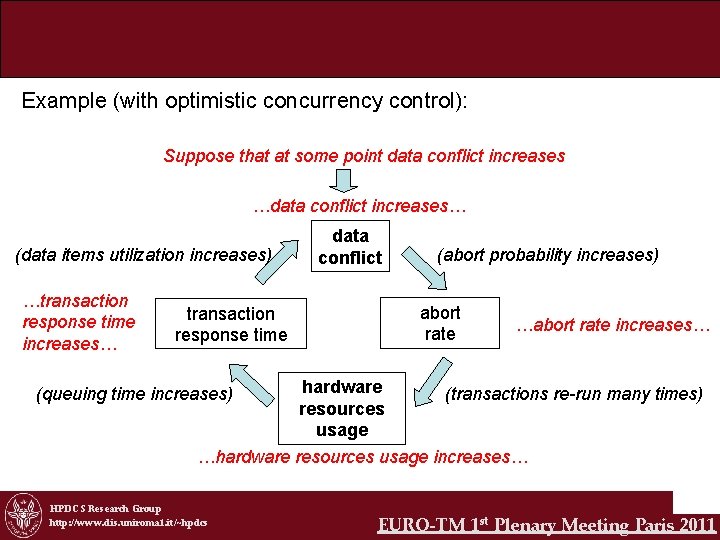
Example (with optimistic concurrency control): Suppose that at some point data conflict increases …data conflict increases… (data items utilization increases) …transaction response time increases… transaction response time data conflict (abort probability increases) abort rate …abort rate increases… hardware (transactions re-run many times) resources usage …hardware resources usage increases… (queuing time increases) HPDCS Research Group http: //www. dis. uniroma 1. it/~hpdcs EURO-TM 1 st Plenary Meeting Paris 2011
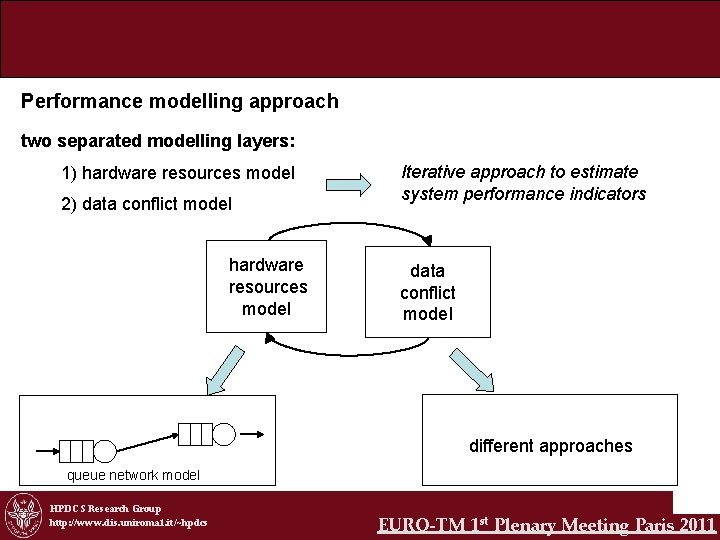
Performance modelling approach two separated modelling layers: 1) hardware resources model 2) data conflict model hardware resources model Iterative approach to estimate system performance indicators data conflict model different approaches queue network model HPDCS Research Group http: //www. dis. uniroma 1. it/~hpdcs EURO-TM 1 st Plenary Meeting Paris 2011
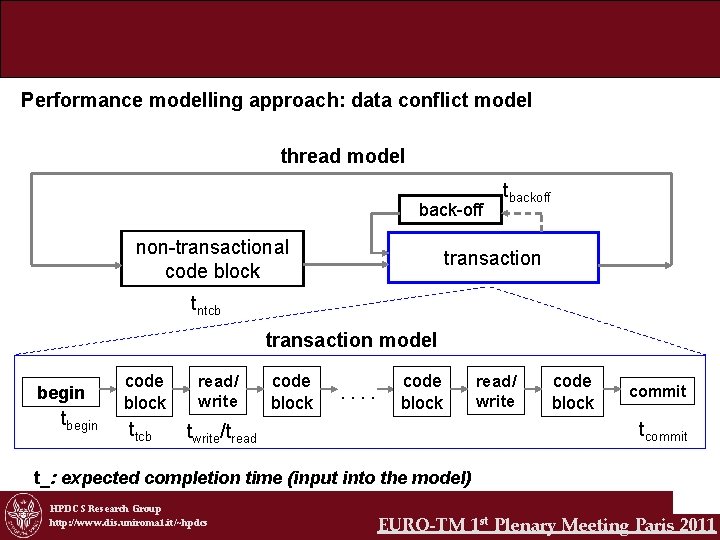
Performance modelling approach: data conflict model thread model back-off non-transactional code block tbackoff transaction tntcb transaction model begin tbegin code block read/ write ttcb twrite/tread code block . . code block read/ write code block commit t_: expected completion time (input into the model) HPDCS Research Group http: //www. dis. uniroma 1. it/~hpdcs EURO-TM 1 st Plenary Meeting Paris 2011
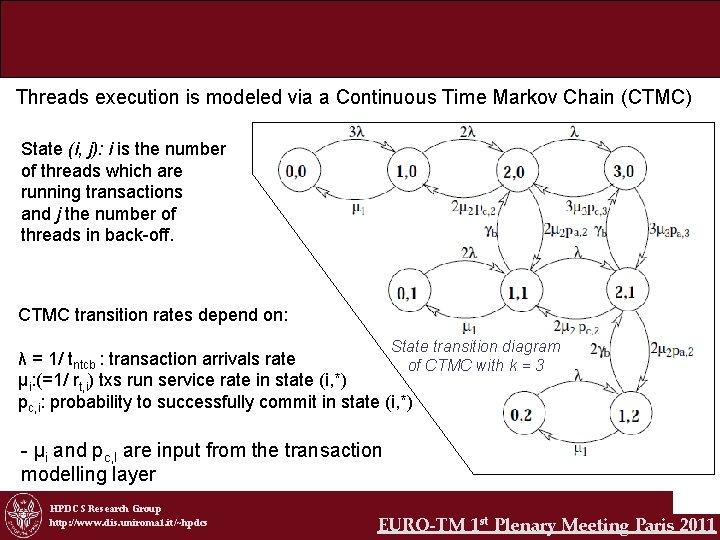
Threads execution is modeled via a Continuous Time Markov Chain (CTMC) State (i, j): i is the number of threads which are running transactions and j the number of threads in back-off. CTMC transition rates depend on: State transition diagram of CTMC with k = 3 λ = 1/ tntcb : transaction arrivals rate μi: (=1/ rt, i) txs run service rate in state (i, *) pc, i: probability to successfully commit in state (i, *) - μi and pc, I are input from the transaction modelling layer HPDCS Research Group http: //www. dis. uniroma 1. it/~hpdcs EURO-TM 1 st Plenary Meeting Paris 2011
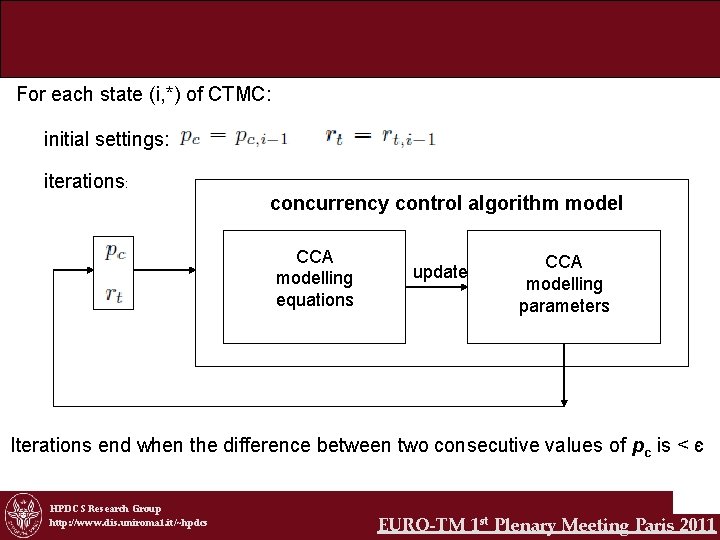
For each state (i, *) of CTMC: initial settings: iterations: concurrency control algorithm model CCA modelling equations update CCA modelling parameters Iterations end when the difference between two consecutive values of pc is < є HPDCS Research Group http: //www. dis. uniroma 1. it/~hpdcs EURO-TM 1 st Plenary Meeting Paris 2011
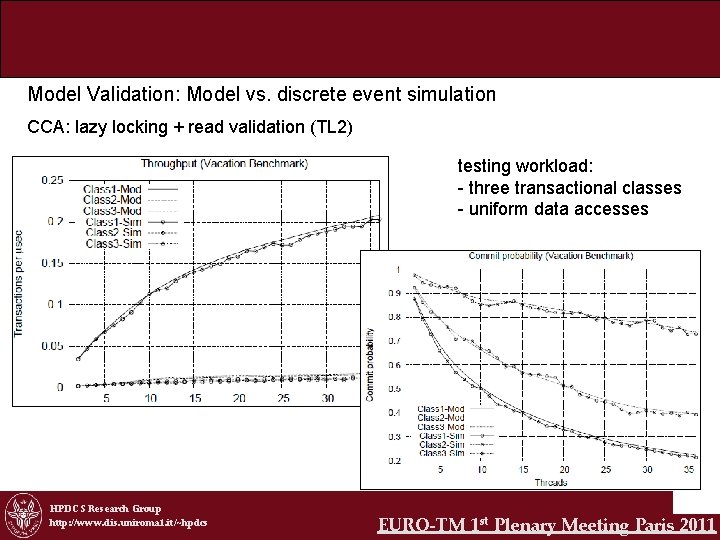
Model Validation: Model vs. discrete event simulation CCA: lazy locking + read validation (TL 2) testing workload: - three transactional classes - uniform data accesses HPDCS Research Group http: //www. dis. uniroma 1. it/~hpdcs EURO-TM 1 st Plenary Meeting Paris 2011
Thank you HPDCS Research Group http: //www. dis. uniroma 1. it/~hpdcs EURO-TM 1 st Plenary Meeting Paris 2011
- Slides: 18