
Research Ethics A Brief Introduction September 2018 Dina

Research Ethics: A Brief Introduction September 2018 Dina Shafey, Associate Director, Research Ethics dshafey@sfu. ca
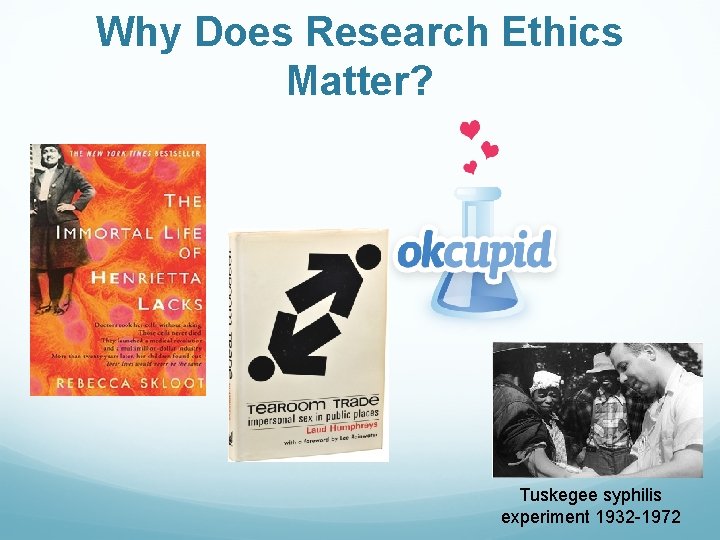
Why Does Research Ethics Matter? Tuskegee syphilis experiment 1932 -1972
Objectives Apply the three core ethics principles to your own research studies Anticipate ethical issues in research Identify the risks of participating in research Identify the components of informed consent
Tri Council Policy Statement: Ethical Conduct for Research Involving Humans (TCPS 2) Overarching Canadian policy framework for research involving human participants TCPS published in 1998 Revised in 2010 and 2014 after extended periods of consultation with relevant stakeholders Clear efforts to make TCPS more relevant/applicable to social scientists
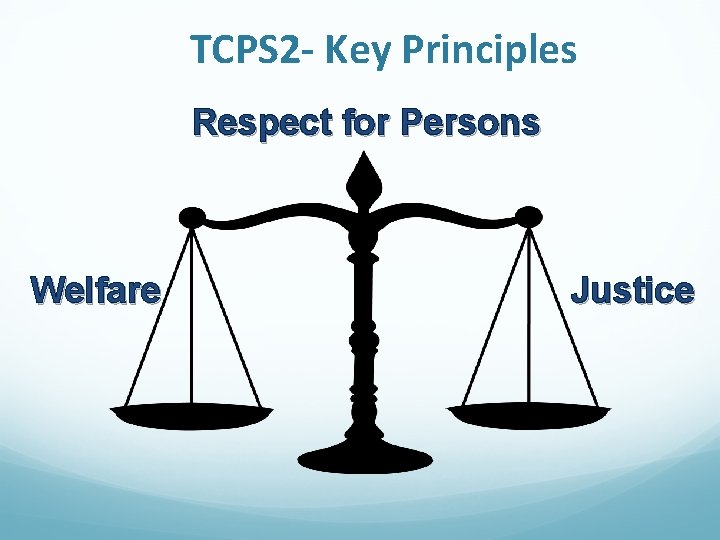
TCPS 2 - Key Principles Respect for Persons Welfare Justice
Centering on the Human Participant Who’s Participating? Recruitment process The consent or assent relationship Methods employed Risk/benefit assessment Confidentiality and privacy protections
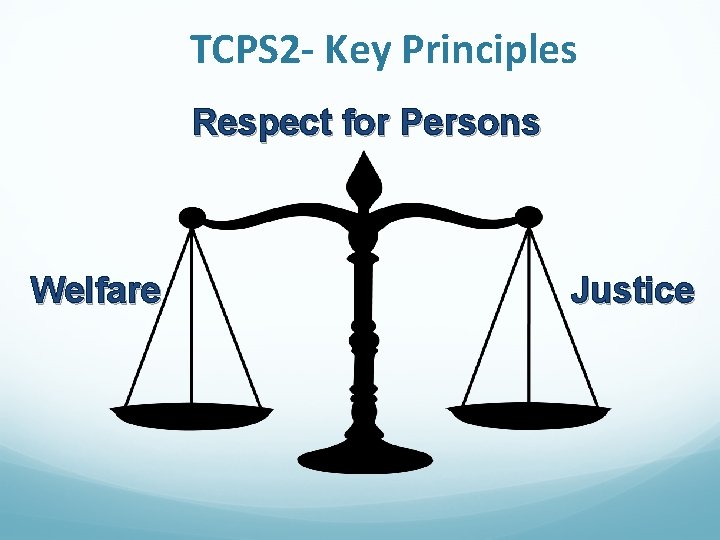
TCPS 2 - Key Principles Respect for Persons Welfare Justice
Principles of Consent Free Informed Ongoing
The Consent Process Consent is not a single act of someone agreeing to participate in a study. It is a process that begins with the recruitment and screening of participants and continues throughout their involvement in the research. Components of the Consent Process are: Recruitment Information Documenting Consent Debriefing (when required)
Keeping Consent Free When someone consents to be a participant in a study it is important that they have done so entirely of their own free will. Are there ways in which voluntariness can be compromised? Incentives Authority/Power Relationships Undue Influence
Elements of Informed Consent form should be written in plain and simple language and provide an accurate description of: The research purpose and proposed use of data collected Foreseeable risks and potential benefits Extent of confidentiality promised Requirements of the study (e. g. duration, frequency, nature of tasks and/or measures) Withdrawal procedure Extent of incentives Data management (access and safeguards) Plans for provision of new information Plans for dissemination of results Contact information of the researcher in charge of the study Contact information of the REB
Capacity to Consent Some research requires participants who may lack the necessary cognitive capacity to decide whether or not to participate in research. In research, capacity refers to the ability of prospective participants to: appreciate the possible impact of foreseeable risks and potential benefits on their own well-being understand how the conditions of the research may affect them (e. g. time required, difficulty of tasks) evaluate whether participation in a particular research project may or may not be in their own best interest when research involves those who are not capable of giving consent on their own behalf, researchers must seek the consent of an authorized third party
What scenarios/participant populations can you think of where capacity to consent may be an issue? children whose capacity is still developing Adults whose capacity is diminishing or fluctuating due to illness or injury Those whose capacity remains only partially developed Individuals under the influence of drugs or alcohol
Assent & Dissent Even when an individual’s authorized third party gives consent, it is important to involve the individual to the greatest extent possible. As prospective participants they may agree (assent) or not agree (dissent) with their authorized third party’s decision to consent.
Secondary Use of Information that was collected for one purpose and is now being used to answer the current research question Examples of Secondary Use of Information Data from a previous research study RCMP data Previous student work Other Administrative data It matters if data is identifiable or de-identified.
Secondary Use Not exempt from research ethics review unless publicly available Secondary use of identifiable information - demonstrate that you have met the criteria in TCPS 2 (2014) Article 5. 5 A. Include a letter of permission from the appropriate data steward.
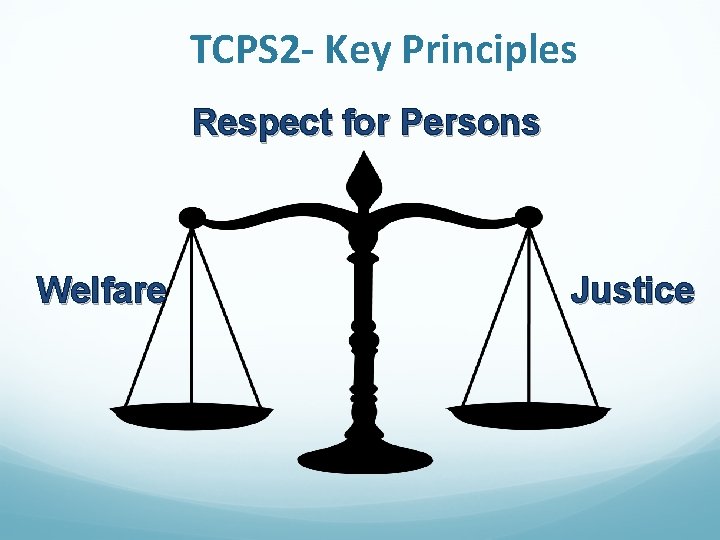
TCPS 2 - Key Principles Respect for Persons Welfare Justice
Centering on the Human Participant Who’s Participating? Recruitment process The consent or assent relationship Methods employed Risk/benefit assessment Confidentiality and privacy protections
Types of Risk Physical Psychological Economic Social Legal
Probability & Magnitude of Risk PROBABILITY: How likely is it that any participant will suffer any harm as a result of the study? MAGNITUDE: How severe could the harm be?
Minimal Risk Research “Research in which the probability and magnitude of possible harms implied by participation in the research is no greater than those encountered by participants in the aspects of their everyday life that relate to the research. ”
What’s the Risk? Study: To examine the interconnectedness of crime and politics in Jamaica Participant Groups Academics or experts in the field Residents of these communities Politicians Individuals involved in organized crime
How To Apply The Principle of Concern for Welfare Consider potential impacts on participants’ physical and mental health, on their social or economic circumstances, and on their privacy Consult any groups that may be affected by the research to assess the risk of negative impacts such as stigmatization and discrimination Eliminate and/or minimize risks Maximize benefits Provide accurate and accessible information
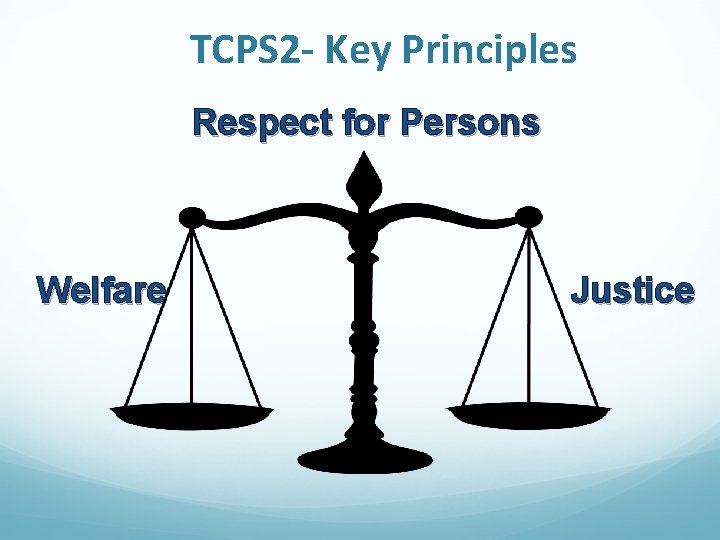
TCPS 2 - Key Principles Respect for Persons Welfare Justice
How To Apply The Principle of Justice In research design it is important to address the following issues: Who are the participants? Why this group and not others? Are any participant groups over- or under-represented because of their vulnerable circumstances? Are there measures in place to treat people in vulnerable circumstances justly in the context of the research? Is there an imbalance of power between participants and researchers?
Centering on the Human Participant Who’s Participating? Recruitment process The consent or assent relationship Methods employed Risk/benefit assessment Confidentiality and privacy protections
Confidentiality Is the obligation of an individual or organization to safeguard entrusted information protect information from unauthorized access, use, disclosure, modification, loss or theft
Major Concepts: Confidentiality and Anonymity Directly Identifying Information Indirectly Identifying Information Coded Information Anonymized Information Anonymous Information
Videos, Photography and Audio Recordings Identifiable information Recommended to provide participants with a choice to be video recorded, photographed, audio recorded. Questions to consider: Are these videos, photographs, audio recordings necessary for the research? Give option to choose. What are the videos, photos, audio recordings going to be used for (analysis only, presentations, publications)? Will images be blurred or voice distorted?
Dissemination Anonymize information as much as possible if you have not had participants consent to being directly identified. Indirectly identifying individuals should be avoided unless you have obtained prior permission to do so. Sharing individual anonymized data after study complete – disclosed in consent form Dissemination can be in made in many different formats (blogs, journal articles, presentations etc. ) – what matters is if the information could identify your participants and what did they give consent to.
Data Storage/Access Data Management Plan http: //www. lib. sfu. ca/help/publish/research-datamanagement/data-management-planning Data Storage SFU Vault - https: //www. sfu. ca/itservices/collaboration/sfuvault. html
Researcher wants to travel to Mexico to examine individual and neighbourhood level risk factors of gang membership and the organization of gangs in Mexico. The researcher is originally from Mexico and has maintained contacts in Mexico. Participants will be gang members. Participants will be recruited through facilitators who have some form of contact with gang members. Then further recruitment will be done through these gang members by word of mouth/snow ball sampling. Participants will be interviewed for approximately 3 hours about the participant’s home life, neighbourhood, peer relationship, gang structure, gang colours and signs, leadership roles, duties of members, past criminal activities, initiations, relationships with politicians, and the role they play in their communities.
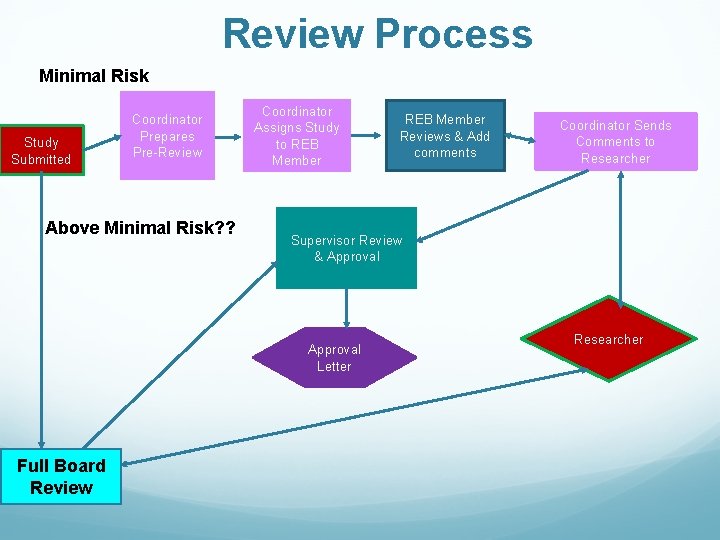
Review Process Minimal Risk Study Submitted Coordinator Prepares Pre-Review Above Minimal Risk? ? Coordinator Assigns Study to REB Member Coordinator Sends Comments to Researcher Supervisor Review & Approval Letter Full Board Review REB Member Reviews & Add comments Researcher
The Role of the SFU REB and ORE What are the primary goals of the SFU REB and ORE? To protect human participants To preserve rights of human participants involved in research
What to Submit A detailed description of the study (Study Details, protocol, proposal etc. ) Consent documents Recruitment materials (posters, letters of introduction, email scripts, etc. ) Any research instruments (questionnaires, interview questions, etc. ) After you submit, you will not be able to go back to the Database to make changes! Send an email to dore@sfu. ca with the changes (e. g. documents attached) and ORE staff will attach to your application.
General Advice Consistency o Make sure details provided are consistent throughout application: recruitment, procedures, consent & assent documents, advertisements, for example Clarity o Explain your procedures as clearly as possible: what you plan to do, how you plan to do it, to whom & how often Detail o Complete all sections of the application o Small details are important but balance between providing too much & too little
Harmonized Ethics Review SFU Processes for the ethical review of multijurisdictional research at SFU are in place: 1. Research Ethics BC PREP Platform 2. Previously reviewed and approved, minimal risk research These processes take more time so be prepared! https: //bcahsn. ca/our-network/research-ethics-bc/
New Ethics Application System What’s new and exciting? Replace the current Ethics Database Improve self-service ability, such as tracking applications through workflows Improve reporting capabilities Single sign-on with your SFU Computing ID Dynamic forms that will focus on capturing appropriate information When is it happening ? The first module, Research Ethics, will likely roll out late 2018/early 2019.
Summary The 3 core ethics principles are the foundation for the ethical reasoning that guides interactions with participants in all research involving human participants. Researchers are obligated to provide as much information as individuals need to make a fully informed choice to consent or refuse to participate. Context matters when determining risk to participants and their vulnerability Be transparent, clear and consistent when describing your research, procedures and risk to the REB and to participants.

Need Help? Let us know!!! Jeff Toward. Director, jtoward@sfu. ca, 778 -782 -6593 Dina Shafey, Associate Director, dshafey@sfu. ca, 778 -782 -9631 Sarah Bennett, Manager, sarah_bennett_2@sfu. ca 778 -782 -3447 Hanna Jones-Eriksson, Ethics Coordinator, hjoneser@sfu. ca, 778 -782 -6618 Alanna Dyck, Ethics Coordinator, alanna_dyck@sfu. ca 778 -782 -5719 Candase Jensen, Ethics Assistant, cspenst@sfu. ca, 778 -782 -5326 Check out our website – sfu. ca/ore
- Slides: 40