
Research Development R D Fabrication R D Fabrication

Research & Development ( R & D Fabrication )
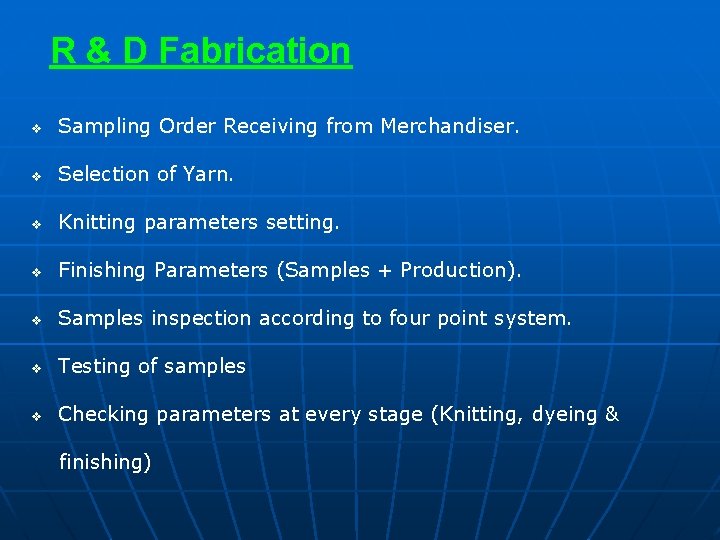
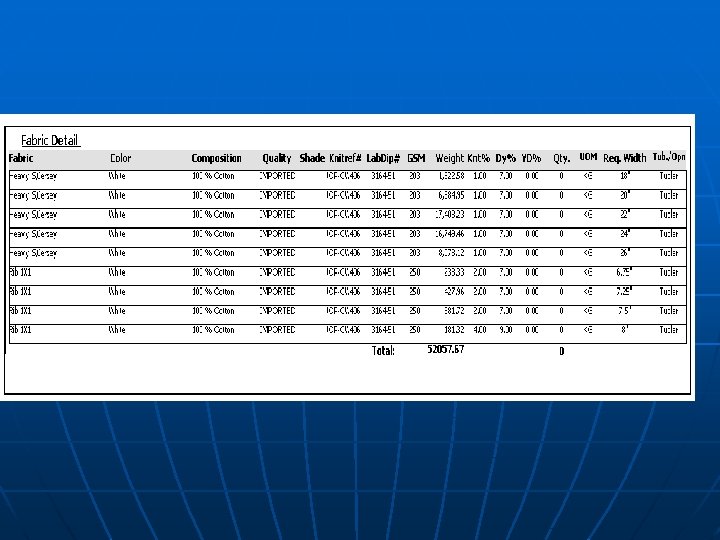
R & D Fabrication v Sampling Order Receiving from Merchandiser. v Selection of Yarn. v Knitting parameters setting. v Finishing Parameters (Samples + Production). v Samples inspection according to four point system. v Testing of samples v Checking parameters at every stage (Knitting, dyeing & finishing)
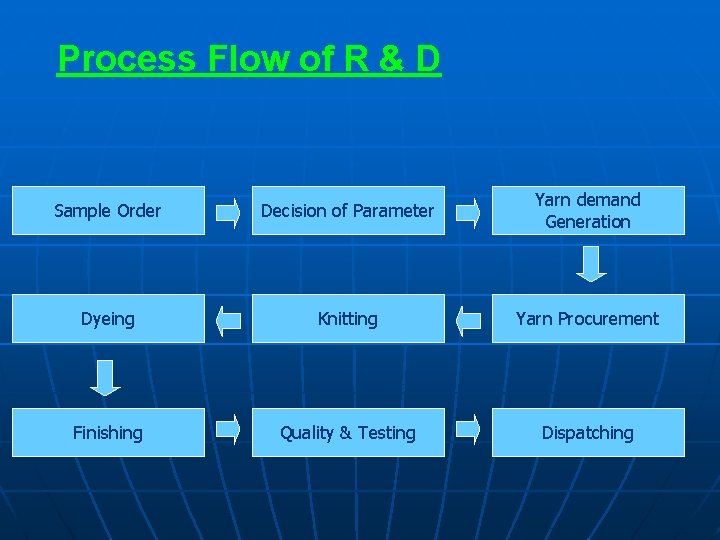
Process Flow of R & D Sample Order Decision of Parameter Yarn demand Generation Dyeing Knitting Yarn Procurement Finishing Quality & Testing Dispatching
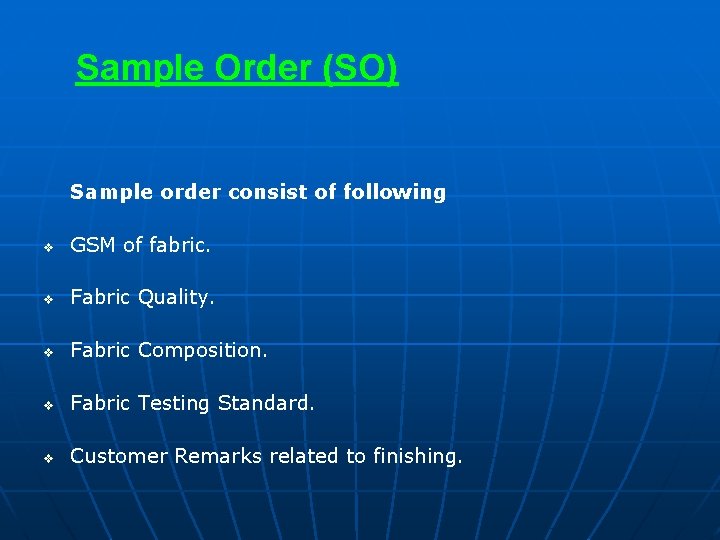
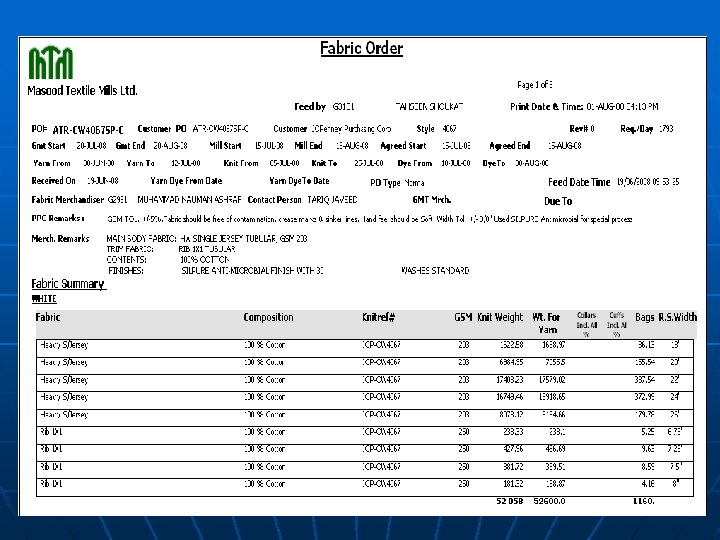
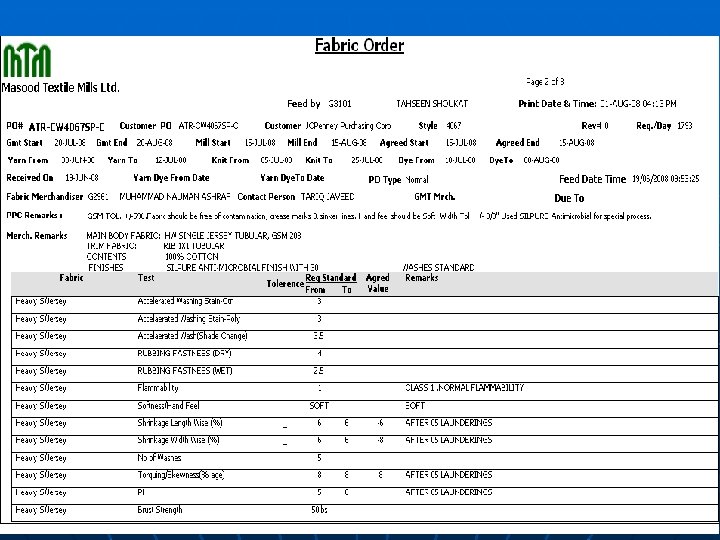
Sample Order (SO) Sample order consist of following v GSM of fabric. v Fabric Quality. v Fabric Composition. v Fabric Testing Standard. v Customer Remarks related to finishing.
Selection of Yarn v Type of yarn v Normal Yarn, Fancy yarn. v v Normal Yarn cotton, polyester, acrylic and nylon are normal yarn. Fancy yarn Slub yarn, Heather yarn, Mélange yarn and lycra yarn.
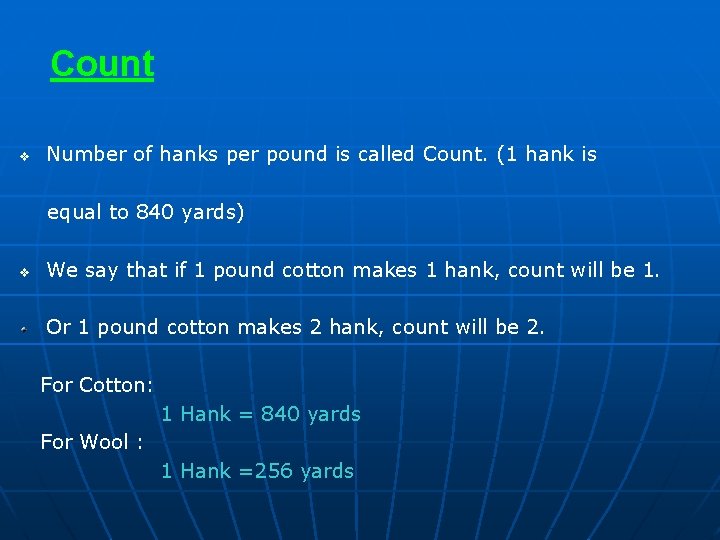
Count v Number of hanks per pound is called Count. (1 hank is equal to 840 yards) v We say that if 1 pound cotton makes 1 hank, count will be 1. Or 1 pound cotton makes 2 hank, count will be 2. For Cotton: 1 Hank = 840 yards For Wool : 1 Hank =256 yards
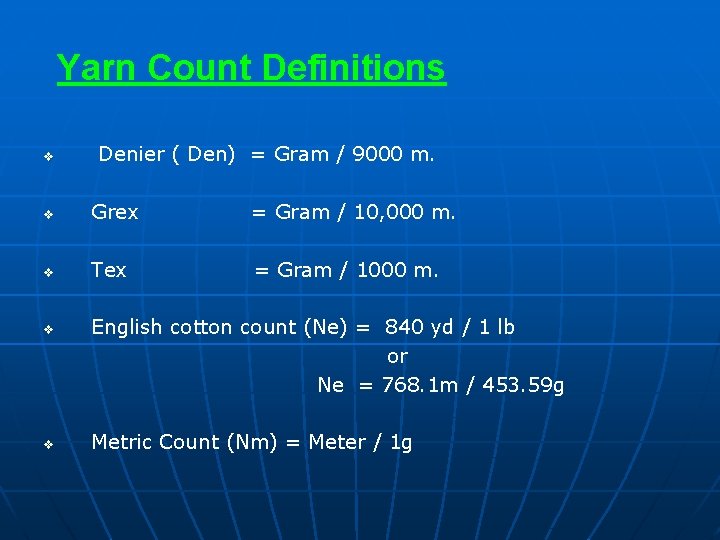
Yarn Count Definitions v Denier ( Den) = Gram / 9000 m. v Grex = Gram / 10, 000 m. v Tex = Gram / 1000 m. v v English cotton count (Ne) = 840 yd / 1 lb or Ne = 768. 1 m / 453. 59 g Metric Count (Nm) = Meter / 1 g
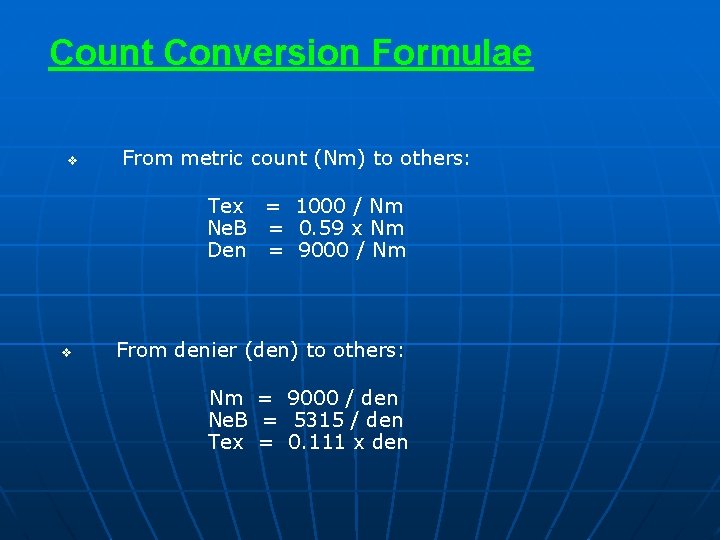
Count Conversion Formulae v From metric count (Nm) to others: Tex = 1000 / Nm Ne. B = 0. 59 x Nm Den = 9000 / Nm v From denier (den) to others: Nm = 9000 / den Ne. B = 5315 / den Tex = 0. 111 x den
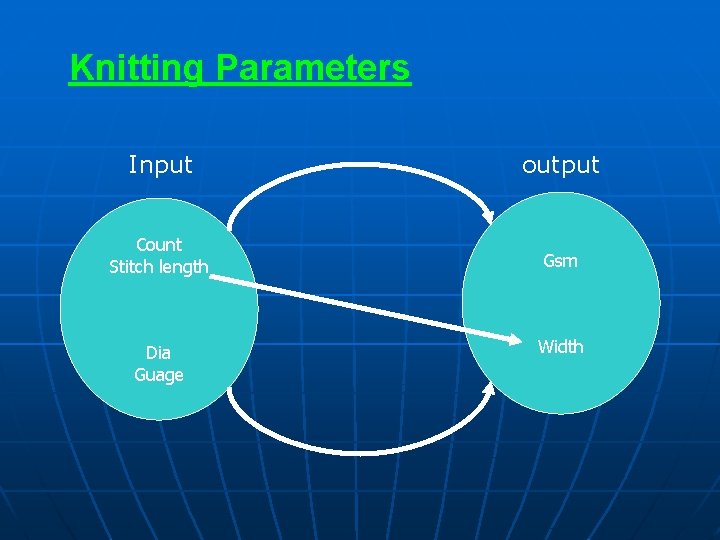
Knitting Parameters Input output Count Stitch length Gsm Dia Guage Width
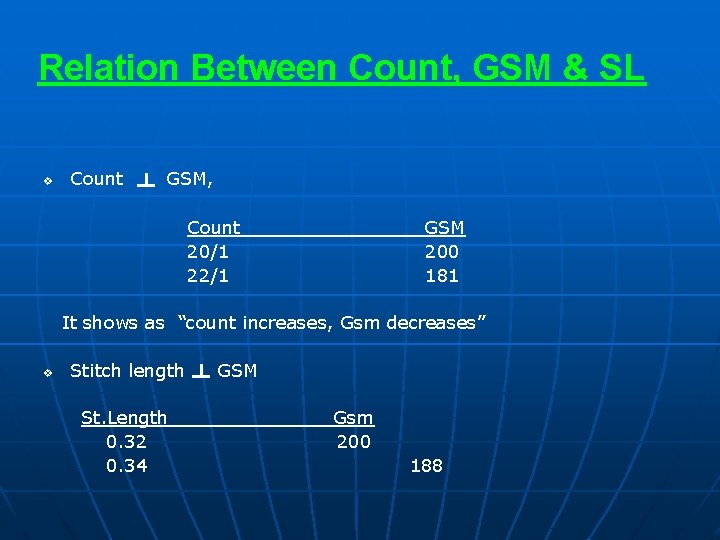
Relation Between Count, GSM & SL v Count GSM, Count 20/1 22/1 GSM 200 181 It shows as “count increases, Gsm decreases” v Stitch length St. Length 0. 32 0. 34 GSM Gsm 200 188
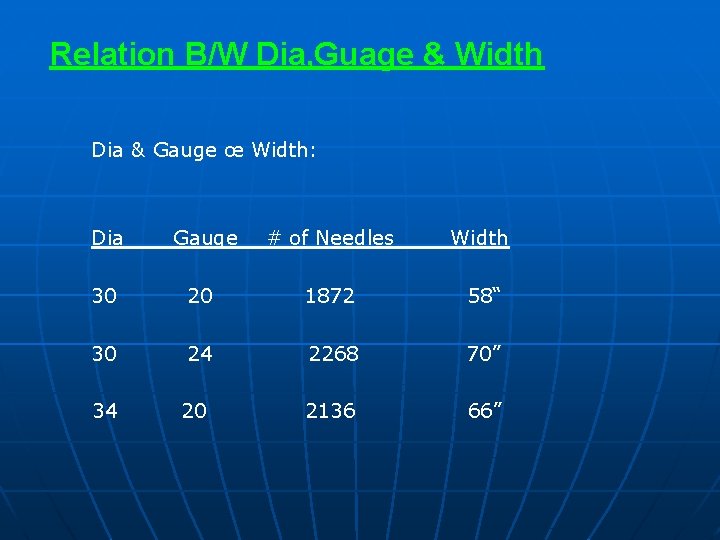
Relation B/W Dia, Guage & Width Dia & Gauge œ Width: Dia Gauge # of Needles Width 30 20 1872 58“ 30 24 2268 70” 2136 66” 34 20
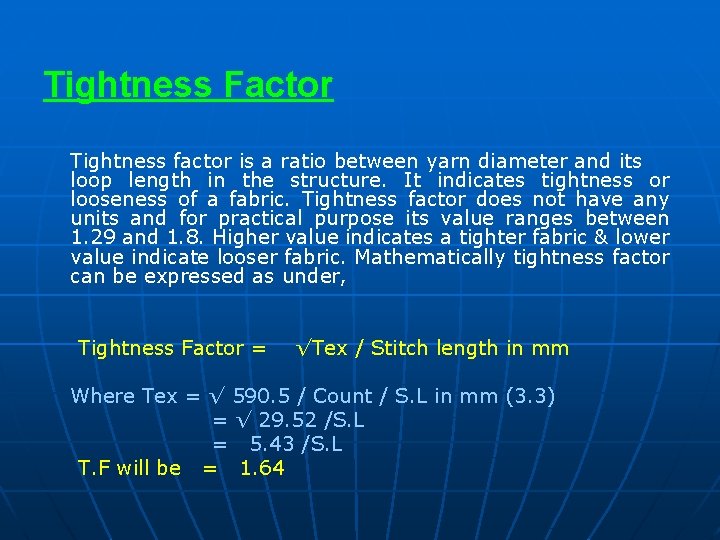
Tightness Factor Tightness factor is a ratio between yarn diameter and its loop length in the structure. It indicates tightness or looseness of a fabric. Tightness factor does not have any units and for practical purpose its value ranges between 1. 29 and 1. 8. Higher value indicates a tighter fabric & lower value indicate looser fabric. Mathematically tightness factor can be expressed as under, Tightness Factor = √Tex / Stitch length in mm Where Tex = √ 590. 5 / Count / S. L in mm (3. 3) = √ 29. 52 /S. L = 5. 43 /S. L T. F will be = 1. 64
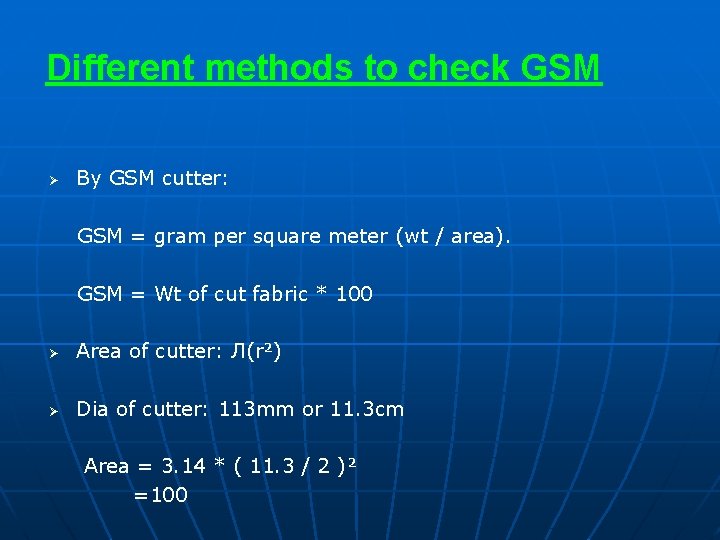
Different methods to check GSM Ø By GSM cutter: GSM = gram per square meter (wt / area). GSM = Wt of cut fabric * 100 Ø Area of cutter: Л(r²) Ø Dia of cutter: 113 mm or 11. 3 cm Area = 3. 14 * ( 11. 3 / 2 )² =100
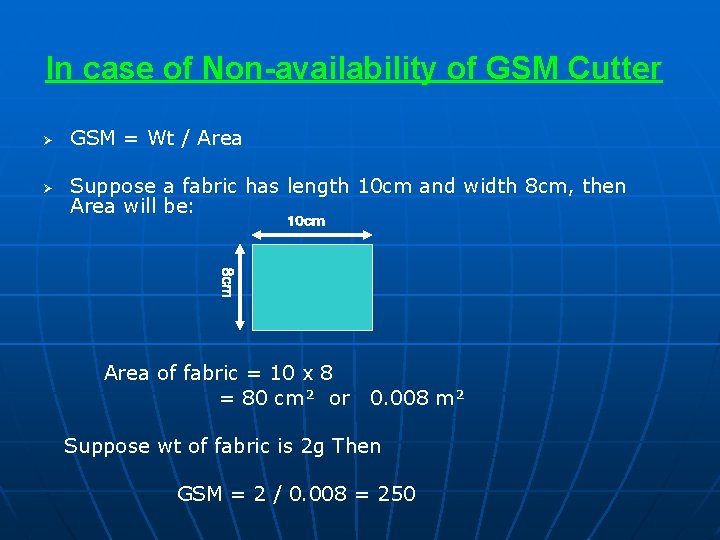
In case of Non-availability of GSM Cutter Ø GSM = Wt / Area Ø Suppose a fabric has length 10 cm and width 8 cm, then Area will be: Area of fabric = 10 x 8 = 80 cm² or 0. 008 m² Suppose wt of fabric is 2 g Then GSM = 2 / 0. 008 = 250
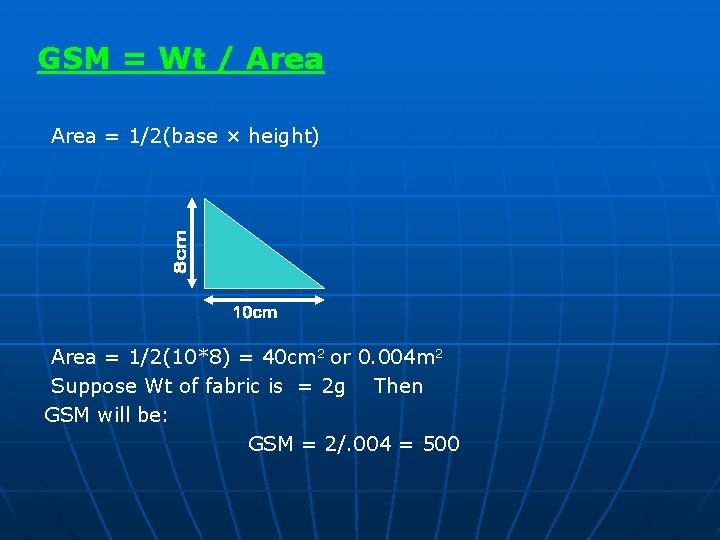
GSM = Wt / Area = 1/2(base × height) Area = 1/2(10*8) = 40 cm 2 or 0. 004 m 2 Suppose Wt of fabric is = 2 g Then GSM will be: GSM = 2/. 004 = 500
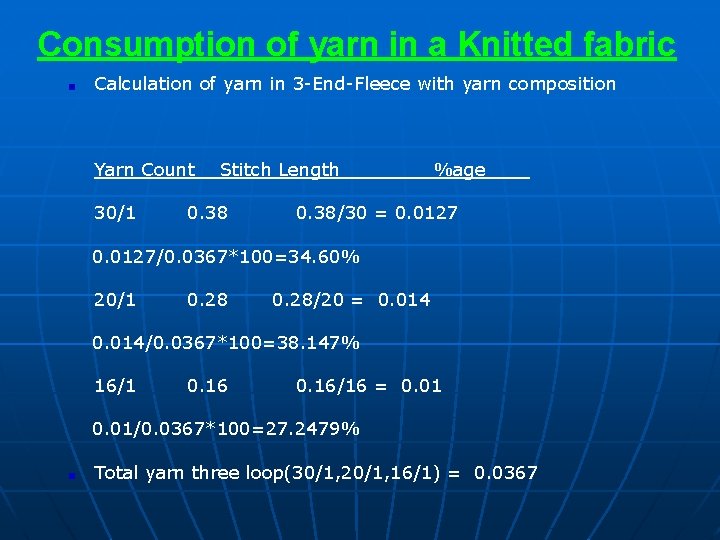
Consumption of yarn in a Knitted fabric Calculation of yarn in 3 -End-Fleece with yarn composition Yarn Count 30/1 Stitch Length 0. 38 %age 0. 38/30 = 0. 0127/0. 0367*100=34. 60% 20/1 0. 28/20 = 0. 014/0. 0367*100=38. 147% 16/1 0. 16/16 = 0. 01/0. 0367*100=27. 2479% Total yarn three loop(30/1, 20/1, 16/1) = 0. 0367
KNITTING “ Knitting is a process in which yarn is converted into loops with the help of needles ”
Types of Knitted Fabric n Single Knit Fabric n Double Knit Fabric
Types of Single Knit Fabric n Single Jersey n Single PQ Loqast n Double PQ n 2. Thread Fleece n 3. Thread Fleece
Types of Double Knit Fabric n Thermal n Waffle n Rib n Interlock n Mesh
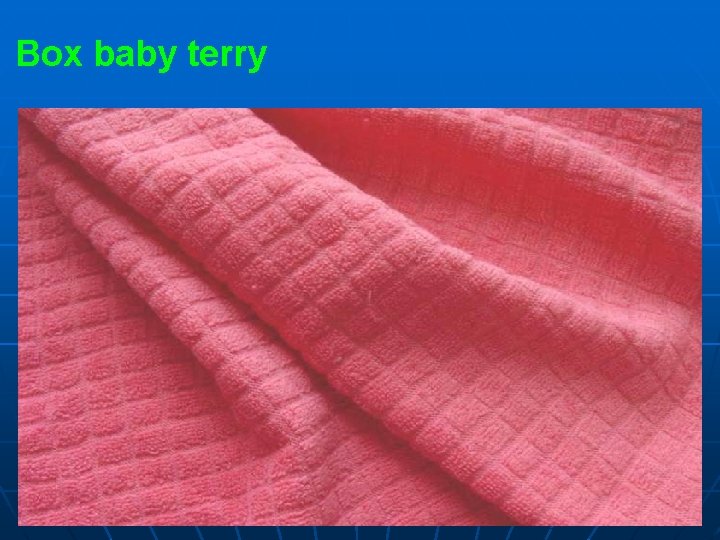
Box baby terry
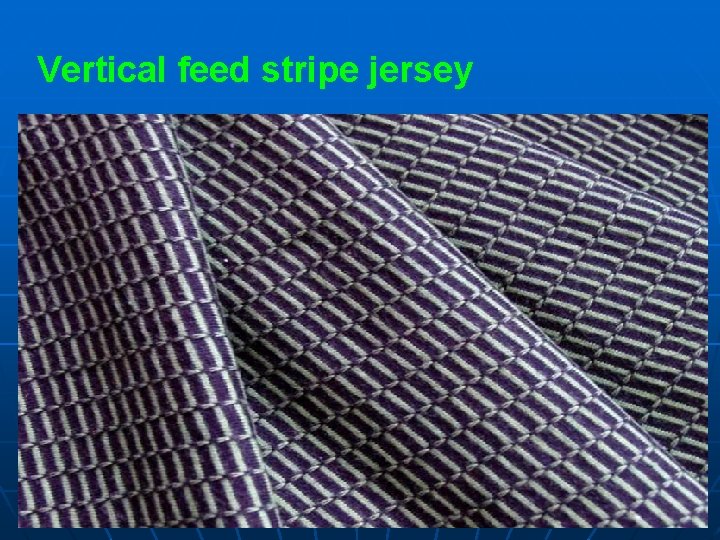
Vertical feed stripe jersey

Single Jersey

Tilla Fleece
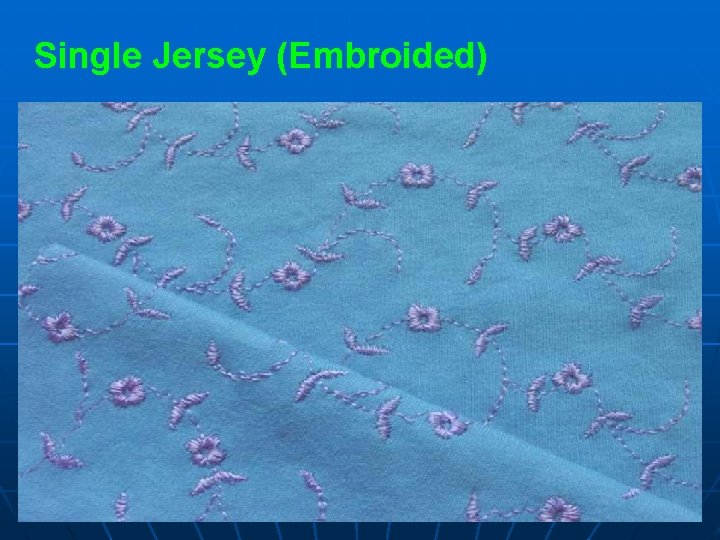
Single Jersey (Embroided)

Finishing Definition: “It is a process, To enhance the aesthetic properties of a fabric by treating with chemical and mechanical devices is called finishing”.
Types of Finishing n Chemical Finishing: In chemical finishing, different finishes are applied on a fabric with the help of chemicals such as, Silicon finish, Stain Release, Anti-microbial finish, Resin finish etc.
Mechanical Finishing In mechanical finishing, fabric is treated with mechanical devices to impart aesthetic look/properties to the fabric such as, Peaching, Raising, Heat setting and Compacting.
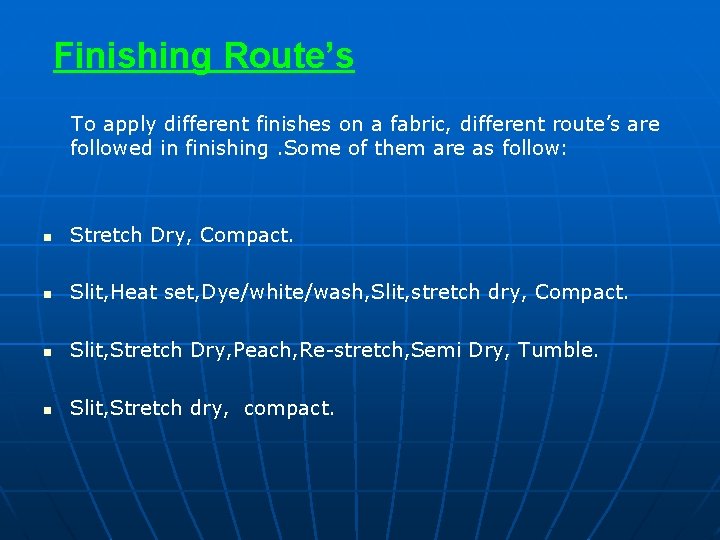
Finishing Route’s To apply different finishes on a fabric, different route’s are followed in finishing. Some of them are as follow: n Stretch Dry, Compact. n Slit, Heat set, Dye/white/wash, Slit, stretch dry, Compact. n Slit, Stretch Dry, Peach, Re-stretch, Semi Dry, Tumble. n Slit, Stretch dry, compact.
Quality Control n Quality: “Quality is a standard achieved by process to render a defect free product to the customer” To control the quality of a fabric, fabric is inspected according to Four point system introduced by JC-penny for fabric inspection.
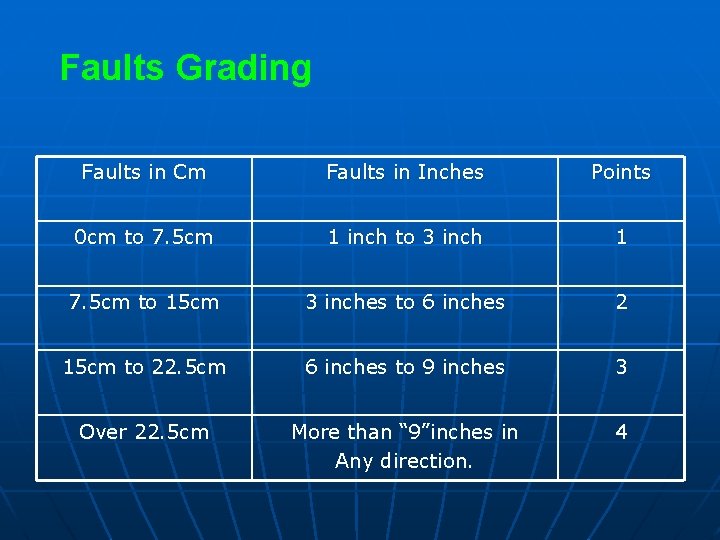
Faults Grading Faults in Cm Faults in Inches Points 0 cm to 7. 5 cm 1 inch to 3 inch 1 7. 5 cm to 15 cm 3 inches to 6 inches 2 15 cm to 22. 5 cm 6 inches to 9 inches 3 Over 22. 5 cm More than “ 9”inches in Any direction. 4
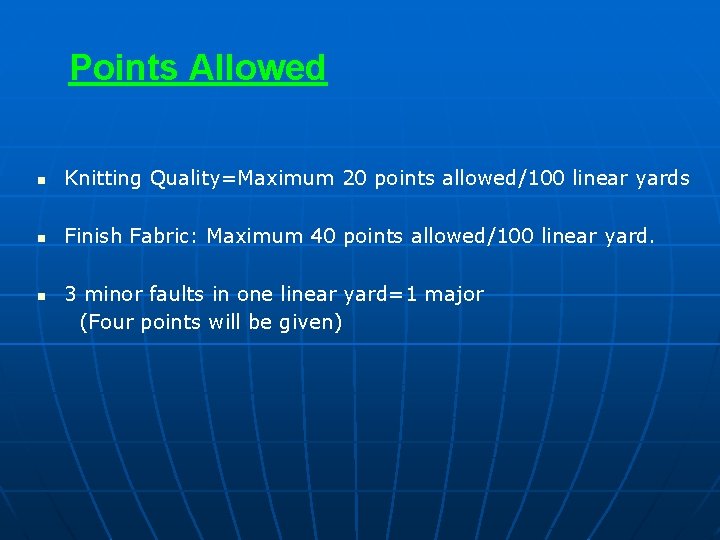
Points Allowed n Knitting Quality=Maximum 20 points allowed/100 linear yards n Finish Fabric: Maximum 40 points allowed/100 linear yard. n 3 minor faults in one linear yard=1 major (Four points will be given)
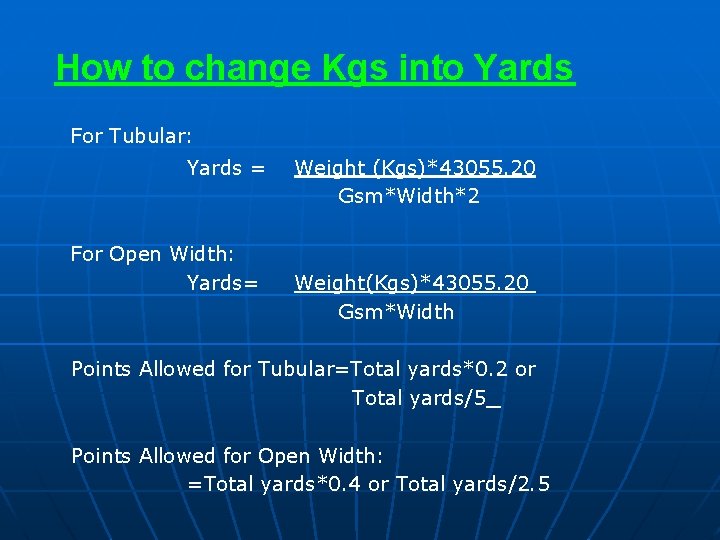
How to change Kgs into Yards For Tubular: Yards = For Open Width: Yards= Weight (Kgs)*43055. 20 Gsm*Width*2 Weight(Kgs)*43055. 20 Gsm*Width Points Allowed for Tubular=Total yards*0. 2 or Total yards/5 Points Allowed for Open Width: =Total yards*0. 4 or Total yards/2. 5
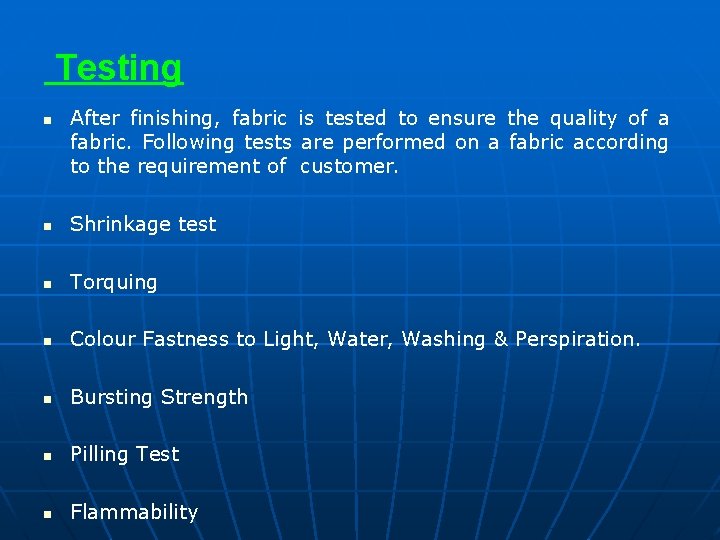
Testing n After finishing, fabric is tested to ensure the quality of a fabric. Following tests are performed on a fabric according to the requirement of customer. n Shrinkage test n Torquing n Colour Fastness to Light, Water, Washing & Perspiration. n Bursting Strength n Pilling Test n Flammability
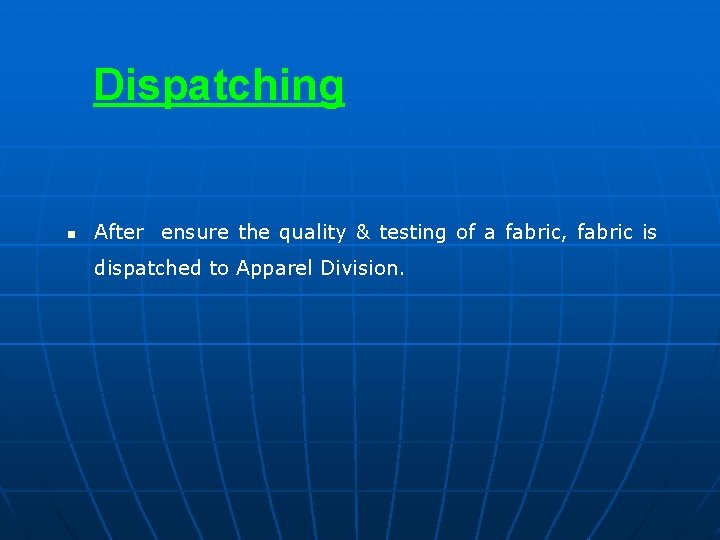
Dispatching n After ensure the quality & testing of a fabric, fabric is dispatched to Apparel Division.

Presented by: Abdul Rouf Deputy Manager Research & Development
- Slides: 40