
Research Design Data Collection Methods EXPERIMENTAL DESIGN DATA
- Slides: 16
Research Design & Data Collection Methods EXPERIMENTAL DESIGN, DATA COLLECTION, AND SAMPLING
Data Collection � The following are 4 data collection methods for research: �Observational study �Experiment �Simulation �Survey
Observational Study � Researchers observe and measures characteristics of interest of part of a population.
Experiment � In an experiment, a treatment is applied to part of a population and responses are observed. For example, an experiment was performed in which diabetics took cinnamon extract daily while a control group took none. After 40 days, the diabetics who had the cinnamon reduced their risk of heart disease while the control group experienced no change.
Observation vs Experiment � Note: The difference between an observational study and an experiment is that in an observational study a researcher does not influence the responses whereas in an experiment a researcher deliberately applies a treatment before observing the responses.
Simulation � A simulation is the use of a mathematical or physical model to reproduce the conditions of a situation or process. Collecting data often involves the use of computers. Simulations allow you to study situations that are impractical or even dangerous to create in real life, and often the save time and money. For examples, automobile manufactures use simulations with dummies to study the effect of crashes on humans.
Surveys �A survey is an investigation of one or more characteristics of a population. The most common types of surveys are done by interview, mail, or telephone. In designing a survey, it is important to word the questions so that they do not lead to biased results.
Census vs Sampling �A census is a count or measure of an entire population. Taking a census provides complete information, but it is often costly and difficult to perform. � A sampling is a count or measure of part of a population. For instance, every year the U. S. Census Bureau samples the U. S. Population to update the most recent census data. Using Samples is often more practical than taking a census.
Sampling Techniques � To collect unbiased data, a researcher must ensure that the sample is representative of the population. Appropriate sampling techniques must be used to ensure that inferences about the population are valid.
Random Sample �A random sample is one in which every member of the population has an equal chance of being selected.
Simple Random Sample A simple random sample is a sample which every possible sample of the same size has the same chance of being selected. One way to collect a simple random sample is to assign a different number to each member of the population and then use a random number table. Responses, counts or measures from members of the population whose numbers than correspond to those generated using a table. Calculators and computer software programs are also used to generate random numbers. � When you choose members of a sample, you should also decide whether it is acceptable to have the same population member selected more than once. �
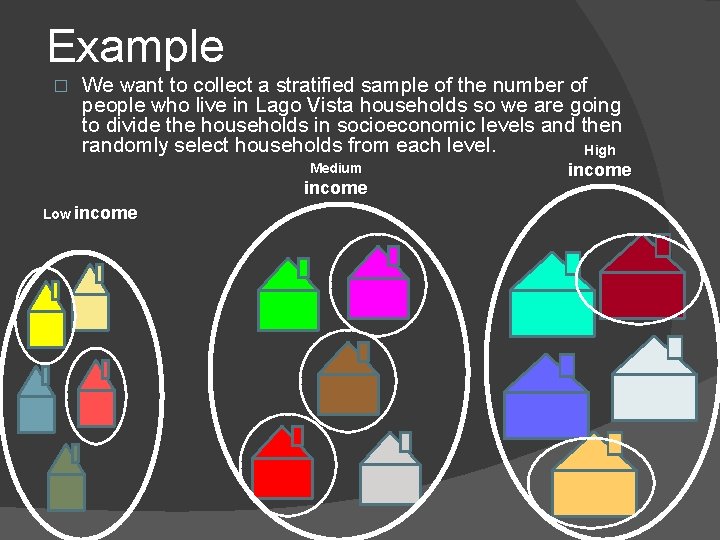
Stratified Sample When it is important for the sample to have members from each segment of the population, you should use a stratified sample. Depending on the focus of the study, members of the population are divided into two or more subsets, called strata, that share a similar characteristic such as age, gender, ethnicity or even political preference. � A sample is then randomly selected from each of the strata. �
Example � We want to collect a stratified sample of the number of people who live in Lago Vista households so we are going to divide the households in socioeconomic levels and then randomly select households from each level. High Medium income Low income
Cluster Sample When the population falls into naturally occurring subgroups, each having similar characteristics, a cluster sample may be the most appropriate. To select a cluster sample, divide the population into groups called clusters, and select all the members in one or more(but not all) of the clusters. � Examples of clusters could be different sections of the same course. Mrs. Bode’s 1 st period Statistics class and her 3 rd period Statistics class. � In using a cluster sample, care must be taken to ensure that all clusters have similar characteristics. For example, if one class has a higher proportion of Pre-AP and AP students data might not be representative of the population. �
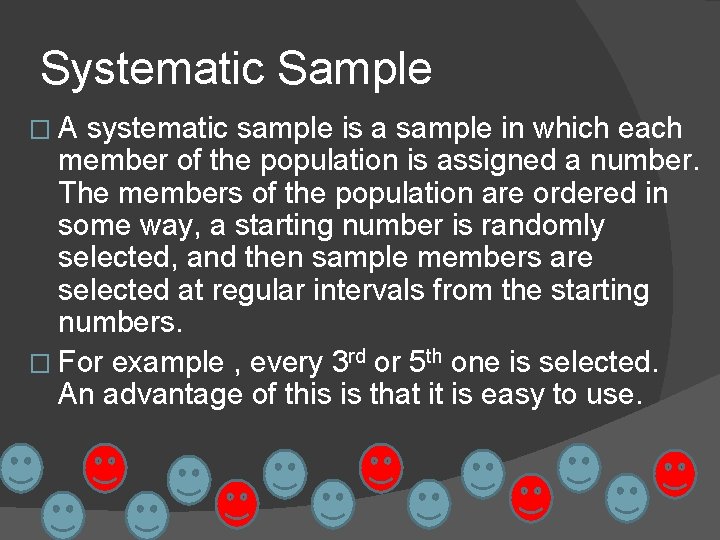
Systematic Sample �A systematic sample is a sample in which each member of the population is assigned a number. The members of the population are ordered in some way, a starting number is randomly selected, and then sample members are selected at regular intervals from the starting numbers. � For example , every 3 rd or 5 th one is selected. An advantage of this is that it is easy to use.
Biased Samples A biased sample is one that is not representative of the population from which it is drawn. For instance, a sample consisting of only 18 to 22 year old University of Texas students would NOT be representative of the entire 18 to 22 year old population in the entire country. � A type of sample that often leads to biased studies (so it is not recommended) is a convenience sample. A convenience sample consists only of available members of the population. �