
Research Design and Implementation Research design Detailed blueprint

Research Design and Implementation
Research design § Detailed blueprint used to guide the research study to its objectives § Defines research approach to be used for obtaining information

RESEARCH DESIGN PROCESS Research Approach Exploratory Descriptive Research Design Choice of data collection method Secondary, standardized, qualitative, Surveys, experiments Role of research supplier Project design Raw data collection Research Tactics Develop measures, Questionnaire, Design experiments, design sampling plan, anticipate analysis Causal
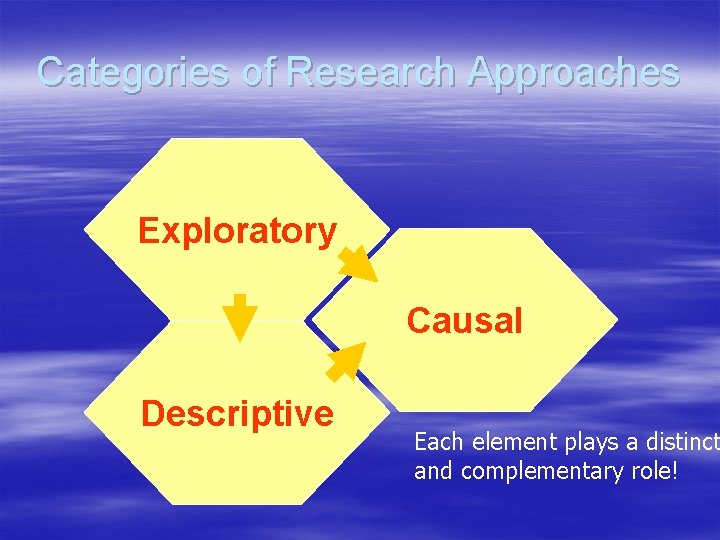
Categories of Research Approaches Exploratory Causal Descriptive Each element plays a distinct and complementary role!

Exploratory Research § Used when seeking insights – Into the general nature of the problem – The decision alternatives – The variables to be included § The questions – “why” and “how” are important § The probe

Exploratory research examples
Limitations of Exploratory Research § No hypothesis or vague or ill-defined hypothesis – Not possible to confirm / disconfirm § No firm preconceptions of what will be found § Biased – relies too much on the interpretation of the researcher § Inaccurate recording and reporting – Technology overcomes this to a large extent § Limited generalizability (external invalidity)
Descriptive Research § Most marketing research falls in this category § Greatest application: describe a marketing situation § Hypothesis exist but may be tentative and speculative § Can only show if two variables are associated § May precede causal research
Limitations of Descriptive Research § Does not focus on the ‘why’ – understanding phenomena § Cannot be used for prediction and control

Descriptive Research examples

Some causal research hypotheses
Causal Research § Shows that one variable causes or determines the value of another variable § Hence controlling one variable can help control the other § Causality can be inferred only if: § Hypothesis stated very specifically in terms of variables and quantity or direction
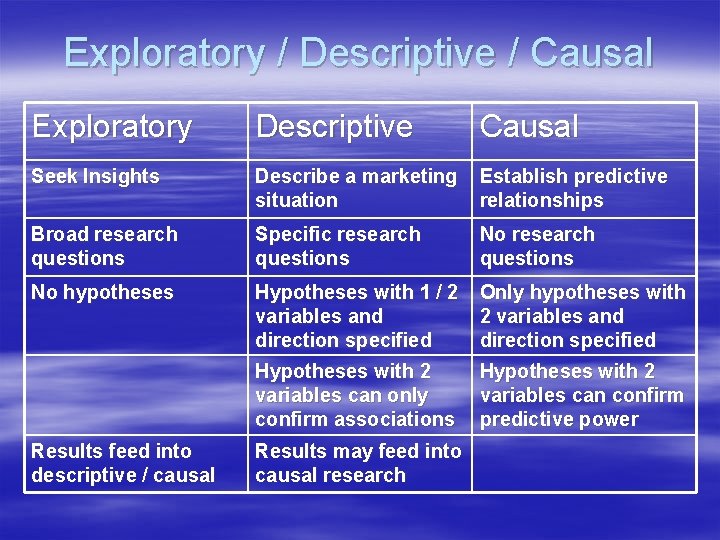
Exploratory / Descriptive / Causal Exploratory Descriptive Causal Seek Insights Describe a marketing situation Establish predictive relationships Broad research questions Specific research questions No hypotheses Hypotheses with 1 / 2 variables and direction specified Only hypotheses with 2 variables and direction specified Hypotheses with 2 variables can only confirm associations Hypotheses with 2 variables can confirm predictive power Results feed into descriptive / causal Results may feed into causal research
Experimental Designs § § Designs to infer causality Aid understanding (“why”) of phenomena Allows prediction and control The observation – “ ”; and exposure or manipulation – “ ” – If “ ” really does cause “ ” then the experiment has internal validity – If there is a question then we may have Plausible Rival Explanations (PRE)
Example – Exp. Designs § Carnival Cruise Lines known for its “party” image wants to attract the family crowd and creates a new campaign showing good, clean fun for families. The campaign runs in Rock Hill for six months. § Assume we want to measure the impact of the campaign on a subject’s likelihood of sailing on Carnival Cruise lines § Basic experimental design:
Some problems with the X O design
An improvement over the X O design § Which effects have been controlled? § Continued Problems
An improvement over the OXO design § Which additional effects have been controlled here? § Continued Problems
More improvement… § Further improvement § The design now controls history, maturation and selection effects
Another case § Sometime ago IBM sold their PC division to Lenovo. At that time Lenovo wanted to know which brand name (IBM Think. Pad or Lenovo) should they use on their line of laptops. Assuming they wanted to ascertain subjects’ willingness to buy based on the logo design only, identify a good experimental design that controls for PRE’s.

Some PREs’ for the Lenovo case
Lenovo Case § What experimental design best controls for the PRE’s? § Design now controls for History, Maturation and selection effects
Exploratory/Descriptive/Causal? Choice of data collection method?
Exploratory/Descriptive/Causal? Choice of data collection method?
- Slides: 24