
RESEARCH DESIGN AN OVERVIEW INSPIRING CREATIVE AND INNOVATIVE

- Slides: 20
RESEARCH DESIGN: AN OVERVIEW INSPIRING CREATIVE AND INNOVATIVE MINDS
“If you can’t describe what you are doing as a process, you don’t know what your doing” W. E. Deming “A good plan is like a road map: it shows the final destination and usually the best way to get there. ” H. Stanley Judd quotes
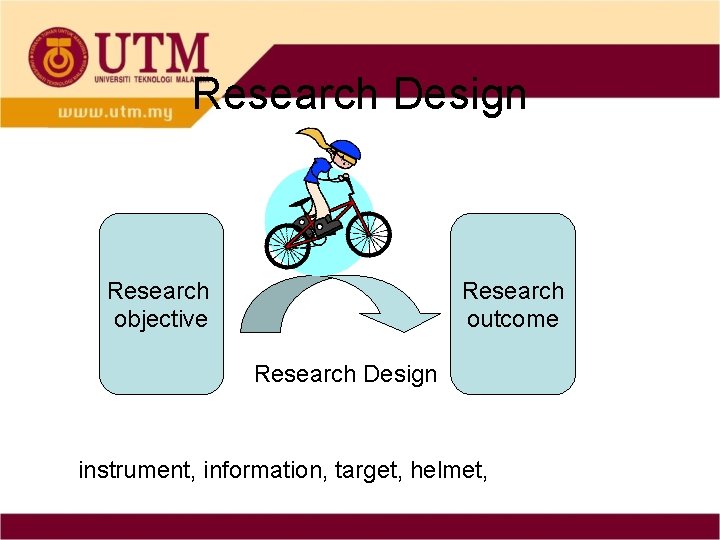
Research Design Research objective Research outcome Research Design instrument, information, target, helmet,
What is Research Design? • Master plan • Framework for action (Research Operational Framework) • Specifies methods and procedures • Can be thought of as the structure of the research that describes and holds together all the elements in a research from start to end. 4 INSPIRING CREATIVE AND INNOVATIVE MINDS
What is Research Design? • Is the strategy for a study and the plan by which the strategy is to be carried out. • Issues relating to purpose of study (exploratory, descriptive, hypothesis testing), its location (setting), type of investigation, time horizon, unit of analysis. • It specifies the methods and procedures for the collection, measurement and analysis of data. 5 INSPIRING CREATIVE AND INNOVATIVE MINDS
What is Research Design? • Covers many variations, some descriptors: – – Exploratory vs formalized Descriptive vs causal Cross-sectional vs longitudinal Field vs laboratory (experimental) vs simulation 6 INSPIRING CREATIVE AND INNOVATIVE MINDS
Research Methodology INSPIRING CREATIVE AND INNOVATIVE MINDS
Research Methods in Computer Science §implementation driven research. This approach progresses by iteratively building better and better systems. §mathematical proof techniques. This approach uses formal proofs to reason about the validity of a hypothesis given some evidence. For example, mathematical reasoning can be used to demonstrate that an algorithm can cover all possible input cases. §empiricism. This approach follows a clearly laid out sequence of steps: hypothesis; methods; results and conclusion. Statistical measures are often use to determine whether an experiment actually supports a hypothesis. §observational studies. This approach removes many of the constraints associated with empiricism by analysing the utility of a system in its eventual context of use. For example, the success or failure of a new programming language can only be assessed in this view if real programmers are trained to use the system on a real project. 8 INSPIRING CREATIVE AND INNOVATIVE MINDS
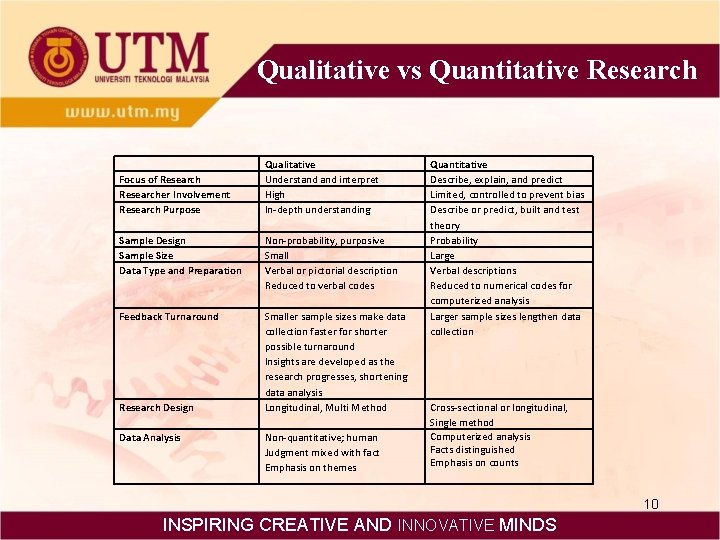
Qualitative vs Quantitative Research Qualitative Research *An array of interpretive techniques which seek to describe, decode, translate in terms of meaning not the frequency. *Aims to achieve an in-depth understanding of a situation. Quantitative Research *Attempts precise measurement of some behavior, knowledge, opinion or attitude. *Operationalization of variables Mixed Method Research * A combination of Qualitative and Quantitative 9 INSPIRING CREATIVE AND INNOVATIVE MINDS
Qualitative vs Quantitative Research Focus of Researcher Involvement Research Purpose Qualitative Understand interpret High In-depth understanding Sample Design Sample Size Data Type and Preparation Non-probability, purposive Small Verbal or pictorial description Reduced to verbal codes Feedback Turnaround Smaller sample sizes make data collection faster for shorter possible turnaround Insights are developed as the research progresses, shortening data analysis Longitudinal, Multi Method Research Design Data Analysis Non-quantitative; human Judgment mixed with fact Emphasis on themes Quantitative Describe, explain, and predict Limited, controlled to prevent bias Describe or predict, built and test theory Probability Large Verbal descriptions Reduced to numerical codes for computerized analysis Larger sample sizes lengthen data collection Cross-sectional or longitudinal, Single method Computerized analysis Facts distinguished Emphasis on counts 10 INSPIRING CREATIVE AND INNOVATIVE MINDS
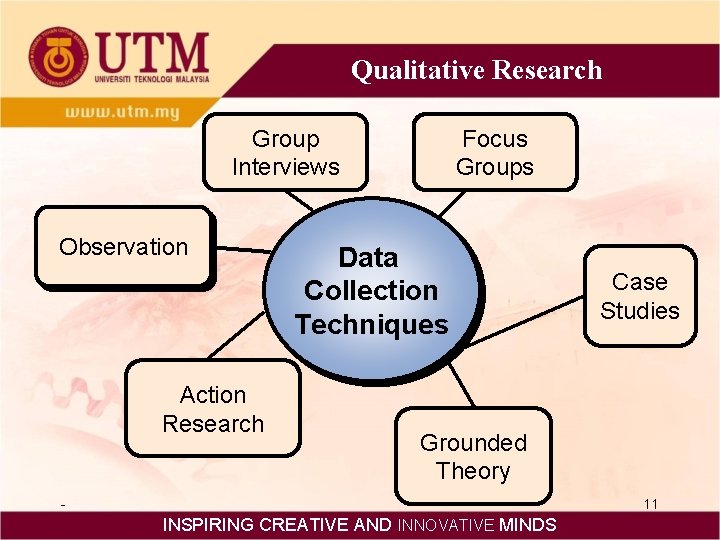
Qualitative Research Focus Group Interviews Observation Action Research Data Collection Techniques Case Studies Grounded Theory - 11 INSPIRING CREATIVE AND INNOVATIVE MINDS
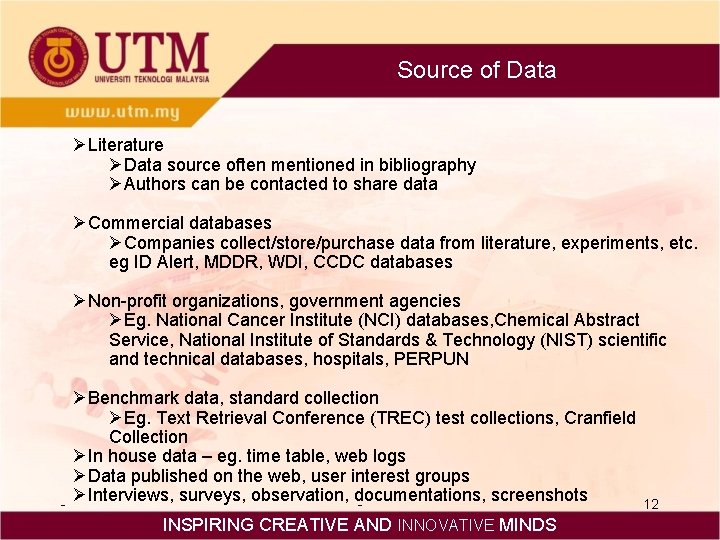
Source of Data ØLiterature ØData source often mentioned in bibliography ØAuthors can be contacted to share data ØCommercial databases ØCompanies collect/store/purchase data from literature, experiments, etc. eg ID Alert, MDDR, WDI, CCDC databases ØNon-profit organizations, government agencies ØEg. National Cancer Institute (NCI) databases, Chemical Abstract Service, National Institute of Standards & Technology (NIST) scientific and technical databases, hospitals, PERPUN - ØBenchmark data, standard collection ØEg. Text Retrieval Conference (TREC) test collections, Cranfield Collection ØIn house data – eg. time table, web logs ØData published on the web, user interest groups ØInterviews, surveys, observation, documentations, screenshots 12 INSPIRING CREATIVE AND INNOVATIVE MINDS
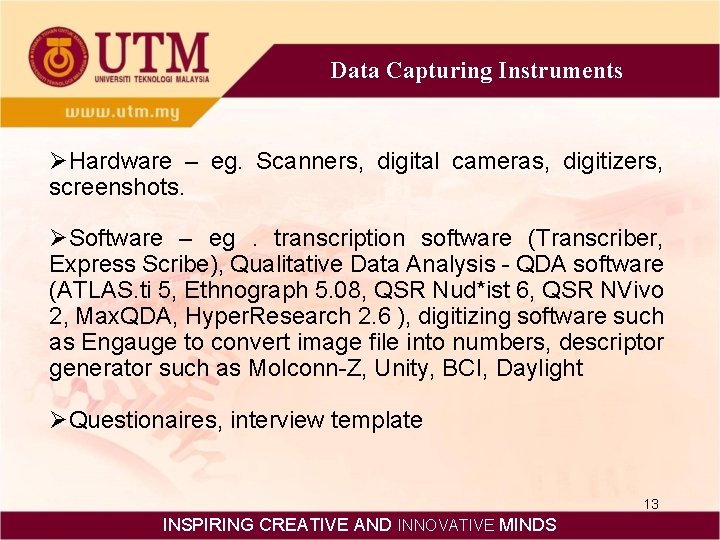
Data Capturing Instruments ØHardware – eg. Scanners, digital cameras, digitizers, screenshots. ØSoftware – eg . transcription software (Transcriber, Express Scribe), Qualitative Data Analysis - QDA software (ATLAS. ti 5, Ethnograph 5. 08, QSR Nud*ist 6, QSR NVivo 2, Max. QDA, Hyper. Research 2. 6 ), digitizing software such as Engauge to convert image file into numbers, descriptor generator such as Molconn-Z, Unity, BCI, Daylight ØQuestionaires, interview template 13 INSPIRING CREATIVE AND INNOVATIVE MINDS
Mix Method • Triangulation: Term to describe the combining of several qualitative methods or combining qualitative and quantitative methods. • Forward thinkers believe that the methodologies complement each other. • Many researchers recognize that qualitative compensates for the weakness of each methods. 14 INSPIRING CREATIVE AND INNOVATIVE MINDS
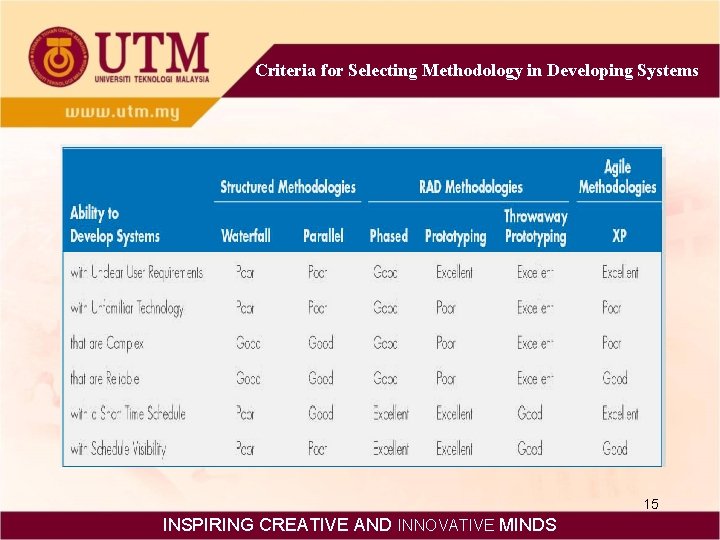
Criteria for Selecting Methodology in Developing Systems 15 INSPIRING CREATIVE AND INNOVATIVE MINDS
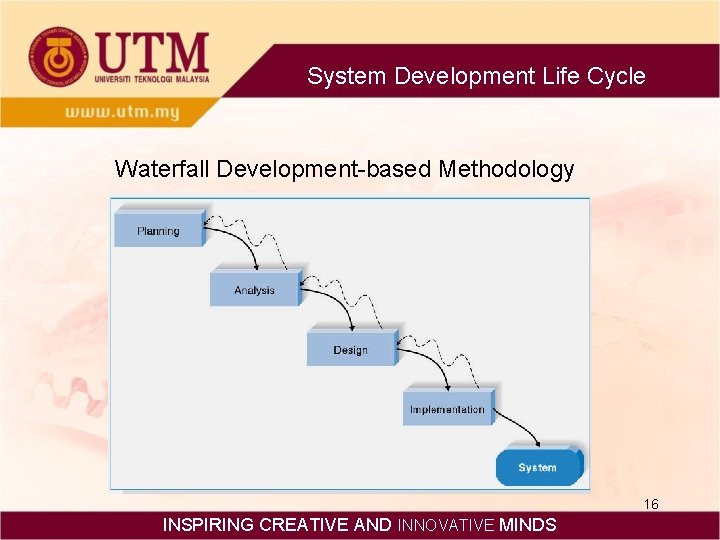
System Development Life Cycle Waterfall Development-based Methodology 16 INSPIRING CREATIVE AND INNOVATIVE MINDS
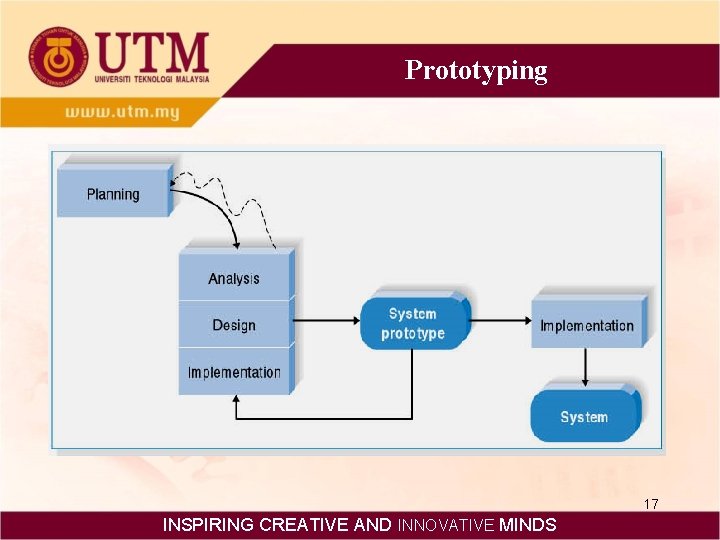
Prototyping 17 INSPIRING CREATIVE AND INNOVATIVE MINDS
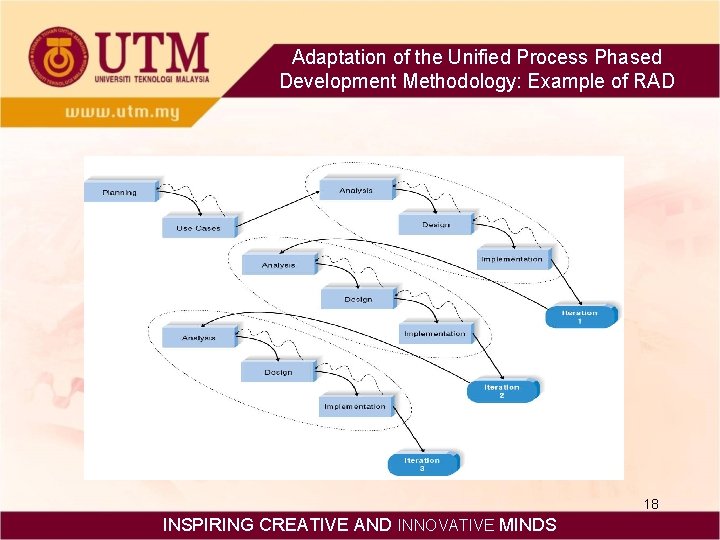
Adaptation of the Unified Process Phased Development Methodology: Example of RAD 18 INSPIRING CREATIVE AND INNOVATIVE MINDS
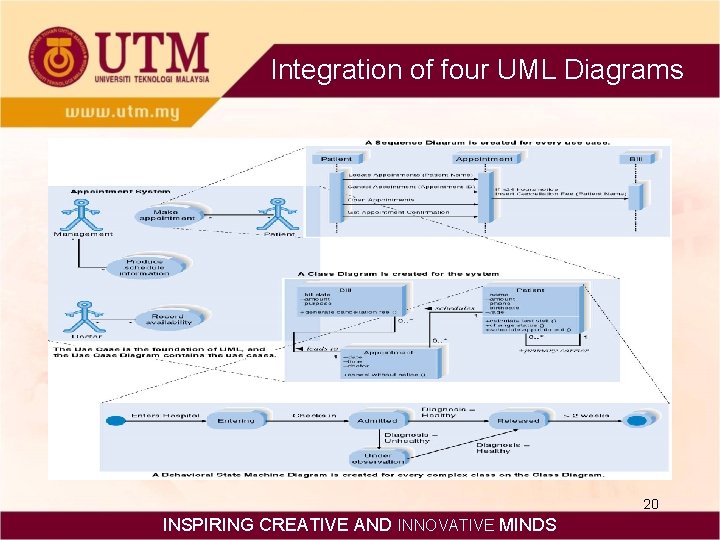
Object-Oriented Modeling Techniques • Major object-oriented modeling techniques include: – Use Case diagrams – Class diagrams – Sequence diagrams – Statechart diagrams 19 INSPIRING CREATIVE AND INNOVATIVE MINDS
Integration of four UML Diagrams 20 INSPIRING CREATIVE AND INNOVATIVE MINDS