
Research Design 1 WHAT IS SCIENCE n SCIENCE

- Slides: 55
Research Design 1
WHAT IS SCIENCE? n SCIENCE COMES FROM LATIN MEANS KNOWLEDGE n IT HAS TWO MEANING: CONTENT (FACTS) & PROCESS (SYSTEMATIC GATHERING DATA & OFFERIG EXPLANATION 2
METHODOLOGY n THE SCIENTIFIC TECHNIQUES USED TO COLLECT & EVALUATE DATA n DATA MAY COME FROM LAB EXPERIMENTS OR FROM REAL WORLD SETTINGS 3
MAJOR OBJECTIVES OF RESEARCH n 1. DESCRIPTION – SYSTEMATIC & UNBIASED OBSERVATION OF BEHIOUR WHICH INCLUDE i) CASE AND ii) FIELD STUDIES n 2. PREDICTION –REFERS CAPACITY OF KNOWLEDGE IN ADVANCE TO EXPECT CERTAIN RELATIONSHIP THAT INCLUDE QUASI & CORRELATIONAL DESIGN 4
n 3. EXPLANATION – CAUSE AND EFFECT – TO UNDERSTAND WHAT CAUSES IT TO OCCUR. n WHAT KNOWLEDGE OF CONDITION THAT REPRODUCED THE OCCURRENCE OF BEH SO WE USE AN EXPERIMENTAL RESEARCH DESIGN 5
n 4. CONTROL – ONCE THE BEHAVIOU HAS BEEN EXPLAINED THROUGH EXPERIMENTATION, IT MAY BE POSSIBLE TO USE THAT KNOWLEDGE TO EFFECT CHANGE OR IMPROVE BEHAVIOUR 6
RESEARCH METHODOLOGY n n n n n WHAT IS RESEARCH METHODOLOY? WHAT CONSTITUTE A RESEARCH PROBLEM? HOW TO SELECT A RESEARCH PROBLEM? WHAT IS LITERATURE REVIEW? HOW TO SELECT AN APPROPRIATE METHODOLOGY? WHAT ARE THE COMMON TYPES OF QUALITATIVE METHODOLOGY? WHAT ARE THE COMMON TYPES OF QUANTITATIVE METHODOLOGY? WHAT TYPES OF DATA TO COLLECT? HOW TO COLLECT DATA?
n n n HOW TO ANALYZE DATA? WHAT ARE THE TESTS ARE BEING USED ON CATEGORICAL DATA? WHAT ARE THE TESTS ARE BEING USED ON CONTINUOUS DATA? HOW TO DRAW CONCLUSION FROM DATA? HOW TO PRESENT RESEARCH FINDING? HOW TO PRESENT YOUR PAPER (LIKE APA)
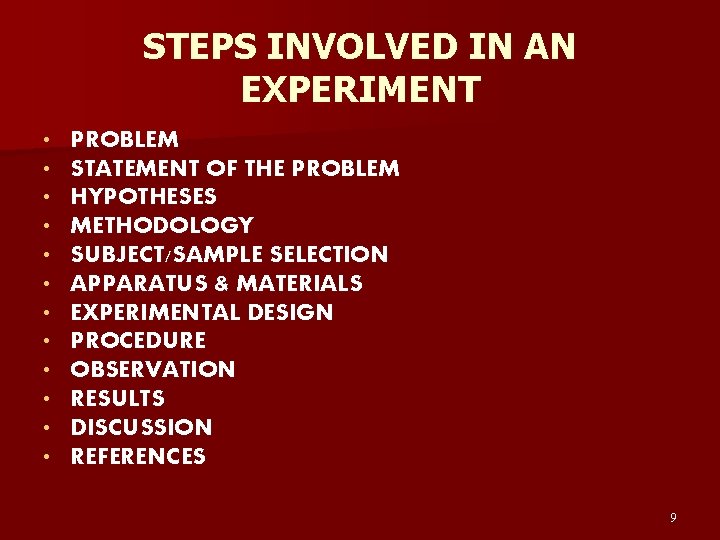
STEPS INVOLVED IN AN EXPERIMENT • • • PROBLEM STATEMENT OF THE PROBLEM HYPOTHESES METHODOLOGY SUBJECT/SAMPLE SELECTION APPARATUS & MATERIALS EXPERIMENTAL DESIGN PROCEDURE OBSERVATION RESULTS DISCUSSION REFERENCES 9
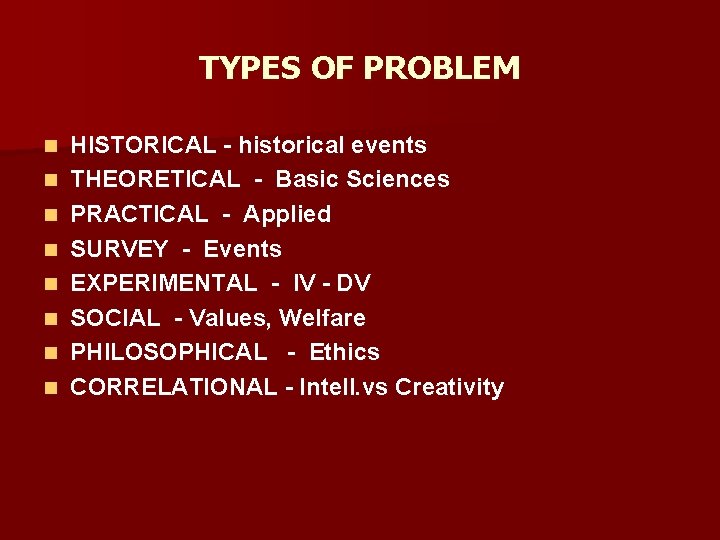
TYPES OF PROBLEM n n n n HISTORICAL - historical events THEORETICAL - Basic Sciences PRACTICAL - Applied SURVEY - Events EXPERIMENTAL - IV - DV SOCIAL - Values, Welfare PHILOSOPHICAL - Ethics CORRELATIONAL - Intell. vs Creativity
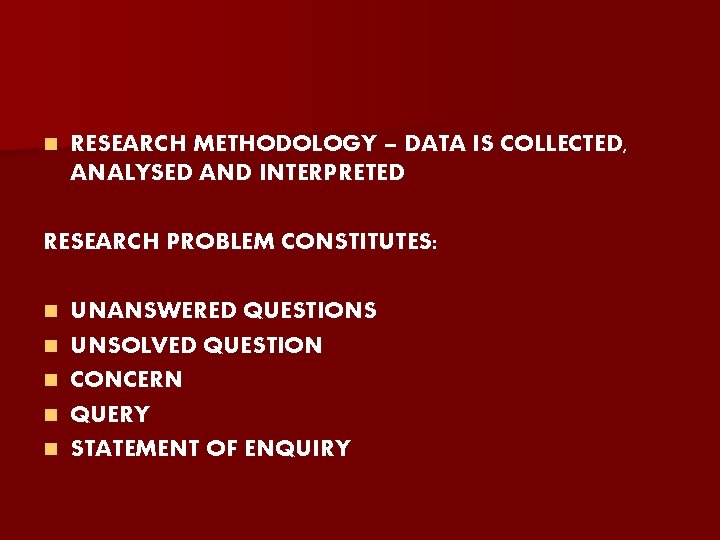
n RESEARCH METHODOLOGY – DATA IS COLLECTED, ANALYSED AND INTERPRETED RESEARCH PROBLEM CONSTITUTES: n n n UNANSWERED QUESTIONS UNSOLVED QUESTION CONCERN QUERY STATEMENT OF ENQUIRY
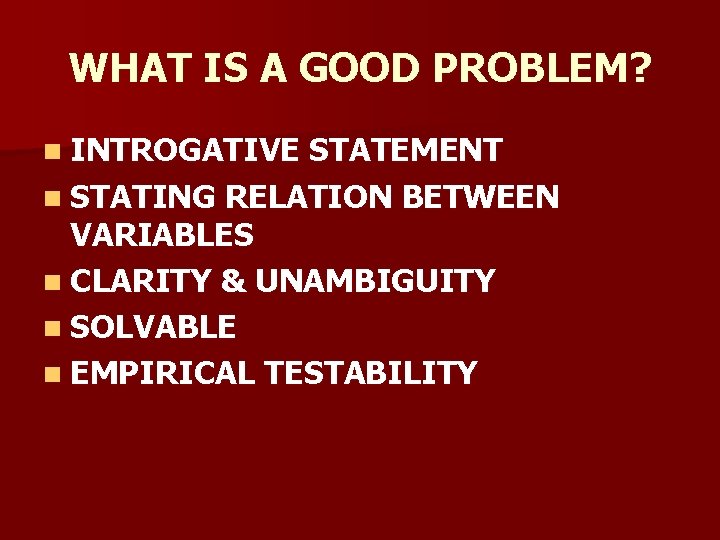
WHAT IS A GOOD PROBLEM? n INTROGATIVE STATEMENT n STATING RELATION BETWEEN VARIABLES n CLARITY & UNAMBIGUITY n SOLVABLE n EMPIRICAL TESTABILITY
HOW TO SELECT A RESEARCH PROBLEM? n PERSONAL INTEREST n SOCIAL PROBLEMS n TESTING THEORY n EMPIRICAL
EXPERIMENTAL PLAN n STATEMENT OF THE PROBLEM n STATEMENT OF THE HYPOTHESIS n DEFINITION OF THE VARIABLE (OPERATIONAL DEFINITION) n SPECIFY APPARATUS 14
VARIABLE n “A VARIABLE IS ANY MEASURABLE ATTRIBUTE OF OBJECTS, THINGS OR BEING. ” n “A VARIABLE IS AN EVENT OR CONDITION WHICH CAN HAVE DIFFERENT VALUES; WHICH CAN BE MEASURED AND WHICH VARIES QUANTITATIVELY. ” 15
TYPES OF VARIABLE n INDEPENDENT VARIABLE n DEPENDENT/CRITERION n ORGANISMIC VARIABLE n INTERVENING n EXTRANEOUS VARIABLE 16
CONTROL OF VARIABLES n FAILING TO CONTROL EXTRANEOUS VARIABLE RESULTS IN A CONFOUNDED EXPERIMENT, A DISASTROUS CONSEQUENCE FOR THE EXPERIMENTER. n CONTROL IN EXPERIMENT IS A CHARACTERISTICS OF THE EXPERIMENTAL METHOD IN WHICH EXTRANEOUS FACTORS WHICH MIGHT AFFECT DEPENDENT VARIABLE ARE HELD CONSTANT OR CANCELLED OUT IN SOME WAY SO THAT ONLY THE SPECIFIED INDEPENDENT VARIABLES ARE ALLOWED TO CHANGE. social work 17
TECHNIQUES OF CONTROL n METHOD OF ELIMINATION n METHOD OF CONSTANT CONDITION n METHOD OF MATCHING n METHOD OF BALANCING n METHOD OF COUNTER-BALANCING n METHOD OF RANDOMIZATION 18
HYPOTHESIS n Mc. GUIGAN, 69 – “HYPOTHESIS AS A TESTABLE STATEMENT OF POTENTIAL RELATIONSHIP BETWEEN TWO OR MORE VARIABLES. ” n CHAPLIN, 75 – “HYPOTHESIS IS AN ASSUMPTION WHICH SERVES AS A TENTATIVE EXPLANATION. ” n REBER, 87 – “HYPOTHESIS IS ANY STATEMENT, PROPOSITION OR ASSUMPTION THAT SERVES AS A TENTATIVE EXPLANATION OF CERTAIN FACTS. ” 19
FUNCTION OF HYPOTHESIS n HYPOTHESIS MAKES THE RESEARCH MEANINGFUL n HYPOTHESIS MAKES THE STUDY SPECIFIC n HYPOTHESIS MAKES THE RESEARCH FOCUSSED n HYPOTHESIS PROVIDES A DIRECTION FOR THE RESEARCH n HYPOTHESIS PROVIDES A STARTING POINT n HYPOTHESIS DELIMITS THE AREA OF RESEARCH 20
TYPES OF HYPOTHESIS: • SIMPLE • DIFFERENCE • NULL • SUBSTANTIAL • STATISTICAL 21
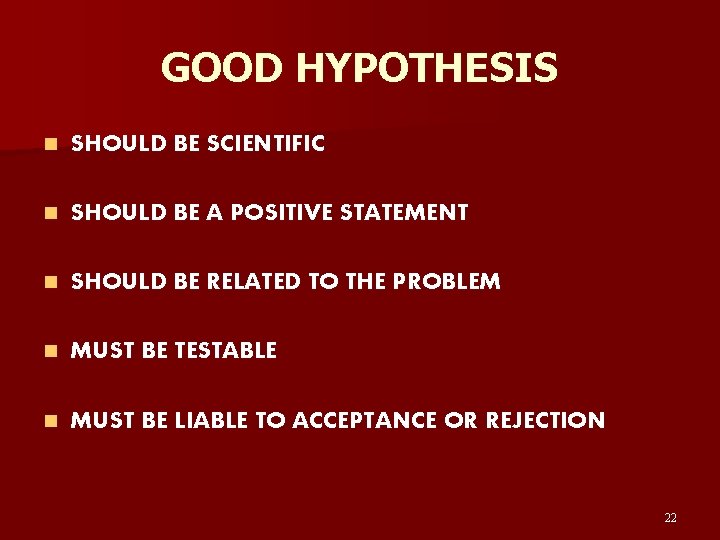
GOOD HYPOTHESIS n SHOULD BE SCIENTIFIC n SHOULD BE A POSITIVE STATEMENT n SHOULD BE RELATED TO THE PROBLEM n MUST BE TESTABLE n MUST BE LIABLE TO ACCEPTANCE OR REJECTION 22
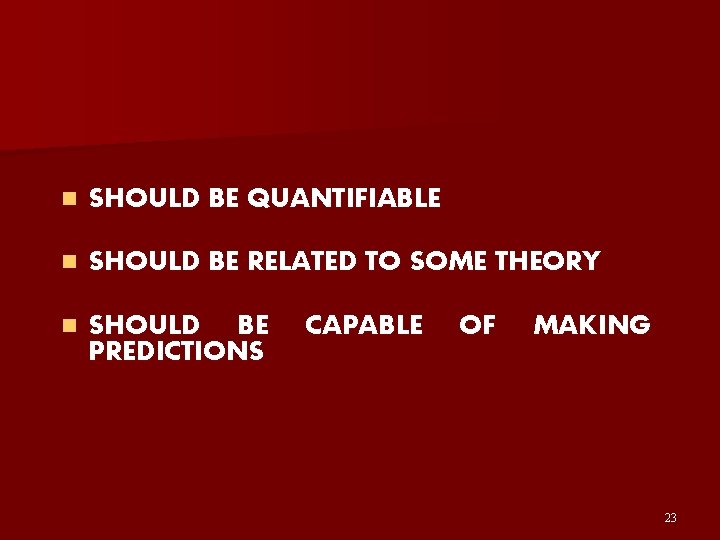
n SHOULD BE QUANTIFIABLE n SHOULD BE RELATED TO SOME THEORY n SHOULD BE PREDICTIONS CAPABLE OF MAKING 23
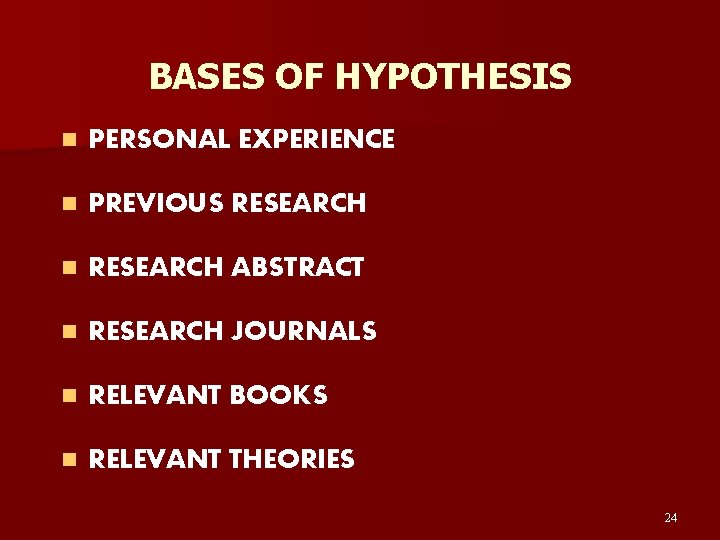
BASES OF HYPOTHESIS n PERSONAL EXPERIENCE n PREVIOUS RESEARCH n RESEARCH ABSTRACT n RESEARCH JOURNALS n RELEVANT BOOKS n RELEVANT THEORIES 24
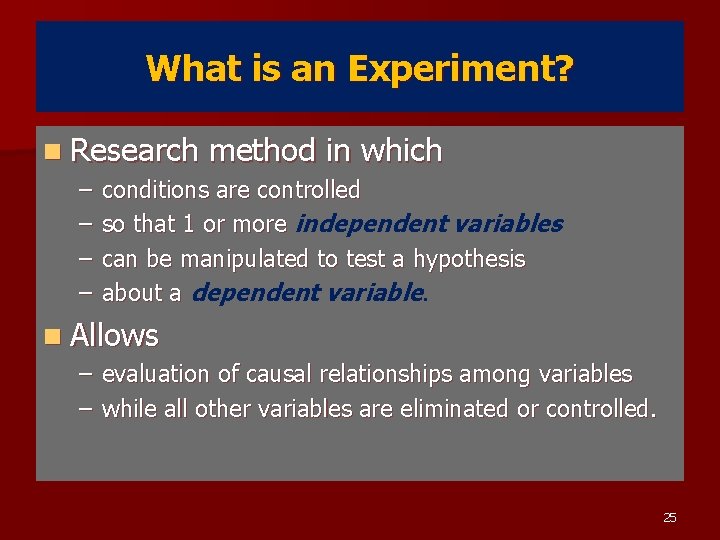
What is an Experiment? n Research – – method in which conditions are controlled so that 1 or more independent variables can be manipulated to test a hypothesis about a dependent variable. n Allows – evaluation of causal relationships among variables – while all other variables are eliminated or controlled. 25
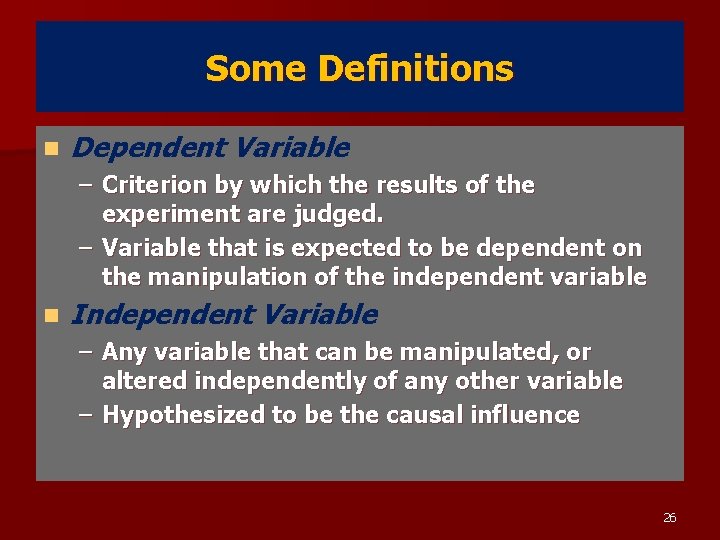
Some Definitions n Dependent Variable – Criterion by which the results of the experiment are judged. – Variable that is expected to be dependent on the manipulation of the independent variable n Independent Variable – Any variable that can be manipulated, or altered independently of any other variable – Hypothesized to be the causal influence 26
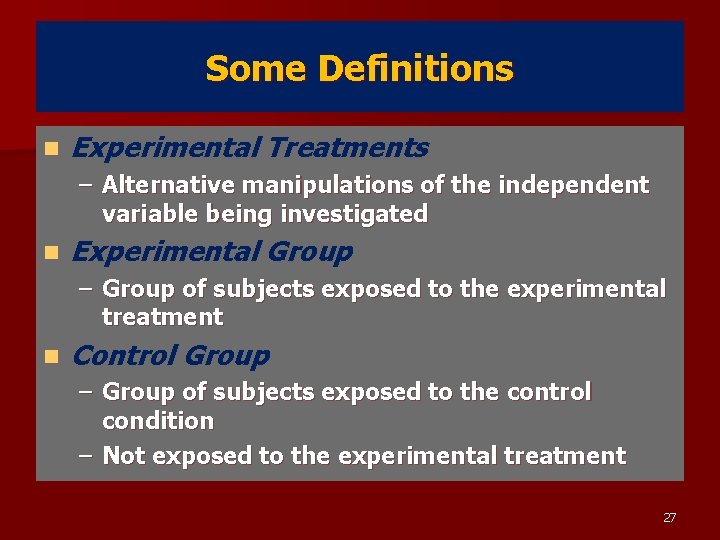
Some Definitions n Experimental Treatments – Alternative manipulations of the independent variable being investigated n Experimental Group – Group of subjects exposed to the experimental treatment n Control Group – Group of subjects exposed to the control condition – Not exposed to the experimental treatment 27
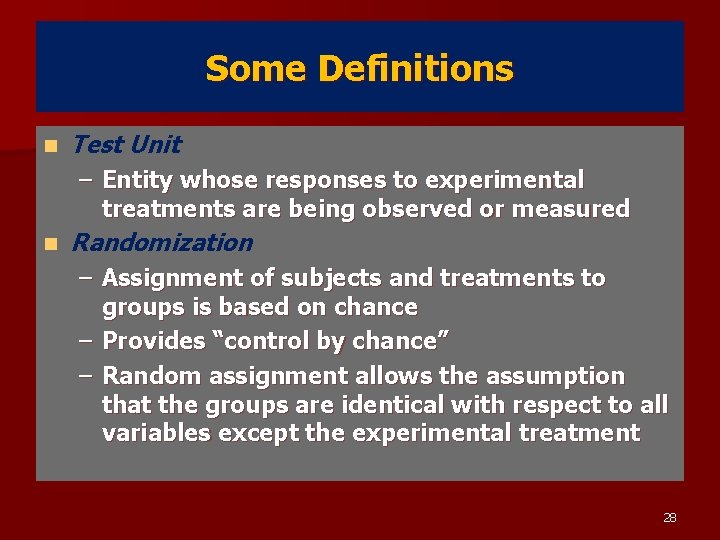
Some Definitions n Test Unit – Entity whose responses to experimental treatments are being observed or measured n Randomization – Assignment of subjects and treatments to groups is based on chance – Provides “control by chance” – Random assignment allows the assumption that the groups are identical with respect to all variables except the experimental treatment 28
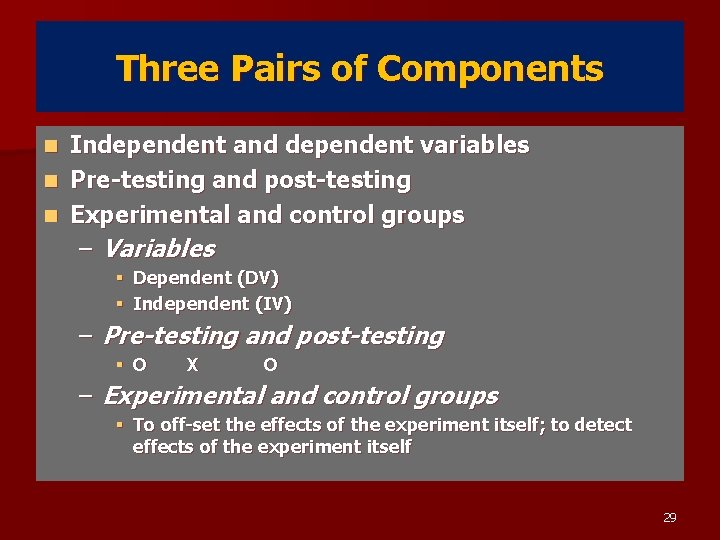
Three Pairs of Components Independent and dependent variables n Pre-testing and post-testing n Experimental and control groups – Variables n § Dependent (DV) § Independent (IV) – Pre-testing and post-testing § O X O – Experimental and control groups § To off-set the effects of the experiment itself; to detect effects of the experiment itself 29
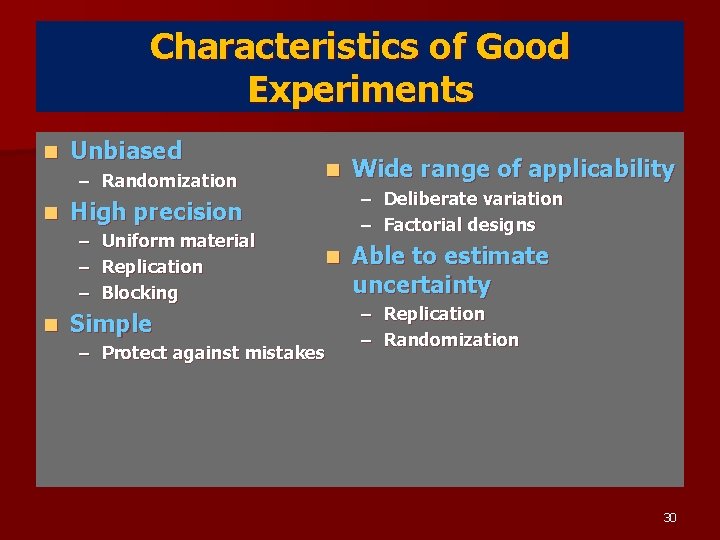
Characteristics of Good Experiments n Unbiased – Randomization n Wide range of applicability – Deliberate variation – Factorial designs High precision – Uniform material – Replication – Blocking n n n Simple – Protect against mistakes Able to estimate uncertainty – Replication – Randomization 30
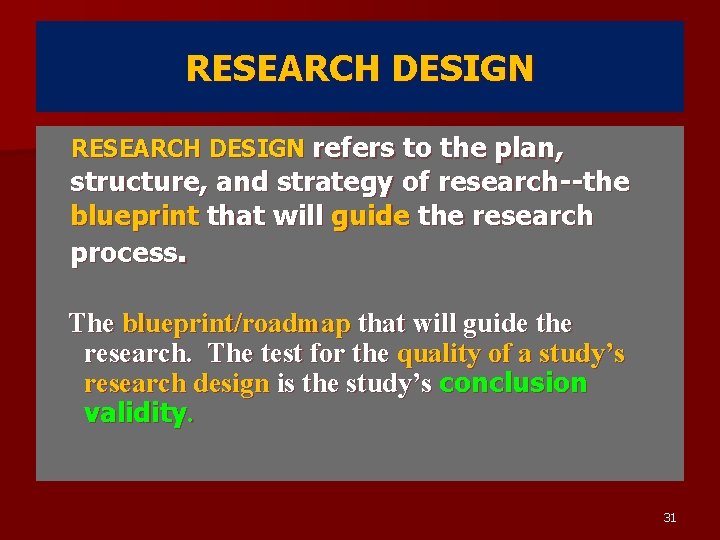
RESEARCH DESIGN refers to the plan, structure, and strategy of research--the blueprint that will guide the research process. The blueprint/roadmap that will guide the research. The test for the quality of a study’s research design is the study’s conclusion validity. 31
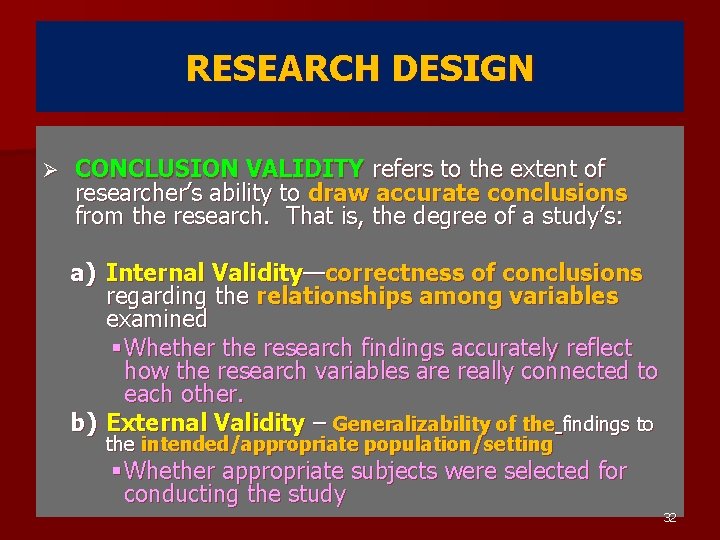
RESEARCH DESIGN Ø CONCLUSION VALIDITY refers to the extent of researcher’s ability to draw accurate conclusions from the research. That is, the degree of a study’s: a) Internal Validity—correctness of conclusions regarding the relationships among variables examined § Whether the research findings accurately reflect how the research variables are really connected to each other. b) External Validity – Generalizability of the findings to the intended/appropriate population/setting § Whether appropriate subjects were selected for conducting the study 32
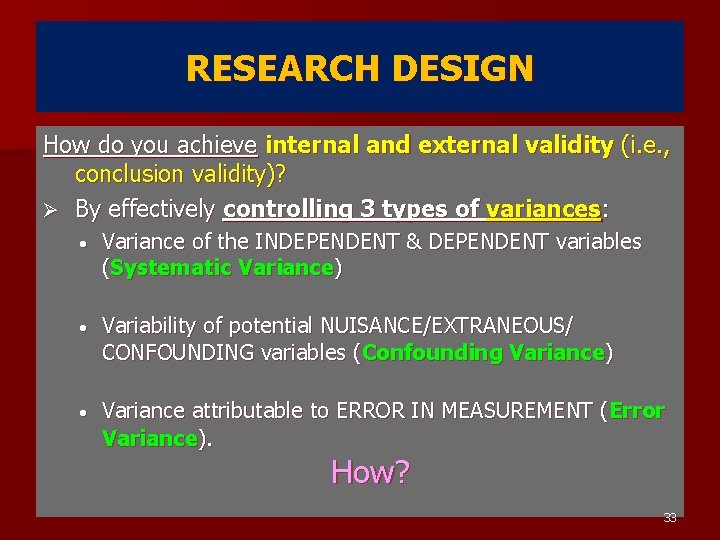
RESEARCH DESIGN How do you achieve internal and external validity (i. e. , conclusion validity)? Ø By effectively controlling 3 types of variances: • Variance of the INDEPENDENT & DEPENDENT variables (Systematic Variance) • Variability of potential NUISANCE/EXTRANEOUS/ CONFOUNDING variables (Confounding Variance) • Variance attributable to ERROR IN MEASUREMENT (Error Variance). How? 33
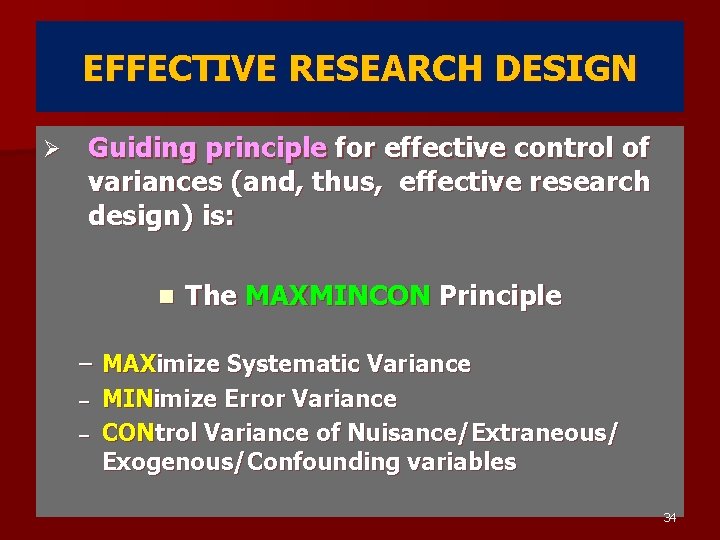
EFFECTIVE RESEARCH DESIGN Ø Guiding principle for effective control of variances (and, thus, effective research design) is: n The MAXMINCON Principle – MAXimize Systematic Variance – MINimize Error Variance – CONtrol Variance of Nuisance/Extraneous/ Exogenous/Confounding variables 34
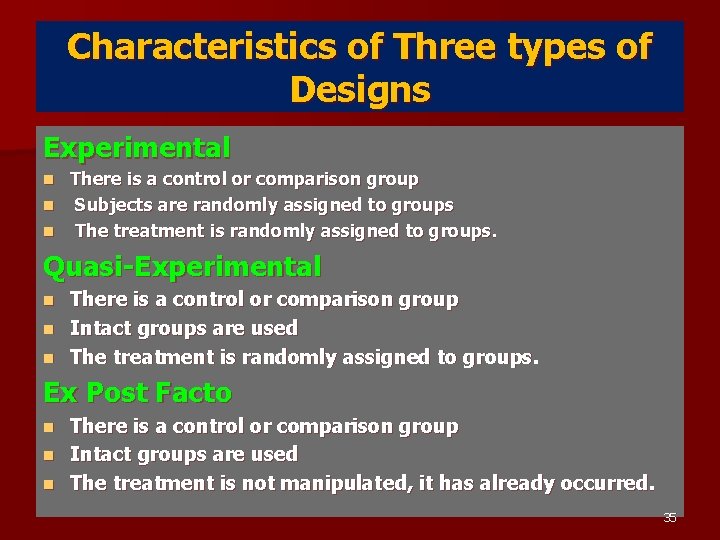
Characteristics of Three types of Designs Experimental There is a control or comparison group n Subjects are randomly assigned to groups n The treatment is randomly assigned to groups. n Quasi-Experimental There is a control or comparison group n Intact groups are used n The treatment is randomly assigned to groups. n Ex Post Facto There is a control or comparison group n Intact groups are used n The treatment is not manipulated, it has already occurred. n 35
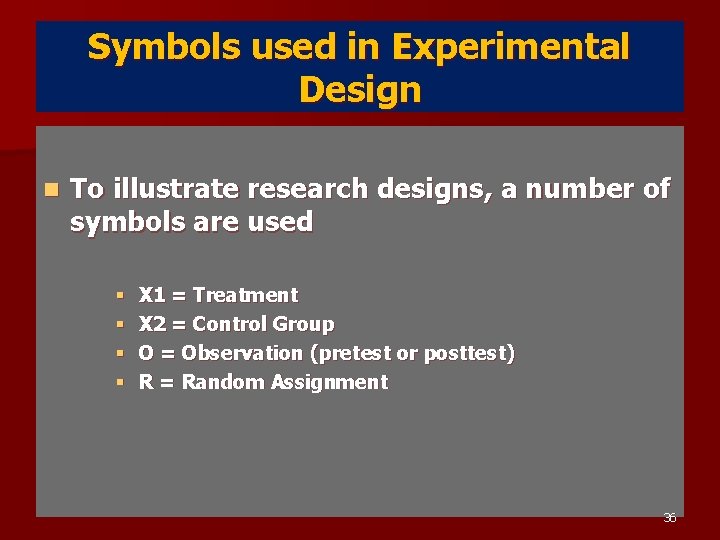
Symbols used in Experimental Design n To illustrate research designs, a number of symbols are used § § X 1 = Treatment X 2 = Control Group O = Observation (pretest or posttest) R = Random Assignment 36
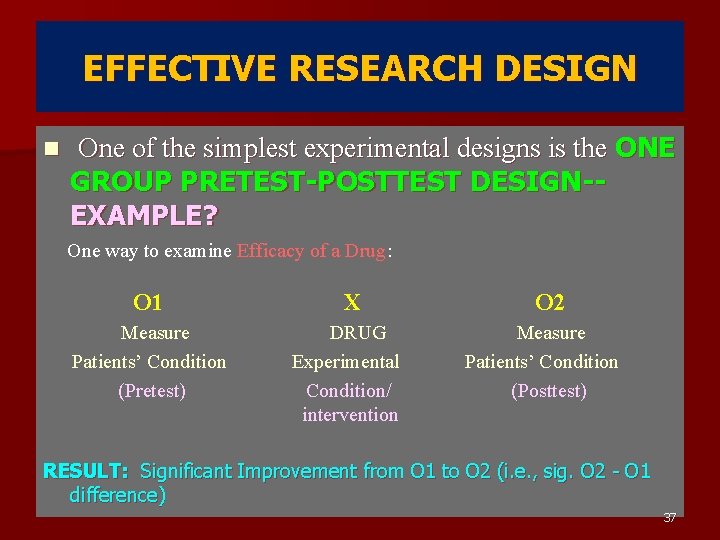
EFFECTIVE RESEARCH DESIGN n One of the simplest experimental designs is the ONE GROUP PRETEST-POSTTEST DESIGN-EXAMPLE? One way to examine Efficacy of a Drug: O 1 Measure Patients’ Condition (Pretest) X DRUG Experimental Condition/ intervention O 2 Measure Patients’ Condition (Posttest) RESULT: Significant Improvement from O 1 to O 2 (i. e. , sig. O 2 - O 1 difference) 37
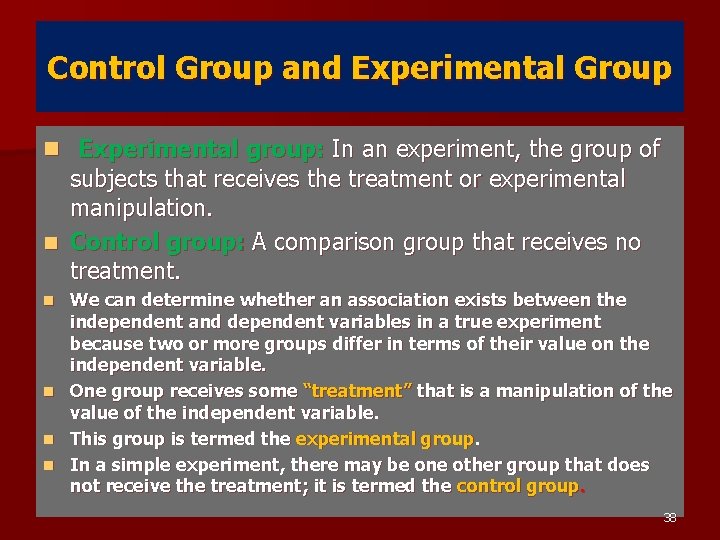
Control Group and Experimental Group n Experimental group: In an experiment, the group of subjects that receives the treatment or experimental manipulation. n Control group: A comparison group that receives no treatment. We can determine whether an association exists between the independent and dependent variables in a true experiment because two or more groups differ in terms of their value on the independent variable. n One group receives some “treatment” that is a manipulation of the value of the independent variable. n This group is termed the experimental group. n In a simple experiment, there may be one other group that does not receive the treatment; it is termed the control group. n 38
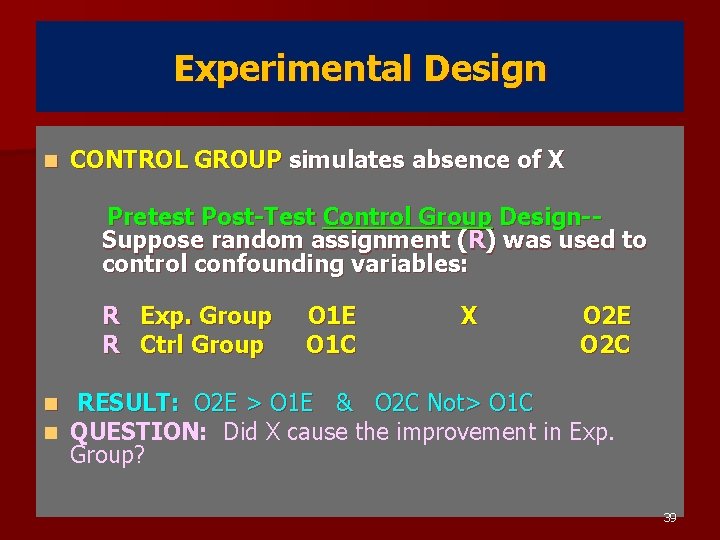
Experimental Design n CONTROL GROUP simulates absence of X Pretest Post-Test Control Group Design-Suppose random assignment (R) was used to control confounding variables: R Exp. Group R Ctrl Group n n O 1 E O 1 C X O 2 E O 2 C RESULT: O 2 E > O 1 E & O 2 C Not> O 1 C QUESTION: Did X cause the improvement in Exp. Group? 39
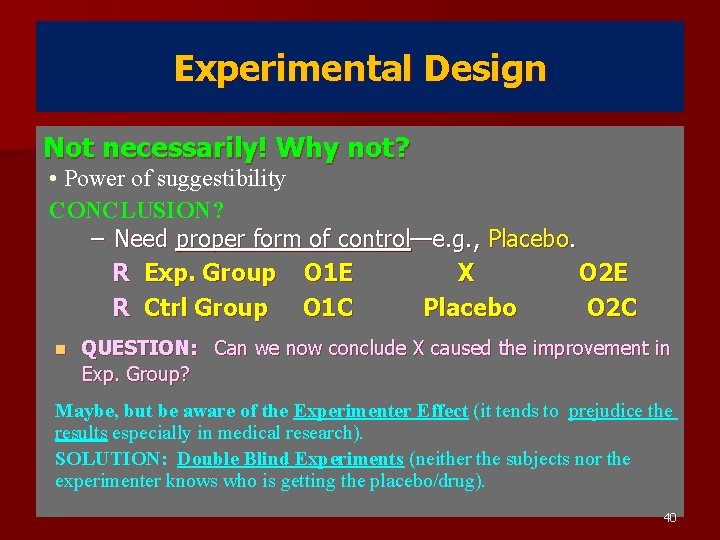
Experimental Design Not necessarily! Why not? • Power of suggestibility CONCLUSION? – Need proper form of control—e. g. , Placebo. R Exp. Group O 1 E X O 2 E R Ctrl Group O 1 C Placebo O 2 C n QUESTION: Can we now conclude X caused the improvement in Exp. Group? Maybe, but be aware of the Experimenter Effect (it tends to prejudice the results especially in medical research). SOLUTION: Double Blind Experiments (neither the subjects nor the experimenter knows who is getting the placebo/drug). 40
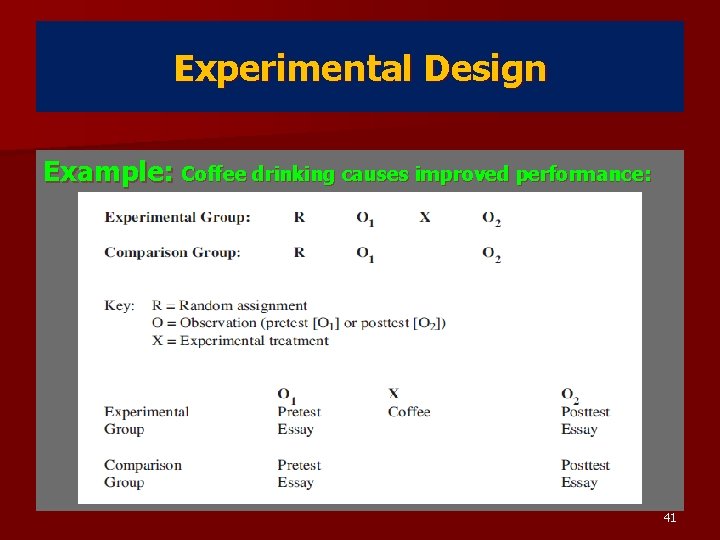
Experimental Design Example: Coffee drinking causes improved performance: 41
Ex Post Facto Design “From what is done afterwards” 42
Characteristics of Ex-Post Facto Webster Dictionary defines Ex Post Facto as: – after the fact : retroactively – Late Latin, literally, from a thing done afterward. First Known Use: 1621 n In situations where it is not possible to manipulate variables. n Ex Post Facto design provides an alternative to investigate how independent variables affect dependant variables. n The researcher can observe the independent variables after the event. n 43
Ex Post Facto Design n Studies that investigate possible cause and effect relationships by observing an existing condition or state of affairs and searching back in time for plausible causal factors. 44
Two approaches to Ex-Post Facto Research One commences with subjects who differ on an independent variable, for example their years of study in mathematics, and then study how they differ on the dependent variable, e. g. a mathematics test. 2. One commences with subjects who differ on the dependent variable (for example their performance in a mathematics test) and discover how they differ on a range of independent variables, e. g. their years of study, their liking for the subject, the amount of homework they do in mathematics). 1. 45
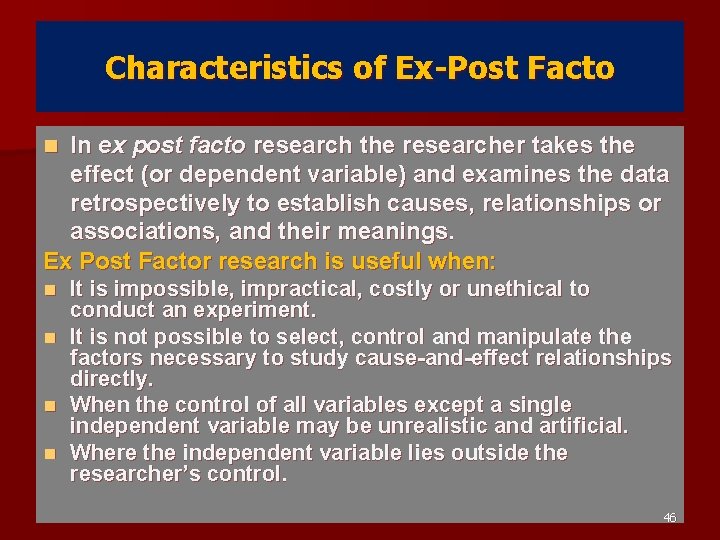
Characteristics of Ex-Post Facto In ex post facto research the researcher takes the effect (or dependent variable) and examines the data retrospectively to establish causes, relationships or associations, and their meanings. Ex Post Factor research is useful when: n n n It is impossible, impractical, costly or unethical to conduct an experiment. It is not possible to select, control and manipulate the factors necessary to study cause-and-effect relationships directly. When the control of all variables except a single independent variable may be unrealistic and artificial. Where the independent variable lies outside the researcher’s control. 46
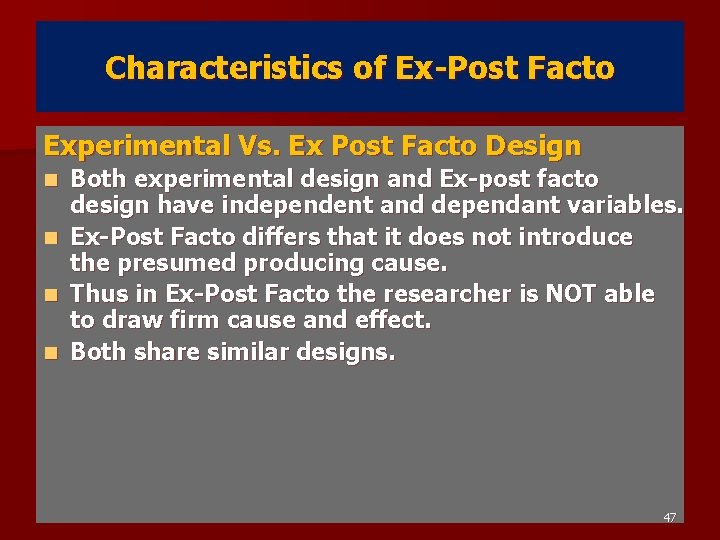
Characteristics of Ex-Post Facto Experimental Vs. Ex Post Facto Design n n Both experimental design and Ex-post facto design have independent and dependant variables. Ex-Post Facto differs that it does not introduce the presumed producing cause. Thus in Ex-Post Facto the researcher is NOT able to draw firm cause and effect. Both share similar designs. 47
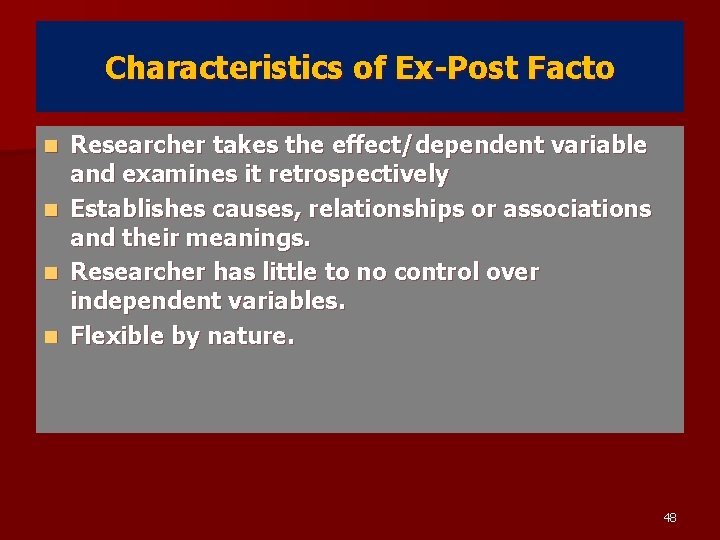
Characteristics of Ex-Post Facto n n Researcher takes the effect/dependent variable and examines it retrospectively Establishes causes, relationships or associations and their meanings. Researcher has little to no control over independent variables. Flexible by nature. 48
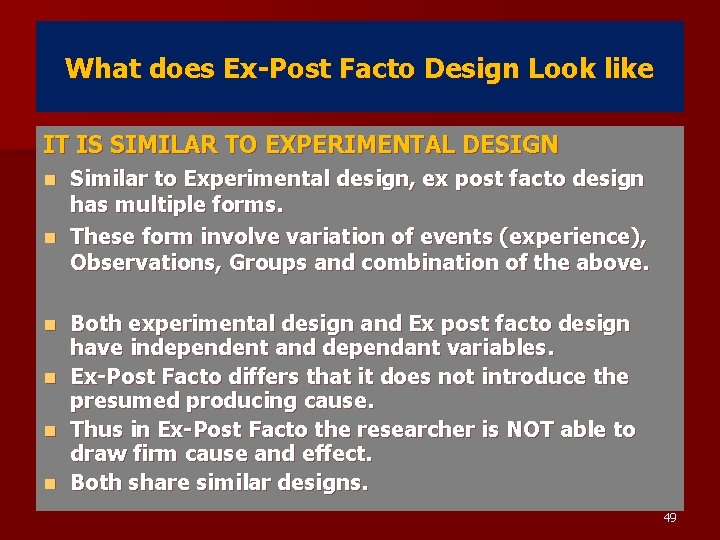
What does Ex-Post Facto Design Look like IT IS SIMILAR TO EXPERIMENTAL DESIGN Similar to Experimental design, ex post facto design has multiple forms. n These form involve variation of events (experience), Observations, Groups and combination of the above. n Both experimental design and Ex post facto design have independent and dependant variables. n Ex-Post Facto differs that it does not introduce the presumed producing cause. n Thus in Ex-Post Facto the researcher is NOT able to draw firm cause and effect. n Both share similar designs. n 49
What does Ex-Post Facto Design Look like IS IT DIFFERENT FROM CORRELATIONAL DESIGN? n Co-relational design and Ex-post facto design involve examining existing conditions. n Ex-Post Facto design has dependant and independent variables whereas Co-relational design does not. 50
When to Use this? n You can use this where more powerful experimental designs are not possible; when you are unable to select, control and manipulate the factors necessary to study cause and effect relationships directly, or when control variables except a single independent variable may be unrealistic and artificial. 51
Factorial Design n In designs that involve multiple dependant variables with Ex Post Facto design, Factorial design is needed. 52
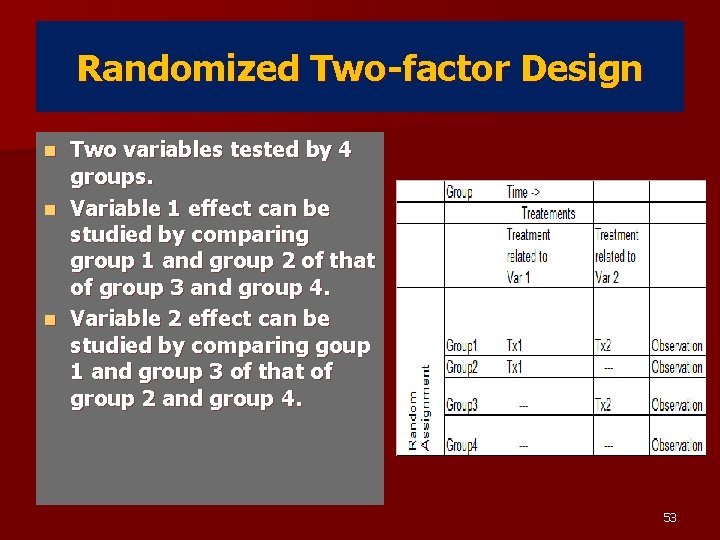
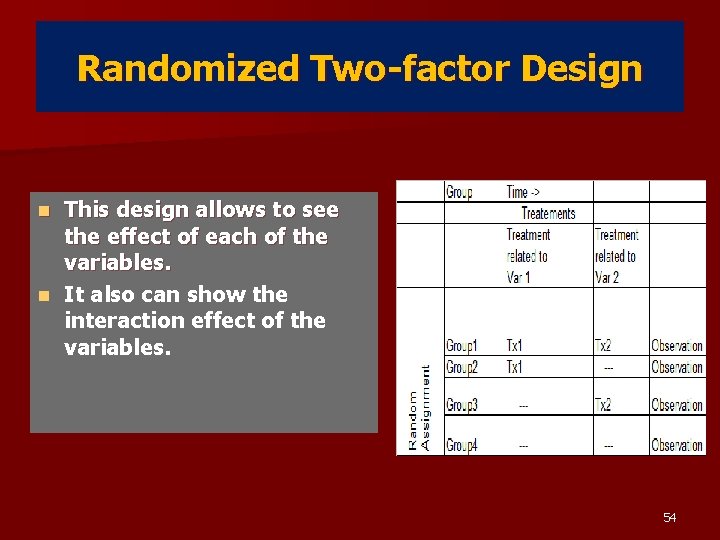
Randomized Two-factor Design Two variables tested by 4 groups. n Variable 1 effect can be studied by comparing group 1 and group 2 of that of group 3 and group 4. n Variable 2 effect can be studied by comparing goup 1 and group 3 of that of group 2 and group 4. n 53
Randomized Two-factor Design This design allows to see the effect of each of the variables. n It also can show the interaction effect of the variables. n 54
Ex post facto advantages and disadvantages Advantages n Show a correlation where more rigorous experimentation is not possible n Exploratory tool n Useful to avoid artifiality in the research. n Shows cause and effect relationships Disadvantages Lack of control for independent variable and randomizing subjects. n Never certain if causative factor has been included or identified n Relationship between two factors does not est. cause and effect. n May be regarded as too flexible. n 55