
Research Degree Theses and Oral Examinations John Kirby
Research Degree Theses and Oral Examinations John Kirby Graduate School Faculty of Medical Sciences University of Newcastle

What is the word limit • Newcastle does not currently have a formally stated word limit. • This is NOT a licence to go on and on…. • Look at plenty of examples – Not just from your own group!
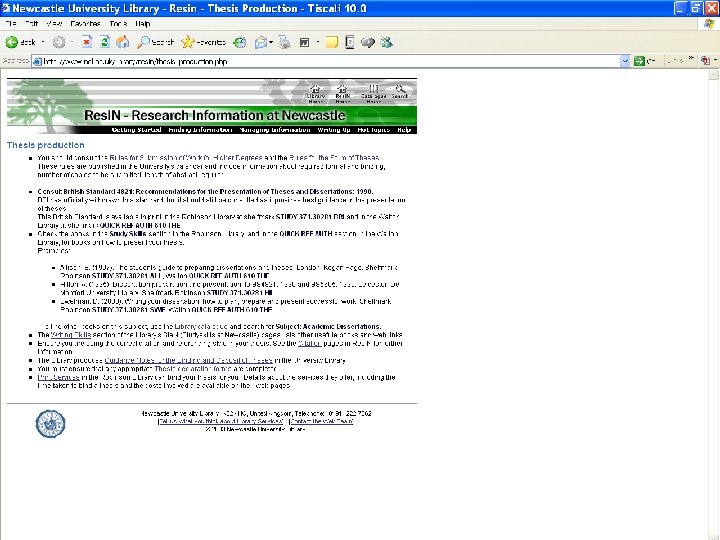
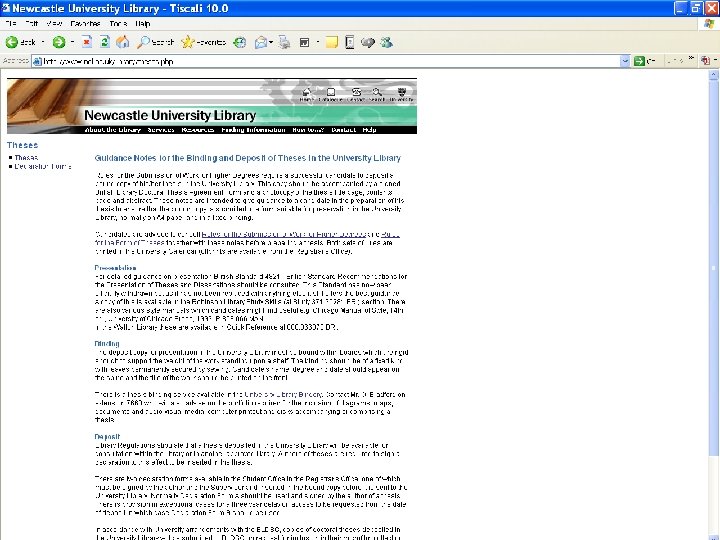
British Standard BSI 4821: 1990 Now withdrawn! But can still provide useful information Library: Quick reference section.
Make life easy! • Produce final quality images as you go along – don’t wait until the end to put these together. • Maintain a bibliography as you go – write your own comments! Don’t simply download abstracts into Endnote.
Types of thesis • ‘Standard’ – Divided into chapters with results and interpretations • By publication – A review and a series of ~5 related papers – Can be difficult to examine as papers have already satisfied external referees! – Only for staff candidates
How do I write a book? • Agree a preliminary table of contents with your supervisor (assessment 3). – Bite sized pieces • Materials and methodology are easy (descriptive) and get you started. • Results is also descriptive and is crucial to the structure of your thesis. • Introduction and discussion are hard
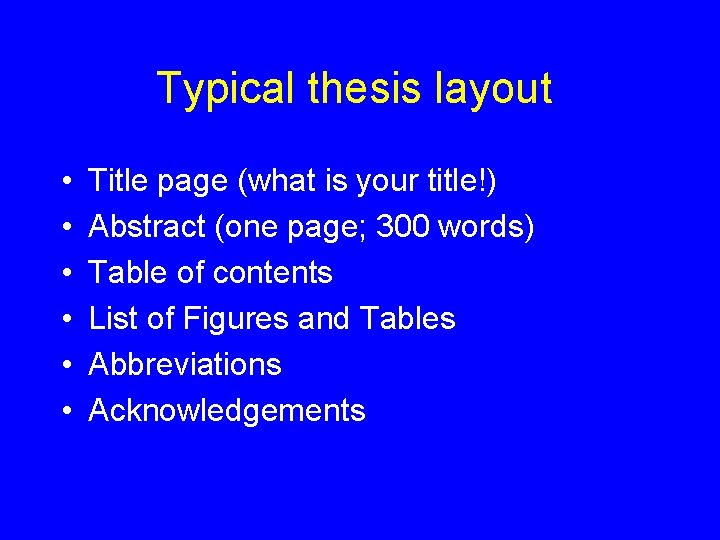
Typical thesis layout • • • Title page (what is your title!) Abstract (one page; 300 words) Table of contents List of Figures and Tables Abbreviations Acknowledgements
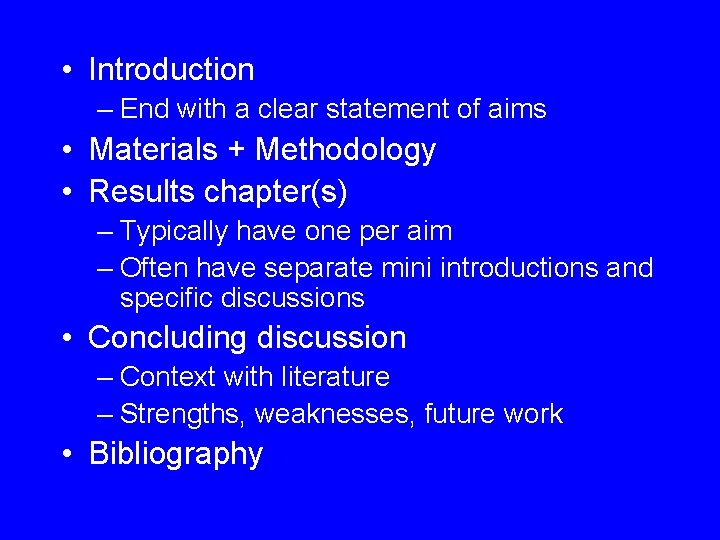
• Introduction – End with a clear statement of aims • Materials + Methodology • Results chapter(s) – Typically have one per aim – Often have separate mini introductions and specific discussions • Concluding discussion – Context with literature – Strengths, weaknesses, future work • Bibliography
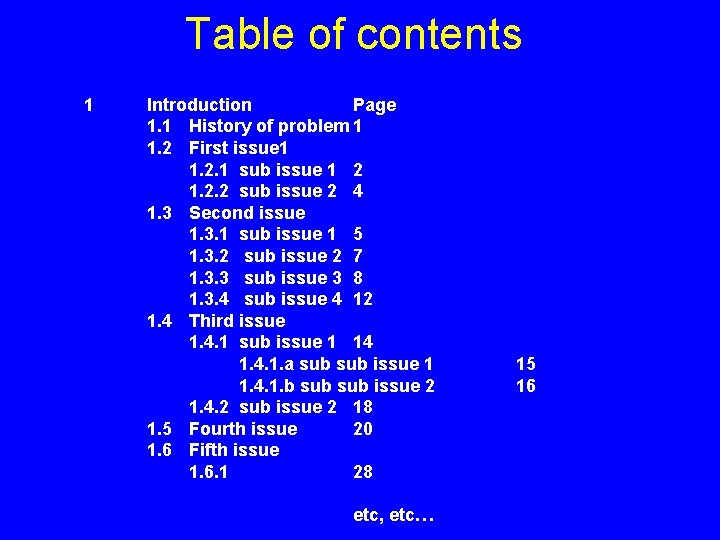
Table of contents 1 Introduction Page 1. 1 History of problem 1 1. 2 First issue 1 1. 2. 1 sub issue 1 2 1. 2. 2 sub issue 2 4 1. 3 Second issue 1. 3. 1 sub issue 1 5 1. 3. 2 sub issue 2 7 1. 3. 3 sub issue 3 8 1. 3. 4 sub issue 4 12 1. 4 Third issue 1. 4. 1 sub issue 1 14 1. 4. 1. a sub issue 1 1. 4. 1. b sub issue 2 1. 4. 2 sub issue 2 18 1. 5 Fourth issue 20 1. 6 Fifth issue 1. 6. 1 28 etc, etc… 15 16
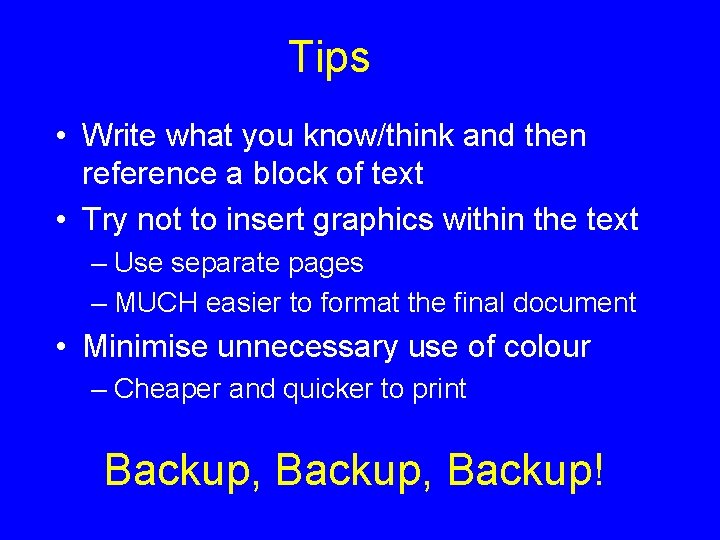
Tips • Write what you know/think and then reference a block of text • Try not to insert graphics within the text – Use separate pages – MUCH easier to format the final document • Minimise unnecessary use of colour – Cheaper and quicker to print Backup, Backup!
Finished • Get fiends and family to prrofread • Final printing takes much longer than you think! • Liaise with your supervisors – They must nominate examiners well in advance of submission! • Binding – Soft at first
Purpose of an examination • For the University – To assess and maintain quality – To mark ‘completion’ of the degree programme • For the Student – Potentially leads to award of a degree – Is an important and memorable life event • can be a real emotional roller coaster (for everyone involved)
Who needs an oral examination? • All Ph. D and MD candidates – Students and full-time JRAs need one internal and one external examiner – Staff candidates require two external examiners • Not all MPhil candidates – Same criteria for examiners as above – Oral examination held at examiners request • Not only for weak students • With a good candidate can be fun for everyone!
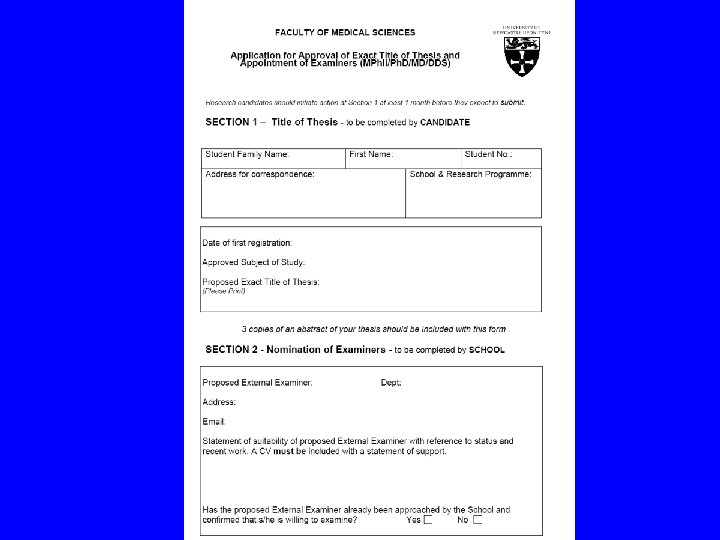
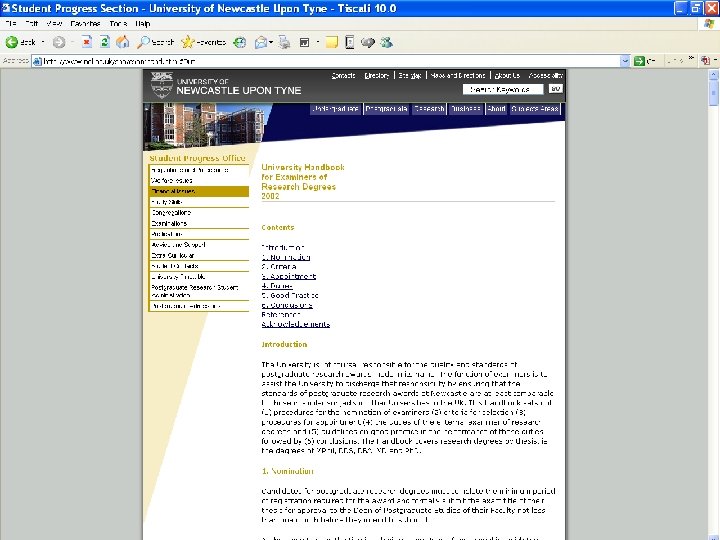
Appointment of examiners • See nomination forms on Graduate School www-site. • Examiners must: – be cognisant of standards – have subject knowledge (need CV) – command authority – not have played a role in the research – (if external) not have been a member of Newcastle staff for at least 3 years – be able and willing to examine
Internal examiners • Liaise with supervisor, student (and sometimes external) to arrange examination • Ensure the examination complies with Newcastle University protocol • Ensure appropriate report forms are completed and submitted in a timely manner • Provide balance, fairness and ensure good examination conduct • Potentially play a role during any appeals process
External examiners • Usually is the scientific specialist • Usually has the ‘casting vote’ • Maintains inter-university quality – Report provides important feedback to Graduate School • May not be completely ‘up to speed’ with local regulations!
Criteria – all theses • Should be: – Authentic – Scholarly – Professional – Well-structured, written and presented
MPhil candidates • Should – Demonstrate advanced knowledge – Have good knowledge of literature • Theses need not be – As original as a Ph. D – Worthy of publication
Ph. D/MD candidates • Should – provide evidence of adequate industry – demonstrate ability for originality – understand relationship with wider field – thesis should contain material worthy of publication
Preliminary Report • Regulations vary between institutions read them! • Many (but not all) institutions require examiners to independently produce reports before the examination – Some need these to be submitted before the examination to flag up potential problems
How to conduct the examination - 1 • Arrange the room – Often good to have pencils and paper to draw on • At the start candidates can be very nervous! – Put them at their ease if possible with a soft start (but don’t anticipate the result!) – Remember to arrange refreshment breaks – Consider the candidate’s bladder
How to conduct the examination - 2 • Agree a plan with your co-examiner • Remember: – Oral examination of a good candidate can/should be one of the most pleasurable academic experiences for all involved – Examination of a poor thesis/candidate can be truly awful! • You need to devise different strategies for both situations
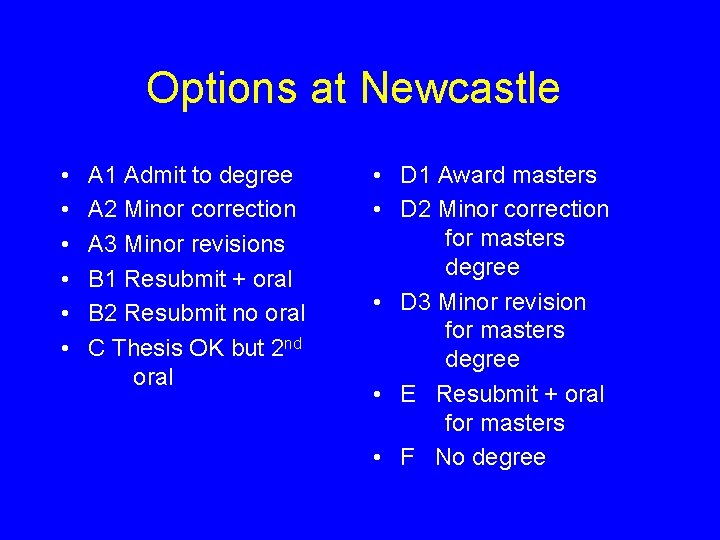
Options at Newcastle • • • A 1 Admit to degree A 2 Minor correction A 3 Minor revisions B 1 Resubmit + oral B 2 Resubmit no oral C Thesis OK but 2 nd oral • D 1 Award masters • D 2 Minor correction for masters degree • D 3 Minor revision for masters degree • E Resubmit + oral for masters • F No degree
At the end (if all has gone well) • Ask the candidate to withdraw for a few minutes • REMEMBER you do not award the degree!! • Work out what you wish to say, then invite the candidate back • Tell the candidate what recommendation you will be making to the higher degrees committee (or other appropriate authority). • Smile and shake hands
- Slides: 29