
Research Data Management Data Management Plans DMPs Sarah
- Slides: 31
Research Data Management & Data Management Plans (DMPs) Sarah Jones DCC, University of Glasgow sarah. jones@glasgow. ac. uk Twitter: @sj. DCC Funded by:
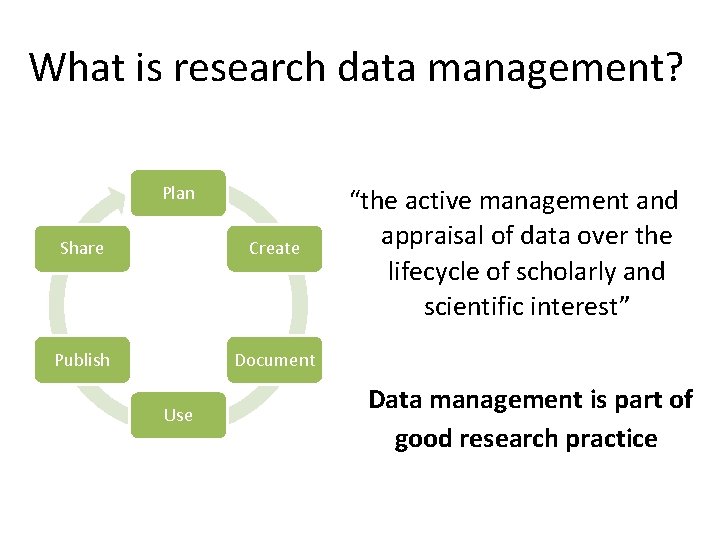
What is research data management? Plan Share Create Publish Document Use “the active management and appraisal of data over the lifecycle of scholarly and scientific interest” Data management is part of good research practice
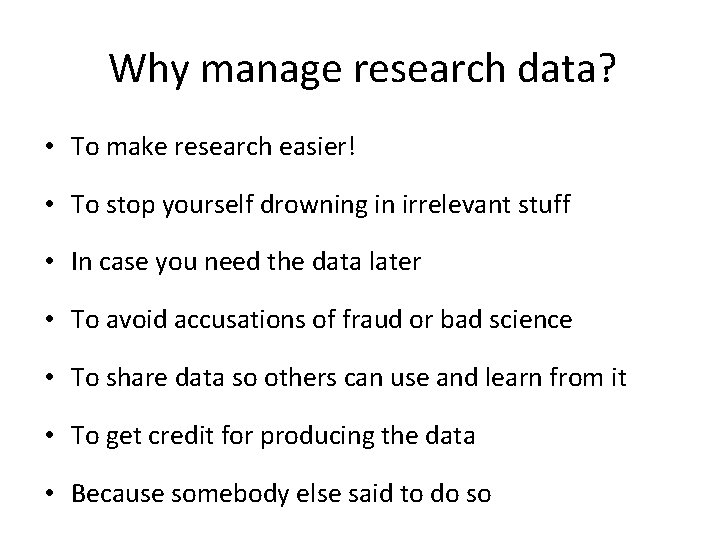
Why manage research data? • To make research easier! • To stop yourself drowning in irrelevant stuff • In case you need the data later • To avoid accusations of fraud or bad science • To share data so others can use and learn from it • To get credit for producing the data • Because somebody else said to do so
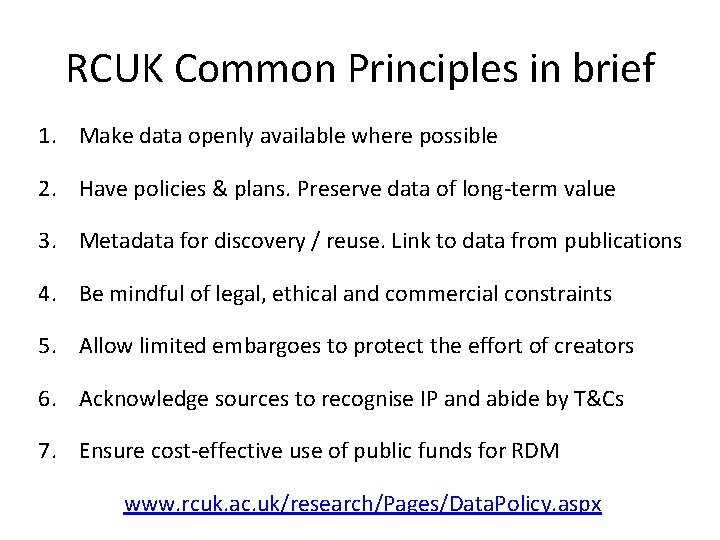
RCUK Common Principles in brief 1. Make data openly available where possible 2. Have policies & plans. Preserve data of long-term value 3. Metadata for discovery / reuse. Link to data from publications 4. Be mindful of legal, ethical and commercial constraints 5. Allow limited embargoes to protect the effort of creators 6. Acknowledge sources to recognise IP and abide by T&Cs 7. Ensure cost-effective use of public funds for RDM www. rcuk. ac. uk/research/Pages/Data. Policy. aspx
Ultimately funders expect: • timely release of data - once patents are filed or on (acceptance for) publication • open data sharing - minimal or no restrictions if possible • preservation of data - typically 5 -10+ years if of long-term value See the RCUK Common Principles on Data Policy: www. rcuk. ac. uk/research/Pages/Data. Policy. aspx
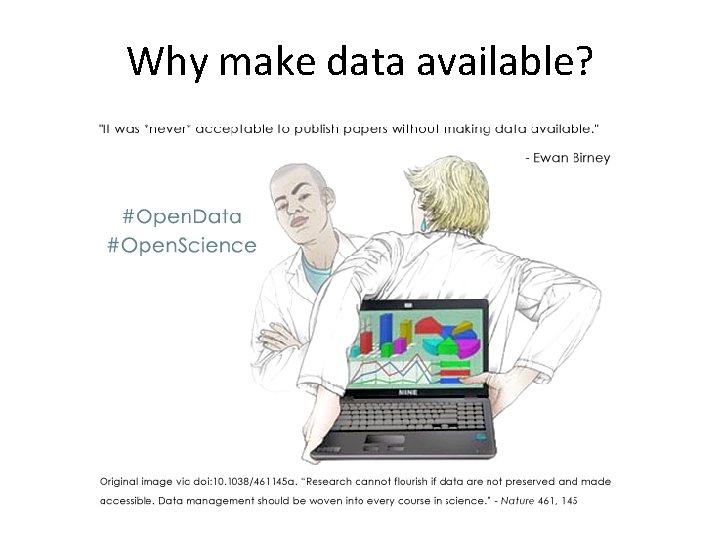
Why make data available?
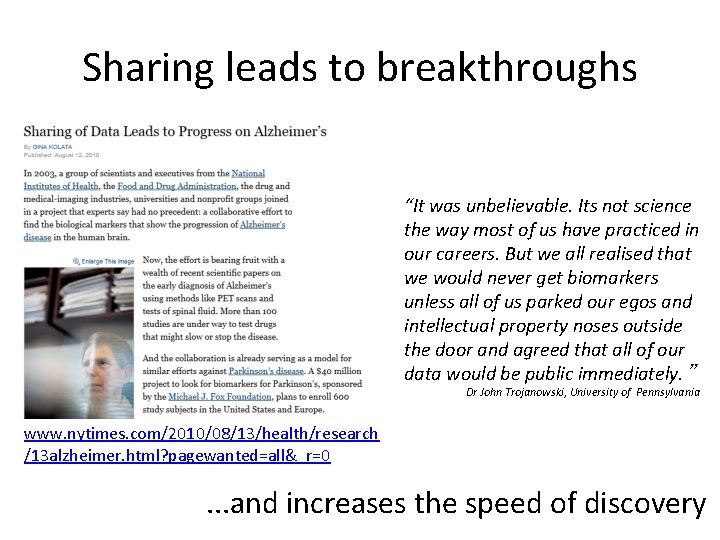
Sharing leads to breakthroughs “It was unbelievable. Its not science the way most of us have practiced in our careers. But we all realised that we would never get biomarkers unless all of us parked our egos and intellectual property noses outside the door and agreed that all of our data would be public immediately. ” Dr John Trojanowski, University of Pennsylvania www. nytimes. com/2010/08/13/health/research /13 alzheimer. html? pagewanted=all&_r=0 . . . and increases the speed of discovery
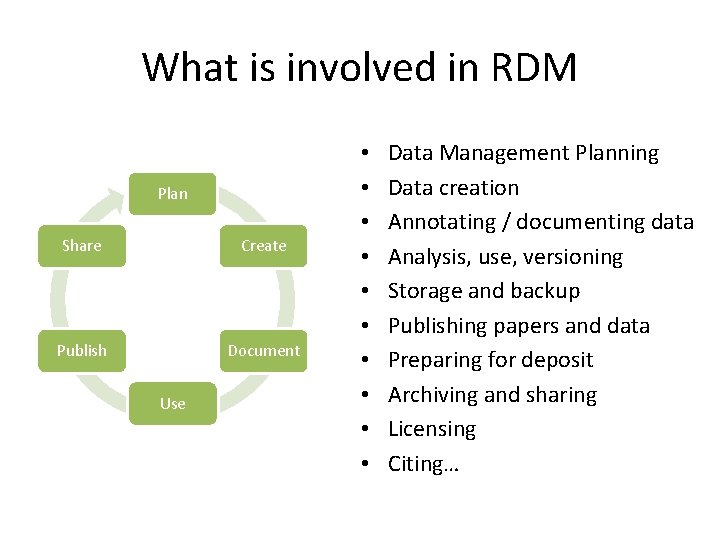
What is involved in RDM Plan Share Create Publish Document Use • • • Data Management Planning Data creation Annotating / documenting data Analysis, use, versioning Storage and backup Publishing papers and data Preparing for deposit Archiving and sharing Licensing Citing…
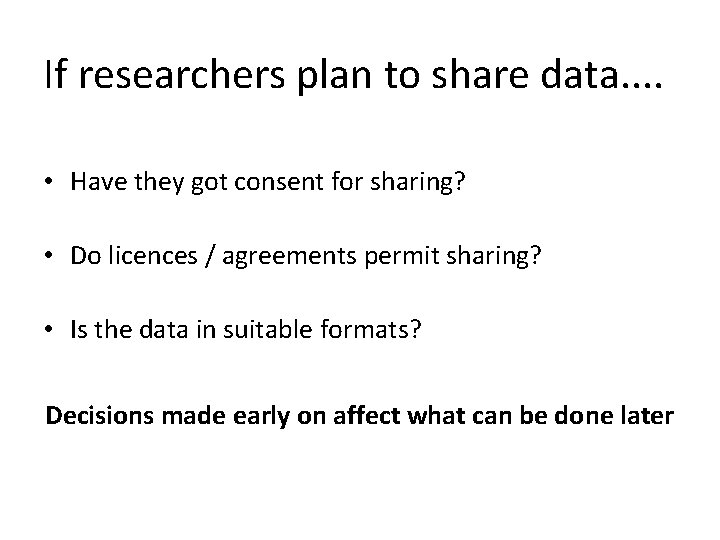
If researchers plan to share data. . • Have they got consent for sharing? • Do licences / agreements permit sharing? • Is the data in suitable formats? Decisions made early on affect what can be done later
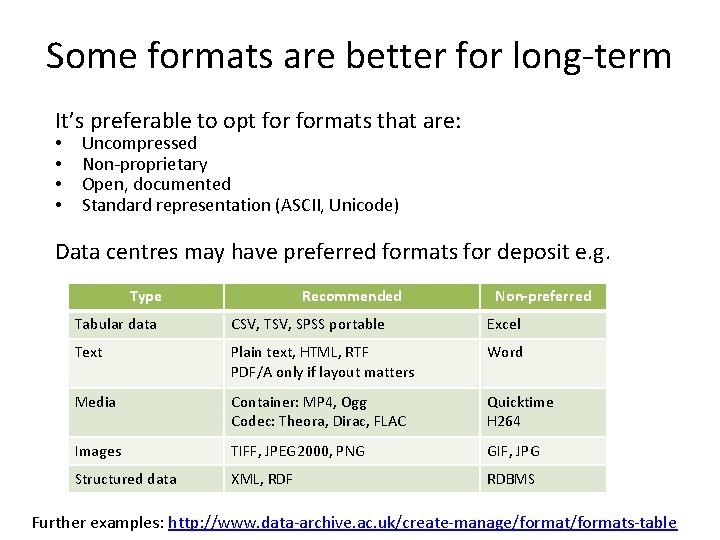
Some formats are better for long-term It’s preferable to opt formats that are: • • Uncompressed Non-proprietary Open, documented Standard representation (ASCII, Unicode) Data centres may have preferred formats for deposit e. g. Type Recommended Non-preferred Tabular data CSV, TSV, SPSS portable Excel Text Plain text, HTML, RTF PDF/A only if layout matters Word Media Container: MP 4, Ogg Codec: Theora, Dirac, FLAC Quicktime H 264 Images TIFF, JPEG 2000, PNG GIF, JPG Structured data XML, RDF RDBMS Further examples: http: //www. data-archive. ac. uk/create-manage/formats-table
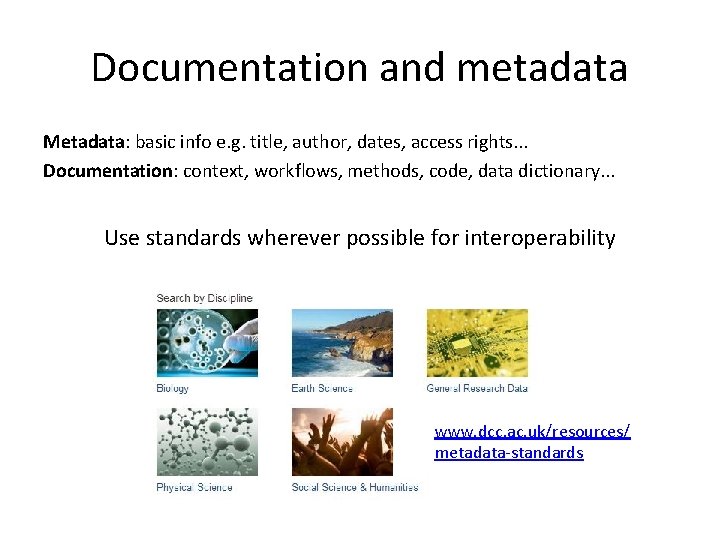
Documentation and metadata Metadata: basic info e. g. title, author, dates, access rights. . . Documentation: context, workflows, methods, code, data dictionary. . . Use standards wherever possible for interoperability www. dcc. ac. uk/resources/ metadata-standards
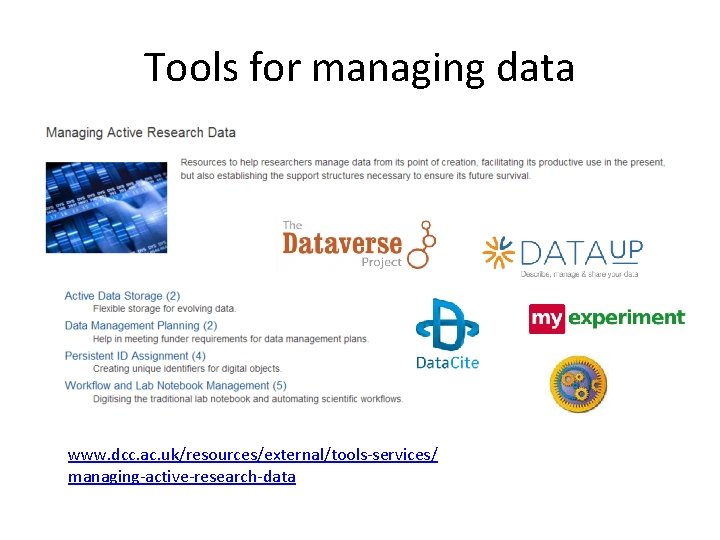
Tools for managing data www. dcc. ac. uk/resources/external/tools-services/ managing-active-research-data
Where to store data? • Your own device (PC, flash drive, etc. ) – And if you lose it? Or it breaks? • Departmental drive or university filestore – Should be more robust with automated back-up • “Cloud” storage – Do they care as much about your data as you do?
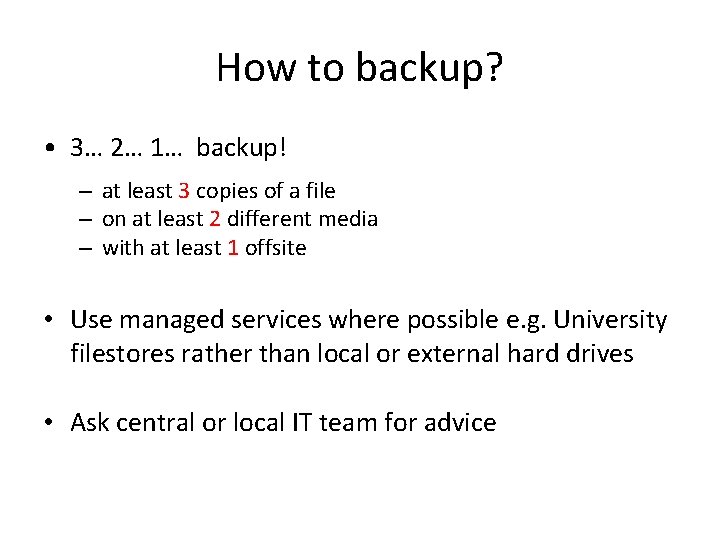
How to backup? • 3… 2… 1… backup! – at least 3 copies of a file – on at least 2 different media – with at least 1 offsite • Use managed services where possible e. g. University filestores rather than local or external hard drives • Ask central or local IT team for advice
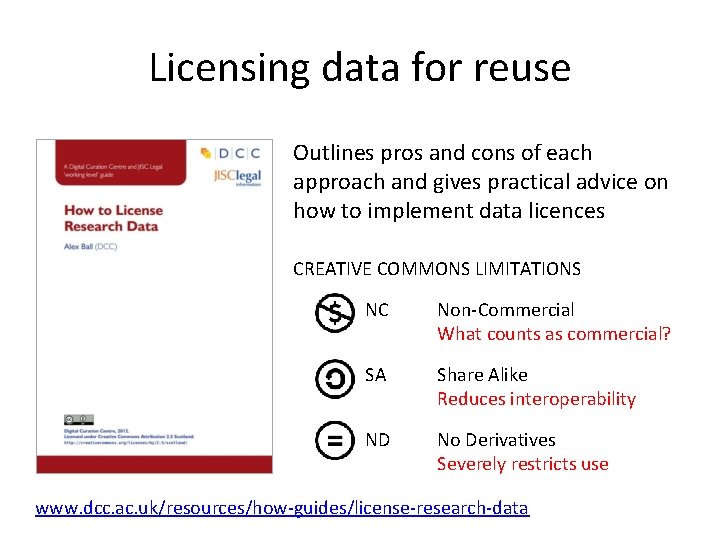
Licensing data for reuse Outlines pros and cons of each approach and gives practical advice on how to implement data licences CREATIVE COMMONS LIMITATIONS NC Non-Commercial What counts as commercial? SA Share Alike Reduces interoperability ND No Derivatives Severely restricts use www. dcc. ac. uk/resources/how-guides/license-research-data
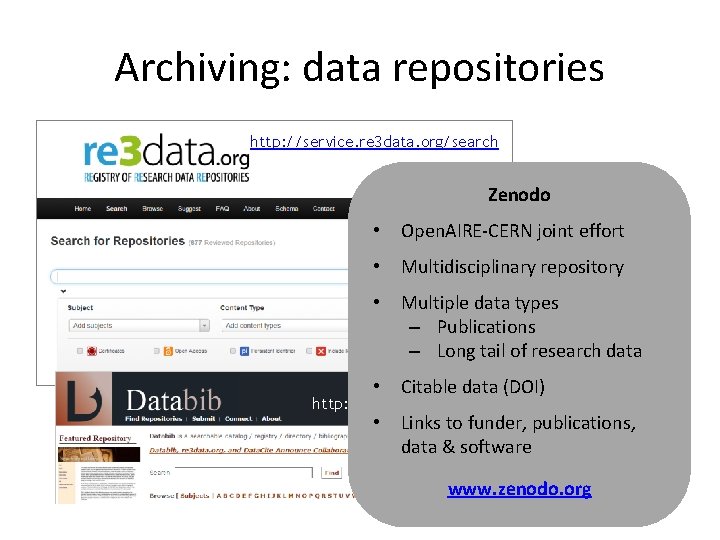
Archiving: data repositories http: //service. re 3 data. org/search Zenodo • Open. AIRE-CERN joint effort • Multidisciplinary repository • Multiple data types – Publications – Long tail of research data • Citable data (DOI) • Links to funder, publications, data & software http: //databib. org www. zenodo. org
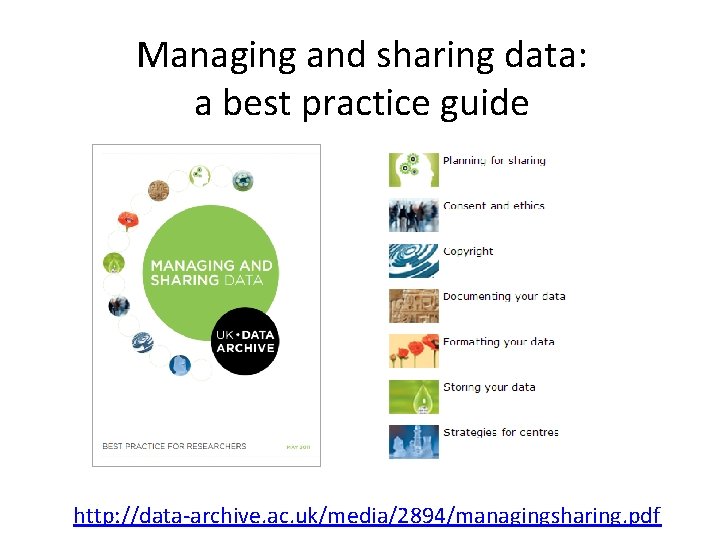
Managing and sharing data: a best practice guide http: //data-archive. ac. uk/media/2894/managingsharing. pdf
What is a data management plan? A brief plan written at the start of your project to define: • how your data will be created? • how it will be documented? • who will access it? • where it will be stored? • who will back it up? • whether (and how) it will be shared & preserved? DMPs are often submitted as part of grant applications, but are useful whenever researchers are creating data.
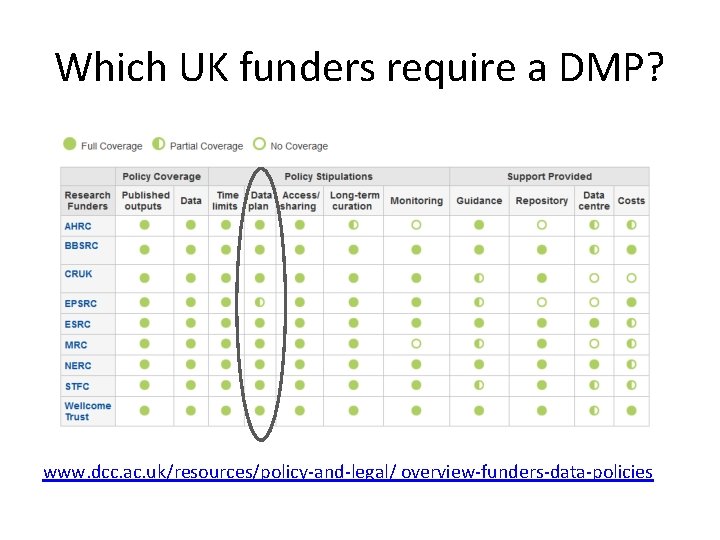
Which UK funders require a DMP? www. dcc. ac. uk/resources/policy-and-legal/ overview-funders-data-policies
DCC Checklist for a DMP • 13 questions on what’s asked across the board • Prompts / pointers to help researchers get started • Guidance on how to answer www. dcc. ac. uk/sites/default/files/documents /resource/DMP_Checklist_2013. pdf
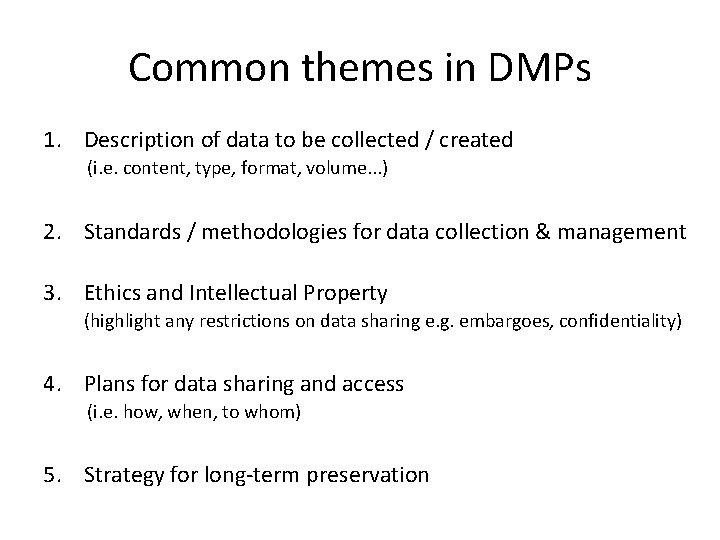
Common themes in DMPs 1. Description of data to be collected / created (i. e. content, type, format, volume. . . ) 2. Standards / methodologies for data collection & management 3. Ethics and Intellectual Property (highlight any restrictions on data sharing e. g. embargoes, confidentiality) 4. Plans for data sharing and access (i. e. how, when, to whom) 5. Strategy for long-term preservation
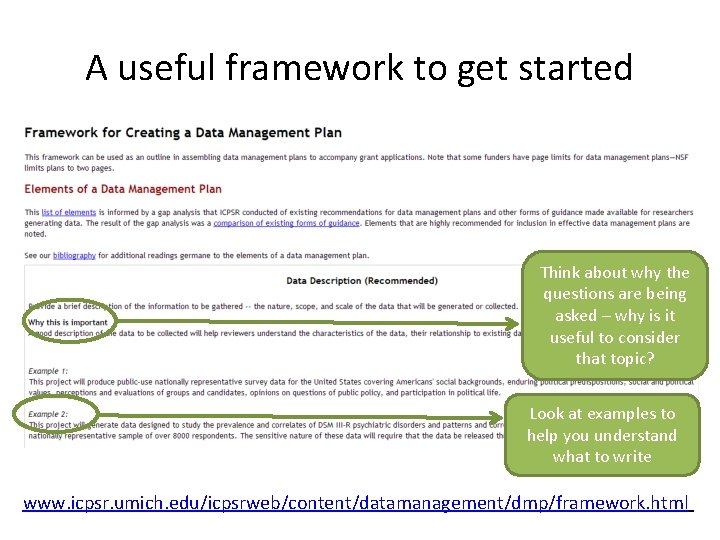
A useful framework to get started Think about why the questions are being asked – why is it useful to consider that topic? Look at examples to help you understand what to write www. icpsr. umich. edu/icpsrweb/content/datamanagement/dmp/framework. html
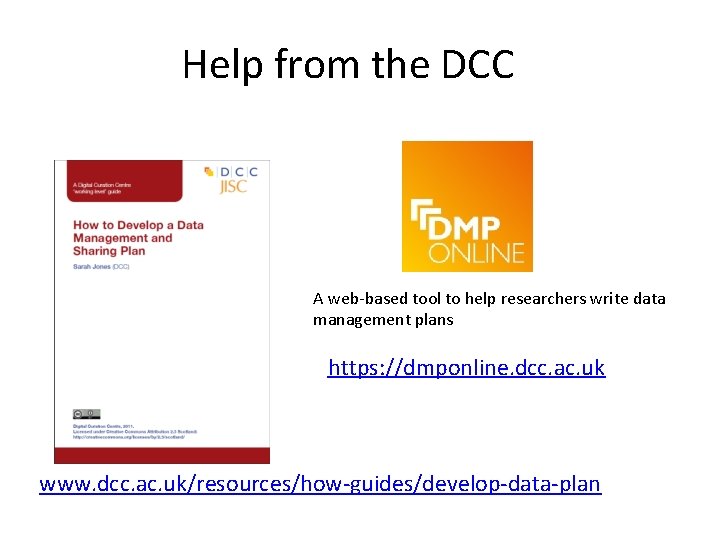
Help from the DCC A web-based tool to help researchers write data management plans https: //dmponline. dcc. ac. uk www. dcc. ac. uk/resources/how-guides/develop-data-plan
Tips to share on writing DMPs • Keep it simple, short and specific • Seek advice - consult and collaborate • Base plans on available skills and support • Make sure implementation is feasible • Justify any resources or restrictions needed www. youtube. com/watch? v=7 OJti. A 53 -Fk
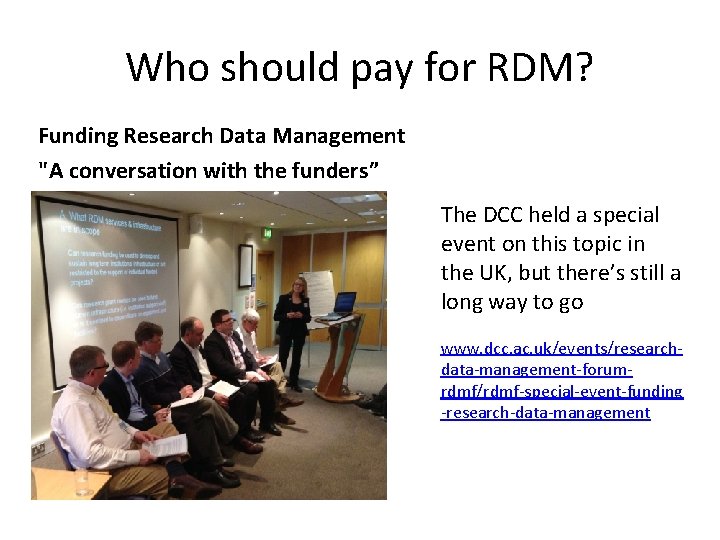
Who should pay for RDM? Funding Research Data Management "A conversation with the funders” The DCC held a special event on this topic in the UK, but there’s still a long way to go www. dcc. ac. uk/events/researchdata-management-forumrdmf/rdmf-special-event-funding -research-data-management
How should costs be recovered? It is for institutions to decide which elements to recover: • Directly (i. e. directly allocated or incurred on grants) • Indirectly (by using QR funding or indirects on grants) If the cost of RDM services and infrastructure is already recovered via your institution’s indirect cost rate, it cannot also be applied for as a direct cost. Guiding principle: don’t charge for the same thing twice
What to charge and how? Direct costs • • In-project costs that must be incurred before the end of the grant Potentially hardware, staff, expenses, costs of preparing data for deposit. . . Could include charges levied by repositories (pay once store forever) May also include costs ordinarily recovered indirectly (e. g. storage) if the requirement is exceptional and exceeds the norm Indirect costs • The general cost of providing RDM services and infrastructure • Designated data services should be used if provided • Outsourcing to a third-party is also an option Remember to make a clear justification for any costs
Be specific for each grant • A flat rate charging structure for RDM services (e. g. 10% of each grant) is not appropriate. • The value of a research grant is not a good proxy for the volume or complexity of data it may generate. • Base costs on each specific case and make a clear justification for them. They should be auditable.
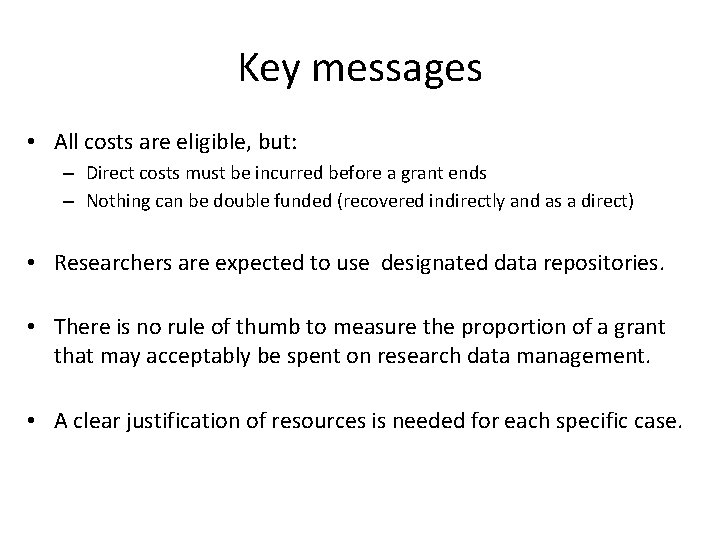
Key messages • All costs are eligible, but: – Direct costs must be incurred before a grant ends – Nothing can be double funded (recovered indirectly and as a direct) • Researchers are expected to use designated data repositories. • There is no rule of thumb to measure the proportion of a grant that may acceptably be spent on research data management. • A clear justification of resources is needed for each specific case.
Thanks – any questions? DCC guidance, tools and case studies: www. dcc. ac. uk/resources Follow us on twitter: @digitalcuration and #ukdcc
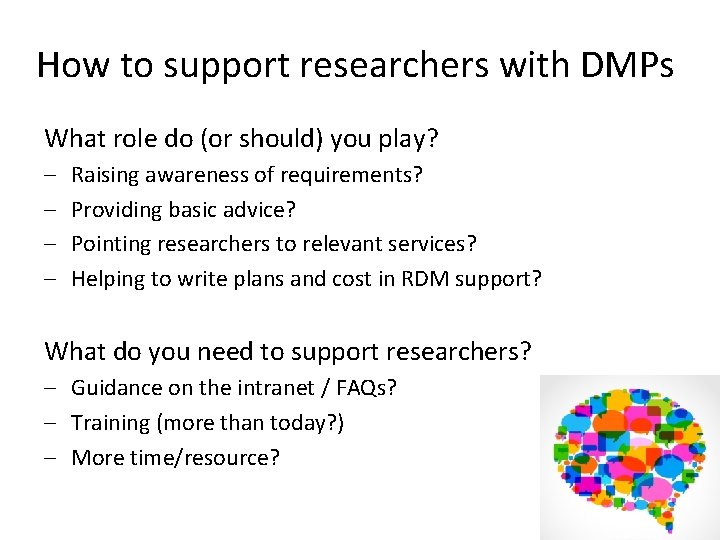
How to support researchers with DMPs What role do (or should) you play? – – Raising awareness of requirements? Providing basic advice? Pointing researchers to relevant services? Helping to write plans and cost in RDM support? What do you need to support researchers? – Guidance on the intranet / FAQs? – Training (more than today? ) – More time/resource?