
Research Based Vocabulary Instruction So Many Words So

Research Based Vocabulary Instruction: So Many Words – So Little Time Vicki La. Rock, Senior Research Associate National Center for Reading First Technical Assistance RMC Research Corporation Washington Reading First 1 February 2007
Objectives Understand the importance of vocabulary development in the reading process. Look at what research says about vocabulary instruction. Learn and practice instructional strategies that promote vocabulary development. Design activities to enhance vocabulary instruction within currently used curriculum materials. 2
Oral Vocabulary’s Critical Role in Learning to Read For beginning readers, reading vocabulary encountered in texts is mapped onto the oral vocabulary the learner brings to the task. Readers learn to translate unfamiliar words in print into speech, with the expectation that the speech forms will be easier to comprehend. When a word is not in the learner’s oral vocabulary, it will not be understood when it occurs in print. National Reading Panel Report (2000) 3
Research: The Vocabulary and Comprehension Connection The relationship between reading comprehension and vocabulary knowledge is strong and unequivocal. (Baker, Simmons & Kame’enui, 2004) The correlation between a reading vocabulary – language test and a reading comprehension test is high, usually over. 80. (Bloom, 1976) 4
Research: The Vocabulary and Comprehension Connection Developed vocabulary size in kindergarten is an effective predictor of reading comprehension in the middle elementary years. (Scarborough, 1998, 2001) Orally-tested vocabulary at the end of Grade 1 is a significant predictor of reading comprehension ten years later. (Cunningham & Stanovich, 1997) 5
Research: The Vocabulary and Comprehension Connection Children with restricted vocabulary by Grade 3 have declining comprehension scores in the later elementary years. (Chall, Jacobs, & Baldwin, 1990) By Grade 4, many children experience a “slump” in reading comprehension caused by below grade level vocabularies (Becker, 1977; Chall & Jacobs, 2003; Chall, Jacobs & Baldwin, 1990) 6
Research: The Vocabulary and Comprehension Connection Adequate reading comprehension depends on a person already knowing 90– 95% of the words in a text. (Nagy & Scott, 2000) Teaching vocabulary can improve reading comprehension for both native English speakers (Beck, Perfetti & Mc. Keown, 1982) and English learners (Carlo et al. , 2004) 7
Vocabulary Estimations 3 rd grade reading vocabularies average around 10, 000 words. 12 th grade reading vocabularies average around 40, 000 words. To reach that average, children would learn about 3, 000 words a year. (Nagy & Herman, 1987) Before 3 rd grade, children add an average of 840 words per year. (Biemiller, 2005) 8
The Vocabulary Gap Children enter school with meaningful differences in vocabulary knowledge as a result of experiences and exposure to literacy and language activities. (Hart & Risley, 1995) The vocabulary gap grows larger in the early grades. Children who enter with limited vocabulary knowledge become more discrepant over time from their peers who have rich vocabulary knowledge. (Biemiller & Slonin, 2001) Coyne, Kame’enui, & Chard. Copyright © 2003 9
The Vocabulary Gap Growing up in poverty can seriously restrict the vocabulary children learn before beginning school and can make attaining an adequate vocabulary a challenging task. (Coyne, Simmons & Kame’enui, 2004; Hart & Risley, 1995) Lack of vocabulary can be a crucial factor underlying the school failure of disadvantaged students. (Becker, 1977; Biemiller, 1999) As reported by Michael F. Graves in The Vocabulary Book 10
Closing the Gap Educators’ chances of successfully addressing vocabulary differences are greatest in the preschool and primary years. (Biemiller, 2006) Students who are already behind need a more intense vocabulary focus to catch up. Research shows most “benchmark” kids need to encounter a word at least 12 times before they know it well enough to improve comprehension. 11
What Does Research Tell Us About Vocabulary Instruction? Children learn the meanings of most words indirectly, through everyday experiences with oral and written language. Although a great deal of vocabulary is learned indirectly, some vocabulary should be directly taught. Direct vocabulary instruction includes teaching individual words and word learning strategies. National Reading Panel Report (2000) 12
NRP findings support methods that include: Repetition and multiple encounters with words in a variety of rich contexts. Active engagement in learning new words. Multimedia approaches, computer technology , and group learning formats. Tasks that can be restructured, if needed. 13
Teaching Word Learning Strategies Teach the meanings of affixes and root words— they carry clues about word meanings. Teach how to apply a consistent process to learning new words. Teach how to use context to confirm meaning. Teach how/when to use dictionaries and other references aids. 14
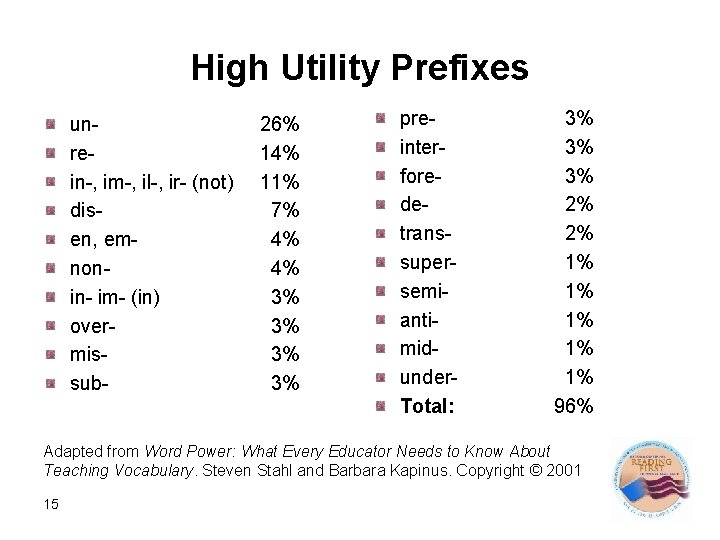
High Utility Prefixes unrein-, im-, il-, ir- (not) disen, emnonin- im- (in) overmissub- 26% 14% 11% 7% 4% 4% 3% 3% preinterforedetranssupersemiantimidunder. Total: 3% 3% 3% 2% 2% 1% 1% 1% 96% Adapted from Word Power: What Every Educator Needs to Know About Teaching Vocabulary. Steven Stahl and Barbara Kapinus. Copyright © 2001 15
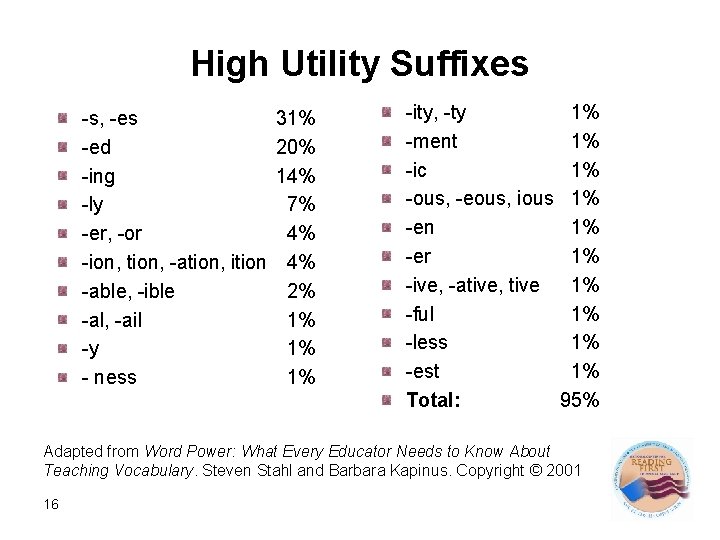
High Utility Suffixes -s, -es -ed -ing -ly -er, -or -ion, tion, -ation, ition -able, -ible -al, -ail -y - ness 31% 20% 14% 7% 4% 4% 2% 1% 1% 1% -ity, -ty 1% -ment 1% -ic 1% -ous, -eous, ious 1% -en 1% -er 1% -ive, -ative, tive 1% -ful 1% -less 1% -est 1% Total: 95% Adapted from Word Power: What Every Educator Needs to Know About Teaching Vocabulary. Steven Stahl and Barbara Kapinus. Copyright © 2001 16
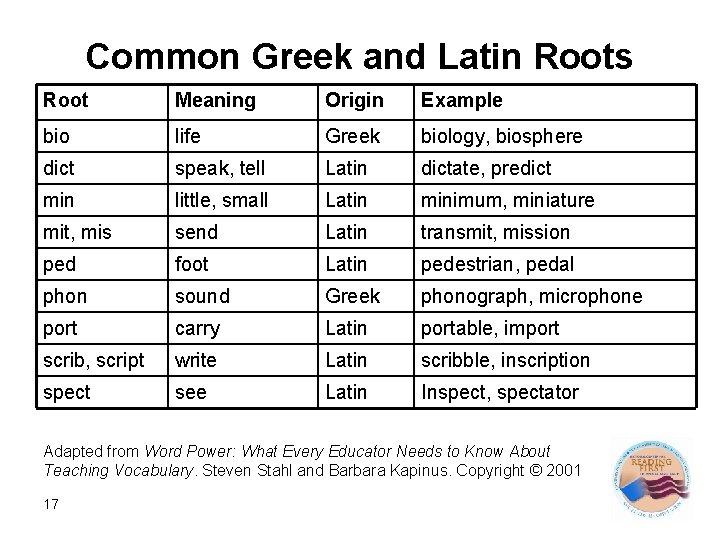
Common Greek and Latin Roots Root Meaning Origin Example bio life Greek biology, biosphere dict speak, tell Latin dictate, predict min little, small Latin minimum, miniature mit, mis send Latin transmit, mission ped foot Latin pedestrian, pedal phon sound Greek phonograph, microphone port carry Latin portable, import scrib, script write Latin scribble, inscription spect see Latin Inspect, spectator Adapted from Word Power: What Every Educator Needs to Know About Teaching Vocabulary. Steven Stahl and Barbara Kapinus. Copyright © 2001 17
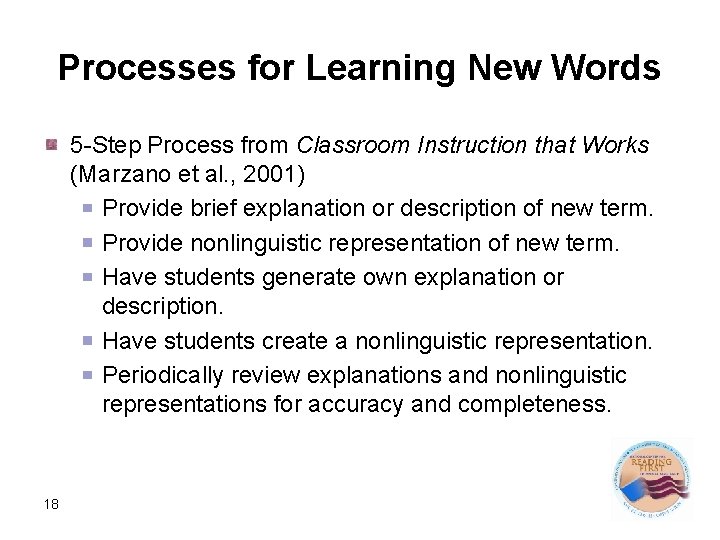
Processes for Learning New Words 5 -Step Process from Classroom Instruction that Works (Marzano et al. , 2001) Provide brief explanation or description of new term. Provide nonlinguistic representation of new term. Have students generate own explanation or description. Have students create a nonlinguistic representation. Periodically review explanations and nonlinguistic representations for accuracy and completeness. 18
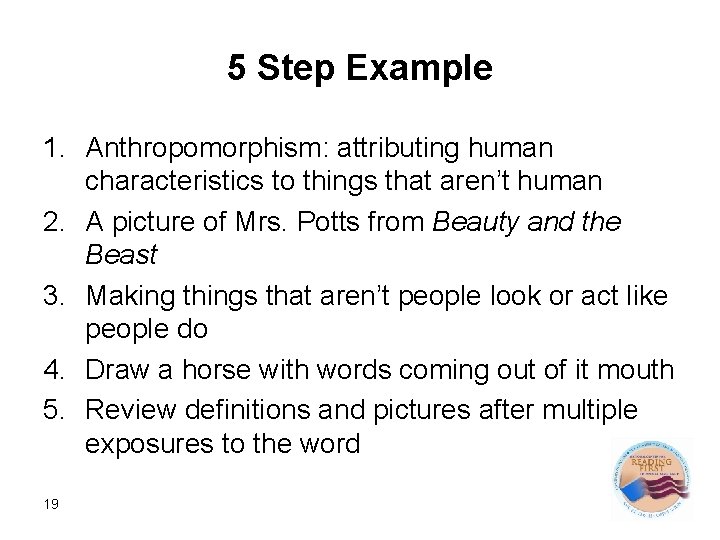
5 Step Example 1. Anthropomorphism: attributing human characteristics to things that aren’t human 2. A picture of Mrs. Potts from Beauty and the Beast 3. Making things that aren’t people look or act like people do 4. Draw a horse with words coming out of it mouth 5. Review definitions and pictures after multiple exposures to the word 19
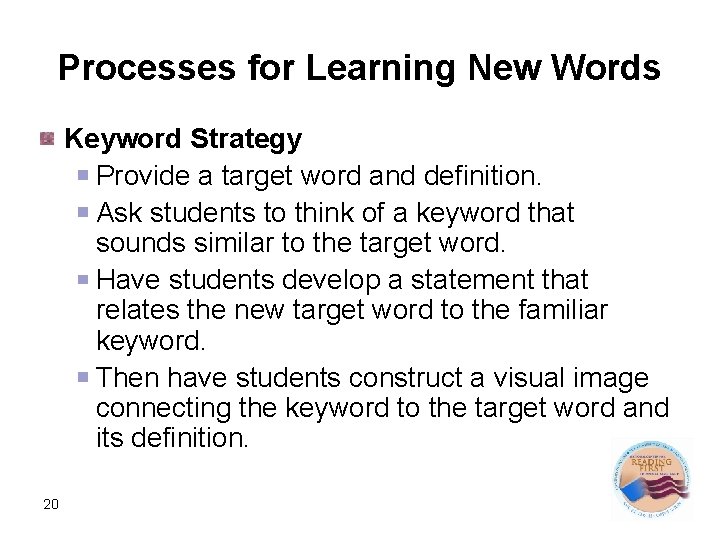
Processes for Learning New Words Keyword Strategy Provide a target word and definition. Ask students to think of a keyword that sounds similar to the target word. Have students develop a statement that relates the new target word to the familiar keyword. Then have students construct a visual image connecting the keyword to the target word and its definition. 20
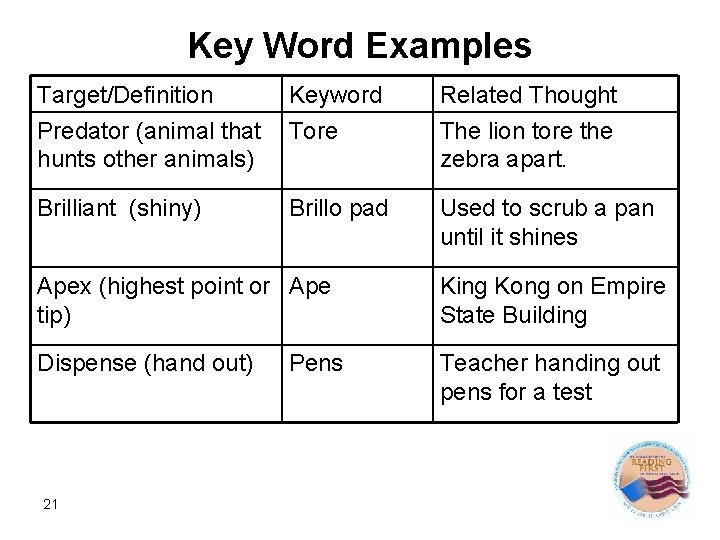
Key Word Examples Target/Definition Predator (animal that hunts other animals) Keyword Tore Related Thought The lion tore the zebra apart. Brilliant (shiny) Brillo pad Used to scrub a pan until it shines Apex (highest point or Ape tip) King Kong on Empire State Building Dispense (hand out) Teacher handing out pens for a test 21 Pens
Using Context to Confirm Meaning Focus the instruction on the process of deriving meaning from context, not the “product” of coming up with the right meaning of an unknown word. Students should be taught to identify relevant information from context and use that information to come up with a reasonable idea of what the word might mean. Adapted from Bringing Words to Life: Robust Vocabulary Instruction. Beck, et al. (2002) 22
Steps in the Process Identify the unknown word. Look for words that give hints about its meaning in the sentence. If you need more cues, read the sentences before and after the one with the word in it. Infer the word’s meaning based on what you found. Adapted from Vocabulary Instruction Module developed for Reading Excellence Act. Graves (2002) 23
Modeling the Process As Tom stepped out of the tent, the moist grass soaked his shoes and he wondered if it had rained. The word I don’t know is moist. Cues to its meaning might be: The grass is moist. It soaks Tom’s shoes. Tom thinks it rained. Rain makes things wet. Adapted from Vocabulary Instruction Module developed for Reading Excellence Act. Graves (2002) 24
Modeling the Process (continued) Putting the cues together The moist grass soaks Tom’s shoes, which means they got wet. Tom thinks it rained which would make the grass wet. Moist must mean wet. Try meaning in sentence to see if it works As Tom stepped out of the tent, the wet grass soaked his shoes and he wondered if it rained. Adapted from Vocabulary Instruction Module developed for Reading Excellence Act. Graves (2002) 25
Your Turn Dan heard the door open and wondered who came in. He couldn’t make out the voices. Then he recognized the lumbering footsteps on the stairs and knew it was Aunt Grace. An hour after Joe and Stan arrived at the party, Stan was more than ready to go home. But Joe was having a great time visiting and telling stories. “I wish I was as gregarious as he is”, thought Stan. Adapted from Vocabulary Instruction Module developed for Reading Excellence Act. Graves (2002) 26
Perhaps the biggest misconception is that teaching vocabulary means teaching formal dictionary definitions. Marzano et al. , Classroom Instruction That Works (2001) 27
Using Dictionaries Strategically Dictionary entries work best when you already know something about the word, not when introducing new words. Once you already know something about a word, use a dictionary to Determine if the word you are using is the right choice in a context. See if the word has other forms (adj. or adv. ). Identify additional meanings of a word. Trace history of word/word origins 28
Less Effective Approaches to Teaching Vocabulary Copying definitions from a dictionary. Writing sentences before studying the word. Just telling students to “use context” to figure out a word. Memorizing lists of “decontextualized” definitions. Adapted from Narrowing the Language Gap: Strategies for Vocabulary Development. Feldman & Kinsella (2003, January) 29
Effective Vocabulary Instruction Includes: Explicitly taught word meanings using clear, consistent, understandable language Multiple encounters (modeling and practice) in a variety of contexts. Rich and extensive opportunities to practice using new words that promote deep processing and more complex levels of understanding. 30
Effective Vocabulary Instruction Includes: Ample structured reviews to revisit learned words within and across lessons (and content areas). Numerous opportunities to learn and reinforce vocabulary through wide independent reading. Nurturing an appreciation for words and how they are used. 31
Examples That Encourage Deep Processing Which word goes with fabulous — ok or super? Why? Is it fabulous if you fall and scrape your knee? What would it be? Maria thought her car was fabulous because. . . If your family is having a fabulous time at the park, what might you be doing? When have you had a fabulous time? Is a masterpiece fabulous? Why? The concert was the best he had ever heard. Every note seemed perfect. Was the concert fabulous or uneventful? Adapted from Coyne, Kame’enui, & Chard. Copyright © 2003 32
Strategies That Promote Deep Understanding of Vocabulary Semantic Feature Analysis Word Sorts Word Pairs Modified Frayer Model Linear Arrays Four Square Semantic, Concept, or Word Maps List-Group-Label 33
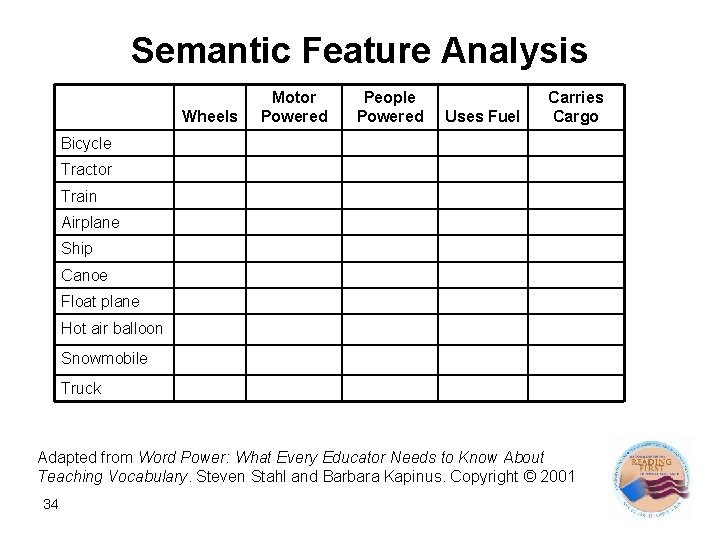
Semantic Feature Analysis Wheels Motor Powered People Powered Uses Fuel Carries Cargo Bicycle Tractor Train Airplane Ship Canoe Float plane Hot air balloon Snowmobile Truck Adapted from Word Power: What Every Educator Needs to Know About Teaching Vocabulary. Steven Stahl and Barbara Kapinus. Copyright © 2001 34
Word Sorts Put vocabulary terms on small cards or post-it notes. Closed sort: Have students sort words into predetermined categories (for younger children and complex concepts). Open sorts: Have students sort words into categories of their own making and label them. Encourage groups to find multiple ways of classifying the words to help refine and extend their understanding of the concepts represented by the words. 35
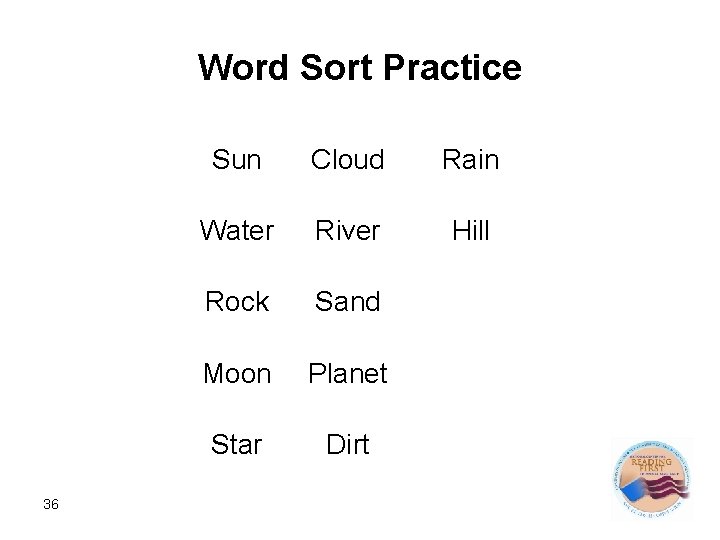
Word Sort Practice 36 Sun Cloud Rain Water River Hill Rock Sand Moon Planet Star Dirt
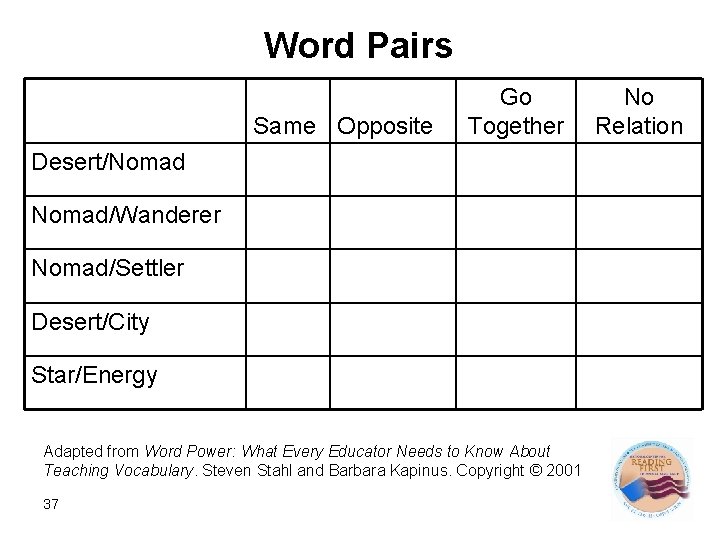
Word Pairs Same Opposite Go Together Desert/Nomad/Wanderer Nomad/Settler Desert/City Star/Energy Adapted from Word Power: What Every Educator Needs to Know About Teaching Vocabulary. Steven Stahl and Barbara Kapinus. Copyright © 2001 37 No Relation
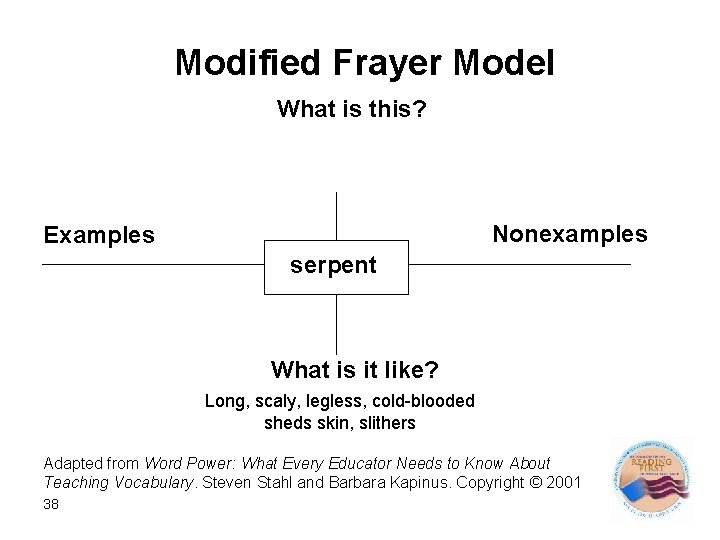
Modified Frayer Model What is this? Nonexamples Examples serpent What is it like? Long, scaly, legless, cold-blooded sheds skin, slithers Adapted from Word Power: What Every Educator Needs to Know About Teaching Vocabulary. Steven Stahl and Barbara Kapinus. Copyright © 2001 38
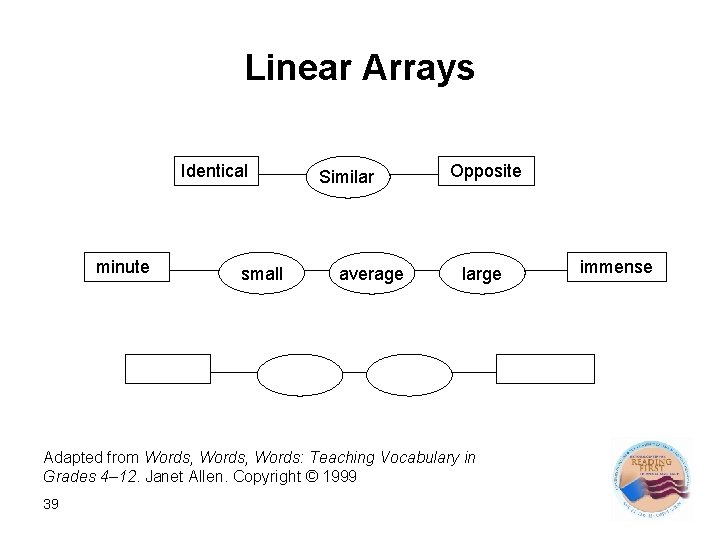
Linear Arrays Identical minute small Similar average Opposite large Adapted from Words, Words: Teaching Vocabulary in Grades 4– 12. Janet Allen. Copyright © 1999 39 immense
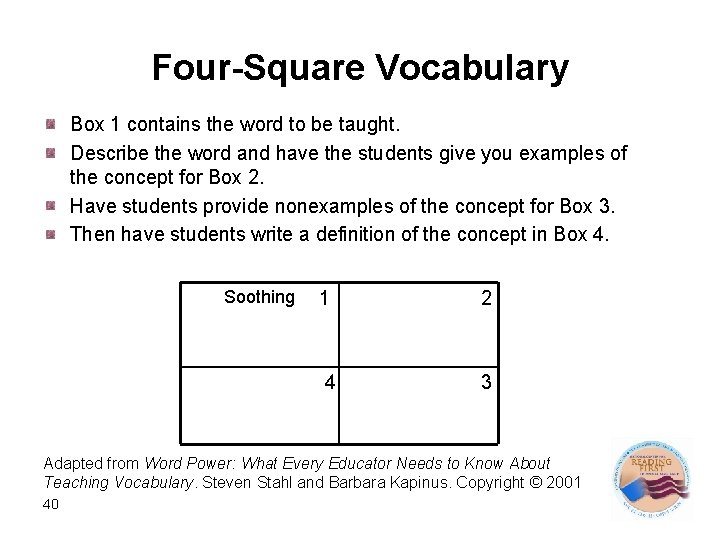
Four-Square Vocabulary Box 1 contains the word to be taught. Describe the word and have the students give you examples of the concept for Box 2. Have students provide nonexamples of the concept for Box 3. Then have students write a definition of the concept in Box 4. Soothing 1 2 4 3 Adapted from Word Power: What Every Educator Needs to Know About Teaching Vocabulary. Steven Stahl and Barbara Kapinus. Copyright © 2001 40
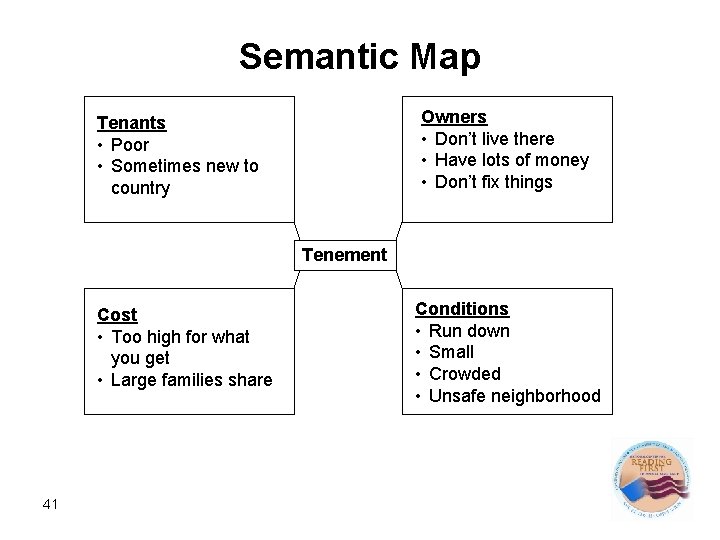
Semantic Map Owners • Don’t live there • Have lots of money • Don’t fix things Tenants • Poor • Sometimes new to country Tenement Cost • Too high for what you get • Large families share 41 Conditions • Run down • Small • Crowded • Unsafe neighborhood
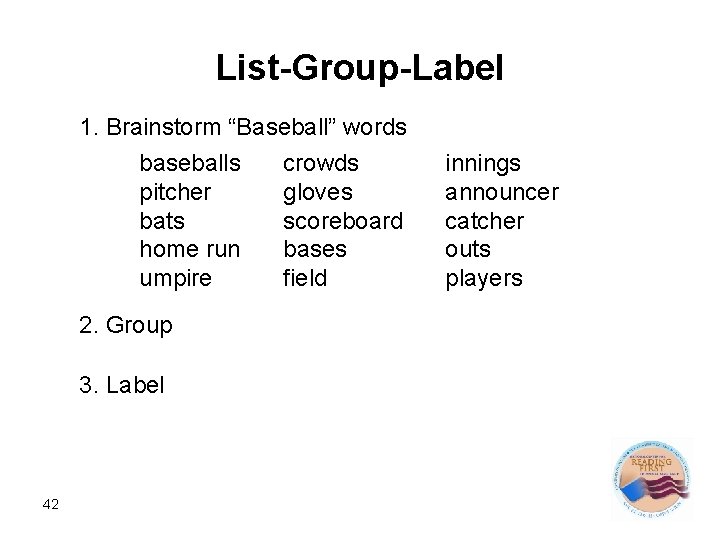
List-Group-Label 1. Brainstorm “Baseball” words baseballs crowds pitcher gloves bats scoreboard home run bases umpire field 2. Group 3. Label 42 innings announcer catcher outs players
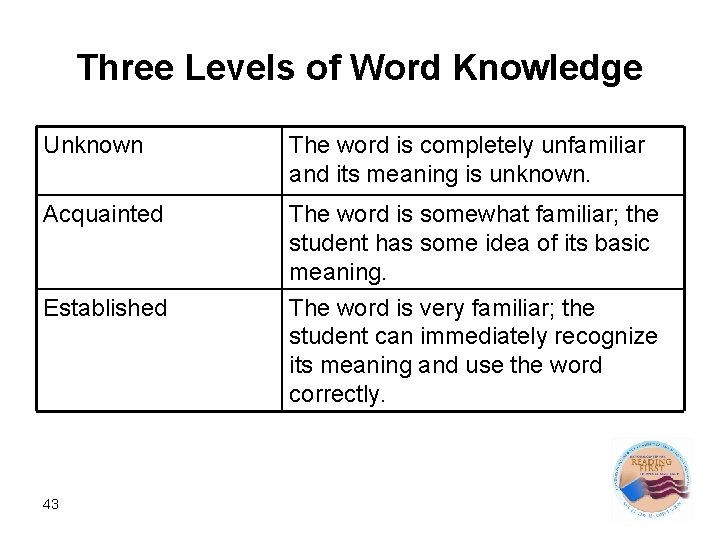
Three Levels of Word Knowledge Unknown The word is completely unfamiliar and its meaning is unknown. Acquainted The word is somewhat familiar; the student has some idea of its basic meaning. The word is very familiar; the student can immediately recognize its meaning and use the word correctly. Established 43
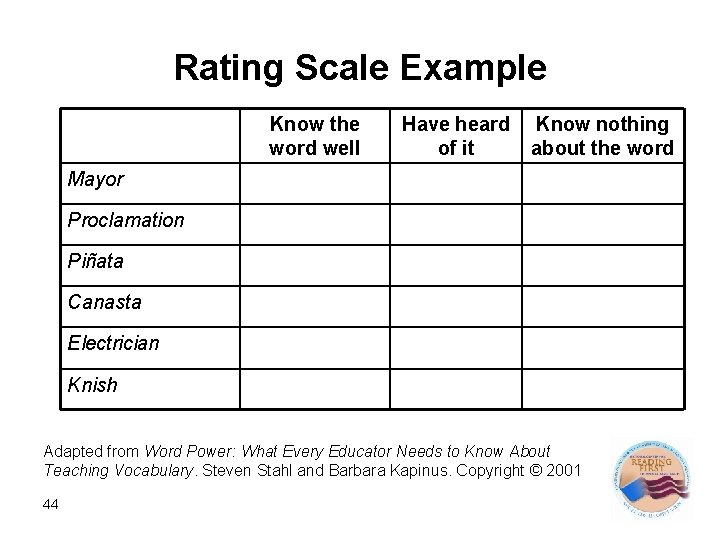
Rating Scale Example Know the word well Have heard of it Know nothing about the word Mayor Proclamation Piñata Canasta Electrician Knish Adapted from Word Power: What Every Educator Needs to Know About Teaching Vocabulary. Steven Stahl and Barbara Kapinus. Copyright © 2001 44
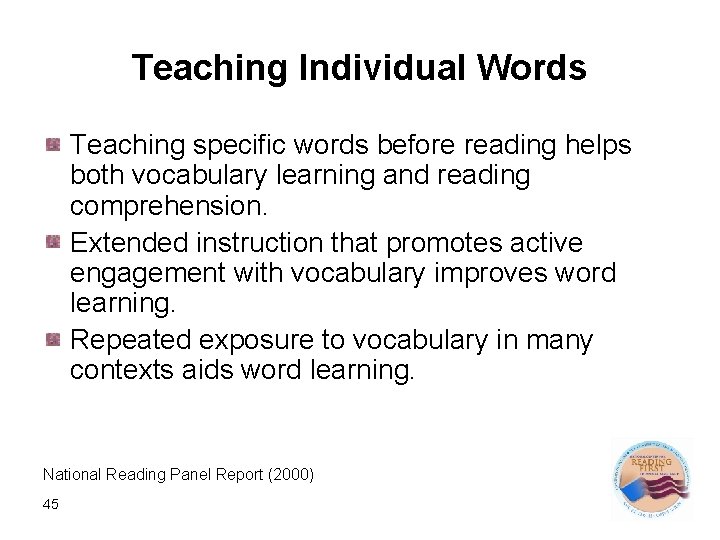
Teaching Individual Words Teaching specific words before reading helps both vocabulary learning and reading comprehension. Extended instruction that promotes active engagement with vocabulary improves word learning. Repeated exposure to vocabulary in many contexts aids word learning. National Reading Panel Report (2000) 45
So, What Words Should We Teach? Basic, high frequency words Words that are critical for understanding the text Useful words likely to be encountered in the future Difficult words National Reading Panel Report (2000) 46
Choosing and Introducing New Words Real Tips for Real Teachers from Beck, Mc. Keown, and Kucan’s Research on Vocabulary (Primary Grades) Adapted from Bringing Words to Life by Isabel Beck, Margaret Mc. Keown, Linda Kucan, 2002 47
Idea 1. Stop and Show and/or Tell Meaning of Words When? At the moment the word is encountered in read alouds, core reading program (whole class and small group), content areas, intervention groups, throughout the day. How? Give a quick demonstration or explanation of the meaning and go on. Demonstrate: skittering, vest, scowl Explain: Intrigued means he was very interested in dinosaurs. Identical means looks just the same as. Adapted from Beck, et al. , 2002 by Jo Robinson. © 2004 48
Your Turn Show: antennae ricochet jostle twitter Tell: surplus avoid glutton cunning calm taunt Show and Tell: lasso pattern exhausted outfit Adapted from Beck, et al. , 2002 by Jo Robinson. Copyright © 2004 (Permission required to duplicate) 49
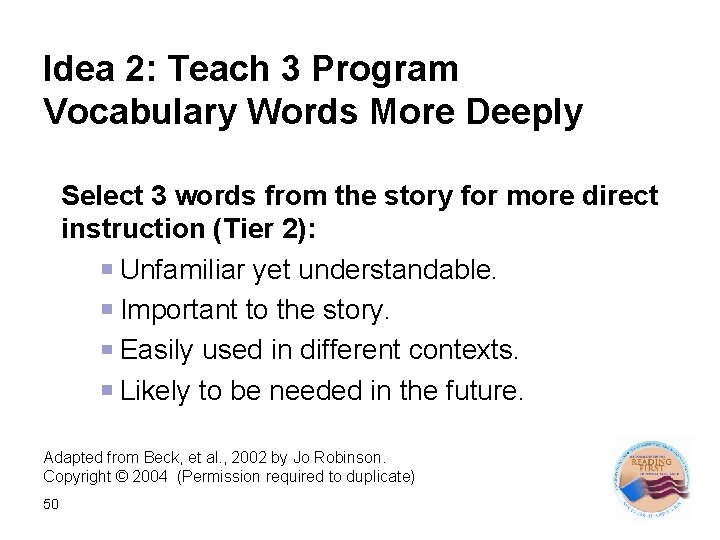
Idea 2: Teach 3 Program Vocabulary Words More Deeply Select 3 words from the story for more direct instruction (Tier 2): Unfamiliar yet understandable. Important to the story. Easily used in different contexts. Likely to be needed in the future. Adapted from Beck, et al. , 2002 by Jo Robinson. Copyright © 2004 (Permission required to duplicate) 50
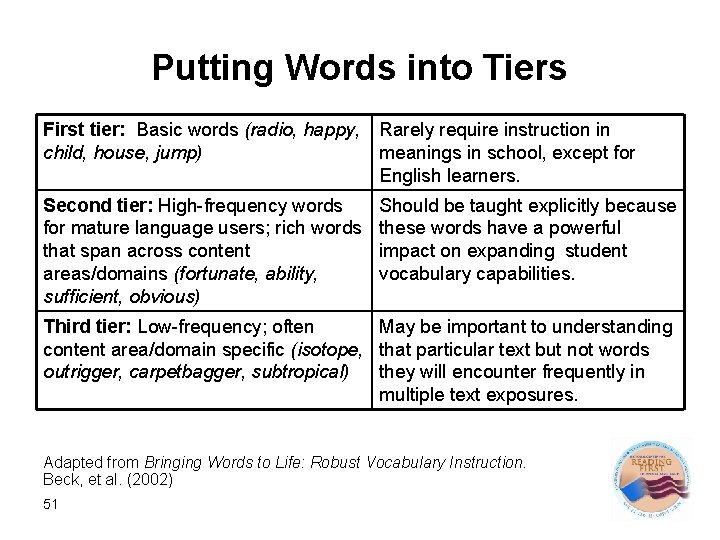
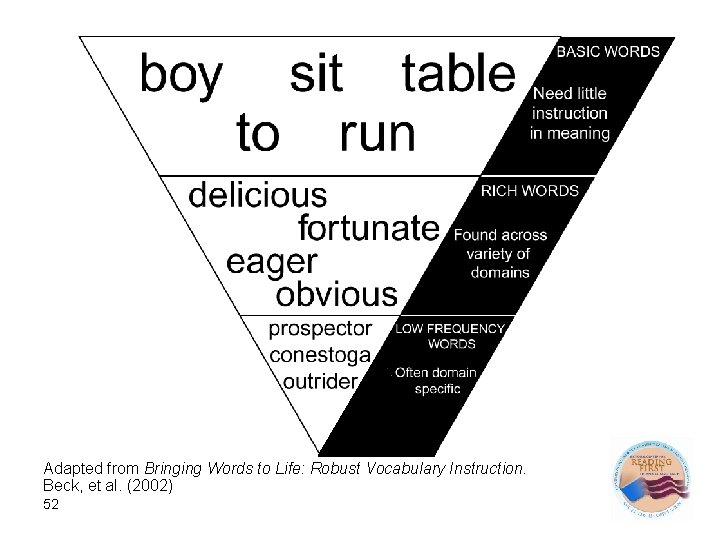
Putting Words into Tiers First tier: Basic words (radio, happy, child, house, jump) Rarely require instruction in meanings in school, except for English learners. Second tier: High-frequency words for mature language users; rich words that span across content areas/domains (fortunate, ability, sufficient, obvious) Should be taught explicitly because these words have a powerful impact on expanding student vocabulary capabilities. Third tier: Low-frequency; often May be important to understanding content area/domain specific (isotope, that particular text but not words outrigger, carpetbagger, subtropical) they will encounter frequently in multiple text exposures. Adapted from Bringing Words to Life: Robust Vocabulary Instruction. Beck, et al. (2002) 51
Adapted from Bringing Words to Life: Robust Vocabulary Instruction. Beck, et al. (2002) 52
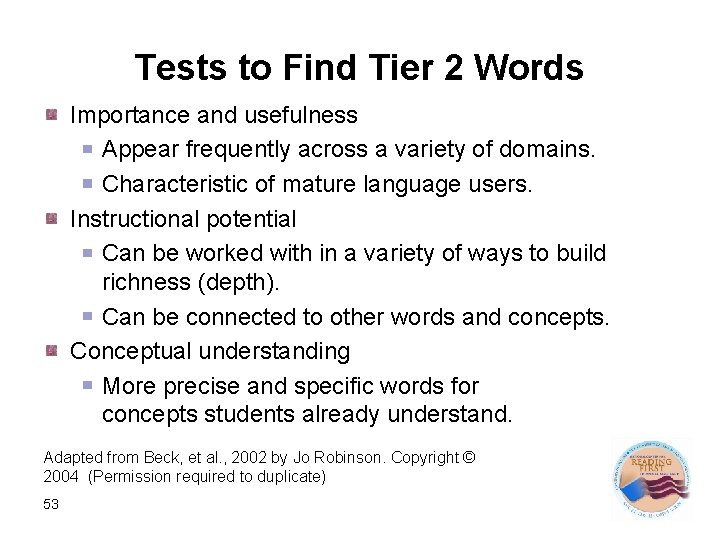
Tests to Find Tier 2 Words Importance and usefulness Appear frequently across a variety of domains. Characteristic of mature language users. Instructional potential Can be worked with in a variety of ways to build richness (depth). Can be connected to other words and concepts. Conceptual understanding More precise and specific words for concepts students already understand. Adapted from Beck, et al. , 2002 by Jo Robinson. Copyright © 2004 (Permission required to duplicate) 53
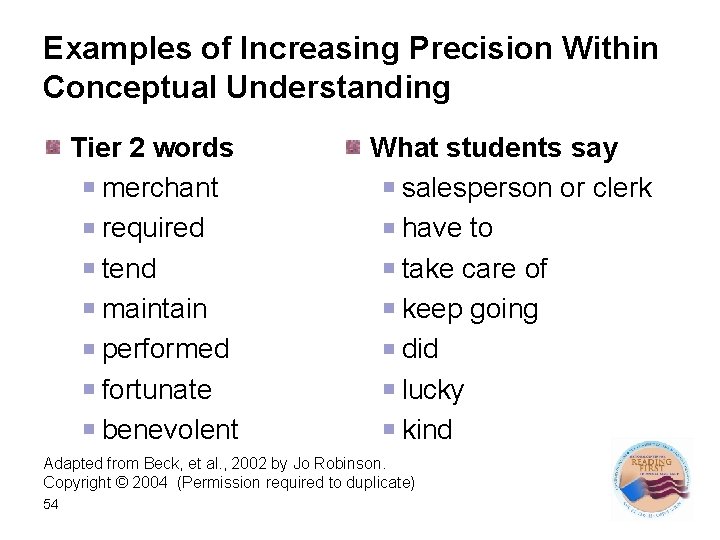
Examples of Increasing Precision Within Conceptual Understanding Tier 2 words merchant required tend maintain performed fortunate benevolent What students say salesperson or clerk have to take care of keep going did lucky kind Adapted from Beck, et al. , 2002 by Jo Robinson. Copyright © 2004 (Permission required to duplicate) 54
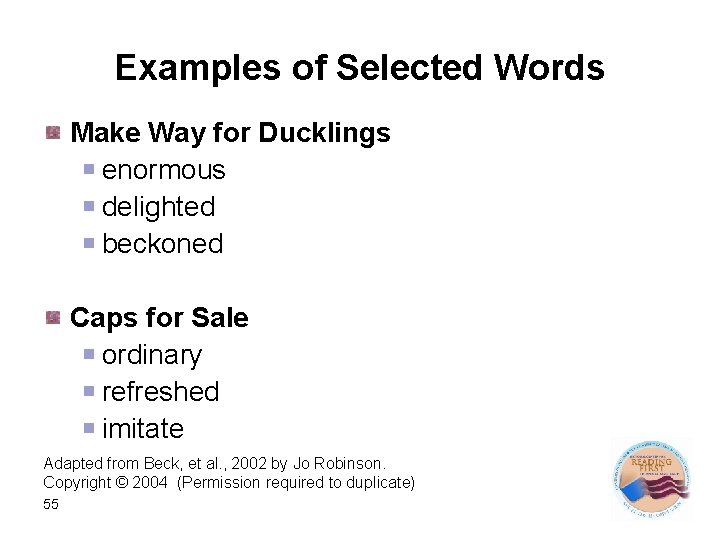
Examples of Selected Words Make Way for Ducklings enormous delighted beckoned Caps for Sale ordinary refreshed imitate Adapted from Beck, et al. , 2002 by Jo Robinson. Copyright © 2004 (Permission required to duplicate) 55
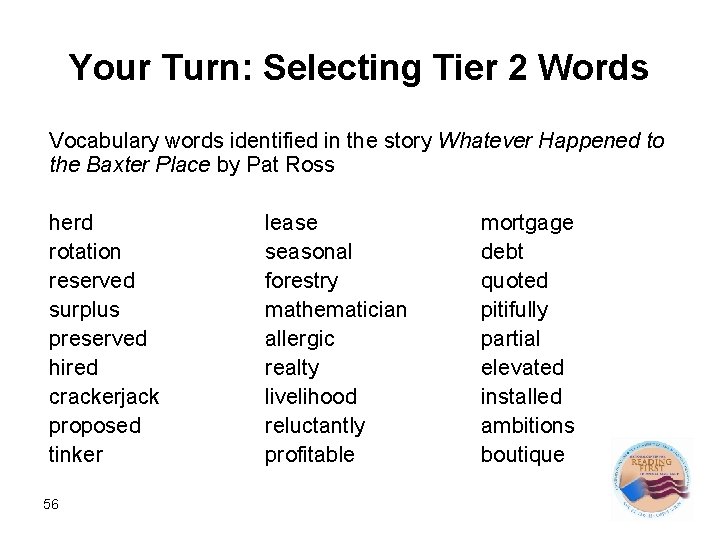
Your Turn: Selecting Tier 2 Words Vocabulary words identified in the story Whatever Happened to the Baxter Place by Pat Ross herd rotation reserved surplus preserved hired crackerjack proposed tinker 56 lease seasonal forestry mathematician allergic realty livelihood reluctantly profitable mortgage debt quoted pitifully partial elevated installed ambitions boutique
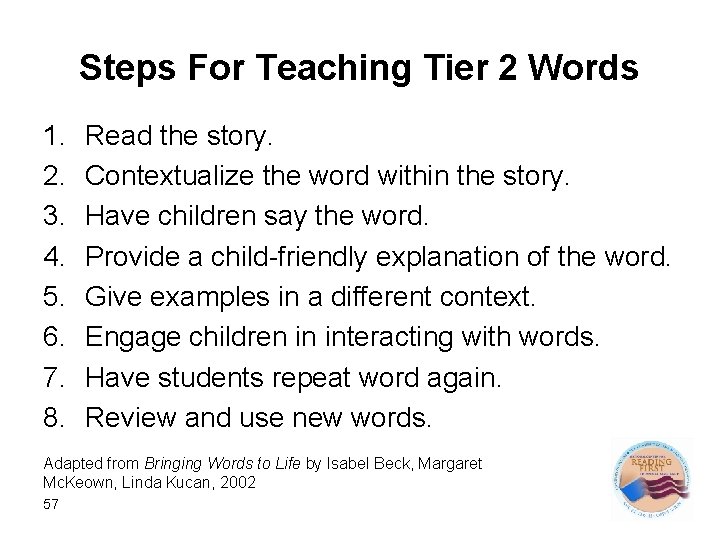
Steps For Teaching Tier 2 Words 1. 2. 3. 4. 5. 6. 7. 8. Read the story. Contextualize the word within the story. Have children say the word. Provide a child-friendly explanation of the word. Give examples in a different context. Engage children in interacting with words. Have students repeat word again. Review and use new words. Adapted from Bringing Words to Life by Isabel Beck, Margaret Mc. Keown, Linda Kucan, 2002 57
Steps for Teaching Tier 2 Words Step 1: Read the story. Step 2: Contextualize the word. In the story, the cows were growing impatient with the farmer. They were tired of waiting for him to bring them electric blankets. Step 3: Have children say word. Say the word with me: impatient Adapted from Bringing Words to Life by Isabel Beck, Margaret Mc. Keown, Linda Kucan, 2002 58
Steps for Teaching Tier 2 Words (continued) Step 4: Provide student friendly definition. Impatient means you are tired of waiting for something or tired of putting up with something. I get impatient when I have to wait in a long line at the grocery store. Adapted from Bringing Words to Life by Isabel Beck, Margaret Mc. Keown, Linda Kucan, 2002 59
Steps for Teaching Tier 2 Words (continued) Step 5: Give examples in another context. Carlos might become impatient with his little sister when she asks too many questions. Tisha might be impatient waiting for her turn to roll the dice in a game. Kelly might get impatient waiting for her friend to call her when she gets home from school. Adapted from Bringing Words to Life by Isabel Beck, Margaret Mc. Keown, Linda Kucan, 2002 60
Steps for Teaching Tier 2 Words (continued) Step 6: Engage children in interacting with words. Generating examples: • Tell me something that makes you impatient. • Finish this sentence “I get impatient when_______. ” Respond with actions: • Show me a face somebody might make if they were impatient. • If you were impatient, how might you act? Adapted from Bringing Words to Life by Isabel Beck, Margaret Mc. Keown, Linda Kucan, 2002 61
Steps for Teaching Tier 2 Words (continued) Answering questions/giving reasons: What are some things your friends do that make you impatient? What do you get impatient waiting for? What could you say or do to calm someone down or help them wait when they are impatient? Adapted from Bringing Words to Life by Isabel Beck, Margaret Mc. Keown, Linda Kucan, 2002 62
Steps for Teaching Tier 2 Words (continued) Identifying examples and nonexamples: Who is impatient? • The little girl who waits quietly to get on the bus • The little girl who interrupts her friend before she is done talking Would you be impatient if. . . • You couldn’t go to recess until everyone was quiet? • Your table got to go to lunch first? Adapted from Bringing Words to Life by Isabel Beck, Margaret Mc. Keown, Linda Kucan, 2002 63
Steps for Teaching Tier 2 Words (continued) Step 7: Have students repeat the word again. “What is the word we are learning? ” Step 8: Review and use the new words. Post book cover and the selected words. Catch kids using the words or noticing them being used. • Visual recognition like charts. • Verbal recognition like “What a word wizard! You really have your word antenna on today. ” Adapted from Bringing Words to Life by Isabel Beck, Margaret Mc. Keown, Linda Kucan, 2002 64
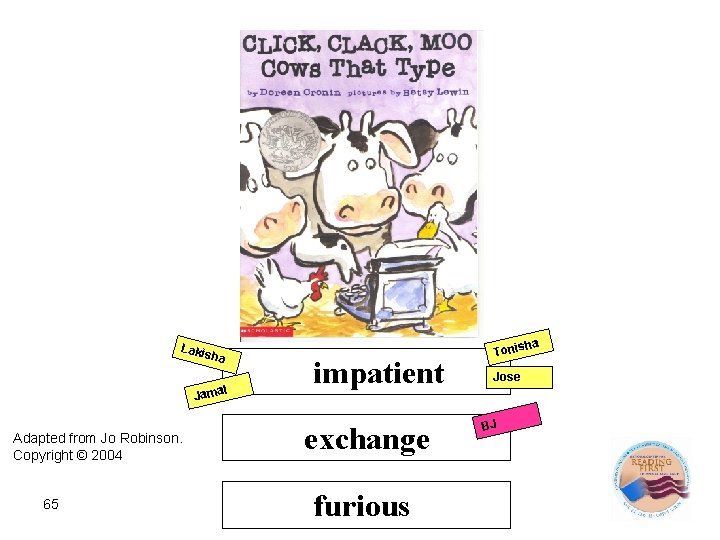
Laki sha l Jama Adapted from Jo Robinson. Copyright © 2004 65 impatient exchange furious ha Tonis Jose BJ
Steps for Teaching Tier 2 Words (continued) Step 8: Review and use the new words. Incorporate words into daily language. “Are you getting impatient to finish this book? ” “Being impatient won’t make the bell ring any faster. ” Miss Wilson will become impatient if it takes you too long to get to music. Adapted from Bringing Words to Life by Isabel Beck, Margaret Mc. Keown, Linda Kucan, 2002 66
Your Turn: Select 3 Tier 2 Words From This Passage Bats are mammals. They are the only flying animals that nurse. This means that the mothers’ bodies make milk to feed their babies. Bat pups hang together in large groups called nurseries. Each mother returns to feed her pup at least twice a night. The pups need their mothers’ milk to survive. If you disturb a nursery cave, the frightened mothers may leave, and the pups will starve. Zipping, Zapping, Zooming Bats by Ann Earle 67
Remember the Criteria Unfamiliar yet understandable and easy to explain. Important to the story. Used in different contexts/domains. Likely to be needed in future (high utility). Adapted from Bringing Words to Life by Isabel Beck, Margaret Mc. Keown, Linda Kucan, 2002 68
Your Turn Step 1: Read the passage. Step 2: Create a statement that would contextualize the word you’ve selected and share it with your partner. Step 3: Have partner say word. Step 4: Provide your partner with a student friendly explanation of your word. Adapted from Bringing Words to Life by Isabel Beck, Margaret Mc. Keown, Linda Kucan, 2002 69
Your Turn (continued) Step 5: Create examples of your word in different contexts and share them with your partner. Step 6: Develop one activity to engage your partner in interacting with your word. Generate examples. Respond with actions. Answer questions/give reasons. Identify examples and nonexamples. Adapted from Bringing Words to Life by Isabel Beck, Margaret Mc. Keown, Linda Kucan, 2002 70
Your Turn (continued) Step 7: What word are we studying? (partner repeats) Step 8: Create a sentence using your word that you would logically use in your classroom. Adapted from Bringing Words to Life by Isabel Beck, Margaret Mc. Keown, Linda Kucan, 2002 71
More Activities to Engage Student in Processing Word Meanings Word associations: After students have explanations of a group of words, ask them to make associations between the new word and words we give them. miser hermit imposter glutton Which word goes with a stomach ache? Why? Which word goes with pretend? Why? Which word goes with money? Why? Adapted from Bringing Words to Life by Isabel Beck, Margaret Mc. Keown, Linda Kucan, 2002 72
Have you ever? After students have explanations to a group of words, ask them to relate the words to their own experiences with stems like these Describe a time when you might want to avoid someone. When would we want to commend someone? Adapted from Bringing Words to Life by Isabel Beck, Margaret Mc. Keown, Linda Kucan, 2002 73
Applause, Applause! Ask students to clap to indicate how much they would like to be described by the target words (not at all, a little, a lot). Use target words that are character trait adjectives. competent pitiful vain fearless tranquil Adapted from Bringing Words to Life by Isabel Beck, Margaret Mc. Keown, Linda Kucan, 2002 74
Idea completion: Provide sentence stems that require students to use meaning in context correctly. • The runner felt triumphant because. . . • Tom regretted leaving his bowl of ice cream on the counter because. . . Adapted from Bringing Words to Life by Isabel Beck, Margaret Mc. Keown, Linda Kucan, 2002 75
Closing the Gap: Addressing the Vocabulary Needs of English-Language Learners in Bilingual and Mainstream Classrooms Maria S. Carlo Cheryl Dressler Diane August David N. Lippman Barry Mc. Laughlin Teresa J. Lively Catherine E. Snow Claire E. White Reading Research Quarterly, Vol. 39, No. 2 (April/May/June 2004) 76
Closing the Gap Conclusions Direct vocabulary instruction is effective, with both ELL and EO learners, if it incorporates the various principles gleaned from previous work on monolingual English speakers and ELLs. In other words, teachers should Introduce novel words in the context of engaging texts. Design multiple activities that allow learners to manipulate and analyze word meaning. 77
Closing the Gap Conclusions (continued) Teachers should Heighten attention to words in general (build word consciousness). Have learners write and spell targeted words multiple times. Ensure repeated exposure to new words and help children see how the meaning varies in relation to context. Teach strategies for inferring the meaning of unknown words using well-verified procedures (using context clues and morphology and teaching about cognates). 78
Other ELL Considerations Provide concrete experiences with words. Demonstrate (actions, expressions, positional and ordinal words). Provide picture files. Use realia (actual objects). Use semantic mapping and graphic organizers. Build background knowledge. Have children make comparisons to similar words and concepts in first language. 79
Other ELL Considerations Provide multiple opportunities for verbal interaction with native English speakers. Teach them how to use cognates to make connections between similar words in both languages. 80
Cognates and False Cognates are words that have similar spellings in English and Spanish and are related in meaning. secret-secreto; family-familia; fruit-fruta; increible-incredible; future-futuro “tion” = “cion”; “ent” = “ente”; “cy” = “cia” False cognates have similar spellings in both languages but different meanings. Red means net in Spanish. 81

Promising New Website Sponsored by AFT and WETA www. colorincolorado. org 82
Putting It All Together For identified vocabulary words to be taught in a core program lesson or over multiple lessons, develop vocabulary strategies or activities from this workshop that could be used to extend, enhance and/or review student understanding of the targeted words. 83
- Slides: 83