
Research and Development Recent NHTSA Dynamic Rollover Testing
- Slides: 15
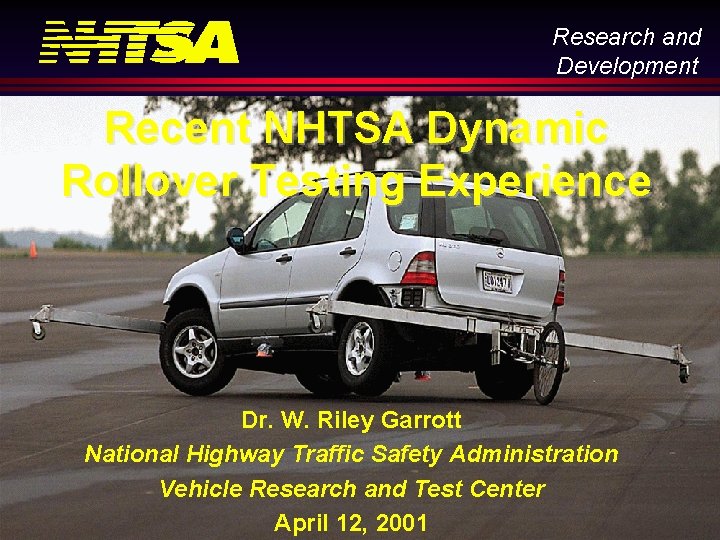
Research and Development Recent NHTSA Dynamic Rollover Testing Experience Dr. W. Riley Garrott National Highway Traffic Safety Administration Vehicle Research and Test Center April 12, 2001 5 Mar 01, page 1
Research and Development Presentation Overview • • • Summary of Recent Testing Test Maneuvers Our Test Facilities Repeatability Outstanding Issues 5 Mar 01, page 2
Research and Development Summary of Recent Testing • NHTSA has been performing dynamic rollover testing steadily since fall of 1996 – – – – Isuzu Trooper investigation in 1996 Phase I-A research in 1997 Phase I-B research in 1997 – 98 Phase II research in 1998 Phase III research in 1999 – 2000 Ford Explorer investigation in 2000 Phase IV research in 2001 5 Mar 01, page 3
Research and Development Dynamic Rollover Testing Video AVI Not Included 5 Mar 01, page 4
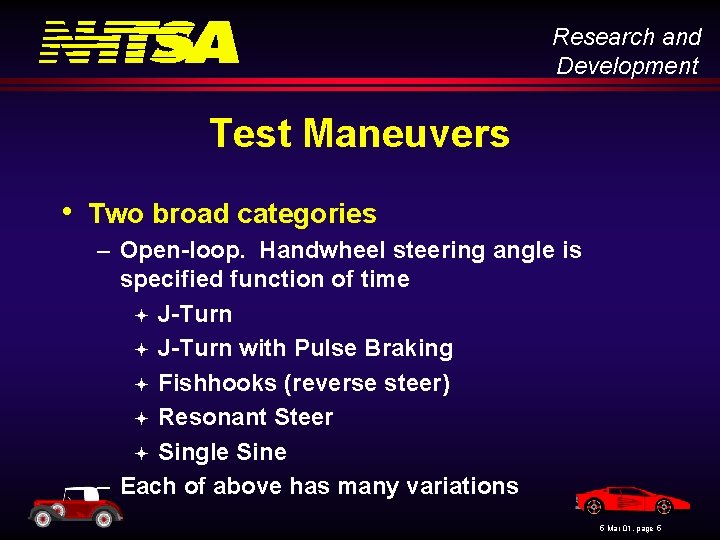
Research and Development Test Maneuvers • Two broad categories – Open-loop. Handwheel steering angle is specified function of time ª J-Turn with Pulse Braking ª Fishhooks (reverse steer) ª Resonant Steer ª Single Sine – Each of above has many variations 5 Mar 01, page 5
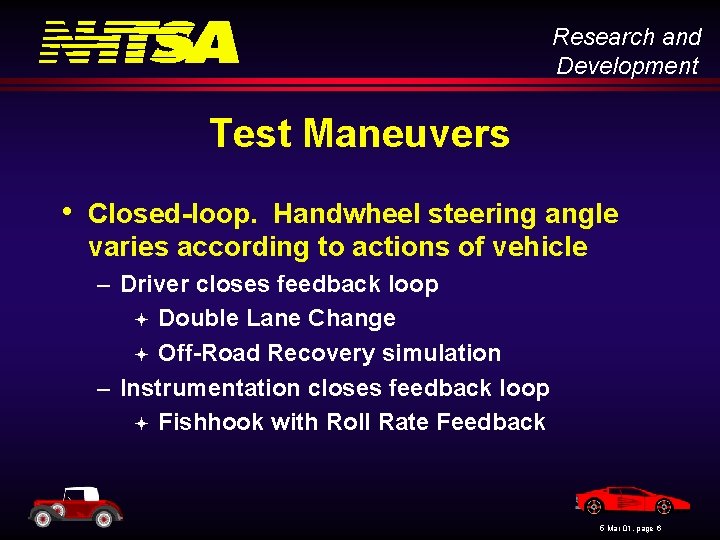
Research and Development Test Maneuvers • Closed-loop. Handwheel steering angle varies according to actions of vehicle – Driver closes feedback loop ª Double Lane Change ª Off-Road Recovery simulation – Instrumentation closes feedback loop ª Fishhook with Roll Rate Feedback 5 Mar 01, page 6
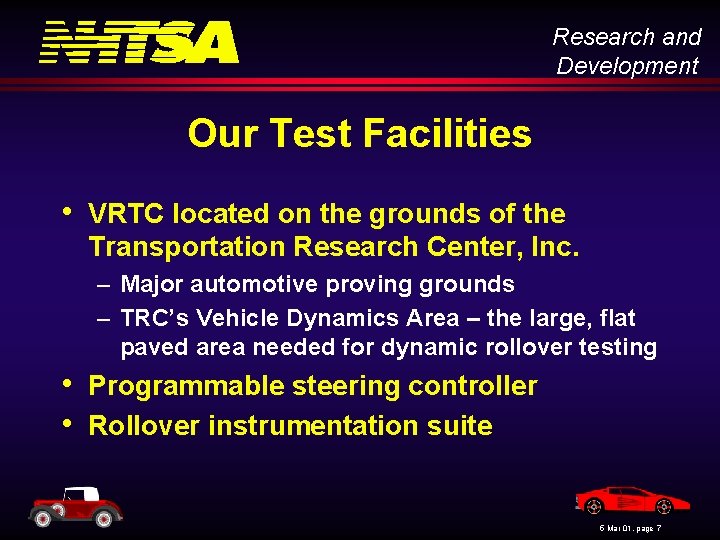
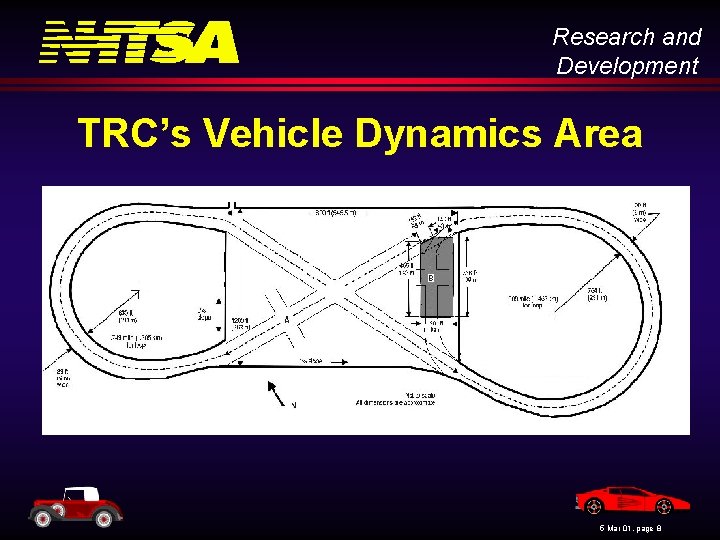
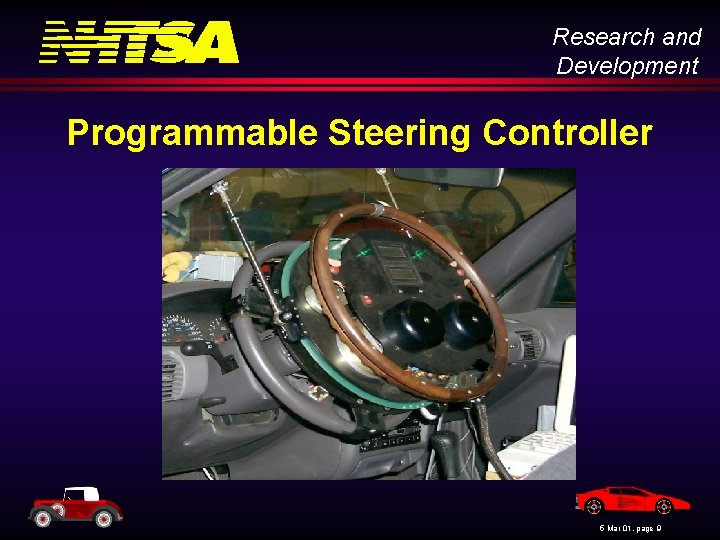
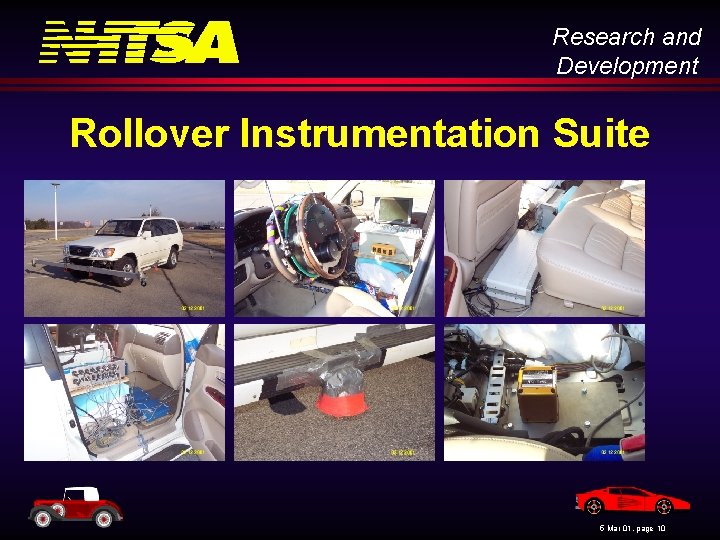
Research and Development Our Test Facilities • VRTC located on the grounds of the Transportation Research Center, Inc. – Major automotive proving grounds – TRC’s Vehicle Dynamics Area – the large, flat paved area needed for dynamic rollover testing • Programmable steering controller • Rollover instrumentation suite 5 Mar 01, page 7
Research and Development TRC’s Vehicle Dynamics Area 5 Mar 01, page 8
Research and Development Programmable Steering Controller 5 Mar 01, page 9
Research and Development Rollover Instrumentation Suite 5 Mar 01, page 10
Research and Development Repeatability • During dynamic rollover testing, vehicles become highly non-linear – Small changes in inputs, test conditions can lead to large changes in test outcomes – Testing in early-70’s found up to 40% run-torun variability 5 Mar 01, page 11
Research and Development Repeatability • Have had good repeatability in our testing – Major improvement over 70’s – Less tire wear with radial tires plus better equipment • Open-loop maneuver repeatability – Peak lateral accelerations – 0. 05 g – Peak roll angles – 0. 5 degrees – Minimum speed for two-wheel lifts to occur – 2 mph • Closed-loop double lane change 5 Mar 01, page 12
Research and Development Issues • Maneuver(s) to use for rollover ratings • Ensuring that cannot get good rollover rating by degrading vehicle handling – By putting tires with poor traction on a vehicle, can prevent two-wheel lifts in these maneuvers – Safety may be degraded because cannot turn as sharply • Use of two-wheel lifts as safety-relevant measure – Minor two-wheel lifts may not be safety issue 5 Mar 01, page 13
Research and Development Issues • Longer-term repeatability – Effects of weather of results ª Summer versus winter – Changes to the same test surface with time • Reproducibility – Effects of testing on different test surfaces 5 Mar 01, page 14
Research and Development Issues • Outrigger effects – Must have for safety, prevention of test surface damage – How do they change a vehicles rollover propensity? • Tire wear – How much testing can be performed on a set of tires before wear effects become significant • Tire debeading – What to do if tires debead while performing rollover rating testing 5 Mar 01, page 15