
Rescheduled Webinar Progressive Case Management in SSVF Programs
Rescheduled Webinar: Progressive Case Management in SSVF Programs MARCH 21, 2013 2: 00 -3: 30 PM
John Kuhn, U. S. Department of Veteran Affairs SSVF NATIONAL DIRECTOR’S UPDATE

What, Why and How: Overview of Progressive Case Management Marge Wherley, Abt Associates 3
What is “Progressive Case Management”? • A baseline level of case management assistance. • Intensity and/or duration of case management will be increased for an individual, but only if and when the baseline is shown to be inadequate for that person. 4
The Rationale • Efficiency: by avoiding more assistance than is required, the program can help more people. • Individualization: When a person shows s/he needs more help, that help can be provided. • Avoids false assumptions about disability and/or poverty: persons with those demographics do not uniformly require more intensive or longer-term assistance. • Effectiveness: Research, including random assignment to high and moderate levels of case management have not found differences in outcomes. 5
Core Concepts of SSVF • Housing First: Maintain or obtain permanent housing as soon as possible, without preconditions. • Crisis Response: Short-term intervention to quickly resolve a housing crisis. • Client Choice: The person in crisis has the choice of addressing or deferring life changes, utilizing referrals, etc. 6
Crisis Intervention Case Management • People experiencing a crisis normally go through periods of disequilibrium and equilibrium until they can return to a state of relative stability. This is highly stressful. • Crisis intervention aims to reduce the duration and intensity of disequilibrium and allow the person to return more quickly to their previous level of stability, reducing stress levels. • Stress has physical and psychological consequences, including an inability to focus on long-range goals, learn new information, or make changes that require self-control and willpower. 7
Defining Baseline in SSVF Case Management Tasks for Homelessness Prevention: • Identify barriers to keeping housing • Provide assistance with relocation if housing cannot be retained • Provide assistance with landlord negotiations, lease compliance, temporary financial assistance, etc. to retain or obtain housing • Provide short-term follow-up on issues related to housing (and income needed for housing). This includes making referrals the household needs/wants to reduce the likelihood of future crises. 8
Defining Baseline in SSVF Case Management Tasks for Rapid Re-Housing: • Identify barriers to keeping housing • Provide assistance with housing search, landlord negotiations, understanding lease compliance, temporary financial assistance, application for benefits, etc. as needed to obtain housing. • Provide short-term follow-up on issues related to housing (and income needed for housing). This includes making referrals the household needs/wants to reduce the likelihood of future crises. 9
Baseline Assessment Tenant Screening Barriers Rapid Re-Housing (always) and Homeless Prevention (when housing relocation is required) • • Income and income history Rental history Criminal history Credit history 10
Assessing Tenant Screening Barriers • Interview client (always) • Collect more formal information (highly recommended): Buy a tenant screening report OR Conduct a screening--obtain release of information and contact previous landlords, credit agencies, access criminal and eviction databases 11
Baseline Assessment Housing Retention Barriers Homelessness Prevention and Rapid Re-Housing • Income, ability to pay rent (even if severely rentburdened) • General understanding of landlord and tenant rights and responsibilities, lease requirements • Ability to comply with the “social expectations” of renting 12
Assessing Housing Retention Barriers • Income: documentation for SSVF eligibility determination • Tenant Screening Report: suggests patterns that could be Housing Retention Barriers. • Interview: discuss red flag items on TSR • Home visits can identify potential HRBs • Checking in with the landlord may identify red flags of potential problems with lease, rent payment, or social expectations (complaints by other tenants). 13
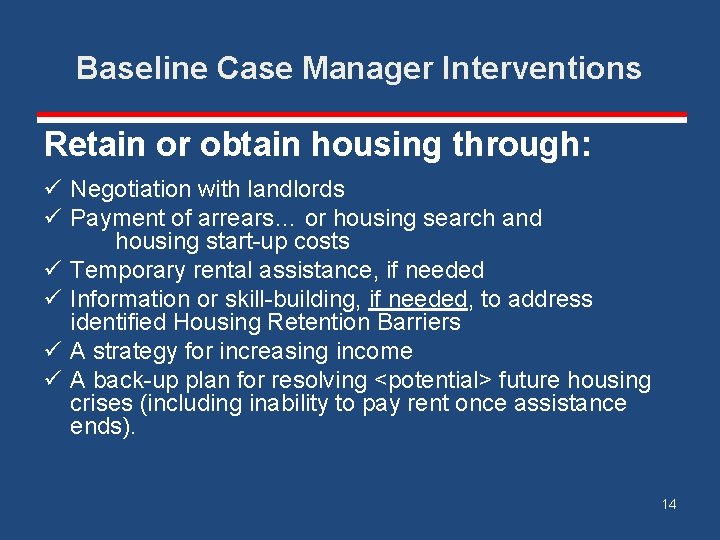
Baseline Case Manager Interventions Retain or obtain housing through: ü Negotiation with landlords ü Payment of arrears… or housing search and housing start-up costs ü Temporary rental assistance, if needed ü Information or skill-building, if needed, to address identified Housing Retention Barriers ü A strategy for increasing income ü A back-up plan for resolving <potential> future housing crises (including inability to pay rent once assistance ends). 14
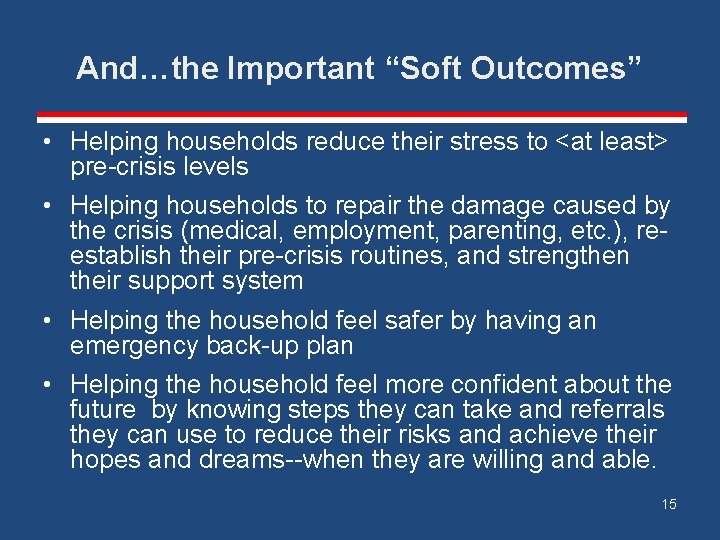
And…the Important “Soft Outcomes” • Helping households reduce their stress to <at least> pre-crisis levels • Helping households to repair the damage caused by the crisis (medical, employment, parenting, etc. ), reestablish their pre-crisis routines, and strengthen their support system • Helping the household feel safer by having an emergency back-up plan • Helping the household feel more confident about the future by knowing steps they can take and referrals they can use to reduce their risks and achieve their hopes and dreams--when they are willing and able. 15
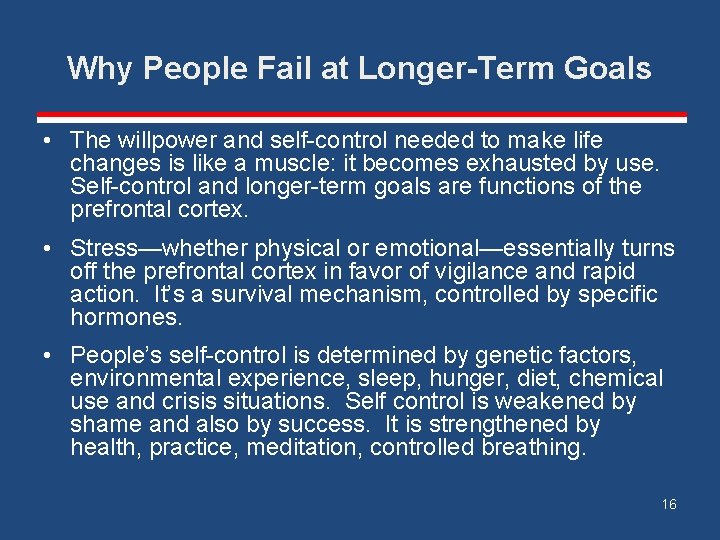
Why People Fail at Longer-Term Goals • The willpower and self-control needed to make life changes is like a muscle: it becomes exhausted by use. Self-control and longer-term goals are functions of the prefrontal cortex. • Stress—whether physical or emotional—essentially turns off the prefrontal cortex in favor of vigilance and rapid action. It’s a survival mechanism, controlled by specific hormones. • People’s self-control is determined by genetic factors, environmental experience, sleep, hunger, diet, chemical use and crisis situations. Self control is weakened by shame and also by success. It is strengthened by health, practice, meditation, controlled breathing. 16
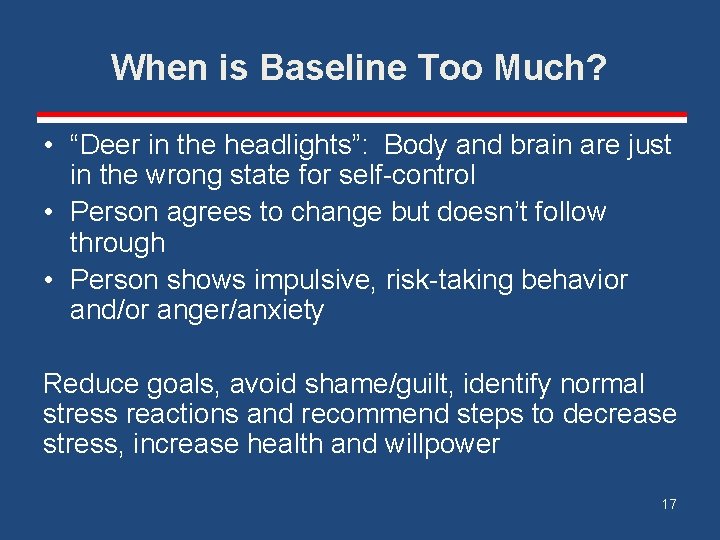
When is Baseline Too Much? • “Deer in the headlights”: Body and brain are just in the wrong state for self-control • Person agrees to change but doesn’t follow through • Person shows impulsive, risk-taking behavior and/or anger/anxiety Reduce goals, avoid shame/guilt, identify normal stress reactions and recommend steps to decrease stress, increase health and willpower 17
When is Baseline Not Enough? • When the landlord reports continuing and serious violations of the lease or complaints by other tenants—to the point housing is still at risk. • When additional assistance is necessary to obtain longer-term financial assistance and/or service from another agency. Identify the specific case management assistance needed to achieve goals-- and the projected intensity/duration 18
When is the Crisis “Resolved”? • Household is current with rent and in compliance with lease • Landlord is willing to continue lease • Tenant can explain landlord-tenant rights and responsibilities* • Tenant can explain “social expectations of leasing” and how the household will meet these* • Tenant believes crisis is resolved and housing is stable • Tenant has a plan and referrals for increasing income • Tenant has referral information to pursue additional goals that are important to household’s future stability • Tenant has a plan for responding to future, predictable risks of a housing crisis (Emergency Plan B) 19
Planning for Progressive Case Management How long will it take to resolve the crisis? When do about 80% of participants reach the baseline expectations? How often does the case manager need to meet with the participant—initially and after the first weeks? What level of contact is sufficient to resolve the crisis for about 80% of participants? These are the baseline, which can be adjusted to respond to individuals who demonstrate they need more frequent or longer case management—or less intensity and duration of case management. 20
Designing Progressive Case Management in Your SSVF Program • Define minimum expectations for frequency of contact and expected duration of assistance • Define a process for increasing the baseline level of case management on a case-by-case basis when it is demonstrably inadequate to resolve the crisis • Design caseload sizes based upon baseline intensity and duration (as an average which can be over-ridden according to agency process) 21
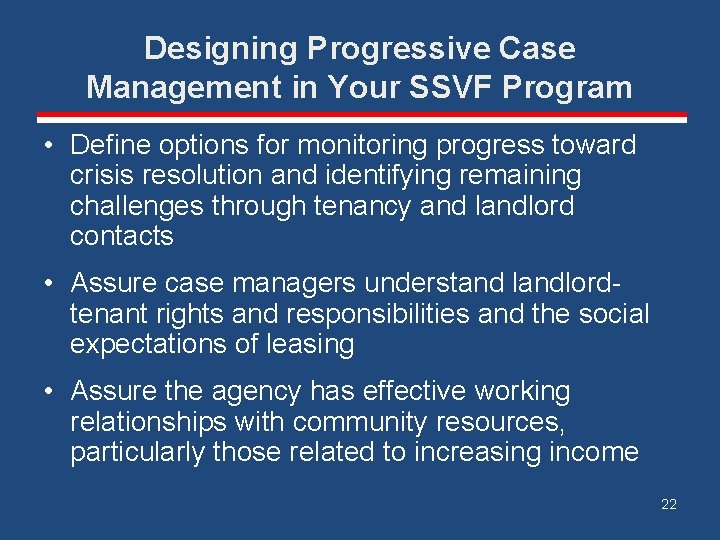
Designing Progressive Case Management in Your SSVF Program • Define options for monitoring progress toward crisis resolution and identifying remaining challenges through tenancy and landlord contacts • Assure case managers understand landlordtenant rights and responsibilities and the social expectations of leasing • Assure the agency has effective working relationships with community resources, particularly those related to increasing income 22
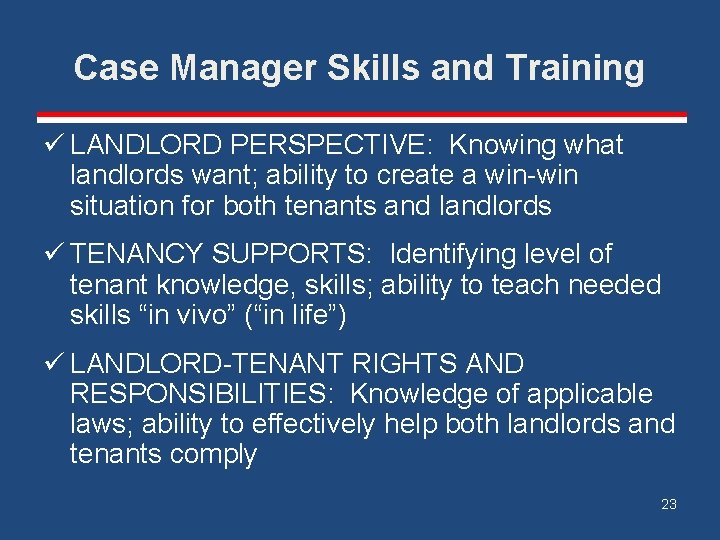
Case Manager Skills and Training ü LANDLORD PERSPECTIVE: Knowing what landlords want; ability to create a win-win situation for both tenants and landlords ü TENANCY SUPPORTS: Identifying level of tenant knowledge, skills; ability to teach needed skills “in vivo” (“in life”) ü LANDLORD-TENANT RIGHTS AND RESPONSIBILITIES: Knowledge of applicable laws; ability to effectively help both landlords and tenants comply 23
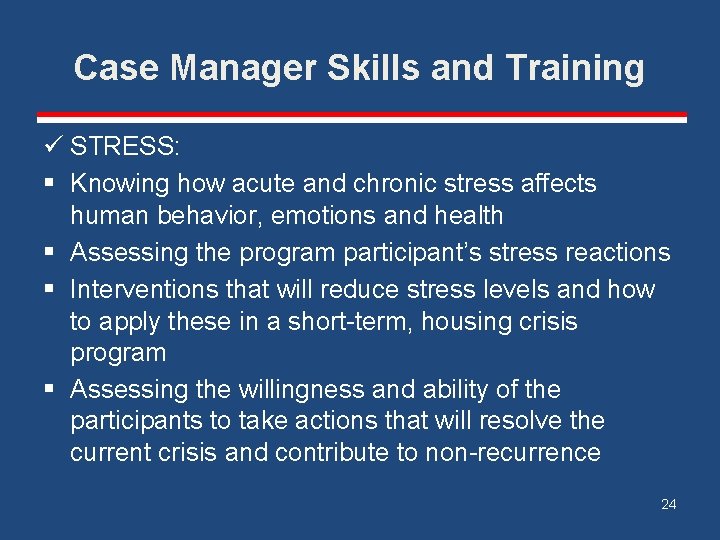
Case Manager Skills and Training ü STRESS: § Knowing how acute and chronic stress affects human behavior, emotions and health § Assessing the program participant’s stress reactions § Interventions that will reduce stress levels and how to apply these in a short-term, housing crisis program § Assessing the willingness and ability of the participants to take actions that will resolve the current crisis and contribute to non-recurrence 24
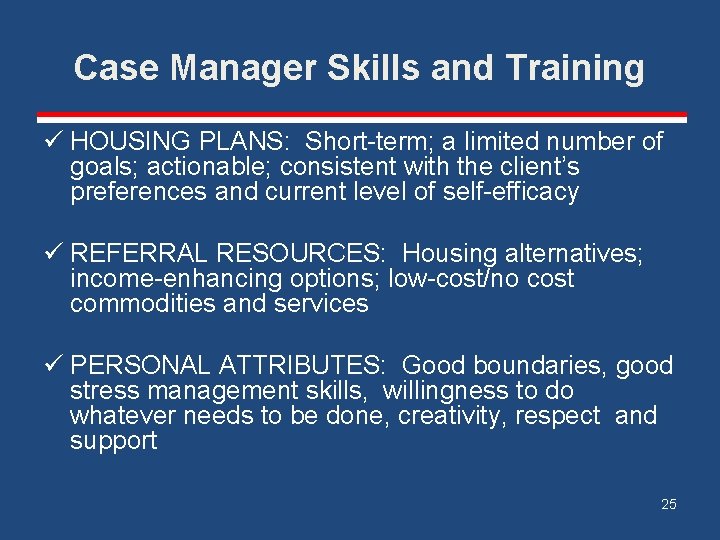
Case Manager Skills and Training ü HOUSING PLANS: Short-term; a limited number of goals; actionable; consistent with the client’s preferences and current level of self-efficacy ü REFERRAL RESOURCES: Housing alternatives; income-enhancing options; low-cost/no cost commodities and services ü PERSONAL ATTRIBUTES: Good boundaries, good stress management skills, willingness to do whatever needs to be done, creativity, respect and support 25
Keeping Your Head Above Water • Understand the neurological limits of making multiple or significant life changes, particularly when a person is under stress • Challenge our tendencies toward cynicism when people cannot focus on anything but the immediate crisis • Develop pride in the importance of crisis intervention!!!!! It is a challenging and rewarding profession! Celebrate the short-term! 26
Kristina Hals, SSVF Technical Assistance REFERRALS FOR INCOME KEY TO SSVF PROGRESSIVE CASE MANAGEMENT 27
Crisis Response Paradigm of SSVF Implications for Referrals: § § § Sharpens focus on key referral arenas. Narrows range of referrals to a hierarchy. Prioritizes resolving immediate crisis. Requires expert navigation of key arenas. Creates imperative for referring externally. 28
Choice of Arenas for SSVF Referrals Will be: • Driven by consumer choice. • Framed by crisis response. • Key to integrating SSVF w/mainstream resources. • Focused on: a) Maximizing income. b) Accessing housing. c) Accessing Veteran benefits/systems. 29
Our Focus Today: Income Maximization Referrals Why Focus on Income? • 1 st order in the “progress” of progressive case management. • Primary for prevention and re-housing. • Some opportunities specific to: ØHomeless. ØVeterans. ØHomeless Veterans. 30
Income Status of SSVF Participants Varying Profiles: • • All are @ 50% Area Media Income – many @ 15%. Some have zero income. Income drop may have precipitated housing crisis. Work histories include: ØEmployment barriers specific to Veterans. ØLong and steady or intermittent work histories. ØInformal work, flexible employment. ØJob loss, terminations, lay off. ØLack of progress beyond transitional jobs. ØLong term unemployed, discouraged workers. 31
Benefit Status of SSVF Participants Varying Profiles: • • • Never applied for public benefits. Pending application(s). Receive or applied/denied TANF/SNAPs. Receive or applied/denied SSI/SSDI. Receive or applied/denied to Vet’s “Pension”. Sanctioned from TANF/SSI/SSDI/Vet Benefits. 32
Income for SSVF Crisis Resolution May Come From: 1. 2. 3. 4. 5. 6. 7. 8. Work: temporary, day labor, transitional, etc. Stipends: job training/intern programs. GI Bill: stipend and housing allowance. Public benefits (can combine with job). Non-SSVF temporary financial assistance. Child support - recaptured of unpaid. Shared expenses via SSVF roommate(s) Gifts (local charities, faith based groups). 33
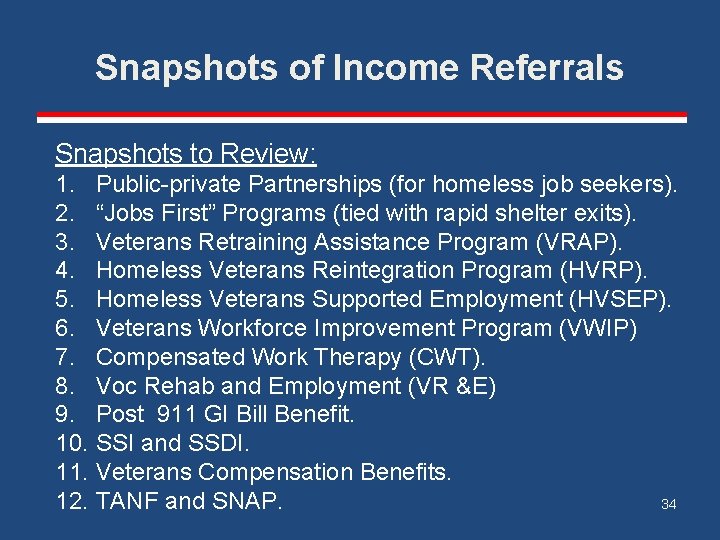
Snapshots of Income Referrals Snapshots to Review: 1. Public-private Partnerships (for homeless job seekers). 2. “Jobs First” Programs (tied with rapid shelter exits). 3. Veterans Retraining Assistance Program (VRAP). 4. Homeless Veterans Reintegration Program (HVRP). 5. Homeless Veterans Supported Employment (HVSEP). 6. Veterans Workforce Improvement Program (VWIP) 7. Compensated Work Therapy (CWT). 8. Voc Rehab and Employment (VR &E) 9. Post 911 GI Bill Benefit. 10. SSI and SSDI. 11. Veterans Compensation Benefits. 12. TANF and SNAP. 34
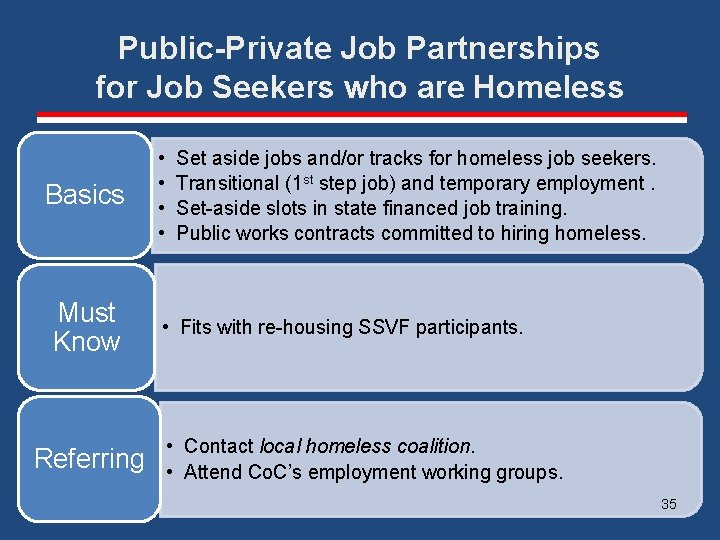
Public-Private Job Partnerships for Job Seekers who are Homeless Basics Must Know Referring • • Set aside jobs and/or tracks for homeless job seekers. Transitional (1 st step job) and temporary employment. Set-aside slots in state financed job training. Public works contracts committed to hiring homeless. • Fits with re-housing SSVF participants. • Contact local homeless coalition. • Attend Co. C’s employment working groups. 35
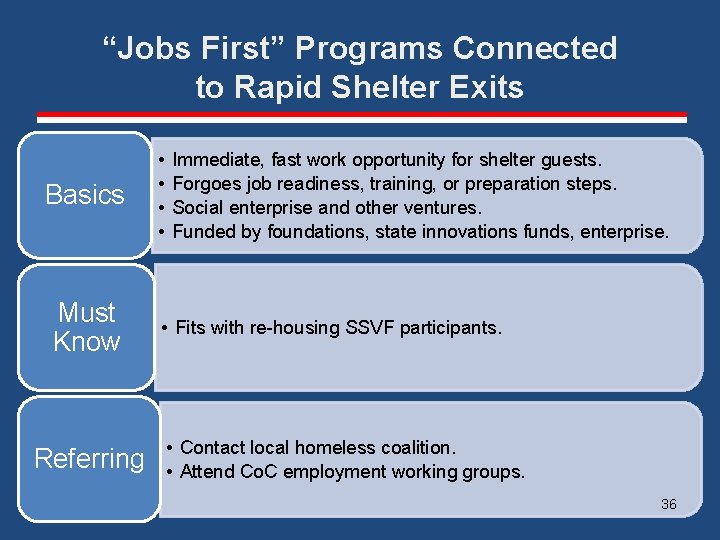
“Jobs First” Programs Connected to Rapid Shelter Exits Basics Must Know Referring • • Immediate, fast work opportunity for shelter guests. Forgoes job readiness, training, or preparation steps. Social enterprise and other ventures. Funded by foundations, state innovations funds, enterprise. • Fits with re-housing SSVF participants. • Contact local homeless coalition. • Attend Co. C employment working groups. 36
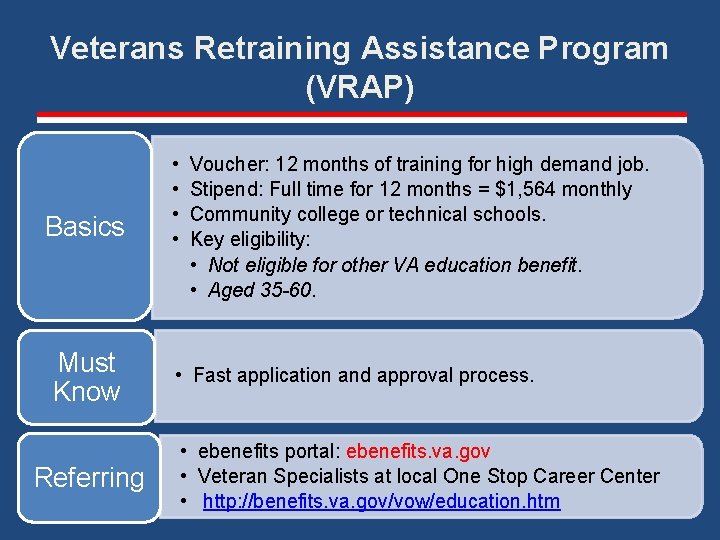
Veterans Retraining Assistance Program (VRAP) Basics Must Know Referring • • Voucher: 12 months of training for high demand job. Stipend: Full time for 12 months = $1, 564 monthly Community college or technical schools. Key eligibility: • Not eligible for other VA education benefit. • Aged 35 -60. • Fast application and approval process. • ebenefits portal: ebenefits. va. gov • Veteran Specialists at local One Stop Career Center • http: //benefits. va. gov/vow/education. htm
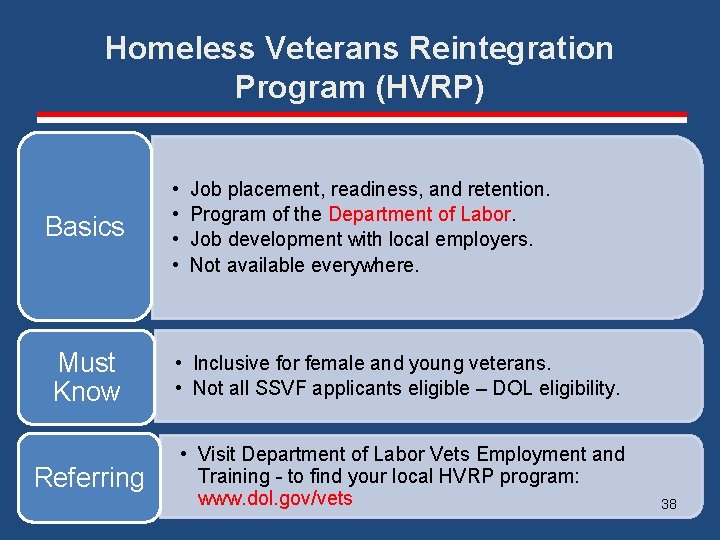
Homeless Veterans Reintegration Program (HVRP) Basics Must Know Referring • • Job placement, readiness, and retention. Program of the Department of Labor. Job development with local employers. Not available everywhere. • Inclusive for female and young veterans. • Not all SSVF applicants eligible – DOL eligibility. • Visit Department of Labor Vets Employment and Training - to find your local HVRP program: www. dol. gov/vets 38
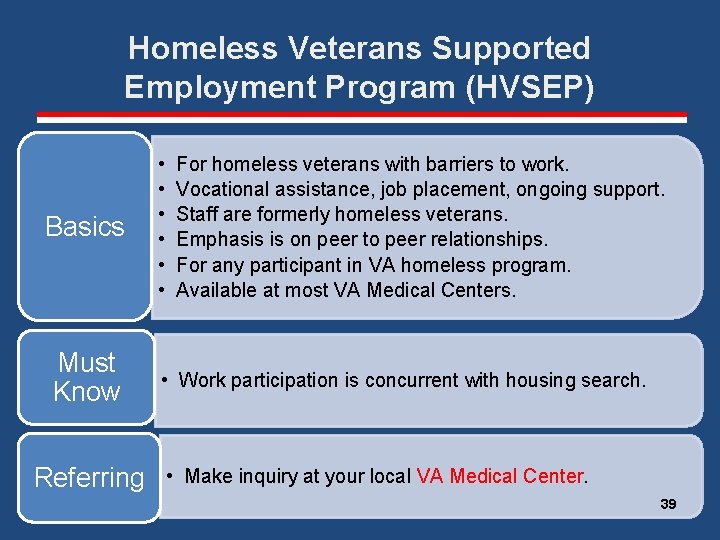
Homeless Veterans Supported Employment Program (HVSEP) Basics Must Know Referring • • • For homeless veterans with barriers to work. Vocational assistance, job placement, ongoing support. Staff are formerly homeless veterans. Emphasis is on peer to peer relationships. For any participant in VA homeless program. Available at most VA Medical Centers. • Work participation is concurrent with housing search. • Make inquiry at your local VA Medical Center. 39
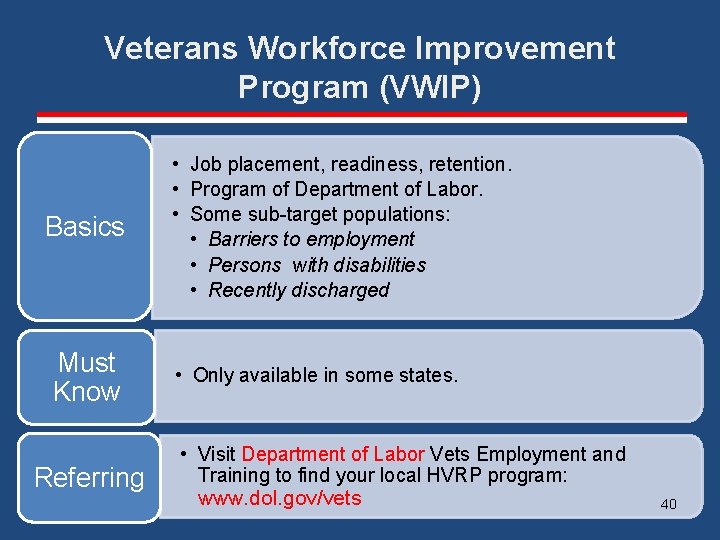
Veterans Workforce Improvement Program (VWIP) Basics Must Know Referring • Job placement, readiness, retention. • Program of Department of Labor. • Some sub-target populations: • Barriers to employment • Persons with disabilities • Recently discharged • Only available in some states. • Visit Department of Labor Vets Employment and Training to find your local HVRP program: www. dol. gov/vets 40
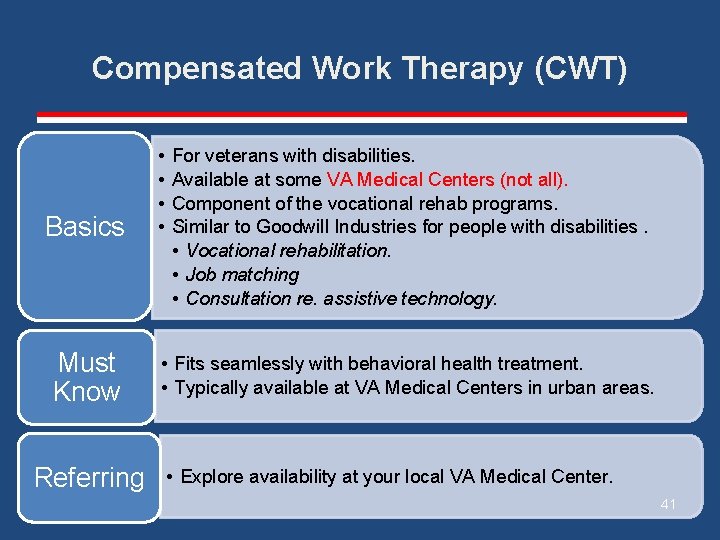
Compensated Work Therapy (CWT) Basics Must Know Referring • • For veterans with disabilities. Available at some VA Medical Centers (not all). Component of the vocational rehab programs. Similar to Goodwill Industries for people with disabilities. • Vocational rehabilitation. • Job matching • Consultation re. assistive technology. • Fits seamlessly with behavioral health treatment. • Typically available at VA Medical Centers in urban areas. • Explore availability at your local VA Medical Center. 41
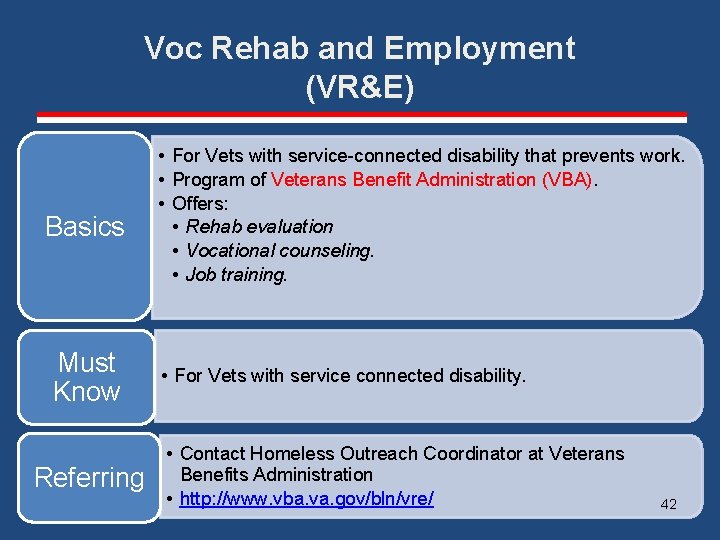
Voc Rehab and Employment (VR&E) Basics Must Know Referring • For Vets with service-connected disability that prevents work. • Program of Veterans Benefit Administration (VBA). • Offers: • Rehab evaluation • Vocational counseling. • Job training. • For Vets with service connected disability. • Contact Homeless Outreach Coordinator at Veterans Benefits Administration • http: //www. vba. va. gov/bln/vre/ 42
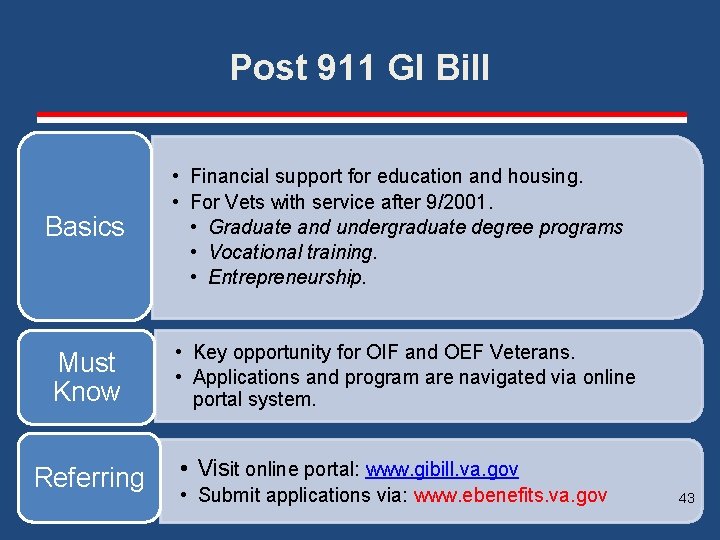
Post 911 GI Bill Basics Must Know Referring • Financial support for education and housing. • For Vets with service after 9/2001. • Graduate and undergraduate degree programs • Vocational training. • Entrepreneurship. • Key opportunity for OIF and OEF Veterans. • Applications and program are navigated via online portal system. • Visit online portal: www. gibill. va. gov • Submit applications via: www. ebenefits. va. gov 43
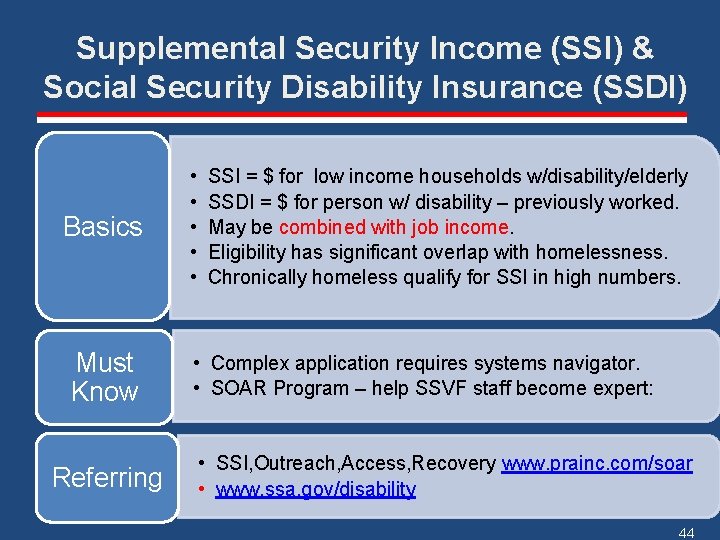
Supplemental Security Income (SSI) & Social Security Disability Insurance (SSDI) Basics Must Know Referring • • • SSI = $ for low income households w/disability/elderly SSDI = $ for person w/ disability – previously worked. May be combined with job income. Eligibility has significant overlap with homelessness. Chronically homeless qualify for SSI in high numbers. • Complex application requires systems navigator. • SOAR Program – help SSVF staff become expert: • SSI, Outreach, Access, Recovery www. prainc. com/soar • www. ssa. gov/disability 44
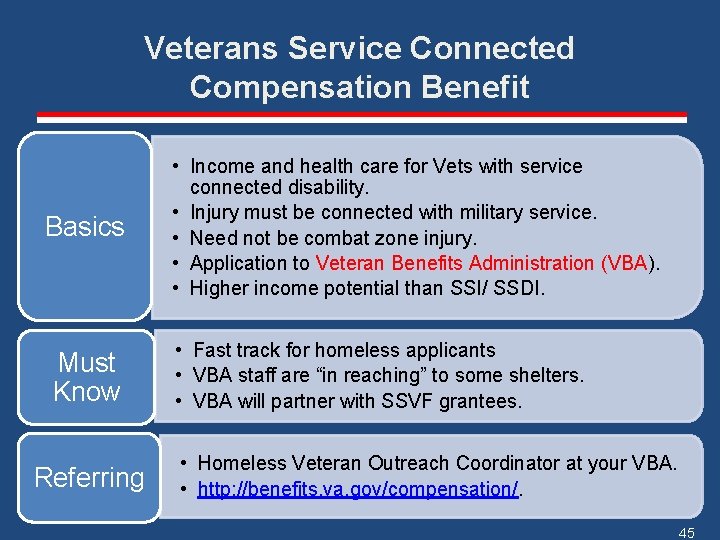
Veterans Service Connected Compensation Benefit Basics Must Know Referring • Income and health care for Vets with service connected disability. • Injury must be connected with military service. • Need not be combat zone injury. • Application to Veteran Benefits Administration (VBA). • Higher income potential than SSI/ SSDI. • Fast track for homeless applicants • VBA staff are “in reaching” to some shelters. • VBA will partner with SSVF grantees. • Homeless Veteran Outreach Coordinator at your VBA. • http: //benefits. va. gov/compensation/. 45
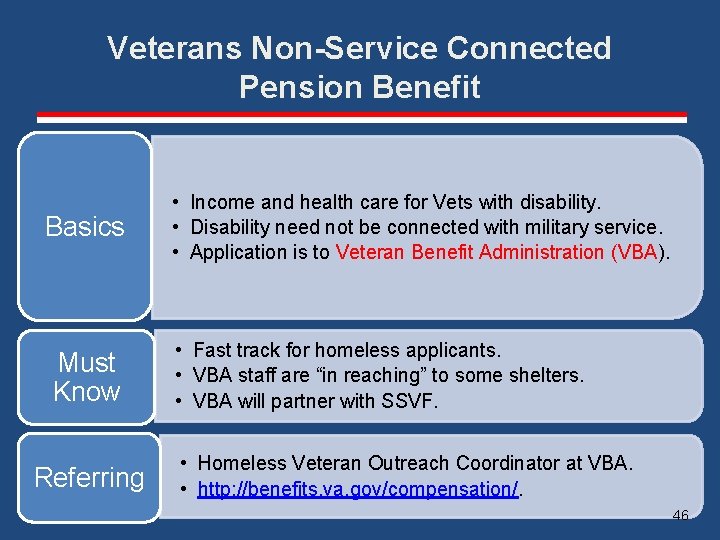
Veterans Non-Service Connected Pension Benefit Basics Must Know Referring • Income and health care for Vets with disability. • Disability need not be connected with military service. • Application is to Veteran Benefit Administration (VBA). • Fast track for homeless applicants. • VBA staff are “in reaching” to some shelters. • VBA will partner with SSVF. • Homeless Veteran Outreach Coordinator at VBA. • http: //benefits. va. gov/compensation/. 46
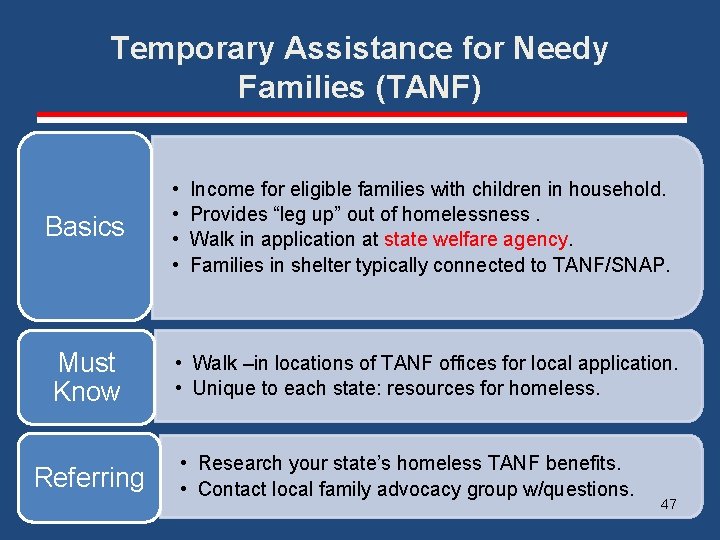
Temporary Assistance for Needy Families (TANF) Basics Must Know Referring • • Income for eligible families with children in household. Provides “leg up” out of homelessness. Walk in application at state welfare agency. Families in shelter typically connected to TANF/SNAP. • Walk –in locations of TANF offices for local application. • Unique to each state: resources for homeless. • Research your state’s homeless TANF benefits. • Contact local family advocacy group w/questions. 47
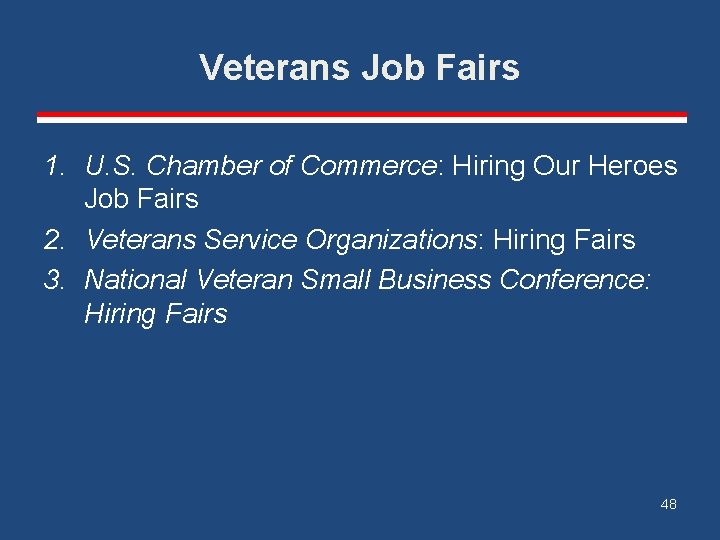
Veterans Job Fairs 1. U. S. Chamber of Commerce: Hiring Our Heroes Job Fairs 2. Veterans Service Organizations: Hiring Fairs 3. National Veteran Small Business Conference: Hiring Fairs 48
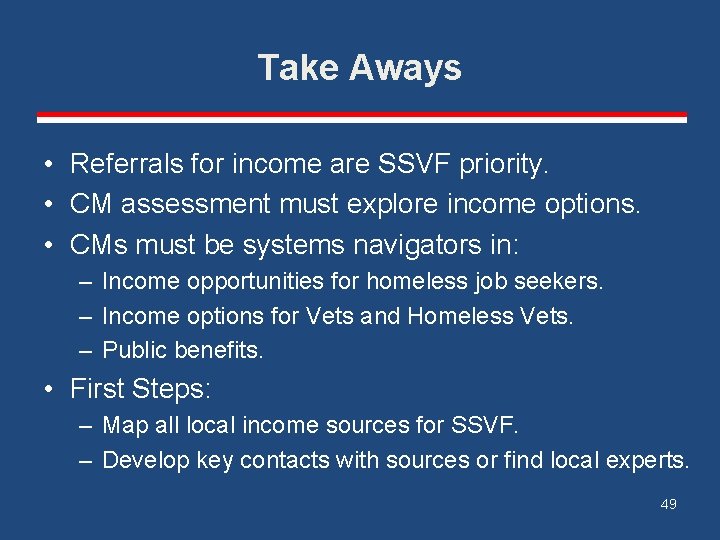
Take Aways • Referrals for income are SSVF priority. • CM assessment must explore income options. • CMs must be systems navigators in: – Income opportunities for homeless job seekers. – Income options for Vets and Homeless Vets. – Public benefits. • First Steps: – Map all local income sources for SSVF. – Develop key contacts with sources or find local experts. 49
Questions 1. Visit SSVF Website for archived webinar. 2. Contact SSVF Regional Coordinators. 50
- Slides: 50