
Requirements Requirements Engineering The process of establishing the
Requirements
Requirements Engineering Ø The process of establishing the services that the customer requires from a system and the constraints under which it operates and is developed. Ø The requirements themselves are the descriptions of the system services and constraints that are generated during the requirements engineering process.

What is Requirement? Ø It may range from a high-level, abstract statement of a service that the system should provide or constraint on the system. Ø This is inevitable as requirements may serve a dual function ØMay be the basis for a bid for a contract therefore must be open to interpretation; ØMay be the basis for the contract itself - therefore must be defined in detail; ØBoth these statements may be called requirements.
Types of Requirement Ø User requirements: Ø Statements Ø In natural language plus diagrams, of what the services the system provides and its operational constraints. Ø Written for customers. Ø System requirements: Ø A structured document setting out detailed descriptions of the system’s functions, services and operational constraints. Ø Defines what should be implemented so may be part of a contract between client (system buyer) and contractor (software developer).
Functional and Non-Functional Requirements Ø Functional requirements Ø Statements of services the system should provide, how the system should react to particular inputs and how the system should behave in particular situations. Ø Non-functional requirements Ø constraints on the services or functions offered by the system such as timing constraints, constraints on the development process, standards, etc. Ø Domain requirements Ø Requirements that come from the application domain of the system and that reflect characteristics of that domain.
Functional Requirements Ø Describe functionality or system services. Ø Depend on the type of software, expected users and the type of system which is being developed. Ø Functional user requirements may be high-level statements of what the system should do but functional system requirements should describe the system services in detail.
LIBSYS Ø A library system that provides a single interface to a number of databases of articles in different libraries. Ø Users can search, download and print these articles for personal study.
Examples of Functional Requirements Ø The user shall be able to search either all of the initial set of databases or select a subset from it. Ø The system shall provide appropriate viewers for the user to read documents in the document store. Ø Every order shall be allocated a unique identifier (ORDER_ID) which the user shall be able to copy to the account’s permanent storage area.
Requirements Imprecision Ø Problems arise when requirements are not precisely stated. Ø Ambiguous requirements may be interpreted in different ways by developers and users. Ø Consider the term ‘appropriate viewers’ ØUser intention - special purpose viewer for each different document type; ØDeveloper interpretation - Provide a text viewer that shows the contents of the document.
Non-Functional Requirements Ø “These define system properties and constraints e. g. reliability, response time and storage requirements. Constraints are I/O device capability, system representations, etc. Ø Process requirements may also be specified mandating a particular CASE system, programming language or development method. Ø Non-functional requirements may be more critical than functional requirements. If these are not met, the system is useless.
Non-Functional Classification Ø Product requirements Ø Requirements which specify that the delivered product must behave in a particular way e. g. execution speed, reliability, etc. Ø Organisational requirements Ø Requirements which are a consequence of organisational policies and procedures e. g. process standards used, implementation requirements, etc. Ø External requirements Ø Requirements which arise from factors which are external to the system and its development process e. g. interoperability requirements, legislative requirements, etc.
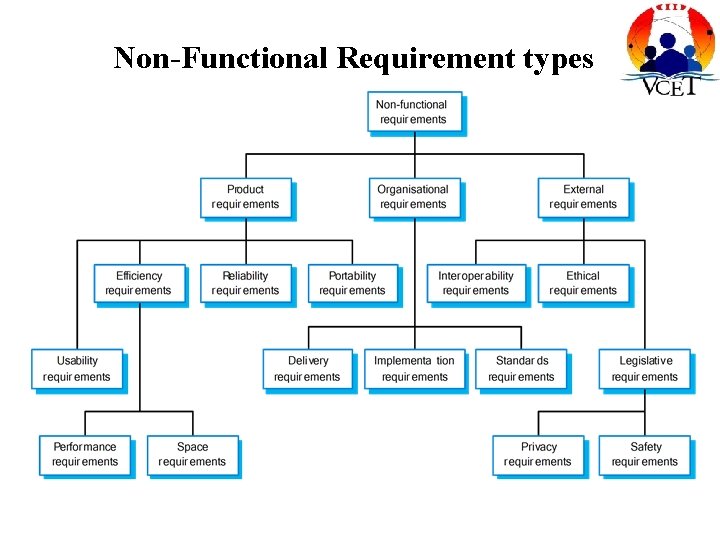
Non-Functional Requirement types
Non-Functional Requirements example Ø Product requirement Ø The user interface for LIBSYS shall be implemented as simple HTML without frames or Java applets. Ø Organisational requirement Ø The system development process and deliverable documents shall conform to the process and deliverables defined in XYZCo-SP-STAN-95. Ø External requirement Ø The system shall not disclose any personal information about customers apart from their name and reference number to the operators of the system.
Goals and Requirements Ø Non-functional requirements may be very difficult to state precisely and imprecise requirements may be difficult to verify. Ø Goal ØA general intention of the user such as ease of use. Ø Verifiable non-functional requirement ØA statement using some measure that can be objectively tested. Ø Goals are helpful to developers as they convey the intentions of the system users.
Examples Ø A system goal ØThe system should be easy to use by experienced controllers and should be organised in such a way that user errors are minimised. Ø A verifiable non-functional requirement ØExperienced controllers shall be able to use all the system functions after a total of two hours training. After this training, the average number of errors made by experienced users shall not exceed two per day.
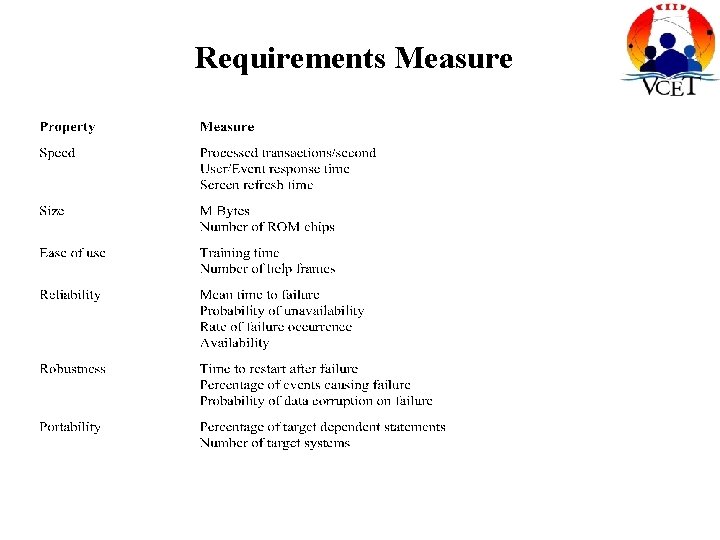
Requirements Measure
Requirements Interaction Ø Conflicts between different non-functional requirements are common in complex systems. Ø Spacecraft system ØTo minimise weight, the number of separate chips in the system should be minimised. ØTo minimise power consumption, lower power chips should be used. ØHowever, using low power chips may mean that more chips have to be used. Which is the most critical requirement?
Software Requirements Specification
Software Requirements Specification: A Contract Document • Requirements document is a reference document. • SRS document is a contract between the development team and the customer. – Once the SRS document is approved by the customer, • any subsequent controversies are settled by referring the SRS document.
SW Requirements Specification • Purpose of SRS – communication between the Customer, Analyst, system developers, maintainers, . . . – contract between Purchaser and Supplier – firm foundation for the design phase – support system testing activities – support project management and control – controlling the evolution of the system
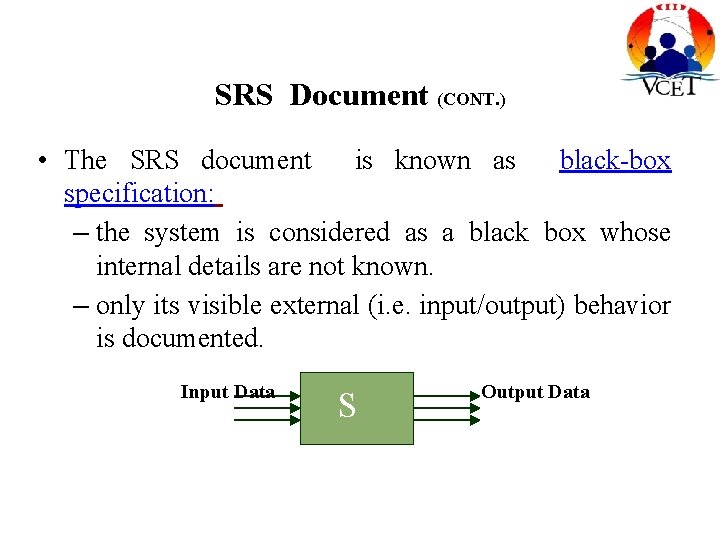
SRS Document (CONT. ) • The SRS document is known as black-box specification: – the system is considered as a black box whose internal details are not known. – only its visible external (i. e. input/output) behavior is documented. Input Data S Output Data
SRS Document (CONT. ) • SRS document concentrates on: – what needs to be done – carefully avoids the solution (“how to do”) aspects. • The SRS document serves as a contract – between development team and the customer. – Should be carefully written
SRS Document (CONT. ) • The requirements at this stage: – written using end-user terminology. • If necessary: – later a formal requirement specification may be developed from it.
Software Requirements Specification (SRS) • Defines the customer’s requirements in terms of : – – Function Performance External interfaces Design constraints • The SRS is the basis of contract between the purchaser and supplier
Specification Principles • • • Separate functionality from implementation Develop model of desired behavior of the system Establish the context in which s/w operates Define the environment in which system operates Create a cognitive model Specifications must be tolerant of incompleteness & augmentable • Content & structure of a specifications should be amenable to change
What is not included in an SRS ? 6 Project requirements – cost, delivery schedules, staffing, reporting procedures 6 Design solutions – partitioning of SW into modules, choosing data structures 6 Product assurance plans – Quality Assurance procedures, Configuration Management procedures, Verification & Validation procedures
Benefits of SRS • Forces the users to consider their specific requirements carefully • Enhances communication between the Purchaser and System developers • Provides a firm foundation for the system design phase • Enables planning of validation, verification, and acceptance procedures • Enables project planning eg. estimates of cost and time, resource scheduling • Usable during maintenance phase
SRS Standards • ANSI/IEEE SRS Standard 830 -1984 • BS 6719: 1986 • European Space Agency Standards (ESA PSS-05 -0, Jan 1987) • US Do. D-Std-7935 A • . . .
SRS Prototype Outline [ IEEE SRS Standard ] 1. Introduction 1. 1 Purpose 1. 2 Scope 1. 3 Definitions, Acronyms and Abbreviations 1. 4 References 1. 5 Overview
SRS - Introduction Section • Purpose – delineate the purpose of the particular SRS – specify the intended audience for the SRS • Scope – identify the SW products to be produced by name – explain what the SW product will do, and if necessary, what it will not do – describe the application of the SW being specified. ie. benefits, objectives, goals as precisely as possible • Overview – describe what the rest of the SRS contains – how the SRS is organized
SRS Prototype Outline [ IEEE SRS Standard ] 2. General description 2. 1 Product perspective 2. 2 Product function summary 2. 3 User characteristics 2. 4 General constraints 2. 5 Assumptions and dependencies
Product Perspective • State whether the product is independent and totally self contained • If the product is component of a larger system then: – describe the functions of each component of the larger system and identify interfaces – overview of the principal external interfaces of this product – overview of HW and peripheral equipment to be used • Give a block diagram showing the major components of the product, interconnections, and external interfaces.
Product Functions • Provide a summary of functions the SW will perform • The functions should be organized in such a way that they are understandable by the user User Characteristics • Describe the general characteristics of the eventual users of the product. (such as educational level, experience and technical expertise )
General Constraints • • Regulatory policies HW limitations Interfaces to other applications Parallel operation Audit functions Control functions Criticality of the application Safety and security considerations
SRS Prototype Outline [ IEEE SRS Standard ] 3. Specific Requirements - Functional requirements - External interface requirements - Performance requirements - Design constraints - Attributes eg. security, availability, maintainability, transferability/conversion - Other requirements Appendices Index
Appendices • Not always necessary • It may include: – sample I/O formats – DFD, ERD documents – results of user surveys, cost analysis studies – supporting documents to help readers of SRS
Characteristics of a Good SRS • • Unambiguous Complete Verifiable Consistent Modifiable Traceable Usable during the Operation and Maintenance phase
Complete • All significant requirements are included • Definition of responses of the SW to all realizable classes of input data in all situations. • Conformity to a standard • Full labeling and referencing of all figures, tables etc. and definition of all terms and units of measure
Verifiable • A requirement is verifiable if and only if there exists some finite cost effective process with which a person or machine can check that the SW meets the requirement. Consistent • No two requirements are in conflict
Modifiable • Structure and style of SRS is such that changes to requirements can be made easily, completely and consistently. – SRS organisation -- table of contents, index, explicit cross-referencing – no redundancy
Traceable • An SRS is traceable if the origin of each requirement is clear and it facilitates the referencing of each requirement in future. • Backward traceability – Requirement explicitly referencing its source in previous documents • Forward traceability – Each requirement has a unique name or reference number and it can be traced to design documents, program implementation.
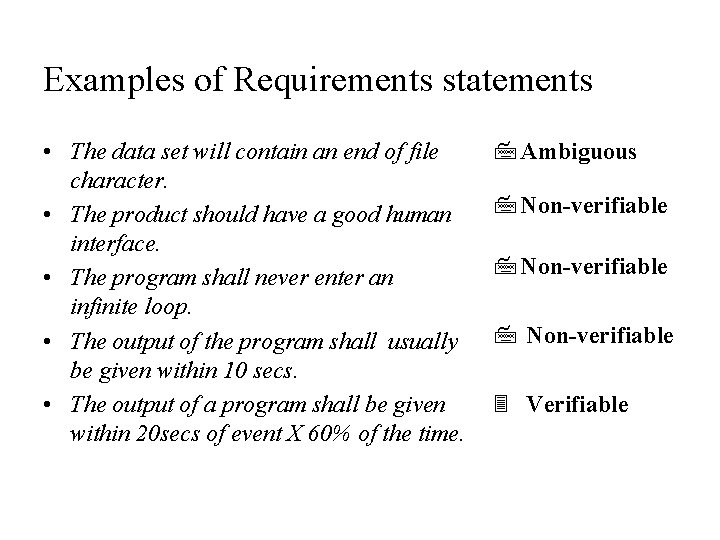
Examples of Requirements statements • The data set will contain an end of file character. • The product should have a good human interface. • The program shall never enter an infinite loop. • The output of the program shall usually be given within 10 secs. • The output of a program shall be given within 20 secs of event X 60% of the time. 7 Ambiguous 7 Non-verifiable 3 Verifiable
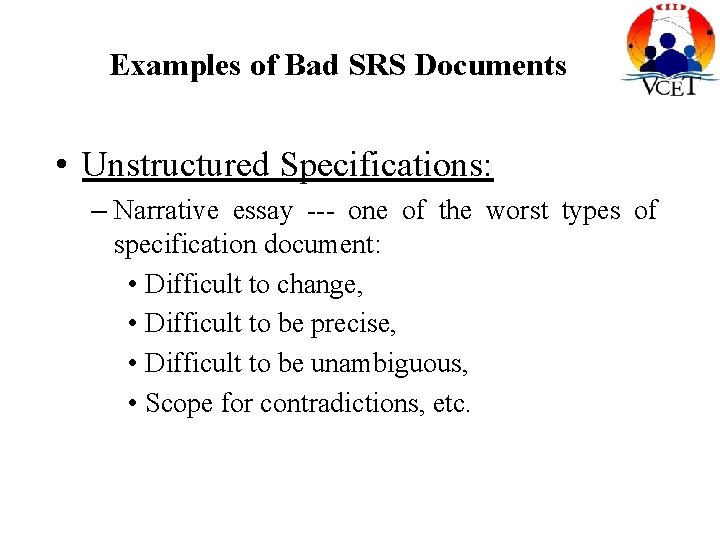
Examples of Bad SRS Documents • Unstructured Specifications: – Narrative essay --- one of the worst types of specification document: • Difficult to change, • Difficult to be precise, • Difficult to be unambiguous, • Scope for contradictions, etc.
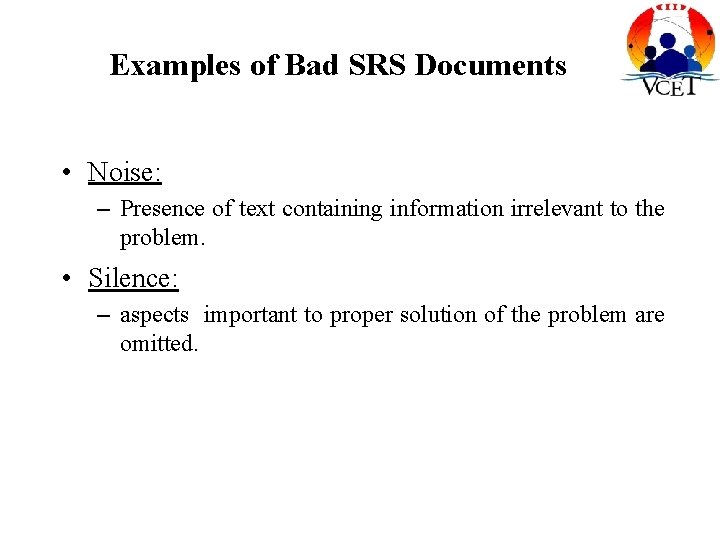
Examples of Bad SRS Documents • Noise: – Presence of text containing information irrelevant to the problem. • Silence: – aspects important to proper solution of the problem are omitted.
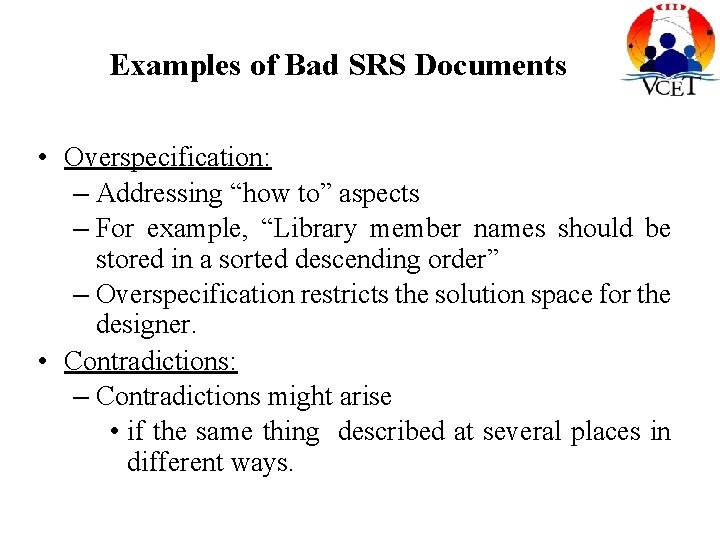
Examples of Bad SRS Documents • Overspecification: – Addressing “how to” aspects – For example, “Library member names should be stored in a sorted descending order” – Overspecification restricts the solution space for the designer. • Contradictions: – Contradictions might arise • if the same thing described at several places in different ways.
Examples of Bad SRS Documents • Ambiguity: – Literary expressions – Unquantifiable aspects, e. g. “good user interface” • Forward References: – References to aspects of problem • defined only later on in the text. • Wishful Thinking: – Descriptions of aspects • for which realistic solutions will be hard to find.
SRS Review • Formal Review done by Users, Developers, Managers, Operations personnel • To verify that SRS confirms to the actual user requirements • To detect defects early and correct them. • Review typically done using checklists.
- Slides: 47