
Requirements on the Execution of Kahn Process Networks



![Implementations of KPNs • Often follow [Thomas Parks ’ 95] scheduling approach YAPI, Jade/Pagis,](https://slidetodoc.com/presentation_image_h/2536b39d9a79e65023bc058f47bd1a41/image-15.jpg "Implementations of KPNs • Often follow [Thomas Parks ’ 95] scheduling approach YAPI, Jade/Pagis,")
- Slides: 27
Requirements on the Execution of Kahn Process Networks Marc Geilen and Twan Basten 11 April 2003 /e
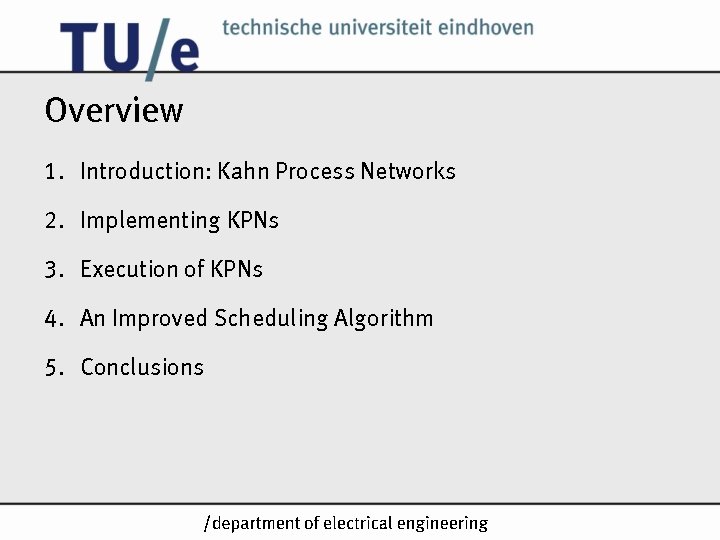
Overview 1. Introduction: Kahn Process Networks 2. Implementing KPNs 3. Execution of KPNs 4. An Improved Scheduling Algorithm 5. Conclusions /e
1. Introduction: Kahn Process Networks /e
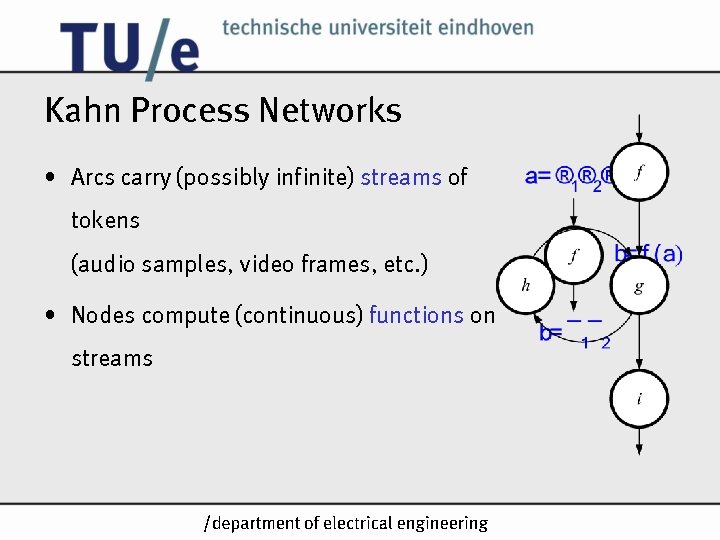
Kahn Process Networks • Arcs carry (possibly infinite) streams of tokens (audio samples, video frames, etc. ) • Nodes compute (continuous) functions on streams /e
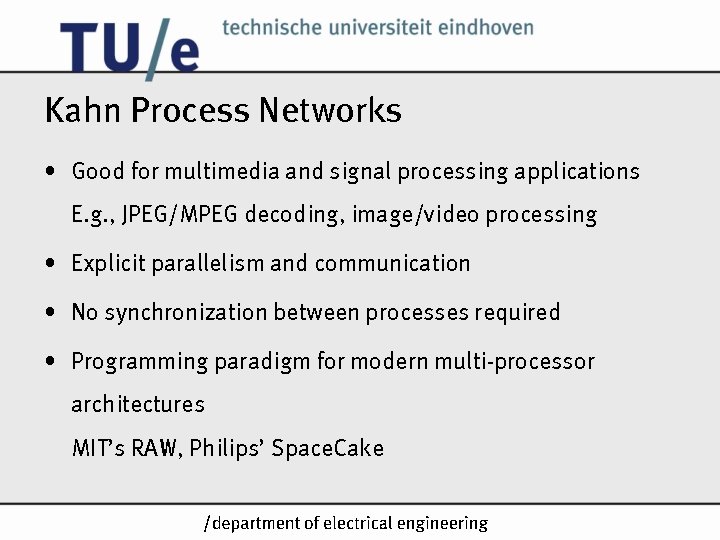
Kahn Process Networks • Good for multimedia and signal processing applications E. g. , JPEG/MPEG decoding, image/video processing • Explicit parallelism and communication • No synchronization between processes required • Programming paradigm for modern multi-processor architectures MIT’s RAW, Philips’ Space. Cake /e
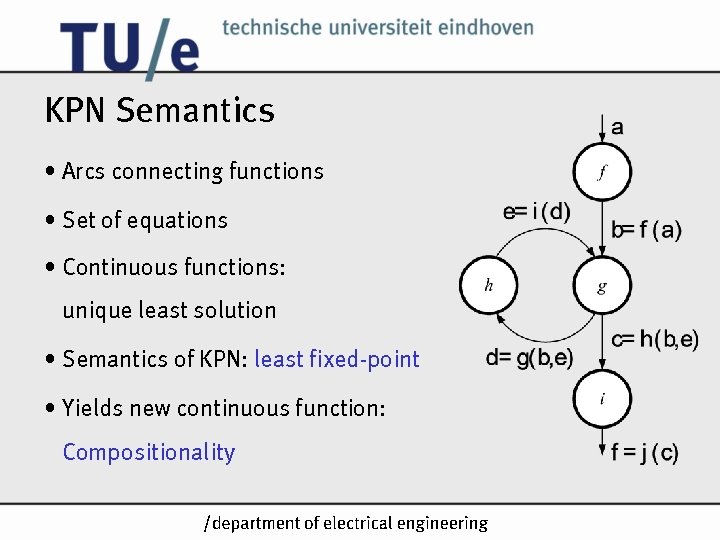
KPN Semantics • Arcs connecting functions • Set of equations • Continuous functions: unique least solution • Semantics of KPN: least fixed-point • Yields new continuous function: Compositionality /e
2. Implementing KPNs /e
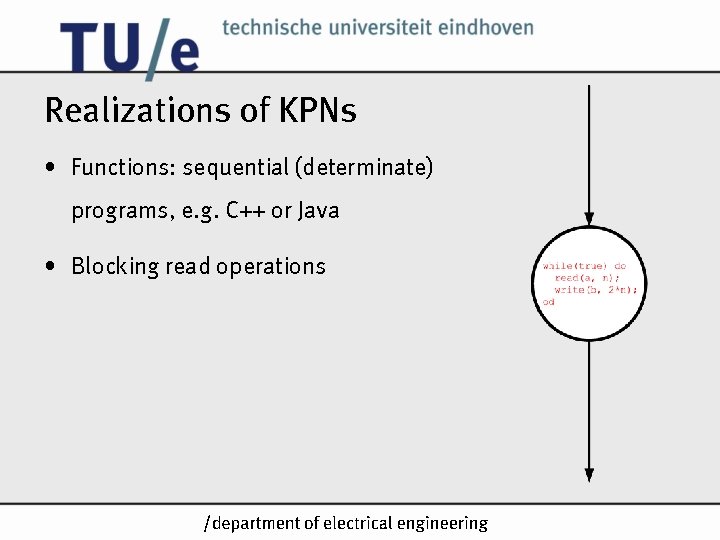
Realizations of KPNs • Functions: sequential (determinate) programs, e. g. C++ or Java • Blocking read operations /e
Realizations of KPNs • Functions: sequential (determinate) programs, e. g. C++ or Java • Blocking read operations • Arcs: FIFO queues Store tokens that are written but not yet read /e
Realizations of KPNs • Determinacy Output is independent of scheduling order • Compositionality Hierarchically, recursively, … • The Kahn Principle Operational model with fair execution and unbounded channels realizes the formal semantics /e
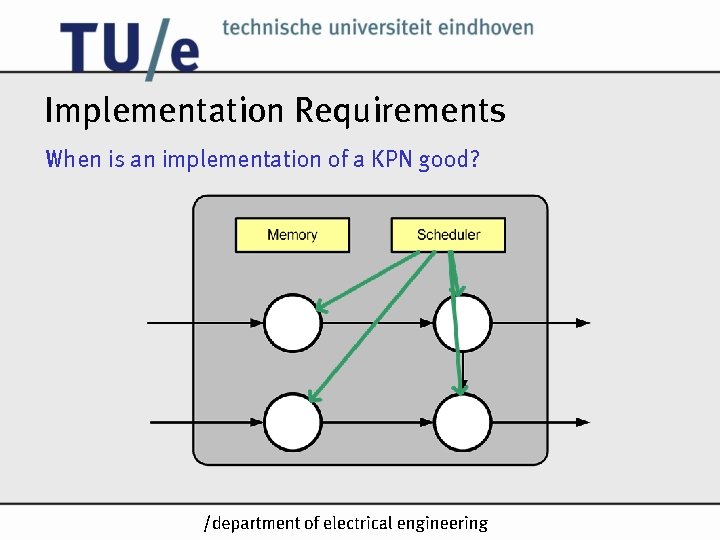
Implementation Requirements When is an implementation of a KPN good? /e
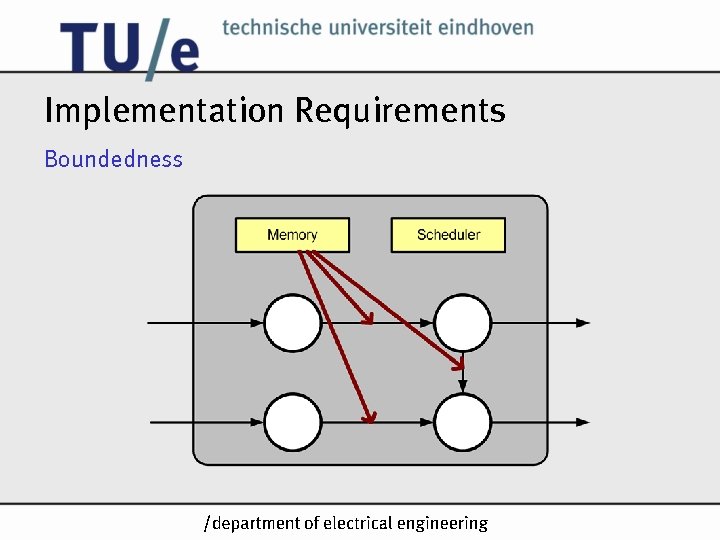
Implementation Requirements Boundedness /e
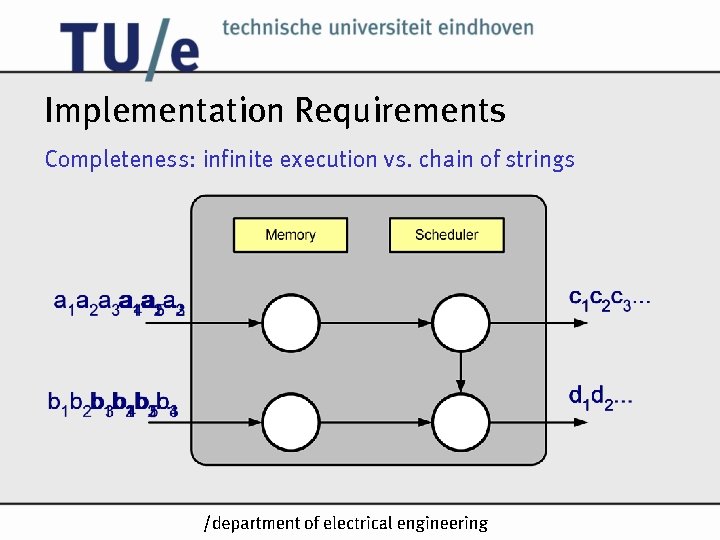
Implementation Requirements Completeness: infinite execution vs. chain of strings /e
3. Execution of KPNs /e
Implementations of KPNs • Often follow [Thomas Parks ’ 95] scheduling approach YAPI, Jade/Pagis, Ptolemy II among others • Bounded FIFOs combine aspects of data- and demand driven execution • FIFO bounds balance memory usage and context switching • (Minimal) FIFO bounds are undecidable Run-time management /e
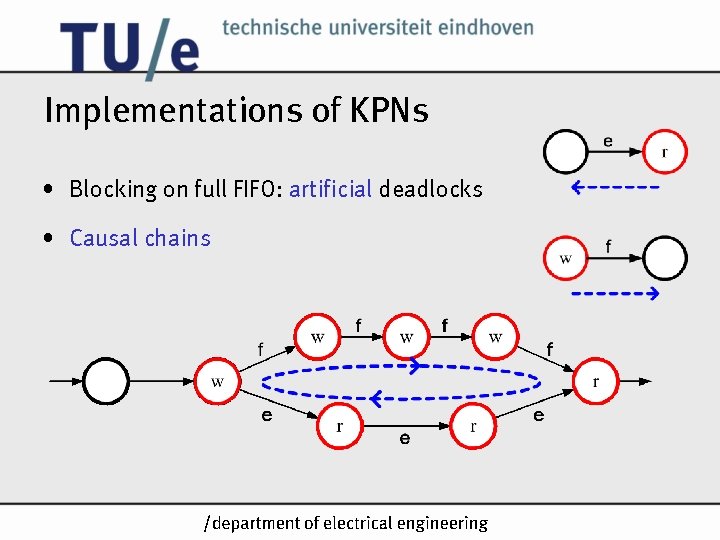
Implementations of KPNs • Blocking on full FIFO: artificial deadlocks • Causal chains /e
Implementations of KPNs • Execution thread per process POSIX threads, Java threads, … • Artificial deadlock detection and resolution strategies • Often: global deadlock detection Low priority thread /e
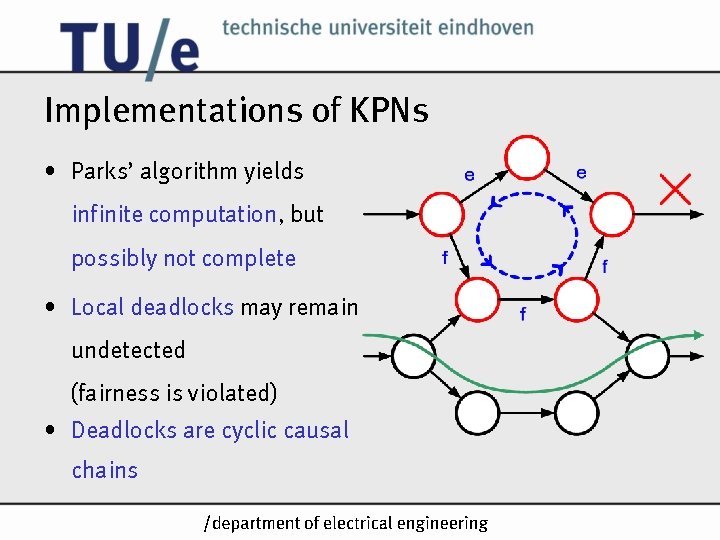
Implementations of KPNs • Parks’ algorithm yields infinite computation, but possibly not complete • Local deadlocks may remain undetected (fairness is violated) • Deadlocks are cyclic causal chains /e
4. An Improved Scheduling Algorithm /e
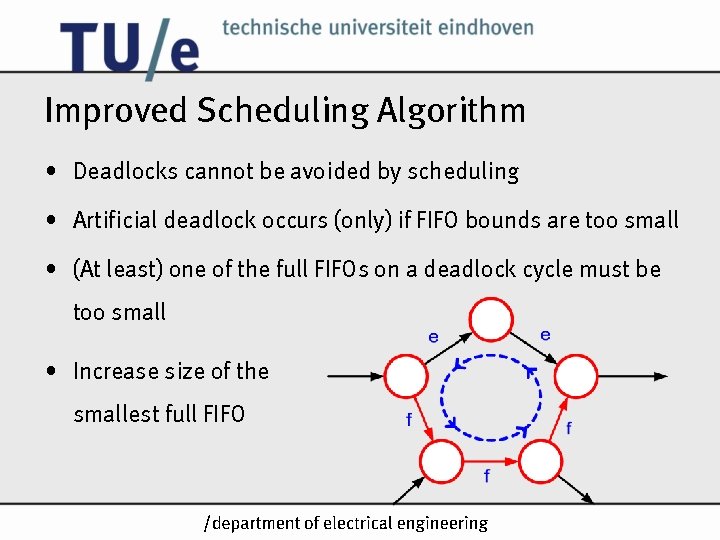
Improved Scheduling Algorithm • Deadlocks cannot be avoided by scheduling • Artificial deadlock occurs (only) if FIFO bounds are too small • (At least) one of the full FIFOs on a deadlock cycle must be too small • Increase size of the smallest full FIFO /e
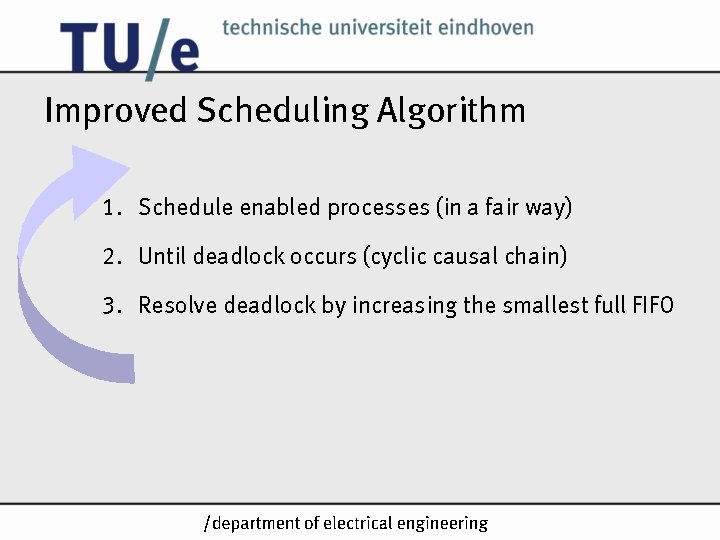
Improved Scheduling Algorithm 1. Schedule enabled processes (in a fair way) 2. Until deadlock occurs (cyclic causal chain) 3. Resolve deadlock by increasing the smallest full FIFO /e
Correctness • Operational (LTS) semantics of KPNs (see paper) Equivalent to KPN semantics by the Kahn Principle • Operational semantics of realizations of KPNs bounded channels • Show that both implement the same function /e
Correctness The new scheduling algorithm realizes the formal semantics of Kahn Process Networks: Every bounded and effective KPN is executed in bounded memory by our scheduler and produces the complete output. /e
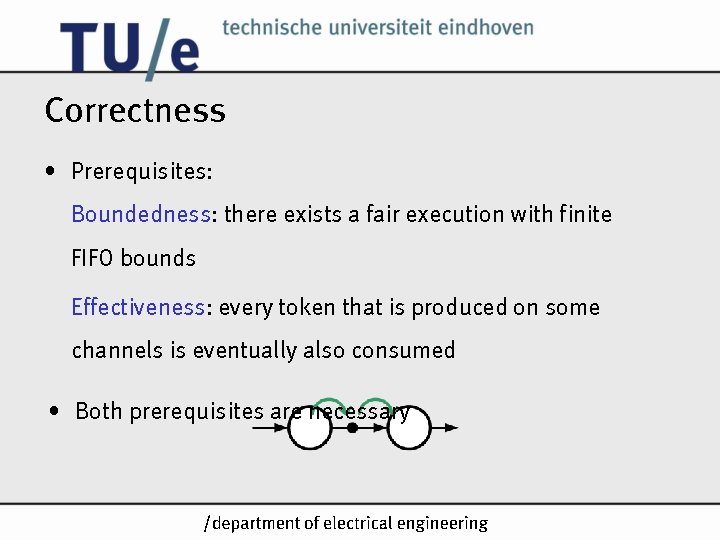
Correctness • Prerequisites: Boundedness: there exists a fair execution with finite FIFO bounds Effectiveness: every token that is produced on some channels is eventually also consumed • Both prerequisites are necessary /e
Local deadlock detection • Deadlock detection becomes more involved • Need not be done at every step of the execution • May be possible to do this concurrently /e
Conclusions • Studied implementation requirements for KPNs: boundedness and completeness • Widely used implementation of KPNs does not schedule all KPNs correctly • We have presented an improved scheduling algorithm that resolves the problem for a large class of KPNs • And proved its correctness (in the paper) /e
Future Work • An implementation of the improved scheduling algorithm is being made for YAPI • Efficiency of scheduling. Optimal bounds, efficient deadlock detection • Hierarchical or distributed implementations Distributed deadlock detection /e