
Requirements of the Standard IAS 7 An entity
- Slides: 22
Requirements of the Standard IAS 7 • An entity shall prepare a statement of cash flows (SCF) in accordance with the requirements of this Standard and shall present it as an integral part of its financial statements for each period for which financial statements are presented. Pw. C 2015 1
Some benefits of Cash Flow Information • Cash flow information is useful in assessing the ability of the entity to generate cash and cash equivalents • Enables users to develop models to assess and compare the present value of the future cash flows of different entities • It provides information that enables users to evaluate the changes in net assets of an entity • Its financial structure (including its liquidity and solvency) • Its ability to affect the amounts and timing of cash flows in order to adapt to changing circumstances and opportunities • Enhances the comparability of the reporting of operating performance by different entities Pw. C 2015 2
Definitions of terms in the standard • Cash comprises cash on hand demand deposits • Cash equivalents are short-term, highly liquid investments that are readily convertible to known amounts of cash and which are subject to an insignificant risk of changes in value • Cash flows are inflows and outflows of cash and cash equivalents • Operating activities are the principal revenue-producing activities of the entity and other activities that are not investing or financing activities • Investing activities are the acquisition and disposal of long-term assets and other investments not included in cash equivalents • Financing activities are activities that result in changes in the size and composition of the contributed equity and borrowings of the entity Pw. C 2015 3
IAS 7 Cash Flow Statement • Need to report movements in cash and cash equivalents • Cash = cash in hand, on demand deposits • Cash equivalents = short-term, highly liquid investments. Readily convertible into cash. • Show movement in cash and cash equivalents defined as: • Operating • Investing • Financing Pw. C 2015 4
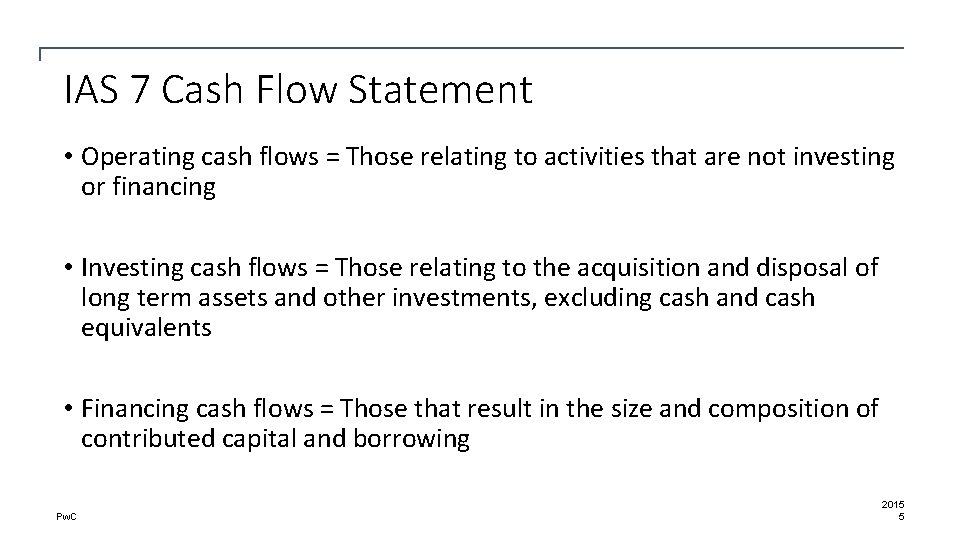
IAS 7 Cash Flow Statement • Operating cash flows = Those relating to activities that are not investing or financing • Investing cash flows = Those relating to the acquisition and disposal of long term assets and other investments, excluding cash and cash equivalents • Financing cash flows = Those that result in the size and composition of contributed capital and borrowing Pw. C 2015 5
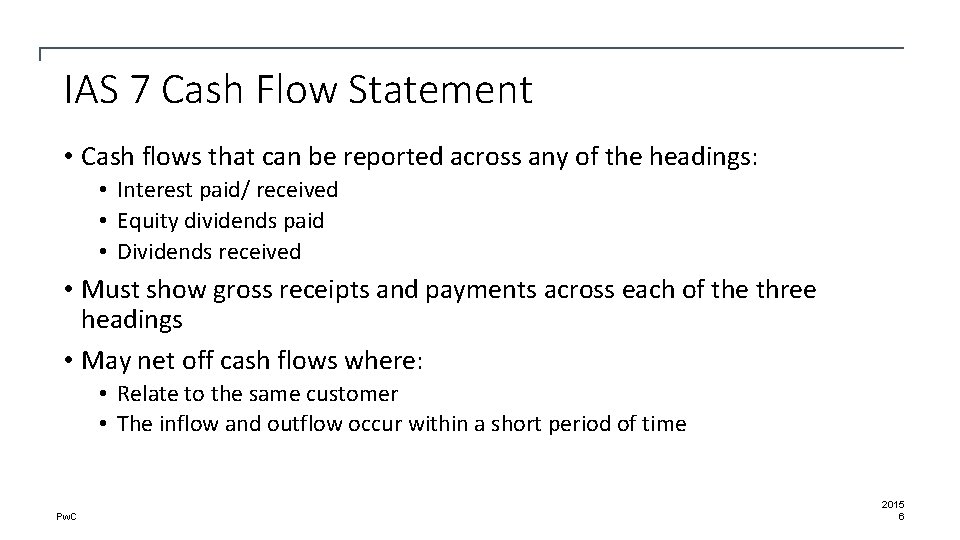
IAS 7 Cash Flow Statement • Cash flows that can be reported across any of the headings: • Interest paid/ received • Equity dividends paid • Dividends received • Must show gross receipts and payments across each of the three headings • May net off cash flows where: • Relate to the same customer • The inflow and outflow occur within a short period of time Pw. C 2015 6
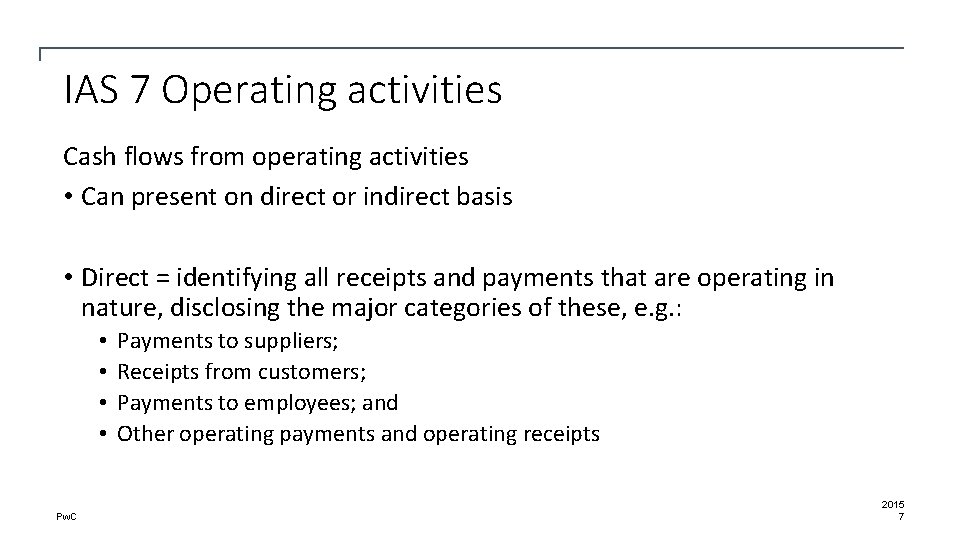
IAS 7 Operating activities Cash flows from operating activities • Can present on direct or indirect basis • Direct = identifying all receipts and payments that are operating in nature, disclosing the major categories of these, e. g. : • • Pw. C Payments to suppliers; Receipts from customers; Payments to employees; and Other operating payments and operating receipts 2015 7
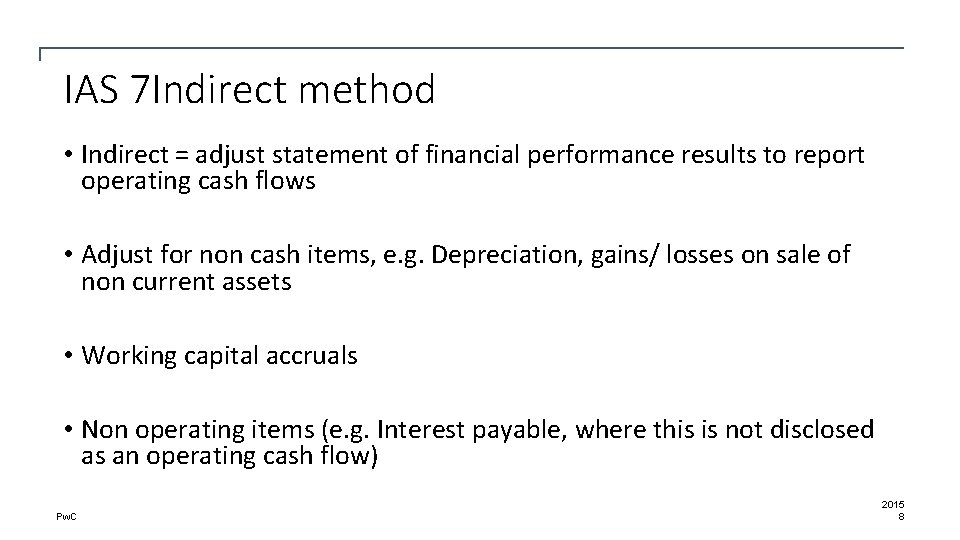
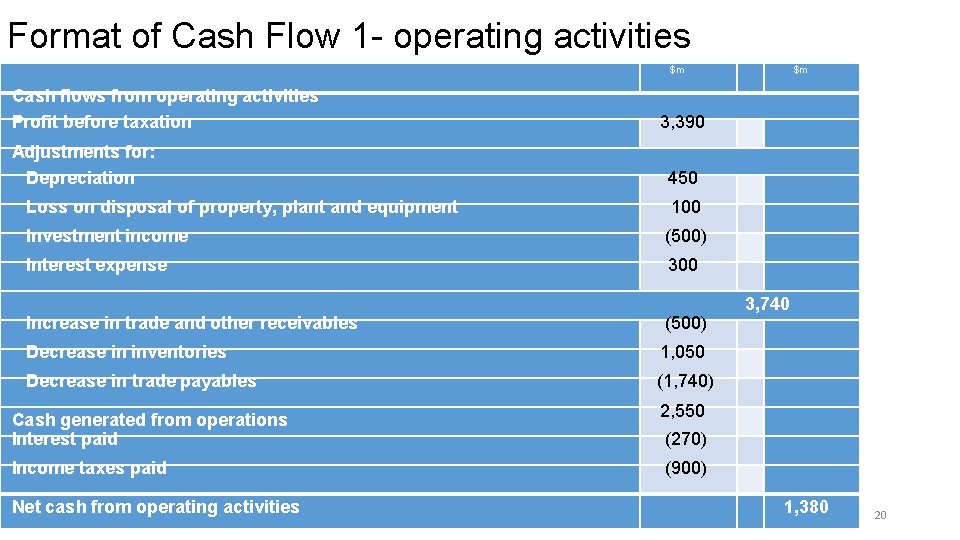
IAS 7 Indirect method • Indirect = adjust statement of financial performance results to report operating cash flows • Adjust for non cash items, e. g. Depreciation, gains/ losses on sale of non current assets • Working capital accruals • Non operating items (e. g. Interest payable, where this is not disclosed as an operating cash flow) Pw. C 2015 8
IAS 7 Investing activities Cash flows from investing activities • Typically would include: • Cash paid to acquire, or a receipt from the sale of, an item of property, plant or equipment; • Cash paid to acquire, or a receipt from the sale of, an intangible asset such as a brand or trademark; • Cash paid to acquire, or a receipt from the sale of, a separate entity; • Cash paid to acquire, or a receipt from the sale of, an equity or debt instrument in another entity, such as a joint venture; and • Cash given as an advance or loan to another entity, or the repayment of such items. Pw. C 2015 9
IAS 7 Investing activities • Where cash flows arise from the sale or purchase of a controlled entity or other operating unit, these cash flows should be separately identified. • Need to show: • The total purchase or disposal consideration, separately identifying the proportion that is discharged by cash and cash equivalents; • The amount of cash and cash equivalents that is included in the entity being purchased or sold; and • A summary of the assets and liabilities, other than cash and cash equivalents, of the entity acquired or disposed of. Pw. C 2015 10
IAS 7 Financing activities Cash flows from financing activities • Typically would include: • Cash proceeds received from issuing debt instruments, such as debentures, bonds or long-term borrowings; • Cash paid to repay debt instruments; and • The capital element in finance lease payments made during the period. Pw. C 2015 11
Cash and Cash Equivalents • Cash equivalents are held for the purpose of meeting short-term cash commitments • It must: • Be readily convertible to a known amount of cash • Be subject to an insignificant risk of changes in value • Have a short maturity of, say, three months or less from the date of acquisition Pw. C 2015 12
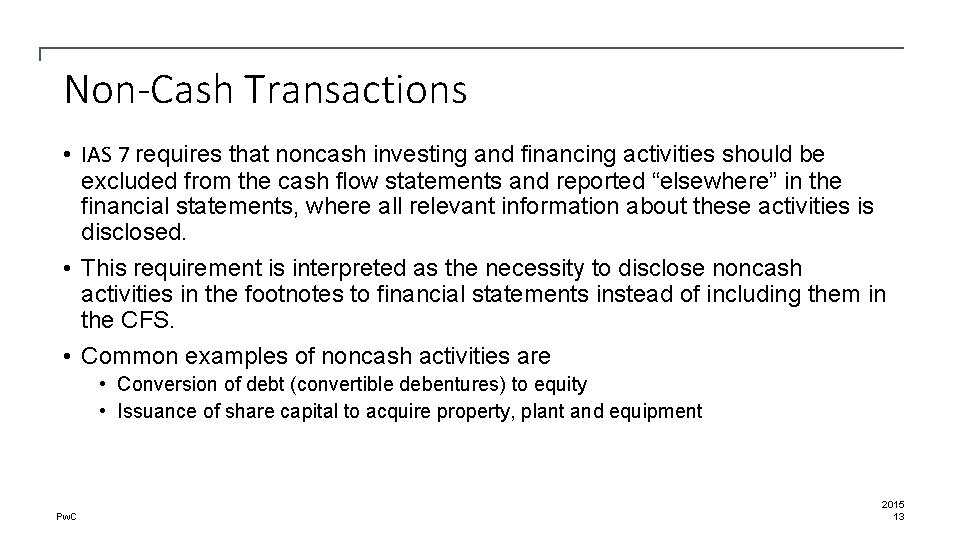
Non-Cash Transactions • IAS 7 requires that noncash investing and financing activities should be excluded from the cash flow statements and reported “elsewhere” in the financial statements, where all relevant information about these activities is disclosed. • This requirement is interpreted as the necessity to disclose noncash activities in the footnotes to financial statements instead of including them in the CFS. • Common examples of noncash activities are • Conversion of debt (convertible debentures) to equity • Issuance of share capital to acquire property, plant and equipment Pw. C 2015 13
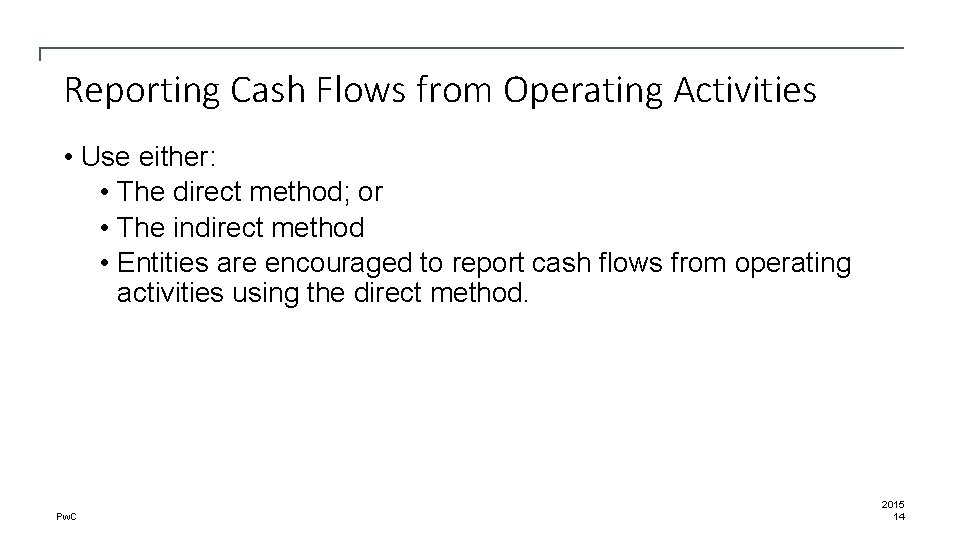
Reporting Cash Flows from Operating Activities • Use either: • The direct method; or • The indirect method • Entities are encouraged to report cash flows from operating activities using the direct method. Pw. C 2015 14
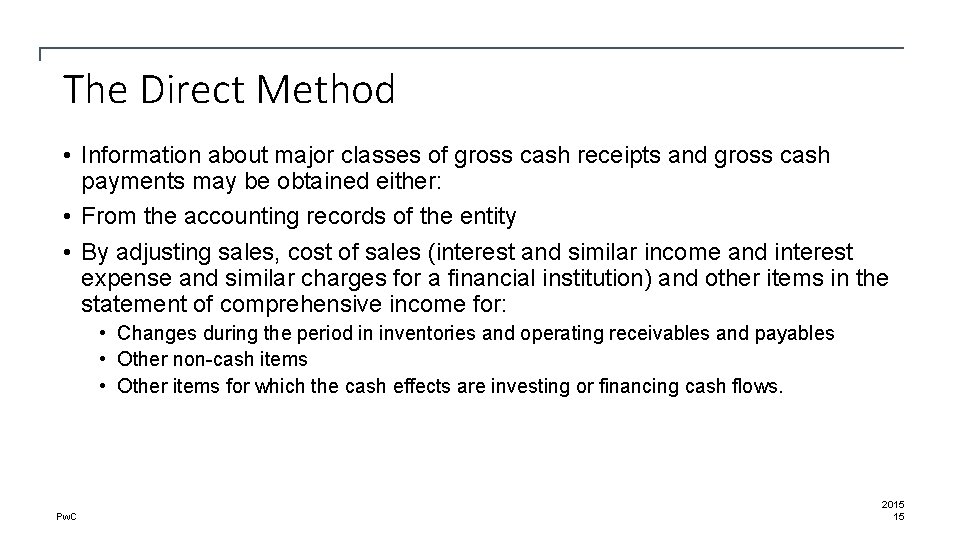
The Direct Method • Information about major classes of gross cash receipts and gross cash payments may be obtained either: • From the accounting records of the entity • By adjusting sales, cost of sales (interest and similar income and interest expense and similar charges for a financial institution) and other items in the statement of comprehensive income for: • Changes during the period in inventories and operating receivables and payables • Other non-cash items • Other items for which the cash effects are investing or financing cash flows. Pw. C 2015 15
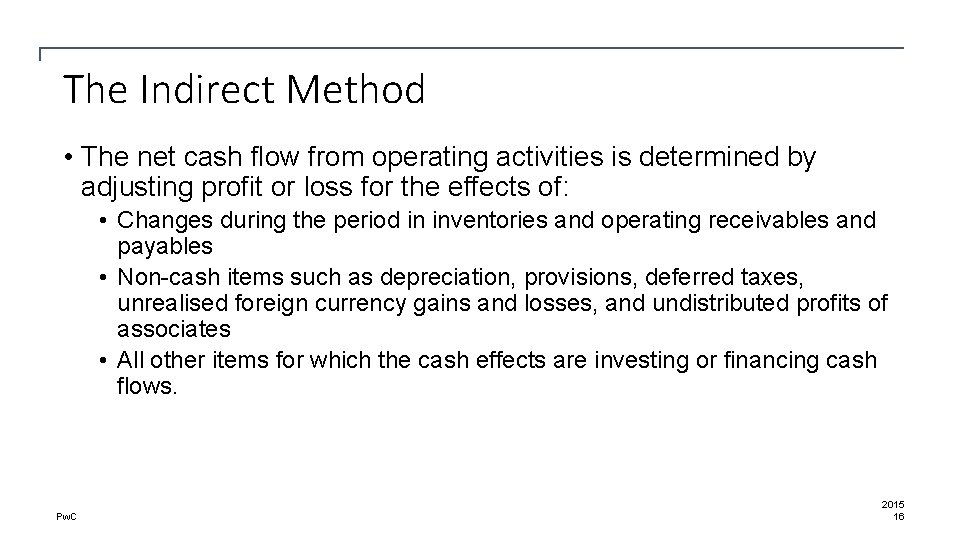
The Indirect Method • The net cash flow from operating activities is determined by adjusting profit or loss for the effects of: • Changes during the period in inventories and operating receivables and payables • Non-cash items such as depreciation, provisions, deferred taxes, unrealised foreign currency gains and losses, and undistributed profits of associates • All other items for which the cash effects are investing or financing cash flows. Pw. C 2015 16
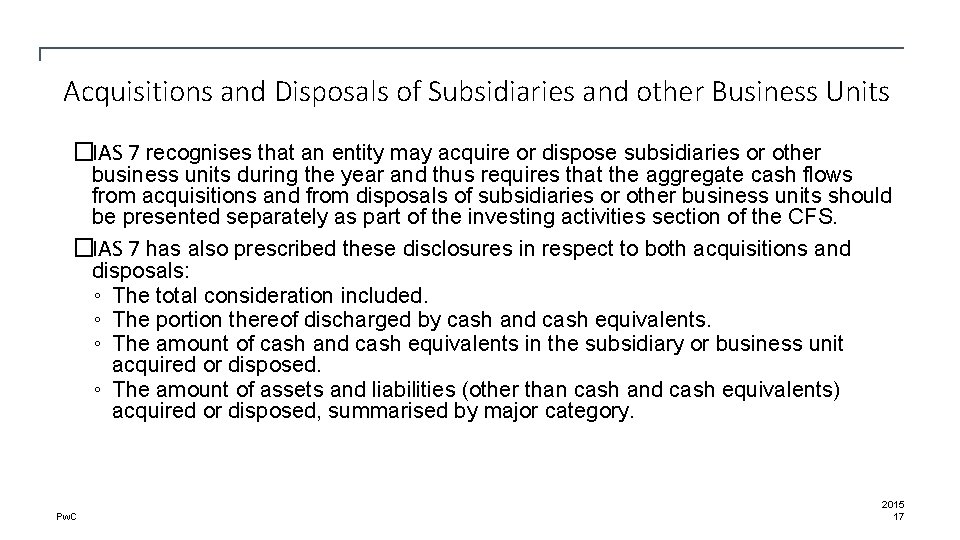
Acquisitions and Disposals of Subsidiaries and other Business Units �IAS 7 recognises that an entity may acquire or dispose subsidiaries or other business units during the year and thus requires that the aggregate cash flows from acquisitions and from disposals of subsidiaries or other business units should be presented separately as part of the investing activities section of the CFS. �IAS 7 has also prescribed these disclosures in respect to both acquisitions and disposals: ◦ The total consideration included. ◦ The portion thereof discharged by cash and cash equivalents. ◦ The amount of cash and cash equivalents in the subsidiary or business unit acquired or disposed. ◦ The amount of assets and liabilities (other than cash and cash equivalents) acquired or disposed, summarised by major category. Pw. C 2015 17
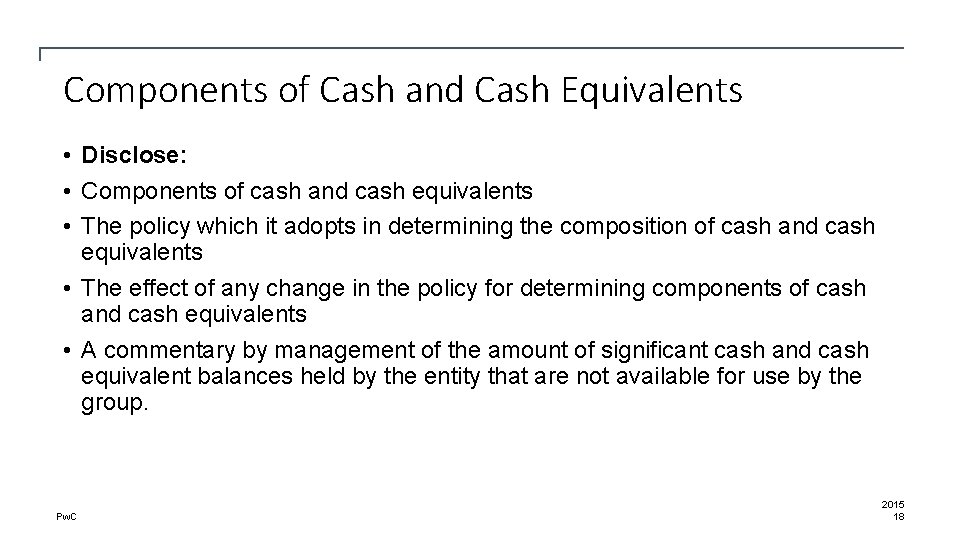
Components of Cash and Cash Equivalents • Disclose: • Components of cash and cash equivalents • The policy which it adopts in determining the composition of cash and cash equivalents • The effect of any change in the policy for determining components of cash and cash equivalents • A commentary by management of the amount of significant cash and cash equivalent balances held by the entity that are not available for use by the group. Pw. C 2015 18
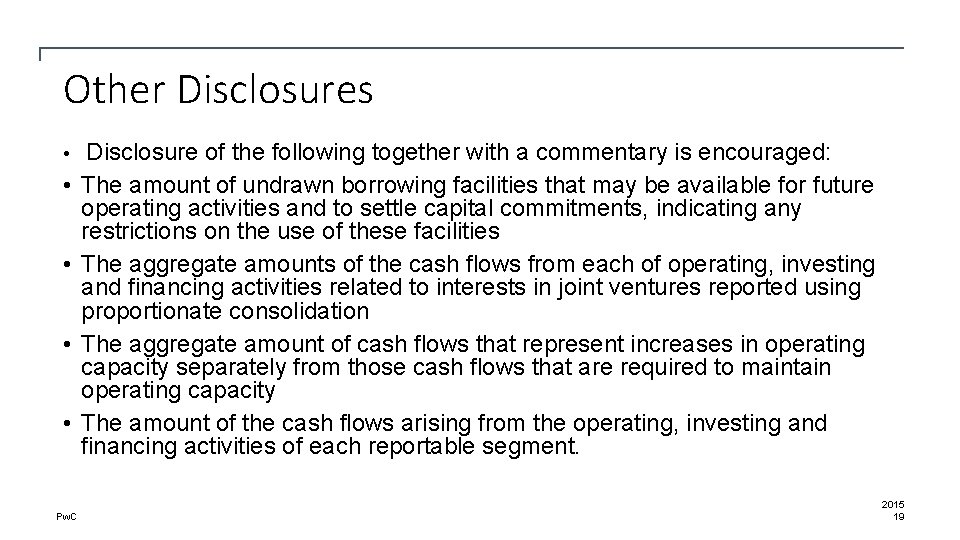
Other Disclosures • • • Pw. C Disclosure of the following together with a commentary is encouraged: The amount of undrawn borrowing facilities that may be available for future operating activities and to settle capital commitments, indicating any restrictions on the use of these facilities The aggregate amounts of the cash flows from each of operating, investing and financing activities related to interests in joint ventures reported using proportionate consolidation The aggregate amount of cash flows that represent increases in operating capacity separately from those cash flows that are required to maintain operating capacity The amount of the cash flows arising from the operating, investing and financing activities of each reportable segment. 2015 19
Format of Cash Flow 1 - operating activities $m Cash flows from operating activities Profit before taxation Adjustments for: Depreciation Loss on disposal of property, plant and equipment 3, 390 450 100 Investment income (500) Interest expense 300 Increase in trade and other receivables (500) Decrease in inventories 1, 050 Decrease in trade payables (1, 740) Cash generated from operations Interest paid 2, 550 Income taxes paid (900) Net cash from operating activities 2015 $m 3, 740 (270) 1, 380 20
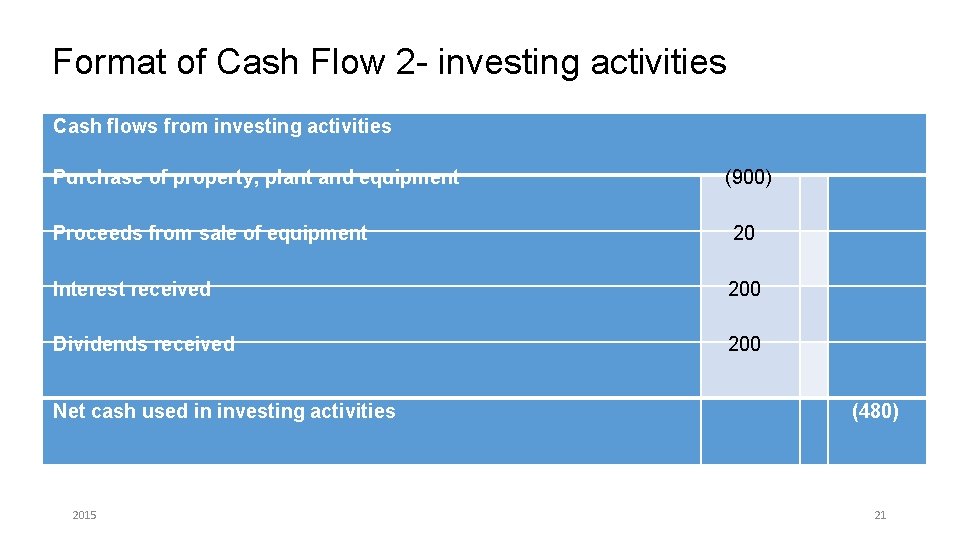
Format of Cash Flow 2 - investing activities Cash flows from investing activities Purchase of property, plant and equipment (900) Proceeds from sale of equipment 20 Interest received 200 Dividends received 200 Net cash used in investing activities 2015 (480) 21
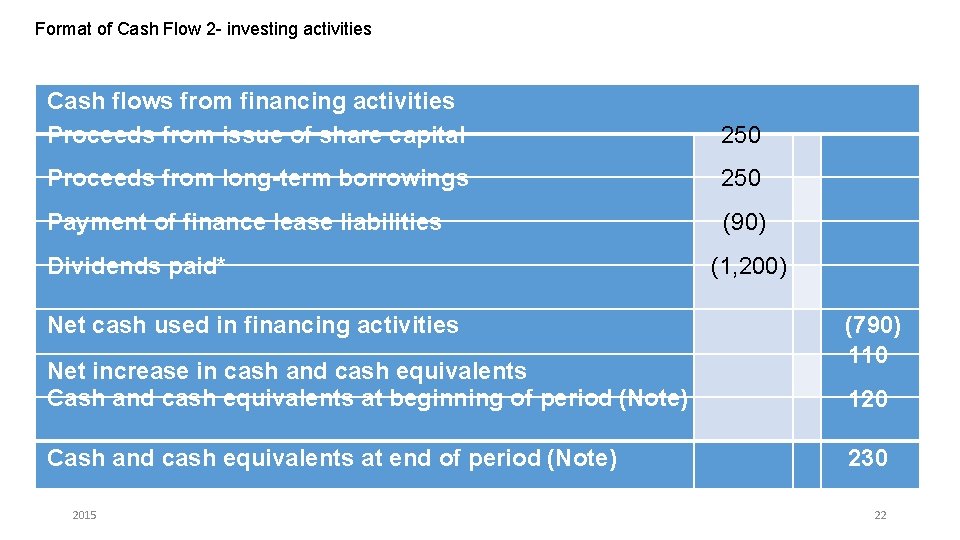
Format of Cash Flow 2 - investing activities Cash flows from financing activities Proceeds from issue of share capital 250 Proceeds from long-term borrowings 250 Payment of finance lease liabilities (90) Dividends paid* Net cash used in financing activities Net increase in cash and cash equivalents Cash and cash equivalents at beginning of period (Note) Cash and cash equivalents at end of period (Note) 2015 (1, 200) (790) 110 120 230 22