
Requirements Module Configuration Change Management Space Systems Engineering
- Slides: 23
Requirements Module: Configuration & Change Management Space Systems Engineering, version 1. 0 Space Systems Engineering: Requirements — Configuration & CM Module
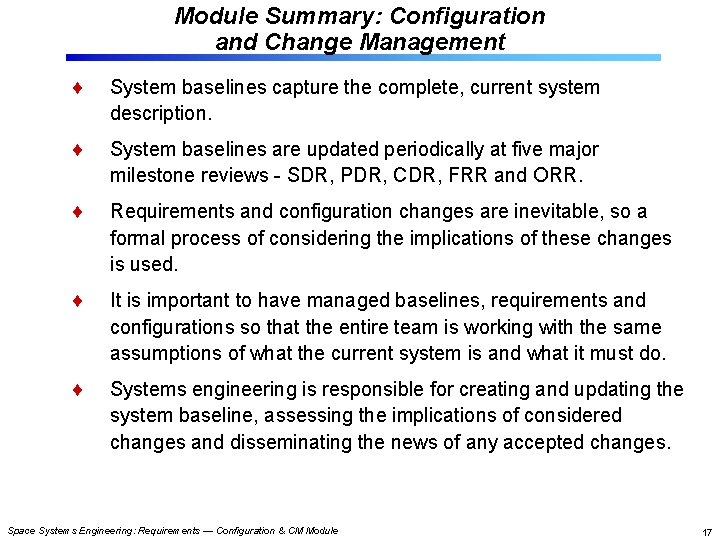
Module Purpose: Configuration and Change Management Define system baselines and when they are updated. Describe why system baselines are useful. Define requirements and configuration management and why they are necessary. Discuss the fact that changes are inevitable. Describe a typical management process for considering and assessing the impact of requirements and configuration changes. Space Systems Engineering: Requirements — Configuration & CM Module 2
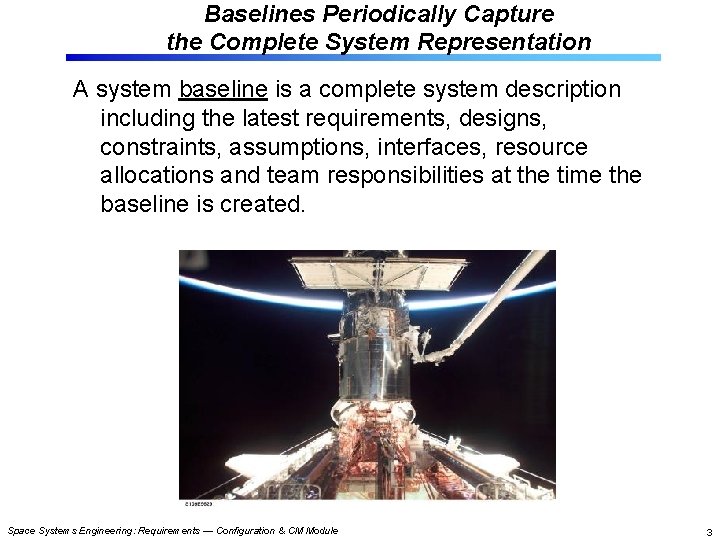
Baselines Periodically Capture the Complete System Representation A system baseline is a complete system description including the latest requirements, designs, constraints, assumptions, interfaces, resource allocations and team responsibilities at the time the baseline is created. Space Systems Engineering: Requirements — Configuration & CM Module 3
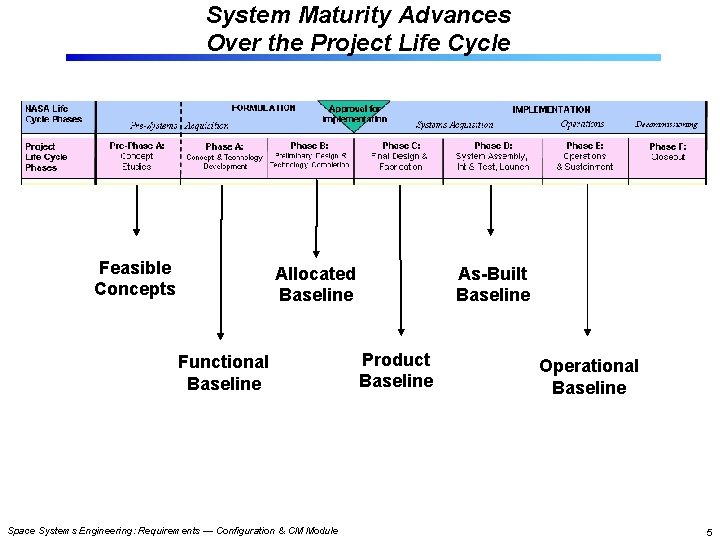
Baselines Help Ensure Everyone is on the Same Page With large teams working on many different parts of a project simultaneously, it is important to make sure there is a common understanding of what is to be done and that no necessary task is ignored. Baselines are established at milestone reviews (SDR, PDR, CDR, ORR) and are the common departure point for subsequent design and product maturation. Baselines also ensure that the entire project matures at an approximately uniform rate. • If one subsystem design is advanced much beyond its peers and it is later discovered that the allocations or interfaces are inappropriate, more rework will have to be done than if the subsystems had advanced at the same rate. Space Systems Engineering: Requirements — Configuration & CM Module 4
System Maturity Advances Over the Project Life Cycle Feasible Concepts Allocated Baseline Functional Baseline Space Systems Engineering: Requirements — Configuration & CM Module As-Built Baseline Product Baseline Operational Baseline 5
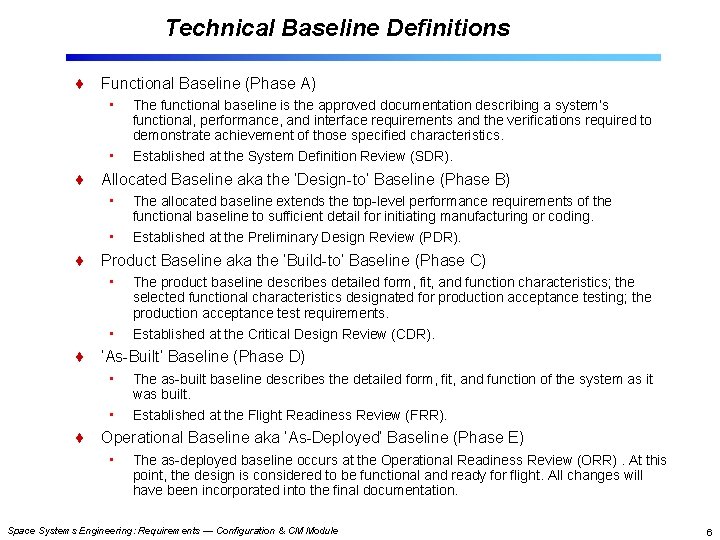
Technical Baseline Definitions Functional Baseline (Phase A) • • The functional baseline is the approved documentation describing a system’s functional, performance, and interface requirements and the verifications required to demonstrate achievement of those specified characteristics. Established at the System Definition Review (SDR). Allocated Baseline aka the ‘Design-to’ Baseline (Phase B) • • The allocated baseline extends the top-level performance requirements of the functional baseline to sufficient detail for initiating manufacturing or coding. Established at the Preliminary Design Review (PDR). Product Baseline aka the ‘Build-to’ Baseline (Phase C) • The product baseline describes detailed form, fit, and function characteristics; the selected functional characteristics designated for production acceptance testing; the production acceptance test requirements. • Established at the Critical Design Review (CDR). ‘As-Built’ Baseline (Phase D) • • The as-built baseline describes the detailed form, fit, and function of the system as it was built. Established at the Flight Readiness Review (FRR). Operational Baseline aka ‘As-Deployed’ Baseline (Phase E) • The as-deployed baseline occurs at the Operational Readiness Review (ORR). At this point, the design is considered to be functional and ready for flight. All changes will have been incorporated into the final documentation. Space Systems Engineering: Requirements — Configuration & CM Module 6
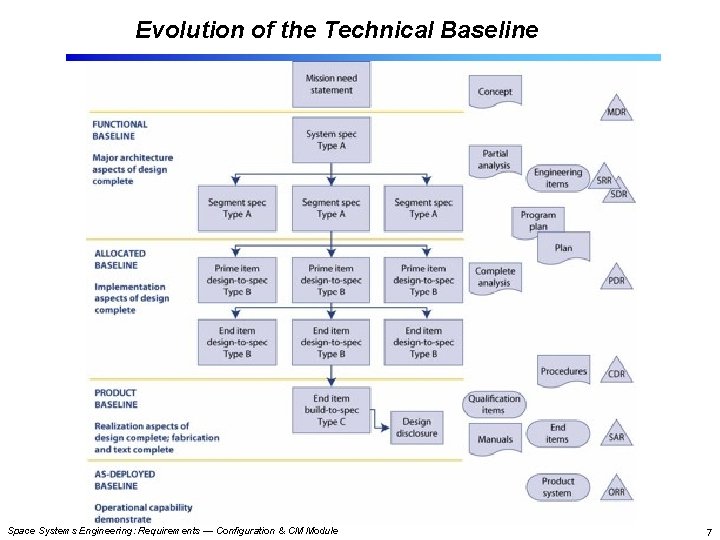
Evolution of the Technical Baseline Space Systems Engineering: Requirements — Configuration & CM Module 7
Baselines Are More Than Just Requirements and Designs Technical baseline deals with requirements and design. New focus: Integrated program management synchronizes these baselines: • • • Requirements Design Affordability ($$$) Schedule Risk All 5 baselines need to be linked and tracked over the project life cycle. Use of tools and processes to ensure that the linkages and their impacts are captured and updated in all major project documents. This practice enables informed decision making for the future. Space Systems Engineering: Requirements — Configuration & CM Module Integrated Program Management 8
Managing Requirements and the System Configuration is a Necessity Capturing all the requirements and their traceability can be a mess! • Parent requirements beget child requirements • Problem-space requirements beget solution-space requirements • Functional and performance requirements have lots and lots of peers • Traceability, linkages and rationale must be documented and maintained • So baselined requirements are required for each control gate Management of it all. • Configuration management keeps track of all of the requirements, and once hardware is built or software coded, keeps track of what has been built and coded. • This is a huge, complex and extremely important bookkeeping job – made easier today by database tools (e. g. , CRADLE or DOORS). Space Systems Engineering: Requirements — Configuration & CM Module 9
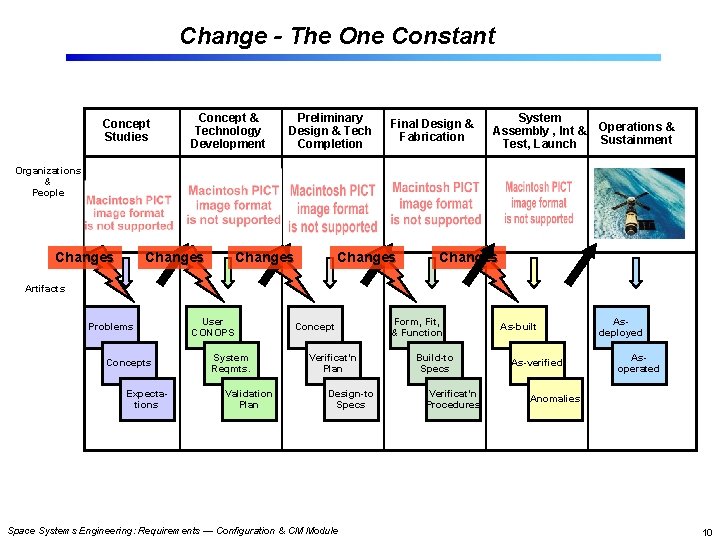
Change - The One Constant Concept Studies Concept & Technology Development Preliminary Design & Tech Completion Final Design & Fabrication System Assembly , Int & Test, Launch Operations & Sustainment Organizations & People Changes Changes Artifacts Problems Concepts Expectations User CONOPS System Reqmts. Validation Plan Concept Verificat’n Plan Design-to Specs Space Systems Engineering: Requirements — Configuration & CM Module Form, Fit, & Function Build-to Specs Verificat’n Procedures As-built As-verified Asdeployed Asoperated Anomalies 10
Where Do Changes Come From? Requirements change when: • They are reallocated as the system design matures, since initial allocations are typically suboptimal. • New requirements are added to the system, since initial requirements may not have been complete. • A stakeholder decides that new functions or performance is needed. • Measured performance does not meet requirements. Reallocation or redesign are possible responses to non-compliance in test. Configurations change when: • What is built is not identical to what is designed. Configuration descriptions strive to be the most accurate possible description of the current system. • Something breaks in test. Reallocation or redesign are possible responses to test failures. Space Systems Engineering: Requirements — Configuration & CM Module 11
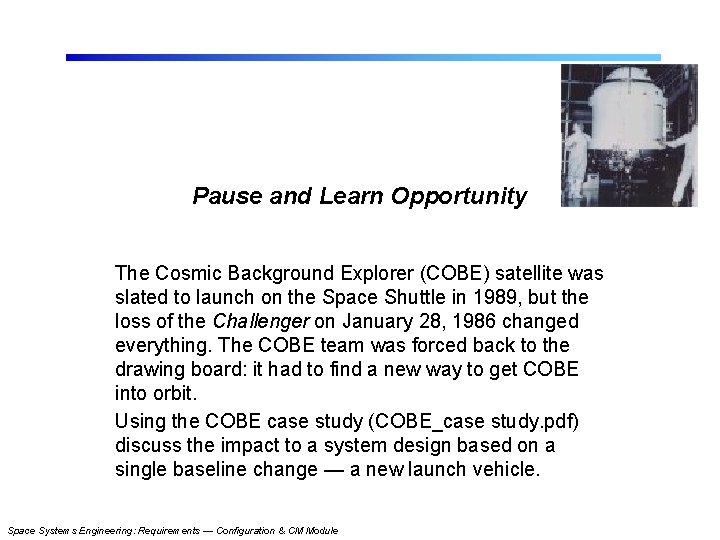
Pause and Learn Opportunity The Cosmic Background Explorer (COBE) satellite was slated to launch on the Space Shuttle in 1989, but the loss of the Challenger on January 28, 1986 changed everything. The COBE team was forced back to the drawing board: it had to find a new way to get COBE into orbit. Using the COBE case study (COBE_case study. pdf) discuss the impact to a system design based on a single baseline change — a new launch vehicle. Space Systems Engineering: Requirements — Configuration & CM Module
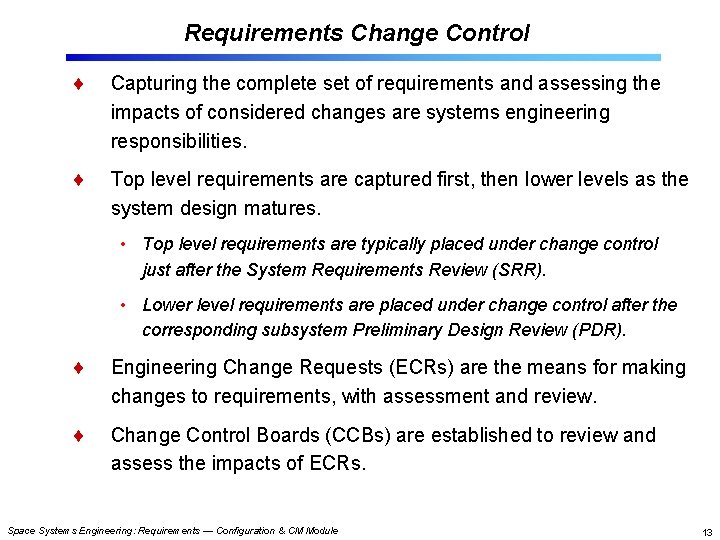
Requirements Change Control Capturing the complete set of requirements and assessing the impacts of considered changes are systems engineering responsibilities. Top level requirements are captured first, then lower levels as the system design matures. • Top level requirements are typically placed under change control just after the System Requirements Review (SRR). • Lower level requirements are placed under change control after the corresponding subsystem Preliminary Design Review (PDR). Engineering Change Requests (ECRs) are the means for making changes to requirements, with assessment and review. Change Control Boards (CCBs) are established to review and assess the impacts of ECRs. Space Systems Engineering: Requirements — Configuration & CM Module 13
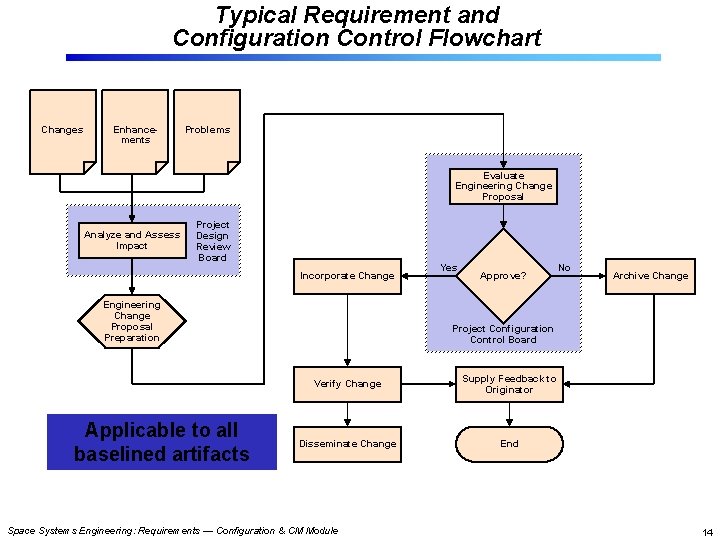
Typical Requirement and Configuration Control Flowchart Changes Enhancements Problems Evaluate Engineering Change Proposal Analyze and Assess Impact Project Design Review Board Incorporate Change Engineering Change Proposal Preparation Applicable to all baselined artifacts Yes Approve? No Archive Change Project Configuration Control Board Verify Change Supply Feedback to Originator Disseminate Change End Space Systems Engineering: Requirements — Configuration & CM Module 14
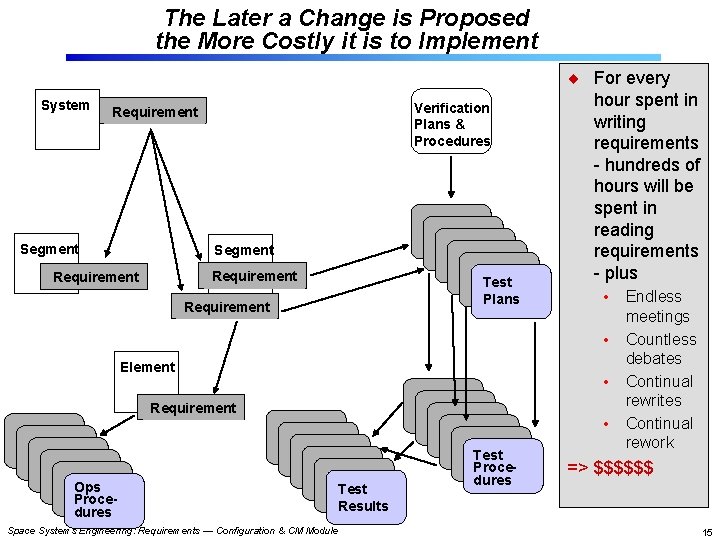
The Later a Change is Proposed the More Costly it is to Implement System Verification Plans & Procedures Requirement Segment Requirement Test Plans Requirement For every hour spent in writing requirements - hundreds of hours will be spent in reading requirements - plus • • Element • Requirement Ops Procedures • Test Results Space Systems Engineering: Requirements — Configuration & CM Module Test Procedures Endless meetings Countless debates Continual rewrites Continual rework => $$$$$$ 15
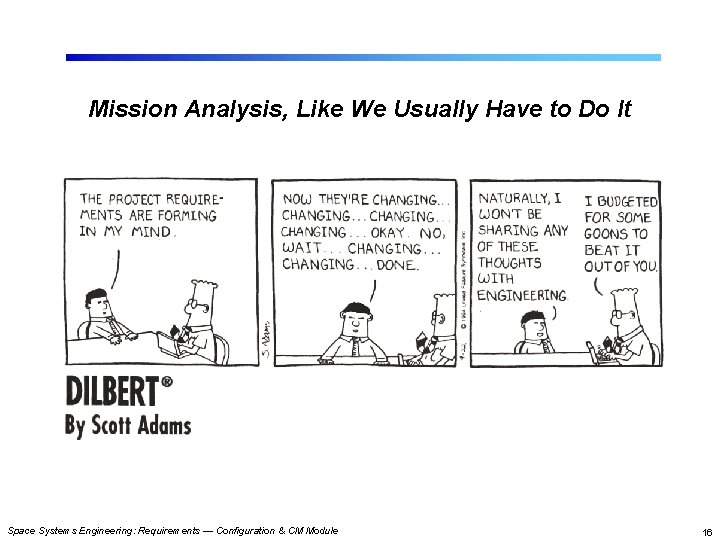
Mission Analysis, Like We Usually Have to Do It Space Systems Engineering: Requirements — Configuration & CM Module 16
Module Summary: Configuration and Change Management System baselines capture the complete, current system description. System baselines are updated periodically at five major milestone reviews - SDR, PDR, CDR, FRR and ORR. Requirements and configuration changes are inevitable, so a formal process of considering the implications of these changes is used. It is important to have managed baselines, requirements and configurations so that the entire team is working with the same assumptions of what the current system is and what it must do. Systems engineering is responsible for creating and updating the system baseline, assessing the implications of considered changes and disseminating the news of any accepted changes. Space Systems Engineering: Requirements — Configuration & CM Module 17
Backup Slides for Requirements — Configuration &CM Module Space Systems Engineering: Requirements — Configuration & CM Module
Pause and Learn Opportunity Discuss James Webb Space Telescope (JWST) Requirements Examples using the following document: JWST Mission Requirements Document (. pdf) Section 4. 1 Descriptions of types of verification Section 4. 2 Verification Matrix See Notes to this slide for more detail. Space Systems Engineering: Requirements — Configuration & CM Module
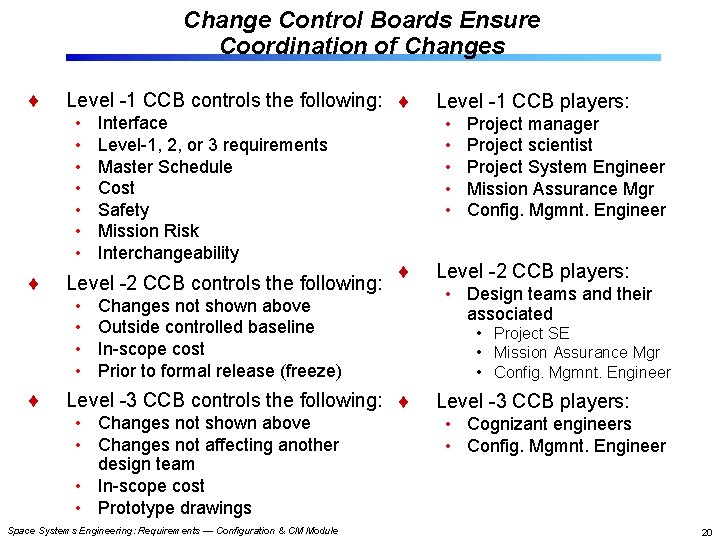
Change Control Boards Ensure Coordination of Changes Level -1 CCB controls the following: • • Level -2 CCB controls the following: • • Interface Level-1, 2, or 3 requirements Master Schedule Cost Safety Mission Risk Interchangeability • • • Changes not shown above Outside controlled baseline In-scope cost Prior to formal release (freeze) Level -3 CCB controls the following: • Changes not shown above • Changes not affecting another design team • In-scope cost • Prototype drawings Space Systems Engineering: Requirements — Configuration & CM Module Level -1 CCB players: Project manager Project scientist Project System Engineer Mission Assurance Mgr Config. Mgmnt. Engineer Level -2 CCB players: • Design teams and their associated • Project SE • Mission Assurance Mgr • Config. Mgmnt. Engineer Level -3 CCB players: • Cognizant engineers • Config. Mgmnt. Engineer 20
Blue text indicates changes from last update Space Systems Engineering: Requirements — Configuration & CM Module 21
Prioritization • • • List items that are mandatory. Group them as “musts. ” All other items are “wants” that can be prioritized. Important “wants” are given a high weighted value. When candidate concepts are evaluated, if they do not satisfy all the “musts, ” they are eliminated. Be careful about overstating the “musts. ” Otherwise, promising candidates may be prematurely eliminated. Space Systems Engineering: Requirements — Configuration & CM Module 22
Prioritizing Wants Several methods: • High, Medium, Low • Select highs and lows and all else falls into medium • One, Two, Three • Same as high, medium, and low • Relative to a base of ten • Relative importance assigned a number against a scale (0 -10), with ten being the highest. • Pair-wise comparison • Each “want” is compared to each other and a decision is made as to which one is more important. When all comparisons have been made a priority stacking results. • Categorize “satisfaction” and “dissatisfaction” • • “How pleased will you be when this capability is provided? ” “How upset will you be if we cannot provide this capability? ” Get the users involved to establish and baseline the priorities. Space Systems Engineering: Requirements — Configuration & CM Module 23