
Requirements Gathering and Capturing SENG 301 Learning Objectives
Requirements Gathering and Capturing SENG 301
Learning Objectives By the end of this lecture, you should be able to: - Discuss several techniques for gathering requirements - Identify functional vs. non-functional requirements - Discuss the distinction between functional vs. non-functional requirements - Explain why we need techniques to capture requirements - Understand how User Stories and Story Mapping works (you will practice this in tutorial)
Gathering Requirements You and the two people sitting next to you are on a team to develop a tool for post-secondary education that allows students in a class to ask and discuss questions about assignments with the professor. What methods would you employ to gather requirements for this system?
Techniques for Gathering Requirements Your goal is to understand the domain as best you can, typically with respect to the particular (focused) context. Interviews with stakeholders Analysis of competing products (or previous versions) Observation of stakeholders at work (e. g. POS systems) Questionnaires and surveys Collection of process/procedure documents
Wait, what are requirements? Things your system should do Things your system should not do Features your system must provide Things your users will expect
Functional Requirements Inputs the system should accept Outputs the system should produce Data the system should store that other systems might use Computations the system should perform Timing and synchronization of the above (i. e. ordering of events)
Functional vs. Non-functional Requirements Functional requirements: “What should the system do” (independent of the implementation) Non-functional requirements: How does the system do the thing? E. g. quality attributes, or quality characteristics Example: - Functional requirement: A user should be able to scroll through the chat history to examine the chat history. - Functional requirement: A user should be able to enter in query terms to search the chat history. - Non-functional requirement: Scrolling through the chat history should be smooth. - Non-functional requirement: A user should be able to find pertinent search terms within 1 s.
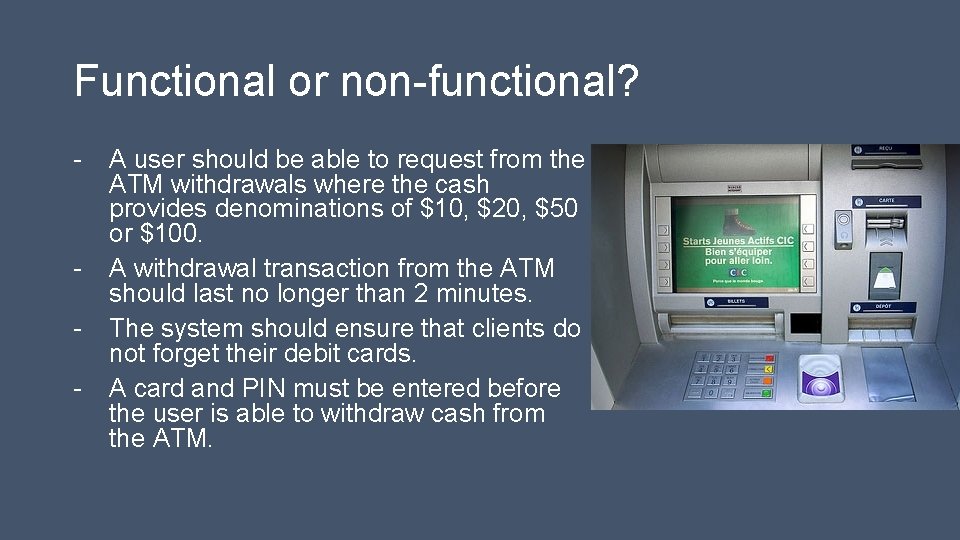
Functional or non-functional? - - A user should be able to request from the ATM withdrawals where the cash provides denominations of $10, $20, $50 or $100. A withdrawal transaction from the ATM should last no longer than 2 minutes. The system should ensure that clients do not forget their debit cards. A card and PIN must be entered before the user is able to withdraw cash from the ATM.
Non-functional requirements Response Time Throughput Resource usage Reliability Availability Failure recovery Maintainability
More non-functional requirements Modularity Testability Security Learnability Usability Price Extensibility Reusability
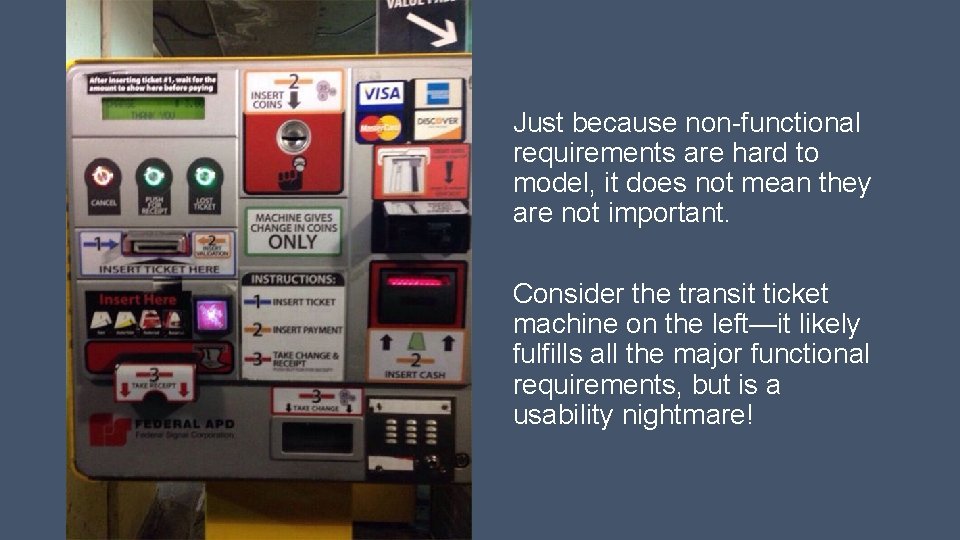
Just because non-functional requirements are hard to model, it does not mean they are not important. Consider the transit ticket machine on the left—it likely fulfills all the major functional requirements, but is a usability nightmare!
Eliciting Non-Functional Requirements Performance Characteristics Are there any speed, throughput, or response time constraints on the system? Are there size or capacity constraints on the data to be processed by the system? Security Issues Must access to any data or the system itself be controlled? Is physical security an issue? User Interface and Human Factors What type of user will be using the system? Will more than one type of user be using the system? Is it particularly important that the system be easy to learn?
How can these requirements be improved? Work with a neighbour: (a) What’s wrong with each, and (b) How can it be improved? 1. The system shall validate and accept credit cards and cashier’s checks. (High priority) 2. The system shall process all mouse clicks quickly to ensure users do not have to wait. 3. The user must have Adobe Acrobat installed.
Some notes about Requirements Functional requirements specify what the system should do, but these are (generally) independent of the implementation We retain requirements because they tell us when we’re “done” in some sense—they can also be used as part of contracts Note: requirements can and do change—sometimes, this is because the stakeholders change. Other times, it is because the stakeholders didn’t know what they wanted until they saw something.

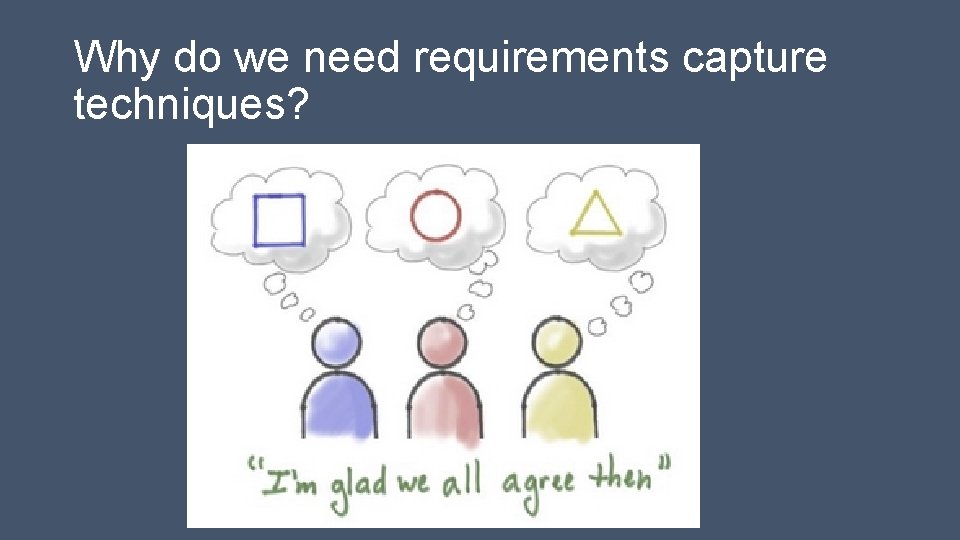
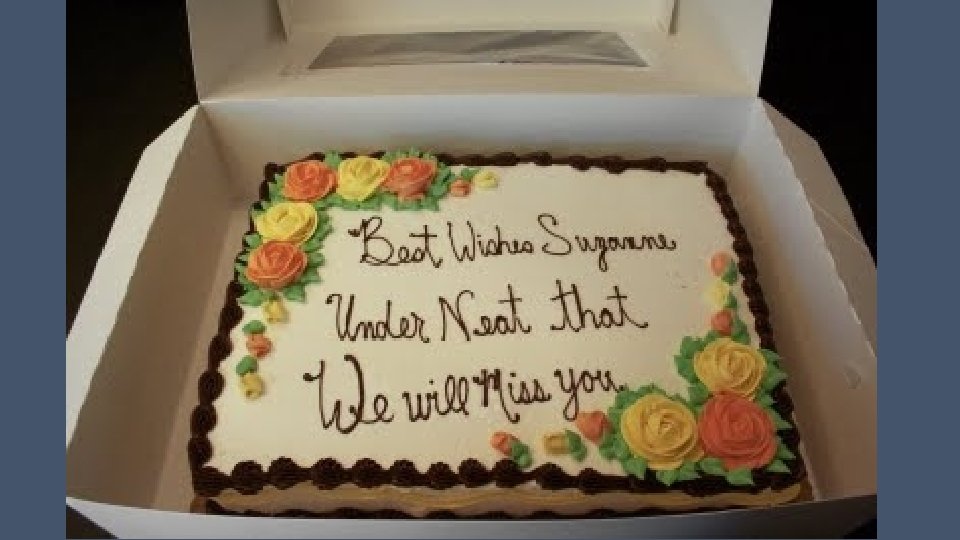
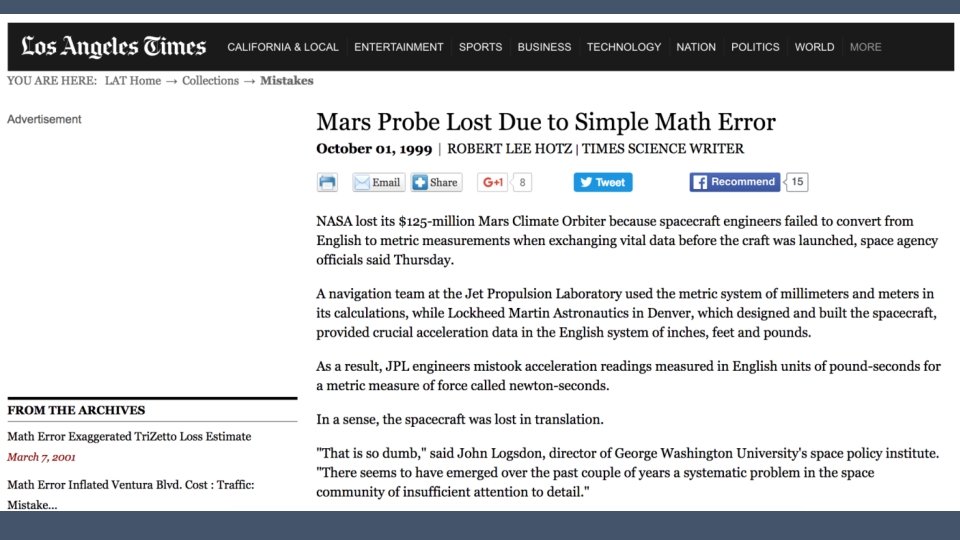
Why do we need requirements capture techniques?
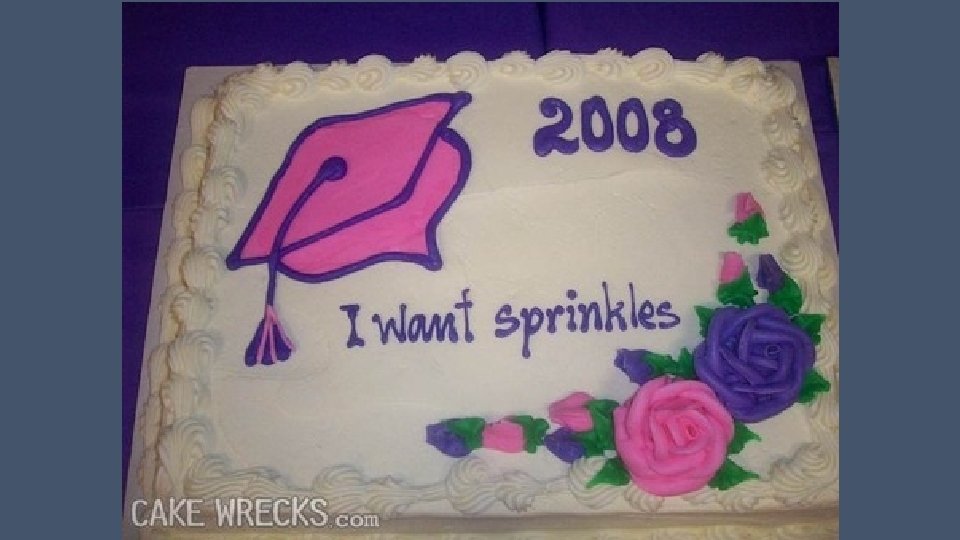


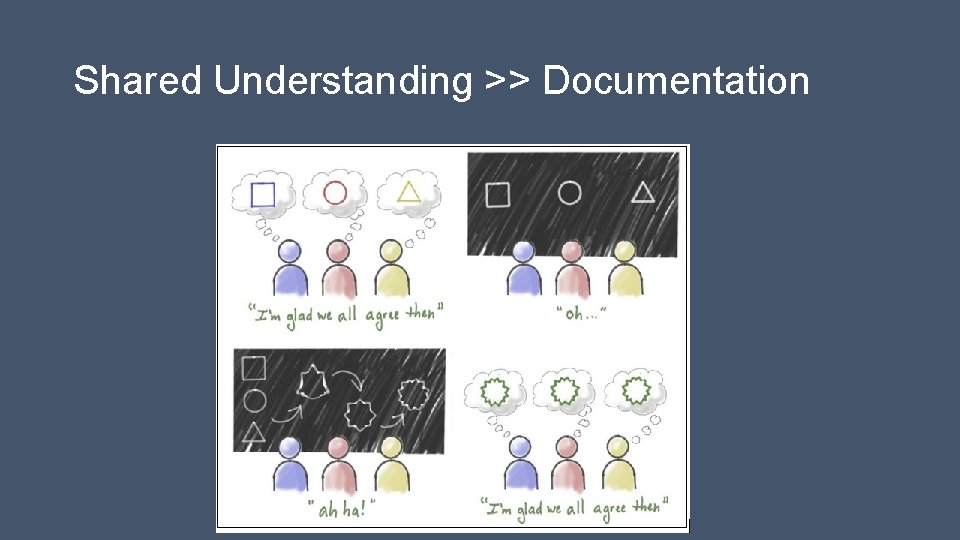
Shared Understanding >> Documentation
User Stories & Story Mapping Invented and popularized by Jeff Patton (look for his webcasts!) Basic idea: externalize understanding of system in digestible bits - Develop a story about how the system is used - Drill down into elements of this story to understand what different ways different parts of the story can be accomplished - Consider user “journeys” to understand what ought to be prioritized - Use the physicality of the story map to facilitate conversation and understanding
Story cards capture user goals Title should be a verb description Goal is written as “As a {type of user}, I want to {perform some action} so I can {achieve a goal}”
Examples of User Stories (for Vending Machine) As a customer, I want to insert coins to be able to pay for my item. As a customer, I want to select my item. As a customer, I want to know the cost of an item. As a technician, I want to set the prices of items. As a technician, I want to open the machine to service it, without injuring anyone.
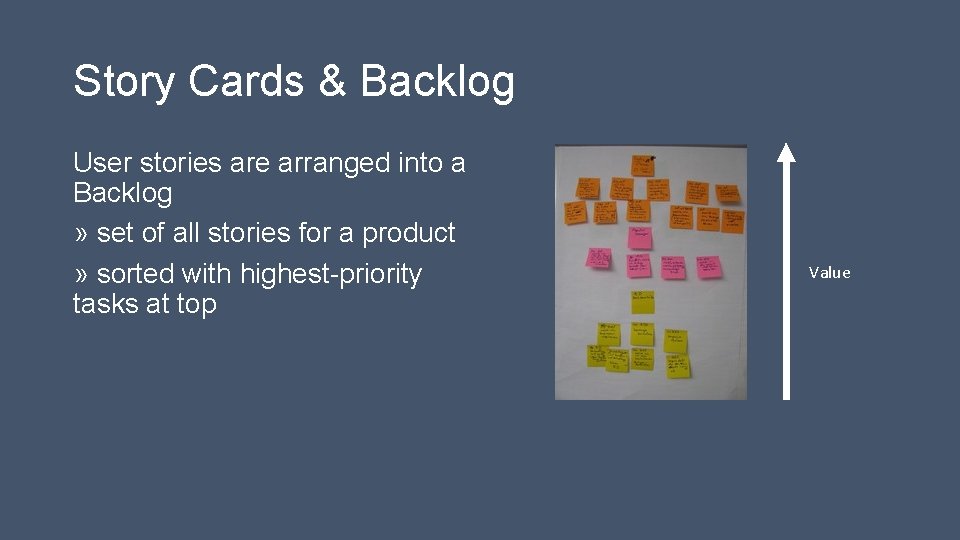
Story Cards & Backlog User stories are arranged into a Backlog » set of all stories for a product » sorted with highest-priority tasks at top Value
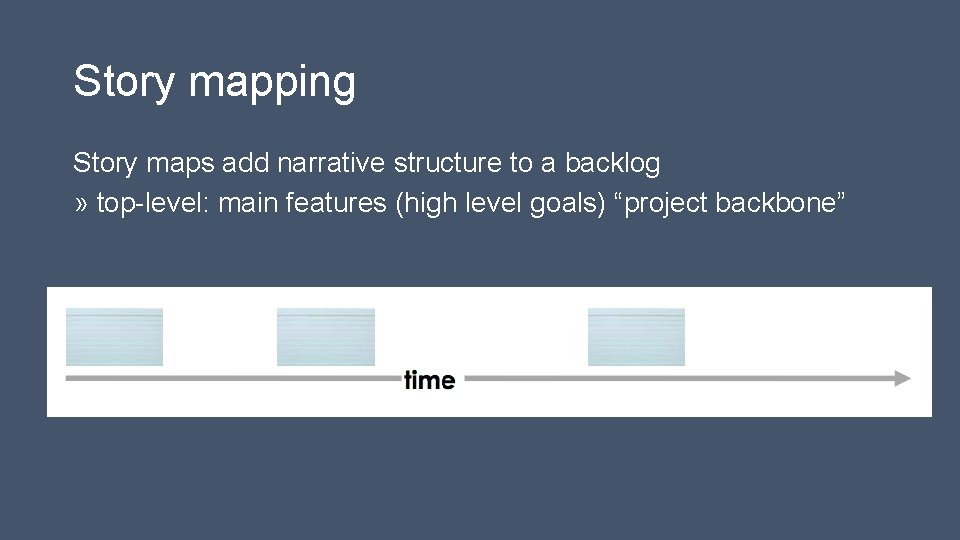
Story mapping Story maps add narrative structure to a backlog » top-level: main features (high level goals) “project backbone”
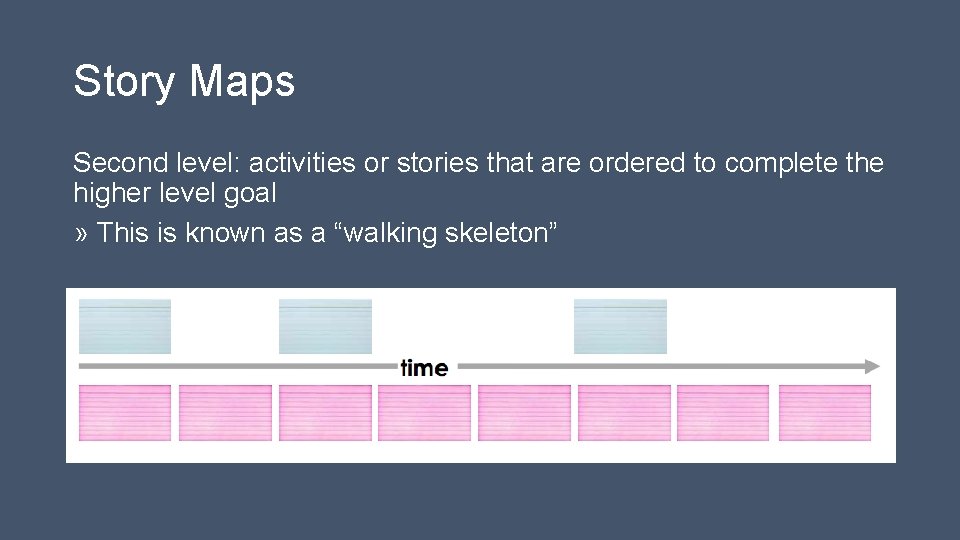
Story Maps Second level: activities or stories that are ordered to complete the higher level goal » This is known as a “walking skeleton”
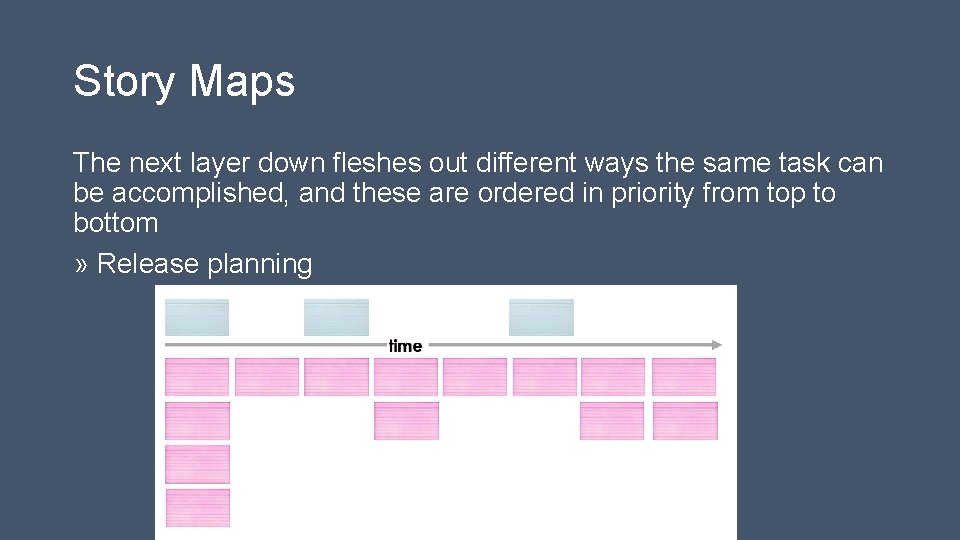
Story Maps The next layer down fleshes out different ways the same task can be accomplished, and these are ordered in priority from top to bottom » Release planning
Learning Objectives By the end of this lecture, you should be able to: - Discuss several techniques for gathering requirements - Identify functional vs. non-functional requirements - Discuss the distinction between functional vs. non-functional requirements - Explain why we need techniques to capture requirements - Understand how User Stories and Story Mapping works (you will practice this in tutorial)

- Slides: 32