
Requirements for Longdistance Bus Terminals in Germany Prof
Requirements for Long-distance Bus Terminals in Germany Prof. Dr. Andreas Saxinger Michaela Nachtsheim 1
Prof. Dr. Andreas Saxinger Michaela Nachtsheim Long-distance Bus Terminals Agenda Introduction – current relevance of this topic Deficits – where and why? Survey of requirements for long-distance bus terminals Results of the survey Conclusion 2
Prof. Dr. Andreas Saxinger Michaela Nachtsheim Long-distance Bus Terminals Introduction (1) - Legal realities § For many decades: no relevance of long-distance busses in Germany • Long distance passenger transport by rail was legally protected from competition • Applications for long-distance bus line concessions had no chance of success § Significantly liberalized market for long-distance busses by the Amendment of the German Federal Passenger Transportation Act to 1 st January 2013 • Entrepreneurs still need an official concession (only for security reasons) • For granting concessions it is irrelevant, whether other bus or railway companies already operate the transport service applied for (parallel operations are allowed) • On long-distance lines competition between different bus companies is now possible • No regulation of fares by public authorities 3
Prof. Dr. Andreas Saxinger Michaela Nachtsheim Long-distance Bus Terminals Introduction (2) - Market development since the liberalisation § Really fast market grown since the liberalisation • A new market in Germany was created on 1 st January 2013 • Within a short time applications for many new connections from different companies were submitted • The acceptance of domestic long-distance bus services by passengers is extremely high • Currently companies compete heavily on low special prices § Rapid growth of new services but no new infrastructure • In many cities new infrastructure for the passengers is required (bus terminals) • The German Federal Legislator provides no regulations for this type of infrastructure • The German Federal Passenger Transportation Act only knows the term “bus stop”, which requires signage by the bus company (minimal standard) 4
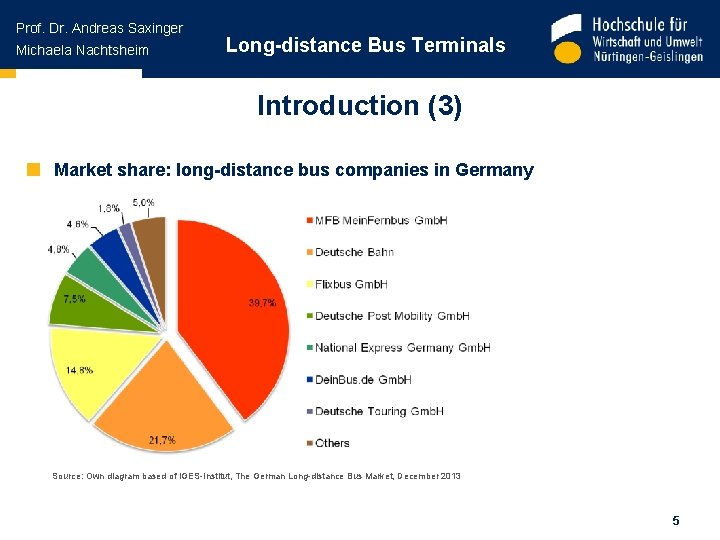
Prof. Dr. Andreas Saxinger Michaela Nachtsheim Long-distance Bus Terminals Introduction (3) Market share: long-distance bus companies in Germany Source: Own diagram based of IGES-Institut, The German Long-distance Bus Market, December 2013 5
Prof. Dr. Andreas Saxinger Michaela Nachtsheim Long-distance Bus Terminals Deficits - Long-distance bus terminals § Many cities in Germany do not have a suitable infrastructure for long-distance bus terminals (infrastructure only for urban traffic) • Available bus stops are overburdened • Bus companies are forced to choose second best bus stops • Location of a bus terminal has to be integrated in the urban planning process § Consequence: new infrastructure is required • Bus companies wish bus terminals in an attractive location with a minimum of comfort for their passengers § Outstanding questions: • Who is responsible for the financing and construction? • What are the requirements concerning location and facilities? 6
Prof. Dr. Andreas Saxinger Michaela Nachtsheim Long-distance Bus Terminals Survey Basis of the survey of requirements for long-distance bus terminals • 50 municipalities were contacted, 27 responded • The most important cities in Germany were questioned • Included are smaller cities as well, because in Germany the long-distance bus transport is important also for smaller cities, where the rail connection is not well developed Questions referred to… 1. . the current relevance of this topic for municipalities 2. … the importance to keep the planning process in their own hands 3. … the decision if bus terminals should be constructed centrally or decentralised 4. … who should be the developer and who should be the operator 5. … the financing possibilities (e. g. user fee, rental income, public funds, …) 6. … the requirements concerning the relevant facilities for long-distance bus Terminals 7. … the implementation of accessibility (also disabled access) 7
Prof. Dr. Andreas Saxinger Michaela Nachtsheim Long-distance Bus Terminals Results of the survey (1) 93 % of the cities are discussing about long-distance bus terminals 100 % want to keep the planning process in their own hands 81 % prefer central locations for bus terminals Existing infrastructure is the most important requirement factor for long-distance bus terminals, but currently mostly suitable for urban traffic The opinion concerning developer and operator is balanced • 33 %: Developer and operator should be the municipality • 30 %: Developer and operator should be a private company • 30 %: Developer should be the municipality, operator a private company • 27 %: Any other combination is possible 8
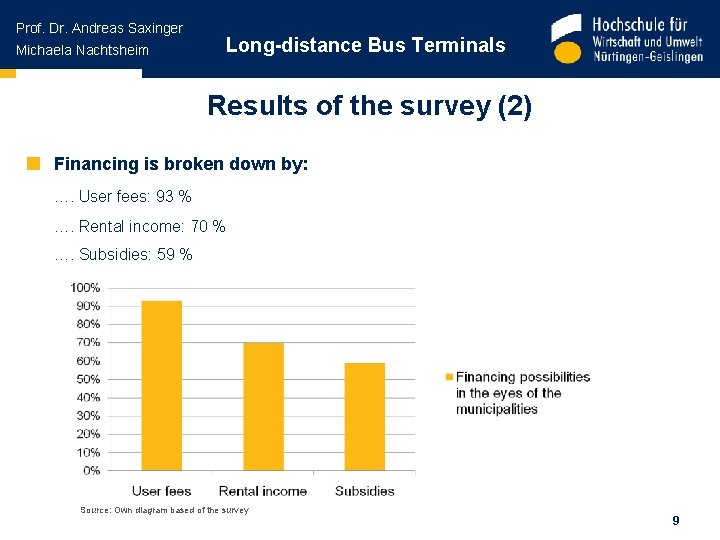
Prof. Dr. Andreas Saxinger Michaela Nachtsheim Long-distance Bus Terminals Results of the survey (2) Financing is broken down by: …. User fees: 93 % …. Rental income: 70 % …. Subsidies: 59 % Source: Own diagram based of the survey 9
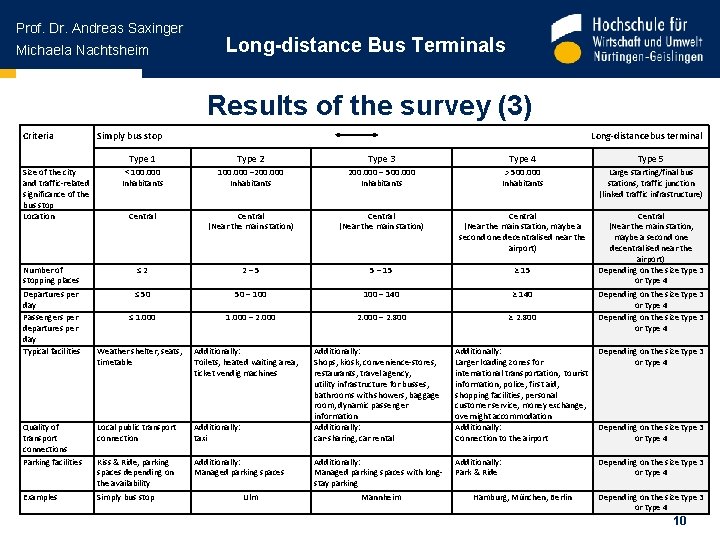
Prof. Dr. Andreas Saxinger Michaela Nachtsheim Long-distance Bus Terminals Results of the survey (3) Criteria Simply bus stop Long-distance bus terminal Type 1 Type 2 Type 3 Type 4 Type 5 < 100. 000 Inhabitants 100. 000 – 200. 000 Inhabitants 200. 000 – 500. 000 Inhabitants > 500. 000 Inhabitants Large starting/final bus stations, traffic junction (linked traffic infrastructure) Central (Near the main station) Central (Near the main station, maybe a second one decentralised near the airport) Number of stopping places ≤ 2 2– 5 5 – 15 ≥ 15 Central (Near the main station, maybe a second one decentralised near the airport) Depending on the size type 3 or type 4 Departures per day Passengers per departures per day Typical facilities ≤ 50 50 – 100 – 140 ≥ 140 ≤ 1. 000 – 2. 800 ≥ 2. 800 Size of the city and traffic-related significance of the bus stop Location Weather shelter, seats, timetable Additionally: Toilets, heated waiting area, ticket vendig machines Quality of transport connections Parking facilities Local public transport connection Additionally: taxi Kiss & Ride, parking spaces depending on the availability Additionally: Managed parking spaces Examples Simply bus stop Ulm Depending on the size type 3 or type 4 Additionally: Shops, kiosk, convenience-stores, restaurants, travel agency, utility infrastructure for busses, bathrooms with showers, baggage room, dynamic passenger information Additionally: car-sharing, car rental Additionally: Larger loading zones for international transportation, tourist information, police, first aid, shopping facilities, personal customer service, money exchange, overnight accommodation Additionally: Connection to the airport Depending on the size type 3 or type 4 Additionally: Managed parking spaces with longstay parking Additionally: Park & Ride Depending on the size type 3 or type 4 Mannheim Hamburg, München, Berlin Depending on the size type 3 or type 4 10
Prof. Dr. Andreas Saxinger Michaela Nachtsheim Long-distance Bus Terminals Conclusions 1. The long-distance bus transport market recorded a rapid growth since the Amendment of the German Federal Passenger Transportation Act to 1 st January 2013 2. New infrastructure in the form of central long-distance bus terminals for the passengers is required Most suitable are central locations near the main railway station, because of the existing infrastructure 3. There are different requirements for long-distance bus terminals depending on - the size of the city, - the traffic-related significance and - the existing infrastructure 11
Thank you for your attention! Prof. Dr. Andreas Saxinger Nurtingen-Geislingen University Parkstraße 4 D-73312 Geislingen Tel. : 0049 / 7331 / 22 - 584 / -543 e-mail: andreas. saxinger@hfwu. de Michaela Nachtsheim (Research assistant) Nurtingen-Geislingen University Parkstraße 4 D-73312 Geislingen Tel. : 0049 / 7331 / 22 - 584 / -543 e-mail: nachtsheimm@stud. hfwu. de 12
- Slides: 12