
Requirements Engineering The KAOS GoalOriented Approach UFCE 4
- Slides: 17
Requirements Engineering: The KAOS Goal-Oriented Approach UFCE 4 S-10 -3 Lecture Four Stewart Green Requirements Engineering UFCE 4 S-10 -3 Lecture Four
Lecture Structure KAOS: introduction KAOS: inputs and outputs KAOS: meta model KAOS: process KAOS: meeting scheduler example KAOS: decomposition of schedule meeting system goal KAOS: operationalising goals KAOS: requirements model 2/19/2021 Requirements Engineering UFCE 4 S-10 -3 Lecture Four 2
KAOS References Goal-Oriented Requirements Engineering: A Guided Tour, A. van Lamsweerde, 5 th International Symposium on Requirements Engineering, IEEE Computer Society Press, 2001 Goal-directed Requirements Acquisition, A. Dardenne, A. van Lamsweerde and S. Fickas, Science of Computer Programming, 20, pp 3 – 50, 1993 Goal-Oriented Approaches to Requirements Engineering, S. Green, (Lecture three handout-1) 2/19/2021 Requirements Engineering UFCE 4 S-10 -3 Lecture Four 3
Formalising Requirements expressed in English, perhaps augmented with diagrams, may be formalised. In other words, the goals may be re-expressed in a more formal language. 2/19/2021 Requirements Engineering UFCE 4 S-10 -3 Lecture Four 4
requirements KAOS is a research project, but it is wellin KAOS: Knowledge Acquisition documented, and has tool support from a tool Automated called GRAIL Specification The aim of the KAOS approach is to derive a description of a system’s behaviour and an initial analysis of its structure through acquiring and formalising functional and nonfunctional goals for a composite system 2/19/2021 Requirements Engineering UFCE 4 S-10 -3 Lecture Four 5
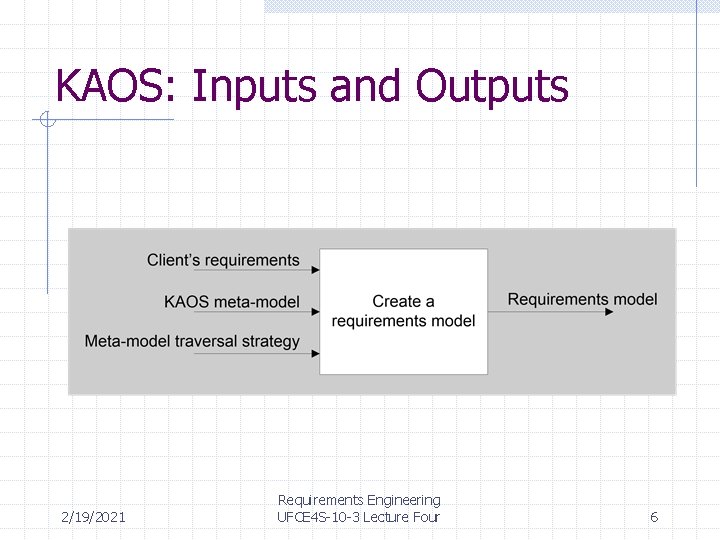
KAOS: Inputs and Outputs 2/19/2021 Requirements Engineering UFCE 4 S-10 -3 Lecture Four 6
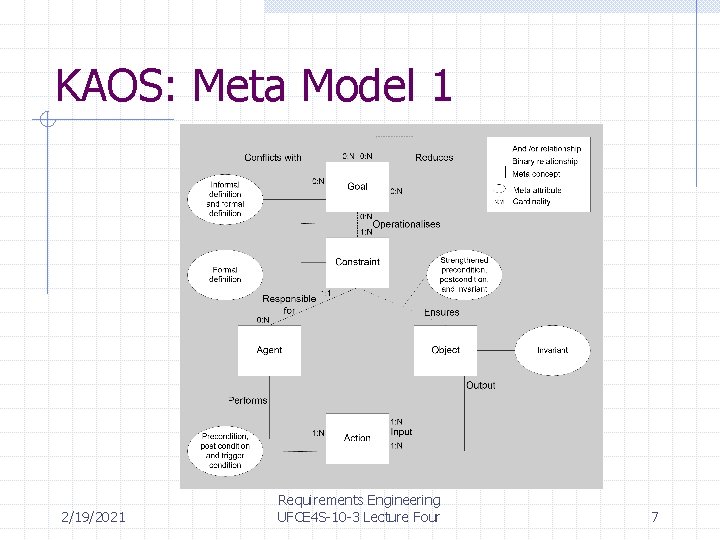
KAOS: Meta Model 1 2/19/2021 Requirements Engineering UFCE 4 S-10 -3 Lecture Four 7
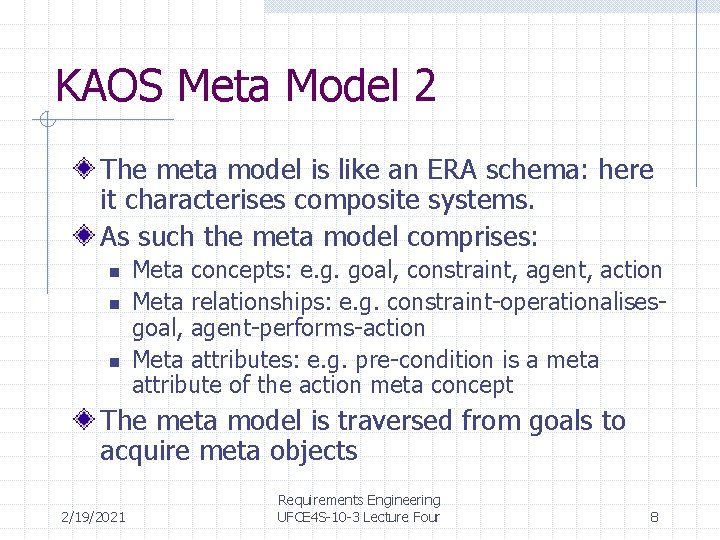
KAOS Meta Model 2 The meta model is like an ERA schema: here it characterises composite systems. As such the meta model comprises: n n n Meta concepts: e. g. goal, constraint, agent, action Meta relationships: e. g. constraint-operationalisesgoal, agent-performs-action Meta attributes: e. g. pre-condition is a meta attribute of the action meta concept The meta model is traversed from goals to acquire meta objects 2/19/2021 Requirements Engineering UFCE 4 S-10 -3 Lecture Four 8
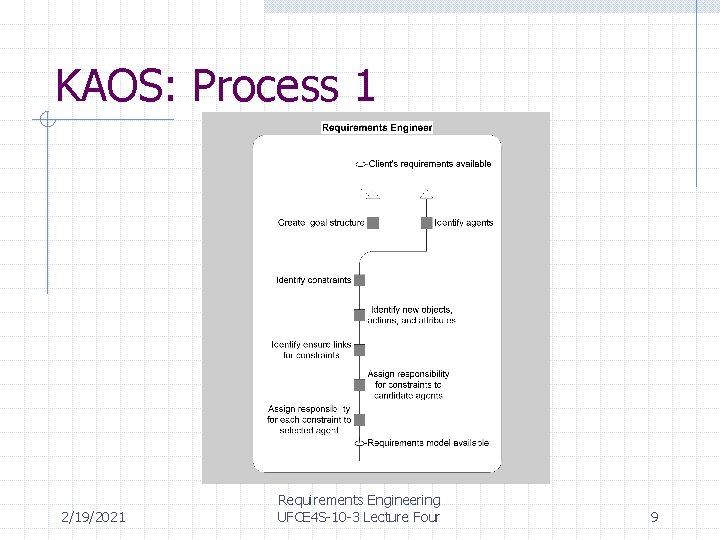
KAOS: Process 1 2/19/2021 Requirements Engineering UFCE 4 S-10 -3 Lecture Four 9
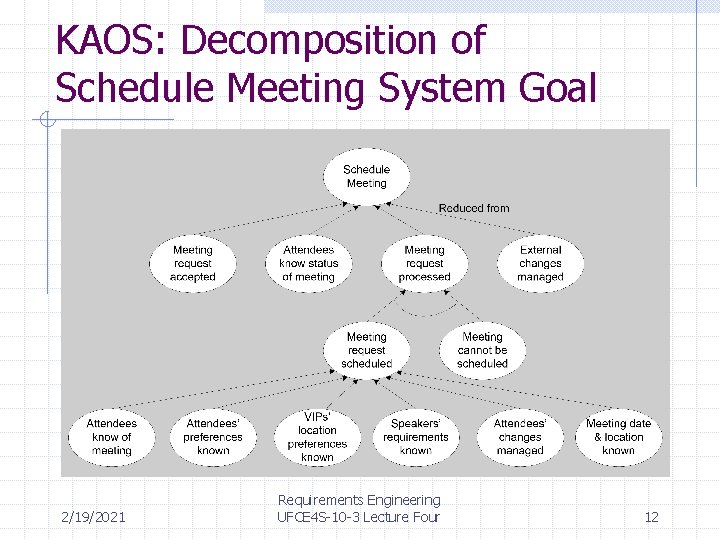
KAOS Process 2 During the KAOS process, instances of the meta objects are acquired as a requirements model is created. The highest-level goals are identified from the requirements. Goals are system objectives that cannot be met by a single agent. These are reduced to constraints (leaf goals) which can be met by a single agent. Reduction is achieved by goal decomposition. 2/19/2021 Requirements Engineering UFCE 4 S-10 -3 Lecture Four 10
KAOS: The Meeting Scheduler Problem See lecture handout for full details Meetings are typically arranged in the following way. A meeting initiator asks all the potential meeting attendees for the following information: n A set of dates on which they cannot attend the meeting n A set of dates on which they would prefer the meeting to take place The initiator asks active participants to provide special equipment requirements A date conflict occurs when no satisfactory date can be found The meeting scheduler must handle several meeting requests in parallel 2/19/2021 Requirements Engineering UFCE 4 S-10 -3 Lecture Four 11
KAOS: Decomposition of Schedule Meeting System Goal 2/19/2021 Requirements Engineering UFCE 4 S-10 -3 Lecture Four 12
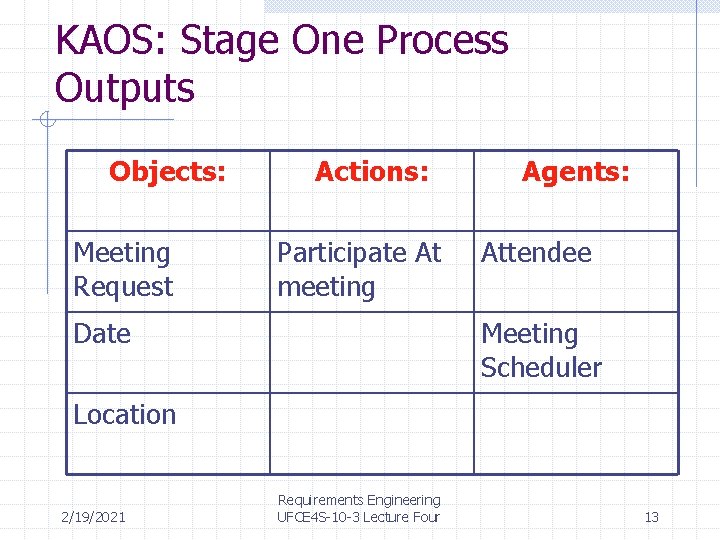
KAOS: Stage One Process Outputs Objects: Meeting Request Actions: Participate At meeting Date Agents: Attendee Meeting Scheduler Location 2/19/2021 Requirements Engineering UFCE 4 S-10 -3 Lecture Four 13
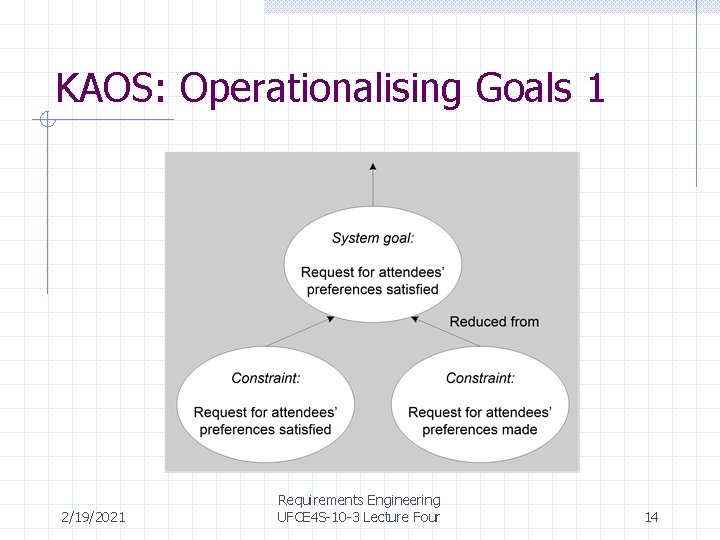
KAOS: Operationalising Goals 1 2/19/2021 Requirements Engineering UFCE 4 S-10 -3 Lecture Four 14
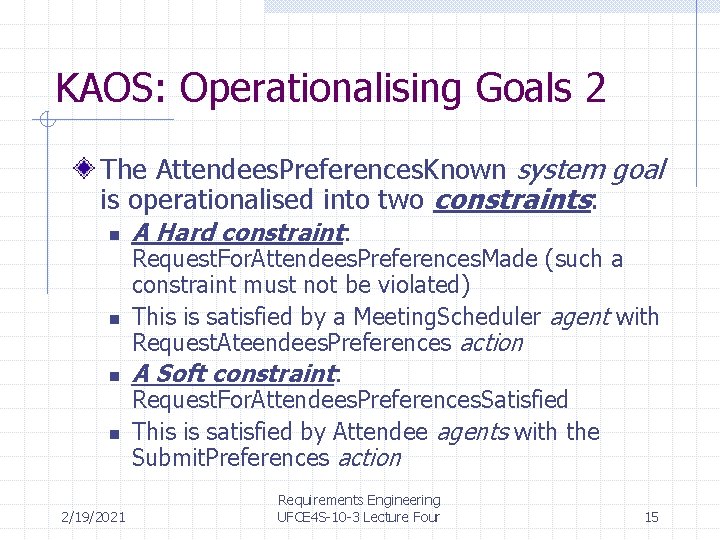
KAOS: Operationalising Goals 2 The Attendees. Preferences. Known system goal is operationalised into two constraints: n n 2/19/2021 A Hard constraint: Request. For. Attendees. Preferences. Made (such a constraint must not be violated) This is satisfied by a Meeting. Scheduler agent with Request. Ateendees. Preferences action A Soft constraint: Request. For. Attendees. Preferences. Satisfied This is satisfied by Attendee agents with the Submit. Preferences action Requirements Engineering UFCE 4 S-10 -3 Lecture Four 15
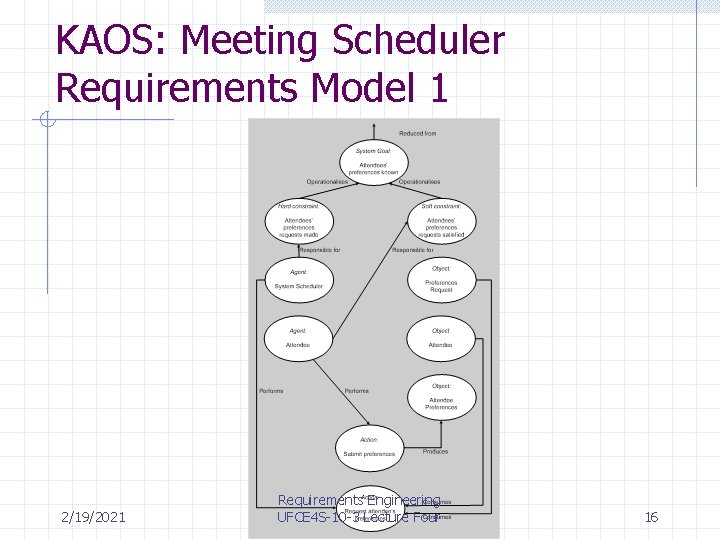
KAOS: Meeting Scheduler Requirements Model 1 2/19/2021 Requirements Engineering UFCE 4 S-10 -3 Lecture Four 16
KAOS Meeting Scheduler Requirements Model 2 The requirements model shows for example: n n n 2/19/2021 How one system goal has been reduced to constraints How these constraints are met by the actions of agents on objects The objects involved: such as Preferences Request, Attendee, and Attendee. Preferences Requirements Engineering UFCE 4 S-10 -3 Lecture Four 17