
Requirements Engineering SemiFormal Specification Structural Functional Requirements Structured




















- Slides: 69
Requirements Engineering Semi-Formal Specification: Structural Functional Requirements – Structured Analysis q. Data Flow Diagrams q. SADT q. IDEF 0 1
Types of Requirements along different views n Functional Requirements (FRs) n Structural Functional Requirements n n n Functional, i. e. , Function-oriented Informational. i. e. , Information-oriented Behavioral Functional Requirements n Non-Functional Requirements (NFRs) 2
Function Oriented Problem Analysis n Creates a hierarchy of functions n Also called (process, activity, work-step, transactions, transforms, bubbles) n Root is most abstract n Leaf nodes the most detailed n Most methods use data flow diagrams and dictionaries n Examples n SRD structured requirements definition n SADT n Information Engineering n Modern structured Analysis n Problem statement Language 3
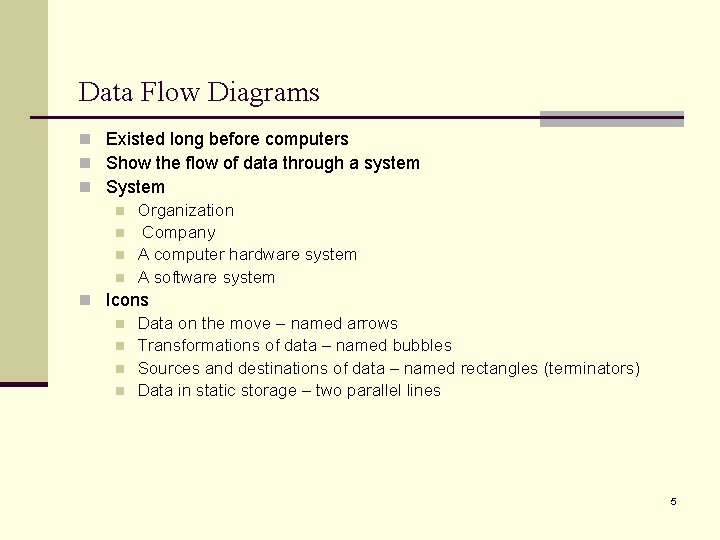
Process Modeling A data flow diagram (DFD) is a tool (and type of process model) that depicts the flow of data through a system and the work or processing performed by that system. DFDs have become a popular tool for business process redesign. 4
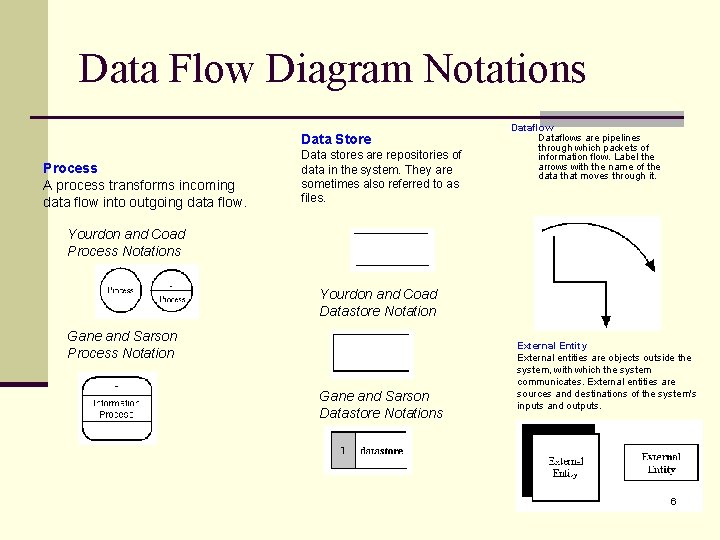
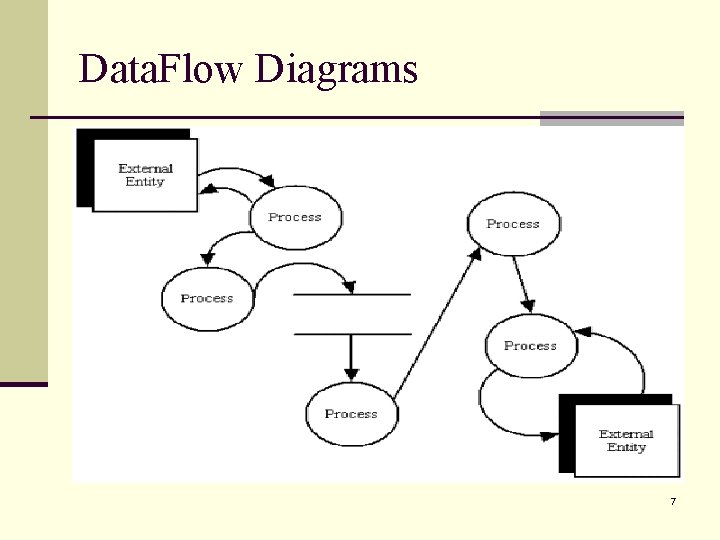
Data Flow Diagrams n Existed long before computers n Show the flow of data through a system n System n Organization n Company n A computer hardware system n A software system n Icons n Data on the move – named arrows n Transformations of data – named bubbles n Sources and destinations of data – named rectangles (terminators) n Data in static storage – two parallel lines 5
Data Flow Diagram Notations Data Store Process A process transforms incoming data flow into outgoing data flow. Data stores are repositories of data in the system. They are sometimes also referred to as files. Dataflows are pipelines through which packets of information flow. Label the arrows with the name of the data that moves through it. Yourdon and Coad Process Notations Yourdon and Coad Datastore Notation Gane and Sarson Process Notation Gane and Sarson Datastore Notations External Entity External entities are objects outside the system, with which the system communicates. External entities are sources and destinations of the system's inputs and outputs. 6
Data. Flow Diagrams 7
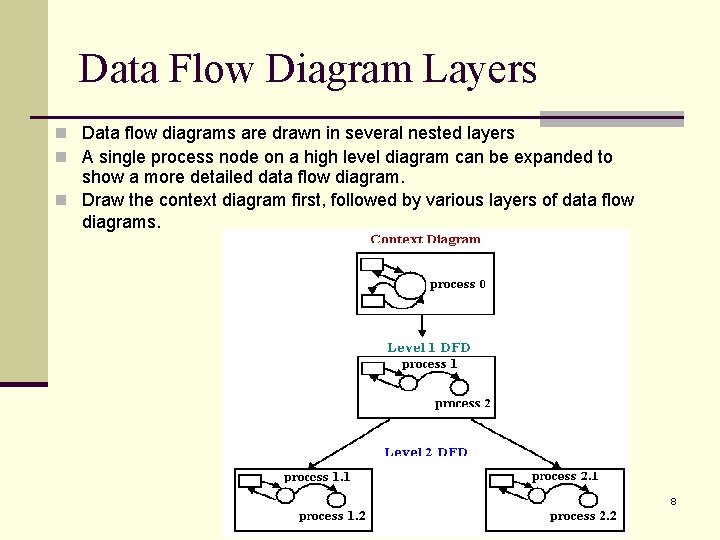
Data Flow Diagram Layers n Data flow diagrams are drawn in several nested layers n A single process node on a high level diagram can be expanded to show a more detailed data flow diagram. n Draw the context diagram first, followed by various layers of data flow diagrams. 8
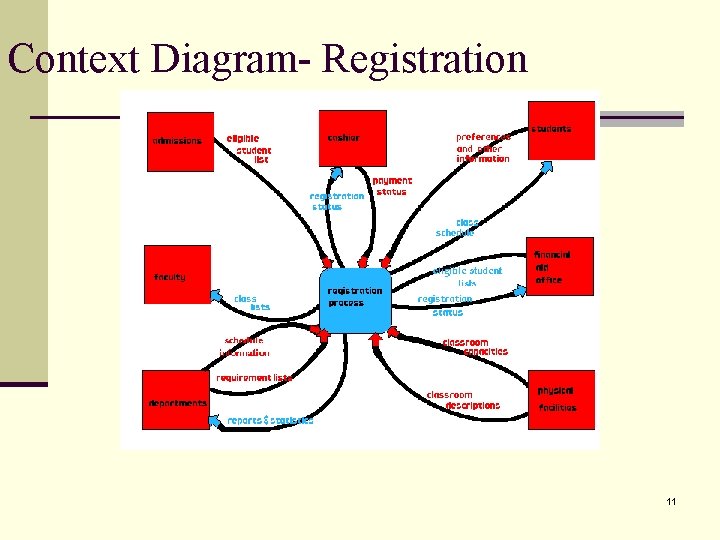
Context Diagrams n A context diagram is a top level (also known as Level 0) data flow diagram. It only contains one process node (process 0) that generalizes the function of the entire system in relationship to external entities. 9
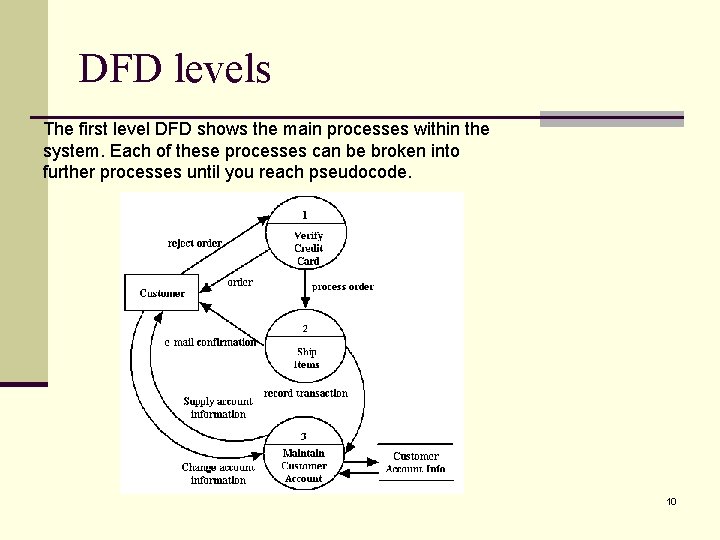
DFD levels The first level DFD shows the main processes within the system. Each of these processes can be broken into further processes until you reach pseudocode. 10
Context Diagram- Registration 11
Level 0 Data Flow Diagram 12
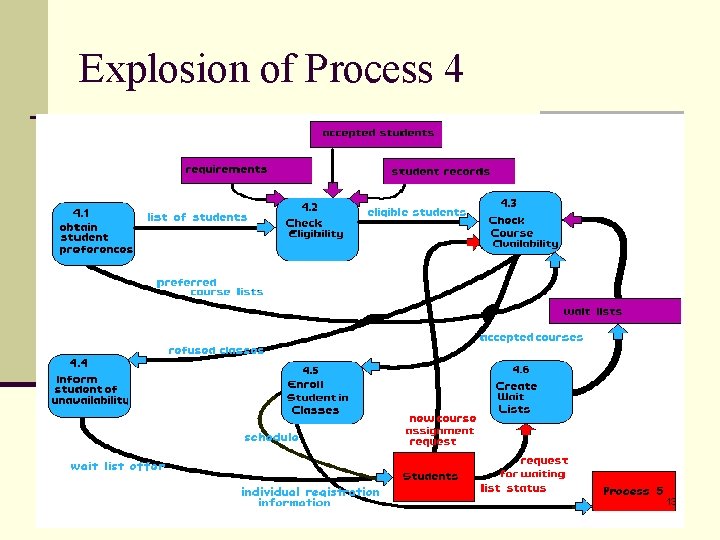
Explosion of Process 4 13
Data Flow Diagrams n Rules n All names must be unique n Not a flow chart – no order implied n No logical decisions n Don’t get bogged down in detail n Leveling n Preserve the number of inputs and outputs between the levels I 1 O 1 A I 2 O 1 A 1 I 2 A 3 data 14
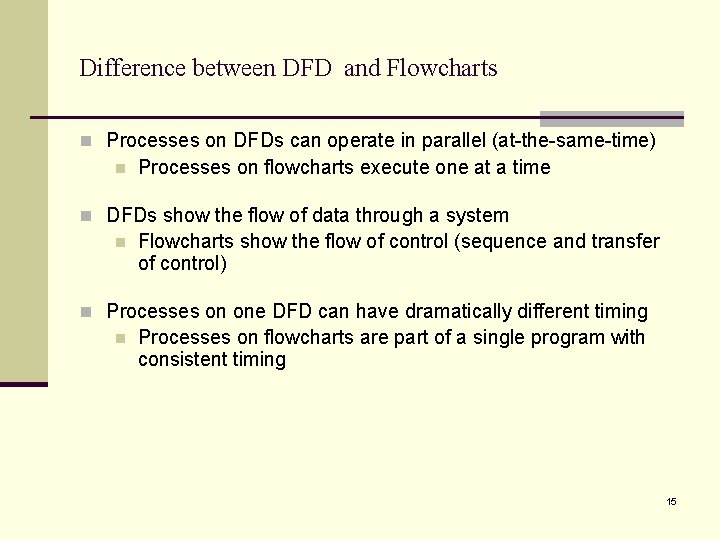
Difference between DFD and Flowcharts n Processes on DFDs can operate in parallel (at-the-same-time) n Processes on flowcharts execute one at a time n DFDs show the flow of data through a system n Flowcharts show the flow of control (sequence and transfer of control) n Processes on one DFD can have dramatically different timing n Processes on flowcharts are part of a single program with consistent timing 15
Homework n Draw a DFD for an ATM 16
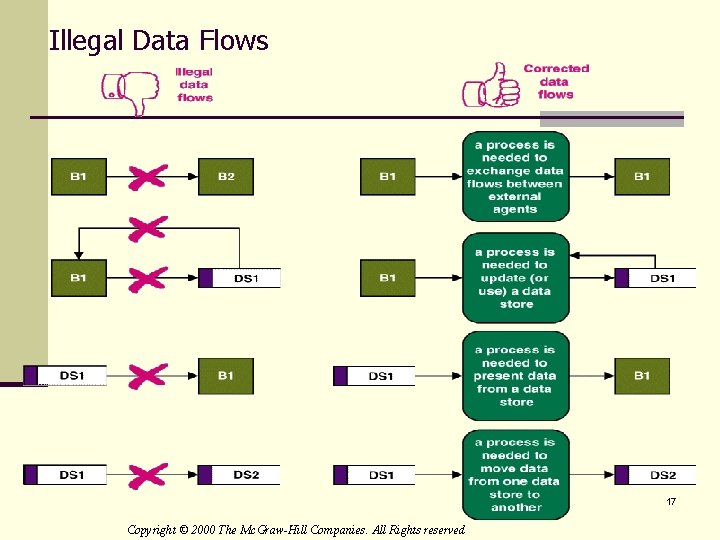
Illegal Data Flows 17 Copyright © 2000 The Mc. Graw-Hill Companies. All Rights reserved
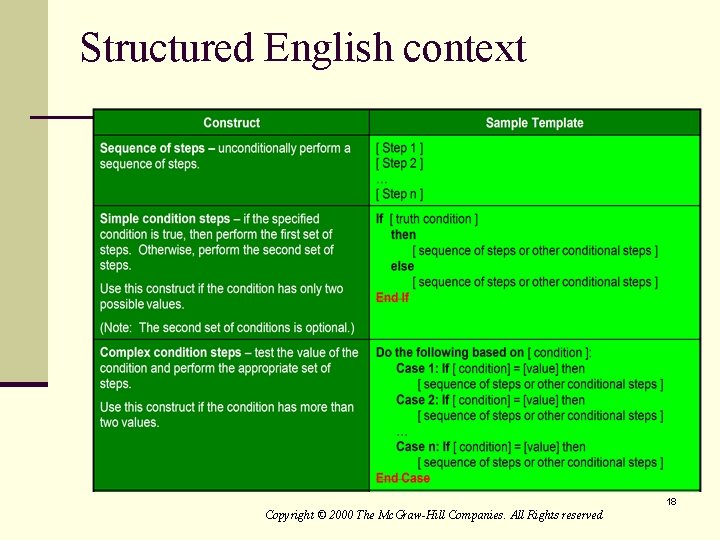
Structured English context 18 Copyright © 2000 The Mc. Graw-Hill Companies. All Rights reserved
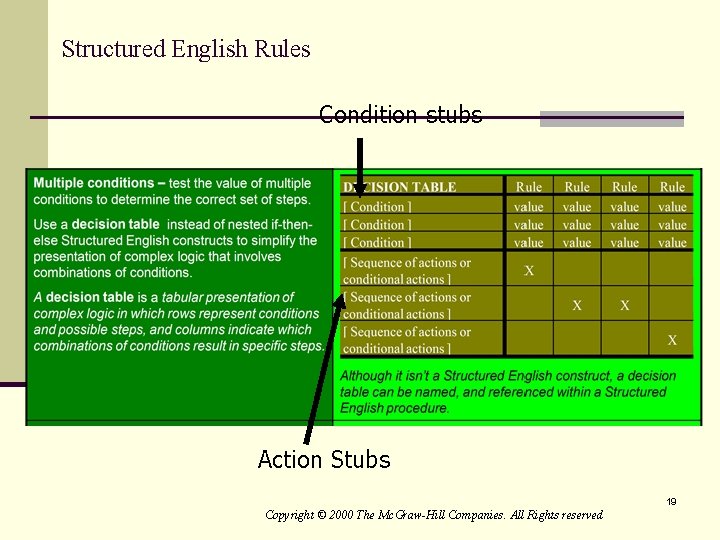
Structured English Rules Condition stubs Action Stubs 19 Copyright © 2000 The Mc. Graw-Hill Companies. All Rights reserved
Decision Table Example Condition Entry Condition Stub If Customer is bookstore Y Y N N Order size > 6 copies Y N N N Y Y Y N N N Y N Customer is librarian/individual Order size 50 copies or more Order size 20 to 49 copies Order size 6 – 19 copies Then Allow a 25% discount X Allow a 15% discount X Allow 10% discount X Allow a 5 % discount Allow 0% discount Action Stub X X X Action Entries 20
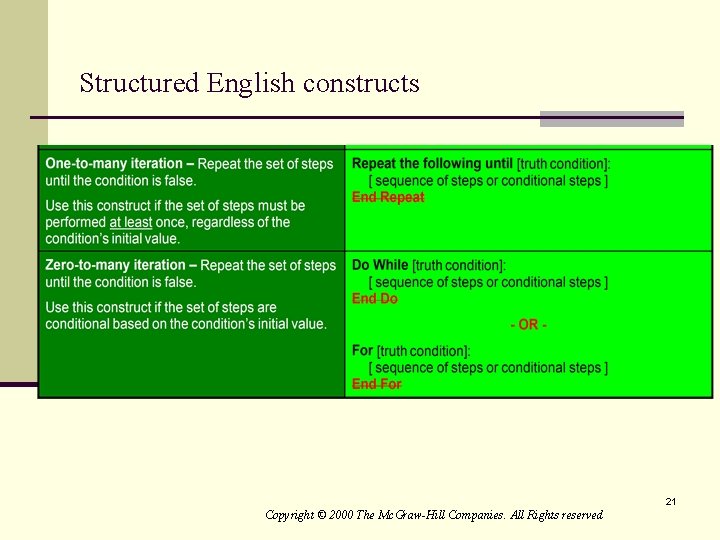
Structured English constructs 21 Copyright © 2000 The Mc. Graw-Hill Companies. All Rights reserved
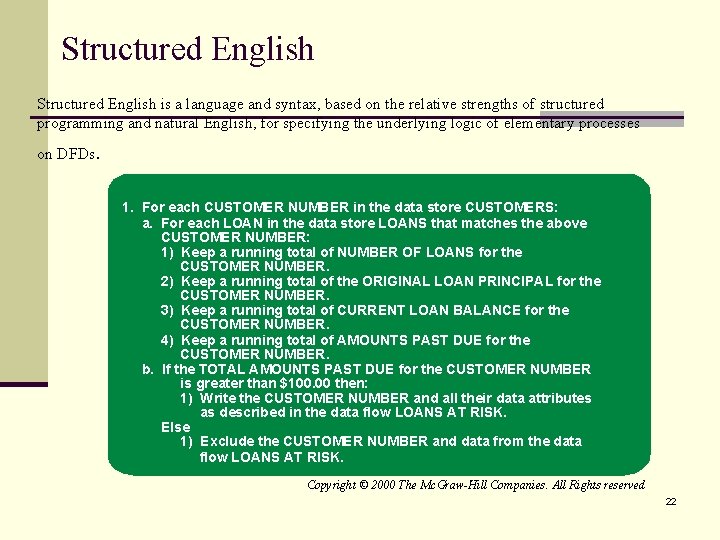
Structured English is a language and syntax, based on the relative strengths of structured programming and natural English, for specifying the underlying logic of elementary processes on DFDs . 1. For each CUSTOMER NUMBER in the data store CUSTOMERS: a. For each LOAN in the data store LOANS that matches the above CUSTOMER NUMBER: 1) Keep a running total of NUMBER OF LOANS for the CUSTOMER NUMBER. 2) Keep a running total of the ORIGINAL LOAN PRINCIPAL for the CUSTOMER NUMBER. 3) Keep a running total of CURRENT LOAN BALANCE for the CUSTOMER NUMBER. 4) Keep a running total of AMOUNTS PAST DUE for the CUSTOMER NUMBER. b. If the TOTAL AMOUNTS PAST DUE for the CUSTOMER NUMBER is greater than $100. 00 then: 1) Write the CUSTOMER NUMBER and all their data attributes as described in the data flow LOANS AT RISK. Else 1) Exclude the CUSTOMER NUMBER and data from the data flow LOANS AT RISK. Copyright © 2000 The Mc. Graw-Hill Companies. All Rights reserved 22
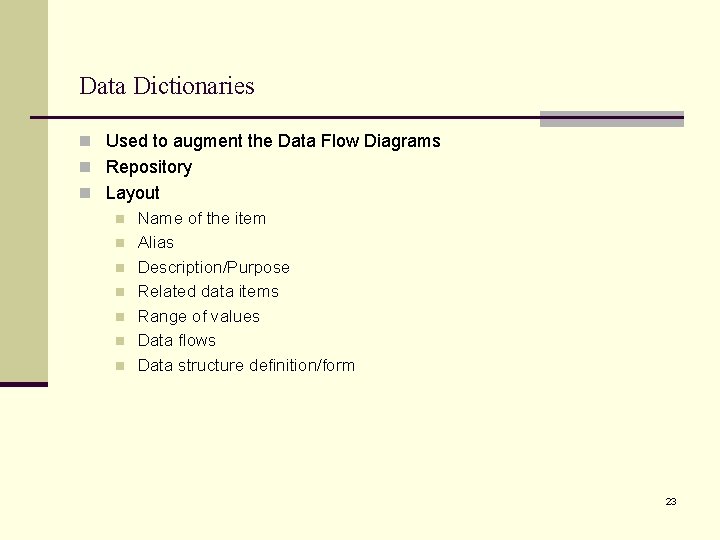
Data Dictionaries n Used to augment the Data Flow Diagrams n Repository n Layout n Name of the item n Alias n Description/Purpose n Related data items n Range of values n Data flows n Data structure definition/form 23
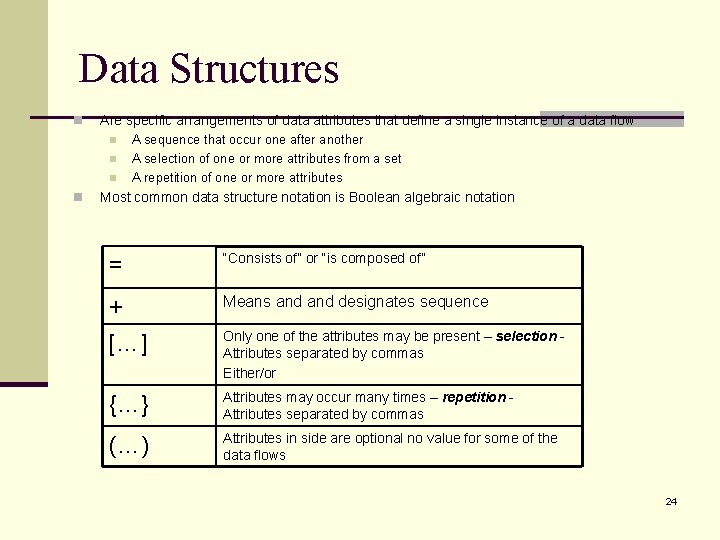
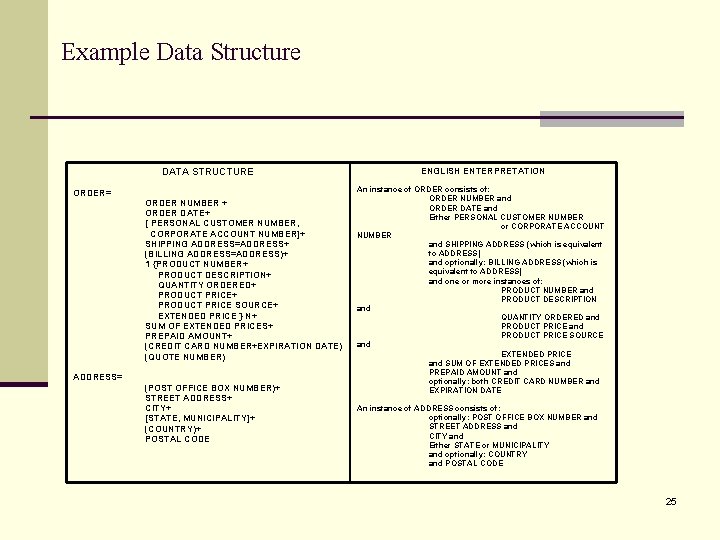
Data Structures n Are specific arrangements of data attributes that define a single instance of a data flow n n A sequence that occur one after another A selection of one or more attributes from a set A repetition of one or more attributes Most common data structure notation is Boolean algebraic notation = “Consists of” or “is composed of” + […] Means and designates sequence {…} Attributes may occur many times – repetition Attributes separated by commas (…) Attributes in side are optional no value for some of the data flows Only one of the attributes may be present – selection Attributes separated by commas Either/or 24
Example Data Structure DATA STRUCTURE ORDER= ORDER NUMBER + ORDER DATE+ [ PERSONAL CUSTOMER NUMBER, CORPORATE ACCOUNT NUMBER]+ SHIPPING ADDRESS=ADDRESS+ (BILLING ADDRESS=ADDRESS)+ 1 {PRODUCT NUMBER+ PRODUCT DESCRIPTION+ QUANTITY ORDERED+ PRODUCT PRICE SOURCE+ EXTENDED PRICE } N+ SUM OF EXTENDED PRICES+ PREPAID AMOUNT+ (CREDIT CARD NUMBER+EXPIRATION DATE) (QUOTE NUMBER) ADDRESS= (POST OFFICE BOX NUMBER)+ STREET ADDRESS+ CITY+ [STATE, MUNICIPALITY]+ (COUNTRY)+ POSTAL CODE ENGLISH ENTERPRETATION An instance of ORDER consists of: ORDER NUMBER and ORDER DATE and Either PERSONAL CUSTOMER NUMBER or CORPORATE ACCOUNT NUMBER and SHIPPING ADDRESS (which is equivalent to ADDRESS) and optionally: BILLING ADDRESS (which is equivalent to ADDRESS) and one or more instances of: PRODUCT NUMBER and PRODUCT DESCRIPTION and QUANTITY ORDERED and PRODUCT PRICE SOURCE and EXTENDED PRICE and SUM OF EXTENDED PRICES and PREPAID AMOUNT and optionally: both CREDIT CARD NUMBER and EXPIRATION DATE An instance of ADDRESS consists of: optionally: POST OFFICE BOX NUMBER and STREET ADDRESS and CITY and Either STATE or MUNICIPALITY and optionally: COUNTRY and POSTAL CODE 25
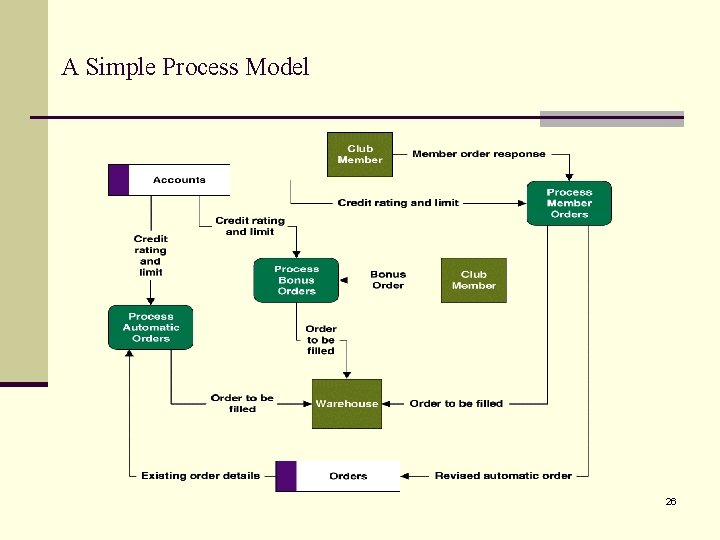
A Simple Process Model 26
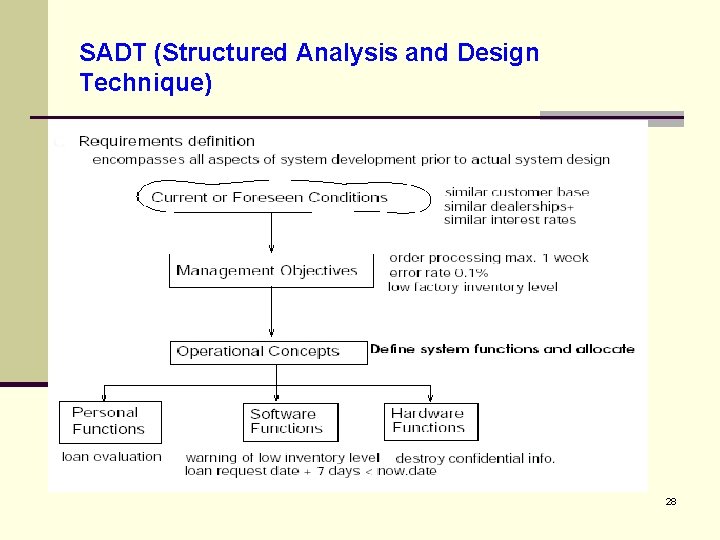
Traditional Approaches to Enterprise Modeling SADT (Structured Analysis and Design Technique) • Background • in use since the mid-seventies • inspiration for many commercial tools • (DFD? )trademark of Softech, Inc. • View • "System" refers to any enterprise/organization, physical, manufacturing, and SW system • Context Analysis should involve • technical assessment: feasibility of system architecture • Are the components and inter-relationships technically realizable? • operational assessment: system performance in a working environment • Can the system perform task X in less than a week of time? • economic assessment: costs & impacts of system implementation & use • Can the system be built with $20 M, 1000 SE’s, in 2 yrs? 27
SADT (Structured Analysis and Design Technique) 28
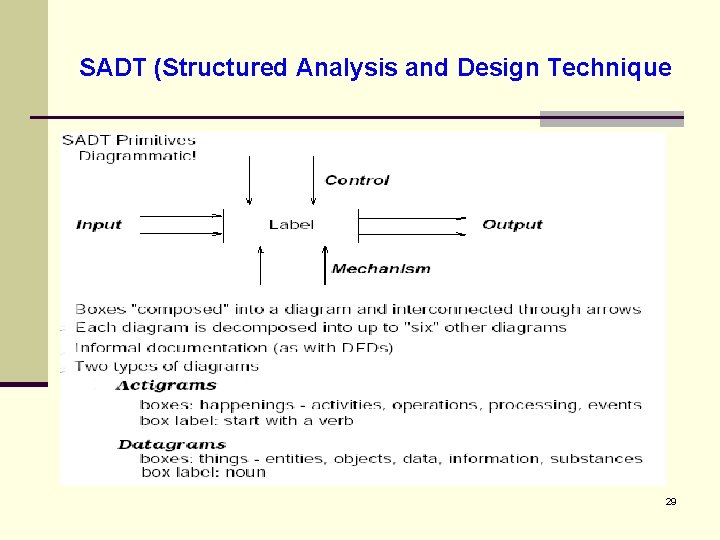
SADT (Structured Analysis and Design Technique 29
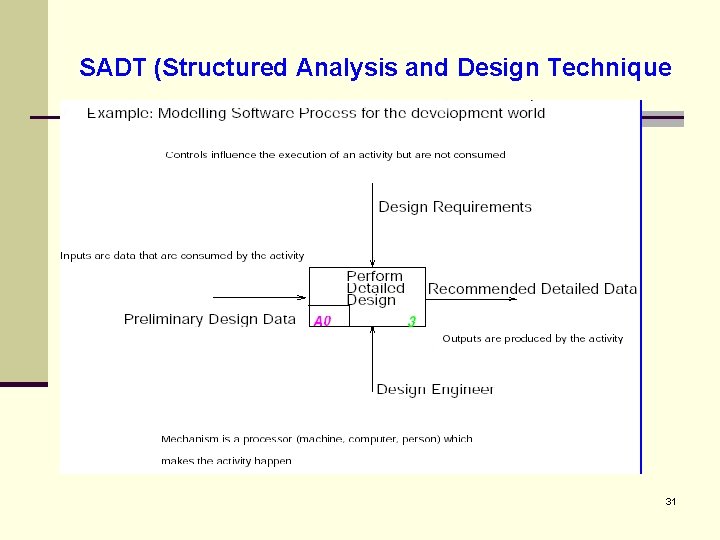
SADT (Structured Analysis and Design Technique Semantics of Arrows In an actigram • Inputs are data that are consumed by the activity • Outputs are produced by the activity • Controls influence the execution of an activity but are not consumed • Mechanism is a processor (machine, computer, person) which makes the activity happen 30
SADT (Structured Analysis and Design Technique 31
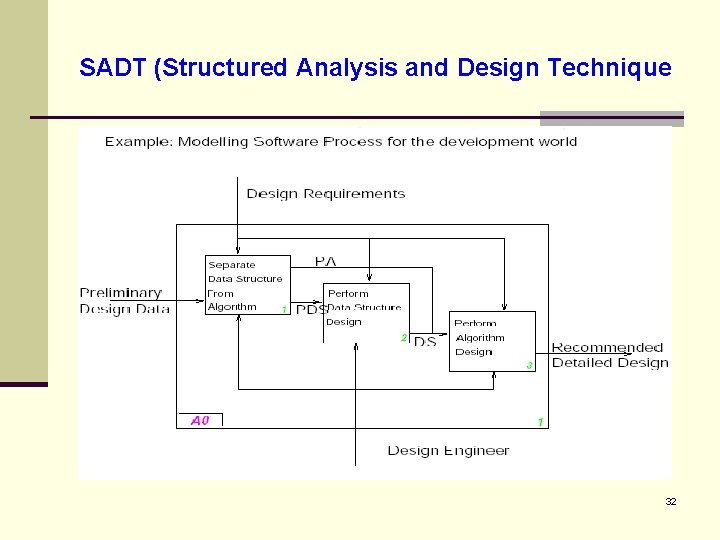
SADT (Structured Analysis and Design Technique 32
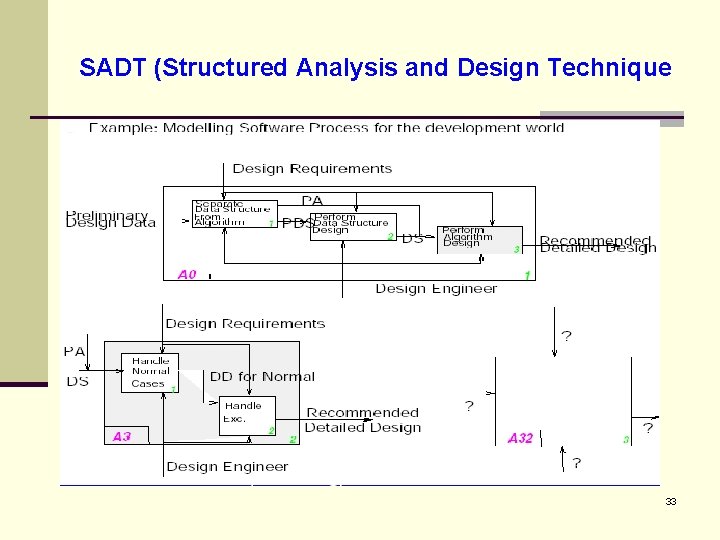
SADT (Structured Analysis and Design Technique 33
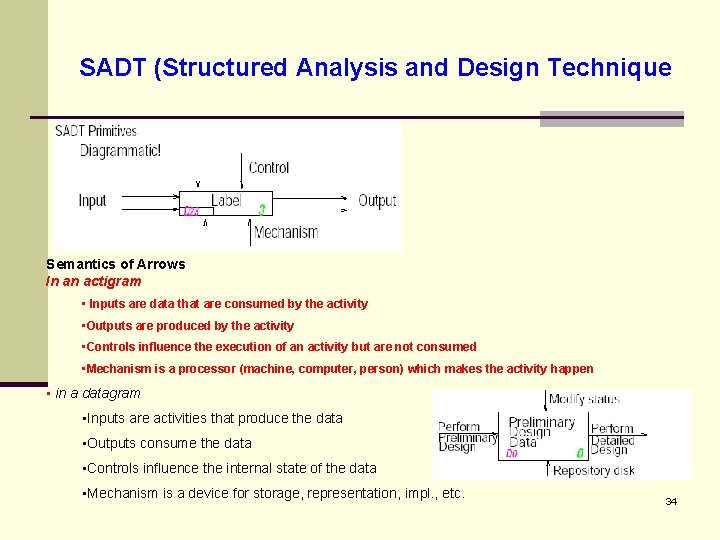
SADT (Structured Analysis and Design Technique Semantics of Arrows In an actigram • Inputs are data that are consumed by the activity • Outputs are produced by the activity • Controls influence the execution of an activity but are not consumed • Mechanism is a processor (machine, computer, person) which makes the activity happen • in a datagram • Inputs are activities that produce the data • Outputs consume the data • Controls influence the internal state of the data • Mechanism is a device for storage, representation, impl. , etc. 34
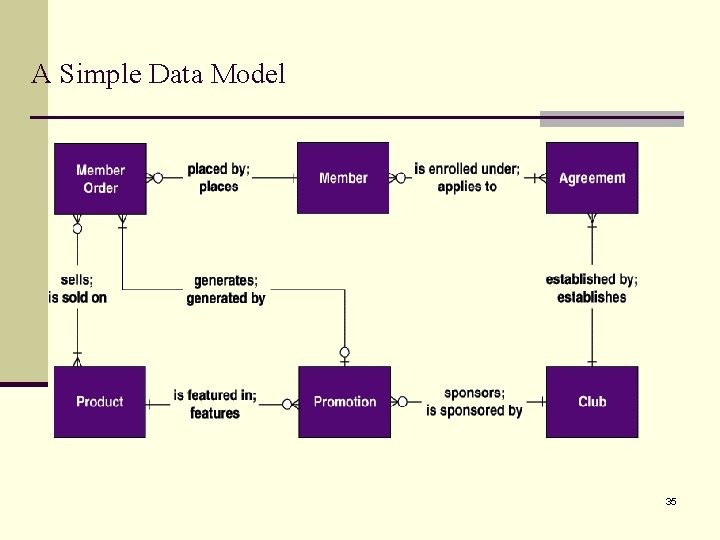
A Simple Data Model 35
FUNCTION MODELING USING IDEF-0 A Function Model is a Representation of the Activities and Relationships Between Activities in an Existing or Planned System. 36
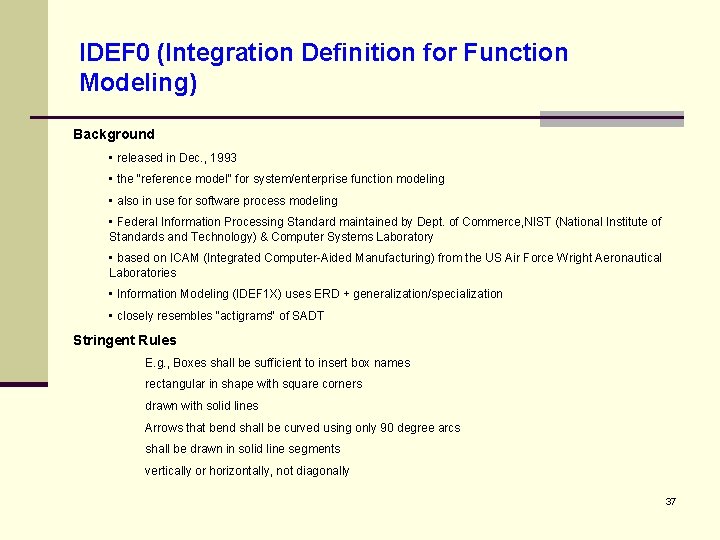
IDEF 0 (Integration Definition for Function Modeling) Background • released in Dec. , 1993 • the "reference model" for system/enterprise function modeling • also in use for software process modeling • Federal Information Processing Standard maintained by Dept. of Commerce, NIST (National Institute of Standards and Technology) & Computer Systems Laboratory • based on ICAM (Integrated Computer-Aided Manufacturing) from the US Air Force Wright Aeronautical Laboratories • Information Modeling (IDEF 1 X) uses ERD + generalization/specialization • closely resembles "actigrams" of SADT Stringent Rules E. g. , Boxes shall be sufficient to insert box names rectangular in shape with square corners drawn with solid lines Arrows that bend shall be curved using only 90 degree arcs shall be drawn in solid line segments vertically or horizontally, not diagonally 37
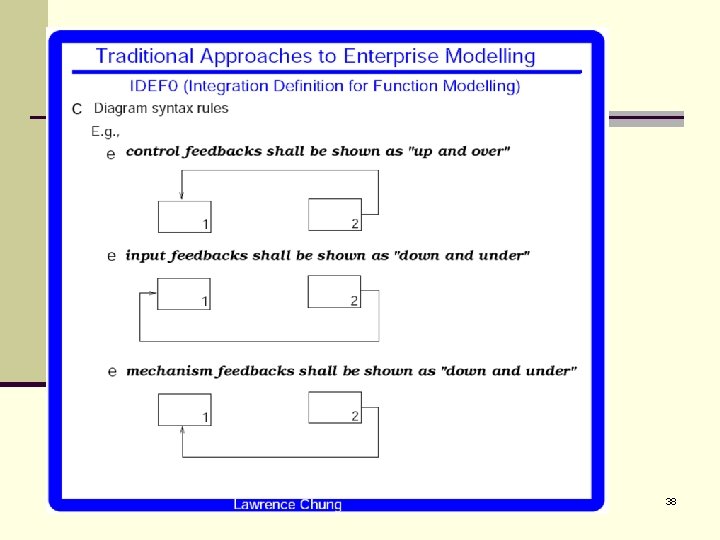
38
Terminology of IDEFØ n Functions and activities n Diagrams, Boxes, and Arrows n ICOMs: Inputs, Controls, Outputs, and Mechanisms n Arrows, links, relationships, and concepts n Splits, Joins, Unbundling, Bundling, and Branching n Decompositions n Viewpoint, Purpose, and Context n NIST (FIPS ) standard 39
What is IDEFØ? n An IDEF method for modeling functions n n Graphics (diagrams) Text (glossary & narrative) n Provides both a process and a language for constructing a model of the decisions, actions, and activities in an organization 40
What is an IDEFØ Model? n A definition of activities and information n Within a particular Context Having a consistent Viewpoint For a particular Purpose n Series of diagrams (that decompose a subject into manageable chunks) n A foundation for requirements specification, design, and programming n A useful record throughout the life-cycle of an enterprise 41
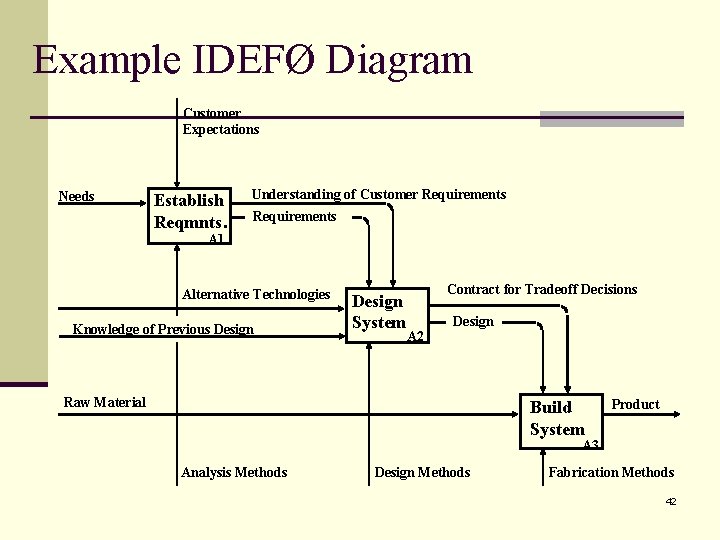
Example IDEFØ Diagram Customer Expectations Needs Establish Reqmnts. Understanding of Customer Requirements A 1 Alternative Technologies Knowledge of Previous Design System Contract for Tradeoff Decisions A 2 Design Raw Material Build System Product A 3 Analysis Methods Design Methods Fabrication Methods 42
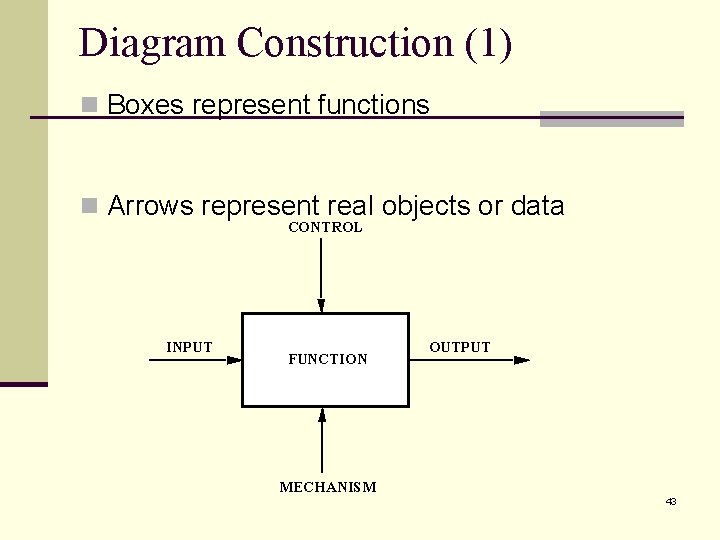
Diagram Construction (1) n Boxes represent functions n Arrows represent real objects or data CONTROL INPUT FUNCTION OUTPUT MECHANISM 43
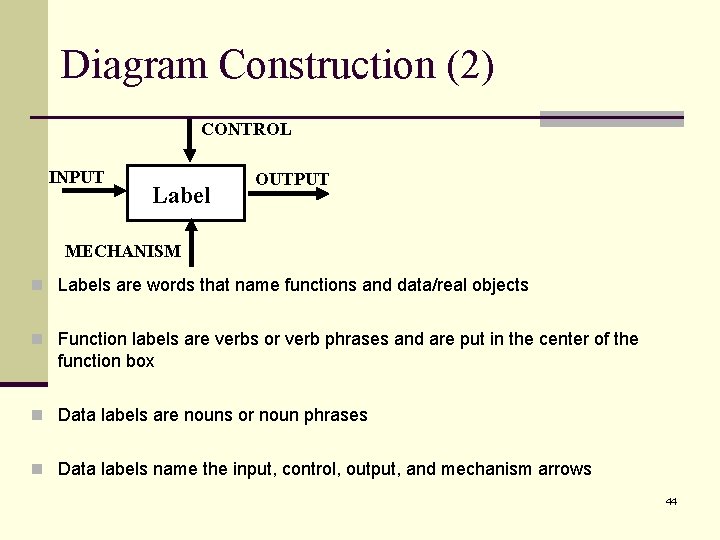
Diagram Construction (2) CONTROL INPUT Label OUTPUT MECHANISM n Labels are words that name functions and data/real objects n Function labels are verbs or verb phrases and are put in the center of the function box n Data labels are nouns or noun phrases n Data labels name the input, control, output, and mechanism arrows 44
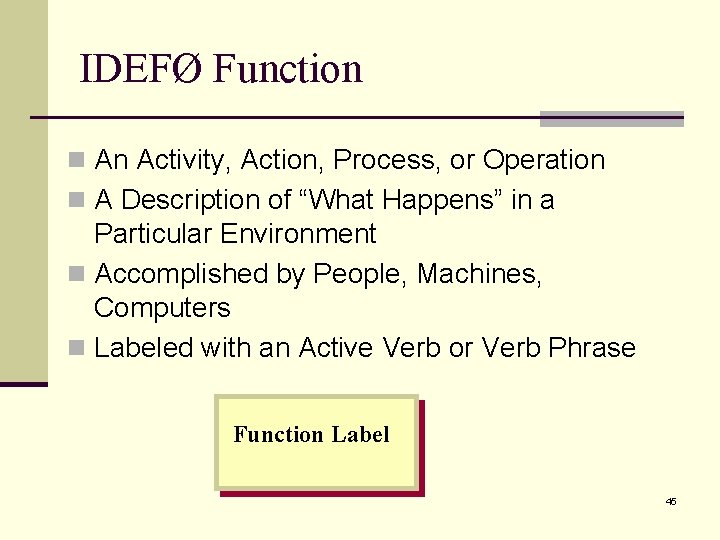
IDEFØ Function n An Activity, Action, Process, or Operation n A Description of “What Happens” in a Particular Environment n Accomplished by People, Machines, Computers n Labeled with an Active Verb or Verb Phrase Function Label 45
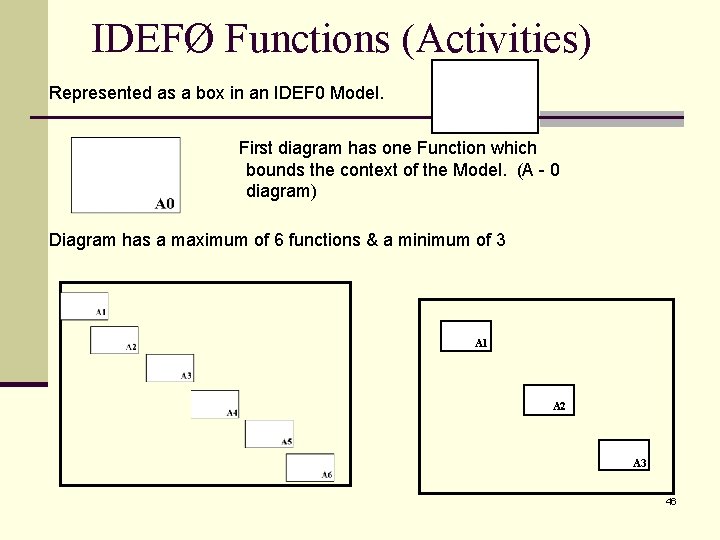
IDEFØ Functions (Activities) Represented as a box in an IDEF 0 Model. First diagram has one Function which bounds the context of the Model. (A - 0 diagram) Diagram has a maximum of 6 functions & a minimum of 3 A 1 A 2 A 3 46
IDEFØ Relationships (Between Functions) n Represented as arrows n AKA concepts n Real objects, data, people, machines, and computers 47
ICOMs n Inputs n Controls n Outputs n Mechanisms 48
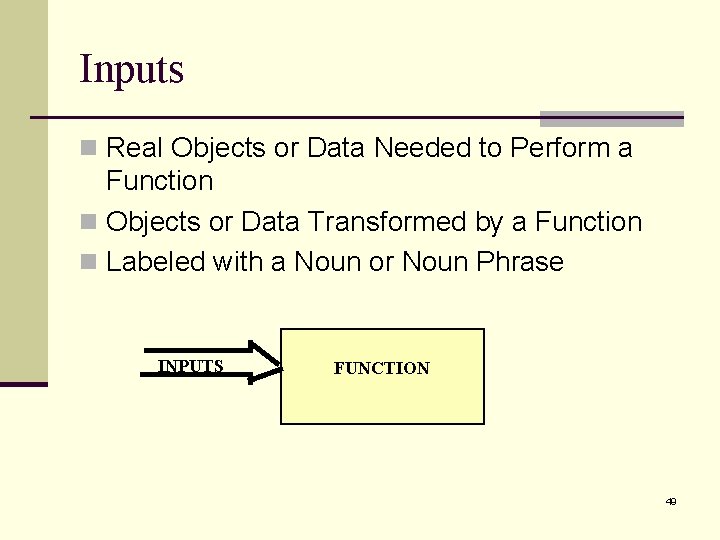
Inputs n Real Objects or Data Needed to Perform a Function n Objects or Data Transformed by a Function n Labeled with a Noun or Noun Phrase INPUTS FUNCTION 49
Output n Objects or Data Produced as a Result of the Function n Labeled with a Noun or Noun Phrase INPUTS FUNCTION OUTPUTS 50
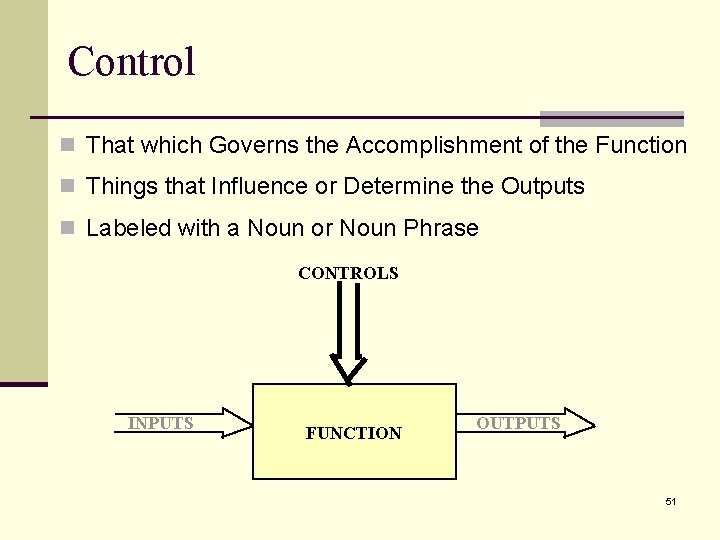
Control n That which Governs the Accomplishment of the Function n Things that Influence or Determine the Outputs n Labeled with a Noun or Noun Phrase CONTROLS INPUTS FUNCTION OUTPUTS 51
Mechanism n Person, Device, or Data which Carries out the Function n The Means by which the Function is Performed n Labeled with a Noun or Noun Phrase CONTROLS INPUTS FUNCTIO N MECHANISMS OUTPUTS 52
Box and Arrow Relations in a Diagram (Join) FEED BACK OUTPUT TO CONTROL OUTPUT TO INPUTS INPUT 1 OUTPUT TO CONTROL ARROWS BRANCHING (Split) 2 3 OUTPUT TO MECHANISM 53
Arrows: "Branching" Output can branch and be used by two functions simultaneously or sequentially OUTPUT DATA 1 ONCE THIS DATA IS SUPPLIED, FUNCTIONS 2 & 3 CAN OPERATE SIMULTANEOUSLY OR SEQUENTIALLY 2 3 Without labels we cannot tell how the branching occurs 54
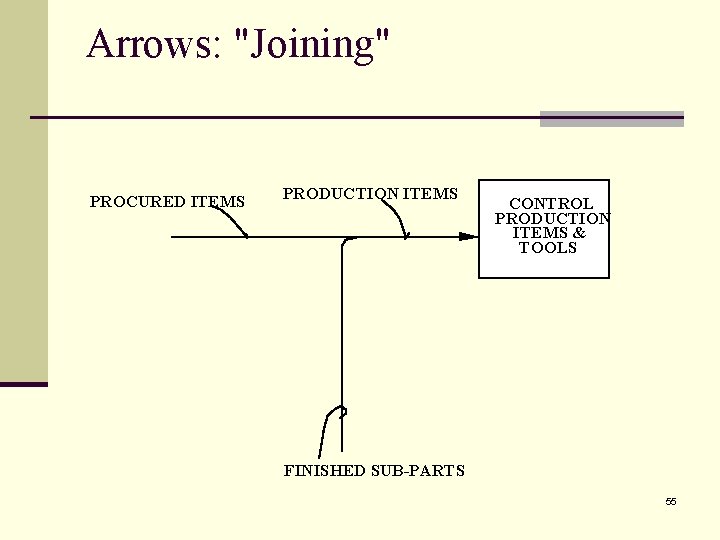
Arrows: "Joining" PROCURED ITEMS PRODUCTION ITEMS CONTROL PRODUCTION ITEMS & TOOLS FINISHED SUB-PARTS 55
Arrows: "Feedback" COMMENTS SYSTEM REQUIREMENTS DRAFT SPECIFICATIONS DESIGN REVIEW DRAFT SPECIFICATION WITH DESIGN CHANGES APPROVED DESIGN 56
Bundling and Unbundling Bundle: Concepts B and C are bundled to form concept A. C B A Unbundle: Concept A is unbundled into concepts B and C. A B C 57
Bundles and Unbundles Unbundle Management Directives Keep Records A 1 Orders Bundle Files Customer Records Deliver Products Account Entries Transaction Entries A 2 Transactions Prices &Tax Tables Perform Billing A 3 Billing Entries Invoices Files = Customer Records + Price & Tax Tables Account Entries = Transaction Entries + Billing Entries 58
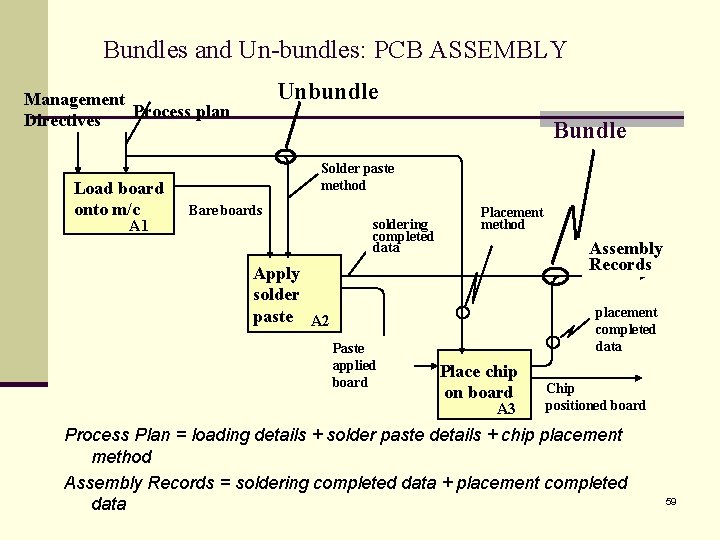
Bundles and Un-bundles: PCB ASSEMBLY Unbundle Management Process plan Directives Load board onto m/c A 1 Bundle Solder paste method Bare boards soldering completed data Placement method Assembly Records Apply solder paste A 2 Paste applied board placement completed data Place chip on board A 3 Chip positioned board Process Plan = loading details + solder paste details + chip placement method Assembly Records = soldering completed data + placement completed data 59
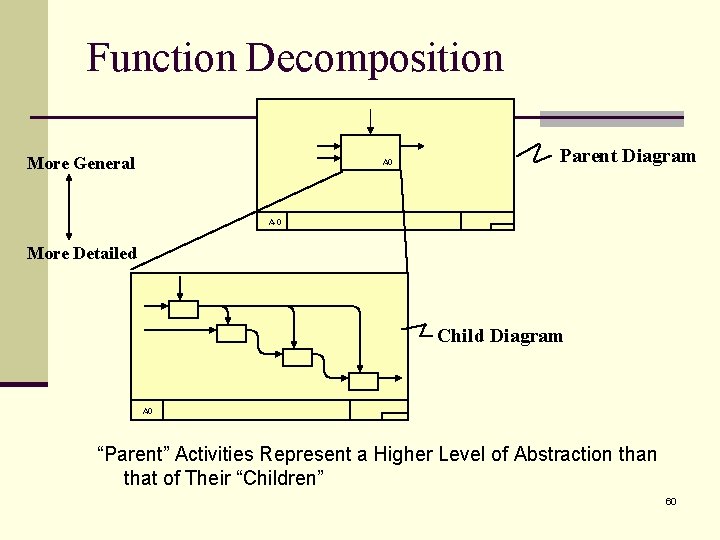
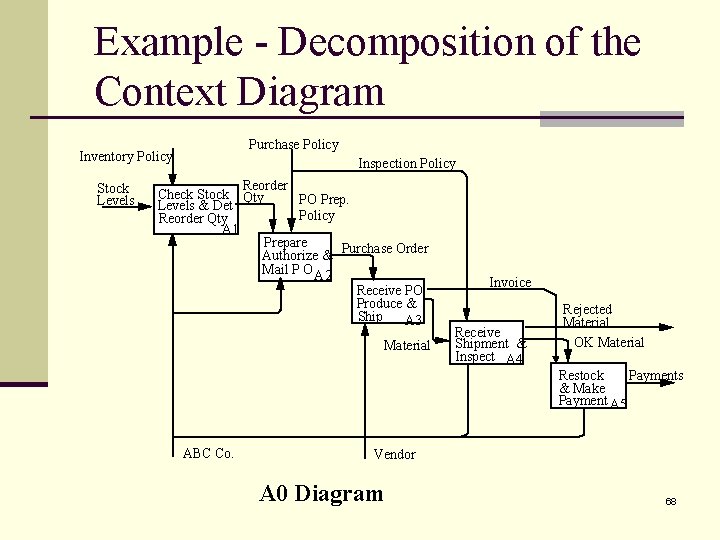
Function Decomposition More General A 0 Parent Diagram A-0 More Detailed A 1 Child Diagram A 2 A 3 A 4 A 0 “Parent” Activities Represent a Higher Level of Abstraction that of Their “Children” 60
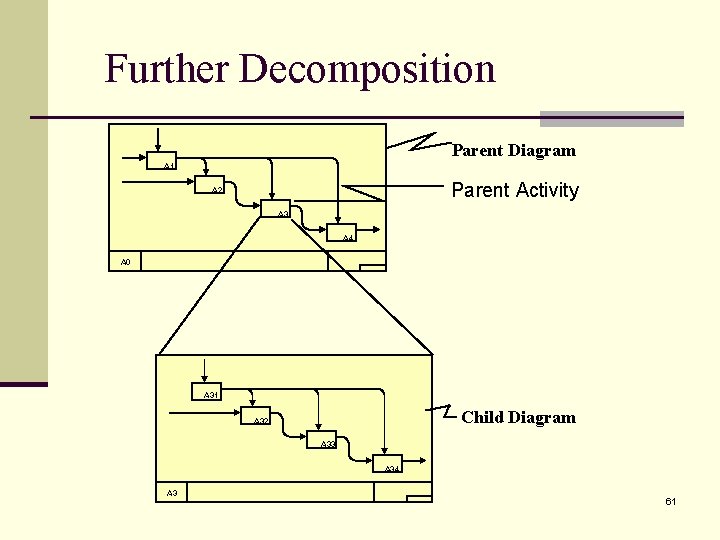
Further Decomposition Parent Diagram A 1 Parent Activity A 2 A 3 A 4 A 0 A 31 Child Diagram A 32 A 33 A 34 A 3 61
Decomposition n Establishes model hierarchy n Functions are comprised of other functions n Decompositions is a process of breaking down of the functions (level-by-level) n Data consistency is required throughout the level-by-level decomposition breakdown 62
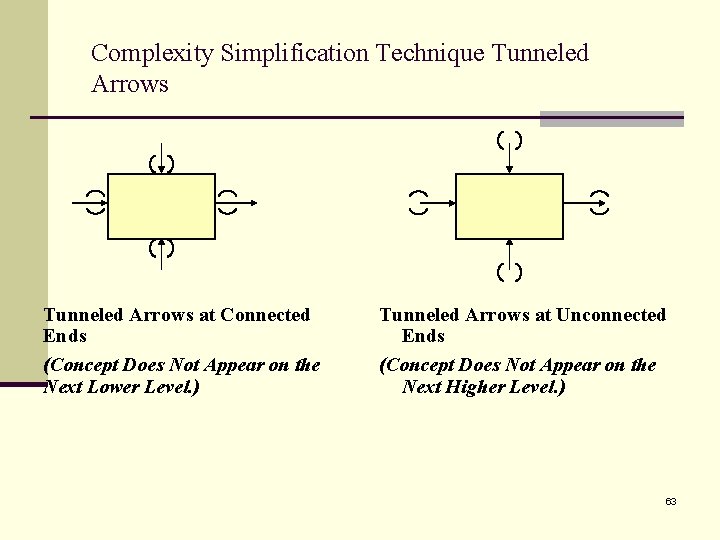
Complexity Simplification Technique Tunneled Arrows at Connected Ends (Concept Does Not Appear on the Next Lower Level. ) Tunneled Arrows at Unconnected Ends (Concept Does Not Appear on the Next Higher Level. ) 63
Tunneling Example This control will not appear on child diagram. This control will still be designated as C 3 on child diagram. A 0 Parent Diagram A-0 C 1 I 1 This output will not be shown on parent diagram. C 3 A 1 A 2 A 3 A 0 O 1 Child Diagram 64
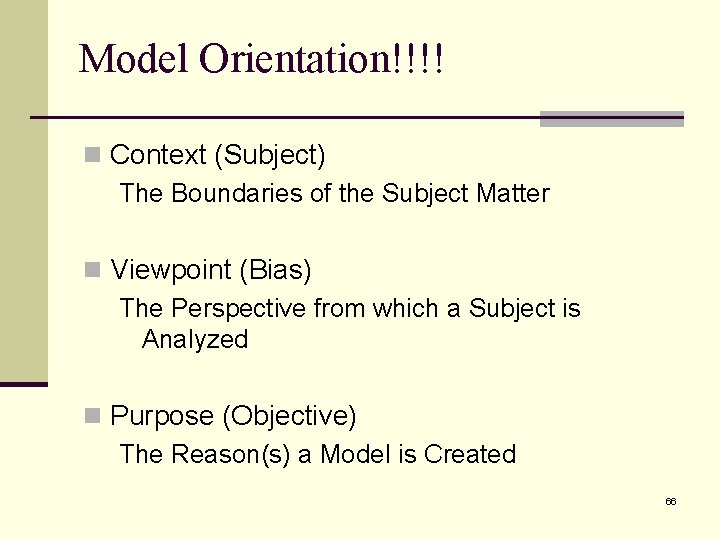
Steps in Building a Model n 1. Define Viewpoint, Purpose, and Context n 2. Develop the Context Diagram (Putting the situation in context) n 3. Decompose activities to fit scope of modeling task (complete modeling per rules, etc) n 4. Develop glossary 65
Model Orientation!!!! n Context (Subject) The Boundaries of the Subject Matter n Viewpoint (Bias) The Perspective from which a Subject is Analyzed n Purpose (Objective) The Reason(s) a Model is Created 66
Example - Context Diagram Inventory Policy Purchase policy Stock Levels Acquire Materials A 0 Payments Rejected Materials Vendor ABC Co. A-0 Diagram 67
Example - Decomposition of the Context Diagram Purchase Policy Inventory Policy Stock Levels Inspection Policy Reorder Check Stock Qty PO Prep. Levels & Det Policy Reorder Qty A 1 Prepare Purchase Order Authorize & Mail P O A 2 Receive PO Produce & Ship A 3 Material Invoice Receive Shipment & Inspect A 4 Rejected Material OK Material Payments Restock & Make Payment A 5 ABC Co. Vendor A 0 Diagram 68
Function Model for Planning and Implementing a Feature Extraction module n Purpose: To obtain a better understanding of the various tasks involved in planning and implementation of a feature extraction module n Context: We will assume CAD model formats, process planning requirements and resources available (people and computers) are known. The FE module will be built using available existing resources (no new tools or software will be purchased). n Viewpoint: that of an industrial / mfg engineer who has a background in designing / building software systems 69