
Requirements Determination Penentuan Kebutuhan Tujuan Memahami bagaimana cara
Requirements Determination (Penentuan Kebutuhan)
Tujuan Memahami bagaimana cara mendefinisikan kebutuhan (requirement) ? l Mampu menerapkan teknis analisa kebutuhan l Mengetahui macam-macam teknik pengumpulan kebutuhan l Slide 2
Kebutuhan (Requirements) Requirement determination merupakan tahap penting pada SDLC karena merupakan awalan pembangunan sistem. l A requirement menyatakan apa saja yang harus mampu dilakukan sistem atau karakteristik seperti apa yang harus dimiliki sistem. l Identifikasi kebutuhan dilakukan dari perspektif pengguna. l Fokus pada “what” dari sistem & kebutuhan user. l Slide 3
Functional Requirement Is a process the system has to perform or information it needs to contain l These requirements are the technical specifications, system design parameters and guidelines, data manipulation, data processing, and calculation modules etc, of the proposed system. l Slide 4
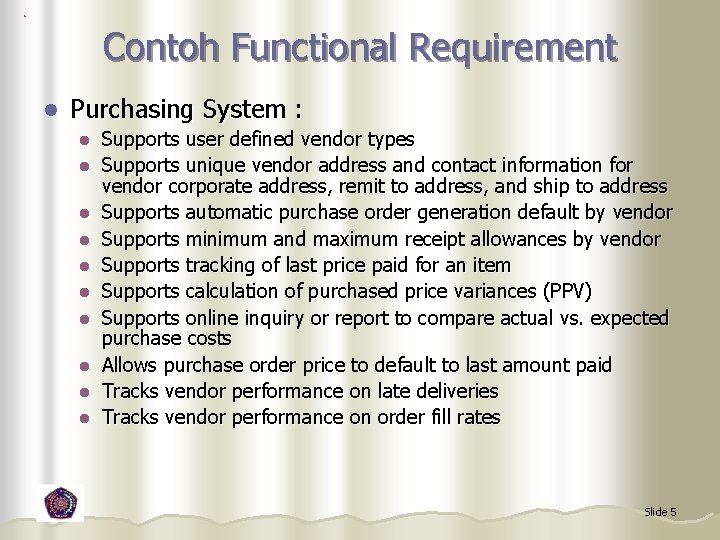
Contoh Functional Requirement l Purchasing System : l l l l l Supports user defined vendor types Supports unique vendor address and contact information for vendor corporate address, remit to address, and ship to address Supports automatic purchase order generation default by vendor Supports minimum and maximum receipt allowances by vendor Supports tracking of last price paid for an item Supports calculation of purchased price variances (PPV) Supports online inquiry or report to compare actual vs. expected purchase costs Allows purchase order price to default to last amount paid Tracks vendor performance on late deliveries Tracks vendor performance on order fill rates Slide 5
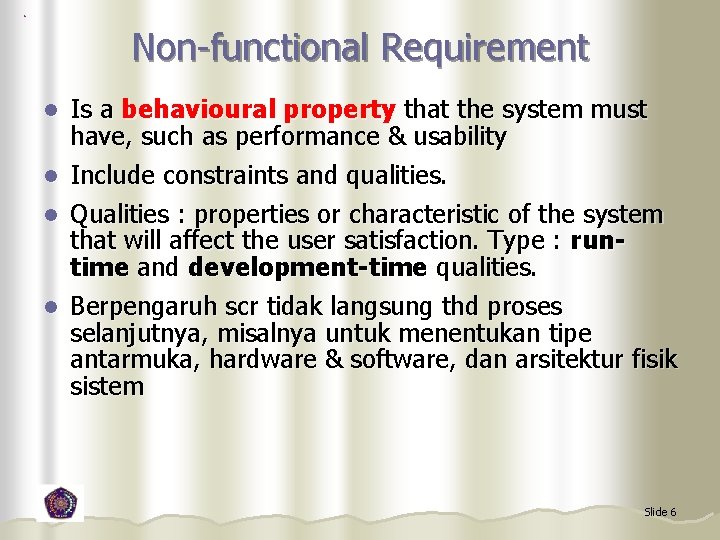
Non-functional Requirement l l Is a behavioural property that the system must have, such as performance & usability Include constraints and qualities. Qualities : properties or characteristic of the system that will affect the user satisfaction. Type : runtime and development-time qualities. Berpengaruh scr tidak langsung thd proses selanjutnya, misalnya untuk menentukan tipe antarmuka, hardware & software, dan arsitektur fisik sistem Slide 6
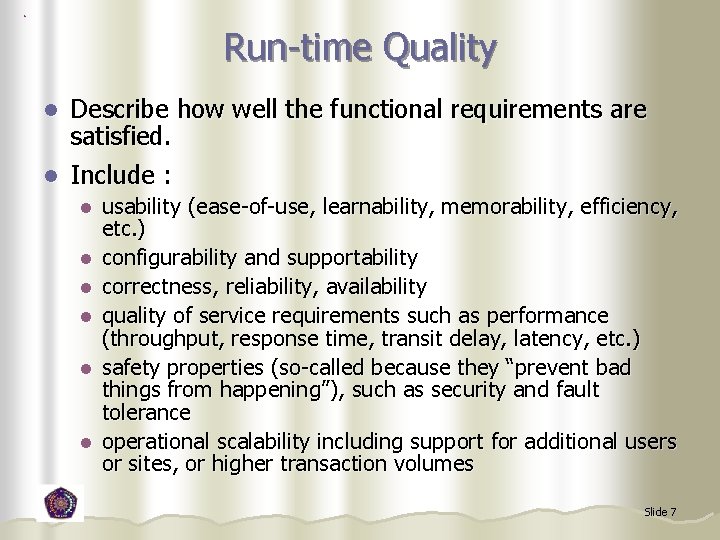
Run-time Quality Describe how well the functional requirements are satisfied. l Include : l l l l usability (ease-of-use, learnability, memorability, efficiency, etc. ) configurability and supportability correctness, reliability, availability quality of service requirements such as performance (throughput, response time, transit delay, latency, etc. ) safety properties (so-called because they “prevent bad things from happening”), such as security and fault tolerance operational scalability including support for additional users or sites, or higher transaction volumes Slide 7
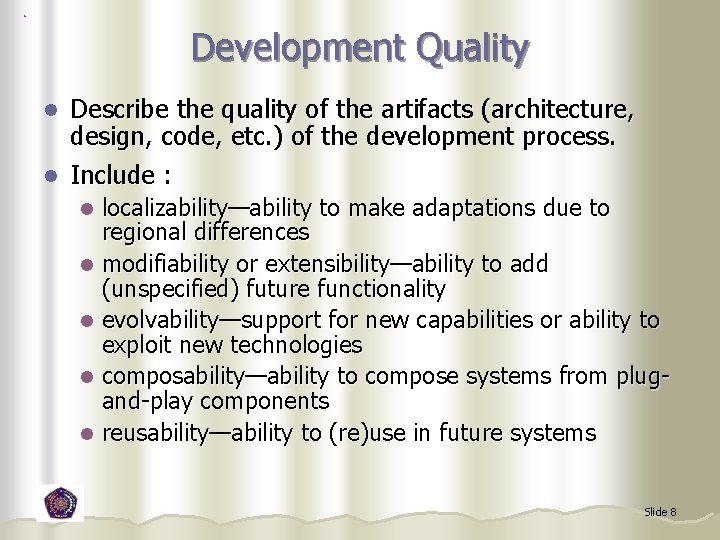
Development Quality Describe the quality of the artifacts (architecture, design, code, etc. ) of the development process. l Include : l localizability—ability to make adaptations due to regional differences l modifiability or extensibility—ability to add (unspecified) future functionality l evolvability—support for new capabilities or ability to exploit new technologies l composability—ability to compose systems from plugand-play components l reusability—ability to (re)use in future systems l Slide 8
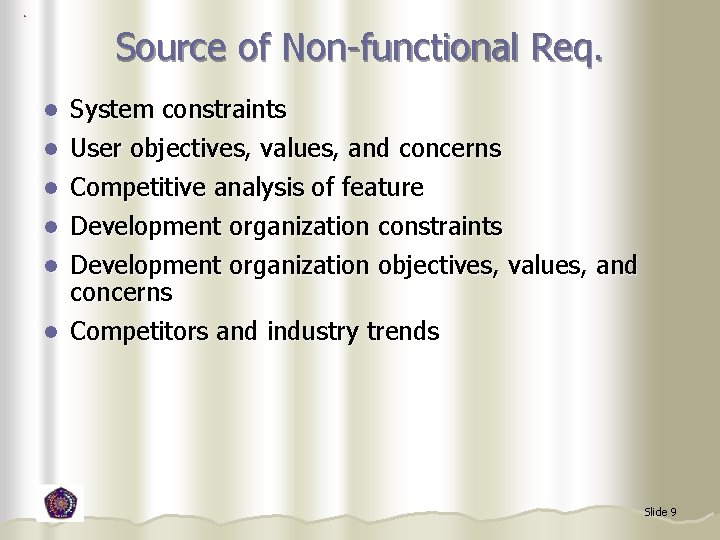
Source of Non-functional Req. System constraints l User objectives, values, and concerns l l l Competitive analysis of feature Development organization constraints Development organization objectives, values, and concerns Competitors and industry trends Slide 9
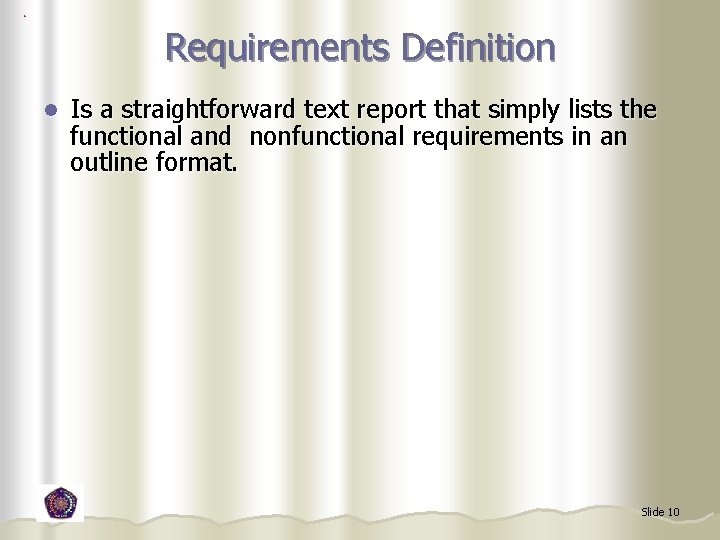
Requirements Definition l Is a straightforward text report that simply lists the functional and nonfunctional requirements in an outline format. Slide 10
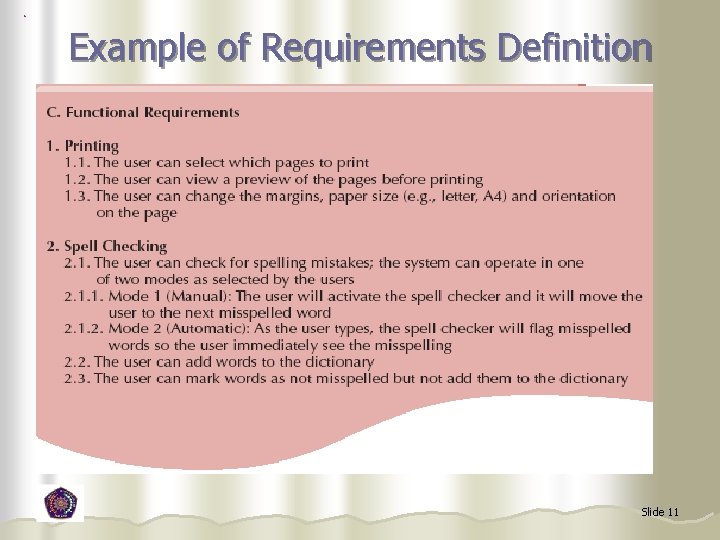
Example of Requirements Definition Slide 11
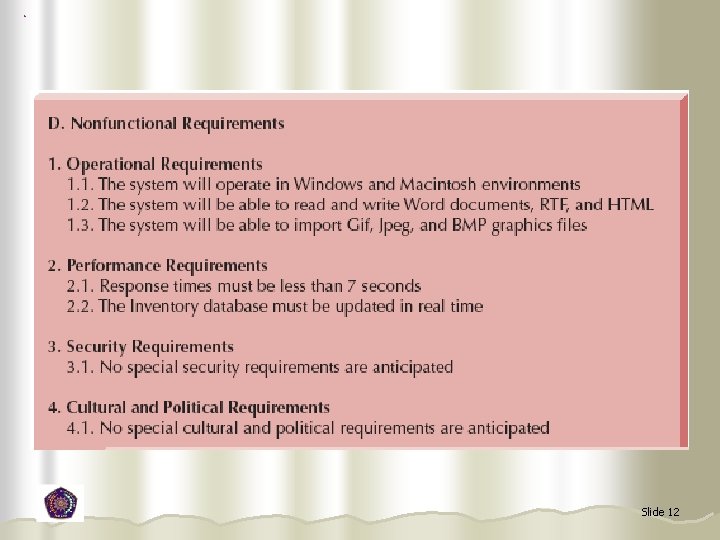
Slide 12
Exercise Tentukan mana yang tmsk kebutuhan functional & non -functional : l Sistem harus mampu : 1. 2. 3. 4. 5. 6. 7. 8. 9. 10. Diakses oleh pengguna web Mencantumkan logo dan theme warna perusahaan Membatasi akses pada informasi tertentu Menampilkan informasi biaya aktual dan anggaran Menyediakan laporan manajemen Menyimpan informasi penjualan yang diperbarui setidaknya sehari sekali Waktu respon untuk pre-defined query adalah max. 2 detik, sedangkan untuk ad-hoc query max. 10 menit Mencantumkan informasi dari seluruh anak perusahaan Mencetak laporan tiap cabang sesuai dengan jenis bahasa yang umum digunakan di tiap cabang Menyediakan rangking untuk kinerja staf penjualan Slide 13
Requirements Analysis Techniques l Basic process of analysis : understanding the as-is system l identifying improvements l developing requirements for the to-be system l l Drives the kind of information that is gathered and how it is ultimately analyzed. Slide 14
Determining Requirements l 3 macam teknik : Business Process Automation (BPA) l Business Process Improvement (BPI) l Business Process Reengineering (BPR) l l Those techniques : help users critically examine the current state of systems and processes (the as-is system) l identify exactly what needs to change l develop a concept for a new system (the to-be system) l Slide 15
Business Process Automation l Means : leaving the basic way in which the organization operates unchanged l using computer technology to do some of the work l l Two techniques : l Problem analysis l asking the business users to identify problems with the as-is system and to describe how to solve them l focus on the problems l Root cause analysis l identifying the root cause l focus on the solutions of the problems Slide 16
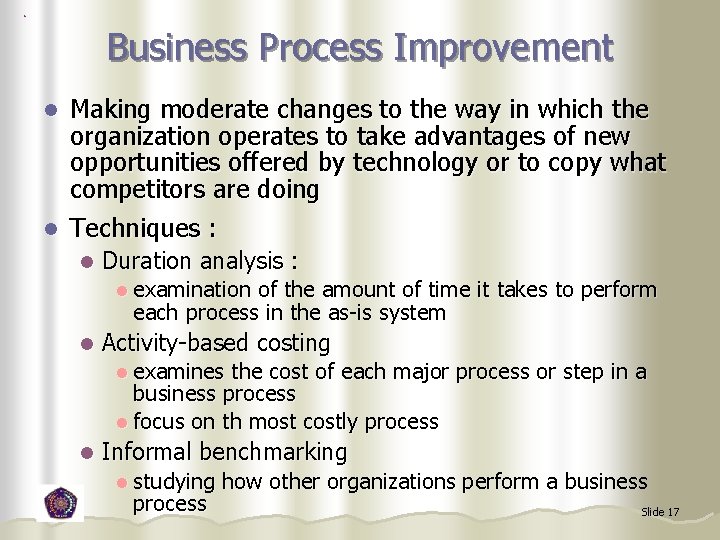
Business Process Improvement Making moderate changes to the way in which the organization operates to take advantages of new opportunities offered by technology or to copy what competitors are doing l Techniques : l l Duration analysis : l examination of the amount of time it takes to perform each process in the as-is system l Activity-based costing l examines the cost of each major process or step in a business process l focus on th most costly process l Informal benchmarking l studying process how other organizations perform a business Slide 17
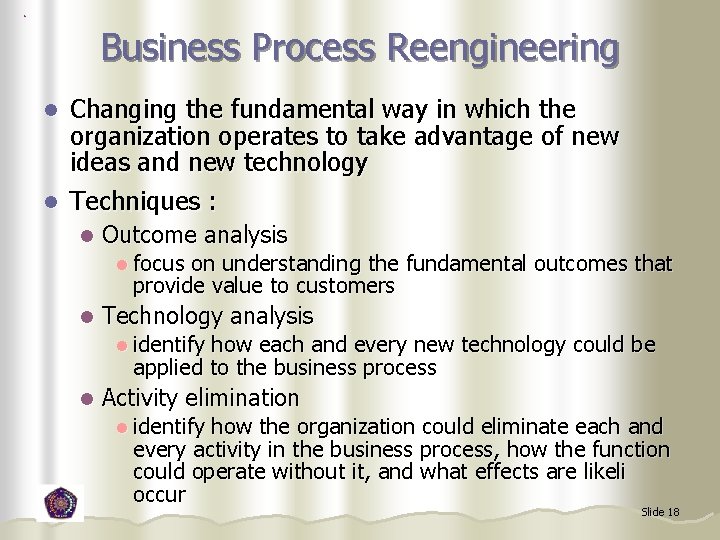
Business Process Reengineering Changing the fundamental way in which the organization operates to take advantage of new ideas and new technology l Techniques : l l Outcome analysis l focus on understanding the fundamental outcomes that provide value to customers l Technology analysis l identify how each and every new technology could be applied to the business process l Activity elimination l identify how the organization could eliminate each and every activity in the business process, how the function could operate without it, and what effects are likeli occur Slide 18
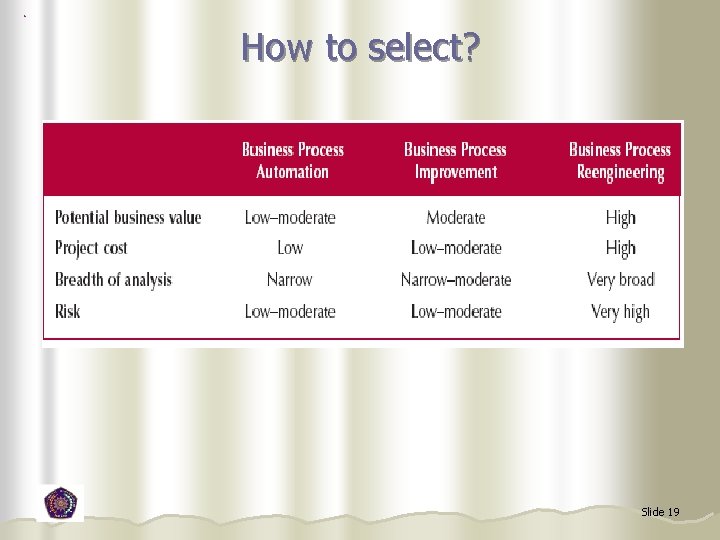
How to select? Slide 19
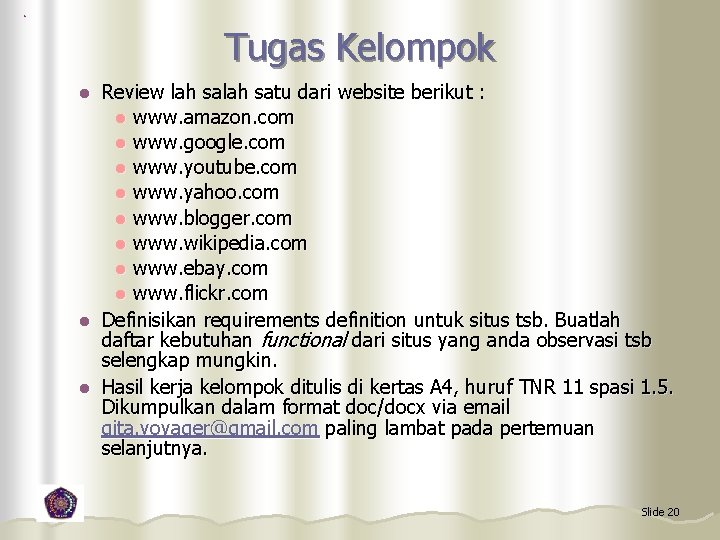
Tugas Kelompok Review lah satu dari website berikut : l www. amazon. com l www. google. com l www. youtube. com l www. yahoo. com l www. blogger. com l www. wikipedia. com l www. ebay. com l www. flickr. com l Definisikan requirements definition untuk situs tsb. Buatlah daftar kebutuhan functional dari situs yang anda observasi tsb selengkap mungkin. l Hasil kerja kelompok ditulis di kertas A 4, huruf TNR 11 spasi 1. 5. Dikumpulkan dalam format doc/docx via email gita. voyager@gmail. com paling lambat pada pertemuan selanjutnya. l Slide 20
Evaluation (15 Menit-Open Book) l Deskripsikan istilah-istilah berikut : 1. 2. 3. 4. 5. Business process improvement The as-is system Requirement definition functional requirements non-functional requirements Slide 21
Evaluation (15 Menit-Open Book) l Deskripsikan istilah-istilah berikut : 1. 2. 3. 4. 5. Business process reengineering The to-be system Duration analysis functional requirements non-functional requirements Slide 22
Evaluation (15 Menit-Open Book) l Deskripsikan istilah-istilah berikut : 1. 2. 3. 4. 5. Business process automation Problem analysis Activity-based costing functional requirements non-functional requirements Slide 23
References Dennis, Alan, et. al. System Analysis and Design with UML Version 2. 0. John Wiley & Sons, Inc. l http: //www. brighthub. com/office/projectmanagement/articles/12259. aspx l Bredmeyer D. , Malan R. Designing Non-functional Requirements. Bredemeyer Consulting. l Slide 24
- Slides: 24