
Requirements concept and design of uplink symbol structure
Requirements, concept and design of uplink symbol structure for 802. 16 m Document Number: IEEE S 802. 16 m-08/266 Date Submitted: May-05 -2008 Source: Yuval Lomnitz Huaning Niu Jong-kae (JK) Fwu Sassan Ahmadi Hujun Yin Intel Corp. Yuval. Lomnitz@intel. com Huaning. Niu@intel. com Jong-kae. Fwu@intel. com Sassan. Ahmadi@intel. com Hujun. Yin@intel. com Venue: IEEE Session #55, Macau. Base Contributions: This presentation supports four contributions: IEEE C 80216 m-08/266: UL symbol structure design for 802. 16 m -- symbol structure and pilot design IEEE C 80216 m-08/267: UL symbol structure design for 802. 16 m – mixed network support IEEE C 80216 m-08/268: UL symbol structure design for 802. 16 m – tile selection and pilots IEEE C 80216 m-08/269: UL symbol structure design for 802. 16 m – hopping localized transmission to improve TX power Purpose: For discussion as introduction to base contributions Notice: This document does not represent the agreed views of the IEEE 802. 16 Working Group or any of its subgroups. It represents only the views of the participants listed in the “Source(s)” field above. It is offered as a basis for discussion. It is not binding on the contributor(s), who reserve(s) the right to add, amend or withdraw material contained herein. Release: The contributor grants a free, irrevocable license to the IEEE to incorporate material contained in this contribution, and any modifications thereof, in the creation of an IEEE Standards publication; to copyright in the IEEE’s name any IEEE Standards publication even though it may include portions of this contribution; and at the IEEE’s sole discretion to permit others to reproduce in whole or in part the resulting IEEE Standards publication. The contributor also acknowledges and accepts that this contribution may be made public by IEEE 802. 16. Patent Policy: The contributor is familiar with the IEEE-SA Patent Policy and Procedures: <http: //standards. ieee. org/guides/bylaws/sect 6 -7. html#6> and <http: //standards. ieee. org/guides/opman/sect 6. html#6. 3>. Further information is located at <http: //standards. ieee. org/board/pat-material. html> and <http: //standards. ieee. org/board/pat >. 1
Table of Content • Section 1: – 802. 16 m UL symbol structure design -- symbol structure and pilot design. – Supporting material for “IEEE C 80216 m-08/266” • Section 2: – 802. 16 m UL symbol structure: mixed network support (Multiplexing Schemes). – Supporting material for “IEEE C 80216 m-08/267” • Section 3: – 802. 16 m UL symbol structure: Tile selection and pilot design – Supporting material for “IEEE C 80216 m-08/268” • Section 4: – 802. 16 m UL symbol structure: Hopping Localized Allocation to Improve UL Tx Power – Supporting material for “IEEE C 80216 m-08/269” 2
Section 1 802. 16 m UL symbol structure: Symbol Structure and Pilot Design Supporting material for “IEEE C 80216 m-08/266: UL symbol structure design for 802. 16 m” 3
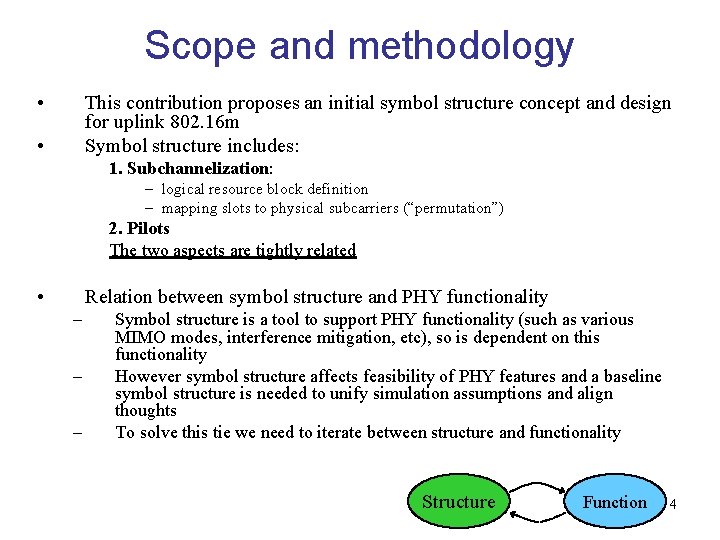
Scope and methodology • This contribution proposes an initial symbol structure concept and design for uplink 802. 16 m Symbol structure includes: • 1. Subchannelization: – logical resource block definition – mapping slots to physical subcarriers (“permutation”) 2. Pilots The two aspects are tightly related • Relation between symbol structure and PHY functionality – – – Symbol structure is a tool to support PHY functionality (such as various MIMO modes, interference mitigation, etc), so is dependent on this functionality However symbol structure affects feasibility of PHY features and a baseline symbol structure is needed to unify simulation assumptions and align thoughts To solve this tie we need to iterate between structure and functionality Structure Function 4
Key points (1) • General Concepts – Design symbol structure to support broadly potential PHY features (FFR, collaborative MIMO, precoding, etc) with considerable flexibility – Based on SRD explicit and derived requirements and trade-offs – Allow flexibility to add future advanced features • Symbol Structure and Resource Blocks – Hierarchical symbol structure for dynamic and effective resource allocation. – Support FDM with 16 e AMC, TDM with 16 e PUSC – Support 3 types of resource allocations: distributed, localized and hopping localized – UL is tile based but with different tiles than 802. 16 e 5
Key points (2) • Pilot Design – Optimize the tradeoff between diversity and pilot efficiency for distributed resources – Optimized for collaborative MIMO as main mode (rather than for SISO), resulting in larger tiles – Reuse the same pilot pattern as DL for localized resources – Support different MIMO modes, # of antennas, and # of streams – Pilot patterns obtained by computer optimization with manual finetuning • Specific SDD texts are proposed for – UL Symbol Structure and general concepts – Various types of UL logical resource blocks – UL Pilot patterns for distributed/localized/hopping localized resources 6
Contents of this contribution • Requirements and tradeoffs • Overview UL resource block and subchannelization • Multiplexing scheme for mixed network support • Tile size selection and pilot optimization for distributed resources • HL OFDMA for power boosting • Review of text proposal 7
Requirements 8
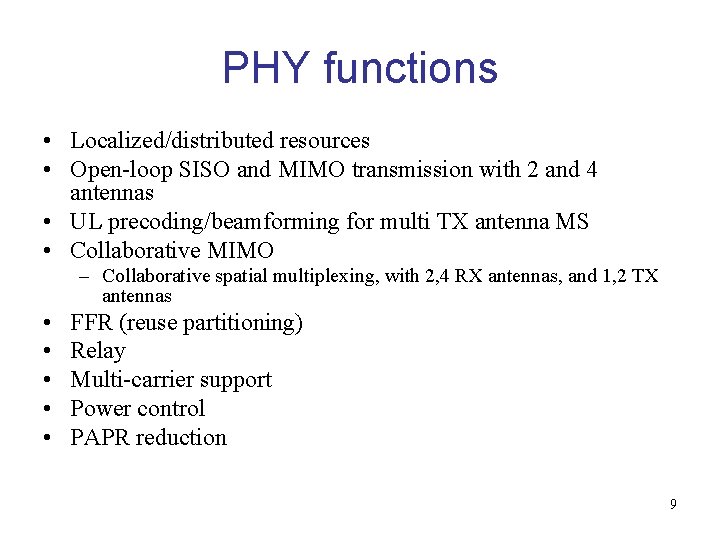
PHY functions • Localized/distributed resources • Open-loop SISO and MIMO transmission with 2 and 4 antennas • UL precoding/beamforming for multi TX antenna MS • Collaborative MIMO – Collaborative spatial multiplexing, with 2, 4 RX antennas, and 1, 2 TX antennas • • • FFR (reuse partitioning) Relay Multi-carrier support Power control PAPR reduction 9
![Derived Requirements and tradeoffs Requirements related to frame structure [7, 8] • Fixed-duration 6](http://slidetodoc.com/presentation_image_h2/5b35ad27d09a8ffe682e692426690a25/image-10.jpg "Derived Requirements and tradeoffs Requirements related to frame structure [7, 8] • Fixed-duration 6")
Derived Requirements and tradeoffs Requirements related to frame structure [7, 8] • Fixed-duration 6 symbol subframe • Multiplexing with 16 e network – Minimize the 16 e link budget and performance loss – Optimize 16 m performance – Desired: Mixed mode should be the superset and greenfield (Wi. MAX 2 only) a subset of this mode 10

Overview of UL Resource Unit and Subchannelization 11
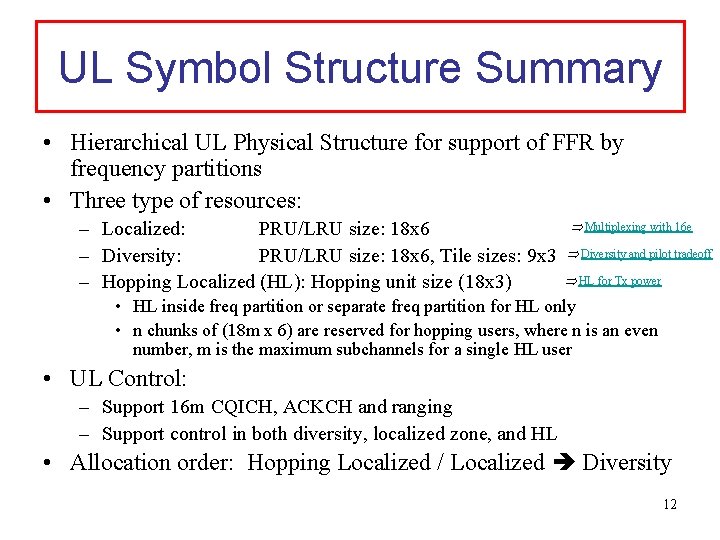
UL Symbol Structure Summary • Hierarchical UL Physical Structure for support of FFR by frequency partitions • Three type of resources: – Localized: PRU/LRU size: 18 x 6 – Diversity: PRU/LRU size: 18 x 6, Tile sizes: 9 x 3 – Hopping Localized (HL): Hopping unit size (18 x 3) Multiplexing with 16 e Diversity and pilot tradeoff HL for Tx power • HL inside freq partition or separate freq partition for HL only • n chunks of (18 m x 6) are reserved for hopping users, where n is an even number, m is the maximum subchannels for a single HL user • UL Control: – Support 16 m CQICH, ACKCH and ranging – Support control in both diversity, localized zone, and HL • Allocation order: Hopping Localized / Localized Diversity 12
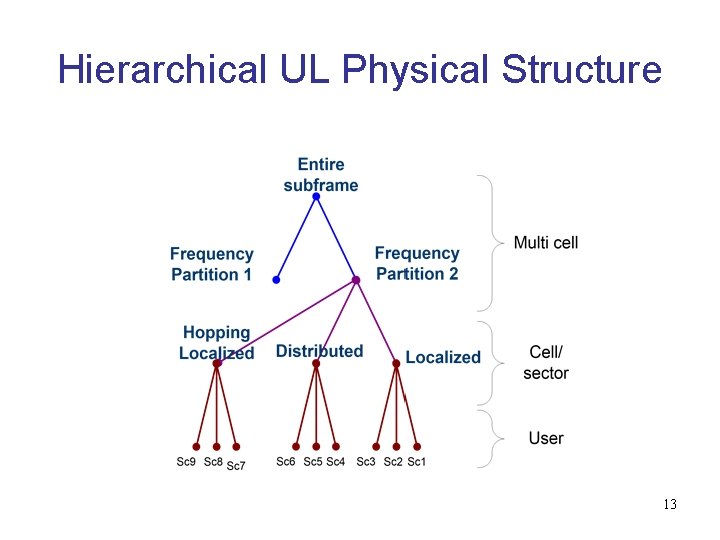
Hierarchical UL Physical Structure 13
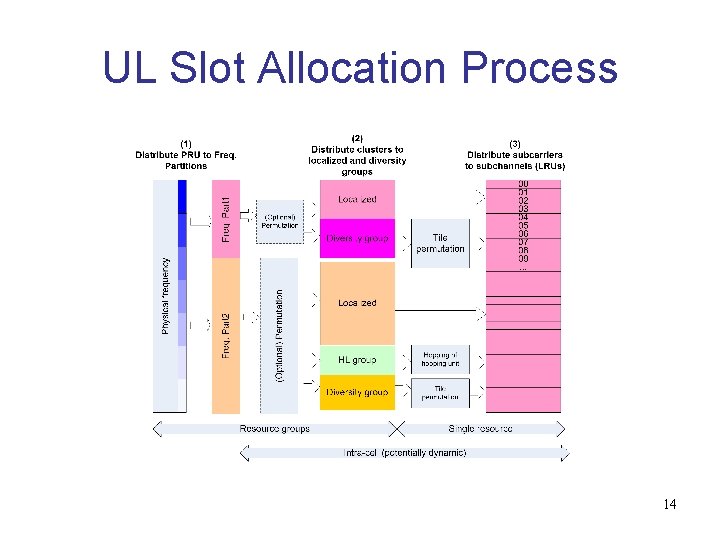
UL Slot Allocation Process 14
UL resource allocation process • The UL PRUs are partitioned into different frequency partitions. • In each frequency partition, distribute PRUs between localized, distributed and HL resource group. The size of each group is flexible. • In localized resource group each PRU is a subchannel • In HL resource, n chunks of (18 m x 6) HL resources are reserved for hopping users, where n is an even number, m is the maximum number of subchannels each HL user can choose. Each HL user is allocated a continuous chunk of UL units changing each dwell time • In distributed resource group, each distributed subchannel is a pseudo random selection of 4 tiles (9 x 3 tile) 15
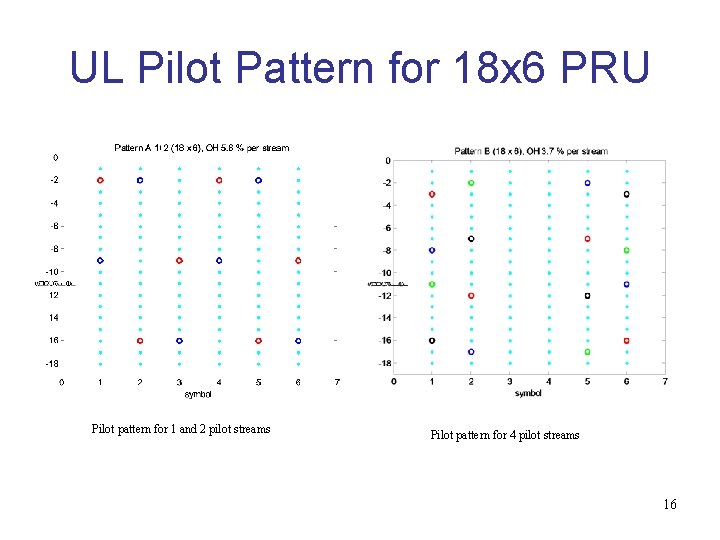
UL Pilot Pattern for 18 x 6 PRU Pilot pattern for 1 and 2 pilot streams Pilot pattern for 4 pilot streams 16
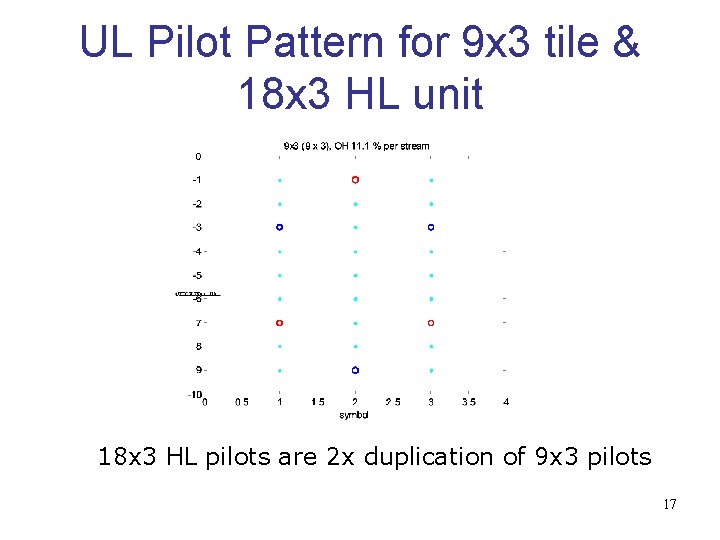
UL Pilot Pattern for 9 x 3 tile & 18 x 3 HL unit 18 x 3 HL pilots are 2 x duplication of 9 x 3 pilots 17
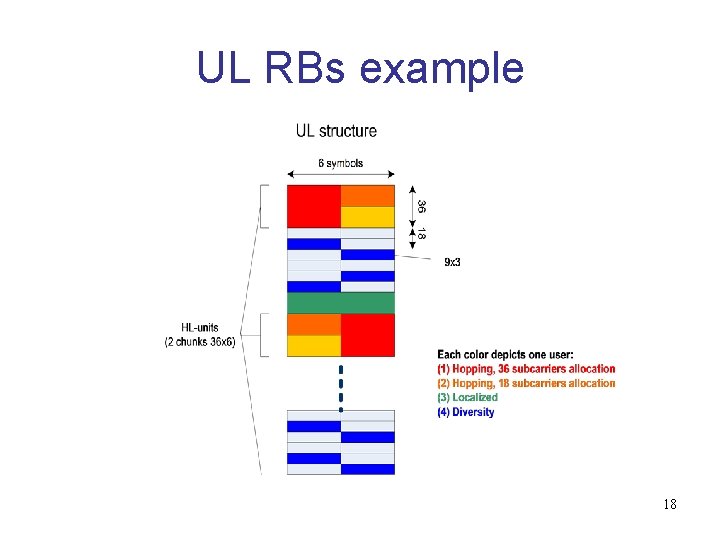
UL RBs example 18
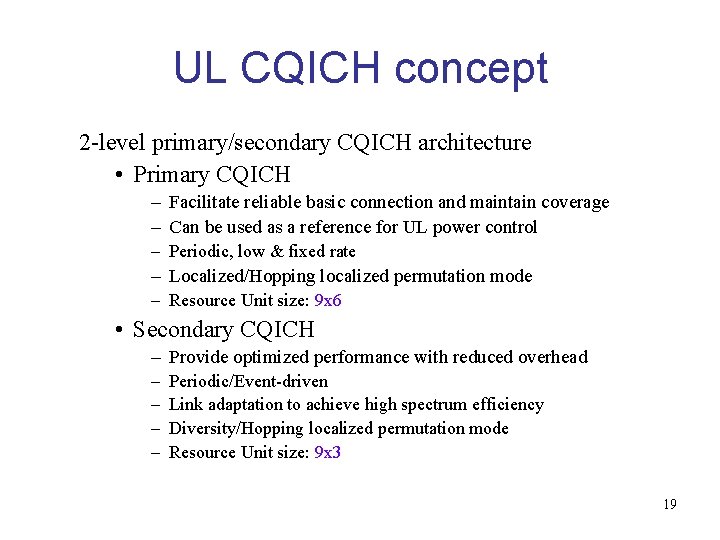
UL CQICH concept 2 -level primary/secondary CQICH architecture • Primary CQICH – Facilitate reliable basic connection and maintain coverage – Can be used as a reference for UL power control – Periodic, low & fixed rate – Localized/Hopping localized permutation mode – Resource Unit size: 9 x 6 • Secondary CQICH – Provide optimized performance with reduced overhead – – Periodic/Event-driven Link adaptation to achieve high spectrum efficiency Diversity/Hopping localized permutation mode Resource Unit size: 9 x 3 19
Section 2 802. 16 m UL symbol structure: mixed network support (Multiplexing Schemes) Supporting material for “IEEE C 80216 m-08/267: UL symbol structure design for 802. 16 m – mixed network support” 20
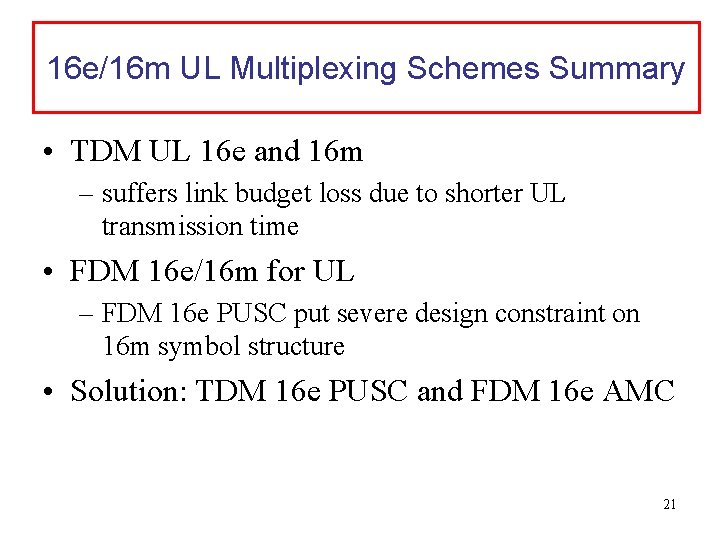
16 e/16 m UL Multiplexing Schemes Summary • TDM UL 16 e and 16 m – suffers link budget loss due to shorter UL transmission time • FDM 16 e/16 m for UL – FDM 16 e PUSC put severe design constraint on 16 m symbol structure • Solution: TDM 16 e PUSC and FDM 16 e AMC 21
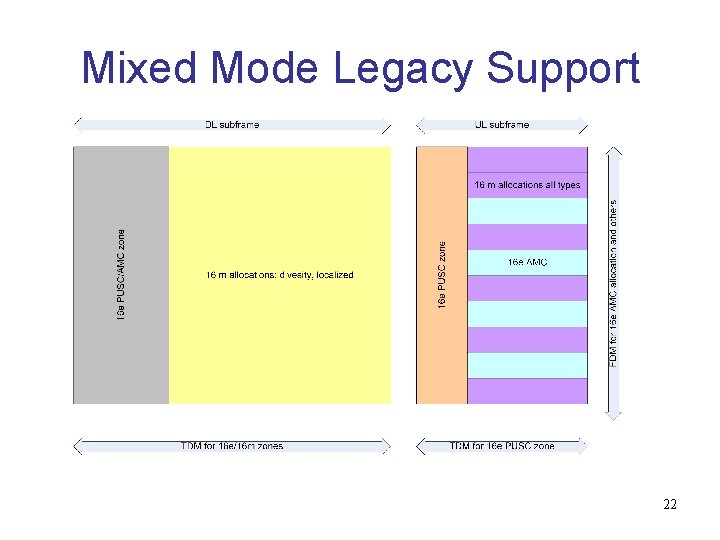
Mixed Mode Legacy Support 22
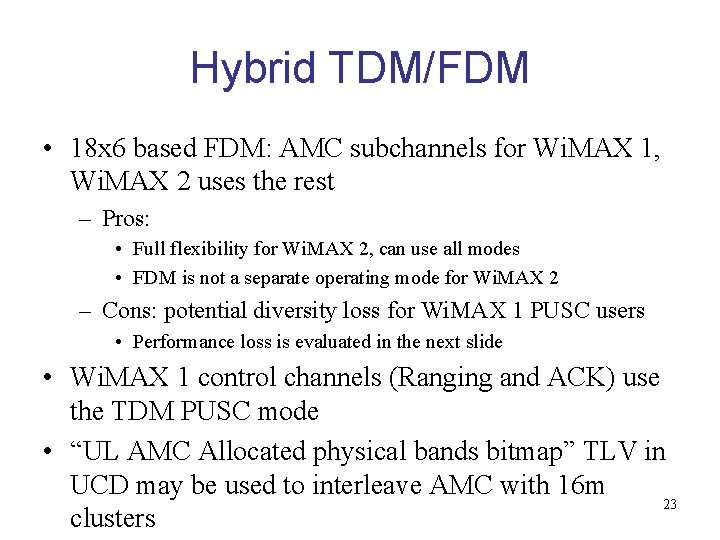
Hybrid TDM/FDM • 18 x 6 based FDM: AMC subchannels for Wi. MAX 1, Wi. MAX 2 uses the rest – Pros: • Full flexibility for Wi. MAX 2, can use all modes • FDM is not a separate operating mode for Wi. MAX 2 – Cons: potential diversity loss for Wi. MAX 1 PUSC users • Performance loss is evaluated in the next slide • Wi. MAX 1 control channels (Ranging and ACK) use the TDM PUSC mode • “UL AMC Allocated physical bands bitmap” TLV in UCD may be used to interleave AMC with 16 m 23 clusters
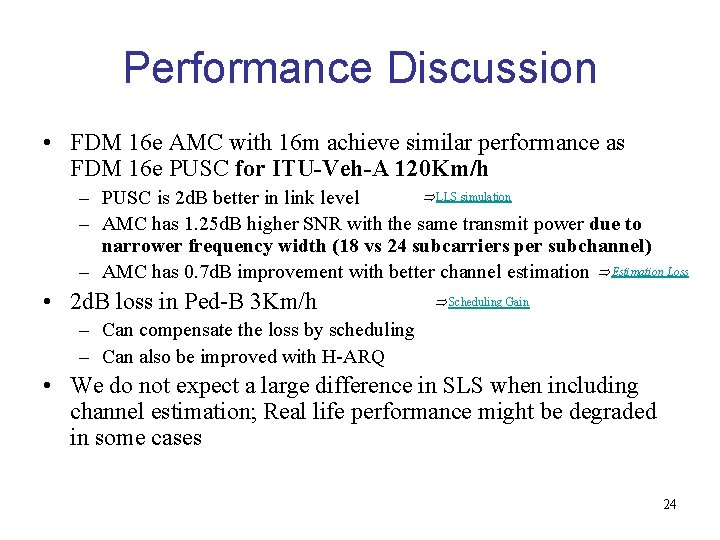
Performance Discussion • FDM 16 e AMC with 16 m achieve similar performance as FDM 16 e PUSC for ITU-Veh-A 120 Km/h LLS simulation – PUSC is 2 d. B better in link level – AMC has 1. 25 d. B higher SNR with the same transmit power due to narrower frequency width (18 vs 24 subcarriers per subchannel) – AMC has 0. 7 d. B improvement with better channel estimation Estimation Loss • 2 d. B loss in Ped-B 3 Km/h Scheduling Gain – Can compensate the loss by scheduling – Can also be improved with H-ARQ • We do not expect a large difference in SLS when including channel estimation; Real life performance might be degraded in some cases 24
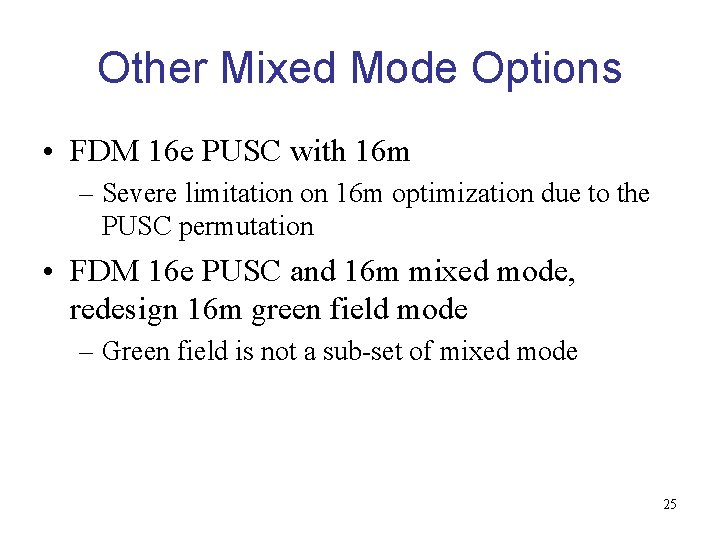
Other Mixed Mode Options • FDM 16 e PUSC with 16 m – Severe limitation on 16 m optimization due to the PUSC permutation • FDM 16 e PUSC and 16 m mixed mode, redesign 16 m green field mode – Green field is not a sub-set of mixed mode 25
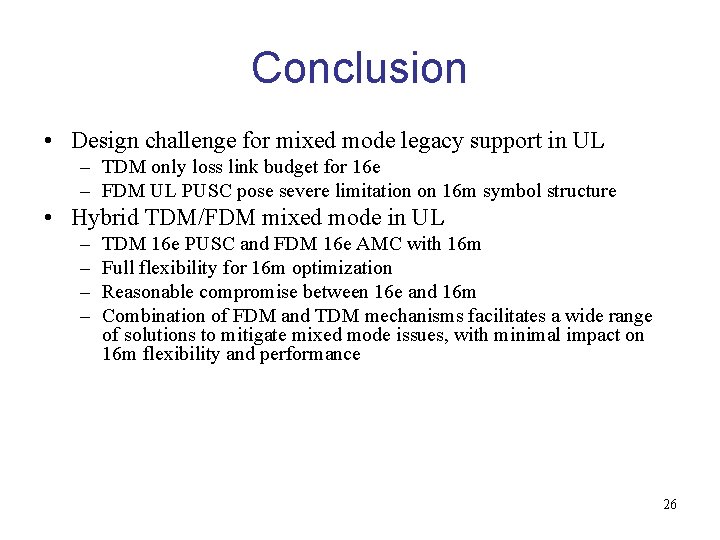
Conclusion • Design challenge for mixed mode legacy support in UL – TDM only loss link budget for 16 e – FDM UL PUSC pose severe limitation on 16 m symbol structure • Hybrid TDM/FDM mixed mode in UL – – TDM 16 e PUSC and FDM 16 e AMC with 16 m Full flexibility for 16 m optimization Reasonable compromise between 16 e and 16 m Combination of FDM and TDM mechanisms facilitates a wide range of solutions to mitigate mixed mode issues, with minimal impact on 16 m flexibility and performance 26
Section 3 802. 16 m UL symbol structure: Tile selection and pilot design Supporting material for “IEEE C 80216 m-08/268: UL symbol structure design for 802. 16 m – tile selection and pilots” 27
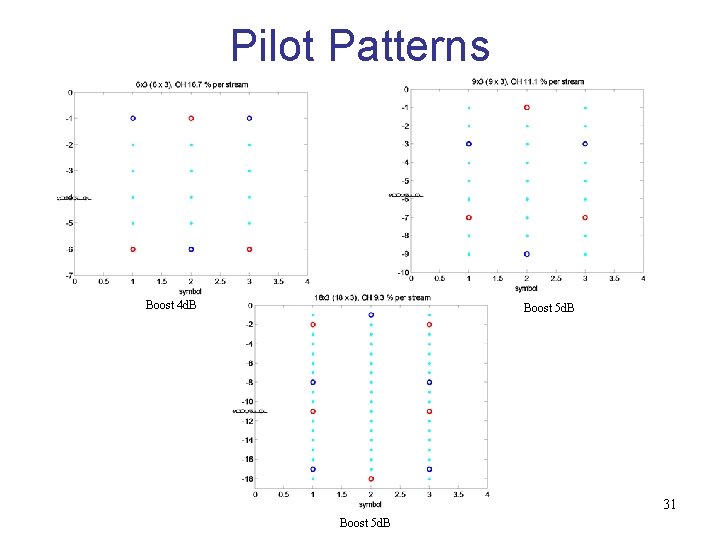
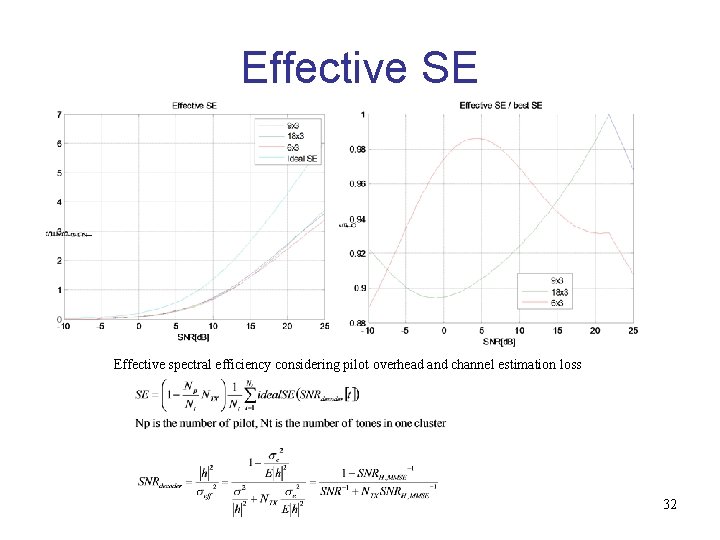
Tile Selection and Pilot Design Summary • Subchannel size is 18 x 6 – Choice from the FDM 16 e AMC with 16 m – Same subchannel size for localized and distributed resource – 18 x 6 subchannel includes both data and pilots • Tile size selection for distributed resource – Tradeoff of diversity and pilot efficiency • Small tile => more tiles: more diversity, smaller pilot efficiency • Large tile => less diversity, better pilot efficiency – Comparison of 6 x 3, 9 x 3, 18 x 3 tiles size • 3 x 3 is not considered due to pilot • 3 x 6 is similar to 6 x 3 and 9 x 6 is similar to 18 x 3 – Optimized for 2 pilot streams (collaborative MIMO) • Recommend 9 x 3 tile for UL Distributed Resource 28
Optimization Method • In order to compare the diversity gain with different tile size, link level simulation is done to generate throughput curve with perfect CSI for different tile size – 480 bits coding block – MIMO 2 x 2 (CSM) – Number of tiles is calculated based on MCS and placed evenly across frequency – SE curve is fitted with 1% PER requirement • Pilot is optimized using different SE curve for different tile shape 29
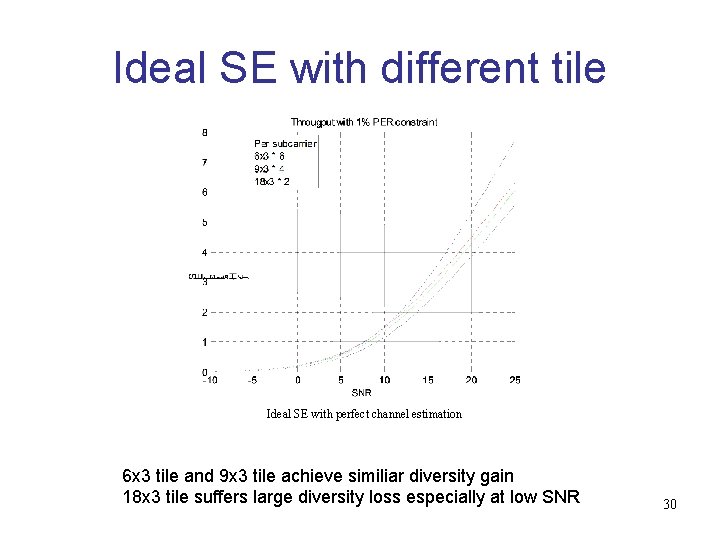
Ideal SE with different tile Ideal SE with perfect channel estimation 6 x 3 tile and 9 x 3 tile achieve similiar diversity gain 18 x 3 tile suffers large diversity loss especially at low SNR 30
Pilot Patterns Boost 4 d. B Boost 5 d. B 31 Boost 5 d. B
Effective SE Effective spectral efficiency considering pilot overhead and channel estimation loss 32
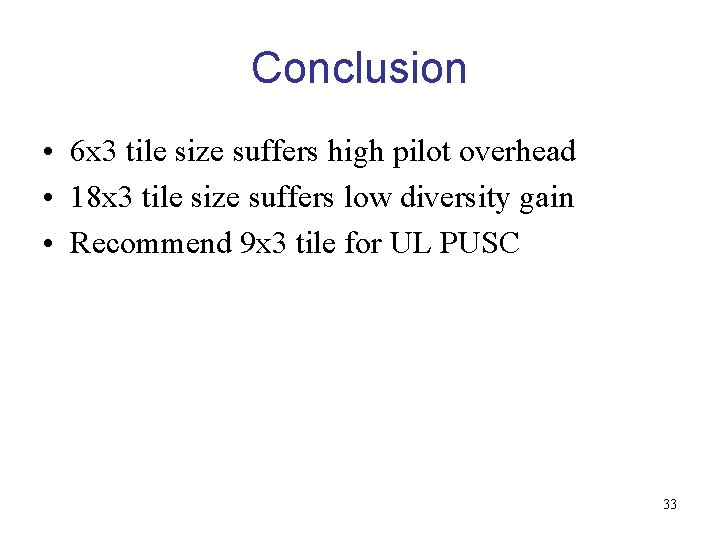
Conclusion • 6 x 3 tile size suffers high pilot overhead • 18 x 3 tile size suffers low diversity gain • Recommend 9 x 3 tile for UL PUSC 33
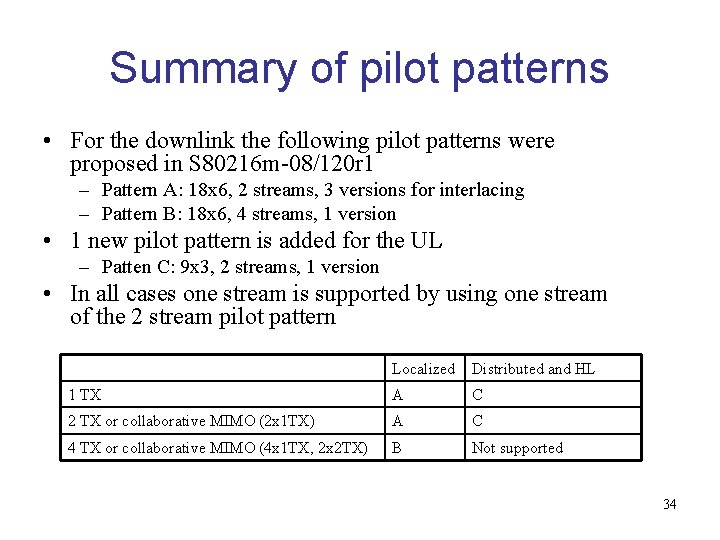
Summary of pilot patterns • For the downlink the following pilot patterns were proposed in S 80216 m-08/120 r 1 – Pattern A: 18 x 6, 2 streams, 3 versions for interlacing – Pattern B: 18 x 6, 4 streams, 1 version • 1 new pilot pattern is added for the UL – Patten C: 9 x 3, 2 streams, 1 version • In all cases one stream is supported by using one stream of the 2 stream pilot pattern Localized Distributed and HL 1 TX A C 2 TX or collaborative MIMO (2 x 1 TX) A C 4 TX or collaborative MIMO (4 x 1 TX, 2 x 2 TX) B Not supported 34
Section 4 802. 16 m UL symbol structure: Hopping Localized Allocation to Improve UL Tx Power Supporting material for “IEEE C 80216 m-08/269: UL symbol structure design for 802. 16 m – hopping localized transmission to improve TX power” 35
Hopping Localized Key Concepts • UL link budget is transmit power limited • Transmit Power Advantage: Allocate narrow localized chunk of subcarriers (hopping unit) for power limited users to maximize TX power efficiency • Diversity: Frequency Hopping for better diversity gain • Hopping Localized: Combining the above two factors for better power efficiency and diversity gain hopping localized • Allocation mechanism targeted for cell-edge (power and throughput limited) users 36
Link budget issue in the uplink • From 802. 16 m SRD, section 7. 4, Cell coverage: – “the link budget of the limiting link (e. g. DL MAP, UL bearer) of IEEE 802. 16 m shall be improved by at least 3 d. B compared to the Wireless. MANOFDMA Reference System. ” • One of the factors affecting UL link budget is the transmit power • Mobile TX power is limited due to the following factors: – High PAPR - large variation of the of OFDM signal envelope – Non-linear “practical” power amplifier – Constraints • Out of band emission is limited by spectral mask (varies by regulation) • Minimum EVM is needed (in-band noise limitation), depending on MCS • PA may have power consumption limitation (in addition to peak power limitation) • 802. 16 e OFDMA uplink performance is limited with respect to the downlink (TX power 23 d. Bm vs. 46 d. Bm, while maximum subchannelization gain ~12 d. B) • Maximum TX power (of lowest rate) is limited by spectral mask requirement (since EVM requirement loosens for low rates) 37
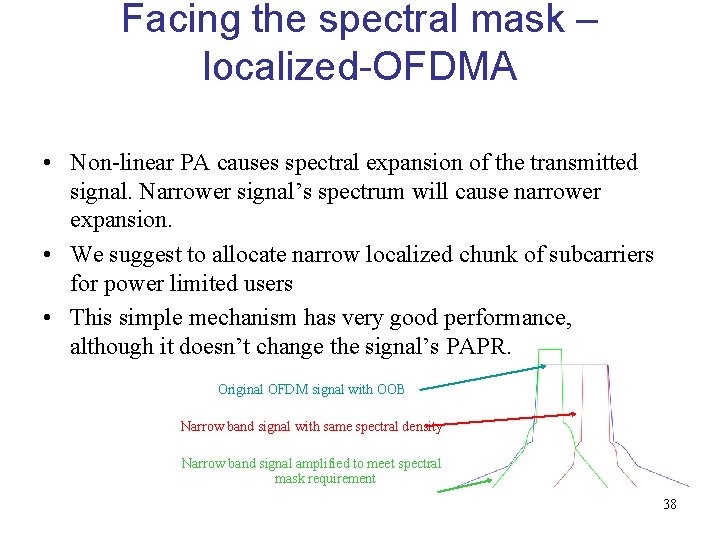
Facing the spectral mask – localized-OFDMA • Non-linear PA causes spectral expansion of the transmitted signal. Narrower signal’s spectrum will cause narrower expansion. • We suggest to allocate narrow localized chunk of subcarriers for power limited users • This simple mechanism has very good performance, although it doesn’t change the signal’s PAPR. Original OFDM signal with OOB Narrow band signal with same spectral density Narrow band signal amplified to meet spectral mask requirement 38
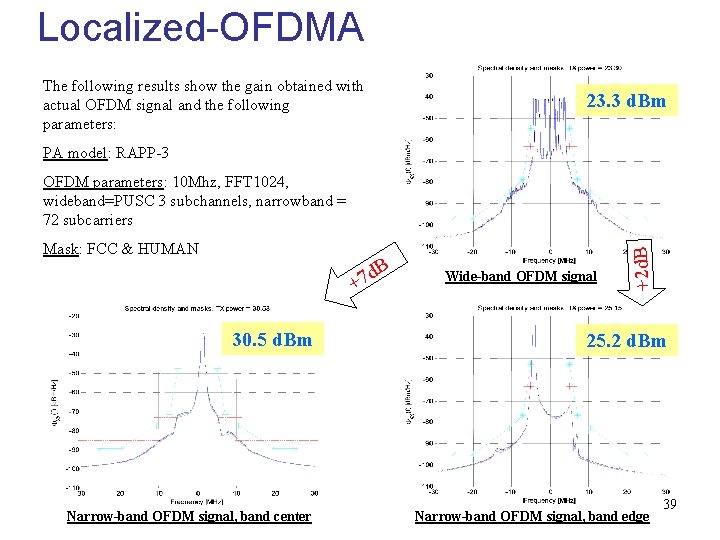
Localized-OFDMA The following results show the gain obtained with actual OFDM signal and the following parameters: 23. 3 d. Bm PA model: RAPP-3 Mask: FCC & HUMAN d +7 30. 5 d. Bm Narrow-band OFDM signal, band center B Wide-band OFDM signal +2 d. B OFDM parameters: 10 Mhz, FFT 1024, wideband=PUSC 3 subchannels, narrowband = 72 subcarriers 25. 2 d. Bm Narrow-band OFDM signal, band edge 39
Adding frequency diversity by hopping • For high mobility user the frequency diversity gain in MIMO 2 x 2 is ~2 -4 d. B (distributed versus localized) • In localized transmission we lose this diversity gain • To combine the frequency diversity of distributed allocation with power advantage of localized allocation, frequency hoping should be applied (e. g. hop duration of 3 symbols), therefore we propose hopping localized transmission • On the other hand hopping localized requires continuous chunk of spectrum to be allocated to a single user which poses a limit on other users. • Therefore we propose to limit this type of allocation to celledge (power and throughput limited) users 40
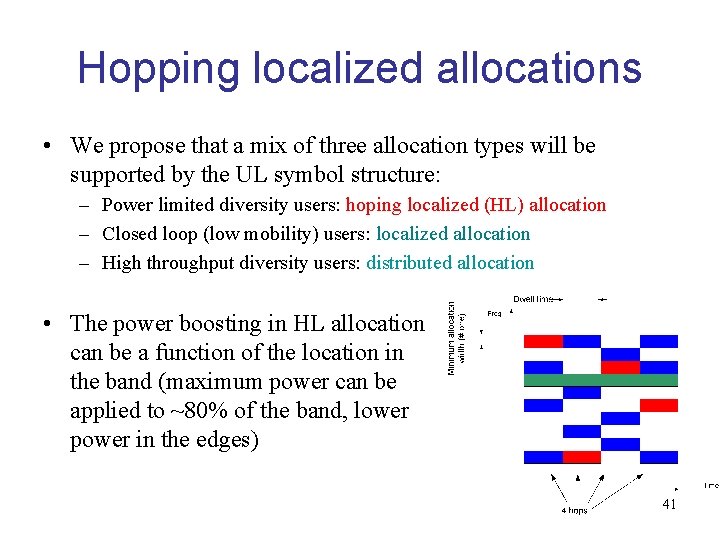
Hopping localized allocations • We propose that a mix of three allocation types will be supported by the UL symbol structure: – Power limited diversity users: hoping localized (HL) allocation – Closed loop (low mobility) users: localized allocation – High throughput diversity users: distributed allocation • The power boosting in HL allocation can be a function of the location in the band (maximum power can be applied to ~80% of the band, lower power in the edges) 41
Dwell time tradeoffs • The basic allocation unit is a time-frequency rectangle. It’s size is affected by: – Large number of sub-carriers reduces the maximum sub-channelization gain, therefore span maximum time (e. g. 2 subframes) minimum frequency – Given the frequency width, the tradeoff on dwell time: • Small dwell time => more hops, more diversity • Large dwell time => higher pilot efficiency • Recommended parameters: – A hop tile size is 18 subcarriers and 3 OFDMA symbols. Assuming UL transmission may span TTI=2 subframes, we assume 4 hops within one TTI – The 18 x 3 tile size optimizes the tradeoff of diversity and pilot efficiency. – The 18 x 3 tile size aligns well with the 9 x 3 tile size for distributed resource and 18 x 6 tile size for localized resource 42
Review of text proposal 43
Specific Text Recommendations for SDD Section 11 – UL Physical Structure 11. x: UL Physical Structure • The uplink physical structure supports three different resource allocation schemes simultaneously in the same subframe/zone, including localized, distributed and hopping localized (HL) allocations. • Localized resources are mainly intended for utilizing frequency selective scheduling gain using channel information/feedback, while distributed and HL resources supply frequency diversity. HL allocations are used by power-limited users to enable higher transmit power. • The uplink physical structure is provided through a hierarchical structure as depicted in Figure XXX, where the symbol is first split into frequency partitions. These partitions are mainly intended for FFR, and are assumed to be slowly changing based on mutli-cell decisions. Each partition can be split into localized, distributed and hopping localized groups, and then these groups are split into individual subchannels or logical resource units (LRUs). • Insert Figure XXX here. * System description document [9] 44
Specific Text Recommendations for SDD Section 11 – UL Physical Structure 11. x: UL Physical and Logical Resource Unit • An UL physical resource unit (PRU) is the basic physical unit for resource allocation that comprises Psc consecutive subcarriers by Nsym consecutive OFDMA symbols. Psc equals to 18 subcarriers and Nsym equals to 6. • An UL logical resource unit (LRU) is the basic logical unit for resource allocation that comprises Lsc subcarriers by Nsym consecutive OFDMA symbols. In the case UL LRU, Lsc is equal to Psc. * System description document [9] 45
Specific Text Recommendations for SDD Section 11 – UL Physical Structure 11. x: UL Symbol Structure • An UL tile is physically contiguous group of 9 subcarriers by 3 symbols. • An UL hopping unit (HU) is physically contiguous group of 18 subcarriers by 3 symbols. • An UL slot/LRU is logical block of Lsc subcarriers by Nsym symbols unit, with default value of 18 subcarriers by 6 OFDM symbols, i. e. Lsc=18, Nsym=6 including both pilots and data tones. – In localized resource allocation, a LRU is one PRU – In distributed resource allocation, a LRU contains 4 tiles distributed across the distributed allocation – In HL allocation, a LRU contains 2 HUs that are hopping across subframe 46
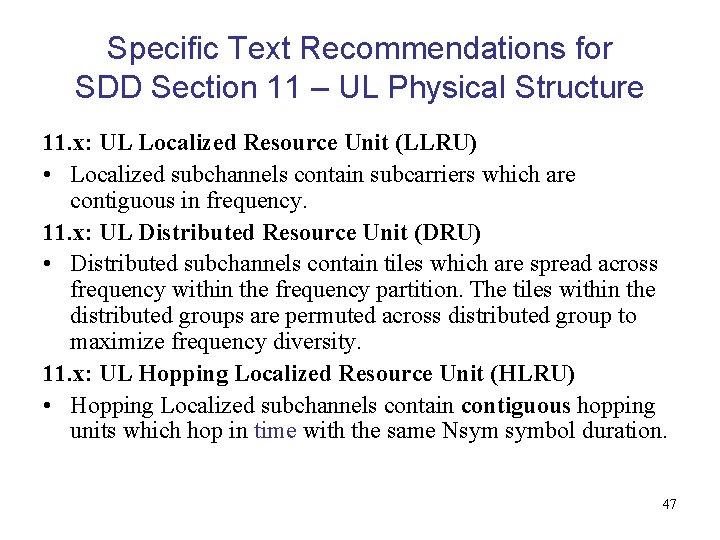
Specific Text Recommendations for SDD Section 11 – UL Physical Structure 11. x: UL Localized Resource Unit (LLRU) • Localized subchannels contain subcarriers which are contiguous in frequency. 11. x: UL Distributed Resource Unit (DRU) • Distributed subchannels contain tiles which are spread across frequency within the frequency partition. The tiles within the distributed groups are permuted across distributed group to maximize frequency diversity. 11. x: UL Hopping Localized Resource Unit (HLRU) • Hopping Localized subchannels contain contiguous hopping units which hop in time with the same Nsym symbol duration. 47
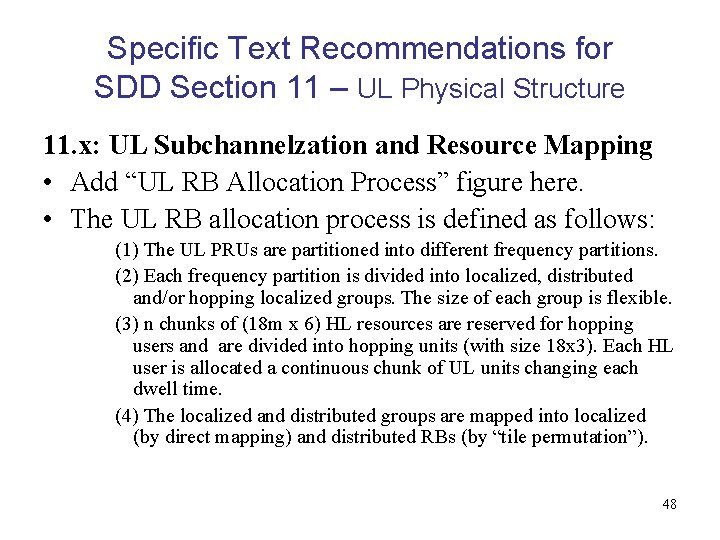
Specific Text Recommendations for SDD Section 11 – UL Physical Structure 11. x: UL Subchannelzation and Resource Mapping • Add “UL RB Allocation Process” figure here. • The UL RB allocation process is defined as follows: (1) The UL PRUs are partitioned into different frequency partitions. (2) Each frequency partition is divided into localized, distributed and/or hopping localized groups. The size of each group is flexible. (3) n chunks of (18 m x 6) HL resources are reserved for hopping users and are divided into hopping units (with size 18 x 3). Each HL user is allocated a continuous chunk of UL units changing each dwell time. (4) The localized and distributed groups are mapped into localized (by direct mapping) and distributed RBs (by “tile permutation”). 48
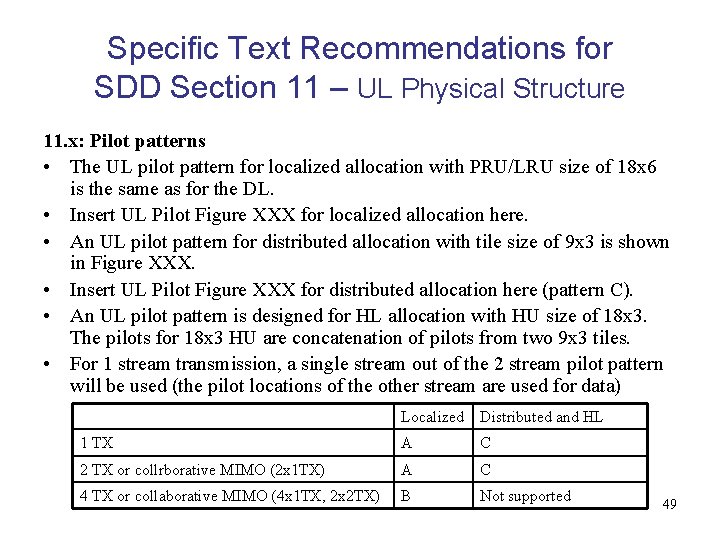
Specific Text Recommendations for SDD Section 11 – UL Physical Structure 11. x: Pilot patterns • The UL pilot pattern for localized allocation with PRU/LRU size of 18 x 6 is the same as for the DL. • Insert UL Pilot Figure XXX for localized allocation here. • An UL pilot pattern for distributed allocation with tile size of 9 x 3 is shown in Figure XXX. • Insert UL Pilot Figure XXX for distributed allocation here (pattern C). • An UL pilot pattern is designed for HL allocation with HU size of 18 x 3. The pilots for 18 x 3 HU are concatenation of pilots from two 9 x 3 tiles. • For 1 stream transmission, a single stream out of the 2 stream pilot pattern will be used (the pilot locations of the other stream are used for data) Localized Distributed and HL 1 TX A C 2 TX or collrborative MIMO (2 x 1 TX) A C 4 TX or collaborative MIMO (4 x 1 TX, 2 x 2 TX) B Not supported 49
![References [1] Cosovic, I. ; Auer, G. , "Capacity Achieving Pilot Design for MIMO-OFDM](http://slidetodoc.com/presentation_image_h2/5b35ad27d09a8ffe682e692426690a25/image-50.jpg "References [1] Cosovic, I. ; Auer, G. , \"Capacity Achieving Pilot Design for MIMO-OFDM")
References [1] Cosovic, I. ; Auer, G. , "Capacity Achieving Pilot Design for MIMO-OFDM over Time-Varying Frequency. Selective Channels, " Communications, 2007. ICC '07. IEEE International Conference on , vol. , no. , pp. 779784, 24 -28 June 2007 [2] Hassibi, B. ; Hochwald, B. M. , "How much training is needed in multiple-antenna wireless links? , " Information Theory, IEEE Transactions on , vol. 49, no. 4, pp. 951 -963, April 2003 [3] Lang Tong; Sadler, B. M. ; Min Dong, "Pilot-assisted wireless transmissions: general model, design criteria, and signal processing, " Signal Processing Magazine, IEEE , vol. 21, no. 6, pp. 12 -25, Nov. 2004 [4] IEEE 802. 16 m-07/002 r 4, “ 802. 16 m System Requirements” [5] IEEE 802. 16 m-008/004, “ 802. 16 m Evaluation Methodology” [6] 3 GPP TS 36. 211 V 8. 1. 0 (2007 -11) Technical Specification, 3 rd Generation Partnership Project; Technical Specification Group Radio Access Network; Evolved Universal Terrestrial Radio Access (E-UTRA); Physical channels and modulation (Release 8) [7] IEEE C 80216 m-08/082, “Proposal for IEEE 802. 16 m Frame Structure” [8] IEEE C 80216 m-08/118 r 1, “Initial Document output of the IEEE 802. 16 TGm Frame Structure Rapporteur Group” [9] IEEE 80216 m-08/003, “The Draft IEEE 802. 16 m System Description Document” [10] IEEE C 80216 m-08/xxx: A high level description of a UL symbol structure concept for 802. 16 m [11] IEEE C 80216 m-08/xxx: UL symbol structure design for 802. 16 m – mixed network support [12] IEEE C 80216 m-08/xxx: UL symbol structure design for 802. 16 m – tile selection and pilots [13] IEEE C 80216 m-08/xxx: UL symbol structure design for 802. 16 m – hopping localized transmission to improve the TX power [14] IEEE S 80216 m-08/120 r 1 “Proposal for IEEE 802. 16 m Downlink Symbol Structure Concept” 50
Backup 51
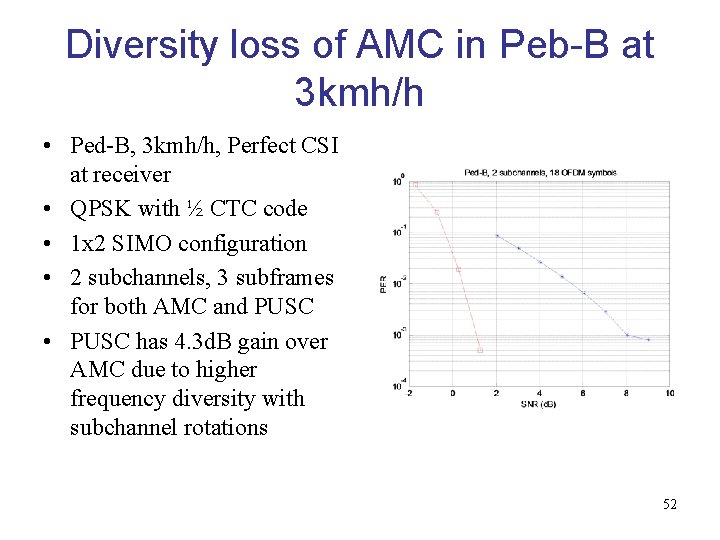
Diversity loss of AMC in Peb-B at 3 kmh/h • Ped-B, 3 kmh/h, Perfect CSI at receiver • QPSK with ½ CTC code • 1 x 2 SIMO configuration • 2 subchannels, 3 subframes for both AMC and PUSC • PUSC has 4. 3 d. B gain over AMC due to higher frequency diversity with subchannel rotations 52
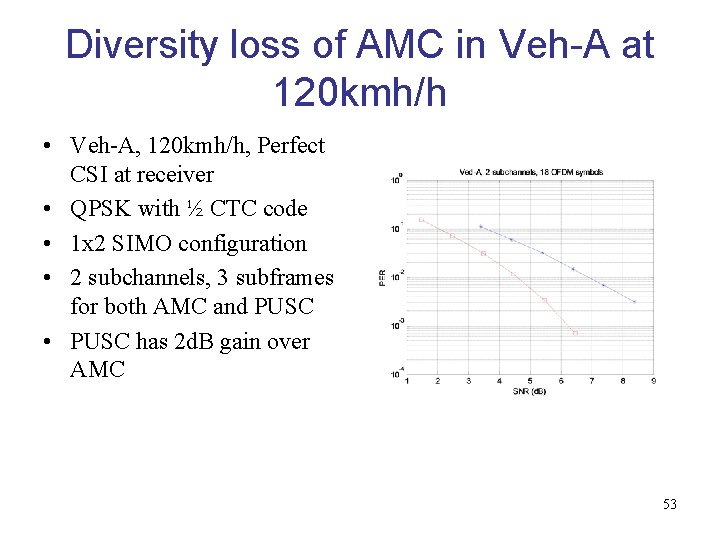
Diversity loss of AMC in Veh-A at 120 kmh/h • Veh-A, 120 kmh/h, Perfect CSI at receiver • QPSK with ½ CTC code • 1 x 2 SIMO configuration • 2 subchannels, 3 subframes for both AMC and PUSC • PUSC has 2 d. B gain over AMC 53
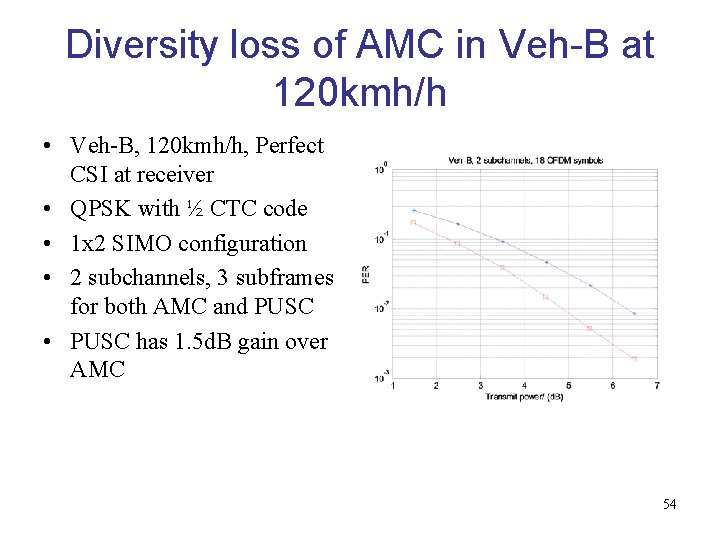
Diversity loss of AMC in Veh-B at 120 kmh/h • Veh-B, 120 kmh/h, Perfect CSI at receiver • QPSK with ½ CTC code • 1 x 2 SIMO configuration • 2 subchannels, 3 subframes for both AMC and PUSC • PUSC has 1. 5 d. B gain over AMC 54
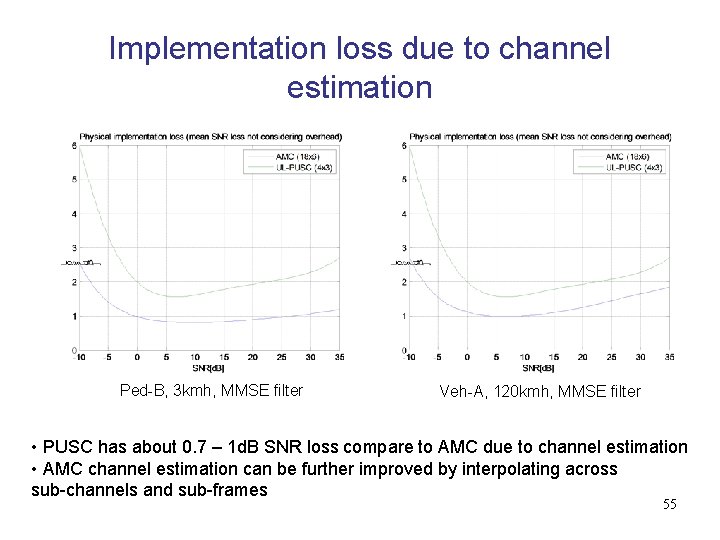
Implementation loss due to channel estimation Ped-B, 3 kmh, MMSE filter Veh-A, 120 kmh, MMSE filter • PUSC has about 0. 7 – 1 d. B SNR loss compare to AMC due to channel estimation • AMC channel estimation can be further improved by interpolating across sub-channels and sub-frames 55
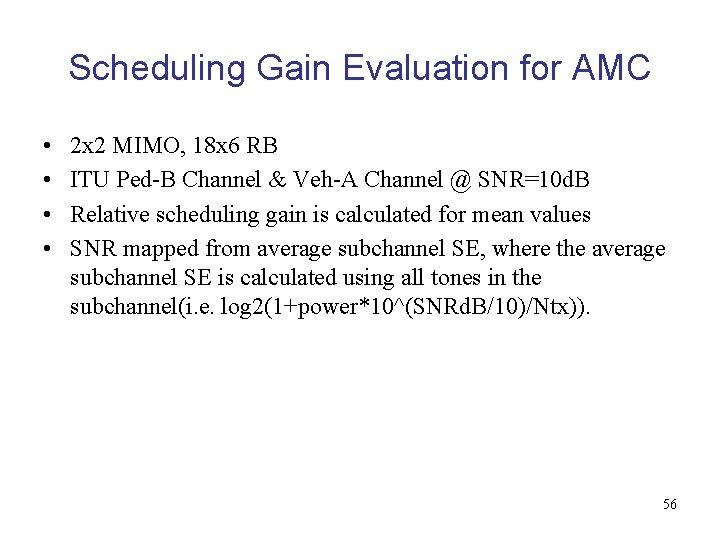
Scheduling Gain Evaluation for AMC • • 2 x 2 MIMO, 18 x 6 RB ITU Ped-B Channel & Veh-A Channel @ SNR=10 d. B Relative scheduling gain is calculated for mean values SNR mapped from average subchannel SE, where the average subchannel SE is calculated using all tones in the subchannel(i. e. log 2(1+power*10^(SNRd. B/10)/Ntx)). 56
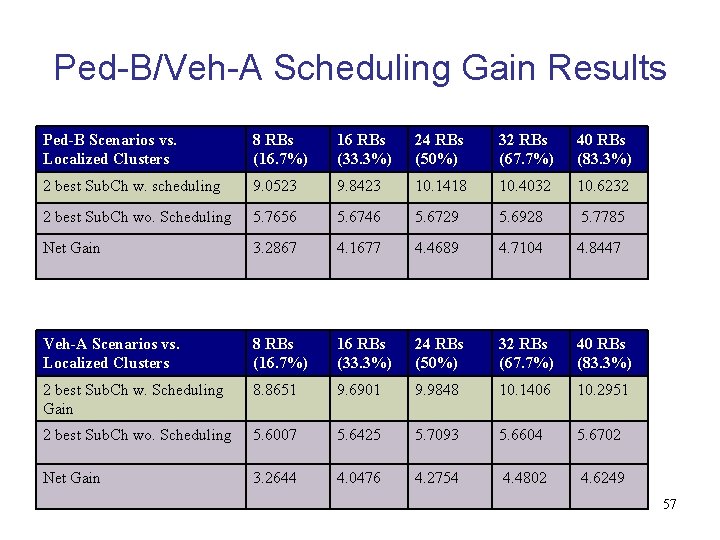
Ped-B/Veh-A Scheduling Gain Results Ped-B Scenarios vs. Localized Clusters 8 RBs (16. 7%) 16 RBs (33. 3%) 24 RBs (50%) 32 RBs (67. 7%) 40 RBs (83. 3%) 2 best Sub. Ch w. scheduling 9. 0523 9. 8423 10. 1418 10. 4032 10. 6232 2 best Sub. Ch wo. Scheduling 5. 7656 5. 6746 5. 6729 5. 6928 5. 7785 Net Gain 3. 2867 4. 1677 4. 4689 4. 7104 4. 8447 Veh-A Scenarios vs. Localized Clusters 8 RBs (16. 7%) 16 RBs (33. 3%) 24 RBs (50%) 32 RBs (67. 7%) 40 RBs (83. 3%) 2 best Sub. Ch w. Scheduling Gain 8. 8651 9. 6901 9. 9848 10. 1406 10. 2951 2 best Sub. Ch wo. Scheduling 5. 6007 5. 6425 5. 7093 5. 6604 5. 6702 Net Gain 3. 2644 4. 0476 4. 2754 4. 4802 4. 6249 57
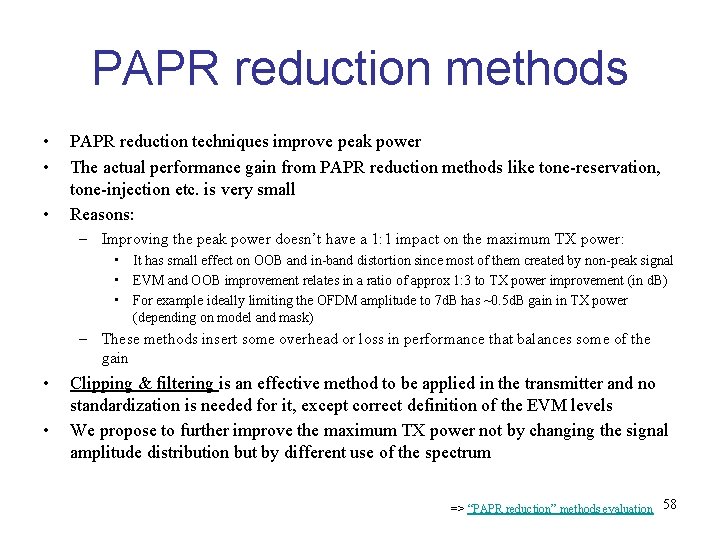
PAPR reduction methods • • • PAPR reduction techniques improve peak power The actual performance gain from PAPR reduction methods like tone-reservation, tone-injection etc. is very small Reasons: – Improving the peak power doesn’t have a 1: 1 impact on the maximum TX power: • It has small effect on OOB and in-band distortion since most of them created by non-peak signal • EVM and OOB improvement relates in a ratio of approx 1: 3 to TX power improvement (in d. B) • For example ideally limiting the OFDM amplitude to 7 d. B has ~0. 5 d. B gain in TX power (depending on model and mask) – These methods insert some overhead or loss in performance that balances some of the gain • • Clipping & filtering is an effective method to be applied in the transmitter and no standardization is needed for it, except correct definition of the EVM levels We propose to further improve the maximum TX power not by changing the signal amplitude distribution but by different use of the spectrum => “PAPR reduction” methods evaluation 58
- Slides: 58