
RequirementDriven Magnetic Beamforming for MIMO Wireless Power Transfer
Requirement-Driven Magnetic Beamforming for MIMO Wireless Power Transfer Optimization Guodong Cao, Hao Zhou, Hangkai Zhang, Jun Xu, Panlong Yang, and Xiang-Yang Li School of Computer Science, USTC 2018 -06 -13
Outline • • • Background Problem formulation Problem solution Evaluation Prototype implementation Conclusion Hao Zhou 2
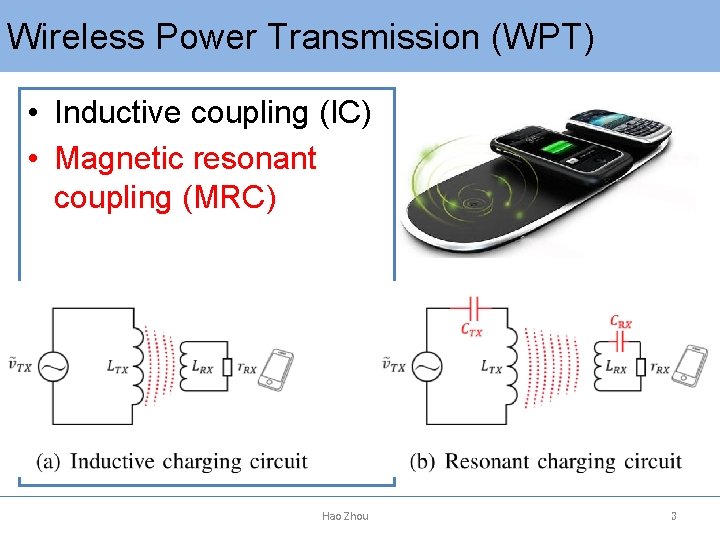
Wireless Power Transmission (WPT) • Inductive coupling (IC) • Magnetic resonant coupling (MRC) Hao Zhou 3

MRC-WPT • SISO / SIMO – Qi 1. 2 – Rezence • MISO – Magnetic mimo [Dina et. al. Mobicom 2014] • MIMO – Multi. Spot [Dina et. al. Mobicom 2015] Hao Zhou 4
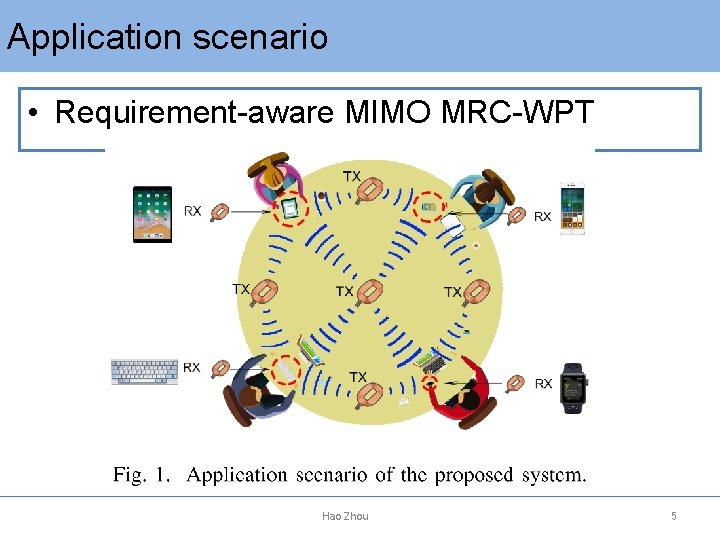
Application scenario • Requirement-aware MIMO MRC-WPT Hao Zhou 5
Outline • • • Background Problem formulation Problem solution Evaluation Prototype implementation Conclusion Hao Zhou 6
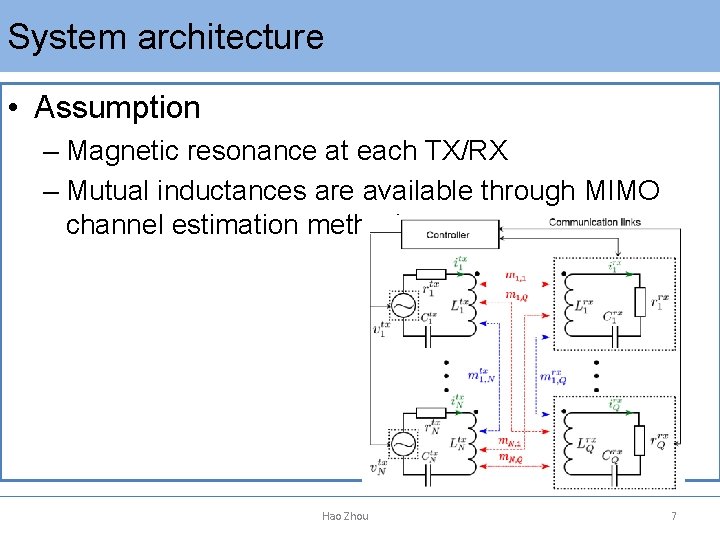
System architecture • Assumption – Magnetic resonance at each TX/RX – Mutual inductances are available through MIMO channel estimation method Hao Zhou 7

Circuit equations • Current equation • Voltage equation Hao Zhou 8
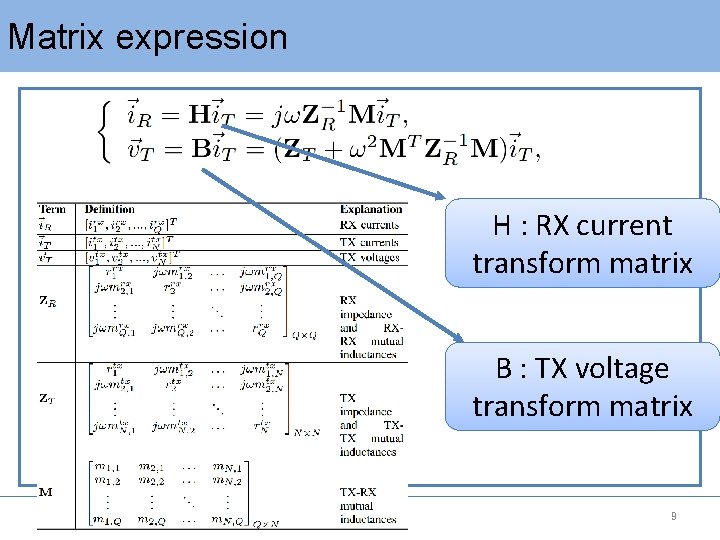
Matrix expression H : RX current transform matrix B : TX voltage transform matrix Hao Zhou 9

Weighted sum-power maximization (WSPMax) Hao Zhou 10
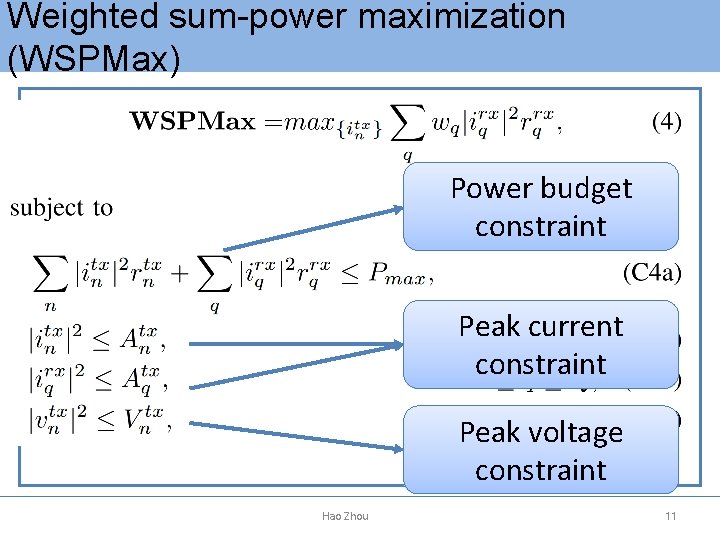
Weighted sum-power maximization (WSPMax) Power budget constraint Peak current constraint Peak voltage constraint Hao Zhou 11
Outline • • • Background Problem formulation Problem solution Evaluation Prototype implementation Conclusion Hao Zhou 12
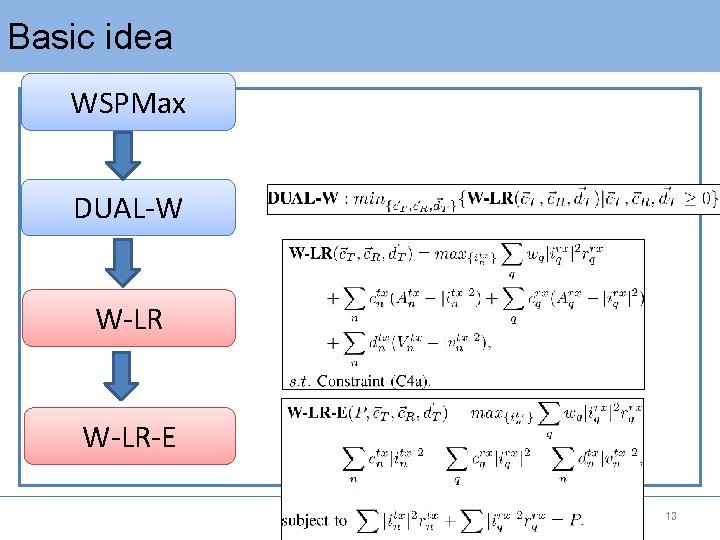
Basic idea WSPMax DUAL-W W-LR-E Hao Zhou 13
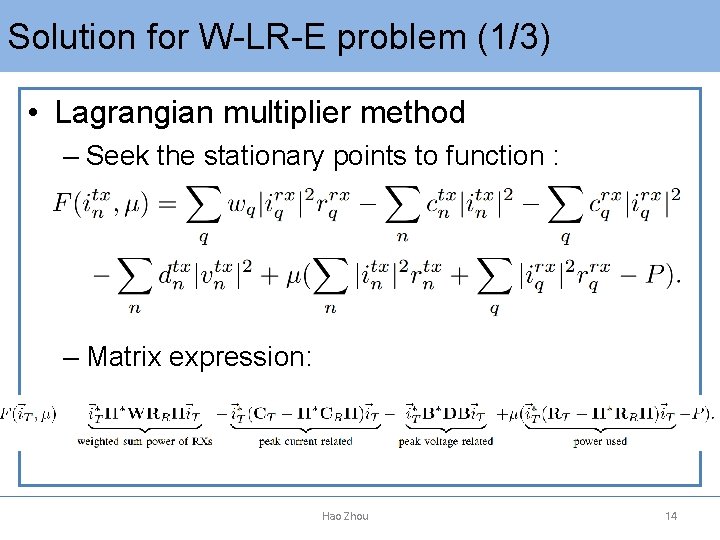
Solution for W-LR-E problem (1/3) • Lagrangian multiplier method – Seek the stationary points to function : – Matrix expression: Hao Zhou 14
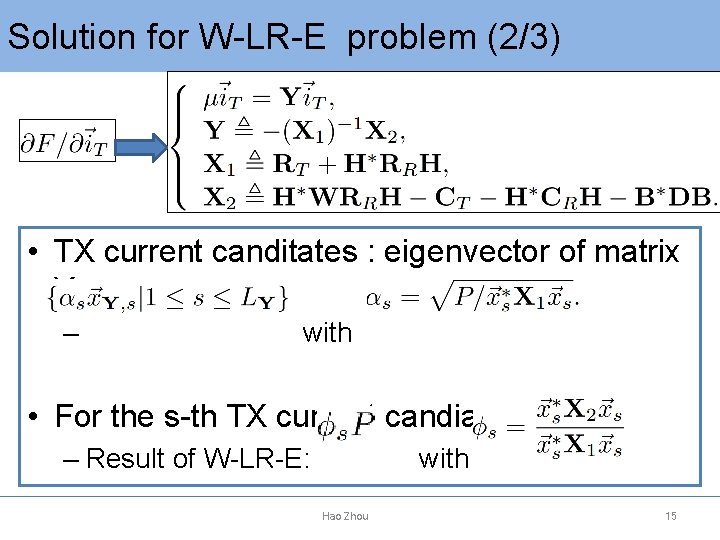
Solution for W-LR-E problem (2/3) • TX current canditates : eigenvector of matrix Y – with • For the s-th TX current candiate – Result of W-LR-E: with Hao Zhou 15

Solution for W-LR-E problem (3/3) • Optimal solution of W-LR-E • Optimal solution of W-LR Hao Zhou 16
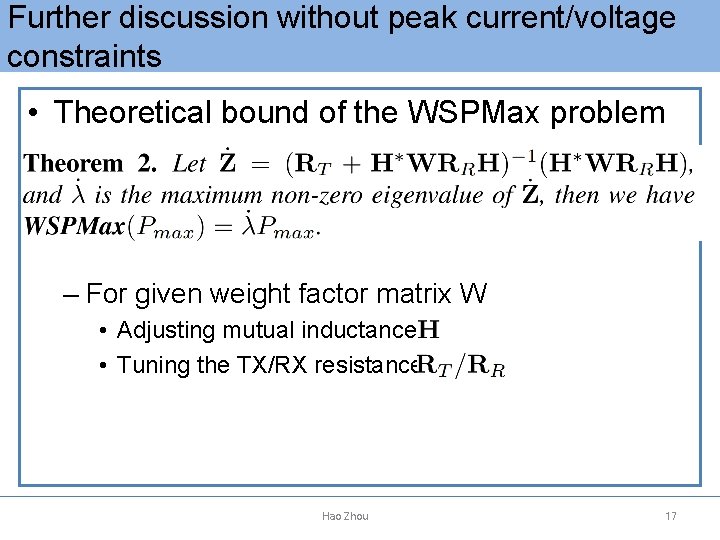
Further discussion without peak current/voltage constraints • Theoretical bound of the WSPMax problem – For given weight factor matrix W • Adjusting mutual inductances • Tuning the TX/RX resistances Hao Zhou 17
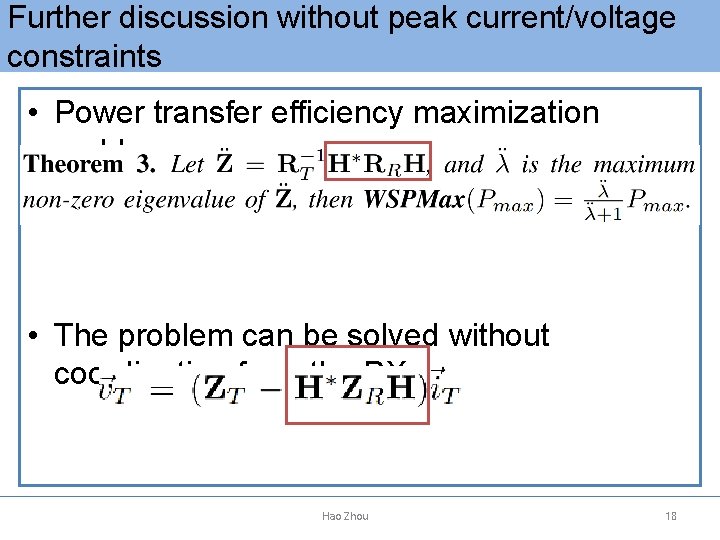
Further discussion without peak current/voltage constraints • Power transfer efficiency maximization problem • The problem can be solved without coordination from the RXs Hao Zhou 18
Outline • • • Background Problem formulation Problem solution Evaluation Prototype implementation Conclusion Hao Zhou 19
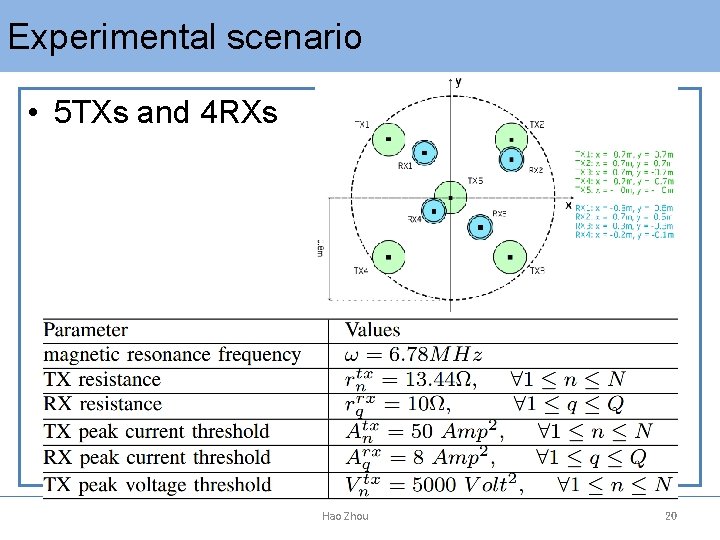
Experimental scenario • 5 TXs and 4 RXs Hao Zhou 20
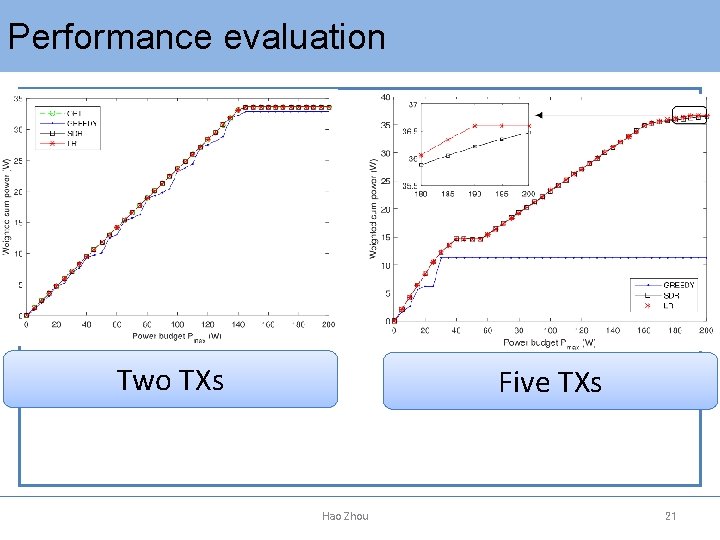
Performance evaluation Two TXs Five TXs Hao Zhou 21

Converge evaluation Hao Zhou 22
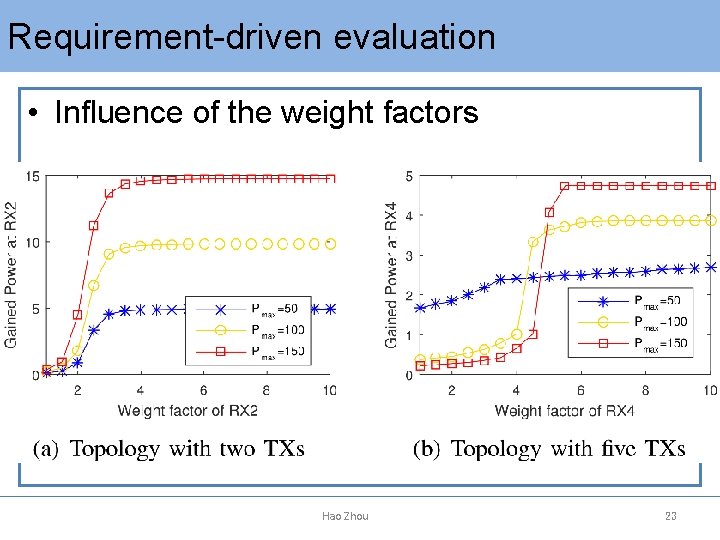
Requirement-driven evaluation • Influence of the weight factors Hao Zhou 23
Outline • • • Background Problem formulation Problem solution Evaluation Prototype implementation Conclusion Hao Zhou 24
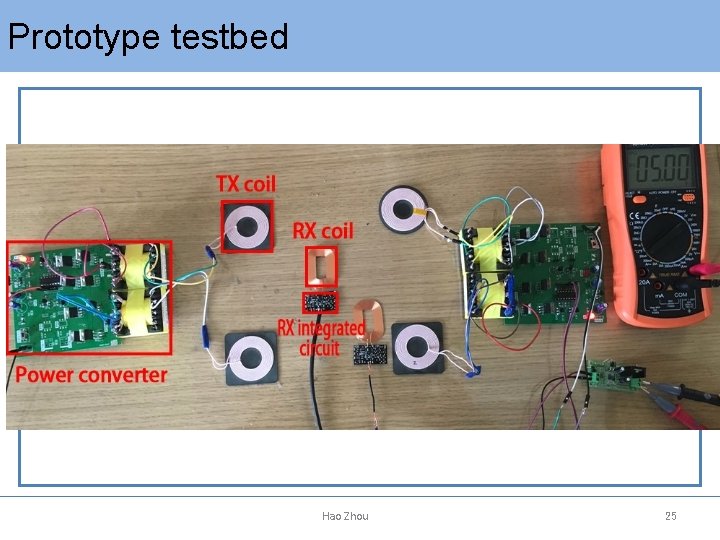
Prototype testbed Hao Zhou 25
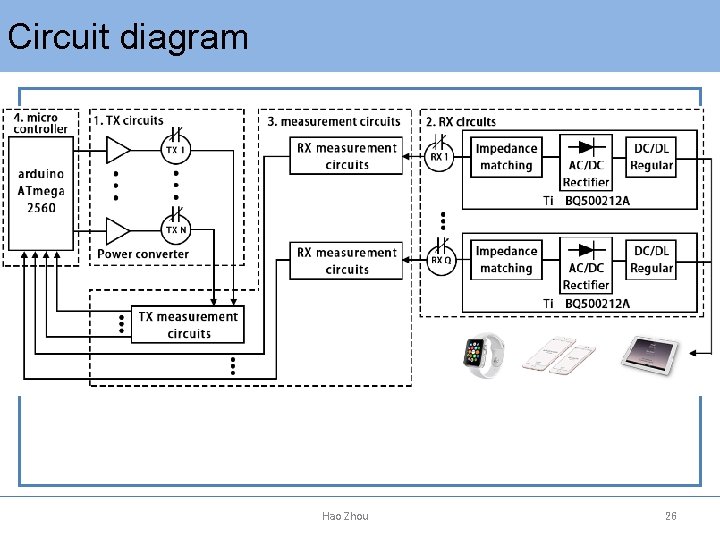
Circuit diagram Hao Zhou 26
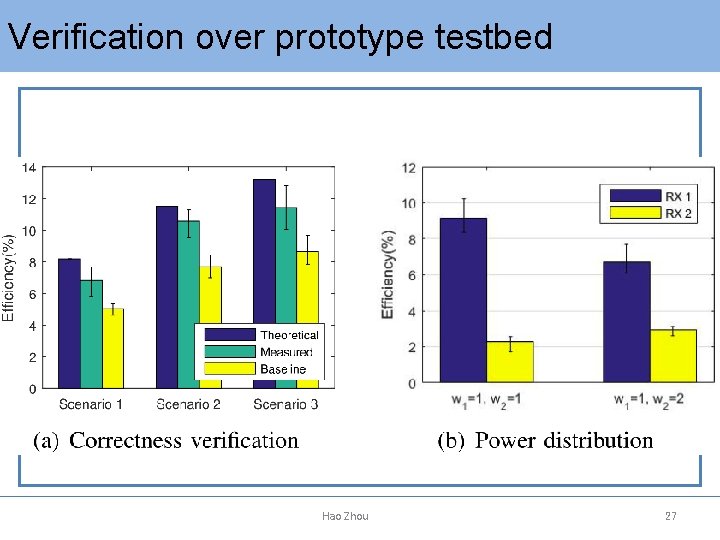
Verification over prototype testbed Hao Zhou 27
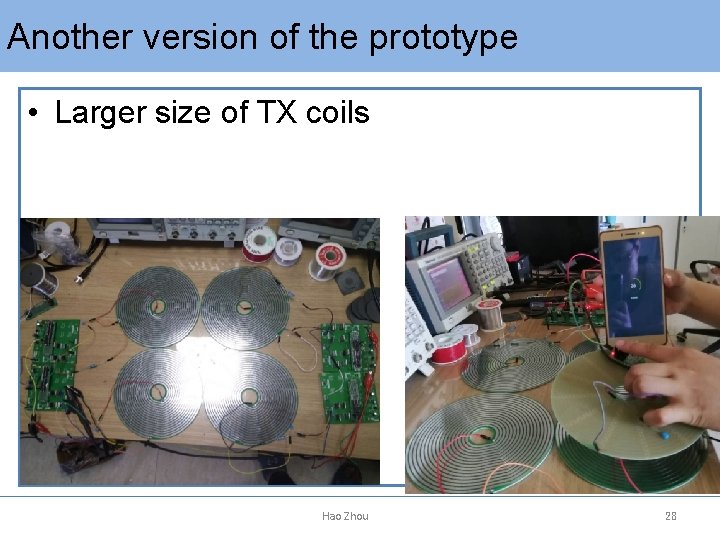
Another version of the prototype • Larger size of TX coils Hao Zhou 28
Outline • • • Background Problem formulation Problem solution Evaluation Prototype implementation Conclusion Hao Zhou 29
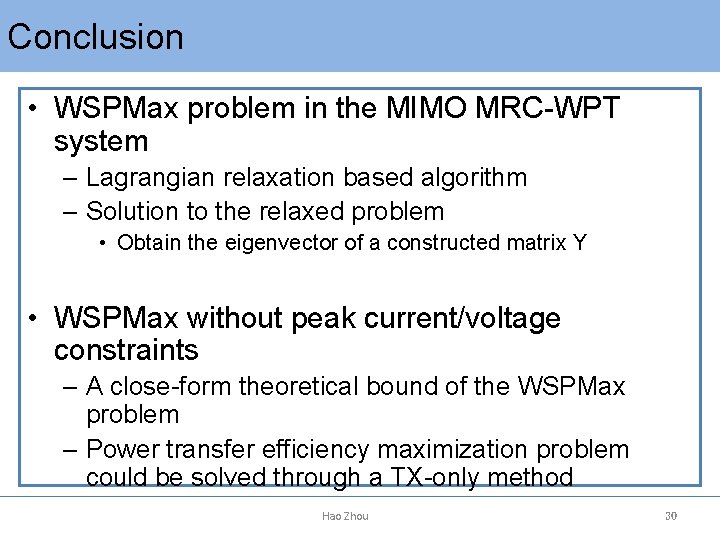
Conclusion • WSPMax problem in the MIMO MRC-WPT system – Lagrangian relaxation based algorithm – Solution to the relaxed problem • Obtain the eigenvector of a constructed matrix Y • WSPMax without peak current/voltage constraints – A close-form theoretical bound of the WSPMax problem – Power transfer efficiency maximization problem could be solved through a TX-only method Hao Zhou 30
Thanks! Thanks Hao Zhou
- Slides: 31