
Requirement Engineering Process Requirements Engineering Establishing what the
Requirement Engineering Process
Requirements Engineering • Establishing what the customer requires from a software system • what is it? • An important life cycle phase • Consists of two distinct activities - Requirements gathering and analysis - Requirements specification 2
Output of Requirements Analysis and Specification Stage • Software Requirements Specification (SRS) Document: • serves as contract between the customer and the developers. 3
What is a requirement? • It may range from a high-level abstract statement of a service or of a system constraint to a detailed mathematical functional specification • This is inevitable as requirements may serve a dual function – May be the basis for a bid for a contract therefore must be open to interpretation – May be the basis for the contract itself therefore must be defined in detail – Both these statements may be called requirements 4
Requirements definition/specification • Requirements definition – A statement in natural language plus diagrams of the services the system provides and its operational constraints. Written for customers • Requirements specification – A structured document setting out detailed descriptions of the system services. Written as a contract between client and contractor • Software specification – A detailed software description which can serve as a basis for a design or implementation. Written for developers 5
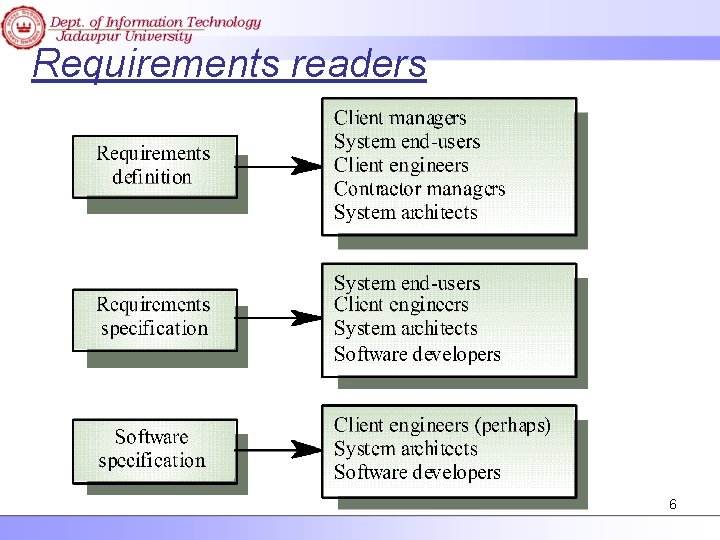
Requirements readers 6
The requirements engineering process • Feasibility study – Find out if the current user needs be satisfied given the available technology and budget? • Requirements analysis – Find out what system stakeholders require from the system • Requirements definition – Define the requirements in a form understandable to the customer • Requirements specification – Define the requirements in detail 7
Requirement Engineering Process Feasibility Study: - Does the system contribute to the overall objective of the Organization ? - Can the system be implemented with current technology, specified cost and schedule constraints ? - Can the system be integrated with the other systems which are already in place ? - Requirement Elicitation and Analysis - Interaction with the customer to understand the domains, scenarios, viewpoints, ethnograpfy etc.
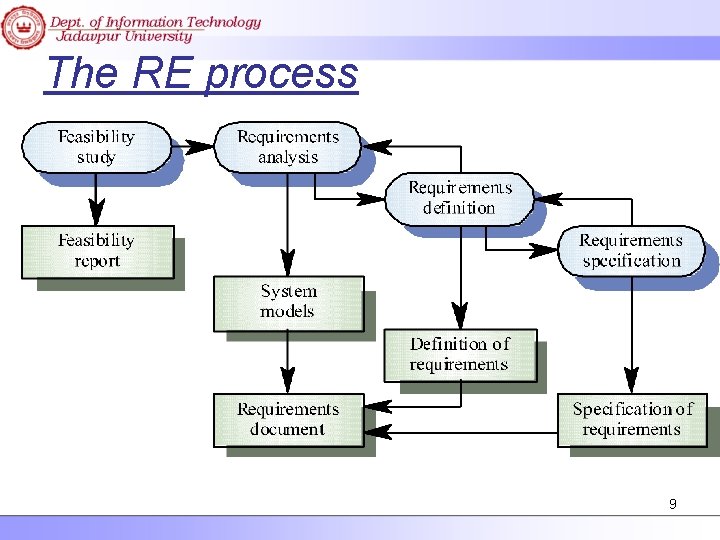
The RE process 9
The Requirements Document • The requirements document is the official statement of what is required of the system developers • Should include both a definition and a specification of requirements • It is NOT a design document. As far as possible, it should set of WHAT the system should do rather than HOW it should do it 10
Requirements document requirements • Specify external system behaviour • Specify implementation constraints • Easy to change • Serve as reference tool for maintenance • Record forethought about the life cycle of the system i. e. predict changes • Characterise responses to unexpected events 11
Requirements document structure • Introduction – Describe need for the system and how it fits with business objectives • Glossary – Define technical terms used • System models – Define models showing system components and relationships • Functional requirements definition – Describe the services to be provided 12
Requirements document structure • Non-functional requirements definition – Define constraints on the system and the development process • System evolution – Define fundamental assumptions on which the system is based anticipated changes • Requirements specification – Detailed specification of functional requirements • Appendices – System hardware platform description – Database requirements (as an ER model perhaps) • Index 13
Requirements validation • Concerned with demonstrating that the requirements define the system that the customer really wants • Requirements error costs are high so validation is very important – Fixing a requirements error after delivery may cost up to 100 times the cost of fixing an implementation error • Prototyping is an important technique of requirements validation 14
Requirements checking • Validity. Does the system provide the functions which best support the customer’s needs? • Consistency. Are there any requirements conflicts? • Completeness. Are all functions required by the customer included? • Realism. Can the requirements be implemented given available budget and technology 15
Types of Requirements • Functional requirements: – input/output – processing. – error handling. • Non-functional requirements: – Physical environment (equipment locations, multiple sites, etc. ). – Interfaces (data medium etc. ). – User & human factors (who are the users, their skill level etc. ). 16
Types of Requirements (Cont. ) • Non-functional requirements (continued): – – – Performance (how well is system functioning). Documentation. Data (qualitative stuff). Resources (finding, physical space). Security (backup, firewall). Quality assurance (max. down time, MTBF, etc. ). 17
Requirement Engineering Process System Model: § Three types of system modeling exists. § Data Requirements leads to Data Modeling and we get ERD ( Entity Relationship Diagram ) § Functional Requirements lead to Functional Modeling and we get DFD ( Data Flow Diagram ). It shows the information flow among various entities and functionalities. § Behavioral Requirements lead to Behavioral Modeling and we get STD ( State Transition Diagram)
- Slides: 18