
Required Communication Performance RCP Moving toward a performancebased
Required Communication Performance (RCP) Moving toward a performancebased air transportation system Presented to: ICAO Worldwide Symposium on Performance of the Air Navigation System By: Tom Kraft, FAA, Aviation Safety Chief Scientific and Technical Advisor (CSTA) for Aeronautical Communications Email: tom. kraft@faa. gov Mobile: 202 -369 -2168 Date: 26 -30 March 2007 Federal Aviation Administration

Overview • • Current situation A little about RCP Activities underway Outlook for implementation RCP 26 -30 March 2007 Federal Aviation Administration 2
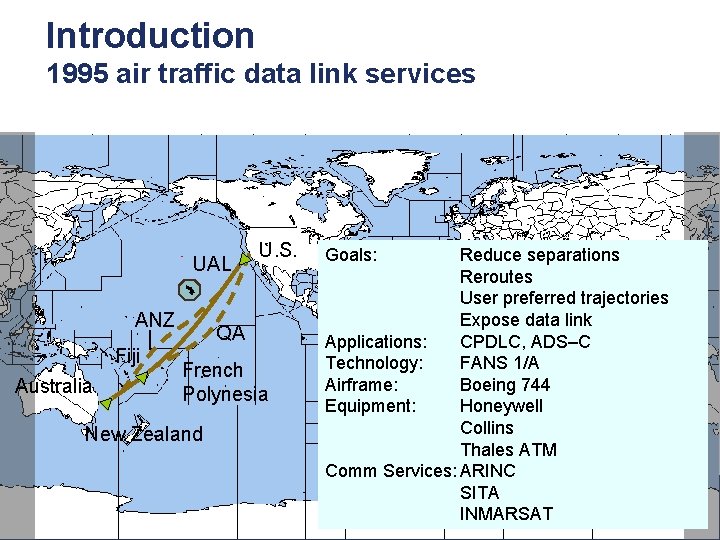
Introduction 1995 air traffic data link services UAL ANZ Fiji Australia QA French Polynesia New Zealand RCP 26 -30 March 2007 U. S. Goals: Reduce separations Reroutes User preferred trajectories Expose data link Applications: CPDLC, ADS–C Technology: FANS 1/A Airframe: Boeing 744 Equipment: Honeywell Collins Thales ATM Comm Services: ARINC SITA Federal Aviation Administration INMARSAT 3
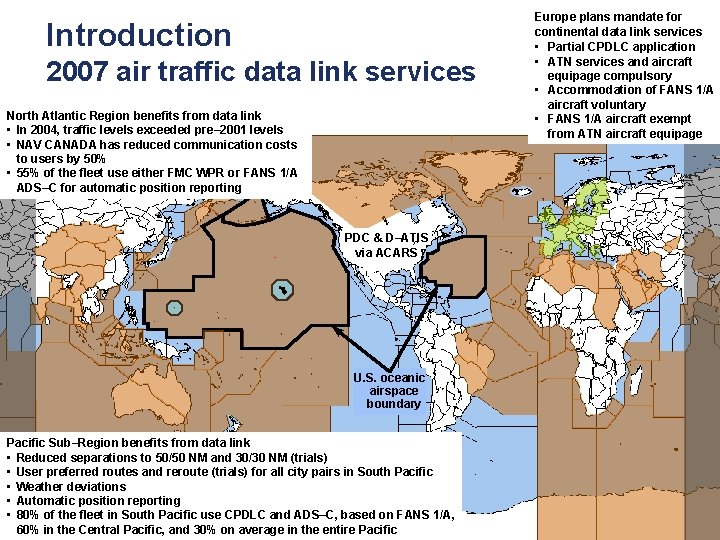
Introduction 2007 air traffic data link services North Atlantic Region benefits from data link • In 2004, traffic levels exceeded pre– 2001 levels • NAV CANADA has reduced communication costs to users by 50% • 55% of the fleet use either FMC WPR or FANS 1/A ADS–C for automatic position reporting Europe plans mandate for continental data link services • Partial CPDLC application • ATN services and aircraft equipage compulsory • Accommodation of FANS 1/A aircraft voluntary • FANS 1/A aircraft exempt from ATN aircraft equipage PDC & D–ATIS via ACARS U. S. oceanic airspace boundary Pacific Sub–Region benefits from data link • Reduced separations to 50/50 NM and 30/30 NM (trials) • User preferred routes and reroute (trials) for all city pairs in South Pacific • Weather deviations RCP • Automatic position reporting 26 -30 March 2007 • 80% of the fleet in South Pacific use CPDLC and ADS–C, based on FANS 1/A, 60% in the Central Pacific, and 30% on average in the entire Pacific Federal Aviation Administration 4
And then some • What will we do with – HF voice – INMARSAT Aero Classic Satellite Service • And what about – Voice communications, e. g. , INMARSAT, Iridium – Data communications, e. g. , HF Data Link, Iridium, Swift Broadband, Internet Protocol Suite (IPS) RCP 26 -30 March 2007 Federal Aviation Administration 5
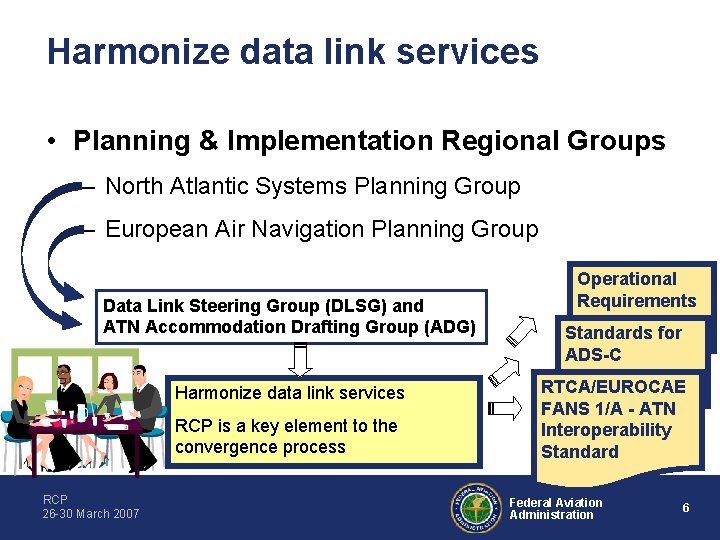
Harmonize data link services • Planning & Implementation Regional Groups – North Atlantic Systems Planning Group – European Air Navigation Planning Group Data Link Steering Group (DLSG) and ATN Accommodation Drafting Group (ADG) Harmonize data link services RCP is a key element to the convergence process RCP 26 -30 March 2007 Operational Requirements Standards for ADS-C RTCA/EUROCAE FANS 1/A - ATN Interoperability Standard Federal Aviation Administration 6
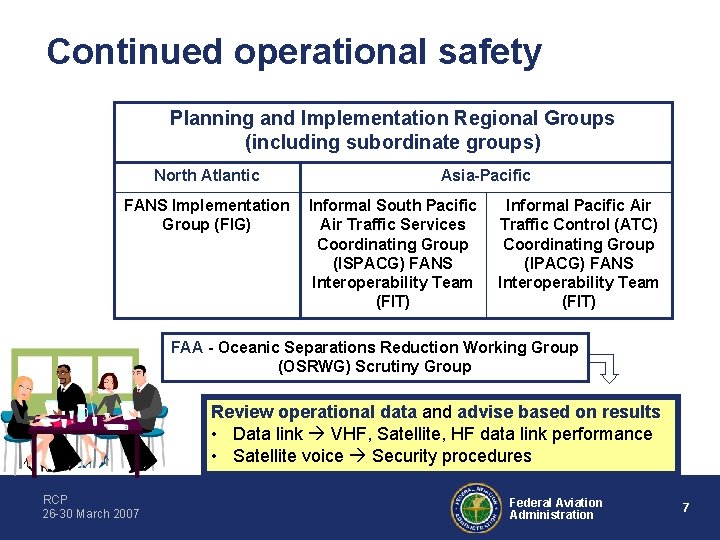
Continued operational safety Planning and Implementation Regional Groups (including subordinate groups) North Atlantic Asia-Pacific FANS Implementation Informal South Pacific Group (FIG) Air Traffic Services Coordinating Group (ISPACG) FANS Interoperability Team (FIT) Informal Pacific Air Traffic Control (ATC) Coordinating Group (IPACG) FANS Interoperability Team (FIT) FAA - Oceanic Separations Reduction Working Group (OSRWG) Scrutiny Group Review operational data and advise based on results • Data link VHF, Satellite, HF data link performance • Satellite voice Security procedures RCP 26 -30 March 2007 Federal Aviation Administration 7
Continued operational safety • Fluctuations in performance levels for commercial satellite services – Backups and redundancy – Dissimilar technologies, e. g. , Iridium, HF data link, INMARSAT, data/voice – What are the performance criteria, what needs to be monitored, and what is the decision process – What about predicted performance? RCP 26 -30 March 2007 Federal Aviation Administration 8
Standards & guidance material • ICAO completed standards and guidance material for RCP – Provisions for RCP in Annex 6 and Annex 11 – Manual on RCP ICAO Doc 9869 • RTCA SC-189/EUROCAE WG-53 completed standards for data link services – Continental Safety and Performance Standard – Oceanic Safety and Performance Standard RCP 26 -30 March 2007 Federal Aviation Administration 9
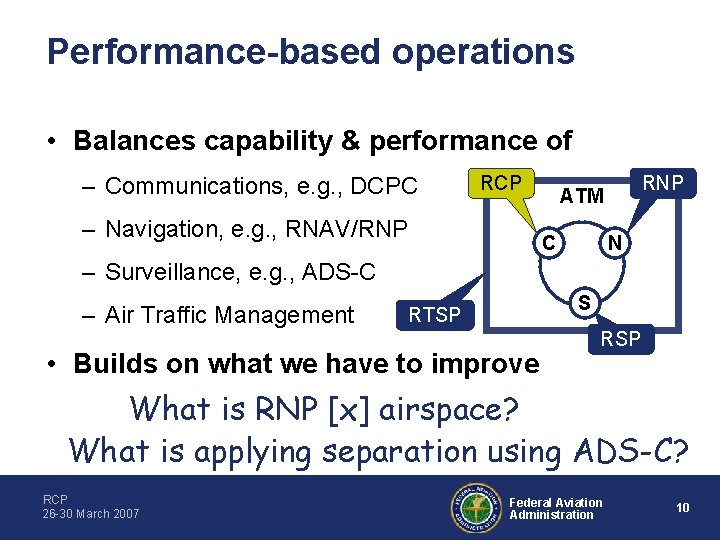
Performance-based operations • Balances capability & performance of – Communications, e. g. , DCPC RCP – Navigation, e. g. , RNAV/RNP ATM C N – Surveillance, e. g. , ADS-C – Air Traffic Management S RTSP • Builds on what we have to improve RSP What is RNP [x] airspace? What is applying separation using ADS-C? RCP 26 -30 March 2007 Federal Aviation Administration 10
Performance-based communications • RCP type specifies communication transaction time, continuity, availability, integrity • Other operational factors may be relevant, for example – Messages or phraseology, transaction types, and intended use – Interactive capability of voice communication – Air–ground integration capability of data communication – Performance monitoring and alerting – Adapting the airspace to changes in performance level RCP 26 -30 March 2007 Federal Aviation Administration 11
Objectives and benefits • Promotes a competitive market for aeronautical communication services enabling cost–effective alternatives that meet business needs in a more timely manner • Provides means to demonstrate communication performance using a variety of acceptable methods in lieu of time consuming data collection and empirical analyses • Defines “needed” operations based on communication performance levels that are not yet obtainable with current technology • Enables varying service levels in common airspace to a fleet of aircraft with varying communication capabilities and performances RCP 26 -30 March 2007 Federal Aviation Administration 12
Applicability • When a change is implemented in air traffic management (ATM) and/or flight operations • And the change is predicated on communication performance • Safety management and monitoring RCP 26 -30 March 2007 Federal Aviation Administration 13
What it does • Establishes operational criteria – Determines capability and performance criteria based on intended operations in oceanic, en route, terminal, and airport domains – Considers voice and data communications – Considers global seamless operations – Specifies RCP type and other relevant operational factors – Not based on any particular technology RCP 26 -30 March 2007 Federal Aviation Administration 14
How it is used • Performance-based criteria is used to – Determine viability of a particular technology – Qualify, certify, and approve various parts of an implementation – Manage performance levels needed to provide a basic level of service and, for eligible operators, higher levels of service • Real time monitoring and alerting (air and ground) • Historical monitoring and evaluation • Adapting the airspace based on the results of monitoring RCP 26 -30 March 2007 Federal Aviation Administration 15
Candidates for implementation • Reduced separation minima, new procedures, or increasing airspace capacity that requires a communication capability and performance • Operating in airspace with a basic level of service and, for eligible operators, with higher levels of service • Provision and use of air traffic service using non-traditional technology or mixed technologies • Communication capability installed on aircraft whose performance is suitable for use in some airspace, but not in others RCP 26 -30 March 2007 Federal Aviation Administration 16
PARC (Who - What) • Performance-Based Operations Aviation Rulemaking Committee (PARC) – Operates under the FAA Administrator’s legal authority in accordance with 49 USC 106(p)(5) – Comprises members from the aviation community at large and FAA – Provides recommendations to FAA’s Senior Management for action & implementation – Effective in implementing RNAV/RNP RCP 26 -30 March 2007 Federal Aviation Administration 17
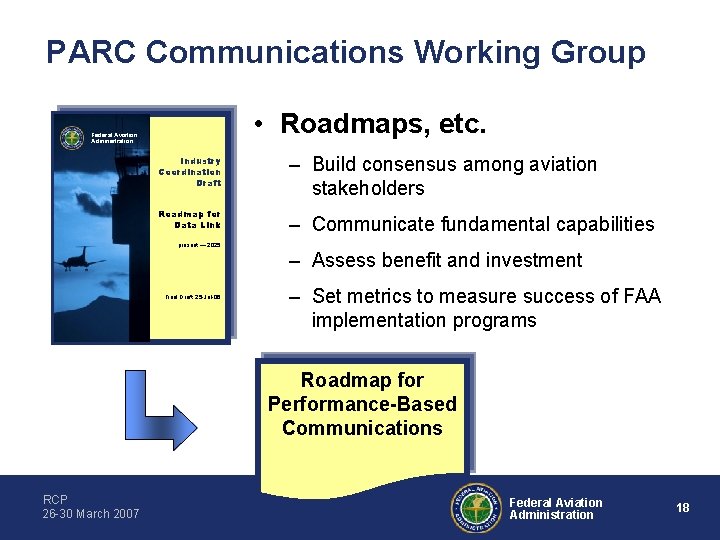
PARC Communications Working Group • Roadmaps, etc. Federal Aviation Administration Industry Coordination Draft – Build consensus among aviation stakeholders Roadmap for Data Link – Communicate fundamental capabilities present — 2025 Final Draft, 25 -Jul-06 – Assess benefit and investment – Set metrics to measure success of FAA implementation programs Roadmap for Performance-Based Communications RCP 26 -30 March 2007 Federal Aviation Administration 18

Outlook • Complete industry-coordinated Roadmap for Performance-Based Communications by September 2007 – What are the applications for performance-based communications – What standards are needed and schedule – What is the strategy for aircraft type certification, operational approval, and implementation RCP 26 -30 March 2007 Federal Aviation Administration 19

Outlook • Develop scenario outlines for implementation of RCP type, considering – Voice and Data communications to increase capacity – Oceanic and domestic (en route, terminal area, airport) – Operating in airspace with a basic level of service and, for eligible operators, with higher levels of service – Some existing communication capabilities and performance that are suitable only for basic level of service – Performance monitoring, alerting, based on RCP type, and adaptation RCP 26 -30 March 2007 Federal Aviation Administration 20
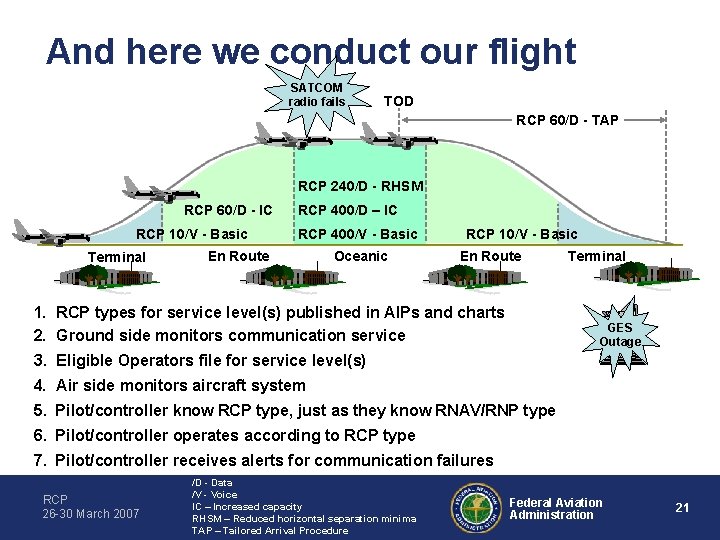
And here we conduct our flight SATCOM radio fails TOD RCP 60/D - TAP RCP 240/D - RHSM RCP 60/D - IC RCP 10/V - Basic Terminal RCP 400/D – IC RCP 400/V - Basic En Route Oceanic RCP 10/V - Basic En Route 1. RCP types for service level(s) published in AIPs and charts 2. Ground side monitors communication service Terminal GES Outage 3. Eligible Operators file for service level(s) 4. Air side monitors aircraft system 5. Pilot/controller know RCP type, just as they know RNAV/RNP type 6. Pilot/controller operates according to RCP type 7. Pilot/controller receives alerts for communication failures RCP 26 -30 March 2007 /D - Data /V - Voice IC – Increased capacity RHSM – Reduced horizontal separation minima TAP – Tailored Arrival Procedure Federal Aviation Administration 21

Thank you Federal Aviation Administration
- Slides: 22