
REQUEST FOR TENDER Request for a Proposal for


- Slides: 42
REQUEST FOR TENDER Request for a Proposal for the Appointment of a Suitable Service Provider to Audit Technical and Vocational Education and Training Colleges’ Immovable Assets by the Department of Higher Education and Training 24 -25 April 2018 Audit of Infrastructure 1
Submit proposals to develop on behalf of the TVET Colleges: • a TVET immovable asset register (NIAMMS) • conduct a conditional technical assessment to establish the status-quo of TVET infrastructure • load the data into an infrastructure software platform • recommend appropriate remedial interventions, prioritise these in terms of criticality, and • determine the associated cost estimates • develop the in-house capacity of officials to maintain the register; and • provide a suitably qualified and competent project manager (full time) Project to be complete by 31 August 2020 24 -25 April 2018 Audit of Infrastructure 2
SCOPE AND DEFINITION OF WORK • DHET provides the software platform (Archibus) & Smartphone App • review existing Infrastructure data: - Raw data and the reports from the TVET college Infrastructure Audit of 2005 (report, drawings and selected raw data are available). - TVET GRAP 17 asset registers (2016) audited by the Auditor General - Site layouts developed by individual colleges (where the site layout does not meet the standard, the provider will be required to amend/develop a new one). - Observation based Condition assessments of selected buildings and assets (Bulk & Essential Services Survey) • barcode each room (if not done by college • provide audit services for immovable assets (buildings & components) of TVET colleges • collect data where existing data is insufficient. • quality assure all data before loading into the software platform The audit shall include 50 TVET colleges Central Offices, 254 campuses, 88 other sites of activities. Current information indicates that there may be in excess of 3000 buildings (unverified) on these sites. 24 -25 April 2018 Audit of Infrastructure 3
Bidder’s Responsibilities Asset Register The provider shall segment and classify TVET college immovable asset portfolio(s) according to the NIAMMS, which requires the level of maintenancesignificant items in accordance with a predetermined asset hierarchy, determine and record the following information against each asset in its asset register: • Asset identification number; • Physical description; • Physical parameters; • Estimated useful life; • Actual and minimum acceptable asset failure mode ratings (condition, performance, capacity and cost-of-operations); • Remaining useful life; • Current and depreciated replacement cost; • Asset criticality rating; • Any statutory obligations regarding the operation and maintenance of the asset; and • Responsible person(s). . 24 -25 April 2018 Audit of Infrastructure 4
Condition Assessment Condition assessment/monitoring will be done according to the International Infrastructure Management Manual (IIMM). The service provider will identify all rooms in the facility and compile the work packages and photos (min 1 photo of approx. 150 kb per item) with specific reference to the relevant room. The purpose of this activity is to perform inspection, assessment, measurement and interpretation of the resultant data, to indicate the condition of a specific component so as to determine the need for preventive or remedial action. 24 -25 April 2018 Audit of Infrastructure 5
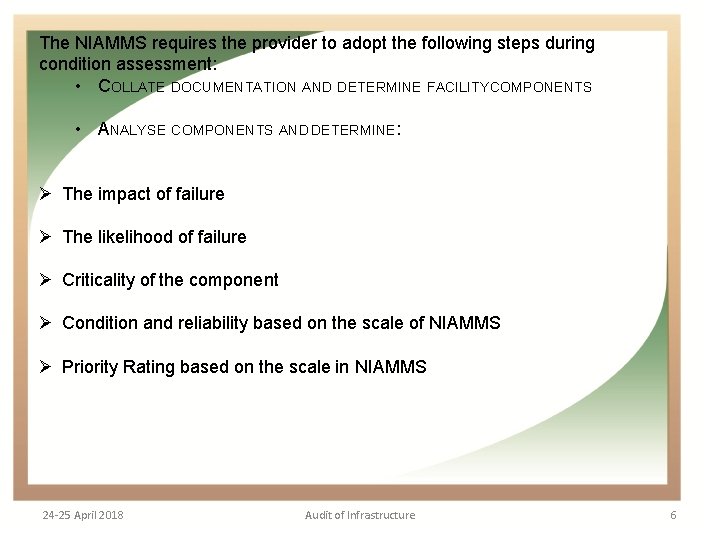
The NIAMMS requires the provider to adopt the following steps during condition assessment: • COLLATE DOCUMENTATION AND DETERMINE FACILITYC OMPONENTS • ANALYSE COMPONENTS AND DETERMINE: Ø The impact of failure Ø The likelihood of failure Ø Criticality of the component Ø Condition and reliability based on the scale of NIAMMS Ø Priority Rating based on the scale in NIAMMS 24 -25 April 2018 Audit of Infrastructure 6
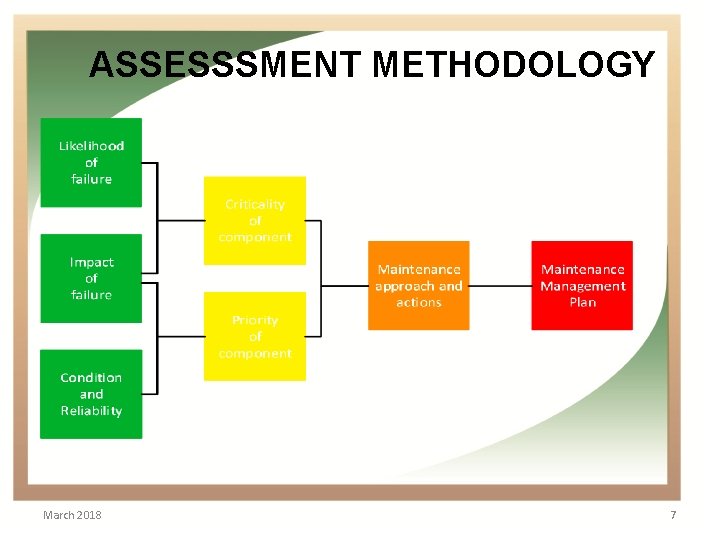
ASSESSSMENT METHODOLOGY March 2018 7
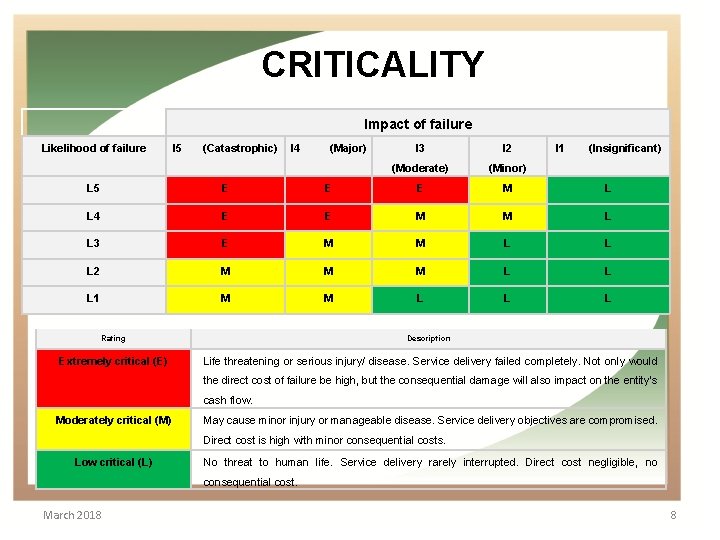
CRITICALITY Impact of failure Likelihood of failure I 5 (Catastrophic) I 4 (Major) I 3 I 2 (Moderate) (Minor) I 1 (Insignificant) L 5 E E E M L L 4 E E M M L L 3 E M M L L L 2 M M M L L L 1 M M L L L Rating Extremely critical (E) Description Life threatening or serious injury/ disease. Service delivery failed completely. Not only would the direct cost of failure be high, but the consequential damage will also impact on the entity’s cash flow. Moderately critical (M) May cause minor injury or manageable disease. Service delivery objectives are compromised. Direct cost is high with minor consequential costs. Low critical (L) No threat to human life. Service delivery rarely interrupted. Direct cost negligible, no consequential cost. March 2018 8
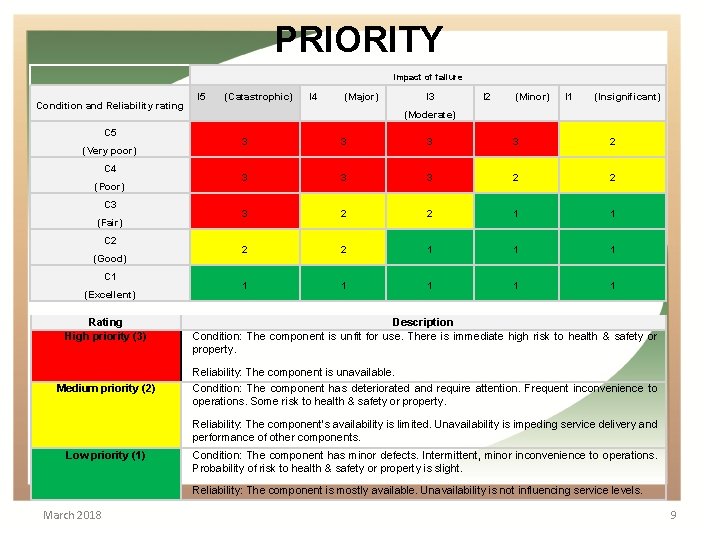
PRIORITY Condition and Reliability rating C 5 (Very poor) C 4 (Poor) C 3 (Fair) C 2 (Good) C 1 (Excellent) Rating High priority (3) Impact of failure I 5 (Catastrophic) I 4 (Major) I 3 I 2 (Minor) I 1 (Insignificant) (Moderate) 3 3 2 3 3 3 2 2 1 1 1 1 Description Condition: The component is unfit for use. There is immediate high risk to health & safety or property. Reliability: The component is unavailable. Medium priority (2) Condition: The component has deteriorated and require attention. Frequent inconvenience to operations. Some risk to health & safety or property. Reliability: The component’s availability is limited. Unavailability is impeding service delivery and performance of other components. Low priority (1) Condition: The component has minor defects. Intermittent, minor inconvenience to operations. Probability of risk to health & safety or property is slight. Reliability: The component is mostly available. Unavailability is not influencing service levels. March 2018 9
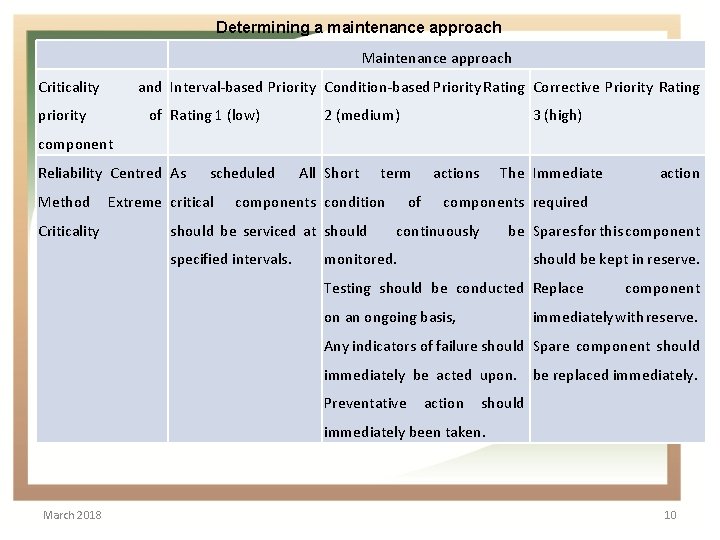
Determining a maintenance approach Maintenance approach Criticality priority and Interval-based Priority Condition-based Priority Rating Corrective Priority Rating of Rating 1 (low) 2 (medium) 3 (high) component Reliability Centred As scheduled Method Extreme critical Criticality All Short term components condition should be serviced at should specified intervals. of actions The Immediate action components required continuously be Spares for this component monitored. should be kept in reserve. Testing should be conducted Replace on an ongoing basis, component immediately with reserve. Any indicators of failure should Spare component should immediately be acted upon. be replaced immediately. Preventative action should immediately been taken. March 2018 10
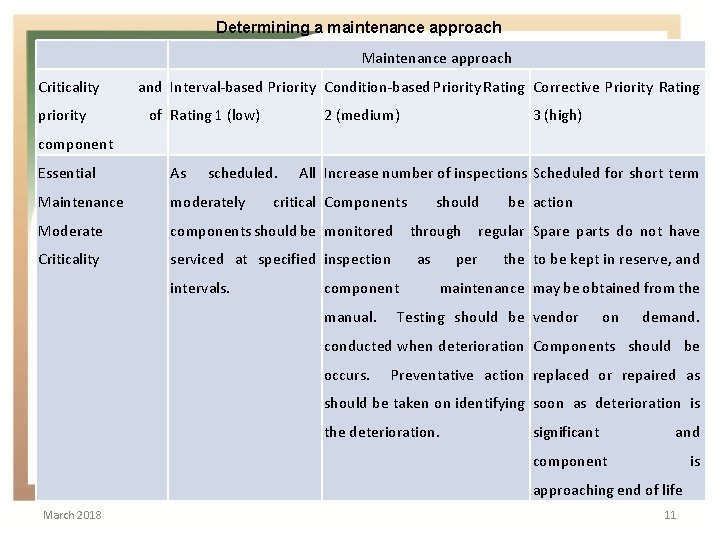
Determining a maintenance approach Maintenance approach Criticality priority and Interval-based Priority Condition-based Priority Rating Corrective Priority Rating of Rating 1 (low) 2 (medium) 3 (high) component Essential As scheduled. Maintenance moderately Moderate components should be monitored through regular Spare parts do not have Criticality serviced at specified inspection intervals. All Increase number of inspections Scheduled for short term critical Components component should as per be action the to be kept in reserve, and maintenance may be obtained from the manual. Testing should be vendor on demand. conducted when deterioration Components should be occurs. Preventative action replaced or repaired as should be taken on identifying soon as deterioration is the deterioration. significant and component is approaching end of life March 2018 11
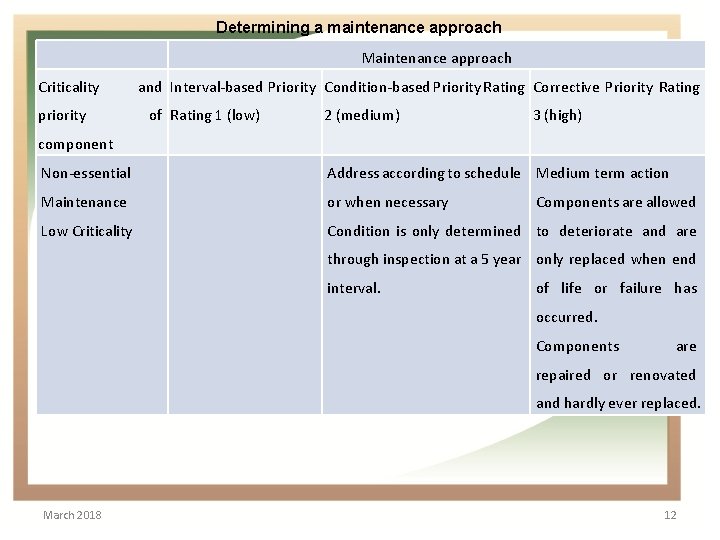
Determining a maintenance approach Maintenance approach Criticality priority and Interval-based Priority Condition-based Priority Rating Corrective Priority Rating of Rating 1 (low) 2 (medium) 3 (high) component Non-essential Address according to schedule Medium term action Maintenance or when necessary Components are allowed Low Criticality Condition is only determined to deteriorate and are through inspection at a 5 year only replaced when end interval. of life or failure has occurred. Components are repaired or renovated and hardly ever replaced. March 2018 12
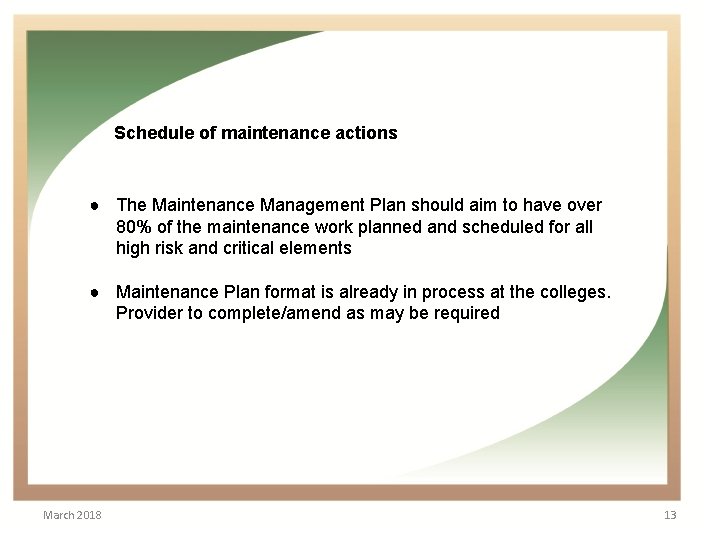
Schedule of maintenance actions ● The Maintenance Management Plan should aim to have over 80% of the maintenance work planned and scheduled for all high risk and critical elements ● Maintenance Plan format is already in process at the colleges. Provider to complete/amend as may be required March 2018 13
Elements for assessment • • • • Building structure, both internal and external; Civil works, both internal and external; Mechanical systems, both internal and external; Electrical services, both internal and external; Lifts and escalators; Wet services, both internal and external; Waste water services (Bulk Services); Fire safety and protection compliance (as per statutory requirements); Fire detection; Basic data and telecommunication (connection points only); Environmental aspects, landscape irrigation and solid waste management; Site safety and security; and Occupational health and safety compliance. March 2018 14
NIAMMS specific Elements • The provider shall check conformity of TVET college immovable assets according to IOS 55 000; • The assessment shall also indicate the buildings and particular parts that require corrective maintenance; • The provider shall identify critical immovable assets according to IIMM; • The assessment shall provide the current replacement cost according to IIMM; • The assessment shall provide necessary information related to decommissioning according to IIMM; and • The assessment shall cover depreciated replacement cost according to IIMM which is also reflected in NIAMMS and GRAP. NOTE: Colleges are currently on GRAP. Where NIAMMS is different both are to be stated March 2018 15
RECOMMENDED PROCEDURES FOR AUDITING • Prepare and sign-off asset hierarchy (project documents mention the level of audit details as per campus/satellite, per building, per room); • List and compile the list of items to be included in the audit and sign off (the project documents mention buildings of TVET colleges and campuses); • Produce the list of reports showing the content and formats, specifications, user/custodian, and asset maintenance plan according to NIAMMS, GIAMA and GRAP 17. This will be done during integration of data collection and TIMIS database; • Finalise and sign off the list of buildings that qualify for audit; • Perform desk assessment using data from available sources i. e. 2005 audit, TVET asset registers, existing sites layout, and rooms’ barcodes; • Set up the timetable for audit showing distribution of company’s personnel with involvement of DHET, Regional, and TVET personnel; March 2018 16
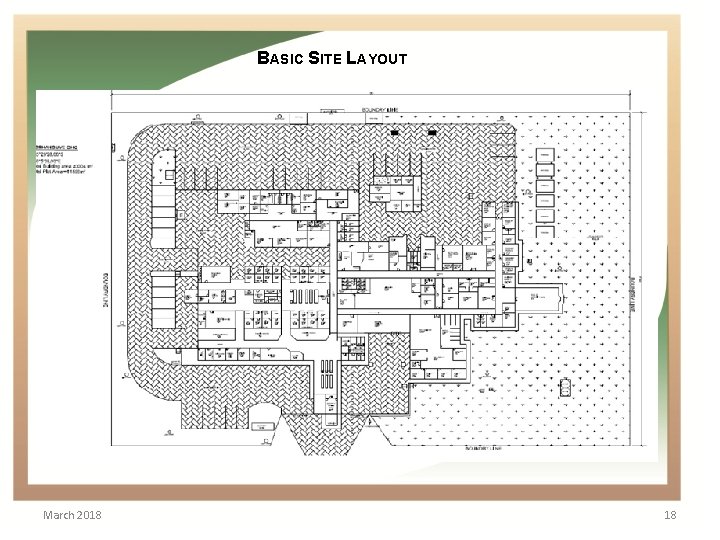
RECOMMENDED PROCEDURES FOR AUDITING • Configure smart-phone software/App that can be used to capture data (GPS codes, pictures, upload files, read barcodes, etc. ). The configuration shall be able to submit data to the TIMIS database. This exercise will involve audit provider, TIMIS provider, DHET, and TVET personnel; • Deploy teams (Company’s personnel, DHET, and TVET personnel) to the sites; an example of a site layout is included; • Conduct quality assurance for data collected from the existing data and from sites before loading into the TIMIS database; and • Submit final reports (including drawings, photos, data transferred to TIMIS) and the database in a separate storage as backup to be kept by DHET. The reports shall also show the room/space ID from the barcode. March 2018 17
BASIC SITE LAYOUT March 2018 18
BASIC SITE LAYOUT DRAWING • The service provider shall review the site layout developed by colleges to quality assure and fill the gaps. The provider shall develop site layouts for TVET colleges which are either inadequate or not available. • The site layouts shall include the layout of all the structures and buildings on the site, indicating the boundary fence, connection points and manholes of all water, electricity, sewer, etc. on site as well as in the buildings. • The drawings also need to indicate the space inside each building: room number (as designated at site), barcode number and the size of each room. The drawing must be to scale in DWG format (AUTO CAD. DWG), PDF format plus a Win. Word version (for colleges to maintain after audit). March 2018 19
BARCODING The provider shall install durable barcodes stickers in each room found not to have them during auditing. The barcode verifiers shall comply with the ISO/IEC 15426 -2 (2 D) or ISO/IEC 15415 (2 D) or International Standard: ISO/IEC 18004 to allow smart-phones camera reading from them. This data will later be stored in TIMIS database March 2018 20
T RAINING REQUIREMENT • • • The service provider shall train 382 users from the department, regional offices, and TVET colleges in infrastructure management. NIAMMS requires personnel dealing with the infrastructure management to have the following competency: INTRODUCTION TO INFRASTRUCTURE MANAGEMENT IN SOUTH AFRICA MAINTENANCE PLANNING MAINTENANCE OPERATIONS MANAGEMENT MAINTENANCE MONITORING RECORDS AND KNOWLEDGE MANAGEMENT PERFORMANCE MANAGEMENT AND REPORTING March 2018 21
The following are details of the training areas that shall be covered by the provider: • Introduction to public immovable assets management • The South Africa legal framework and standards guiding immovable asset management: • Guiding standards (NIAMMS, GRAP 17, GIAMA, etc) • Asset Registers (the immovable assets register: Best practice and requirements, integration and updating, maturity matrix, practical assessment of the organization, compiling audit plans for immovable assets): Maintenance planning • Align maintenance plans with department/TVET plans • Collate documentation and determine facility components • Analyze components to determine the impact and the likelihood of failure • Assess the condition and determine the reliability of components • Determine the criticality of a component • Determine a maintenance approach • Schedule maintenance actions • Cost maintenance actions • Prepare a maintenance budget March 2018. 22
The following are details of the training areas that shall be covered by the provider: Maintenance Operations Management (Introduction & Basics) • Scheduling work and resource planning • Planning shutdown or outage (including demand management and decanting) & Prepare job cards • Manage outsourcing of work: Ø developing specifications for work; Ø procuring service providers; Ø managing contracts; Ø managing access to site; Ø verifying and signing off of work; and Ø completing job cards and paying service providers. Manage stores (Introduction & Basics): Ø purchasing spares and tools; Ø managing and controlling stock levels; and Ø issuing of spares and tools. Manage Safety, Health and Environment. March 2018 23
Re-commission components after shutdown or outage Maintenance monitoring function Record maintenance calls and determine maintenance actions Assessing the condition of a facility or component Monitoring condition & Testing Components Analyzing historic maintenance information Records and knowledge management function Ø Maintenance records management Ø Knowledge management Ø Maintenance Management System Performance management and reporting function Ø Assessing the current state of maintenance management performance Ø Developing performance improvement targets Ø Monitoring maintenance actions implemented against the maintenance plan Monthly reporting against the maintenance plan March 2018 24
• • Quarterly performance reviews Analyzing and planning corrective actions Transfer of data to TIMIS database Practical session (includes application of auditing tools); • Infrastructure Management Software Training (train the trainer and first cohort of users) to be done by TIMIS software provider. March 2018 25
Training Programme ● Develop the training strategy for approval by the Department; ● Develop a training model for trainers and end users for approval by the Department; ● Develop the training curriculum (in consultation with the Software Provider, Colleges and the Department) for approval by the Department; ● The service provider must include in their bid a training proposal (regional combinations, number of learners etc. ) which will optimise the learning outcomes as listed. The combinations of colleges and regions is at the discretion of the service provider. The successful bidders training proposal may be subject to review before implementation; March 2018 26
Training Programme ● The Department will set the location for training once the approach has been agreed with the service provider. The Department will ensure classrooms, computers, printers and the required connectivity are available; ● The service provider shall in addition provide “train the trainers” training for 10 officials, whom will be selected in consultation with the Department; ● The responsibility for the training of end users lies with the service provider. The Users who successfully complete the Trainers Programmes may be deployed to conduct user training under the supervision of the service provider; ● The ownership and intellectual property rights of all training materials (hard and electronic copies) shall vest in the DHET. • March 2018. 27
DELIVERABLES • Ensure that all the deliverables as per these terms of reference will be implemented within budget, quality, time and scope; • Ensure that teaching services continue undisturbed during assessment; • Ensure that the departmental and college management is fully aware of the delivery programme and project progress; • Ensure that data collected from existing data and from sites is successfully transferred to departments software platform; • Ensure resolution of any possible problems that may arise in the delay of any activity that is implemented at the facilities; • Provide progress reports to the Departments project management on weekly basis; and • Ensure that Departmental, Regional, and TVET College personnel are fully involved in implementation of this project for maximum skills March 2018 transfer. 28
DELIVERABLES • Immovable Asset Maintenance Plan per campus per college as per NIAMMS; • Site Specific Compliance (OSH Act, fire, mission critical such as electricity, water, ablution facilities, etc. ) requirements with costing details (Available reports from colleges may be used and verified during the audit); • Installation of durable barcodes stickers in each room found not to have them during auditing, with the intention to have barcoded Unique Identifying Number (UID). • A database/details will link the UID to relevant information about the room/space such as name of the college, Campus/Satellite, building, and the room/space; use of the room/space, when was it built, ownership, GPS codes, etc. • Barcode verifiers shall comply with the ISO/IEC 15426 -2 (2 D) or ISO/IEC 15415 (2 D) or International Standard: ISO/IEC 18004 to allow smartphones camera reading from them. This data will later be stored in TIMIS database; March 2018 29
DELIVERABLES • Training for DHET, Regional, and TVET personnel; and • A dedicated full time Project Manager for the project who must be based at the Department. The Project Manager will be responsible to draw up a full project implementation plan and to ensure that it is effectively implemented. The Project manager is to have at least 5 years’ experience in project management of similar projects. March 2018 30
MONITORING Monitoring will be conducted by the Project Management Team which will be chaired by TVET Infrastructure project manager from DHET. This team will be meeting on a monthly basis and will have, amongst others, the following functions: • Ensure the project schedule and budget is maintained; • Ensure the required quality standard are met for the whole project and its components (within agreed specifications); • Ensure required resources for project implementation are supplied in time and within the set standards; • Receive and discuss monthly progress reports from service providers; • Receive and discuss reports from technical support team; • Ensure project deliverables are delivered in time and within the required quality; • Conduct other aspects of monitoring and evaluation for TVET infrastructure project as may be required. March 2018 31
REPORTING The Project Manager provided by the service provider (in addition to project management responsibilities) will be responsible for the following written reports: • The service provider will report to the Implementation Manager: TVET Infrastructure Development Programme and submit work-in progress reports by email to the Architect: TVET Infrastructure Development Programme by close of business every Friday. • For each deliverable, as identified in Part A – Information on the Tender, paragraph 4, the service provider will submit, weekly, progress reports to the Department in line with approved timeframes in the project plan. The reports should be in MS Word and submitted electronically to the Implementation: TVET Infrastructure Development Programme. • In addition to the above and in conjunction with deliverables submitted, sectional compliance pre-assessment, practical completion preassessment and final works pre-assessment reports. • Any other report as relevant to the project as may be requested by the Department. March 2018 32
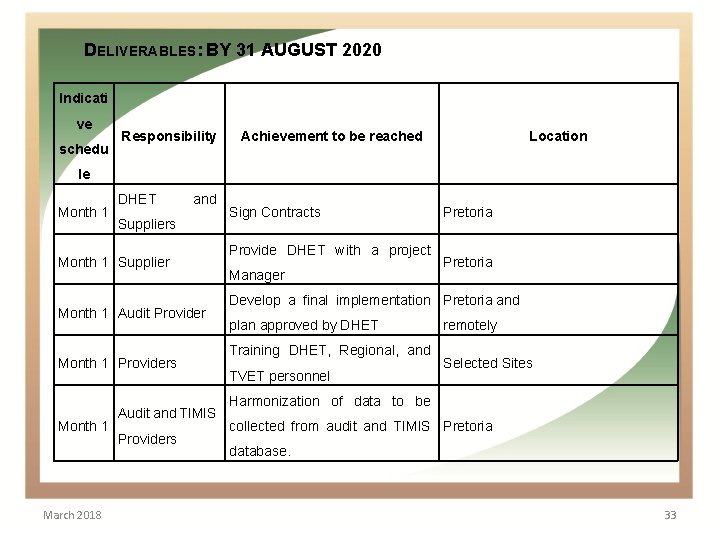
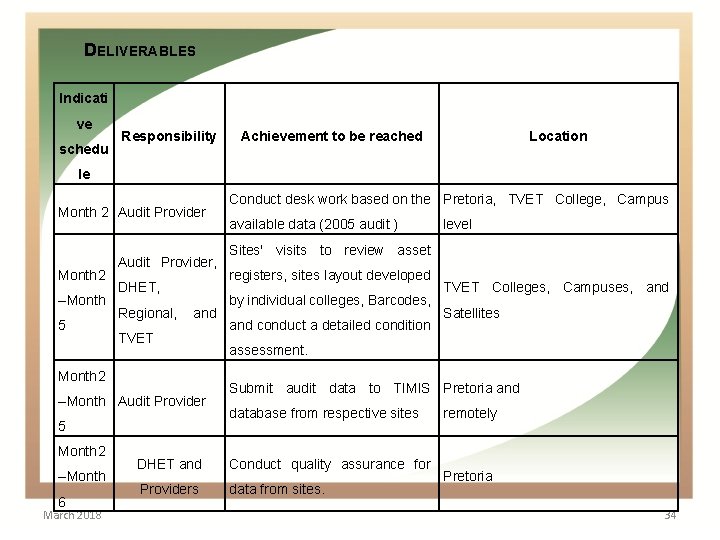
DELIVERABLES: BY 31 AUGUST 2020 Indicati ve schedu Responsibility Achievement to be reached Location le Month 1 DHET and Suppliers Month 1 Supplier Month 1 Audit Provider Month 1 Providers Month 1 March 2018 Audit and TIMIS Providers Sign Contracts Provide DHET with a project Manager Pretoria Develop a final implementation Pretoria and plan approved by DHET Training DHET, Regional, and TVET personnel remotely Selected Sites Harmonization of data to be collected from audit and TIMIS Pretoria database. 33
DELIVERABLES Indicati ve schedu Responsibility Achievement to be reached Location le Month 2 Audit Provider Month 2 – Month 5 Audit Provider, DHET, Regional, and TVET Month 2 – Month Audit Provider 5 Month 2 – Month 6 March 2018 Conduct desk work based on the Pretoria, TVET College, Campus available data (2005 audit ) level Sites' visits to review asset registers, sites layout developed by individual colleges, Barcodes, and conduct a detailed condition TVET Colleges, Campuses, and Satellites assessment. Submit audit data to TIMIS Pretoria and database from respective sites remotely DHET and Conduct quality assurance for Providers data from sites. Pretoria 34
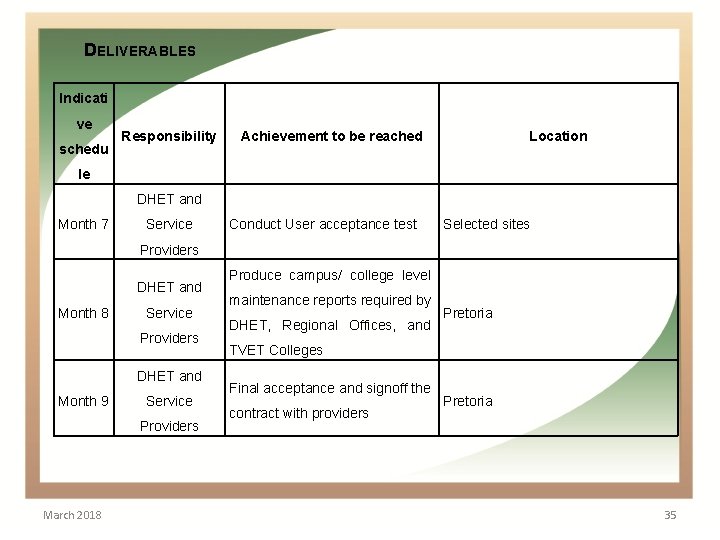
DELIVERABLES Indicati ve schedu Responsibility Achievement to be reached Location le DHET and Month 7 Service Conduct User acceptance test Selected sites Providers DHET and Month 8 Service Providers DHET and Month 9 Service Providers March 2018 Produce campus/ college level maintenance reports required by DHET, Regional Offices, and Pretoria TVET Colleges Final acceptance and signoff the contract with providers Pretoria 35
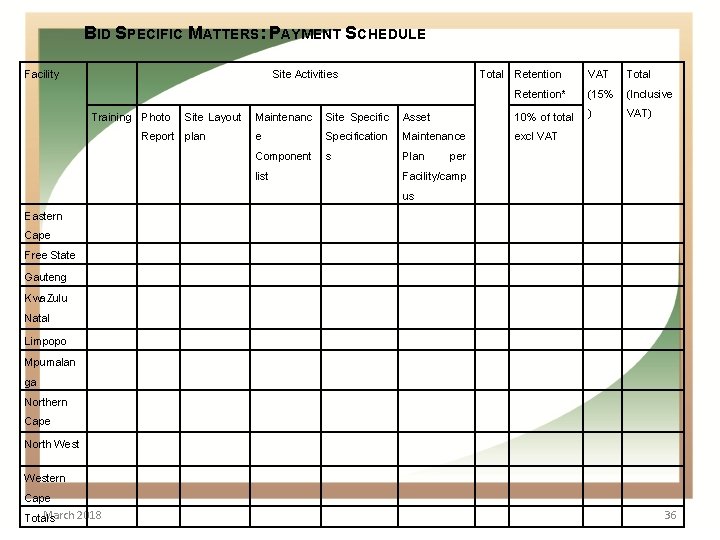
BID SPECIFIC MATTERS: PAYMENT SCHEDULE Facility Site Activities Total Retention VAT Retention* Training Photo Site Layout Maintenanc Report plan e (15% Site Specific Asset 10% of total ) Specification excl VAT Maintenance Component s Plan list Facility/camp Total (Inclusive VAT) per us Eastern Free State Gauteng Kwa. Zulu Limpopo Mpumalan North West Western Cape Natal ga Northern Cape March 2018 Totals 36
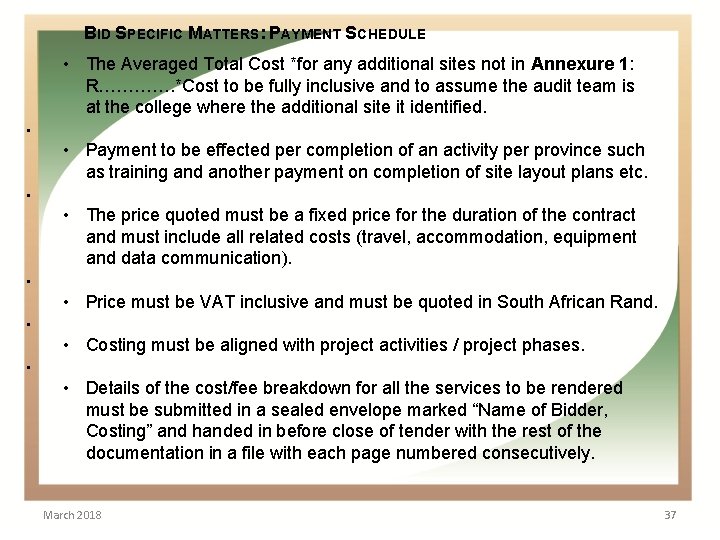
BID SPECIFIC MATTERS: PAYMENT SCHEDULE • The Averaged Total Cost *for any additional sites not in Annexure 1: R…………. *Cost to be fully inclusive and to assume the audit team is at the college where the additional site it identified. • • Payment to be effected per completion of an activity per province such as training and another payment on completion of site layout plans etc. • • The price quoted must be a fixed price for the duration of the contract and must include all related costs (travel, accommodation, equipment and data communication). • • Price must be VAT inclusive and must be quoted in South African Rand. • • Costing must be aligned with project activities / project phases. • • Details of the cost/fee breakdown for all the services to be rendered must be submitted in a sealed envelope marked “Name of Bidder, Costing” and handed in before close of tender with the rest of the documentation in a file with each page numbered consecutively. March 2018 37
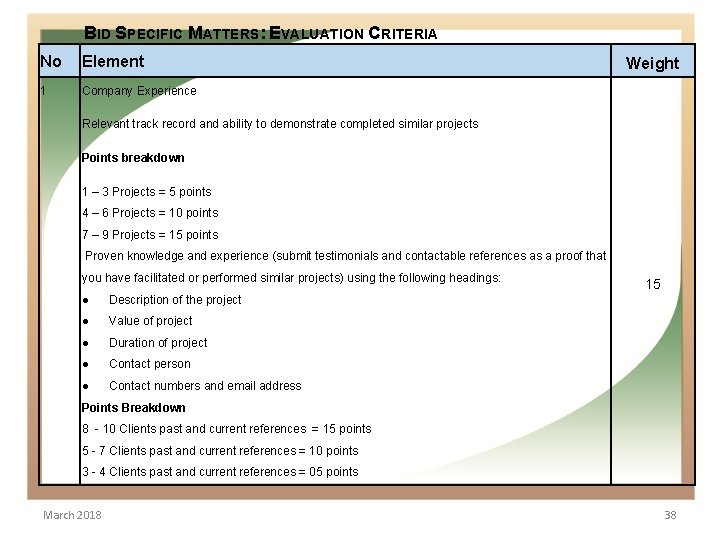
BID SPECIFIC MATTERS: EVALUATION CRITERIA No • Element. 1 Weight Company Experience Relevant track record and ability to demonstrate completed similar projects Points breakdown 1 – 3 Projects = 5 points 4 – 6 Projects = 10 points 7 – 9 Projects = 15 points Proven knowledge and experience (submit testimonials and contactable references as a proof that you have facilitated or performed similar projects) using the following headings: ● Description of the project ● Value of project ● Duration of project ● Contact person ● Contact numbers and email address 15 Points Breakdown 8 - 10 Clients past and current references = 15 points 5 - 7 Clients past and current references = 10 points 3 - 4 Clients past and current references = 05 points March 2018 38
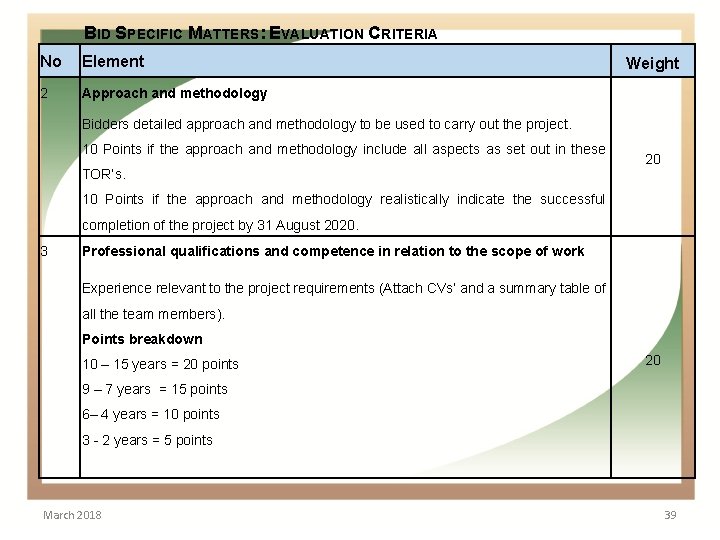
BID SPECIFIC MATTERS: EVALUATION CRITERIA No • Element. 2 Weight Approach and methodology Bidders detailed approach and methodology to be used to carry out the project. 10 Points if the approach and methodology include all aspects as set out in these TOR’s. 20 10 Points if the approach and methodology realistically indicate the successful completion of the project by 31 August 2020. 3 Professional qualifications and competence in relation to the scope of work Experience relevant to the project requirements (Attach CVs’ and a summary table of all the team members). Points breakdown 10 – 15 years = 20 points 20 9 – 7 years = 15 points 6– 4 years = 10 points 3 - 2 years = 5 points March 2018 39
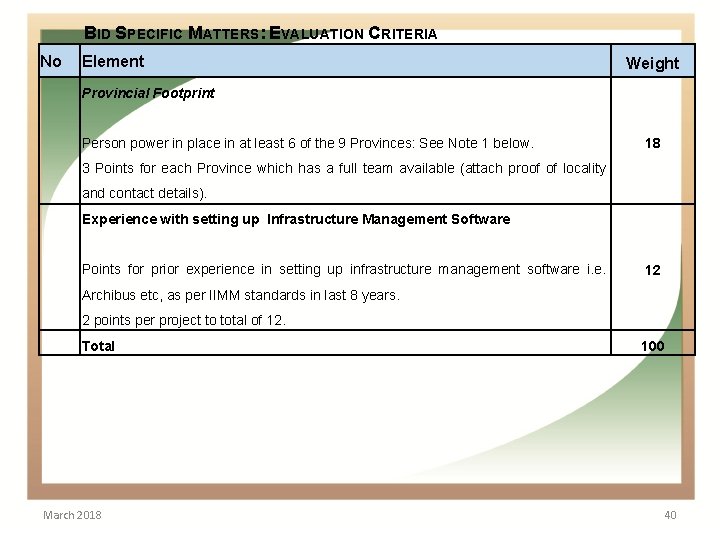
BID SPECIFIC MATTERS: EVALUATION CRITERIA No • Element. Weight Provincial Footprint Person power in place in at least 6 of the 9 Provinces: See Note 1 below. 18 3 Points for each Province which has a full team available (attach proof of locality and contact details). Experience with setting up Infrastructure Management Software Points for prior experience in setting up infrastructure management software i. e. 12 Archibus etc, as per IIMM standards in last 8 years. 2 points per project to total of 12. Total March 2018 100 40
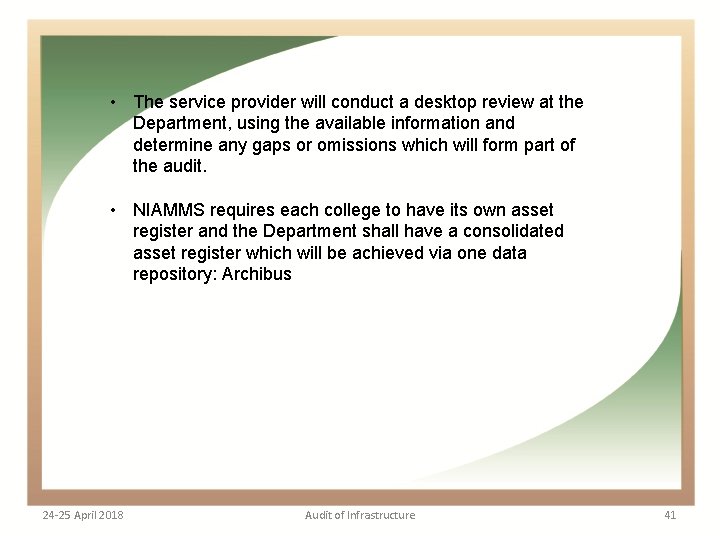
• The service provider will conduct a desktop review at the Department, using the available information and determine any gaps or omissions which will form part of the audit. • NIAMMS requires each college to have its own asset register and the Department shall have a consolidated asset register which will be achieved via one data repository: Archibus 24 -25 April 2018 Audit of Infrastructure 41
FINISH THANK YOU 24 -25 April 2018 Audit of Infrastructure 42