
Reputation Management Reputation entails two main components namely

- Slides: 59
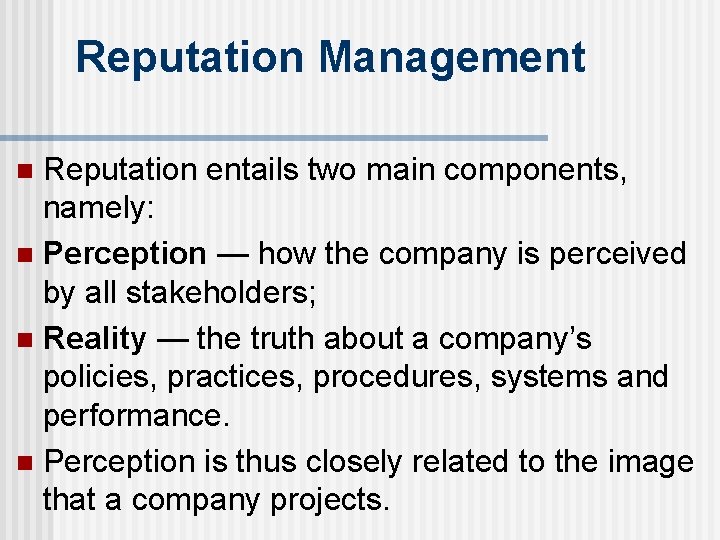
Reputation Management Reputation entails two main components, namely: n Perception — how the company is perceived by all stakeholders; n Reality — the truth about a company’s policies, practices, procedures, systems and performance. n Perception is thus closely related to the image that a company projects. n
Another way of defining the elements of reputation is to represent it as consisting of: n Images — what stakeholders think of the company. n Identity — what the company says it is. n Personality — what the company is all about. n Note: The alignment of these factors is vital if we want to build, sustain and protect an organisation’s reputation
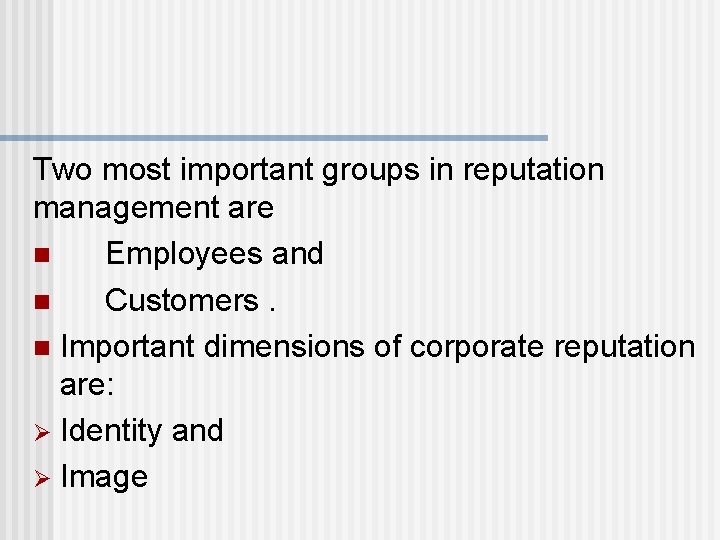
Two most important groups in reputation management are n Employees and n Customers. n Important dimensions of corporate reputation are: Ø Identity and Ø Image
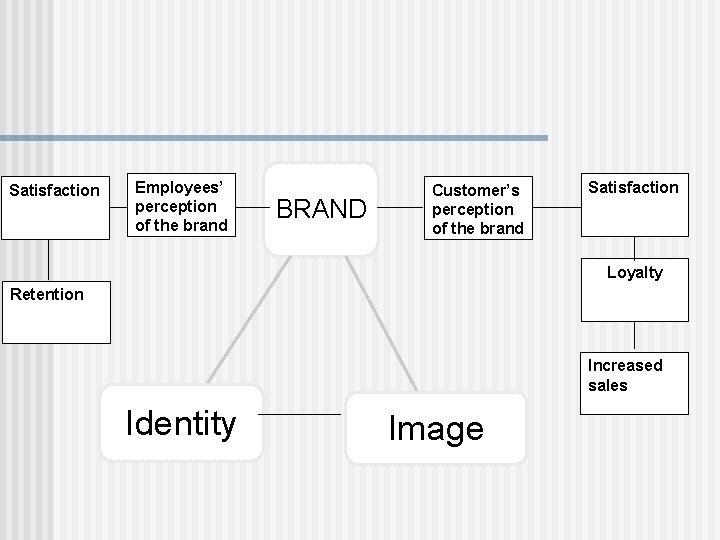
Satisfaction Employees’ perception of the brand BRAND Customer’s perception of the brand Satisfaction Loyalty Retention Increased sales Identity Image
History of Corporate Image n Emerged around the middle of 20 th century n Originally understood as symbolism
Definition: Corporate Image n n …what makes a company unique and special. It’s the company's approach to business, its values and business culture. This will be reflected in the way the company works, the quality of its products, its communication and marketing strategies, its management and leadership style and its visual appearance.
Definition: Corporate identity n Van Riel (1995: 27) : Corporate identity can be seen as ‘the self-portrayal of an organisation, i. e. the cues or signals it offers via its behaviour, communication and symbolism’.
Corporate identity n …can be defined as ”the sum of all methods an organisation uses, willingly and unwillingly, to identify itself to its publics. This is based on an organisation’s philosophy (goals, vision, mission), history, people and its aesthetic expression. “
Corporate culture n n One of the most important parts of CI is corporate culture Corporate culture focuses on the human part of the organisation, the ‘language, norms, folklore, ceremonies, and other social practices that communicate the key ideologies, values and beliefs guiding action'. (Morgan, 1986: 135)
Aim of a corporate identity Internal goals: n Raising motivation and morale n Rationalisation and cost reduction n Inspiring confidence among the external target publics n Acknowledging the vital role of the customer n Acknowledging the vital role of financial target groups
The components of CI strategy n Corporate behaviour n Visual identity n Corporate communications
Corporate behaviour How an organisations interacts with its n employees n customers n financial stakeholders n government and society Happy? ?
Corporate behaviour n Corporate behaviour follows the parameters of the lived corporate culture n This requires careful design and implementation of a corporate vision or mission
Vision/mission A vision or mission contributes to the organisation’s goals in a variety of ways: • It informs staff about the desired values and norms of the organisation. • It contributes to the development of specific guidelines for employees and their work
Vision / mission cntd • It supports management in providing appropriate and systematic leadership for the organisation. • It can show the individual employee how he or she can contribute through their own behaviour to the achievement of the organisation's goals. • A vision or mission is also of external value as it defines how an organisation perceives itself.
Visual identity or corporate design n It’s the visual representation of an organisation’s identity n 'The visual style of a company influences its place in the market, and how the company's goals are made visible in its design and behaviour. ' (Olins, 1989).
Corporate design includes various elements Logo n Colours n Typefaces for stationary and slogans n
Logo Its aim is to 'encapsulate in a simple memorable form the central attribute or attributes of an organisation [and to] trigger appropriate associations and responses' (Bromley, 1993: 158)
Characteristics of a logo • It attracts attention and works as a signpost. • It is informative and memorable. • It is of aesthetic value that doesn't date easily. • It can easily be adapted to a variety of contexts and frameworks
Colour Another design element that can be used for quick identification purposes n Red colour of Coca-Cola n Blue Boots n Green: Marks & Spencer n Orange - clever example of combining colour & slogan n
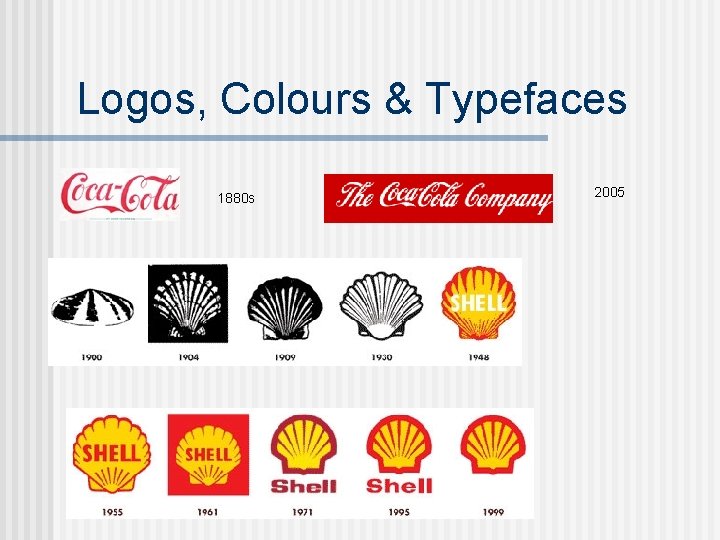
Logos, Colours & Typefaces 1880 s 2005
Typefaces n n The use of a particular typeface can also express identity through the use of conservative typefaces such as Courier or Times or more innovative designs such as Avant Garde. However, it is crucial to consider the lifecycle of style elements and the costs involved should they date quickly.
n n n The British Airways logo was designed in 1997 by Newell & Sorrell. The colours are blue (Pantone 281) and red (Pantone 485). The additional colour is grey (Pantone 877). British Airways uses its proprietary typefaces Mylius Sans and Mylius Serif, both designed by Rodney Mylius at Newell & Sorrell.
The T-Mobile logo was designed in 2001 by Interbrand Zintzmeyer & Lux. The colours are magenta (Pantone Rhodamine Red) and grey (Pantone Cool Gray 7). T-Mobile uses its proprietary typefaces Tele. Antiqua and Tele. Grotesk, which are based on ITC Century and Neue Helvetica respectively.
Design process - summary n All style elements need to be carefully considered, tested and evaluated on an ongoing basis. n Once the house-style is decided, a house-style manual will be developed that covers all possible uses of style elements and acts as a reference-guide for employees.
Corporate communication n n …refers to all communication strategies, tactics and techniques an organisation uses to represent itself, its products and services to the target audiences. …helps to transmit the corporate identity internally and externally through strategically planned and coordinated efforts.
Design process - ctnd n As Bromley points out: 'The design process can be sophisticated, comprehensive and expensive. Complex organisations need to co-ordinate design proposals with corporate policies and practices. This maximises the benefits of their visual identity because the visual identity has to work effectively across divisions within the company, across products, across communications (stationery and packaging), across cultures and over a considerable period. ' (Bromley, 1993: 159)
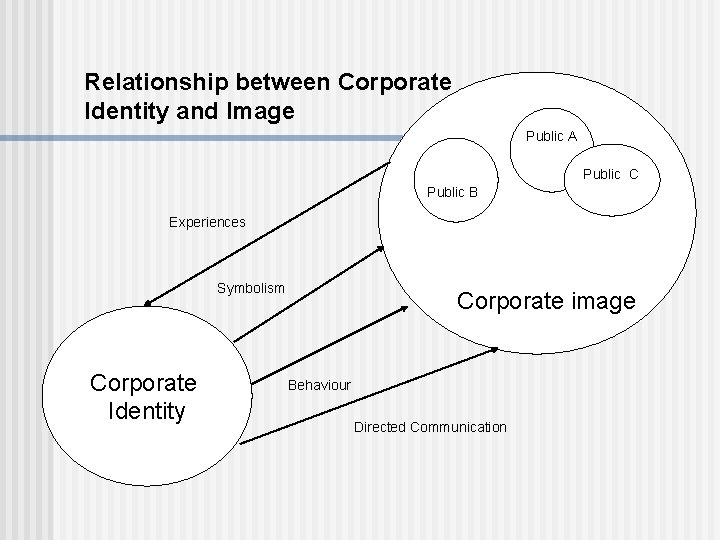
Corporate image n n Corporate identity refers to the self-presentation of an organisation. The identity is relayed in various ways to the publics who interpret the organisation’s behaviour, directed communication and symbolisms. The individual members of those publics then form an image of the organisation which is based on their interpretation of the identity. This might also be influenced by direct experiences they had with the organisation or by accounts of opinion leaders such as family, friends, the media, etc.
Relationship between Corporate Identity and Image Public A Public C Public B Experiences Symbolism Corporate Identity Corporate image Behaviour Directed Communication
The importance of a favourable image n “A positive corporate image is a condition for a continuity and strategic success. It is no longer solely the field of attention of marketing, but a strategic instrument of top management” CEO Dutch KLM, De Soet
Benefits of a favourable image n n A sound CI is a incentive for the sales of products & services It helps the company recruit the right employees It is important to the financial world & investors A sound corporate image creates emotional added value for a company which ensures that a company is always one step ahead of its competitors.
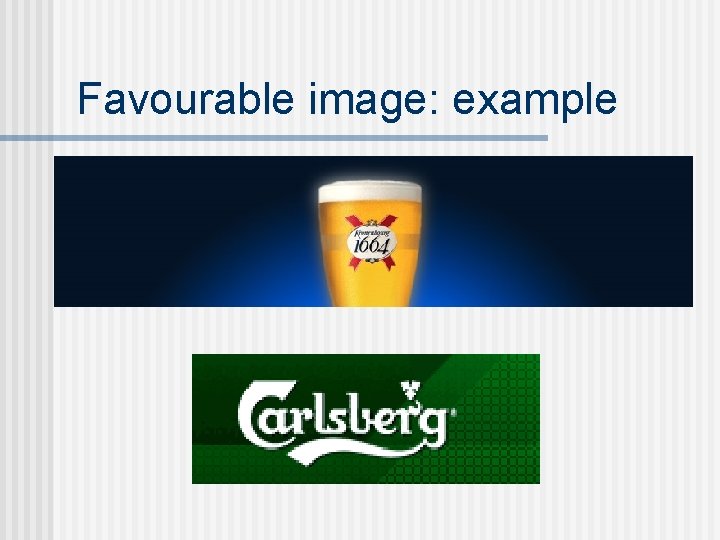
Benefits of a favourable image Research has shown that 9 out of 10 consumers report that when choosing between products that are similar in quality and price, the reputation of the company determines which product they buy! n Example: Lager n
Favourable image: example
CORPORATE REPUTATION EXPLAINED n The principle difference between corporate image and corporate reputation is that reputations are formed over a long time. n However, as with corporate image, reputations can be good, bad, unwanted, out of date etc
The benefits of a positive corporate reputation n Can give distinctiveness and a competitive advantage n can contribute to profits n can act as a safeguard in times of adversity
Reputation as a control mechanism? n n Balmer argued that the organization’s reputation can act as a standard governing behavior i. e. “Would my actions be in line with the company’s good/bad etc reputation” Can be used by employees, those in recruitment etc He developed the DEAR principle to explain the above……………. . .
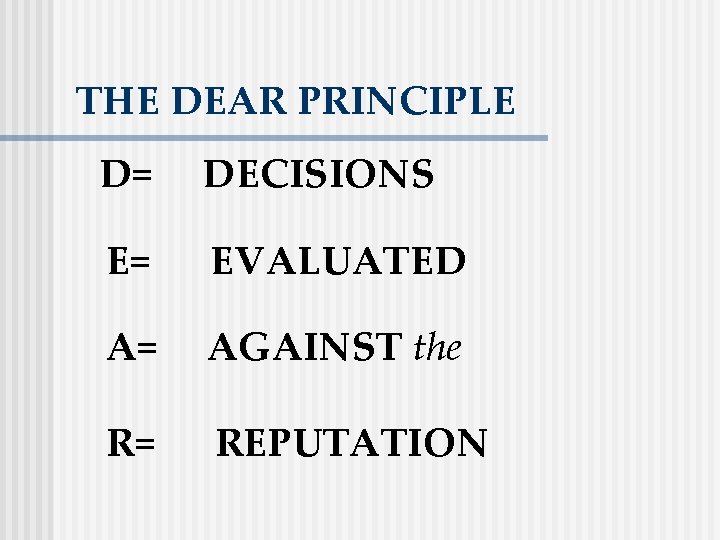
THE DEAR PRINCIPLE D= DECISIONS E= EVALUATED A= AGAINST the R= REPUTATION
REPUTIONS ALSO APPLY TO. . n n n The corporate brand part of an organization (business unit/subsidiary) what an organisation makes as well as how it behaves “I would buy their cars but I would not wish to work for them!”
Finally………. a word of caution n Although a valuable resource (in many instances) a corporate reputation is NO GUARANTEE of business survival or of success. Consider Olivetti which had an enviable reputation as a leading manufacturer of typewriters but took insufficient account of technological developments in the field. . Olivetti computers ?
SUMMARY: CI & Reputation n The concepts of image and reputation are laden with different meanings. n Perception is important because it effects our behavior n Unlike images a reputation is formed over a long time n In considering perceptions held of an organisation consideration should also be given to the image/reputation of the industry, country of origin, corporate and product brands, as well as those of its subsidiaries.
Brands and branding n The particular concern here is with the ways in which an increasing number or products or services have come to be regarded as brands. n It was not always so, and in many poorer parts of the world today brands still do not occupy the position they do in the so-called developed countries. Staple foodstuffs, for example, are bought and sold on markets in developing countries without being branded.
History of brands In the 19 th century the link between consumer and producer was broken n Intermediaries such as wholesalers and brokers tried to exert influence on consumers n Manufacturers hit back by branding their products with distinctive name and appropriate marketing communications n
History of brands n Some of the most familiar brands date back to 19 th century
What is the appeal of brands? Two dimensions: 1) 2) Brand appeal for the consumer Brand appeal for the producer
Brand appeal - consumer Authenticity n Consistency n ‘At its simplest, a brand is a recognisable and trustworthy badge of origin, and also a promise of performance. ’ (Cowley 1996: 21) n E. g. :
Brand appeal - consumer Rational or functional appeal n Helps them to make a choice n saves time and effort through a reduction of perceived risk n Based on trust n In semiotic terms - brands have a denotative meaning n
Brand appeal - consumer E. g. many adults continue to use a brand such as Johnson’s because it evokes childhood memories n Or many Scots reaffirm their cultural identity by drinking Irn-Bru instead of Coca-cola n
Brand appeal - consumer This aspect is well captured by Roderick White, who writes that ‘a brand has a place in people's minds, as a brand, whereas a mere product is simply a way of fulfilling a physical need’ (White, 1993: 5). n Elements are a distinctive & evocative name & logo together with the corporate image n
Brand appeal - consumer n n In addition to the rational and emotional aspects of consumers’ relationships with brands Shimp identifies a third factor, which he calls the ‘experiential’. Thus the impact of a brand on the senses (its look or taste, for instance) is considered a separate aspects from the other two. Brands have to live up to expectations - 80% of the demise of brands is down to disappointing customers’ expectations.
Brand appeal - producer n n Branding provides one of the main ways to differentiate a product or service from those of competitors (positioning). Another potential advantage to producers concerns the addition of new products. The socalled stretching or extending of brand names can be successfully made to apply to these, rather than the riskier option of launching them as brands on their own account.
Brand appeal - producer The calculation is that something of the original brand values will be transferred to the new item, whether it be Mars ice cream (stretching) or Camel clothing (extension). n Consumers also derive reassurance for new goods and services associated with the “ur-brand” n
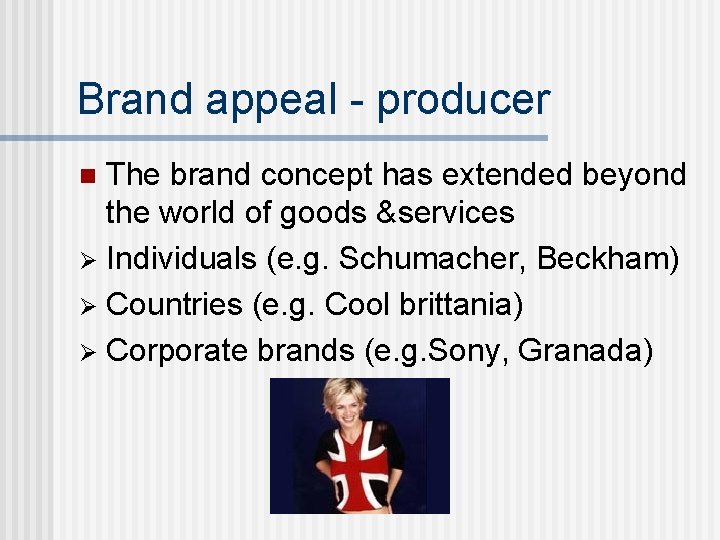
Brand appeal - producer The brand concept has extended beyond the world of goods &services Ø Individuals (e. g. Schumacher, Beckham) Ø Countries (e. g. Cool brittania) Ø Corporate brands (e. g. Sony, Granada) n
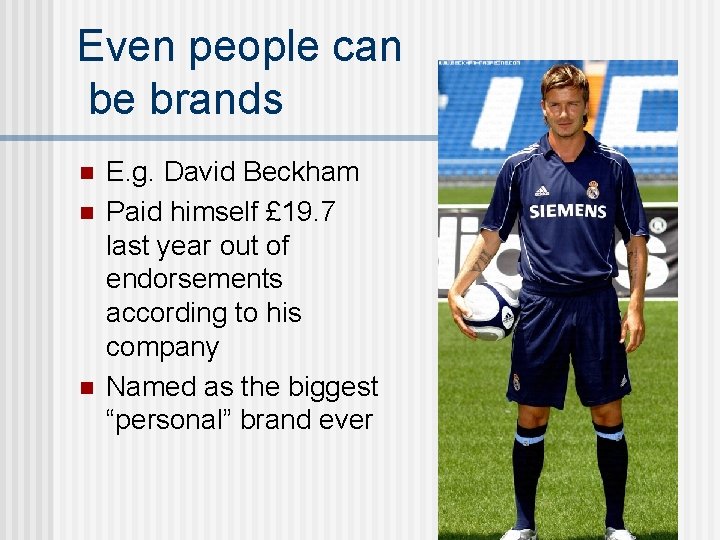
Even people can be brands n n n E. g. David Beckham Paid himself £ 19. 7 last year out of endorsements according to his company Named as the biggest “personal” brand ever
Brand appeal - producer n The role of of brands today is so big that brand equity (formerly goodwill) can be a company’s most important asset. E. g. When Nestle bought Rowntree n Or value of dot. companies n
Trends in brands Growth of own label or private brands n A decline in brand loyalty due to products becoming virtually indistinguishable and customers’ price awareness and growth of sales promotions n
Brands conclusions n n n As Klein says, brands have come to dominate the world of commerce and much more besides, to the extent that we now live in a ‘branded world’. Brands matter to organisations because they are major assets. They consequently need to be managed carefully, with occasional adjustments being made in response to marketing research, but without compromising core values.
Brands - conclusion cntd. n n At the end, they matter because they embody meanings for consumers. It is clear that in the information age this is now truer than ever. As products and services quickly become essentially indistinguishable from the competition, they rely increasingly on branding to differentiate themselves and their users.
Bibliography n n Cowley, Don (ed) (1996), Understanding Brands, London: Kogan Page Klein, Naomi (2000), No Logo, London: Flamingo Randall, Geoffrey (1997), Branding, London: Kogan Page White, Roderick (1993), Advertising. What it is and how to do it, 3 rd ed. , London: Mc. Graw-Hill.
Thank you and have a nice day!