
Republic of Zambia Progress on implementation of Pharmacovigilance
Republic of Zambia Progress on implementation of Pharmacovigilance in the NATIONAL ARV PROGRAMME November 2009 Dr Mwango A Dr Sunkutu K National ARV Programme Coordinator, HIV & AIDS Advisor WHO Zambia Country Office Lusaka, Zambia Ministry of Health, ZAMBIA
OUTLINE of presentation Background n ART Implementation n Legal mandate of PRA n Implementation n Current Analysis n Challenges n The way forward n 2
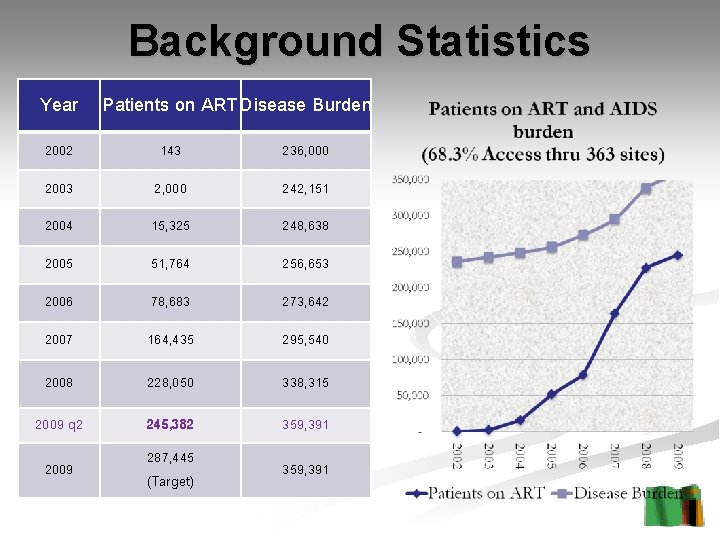
Background Statistics Year Patients on ARTDisease Burden 2002 143 236, 000 2003 2, 000 242, 151 2004 15, 325 248, 638 2005 51, 764 256, 653 2006 78, 683 273, 642 2007 164, 435 295, 540 2008 228, 050 338, 315 2009 q 2 245, 382 359, 391 2009 287, 445 (Target) 359, 391
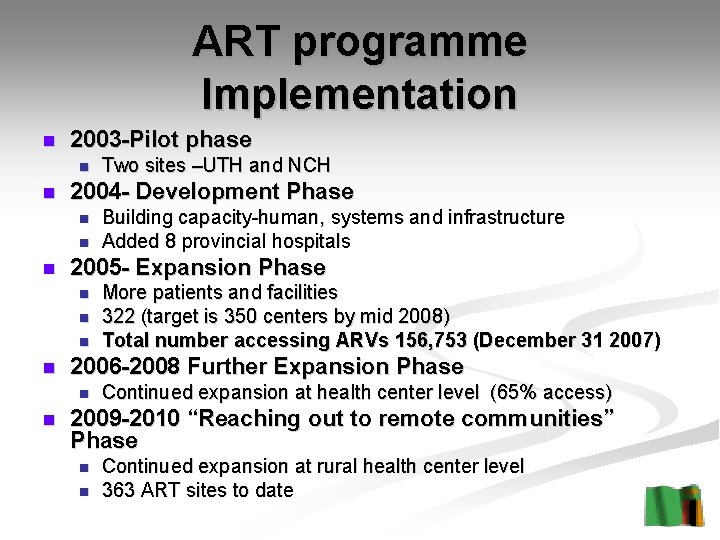
ART programme Implementation n 2003 -Pilot phase n n 2004 - Development Phase n n n More patients and facilities 322 (target is 350 centers by mid 2008) Total number accessing ARVs 156, 753 (December 31 2007) 2006 -2008 Further Expansion Phase n n Building capacity-human, systems and infrastructure Added 8 provincial hospitals 2005 - Expansion Phase n n Two sites –UTH and NCH Continued expansion at health center level (65% access) 2009 -2010 “Reaching out to remote communities” Phase n n Continued expansion at rural health center level 363 ART sites to date
Policy Change Support n n Enabling political will to allow commencement of PV activity for Antiretroviral Therapy Provision of initial funds for PV activity Specific objective to address PV activities in the MOH strategic plan 20062008 (rolling plan to 2009) for ART Legal and regulatory framework adopted
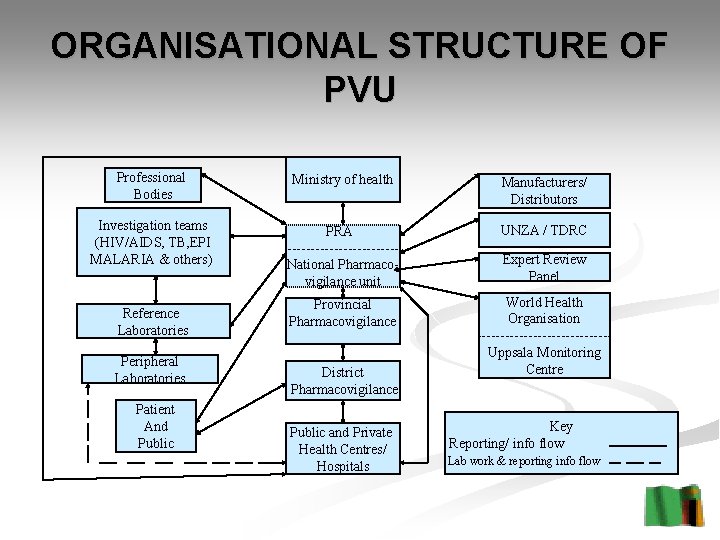
ORGANISATIONAL STRUCTURE OF PVU Professional Bodies Ministry of health Manufacturers/ Distributors Investigation teams (HIV/AIDS, TB, EPI MALARIA & others) PRA ------------National Pharmacovigilance unit UNZA / TDRC Provincial Pharmacovigilance World Health Organisation --------------Uppsala Monitoring Centre Reference Laboratories Peripheral Laboratories Patient And Public District Pharmacovigilance Public and Private Health Centres/ Hospitals Expert Review Panel Key Reporting/ info flow Lab work & reporting info flow
Legal framework n n One of the functions of the Pharmaceutical Regulatory Authority (PRA) in the new legislation which came into effect in November 2004, is post-marketing surveillance and monitoring of ADRs. The PRA is coordinating all PV activities. Pharmacovigilance Unit (PVU) was on 16 th June 2006 and is set up at PRA. 7
Implementation-TWG n TWG to set up the PV system Developed training package, ADR reporting tools, system design, coordinating trainings n HIVDRSS incorporated in the PV system n Supervisory visits to monitor implementation n
Implementation -Planning Original plan was centered on Antimalarials at the National Malaria Control Centre. n The aim was to revise the initial plan to be more inclusive for all drugs including ARVs, TB, Malaria and Vaccines n 9
Implementation-Design of PV and HIVDRSS systems n Manuals developed for training of trainers with financial help from Health Services Systems Project (HSSP under PEPFAR) and WHO. n Different forms for resistance monitoring in HIV/AIDS, Malaria and TB have been developed. n 10
Implementation-Infrastructure Secured a building (needs rehabilitation) for conference, admin offices, data center and utility rooms n Procure field vehicles n Procured office equipment for data analysis and training (laptop, computers, printers, LCD, screens, etc) n 11
Implementation-Training n Trainers (63) have been trained which included doctors, pharmacists, nurses, clinical officers, lab technicians from the Public and Private Sector Ø Health workers in NGO’s e. g. CHAZ, CIDRZ Ø Defense forces medical services and UNZA Ø Health workers (21) from the private sector Ø Total number trained is over 580 HCWs 12
Current Analysis Well established health programmes such as TB, HIV/AIDS, Malaria n Availability of Resources from Global Fund, PEPFAR (thru HSSP and CDC) and UN system n Training conducted on cost sharing basis with health facilities n 13
Current Analysis Some ADR/ADE reports received (now approx. 130 reports annually) and acknowledgement of receipt of reports is done almost immediately. n Causality assessments are yet to be done. n Need to link system to Smart. Care system (Zambia’s Electronic Medical Records System) n 14
Challenges No full time secretariat and short listing for a coordinators for PVU and for HIVDRSS activities (funding yet to be secured) Ø Mechanisms to encourage more reporting by health workers Ø Bring on board all National Health programmes including the private sector Ø Motivation of reporters especially health care professionals Ø 15
Way Forward q Provide support to the pharmacovigilance at provincial and district levels. q Sensitization of members of professional bodies and associations e. g. MAZ, PSZ, Diabetes and Epilepsy associations q Fully operationalise NPV Secretariat q Publication of “Medicines Monitor” 16
Way Forward q Incorporate pharmacovigilance in preservice professional training for medical, pharmacy, nursing etc. q Public sensitization on pharmacovigilance q Secure funds for infrastructure and causality assessments of reports 17

Thank you…
- Slides: 18